 Broward: School employees here will be soon receiving bigger paychecks after the school board approved an agreement with workers unions. Under the deal, bus drivers, cafeteria workers, police officers and other school support staff will be paid 5.5% more, at least for the next four years. That's after the county's voters passed a tax referendum in 2022 to invest in high salaries, mental health resources and school safety. “This helps retain our staff and our employees to make sure that they know we respect them,” Broward Superintendent Peter Licata told reporters after the vote. WLRN. WSVN.
Duval: School officials here are ready to start construction on an estimated $120 million project that would replace Ribault High with a next-generation school financed largely by a voter-approved sales tax. “It’s going to be a sight to see,” School Board member Darryl Willie told a crowd at a groundbreaking. Florida Times-Union.
Sarasota: Two years after the school board here redrew boundaries for the areas represented by the panel's five members, the board started the process to revise district lines yet again. With a lone board member dissenting — Tom Edwards — the school board voted 4-1 to approve a $39,000 contract with a consultant to launch the redistricting effort. Sarasota Herald Tribune. Meanwhile, the school board also adopted a $1.5 billion budget at a special meeting on Monday, ending the district's yearly budget process. The board voted 4-1 to approve the budget, with only Chairwoman Bridget Ziegler dissenting. Sarasota Herald Tribune.
Flagler: The school board in Flagler has assigned fellow board member Will Furry to hire a labor attorney at the district's expense who will assist in firing Kristy Gavin, the board's attorney, without risking a lawsuit. Flagler Live.
Alachua: The school board here hosted a workshop on Wednesday covering transportation changes coming to the Alachua County Public Schools district. Those changes include the elimination of courtesy stops, reduction of magnet stops and re-evaluation of school start times. In the face of a bus driver shortage, students who ride the bus have been up to an hour late for school since the fall semester began. Main Street Daily News.
Blue Ribbon honors: In all, 14 schools in the state of Florida were named National Blue Ribbon schools, according to the U.S Department of Education. The program "recognizes public and private elementary, middle and high schools based on their overall academic excellence or their progress in closing achievement gaps among student subgroups," the department's website said. In all, about 350 schools were named National Blue Ribbon Schools for 2023. WKMG. Patch. WQCS.
University and college news: The U.S. Department of Education on Monday asked state officials to pump more funding into Florida Agriculture & Mechanical University, pointing to what the federal agency called "longstanding and ongoing underinvestment" by the state of Florida. Miguel Cardona, U.S. Secretary of Education, sent letters to Gov. Ron DeSantis and governors of 15 other states highlighting what he noticed as funding disparities between historically Black colleges and universities, or HBCU's, and their "non-HBCU land-grant peers" in the states. According to Cardona's letter, over the past three decades, FAMU has been shortchanged financially by $1.97 billion. “These funds could have supported infrastructure and student services and would have better positioned the university to compete for research grants,” Cardona wrote. WFSU. A study by Degreechoices revealed that the University of Florida is the third best school based on value for money. UF was one of more than 400 national universities and colleges analyzed by college return of investment staff at Degreechoices. Main Street Daily News. Pasco-Hernando State College announced Tuesday that Jesse Pisors was selected as the school's fifth president. Pisors has served as vice president at Texas AP&M University-San Antonio and the University of Houston-Victoria. He was one of four finalists for the job. “We have full confidence that Dr. Pisors will continue to uphold the college’s core values and will lead PHSC to further success in all future endeavors,” Lee Maggard, chairperson of the college’s board of trustees, said in a news release. Tampa Bay Times. The Florida State University System's Board of Governors discussed a proposal by the University of Central Florida to close three of its campuses. According to state officials, the proposal would close the university's South Orlando, Leesburg and Palm Bay campuses. WKMG. The Biden administration has requested a federal judge to dismiss Florida's lawsuit against the accreditation requirements for colleges and universities, citing constitutional challenges. Attorneys for the U.S. Department of Education filed a 40-page motion disputing Florida's arguments that the decades-old accreditation system gives too much power to private accrediting agencies. CBS 47. Action News Jax. Generative artificial intelligence is being integrated into higher education at Florida Gulf Coast University. WGCU.
Opinions on schools: Students must learn math. "Future of work" studies consistently underscore this point as analytical thinking and other math-rooted cognitive skills have become core to success in today's economy. Jeff Livingston, The 74th.
 More than three months after the CARES Act appropriated billions of dollars to aid the education of low-income students in public and private schools, most eligible private schools in Florida have yet to see financial relief according to a recent survey of participating private schools conducted by Step Up for Students, which hosts this blog.
The nation’s largest state-approved nonprofit scholarship funding organization helps administer five scholarship programs in Florida, including two that are income-based programs, the Florida Tax Credit Scholarship and the Family Empowerment Scholarship, as well as the Gardiner Scholarship for students with unique abilities.
The Step Up survey asked more than 1,000 schools that participate in Florida’ scholarship programs questions about the Elementary and Secondary Emergency Relief Fund (ESSER), declining enrollment, and distance learning. Participants returned 662 completed surveys and 140 partial surveys.
Of 683 schools that provided responses regarding ESSER funding, 61%, or 415 schools, reported they qualified for the funding. But of those schools, nearly three-quarters – 74% – said they have not received any emergency funds.
Congress made available $13.2 billion to help stabilize K-12 education funding this summer amidst a global pandemic and rising unemployment. The U.S. Department of Education subsequently was sued over its directive on how to calculate the share provided to private schools. Though the U.S. Department of Education declined to appeal, it noted that local education agencies still were required to share the funds based on the enrollment of low-income students attending private schools.
Fifty-seven percent of survey respondents reported enrollment declines. “Unable to afford tuition” was cited in 63.7% of cases as to why parents no longer were enrolling their child. Forty-five percent of schools (298) expressed concern about losing new students because of the Family Empowerment Scholarship’s prior-year public school attendance requirement.
Additionally, the survey found that 54% of private schools worried that declining enrollment would impact their viability.
Though troubling, these findings nevertheless are more positive than those reported earlier in the pandemic. In April, 73% of private schools reported declining enrollments.
Overall, private school enrollment among lower-income students remains steady. For 2020-21, approximately 130,000 students are utilizing income-based scholarships, up slightly from last year, although these are preliminary enrollment figures.
The Florida Department of Education is expected to release its first-quarter enrollment reports either this month or in November.
A recent federal audit raised concerns about cozy relationships between charter school boards, charter school management companies, and other vendors they do business with.
The report, released late last month by the U.S. Department of Education, has gotten a good deal of attention for concluding those ties could pose a "risk" to federal programs that support charters.
Here's a guide to what the audit found, what it might mean, and what could happen next.
What's the Florida connection?
The report examined 33 charter schools in six states. It covered five Florida schools, all of them in Miami-Dade County.
The schools were not chosen at random, so it would be a mistake to say they reflect what's going on with charter schools generally — in Florida or elsewhere. Auditors chose the schools based on news reports, tax filings and other public information.
Education Department records show the business dealings of charter management organizations, aka CMOs, have been on the inspector general's audit agenda since the fall of 2011.
 Matthew's impact: As Hurricane Matthew works its way up Florida's east coast, many of the state's school districts remain closed today. Orlando Sentinel. Tampa Bay Times. WUSF. WFLA. WTSP. Fort Myers News-Press. Naples Daily News. Bradenton Herald. Sarasota Herald-Tribune. Ocala Star Banner. Daytona Beach News-Journal. Daily Commercial. WCTV.
Charter schools: Just a week after the U.S. Department of Education announces it will make $245 million available for the expansion of charter schools, an audit raises concerns about ties between some charter school boards and management companies that run their schools. Charter groups acknowledge some of the problems, but point out that some charter organizations show strong outcomes for low-income students. U.S. News & World Report.
Consequences of a tweet: A St. Petersburg high school senior who sent a "joke" tweet now wishes he hadn't. Luke Boswell inserted a clown photo into a tweet to his friends Monday. It was quickly passed around Northeast High School, spooking students and drawing attention from the police. Boswell was suspended for a day and lost his spot on the homecoming court. "If I could take this back, I would in a heartbeat," Boswell says. Tampa Bay Times.
Prepaid enrollment: The Florida Prepaid College Board approves college savings plan prices for the 2016-2017 open enrollment period, which runs from Oct. 15 through Feb. 28, 2017. Florida Prepaid College Board. (more…)
Fresh federal figures show Florida has more magnet schools than any other state, and saw its number of charter schools increase at a rate two-thirds faster than the national average during the 2012-13 school year.
The new statistics come from a U.S. Department of Education report released Thursday on the types of public schools around the country.
The number of charter schools jumped 6.7 percent nationwide in 2012-13, compared to an 11.6 percent growth rate reported that year by the Florida Department of Education.
That school year, Florida saw its largest-ever increase in its number of charter schools. The rate of new charters in the state has slowed in more recent years.
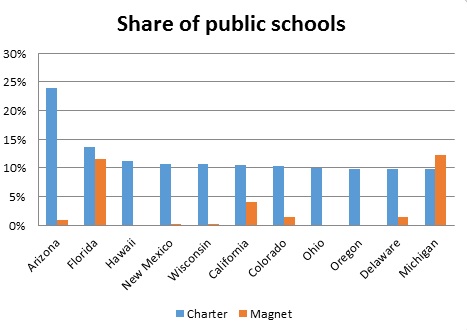
Proportions of charters and magnets in 10 states, excluding D.C., where charters account for the largest share of public schools
Overall, the federal report counts 4,269 public schools in the state, including 581 charters and 494 magnets. That means one out of every four public schools in the state is either a charter school or a magnet of some kind - the highest combined proportion of any state in the country.
Arizona, with its substantial charter sector, and Michigan, with a mix of charters and magnets, are close behind. Florida still trails Washington D.C., which is off the charts. The two choice options account for more than half the public schools in the nation's capital.
Some states either do not designate magnet schools or, in the case of New Jersey and Massachusetts, could not report data on their number of magnet schools.
 For the second time this week, a credible, independent analysis shows Florida students leading the pack in progress.
Between 1992 and 2011, Florida students made bigger gains than students in four other “mega states” in fourth- and eighth-grade reading and fourth-grade math, according to a report released Thursday by an arm of the U.S. Department of Education. In each case, they moved from below the national average to meeting or exceeding it. Low-income and minority students in particular showed traction.
“There is something real going on there,” said Jack Buckley, commissioner of the National Center for Education Statistics, according to Education Week.
The center’s comparison followed Wednesday’s College Board report that showed Florida continues to climb the charts on Advanced Placement exams. The Sunshine State now ranks fourth in the percentage of high school graduates passing AP exams. Over the past decade, it ranks second in progress.
Broken-record alert No. 1: Florida’s trend lines shouldn’t be a surprise, given reports like this, this, this, this and this in the past year alone. Yet there remains a lingering perception, cultivated by critics, that Florida’s public schools are sub par and stagnant.
For Thursday’s report, the center for the first time compared scores from Florida, California, Texas, New York and Illinois – the states with the biggest student populations and arguably the biggest challenges. It used results from the National Assessment of Educational Progress, a battery of tests better known as “The Nation’s Report Card” and considered the gold standard among standardized assessments.
In eighth-grade math, Florida students made gains but remain below the national average. Elsewhere in the report, they were singled out often. (more…)
The Florida Board of Education announced its finalists for education commissioner today, with a list of three candidates including Indiana's outgoing education chief Tony Bennett.
Bennett, who gained national acclaim and criticism for pushing Florida-style education reforms in his home state, lost his re-election bid last month. That immediately sparked rumors that the Chiefs of Change leader might come to the Sunshine State.
The other finalists culled from 53 applications are:
Charles Hokanson Jr. A consultant and former president of the Alliance for School Choice, he also served as a deputy assistant secretary at the U.S. Department of Education, appointed by former President George W. Bush. According to the Orlando Sentinel, Hokanson said he worked on state reform efforts at the alliance, including those pushed in Florida by former Gov. Jeb Bush.
Randy Dunn. Murray State University president and a former Illinois state superintendent of education.
The board will interview the finalists during its Dec. 11 meeting in Tampa.
The new education commissioner will replace Gerard Robinson, who left at the end of August. Robinson, who only took the job a year earlier, said at the time that being apart from his family in Virginia proved too challenging. He also received sharp criticism surrounding changes to the Florida Comprehensive Assessment Test that resulted in test scores dropping statewide.
Pam Stewart, the interim education commissioner, did not submit an application for the permanent post.

Chavous
Kevin Chavous, a senior advisor to the American Federation for Children, criticizes President Obama in this recent Washington Post op-ed for not supporting the Washington D.C. voucher program and suggests a new approach for Term 2:
I have long been a supporter of the president, and I continue to applaud many of his education initiatives, including his embrace of charter schools. But his administration’s opposition to giving low-income families the full slate of educational options — captured when he zeroed out funding for the program in his budget this year, despite the earlier deal in which he agreed to reauthorizing the program for five years — is unacceptable. ...
These roadblocks are part of a long history of the administration’s resolute opposition to the voucher program, from Education Secretary Arne Duncan rescinding 216 scholarships in 2009 to the department ignoring the positive results of a gold-standard study, conducted by its own Institute of Education Sciences, that found that D.C. voucher students graduate at a rate of 91 percent — more than 20 percentage points higher than those who sought a voucher but either didn’t get one or didn’t enroll in the program after being accepted. Because of the delaying tactics of the department, a credible — and federally mandated — new study of the program cannot be conducted unless the program enrolls hundreds of new students next year. ...
On many occasions during his first term, President Obama demonstrated an ability to embrace education reforms that help kids, and I expect that to continue now that he has won a decisive reelection. What’s different about this one? This is an easy one: All he and his Education Department have to do is get out of the way and let a successful program work. Full op-ed here.
 Tea Party groups succeeded in pushing the Republican Party platform to the right this year, but they failed to restore a former plank they favor: Eliminating the U.S. Department of Education.
The effort was led by FreedomWorks, the advocacy group chaired by former U.S. House Majority Leader Dick Armey and a leading force in the Tea Party movement. Brendan Steinhauser, director of federal and state campaigns for FreedomWorks, told redefinED at the RNC that while the group fell short on the platform language, it succeeded in fostering a debate about decentralized decision-making in education – and the effectiveness of federal involvement. (FreedomWorks, by the way, is a strong supporter of expanded school choice).
“I don’t think that there’s any evidence that education has improved in this country because of the Department of Education,” Steinhauser said.
You can hear Steinhauser’s comments in full by clicking on the recorded interview below, but here are some highlights:
On criticism from former Education Secretary Margaret Spellings (who favors a federal role in education): Those who support a federal role “are technocrats who think you can plan education policy from the top down, from Washington D.C., better than you can at the local level. And I just don’t think that that’s the case. … Allowing for local communities to decide what’s best for their children, what’s best for their communities, is the way to go. So when you give a federal department like the Department of Education more power as opposed to less power, they will use it. And I just am not convinced that bureaucrats in Washington D.C. know how best to educate our children in local communities."
On ironically being a bit in sync with the teachers unions (which are critical of federal initiatives like Obama’s Race to the Top): “Given all the fights we’ve had with the teachers unions over the years – they’re kind of our arch enemies when it comes to policies we’re pushing – one particular position like this, I don’t think matters a whole lot. I think you can probably find some common position between just about anybody. But no, when it comes to the big battles, the big debates, I think we’re on the right side here and on the opposite side of the teachers union with about 99 percent of the issues.”

