
Go down, Moses
Way down in Egypt's land
Tell old Pharaoh
Let my people go
The Texas House of Representatives closed out the 3rd special session by filing a deeply flawed ESA bill but never held a hearing on it. Stay tuned for further developments. Meanwhile, the Texas Tribune filed a fantastic piece featuring three Dallas Black mothers who support a choice program in order to allow themselves and others in their communities to run and sustain their own schools. This is an amazing piece of journalism that looks past spokespeople with dueling sets of talking points in Austin to talk to real people and explore their concerns. You should read it and share it widely.
An earlier post on this blog described the era of peonage, whereby private interests availed themselves of convict labor at below-market rates. Described by some as “neo-slavery” this was a morally repugnant institution but one which benefited powerful interests. It lasted far longer than it should have, but eventually earned a well-deserved spot in the dustbin of history.
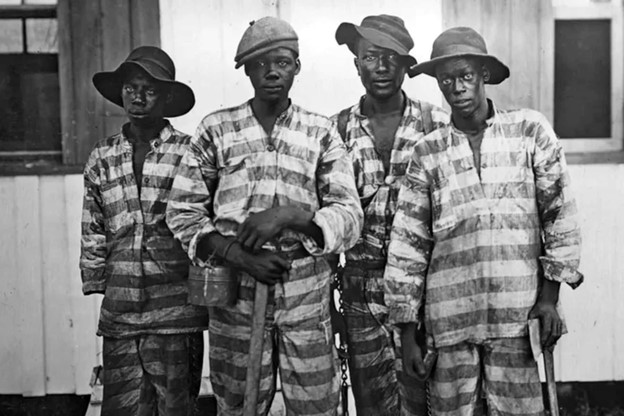
The parallel here is not to public schooling per se but rather to ZIP code assignment. ZIP code assignment to schools effectively reduces children into indentured funding units. Powerful interests in today’s society financially benefit reducing children into indentured funding units. Like southern plantation owners and railroad magnates from a bygone era, they are not going to let peonage go away without a fight.
The Tribune piece can be understood in this light: a struggle for a more humane system, one that acknowledges and respects the need for pluralism and variety in schooling. My heart sang when the story of these heroic women included a description of the aid they had received from their fellows in Arizona:
"In Arizona, 40 Black moms gathered in 2016 with the same worries for their children, ready to dismantle what they call the school-to-prison pipeline. Their kids were bullied in school and did not feel supported by the teachers. The moms started by pushing school districts to form a re-entry-after-suspension plan and find alternatives to suspension as a disciplinary measure.
By 2021, they had opened their own microschool, also known as outsourced home schooling. The Arizona microschools depend on the state’s education savings account program for sustainability.
“The public school system that was in place was not doing what it was supposed to do. Our children were not reaping the benefits,” said Janelle Wood, the founder of Black Mothers Forum in Arizona. “And so we needed a tool to help us fuel our vehicle of the microschool in order for us to grow."
Choice provides families with the tools to chart their own path and determine their own future. It gives teachers like those featured in the Tribune the opportunity to create their own schools. Choice gives families the opportunity to find a school that is a good fit for their children. Texas legislators must decide between clinging to an antiquated past or embracing a brighter future.
Jason Bedrick and I co-authored a new study for the Heritage Foundation last week in which we test an assertion made by Texas choice opponents: choice will destroy rural education. Opponents bandy this assertion as if it were a self-evident fact, but can the assertion withstand scrutiny?
Sadly, we noted that Texas public schools seemed to be doing a rather remarkable job of damaging student learning in the absence of choice. The National Assessment of Educational Progress contains data on rural achievement starting in 2007. It’s not pretty in rural Texas:
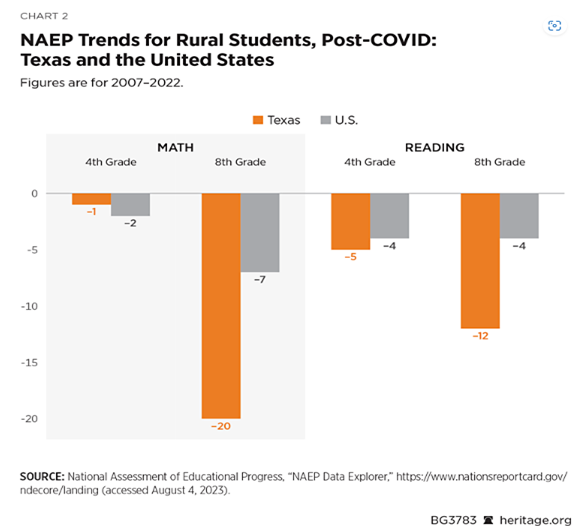
On these exams 10 points roughly equals a grade level worth of progress. Unfortunately, this means that Texas eighth graders demonstrated a command of mathematics in 2022 roughly equivalent to what we would have expected out of a group of Texas sixth graders in 2005. COVID-19 does not account for all of this decline. Between 2007 and 2019, eighth grade students saw approximately a grade level decline in math achievement, and the state suffered another grade level drop between 2019 and 2022.
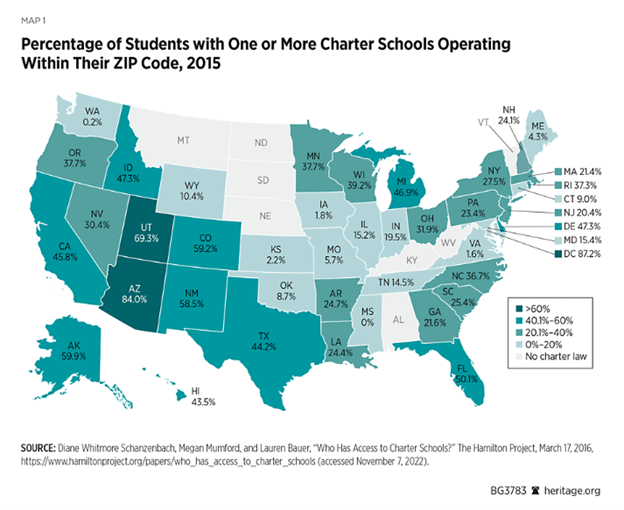
To make the case for choice in rural communities more concrete and less theoretical, we compared academic trends in rural Texas with academic trends in rural Arizona. Arizona has the nation’s largest and most geographically inclusive charter sector (see map above), a very active system of district open enrollment in which nearly all districts participate, tax credit scholarships, ESAs, state funded microschools, homeschooling, and digital learning options.
All of these options reach into rural Arizona communities. Has Arizona rural education suffered “destruction?” No. All Arizona school districts that were educating students in 1993 (the year before the advent of choice) are still educating students in 2023. Moreover, unlike Texas, the academic trends for rural Arizona students have been positive:
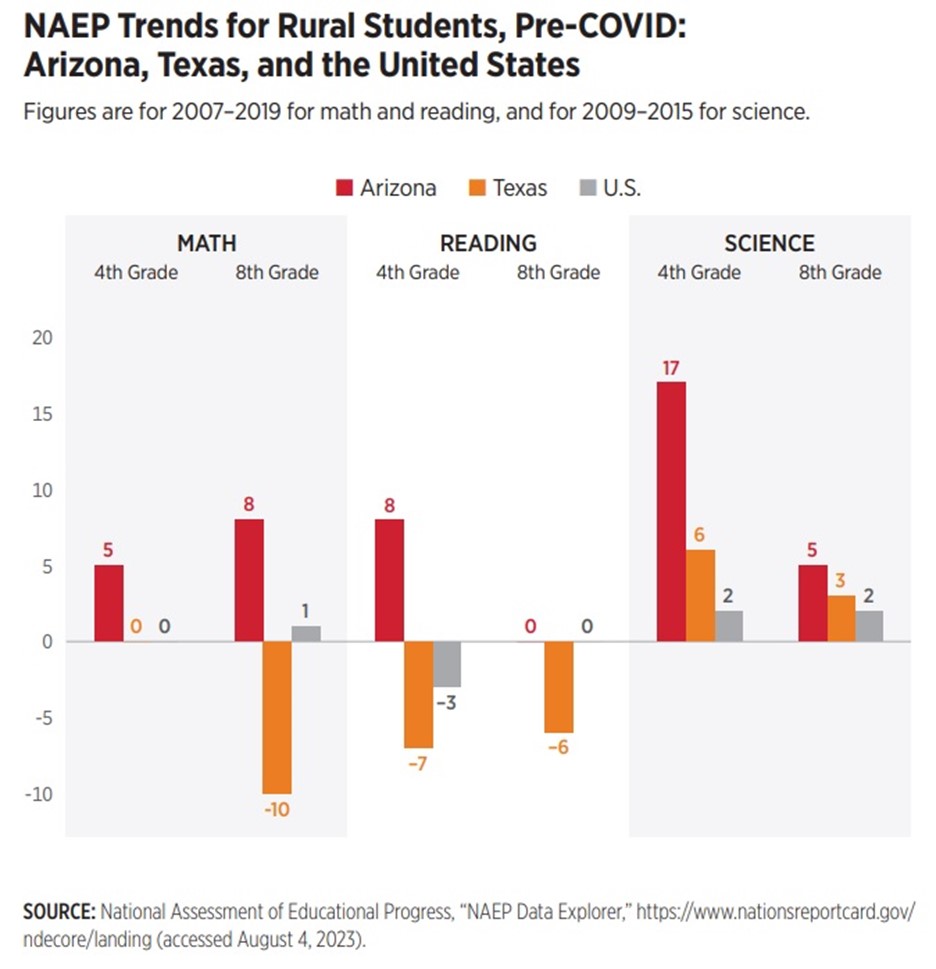
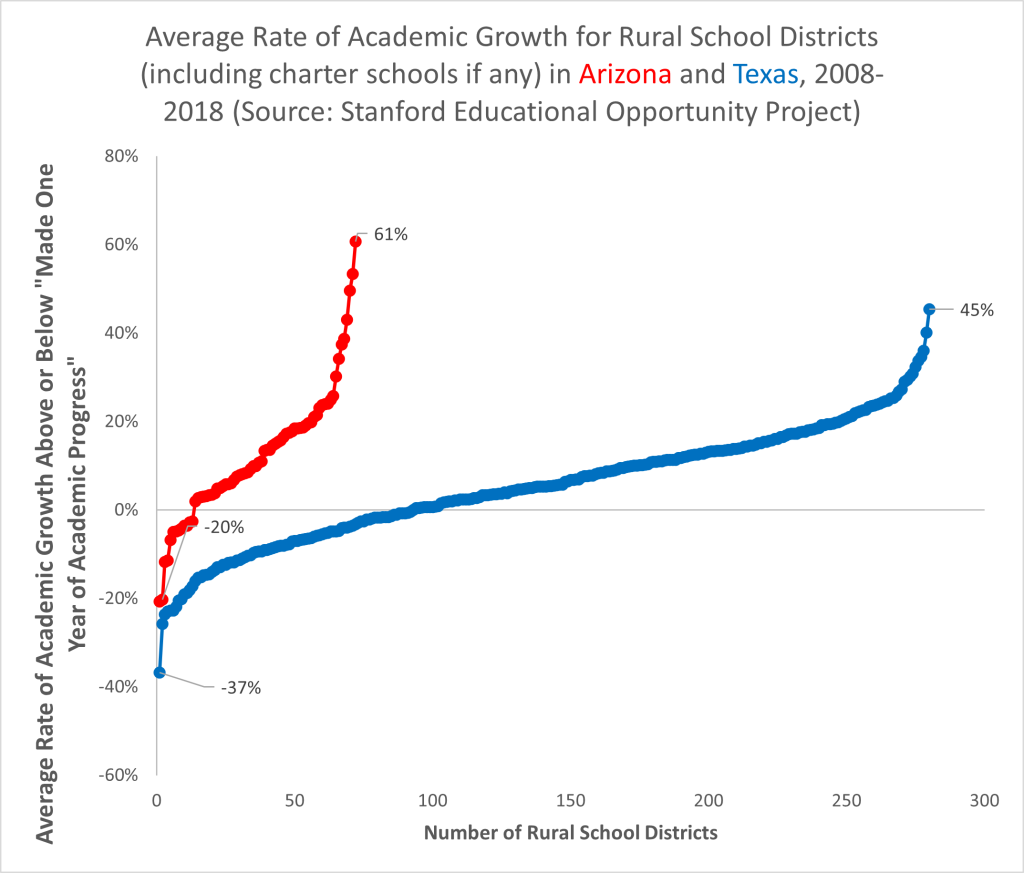
Arizona rural school districts didn’t get the apocalyptic destruction memo. They not only still exist, but their outcomes also improved over time. The Stanford Educational Opportunity project provides a separate source of data showing a similar trend. Stanford scholars linked state testing data in grades 3-8 to enable comparisons across jurisdictions for the 2008-2018 period. Academic growth represents the best measure of school quality, and the project provides growth data for rural school districts (while averaging in charter scores with those of the district in which they reside).
This is my “friendly neighborhood school choice mad scientist makes an excel chart” presentation of that data for rural districts in Arizona and Texas:
And this is the much-improved version of the same data from the data-wizards at Heritage:
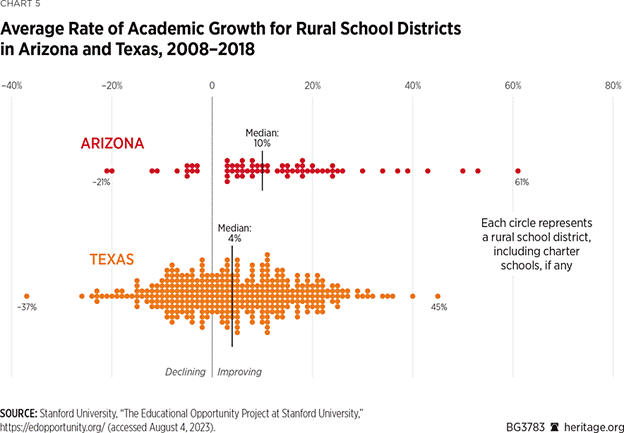
The choice-induced death of rural education appears to have been greatly exaggerated. Choice will be rapidly growing in rural areas of many states in the aftermath of the 2023 legislative sessions. Texas families and teachers deserve these freedoms as well. Arizona lawmakers have empowered teachers to create their own schools and families to sort between schools to find the best fits. Rural teachers and students benefit from variety just like everyone else. Rural Texans have nothing to lose and much to gain from choice.
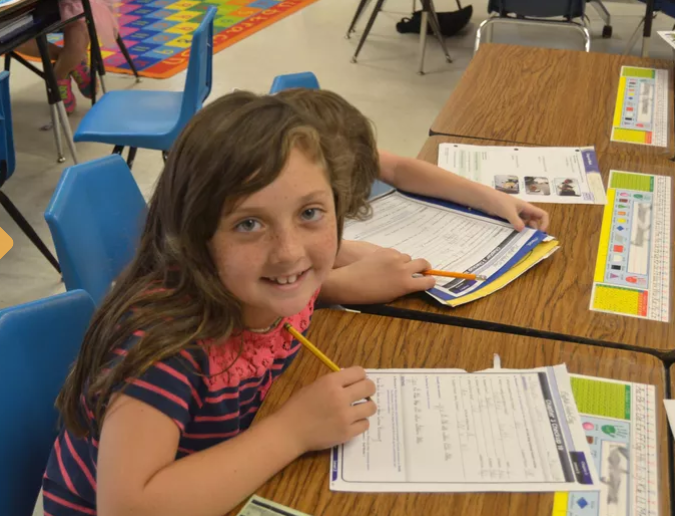
East Texas Christian Academy in Tyler, Texas, is one of 2,037 private schools in the state serving more than 331,600 students. Founded in 1979, East Texas Christian provides a quality education in a loving, supportive environment with a dedicated faculty and staff who integrate the word of God in every subject.
Editor’s note: This commentary from Jonathan Butcher, Will Skillman senior fellow in education at The Heritage Foundation and a reimaginED guest blogger, and Mike Gonzalez, the foundation’s Angeles T. Arredondo E Pluribus Unum senior fellow, appeared Friday on houstonchronicle.com.
Will additional private education choices force a mass exodus from assigned schools in these areas? Or everywhere across the state?
The answer to the first question is no. As best as we can determine, private learning options implemented in states including Arizona and Florida have never resulted in a public school shutting down.
A proposal to create education savings accounts offers parents and students more than just a new school. The accounts are not vouchers, and the distinctions are important. Arizona courts emphasized the differences in a 2013 opinion and ultimately ruled that the accounts did not violate the state constitution.
With vouchers, or private school scholarships, parents can choose a new school for their child — a life-changing option for children who have been bullied, are falling behind in class, or for whom the assigned school has not met their needs.
With an account, after parents choose not to send their child to a public school, the state deposits a portion of a child’s funding from the state education formula into a bank-style account. (Under Abbott’s proposal, that would be $8,000 per year.) The parents can use the money to buy certain preapproved education products and services for their children.
Private school tuition is one option for parents, but not the only one. Parents who want to offer their children a course not available at a local public school can use an account to pay for the course online or at a local college. Or they can find personal tutors or education therapists suited to meet a child’s unique needs.
The education options that Abbott seeks will not change local high schools’ role as key parts of civic life. By our calculations, just 5% of Arizona students use education savings accounts, and 2% of children in Florida participate.
To continue reading, click here.
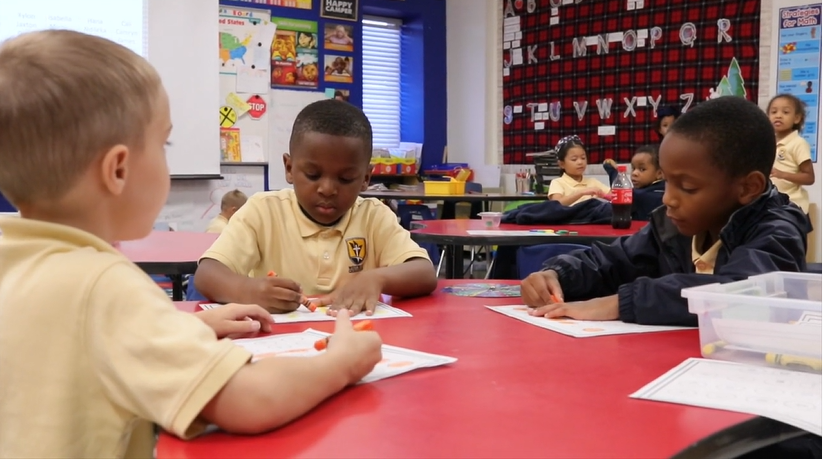
Westbury Christian School in Houston, one of 2,037 private schools in Texas serving more than 331,600 students, is a private, Christian, co-ed, college preparatory K3 through 12th grade school system. Westbury Christian exists to provide each student with the opportunity to acknowledge and respond through faith to the Word of God while participating in an educational program that stresses academic, social, emotional, and physical development.
Editor’s note: This article appeared Sunday on texastribune.org.
Gov. Greg Abbot on Sunday said he would veto a toned-down version of a bill to offer school vouchers in Texas, and threatened to call legislators back for special sessions if they don't "expand the scope of school choice" this month.
"Parents and their children deserve no less," he said in a statement. His dramatic declaration came the night before the House Public Education Committee was scheduled to hold a public hearing on Senate Bill 8, the school voucher bill. That measure passed the Senate more than a month ago but has so far been stalled in lower chamber as it lacks sufficient support.
The committee is set to vote Monday on the latest version of SB 8, authored by Sen. Brandon Creighton, R-Conroe, which would significantly roll back voucher eligibility to only students with disabilities or those that attended an F-rated campus. This would mean that fewer than a million students would be eligible to enter the program.
Abbott doesn't believe the revised version does enough to provide the state with a meaningful "school choice" program. Since the start of the legislative session, Abbott has signaled his support to earlier proposals that would be open to most students.
The governor also said he has had complaints over the new funding for the bill, saying it gives less money to special education students. It also doesn't give priority to low-income students, who "may desperately need expanded education options for their children," he said.
The centerpiece of the original Senate bill was "education savings accounts," which work like vouchers and direct state funds to help Texas families pay for private schooling.
The version approved by the Senate would be open to most K-12 students in Texas and would give parents who opt out of the public school system up to $8,000 in taxpayer money per student each year.
Those funds could be used to pay for a child’s private schooling and other educational expenses, such as textbooks or tutoring. But that idea has faced an uphill climb in the House, where lawmakers signaled last month their support for banning school vouchers in the state.
To continue reading, click here.
 Senior fellow at the American Federation for Children Corey DeAngelis joined The Texan earlier this week to discuss the ongoing push for school choice policies in Texas.
Among the issues DeAngelis talked about was the momentum the school choice movement is enjoying across the nation, the hesitation rural lawmakers often have despite conservative support for the policy, and how similar proposals have fared in other states.
“There's a one-size-fits-all disaster called the government school system that by definition is just never going to meet the needs of individual parents who are just going to disagree about how they want their kids raised,” said DeAngelis.
You can watch the full interview here.

Providence Christian School in Dallas is one of 2,034 private schools in Texas serving more than 331,500 students. With an average student-to-teacher ratio of 9:1, the school believes that early development of a disciplined lifestyle in the context of a relationship with Jesus Christ will provide a solid foundation for a responsible and joyful life.
Editor’s note: This article appeared last week on centersquare.com
Texas should strive to have the best educational system in the country, Gov. Greg Abbott says, and that's why he's supporting school choice initiatives in the Legislature.
“What’s our goal for public education in Texas?” he asked a crowd of business executives at a Houston Region Business Coalition lunch this week.
It should be to be the best in the country, he said.
“No one’s ever said that before now. There seems to be ambiguity about what we want to achieve in education.”
There shouldn’t be ambiguity, Abbott argued, saying the future of Texas and America is “to educate our kids. We should have as a state a goal of nothing less than having the best public education system in the United States of America.
“We do not attain that goal without first stating that is going to be your goal,” he continued. “But then when you establish your goal you then look to what it is that we need to do to make sure that we are going to be able to achieve that goal.”
Abbott said he is advocating for school choice this legislative session because school choice initiatives in Florida worked and helped it become one of the top education states in the country.
“Twenty years ago, in 2002, Florida embarked upon school choice in its state and at that time students who were coming from low-income families were testing on national tests as one of the worst in the country,” he said. “Now 20 years later, they test among the top, among the best in the country.”
“What school choice does ... is ensure competition in the education place and public schools in Florida are doing better,” Abbott continued. “Private schools in Florida are doing better. Homeschooling in Florida is doing better. Across the board, education is better.”
Florida outranks Texas in nearly every education category. Florida ranks first, Texas ranks 21st, for parental involvement in education, according to the most recent Center for Education Reform Parent Power Index.
A recent Heritage Foundation Education Freedom Report Card ranks Florida first and Texas 12th. The Nation’s Report Card ranked Florida 5th and Texas 14th for their respective fourth- and eighth-grade students’ math and reading scores in 2022.
To continue reading, click here.
Since late January, Texas Gov. Greg Abbott has spoken at a dozen “parent empowerment” events where he has pitched education savings accounts, which would allow parents to use state funds to send their children to nonpublic schools.
Editor’s note: This article appeared last week on texastribune.org.
Gov. Greg Abbott said Friday he was not discouraged after the Texas House took a key vote rejecting one his highest priorities this legislative session.
The House voted 86-52 on Thursday to amend the budget to ban state funding for “school vouchers or other similar programs.”
Abbott has spent the past two months touring the state to build support for the proposal, spending tremendous political capital on trying to break through the rural Republican opposition to it.
The amendment came at a crucial time — the same day the Senate passed legislation to create a voucher-like program and five days before a House committee considers proposals on the subject.
“Governor Abbott made education freedom an emergency item this legislative session because no one knows the needs of their child better than a parent,” Abbott spokesperson Renae Eze said in a statement. “The … amendment received the least support ever. This vote shows the legislature remains open to school choice, supporting the majority of Texans who want to expand school choice.”
The 86 votes that the amendment received were less than the 115 votes a similar amendment to the House budget got during the last legislative session. Other prior amendments on the issue have also garnered over 100 votes.
The vote itself is essentially symbolic, as the amendment is expected to be stripped by the Senate before the final budget is passed. But it illustrates how the House may vote on the issue when similar legislation comes to their chamber.
Still, only 52 members voted in favor of school vouchers, far short of the 76-member majority needed to approve any such legislation in the House. Eleven members stayed neutral by registering as “present, not voting,” signaling potential openness to the proposal but still not enough to generate majority support even if they all sided with Abbott.
To continue reading, click here.
One of my darkest days as a sports fan came in January of 1991.
Mrs. Ladner and I were on our honeymoon in Paris, and I picked up a copy of the International Herald Tribune. On the front cover was a photo of University of Miami defensive tackle Russell Maryland sacking Texas quarterback Peter Gardere in the Cotton Bowl.
Beneath the photo was a game summary including a score. I blinked and put the paper closer to my eyes in disbelief: University of Miami 46, Texas 3. My No. 3 ranked Longhorns had been blown out in humiliating fashion.
The Longhorns faced Miami in the 2023 NCAA men’s basketball tournament and that didn’t work out for me either. What Florida has been doing to Texas in K-12 reform results, however, is worse than either of those bitter defeats.
Florida and Texas share a number of things in common; large, diverse populations, Republican state leadership, and strong economic and population growth. Both Florida and Texas have been welcoming migrants, especially from California and New York, where their numbers are declining.
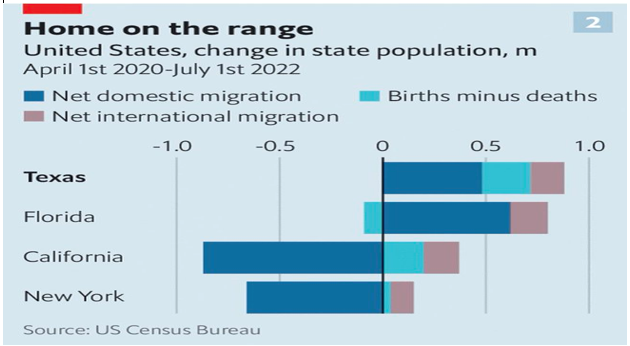
The National Center for Education Statistics projects the school age population of Florida and Texas to shrink by -3.9% and -3.3.%, respectively, between 2022 and 2030. The double impact of a national baby-bust and restrictionist foreign immigration policy will challenge even Florida and Texas.
A clear advantage Florida holds over Texas lies in the modernization of public services. This began in education in both states in the 1990s. Florida, however, has gone much farther in expanding choice by embracing charter schools, statewide virtual schooling, school vouchers, scholarship tax credits and, most recently, education savings accounts.
Texas reform efforts by comparison have been timid, and it shows in crucial outcomes such as NAEP fourth grade reading:
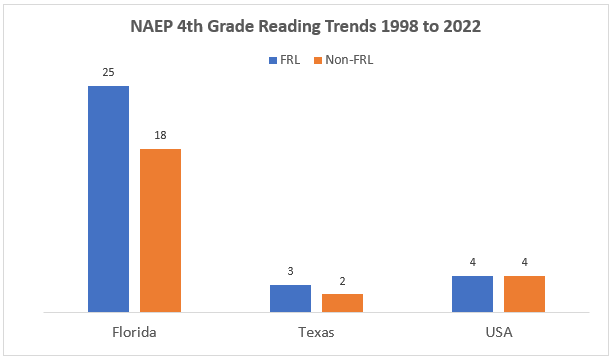
Florida’s embrace of universal private choice in 2023 will simply widen this advantage further, absent action by the Texas Legislature.
Florida has all the ingredients necessary for a pluralistic and dynamic system of education in which teachers have the freedom to create their own schools and families have the ability to shape the K-12 space. The schools families are demanding will open and expand, while schools not valued by families will have fewer students to miseducate. Whether you are a liberal, a conservative, a libertarian, or a vegetarian, this is as it should be.
Together, teachers and families will serve as the two hands of a potter at a wheel, shaping the future of Florida education. Texas lawmakers are two-and-a-half decades behind Florida in this endeavor. Texas families are still largely herded to public schools by their ZIP code.
You can see how this is working out for Texas students in the chart above. Meanwhile, Florida has embraced a dynamic future. Will Texas move beyond an antiquated past?
We’ll soon have our answer until 2025 from Texas.
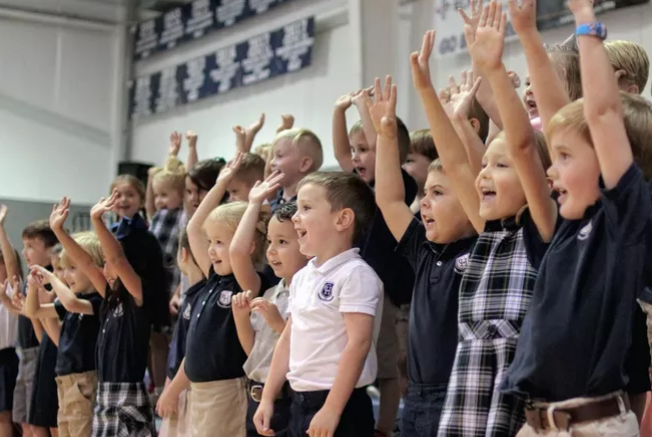
Christian Heritage Classical School in Longview, Texas, one of 1,819 private schools in the state serving more than 308,000 students, has a curriculum and philosophy of learning grounded in classical, Christ-centered education.
Editor’s note: This article appeared Monday on texasscorecard.com.
On the last day of bill filing for the current legislative session, priority legislation on the expansion of school choice and parental rights was finally filed in the Texas Senate.
State Sen. Brandon Creighton (R-Conroe) revealed the bill Lt. Gov. Dan Patrick is getting behind to push the expansion of school choice and parental rights, an issue Patrick and Gov. Greg Abbott have repeatedly expressed support for during the past year.
Some of the bill’s stipulations, however, have educational choice advocates wanting more.
Senate Bill 8 would create education savings accounts administered by Comptroller Glenn Hegar’s office in conjunction with “educational assistance organizations,” which would provide $8,000 of state funding per year for each student enrolled. Although Abbott has been promoting the concept of school choice for some time, he endorsed education savings accounts as his preferred policy solution earlier this year.
House Speaker Dade Phelan (R-Beaumont) has not been nearly as outspoken as Abbott or Patrick on the issue of school choice, and none of his priority legislation pertains to the subject. Still, three House members have filed bills to create school choice programs, and the political momentum for expanding education options for Texas students has never been greater.
One of these bills filed in the House is identical to Sen. Mayes Middleton’s Senate Bill 176, which has been touted by national school choice advocate Corey DeAngelis. Creighton’s Senate Bill 8 is similar, but it contains several key differences.
The accounts created by Middleton’s bill would be managed by each participating student’s parents or guardians, while Creighton’s bill would delegate management to educational assistance organizations selected by the comptroller. In this respect, Creighton’s proposal is more similar to traditional vouchers, which have encountered fierce opposition in the Texas House for many years.
Another key difference is that homeschooling is not an eligible education expense in Creighton’s bill, whereas Middleton’s bill does not contain this restriction.
The most significant difference, however, is the carveout for “rural districts” in Creighton’s bill. Senate Bill 8 stipulates that for school districts with fewer than 20,000 enrolled students, every student who transfers to the alternative state-funded program would obligate the state to reimburse the district to the tune of $10,000, which is roughly equivalent to the average cost incurred per student by Texas public schools each year.
Patrick previously spoke about his intent to include such a carveout in his preferred school choice proposal, aiming to quell the oft-repeated argument that school choice would be detrimental to rural school districts.
To finish reading, click here.
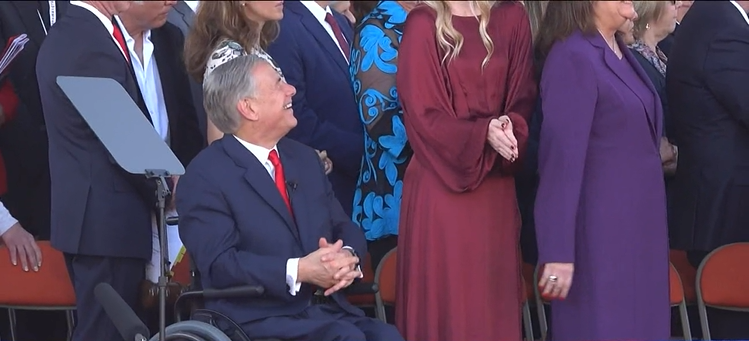
Texas Gov. Greg Abbott on Tuesday took the oath of office at the state Capitol in Austin following an early morning prayer service in which supporters gathered at the University Avenue Church of Christ to pray for lawmakers.
Editor’s note: This article appeared Tuesday on amp.cnn.com.
Texas Gov. Greg Abbott previewed a push for school vouchers and more parental influence over curriculum as part of an effort to "empower parents" in his inaugural address Tuesday in Austin.
Abbott, a Republican who defeated former Rep. Beto O'Rourke to win a third term in November and is seen as a potential 2024 presidential candidate, delivered a speech outside the Capitol in Austin that was largely a forward-looking effort to contrast Texas with the rest of the United States.
He also used his third inaugural address to preview a push for school vouchers, property tax cuts and more in the upcoming months, at the outset of a legislative session in which Abbott and state lawmakers will decide what to do with a $33 billion budget surplus.
Abbott described Texas as a place of "freedom and opportunity" without the "high taxes, red tape, burdensome regulations" of Democratic-led states. He touted the conservative record that Abbott and the state's Republican-dominated legislature have built over eight years.
Abbott did not offer details on what a voucher system would look like but previewed such a push using language that mirrored other Republican governors in recent years.
Parents, Abbott said, "deserve the freedom to choose the education that's best for their child."
He also said schools are for "education, not indoctrination," and suggested schools have in recent years been "pushing social agendas."
"We must reform curriculum to get kids back to learning the basics and empower parents with the tools to challenge that curriculum when it falls short of expectations," Abbott said.
To continue reading, click here.

