 In the classic Krisis at Kamp Krusty episode of “The Simpsons,” Bart discovers that the summer camp he and Lisa attend is a de-facto child slave labor camp, prompting him to lead a rebellion and camp take over. Decades later, your author still laughs uncontrollably when recalling the “Lord of the Flies” reference in this clip from the episode.
Far less laughable is the emergence of reports from teachers concerning post-pandemic-return student behavior. A recent survey of public-school teachers conducted by The 74, a nonpartisan education news group, related:
From regular f-bombs and bullying to difficulty finishing assignments, raising hands or buttoning pants, young people across the country are struggling to adjust to classrooms after lengthy pandemic isolation.
One hundred twenty-two teachers from 37 states and Washington, D.C., painted a picture of a generation emotionally anxious, academically confused and addicted to technology, in a survey created by The 74 … Educators from coast to coast noted students had difficulty with common classroom routines — writing down homework, raising their hands to speak, meeting deadlines. And for the youngest learners, underdeveloped motor skills made it difficult to use scissors, color, paint, and print letters.
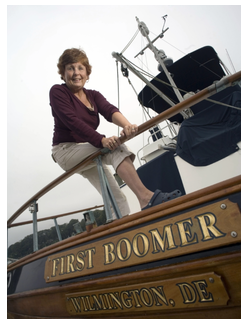
Kathleen Casey-Kirschling
Kathleen Casey-Kirschling, pictured here, was born at midnight on January 1, 1946, making her the first American Baby Boomer. She worked as a public-school teacher and retired (ahem) 15 years ago. All of America’s massive cohort of Baby Boomers will have reached the age of 65 by 2030.
No problem. We’ll just recruit Millennials to replace them, right? Wrong.
We saw declining success in the effort to replace Kathleen and her cohorts even before the COVID-19 pandemic.
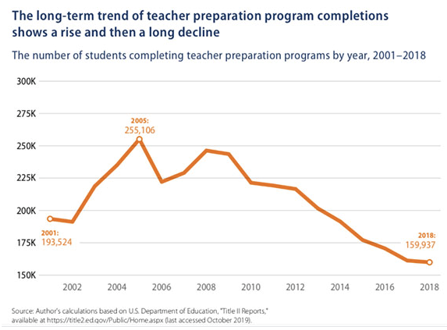 Ante-pandemic, the percentage of college students enrolling in colleges of education began to fall. During and after, the absolute numbers of college students began to fall, so let’s call that a shrinking percentage of a shrinking pool.
Lord of the Flies seems likely to simply reinforce the desire of college students to major in something other than education. With this context in mind, your author got a good, long chuckle from the absurd hysterics of Arizona passing a law to allow public schools to pay student teachers.
Said Jacqueline Rodriguez, vice president of research, policy and advocacy at the American Association of Colleges for Teacher Education:
“We have now allowed K-12 students to be placed in harm’s way with an unprepared person at the helm of the classroom by putting them in a position where they’re not only set up for failure, but it is very unlikely that they are retained in that same position, because they were not set up with the skills, knowledge, and dispositions to be successful.”
It is a tradition of long-standing to force student teachers to pay thousands of dollars and/or go further into debt while providing free labor to schools. This, however, strikes me as a tradition rather ill-suited to our current circumstances.
If districts could pay student teachers, it just might get more people to teach. Student teachers were going to be in schools whether this bill passed or not, but color me all in favor of not exploiting them.
In the end, such proposals work at the margins. The entire teaching profession must be reimagined to attract the talent necessary to allow teachers to teach and to provide the structure necessary for students to thrive.
Some states are moving forward with this, but for the rest, the beatings will continue until morale improves.
 Earlier this year, when a lawsuit by the Florida Times-Union forced the release of evaluation data for thousands of Florida teachers, Daniel Woodring saw an opportunity.
The release of value-added model, or VAM, scores meant that for the first time, the public had access to a trove of quantitative data on the effectiveness of teachers all over the state.
Woodring, a Tallahassee attorney whose clients include charter schools, used the data to create a website, myflteacher.com.
The site uses the unprecedented release of data to help people find the most highly rated teachers. Woodring (who also provides legal counsel to Step Up For Students, which co-hosts this blog) hopes the data could also change the way charter schools recruit top teachers.
Parents can search the site by school to see which teachers are among the top 30 percent. But the more intriguing aspect of the project may be the password-protected area for charter schools, where they can log in and find the top teachers in surrounding schools.
The idea is charter schools could search the data for top teachers in their area. Since they are not unionized and not bound by collectively bargained salary schedules, charters could, in theory, look up the teachers with the highest ratings in the database and offer higher salaries to lure them to their schools. (more…)
by John Merrifield

Merrifield
For years, it was lost in the wreckage from the crash of the politically incorrect “tracking” of students. But now, the worthy concept of “ability grouping” is making a comeback. A June 9 New York Times article on its resurgence is good news, but in the current public school system the much-needed ability grouping by subject is especially costly, with a very a limited upside. If parents had more school choice - more freedom to choose within a system that could easily diversify its instructional offerings in response to families’ interests and needs - the power and attractiveness of the concept would be much greater.
Unlike tracking, which assumes an across-the-board, one-dimensional level of student ability - i.e., students are uniformly brilliant, average, or slow - ability grouping by subject recognizes children have strengths and weaknesses. Strengths probably correlate with interest/talent, so in a system of genuine school choices, parents recognizing those interest/talents would tend to enroll their children in schools specializing in those particular areas. They’d be in classrooms with children who are similarly passionate and able to progress at similar, fast rates. And, likewise, for necessary subject matter in which they are not as adept, again, they’d be in a room and school building full of kids more similar to them. Stigma gone; no self-esteem threat.
This is not to contend that all students in say, an arts- and music-focused school or in a science- and technology-focused school, wouldn’t study some or both those subjects along with standards such as English, math and history. But students in those schools are likely to be more connected and engaged because of the emphasis on things they have strong interest in and an aptitude toward. Undoubtedly, each type of school will attract some students that are strong across the curriculum, but many of the science school students might have a more difficult time with English and the arts and vice versa.
In a traditional public school, children don’t have a common level of ability in particular subjects or means of instruction because they only have their neighborhood in common. You can see the effect in the photo in the Times article. The system would benefit from the option of having a relative uniformity of subject ability in each classroom, but in traditional public schools, ability grouping means dividing classrooms into sets of kids with different abilities for the subject matter at hand. The teacher has to circulate between tables of children with similar abilities, dividing her time between groups and finding the time to differentiate lesson plans; something that taxes time and teaching talent. (more…)

Merrifield: More school choice could make a teacher's job less Herculean. (Image from teacherportal.com)
Editor's note: John Merrifield is an economics professor at the University of Texas at San Antonio whose primary academic interest is school system reform studies. He's also editor of the Journal of School Choice, initiator of the annual School Choice and Reform International Academic Conference, and author of the critically acclaimed "The School Choice Wars."
A recent Wall Street Journal article about a National Council on Teacher Quality report on widespread deficiencies in teacher training programs is the latest example of hand-wringing about teacher ineffectiveness. Without discounting completely the need to address this issue along with others in the teaching profession – such as low pay, tenure, high turnover, poor materials, and the tendency to draw the lowest ability students - allow me to suggest the root of our teaching skill problem is actually the public school system’s monopoly on public funding.
The current system generates classroom composition that is so heterogeneous in student ability and life experience that only an extraordinarily rare teaching talent achieves significant academic progress for a high percentage of students in public school classrooms. Policies like mainstreaming a lot of special needs children will make teacher and public luck, in the form of unusually homogenous classrooms, increasingly rare.
Data reveal a few schools at the top and bottom that perform well or poorly with all students, respectively. But the truth is, teachers are quite effective with certain students and not effective with others - something that is often concealed by comprehensive test score averages. In 2011, I analyzed this fact in Texas, which has test score data disaggregated into several student sub-groups, and is especially important in Texas because of its diversity: large black and Hispanic populations and considerable variation in urban and rural settings. We found schools that taught black students well, and Hispanic students poorly, and vice versa. Other schools did well with low-achieving students, but not well with high achieving students, and vice versa.
Many would like to believe schools do an equally good job, regardless of race, ethnic background, students’ average ability level, or socio-economic status. Sadly this is not the case, and the differences are significant. Each school typically does better than others with different groups because teachers have strengths and weaknesses, even when they are not hired for them. (more…)
School grades. Low grades create more teacher turnover, a teacher columnist argues. StateImpact Florida.
 Turnaround schools. Pushback in Pasco yields some flexibility from the state. Tampa Bay Times.
Charter schools. The League of Women Voters ask questions in Polk. Lakeland Ledger.
Common Core. Administrators are training for Common Core too. StateImpact Florida.
GPAs. A proposed change in how they're calculated in Pasco stirs debate. Tampa Bay Times.
Principals. St. Lucie will have 13 new ones in August. TCPalm.com.
Superintendents. Duval board members evaluate Superintendent Nikolai Vitti, reports the Florida Times Union. Alachua Superintendent Dan Boyd wins the Florida School Boards Association's President's Award, reports the Gainesville Sun. New Lee Superintendent Nancy Graham starts shaking up administrative staff, reports the Fort Myers News Press. More from the Naples Daily News.
School safety. A third custodian is considered a suspect in the shooting deaths of two custodians at a West Palm Beach high school. Palm Beach Post.
School spending. A Marion school board member suggests some controversial cost-savings ideas to save teacher jobs, including having staff clean their own schools and either shutting down or charging students to attend IB programs. Ocala Star Banner.
Reading. More than 100 residents turn out to kick off a reading mentoring program for kids in Fort Meade. Lakeland Ledger.
The National Council on Teacher Quality released its first Teacher Prep Review today, and the findings show only a handful of colleges and universities adequately train aspiring teachers.
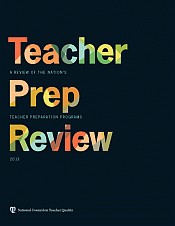 Which means many of the programs are leaving new teachers ill-equipped to keep up with the growing rigor of public instruction – and that’s bad news for a country about to raise the bar on education benchmarks with the adoption of the Common Core State Standards.
“The problem is worse than we thought,’’ said Brian Kelly, editor and chief content officer of U.S. News & World Report, which published the study. “The data show that the academic caliber of many incoming students is quite low, and what they are taught often has little relevance to what they need to succeed in the classroom.
“Very few schools meet even a minimum standard of quality when it comes to using the best practices for educating teachers,’’ he said in a prepared statement.
If the goal is to help all teachers succeed, “we not only need to change what happens in the schools where they work, we must also address the preparation of the next generation of educators,’’ said Kate Walsh, president of the national council. “New teachers deserve training that will enable them to walk into their own classroom on their first day ready to teach, but our review shows that we have a long way to go.’’
The study looked at 1,130 institutions, including 32 in Florida. Among the findings:
 I’m kind of glad the ruckus over the parent trigger is over for now. I continue to believe that despite how mercurial it was, there are far more issues that can unite parents, the press and policymakers, if only we can wall off the static and talk.
Perhaps this is one: I think most of us can agree that poor and minority students are getting shortchanged when it comes to getting the best teachers in traditional public schools. I think most of us can agree this is fundamentally unfair to students and teachers alike.
No matter how you define teacher quality – and let’s leave teacher evaluations out of this for now because, sheesh, that is a mess – poor and minority students get less of what is ideal and more of what isn’t. There are far more rookie teachers in high poverty schools, far more teachers who needed multiple attempts to pass certification exams, far fewer board certified. In many urban districts, the teacher transfer pipeline is one-way from inner city to leafy burbs. Given what we know about great teachers – that they are the biggest in-school variable in student achievement, that they can and do change lives – this is unconscionable.
The latest evidence is from a Stanford University study published last month. It’s based on data from the Miami-Dade School District. And it finds that even within schools, lower-performing students are more likely to be taught by the less-than-ideal teachers.
I wish issues like this got more media attention, especially in Florida. As far as I can tell, the only major news outlets that wrote about the Stanford study were Education Week and BET. I know reporters are under more stress than ever, and the timing – near the end of the Florida legislative session – couldn’t have been worse. But this isn’t a fleeting issue. (more…)
Parent trigger. Parent trigger is headed to the Senate floor, with growing potential for drama. Coverage from redefinED and The Buzz. The latest from Diane Ravitch's blog.
 Charter schools. The Pinellas County School Board agrees to sell the site of a former middle school to a charter school venture started by Cheri Shannon, former head of the Florida Charter School Alliance, reports the Tampa Bay Times. More from the Tampa Tribune. Lawmakers adopt language that would reign in the kind of abuses that happened last year at an Orlando charter, reports Gradebook. The International Studies Charter Middle/High School in Miami is ranked No. 2 in Florida and No. 15 in the nation by U.S. News & World Report's annual ranking of top high schools, reports the Miami Herald.
Teacher quality. A piece of the parent trigger bill regarding ineffective teachers is attached to the teacher eval bill, just in case parent trigger doesn't pass. The Buzz.
Teacher evals. U.S. Education Secretary Arne Duncan urges Florida to make its teacher eval system better, reports the Associated Press. In an editorial, the Ocala Star Banner agrees but also says: "A full generation of Florida schoolchildren have gone through the FCAT process, and in spite of the many political, mechanical and bureaucratic foul-ups along the way, Florida is making remarkable and steady educational progress. That is largely thanks to its teachers and local school officials."
Teacher conduct. The Hillsborough County School Board reverses an earlier decision to stop posting the names of employees facing suspension or dismissal. Tampa Bay Times.
Turnaround. In an attempt to jumpstart struggling Lacoochee Elementary, Superintendent Kurt Browning is replacing the entire staff. Tampa Bay Times.
Religion. The Hillsborough School Board is again wrestling with what religious materials are okay for students to circulate. Tampa Bay Times. (more…)
Graduation requirements. Gov. Rick Scott signs into law the bill that creates additional diploma options that emphasize career education. Coverage from Tampa Bay Times, Orlando Sentinel, Associated Press, News Service of Florida, Northwest Florida Daily News, Tallahassee Democrat, Sarasota Herald Tribune, StateImpact Florida, WFSU.
Magnet schools. Parents are pushing the Palm Beach County school district to expand a popular arts magnet. Palm Beach Post.
IB. Largo High in Pinellas gets official certification for its IB program. Tampa Bay Times.
Students with disabilities. StateImpact Florida writes up the bill that would give parents more power over their child's IEP. Some experts say the Hillsborough school district is unique in not allowing parents to make an audio recording of IEP meetings, reports the Tampa Bay Times.
Teacher pay. Palm Beach County teachers and district official remain skeptical about potential raises coming from the state, reports the Palm Beach Post. Gov. Scott says he's going to the mat for his proposal for across-the-board raises, reports the Tampa Tribune.
Teacher evals. Hernando Teacher of the Year highlights flaws in the new system. Tampa Bay Times. (more…)
The Florida parent trigger bill cleared its third committee Friday – again along party lines – and is headed to a vote by the full House.
More than 20 people signed up to speak before the House Education Committee on HB 867, with a nearly even split between supporters and opponents. They and lawmakers echoed the same arguments that have circulated since last year, when a similar bill passed the House but failed the Senate on a 20-20 tie.
“When we let these corporate interests take over the schools” it won’t empower parents, said Rep. Mark Danish, D-Tampa, a teacher and teachers union representative. “It’s going to muzzle parents and prevent them from voicing their concerns.”
“Let’s not make this a partisan discussion. Let’s not be concerned of this boogieman of phantom interests,” said Rep. Carlos Trujillo, R-Doral, the bill sponsor. Opposition is coming from “the unions and the establishment that are trying to control the debate and trying to control jobs.” (more…)

