
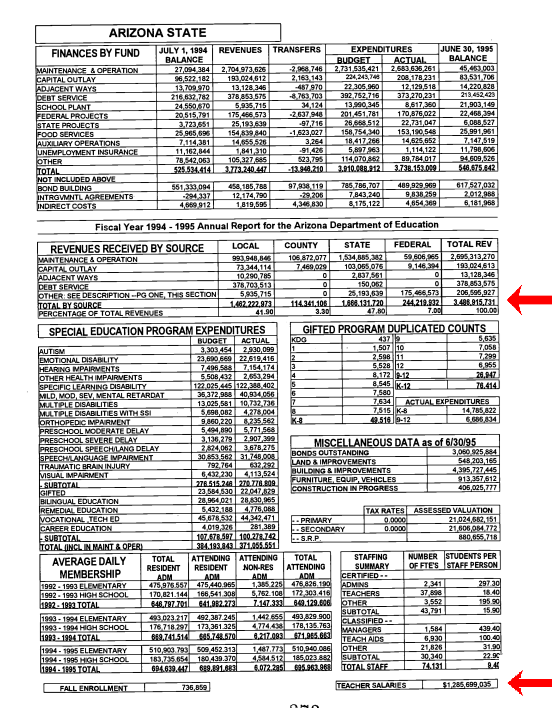
Recently, because this is the sort of thing your friendly neighborhood school choice mad scientist likes to do, I examined the Arizona Superintendent of Public Instruction annual reports. Stick with me; this will be more interesting than you might suspect. So, if you go back to the 1994-95 report (the last year before any charter schools or district open enrollment) and go to page 273 you find that the Arizona school system spent almost $1.3 billion on teacher salaries, on a total spend of $3.5 billion. In other words, 37% of Arizona’s K-12 investment went to teacher salaries.
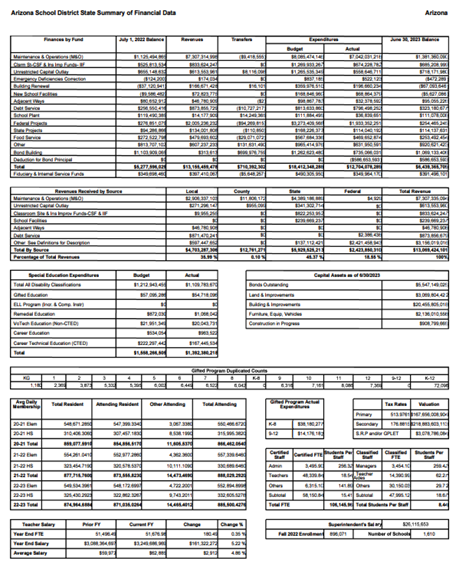
The latest edition of this same report keeps districts and charter schools separate for these calculations. In 2022-23 (see page I-253) Arizona’s total spend on school districts had increased to $13.2 billion, and the line item for district teacher salaries stood at $3.2 billion. Teacher salaries had dropped from 37% of the total spend to 25%. Dividing the total district teacher salary by the number of teachers and then adjusting for inflation revealed that the average teacher salary remained essentially flat in real terms over the 30 years.
That might seem odd at first. Arizona more than doubled the investment in school districts after accounting for inflation but somehow managed to prioritize every other type of spending except teacher salaries. How does this fit with the notion that school districts have been politically captured by teachers unions?
This puzzle is not overly difficult to solve. “Teachers unions” are actually “district employee unions,” and district employee unions can maximize their dues revenue by maximizing the employment of non-teachers. If for example you can hire two non-teachers for the same cost as hiring a single teacher, you can potentially double your dues revenue. The same reports cited above show that Arizona’s district system somehow soldiered on with one non-teacher employee per 19 students in 1994-95, but that had dropped to one per 15 students in 2022-23.
If in fact Arizona’s school districts spent 37% of their revenue on teacher salaries in 2022-23, it would have pushed the average annual teacher salary over $100,000. This could have been achieved without changing student-teacher ratios and would have left 63% of revenue to spend on everything else.
Other factors are at play as well; districts constructing buildings to the 21st century nowhere, etc. Chubb and Moe instructed us back in 1990 that the central problem in K-12 education is politics, a lesson that we seem prone to forget. The K-12 system isn’t just broken. Rather it is broken on purpose, and teachers have been hugely shortchanged in the process. Fortunately, the development of a solution is underway, and choice is key:

NBA Players Association President C.J. McCollum heads an effective labor advocacy organization.
Over the past two decades, taxpayers across the country have increased their investment in public education.
One surprising group hasn't seen much benefit from this spending growth: Public-school teachers.
A new report by the Reason Foundation looks at the state of public education funding. It shows that even as public-school revenue increased by 25 percent from 2002 to 2020, teacher salaries actually declined by 0.6 percent.
States with strong unions and larger-than-average per-student funding increases tended to see larger growth in teacher salaries, but those connections aren't uniform. Major culprits for stagnant teacher salaries include escalating benefit costs (health care and pensions are growing more expensive and crimping potential salary increases) and district officials wary of long-term salary commitments.
As Reason's Christian Barnard writes in Education Next:
[C]ompensation and staffing decisions are made primarily at the school district level, and district leaders have different incentives than governors or state legislators. While state officials might focus on how their teacher salaries compare with those of other states, district leaders are more concerned with day-to-day school operations and competing with neighboring districts for staff. Additionally, district budget officers are risk-averse and thus inclined to deploy new dollars toward marginal support personnel additions rather than increases to teacher salary schedules that lock them into longer-term commitments. Consequently, district leaders rarely plan to take advantage of staff attrition and re-purpose funds for raises.
To be fair, district leaders may have limited latitude to make these kinds of shrewd budget decisions, especially in localities with strong teacher unions. A chief budget officer in Los Angeles or Chicago would likely roll their eyes at any suggestion that they should make long-run budget tradeoffs; even if financial course corrections are desperately needed, their collective bargaining agreements would never allow it. And since nearly one-quarter of the country’s public school students live in one of the largest 120 school districts, a handful of contracts in union-friendly states can exert outsized influence on overall staffing and salary trends.
If they want to make salary increases a priority, unions could use another tool to help hold management's feet to the fire. They could arrive at the bargaining table with a clear demand that teachers receive a guaranteed share of school district revenue.
They could borrow a model from unionized workers in a different industry: Professional basketball players.
The National Basketball Association makes money when people buy tickets to see games or tune in on TV. They tune in or buy tickets to see the players on the court. Those players are unionized, so they’ve struck a deal to ensure that when the league makes more money, so do they.
The NBA Players Association’s collective bargaining agreement revolves around the league's "basketball related income"—the money teams make from ticket sales, TV broadcast and streaming rights, sponsorships, and so on. Each year, the salary cap is pegged at 44.74% of that year's basketball related income, minus the projected cost of player benefits, divided by the number of teams. Each team is required to spend up to 90% of the salary cap on player salaries or face financial penalties. Teams can spend above the salary cap, but to help ensure fair competition, big spenders face escalating restrictions on draft picks and transactions.
The details get complicated, but the basic idea is simple. The players are the main reason people watch games. They generate most of the league's value. So, when the league makes more money, so should the players.
That is the case that any teachers union could make to its local school board. Our members are the ones in the classrooms, teaching students every day. Without us, teaching and learning wouldn't happen. Therefore, when our district gets more money, so should the teachers.
Even if teachers used the NBA salary cap as a benchmark and demanded that districts direct 44.74% of new revenues to teacher salaries, they would make spending decisions dramatically more teacher friendly. (And that would be a modest start, focusing on new revenue, not total revenue).
According to Reason, the state with the best track record of prioritizing teacher salaries was Massachusetts, where only 34 cents of every dollar of new per-student funding increases went to teacher salaries. The national average was seven cents.
Perhaps it's time teachers demanded, and received, their fair share.
 Palm Beach: The future of a West Palm Beach private school for students with special needs is uncertain after school officials say they have not received their allotted funding from the state for scholarship students. Mountaineer's School of Autism has been a cornerstone of the special needs community for years, but the owner says she can only operate for about two more weeks unless she receives money owed from the state's scholarship program. WPTV.
Hillsborough: Plant High school voted to keep a graphic novel in its library in response to the district's first book challenge of the school year. A Plant High parent brought up the objection against "Blankets" by author Craig Thompson. The seven-member review board, comprised of school staff and parents, unanimously voted to keep the book in the school's library collection. WUSF.
Pinellas: The school district in Pinellas has pulled five books from its shelves amid concerns that their content is inappropriate for minors. Tampa Bay Times. Meanwhile, support staff in Pinellas have asked the school district for better pay and living conditions during a recent bargaining session. Nelly Henjes, president of the Pinellas Educational Support Professional Association, said the union is asking the district to pay employees at least $18 per hour or to give them a 7.3% pay increase, depending on which is greater. The union is also asking for child care before and after school, and no increase in health insurance premiums. The two parties did not reach an agreement but plan to meet again on Sept. 28. WFTS.
Volusia: Some local school districts are looking for ways to stand out as they compete for teachers during a shortage and in the face of a population boom in the state. Forough Hosseini, founder of Homes Bring Hope, which is a non-profit that works to help make home ownership more affordable, made a pitch to school board members in Volusia during a recent workshop to turn vacant land into affordable housing for district staff. “As our community grows, the need for teachers and the need for school staff certainly grows,” Volusia County’s Deputy Superintendent Dr. Rachel Hazel said. “This is just one more incentive to come to Volusia County and work for our school system.” WKMG.
Alachua: Shane Andrew, superintendent of Alachua County Public Schools, is aiming to be impactful during the upcoming school year. “I don't know that I necessarily set out that this was my journey and my destiny,” Andrew said in an interview. “But definitely, when called to serve in our school district, I'm going to do whatever I can wherever I can.” Main Street Daily News.
More on book bans: State education officials released a list of books removed from public school libraries last year, and it turns out that South Florida is among the areas with the fewest book removals. A state law enacted last year allows parents or residents of the Florida counties to submit challenges to school books. WLRN.
Teacher pay: A lawmaker wants to raise teacher pay to a minimum salary of $65,000. Rep. Tae Edmonds of West Palm Beach is proposing the "Save Our Teachers Act" to bolster pay for the state's teachers closer to the national average. "This is just a minor step in the right direction to help our teachers," Edmonds said. Florida currently ranks 48th in the nation when it comes to average teacher pay, with the average teacher making about $51,000 per year, according to a report from the National Education Association. A previous education funding boost in 2022 increased base pay for teachers to a minimum of $47,500, but Edmonds think it isn't enough. If the bill is approved by legislators, it would go into effect in July. News 4 Jax.
Opinions on schools: To find out how students are doing in the aftermath of COVID-19, YouthTruth, a nonprofit that elevates voices to help schools improve, set out to answer that question by consulting the experts: students themselves. Jen Vorse Wilka, The 74th.
 CARES Funding: Just 10 percent of the $693.2 million from the CARES Act funds available to Florida has been allocated to schools. Hillsborough County schools have received $29 million and only 10 other school districts have received more than $1 million in funds to date. Tampa Bay Times.
Computer programing: Salaries in Florida for computer based occupations double the state average, but only 30 percent of public schools teach courses in the subject. Nearly 400 teachers in Miami-Dade are prepared to complete state certifications to teach computer science. Miami Herald.
Corona caution: Duval County schools superintendent urges students to be take precautions against the coronavirus at school and at home with face coverings, hand washing and social distancing. WJXT.
Effective?: Palm Beach County Schools Superintendent Donald Fennoy was rated "Effective" by the school board. Two board members pushed unsuccessfully to put Fennoy on an "improvement plan." Palm Beach Post.
Pay Raises: Gov. DeSantis and the legislature set aside $500 million for teacher pay raises, including requiring a minimum teacher salary of $47,500, but not all teachers have seen their pay raise yet. While the teacher union accepted the deal in Palm Beach County the union rejected the raise in Broward. Negotiations are ongoing. Sun Sentinel.
Students for Trump: Students marching through Riverview High School during spirit week face a backlash from classmates. WFLA. A New Smyrna Beach high school student is suing his school after his parking pass was revoked. The 18-year old student believes the punishment was due to the red, white and blue elephant, painted with the word "Trump," in the back of his father's pickup truck. WVTV.
STEM: Former Miami Heat star Chris Bosh will become dean of DRL Academy, helping students learn STEM skills through games and online lessons on how to build drone racers and more. DRL Academy is a project of the Drone Racing League. Bradenton Herald.
Teacher survey: What is it like to teach students during the pandemic? A NBC 6 survey finds out. WVTJ.
Quarantine: 70 students and staff at Palm Lake Elementary School will be in quarantine for two weeks while two high schools in Orange County have reopened. Orlando Sentinel.
Alachua: Covid cases are not as widespread as previously feared, though 507 people in the school district have been infected. More than 30,000 students were enrolled in Alachua County last year. Gainesville Sun.
Manatee: Manatee County schools are looking to do another tax referendum in 2021 or 2022. The last property tax referendum passed in 2018 and is set to expire in 2022. Bradenton Herald.
Opinion: John E. Coons, professor emeritus at the University of California at Berkeley, reflects on the excuses made by opponents of school choice to thwart educational opportunities for low-income students over the past 50 years. redefinED.
The Florida Board of Education on Wednesday overturned the Palm Beach School Board’s rejection of two charter school applications.
The decision followed a recommendation by the Charter School Appeal Commission, which found the School Board did not have good cause to reject the South Palm Beach Charter and Renaissance Charter High School applications. (more…)
Lawsuits. The Florida Education Association says it will drop one of its school choice lawsuits. Associated Press. News Service of Florida. Palm Beach Post. Saint Petersblog. Scripps/Tribune. Times/Herald. redefinED.
Rankings. A change in criteria sends Florida tumbling in Education Week's Quality Counts rankings. redefinED. Tampa Bay Times. Orlando Sentinel. Tampa Tribune. Palm Beach Post. Associated Press. Gradebook. StateImpact. WFSU. US News & World Report.
 Charter schools. South Florida lawmakers file bills to restrict proposed new charter schools. Palm Beach Post.
Teacher pay. Sen. Darren Soto, D-Orlando, files a bill that would raise minimum teacher pay to $50,000 per year. StateImpact. News Service of Florida. Palm Beach Post.
School choice. The South Florida Sun-Sentinel publishes a rundown of different school options parents might consider.
Superintendents. Hillsborough's teachers union leader sticks by her superintendent. Gradebook. Palm Beach schools plan a national search for a new leader. Palm Beach Post.
Charter schools: A report from the National Alliance for Public Charter Schools shows that the massive growth in charter school enrollment experienced by Palm Beach County schools this year is not an isolated incident. Palm Beach Post. More from the Tampa Bay Times. The Leon County School Board on Wednesday unanimously approved a charter application that would create a new charter middle school. Tallahassee Democrat.
 Private schools: After a nationwide search, St. John’s Episcopal Parish Day School in Tampa announces the appointment of Robert S. Stephens Jr. as head of school, effective July 1. The Tampa Tribune. More from Tampa Bay Times.
Jeb Bush: The former Florida governor has reformed the public education system successfully and achieved impressive results, writes Diane Francis for the National Post.
Pay raises: Miami-Dade County school police and bus drivers will see raises under tentative agreements. Miami Herald.
School construction: Agriculture Commissioner Adam Putnam is building support for a plan that would cut some sales taxes paid by businesses and pump money into public school construction. The Buzz.
School grades: StateImpact Florida explains Florida's revamped school grading model. More from The Florida Current. Local school officials say a state proposal to fix the school grade formula falls short. Tampa Bay Times.
Legislation: The Florida affiliate of the National Rifle Association is supporting a proposal that would prevent children from being disciplined for playing with simulated weapons in school. Miami Herald.
Principals: Polk County approves appointments for three new principals. The Ledger.
Private schools: Students half a world away are exchanging their food, music and ideas with the Canterbury School in Lee County thanks to the Cultural Bridges Science and Social Science program. Fort Myers News-Press. Palm Beach County private schools open their doors to students of a local Christian school that announced it's closing. Palm Beach Post.
Faith-based schools: Jacksonville's Catholic schools provide about 46,000 meals to the needy each year. Florida Times-Union.
Charter schools: Tucked in Gov. Rick Scott's proposed budget is a provision for new charter schools that want state construction funding to locate in neighborhoods with schools identified as struggling by the state’s A-F grading system. Tallahassee Democrat.
School choice: Choice options, and fairness, are growing by leaps and bounds, writes Lloyd Brown for Sunshine State News.
Collegiate high schools: A Florida lawmaker tells the Tampa Bay Times he plans to file a proposed bill requiring state colleges to partner with school districts to create collegiate high schools, where students can earn a diploma and an associate degree in a rigorous college environment.
Digital learning: Florida students could choose computer programming courses instead of a foreign language as part of a bill to help Florida schools add more technology and digital instruction. StateImpact Florida.
School safety: The union representing schools police officers reports a marked increase in the number of guns seized from within Miami-Dade County Public Schools in the first half of the school year. Miami Herald.
Evolution: Why are we still debating evolution in education, asks Beth Kassab for the Orlando Sentinel.
Dyslexic students: Duval County's superintendent wants to add more services for dyslexic students. Florida Times-Union.
Financial literacy: The Florida Department of Education wants to hear the public's thoughts on proposed standards for financial literacy, guidelines for what students should learn so they can "make responsible and effective financial decisions." Orlando Sentinel.
School vouchers: House Speaker Will Weatherford is among Republicans looking to expand school choice efforts this year, including beefing up the Florida Tax Credit Scholarship program. Palm Beach Post.
Charter schools: A new state law that requires a "model" contract between school districts and charter operators is not stopping Orange County from requiring new charters to meet performance standards. Orlando Sentinel.
Faith-based schools: Parents are shocked after learning a Palm Beach County Presbyterian church is closing its school. Palm Beach Post. Hundreds of low-income students at Duval County private or parochial schools will likely lose tutoring and other academic help because the federal money paying for it is drying up. Florida Times-Union.
School choice: The city of Hollywood is pushing its public schools to better market themselves this year, in hopes of luring new students — and new families. Sun Sentinel. Pasco County students and parents face a broader array of education options as the district's 2014-15 school choice application window opens. Tampa Bay Times.
Digital learning: A proposed bill to expand school technology could lead to more tablets and computers, more professional development for teachers and more opportunities for K-12 students to take classes in subjects like computer programming. The Tampa Tribune. More from Tampa Bay Times. StateImact Florida asks teachers how they learned to connect technology to learning.
Education budget: While Gov. Rick Scott's suggested a $542 million bump in K-12 funding is no small chunk of change, few people believe it’s anywhere near enough to meet the ever-growing demands of the state’s public schools, writes Rick Christie for the Palm Beach Post.

