An education reform era policy ended recently as New York lawmakers repealed a law that attempted to remove ineffective instructors from public school classrooms. As Kathleen Moore of the Times Union explained:
Districts can still fire probationary employees, as always. The measures that help them remove ineffective teachers who have tenure, however, have been removed. Repealed were measures that called for an expedited hearing for “just cause” termination and stated that reviews showing a pattern of ineffective teaching would be “very significant evidence” in favor of termination.
In addition, teacher evaluations will no longer have to consider test scores, student growth scores and other measures that the state tried to use from 2010 until when the pandemic hit in 2020.
If you have been hanging around the ed reform water cooler long enough, you will recall when New York City “rubber rooms” were a cause celebre back in 2009. Job security for tenured teachers reached such absurdity that NYC schools would send instructors accused of criminal activity to “rubber rooms” in order to keep students safe. Mind you these people continued to draw their salary and benefits while doing absolutely nothing. Rubber rooms existed because it was almost impossible to fire a tenured teacher.
State lawmakers attempted to address this with a statewide evaluation policy that could-in theory- allow school administrators to remove tenured teachers for ineffective instruction. In theory this could have a large impact on average student achievement based upon research such as this chart from a 2006 Brookings Institution study:
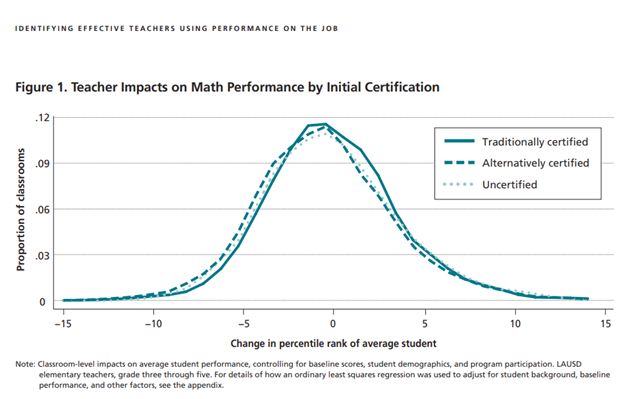
The upshot: Research shows that some teachers are catastrophically poor at getting students to learn (left side of the bell curve) while others are amazing (right side of the bell curve). Obviously what state lawmakers should do is to create a statewide evaluation system to remove the teachers on the left side, and average teacher quality will improve- in theory. As the Times Union article noted, New York had a policy to do just this in theory between 2010 and 2020. Let us then see what happened in New York NAEP scores in practice between 2009 (pre-policy) and 2019 (last NAEP under the policy and before COVID).
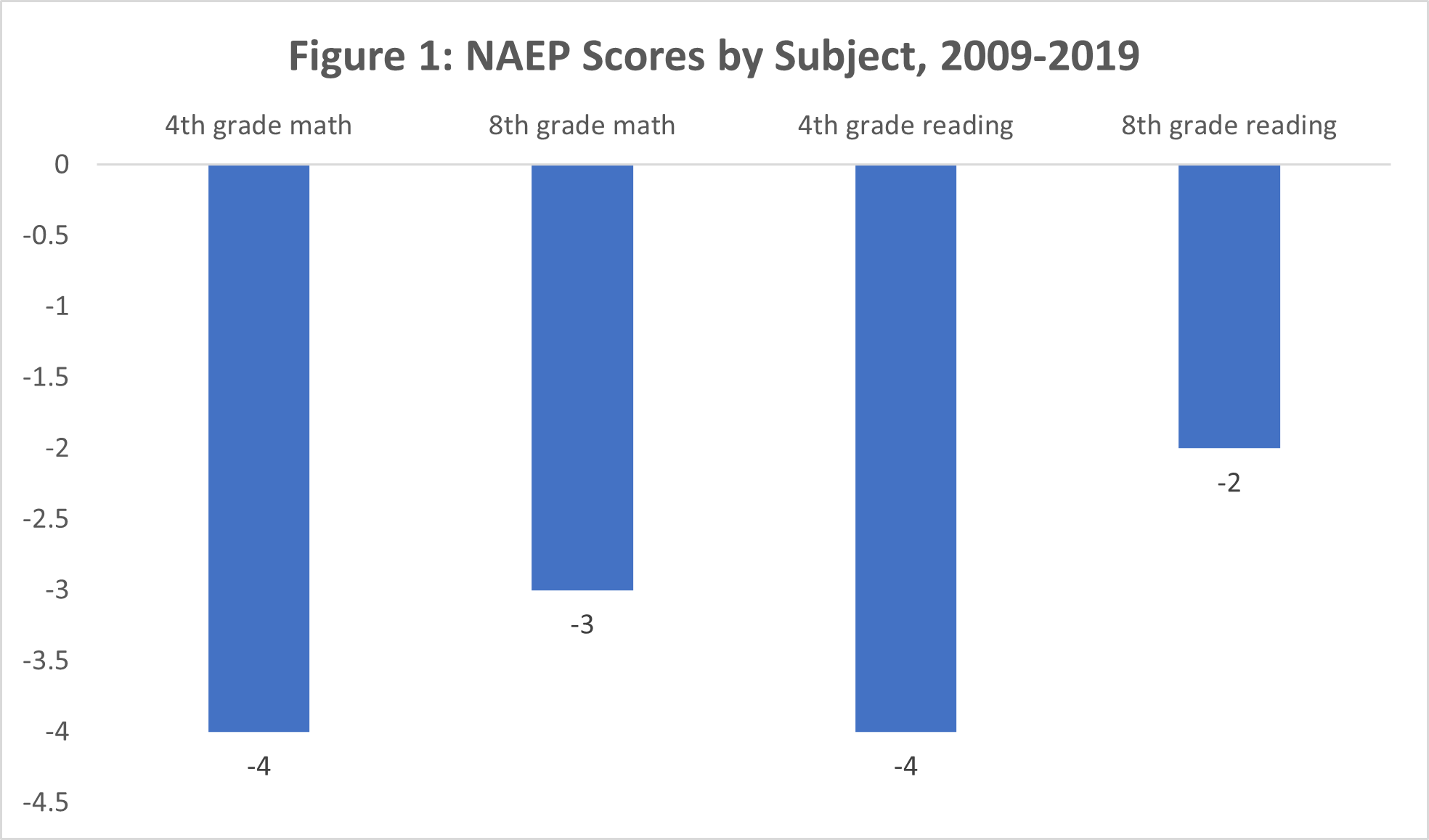
Of course, this does not mean that the New York teacher evaluation policy caused New York NAEP scores to decline. It does however mean that the hoped for large improvement in instruction failed to materialize. I don’t know of any data source to confirm or deny this, but I’d be willing to bet a left toe that very few teachers were removed under the policy.
Despite all the Sturm und Drang surrounding this policy at the time, it limped along ineffectually for a decade or so before repeal effectively never being implemented. It’s almost as if school districts have been subject to a deep level of regulatory capture by reactionaries with abundant ability to engage in passive resistance. Reformers bringing technocracy to a politics fight brings to mind Macbeth:
Life's but a walking shadow, a poor player,
That struts and frets his hour upon the stage,
And then is heard no more. It is a tale
Told by an idiot, full of sound and fury,
Signifying nothing.
It also stands as a great example of Dennis Nedry attempting to get the dinosaur to fetch the stick. Education reform policies require active constituencies in order to work and last. If the supporters of top-down policies recognize this need, they have yet to display much ability to acquire them.
 Earlier this year, when a lawsuit by the Florida Times-Union forced the release of evaluation data for thousands of Florida teachers, Daniel Woodring saw an opportunity.
The release of value-added model, or VAM, scores meant that for the first time, the public had access to a trove of quantitative data on the effectiveness of teachers all over the state.
Woodring, a Tallahassee attorney whose clients include charter schools, used the data to create a website, myflteacher.com.
The site uses the unprecedented release of data to help people find the most highly rated teachers. Woodring (who also provides legal counsel to Step Up For Students, which co-hosts this blog) hopes the data could also change the way charter schools recruit top teachers.
Parents can search the site by school to see which teachers are among the top 30 percent. But the more intriguing aspect of the project may be the password-protected area for charter schools, where they can log in and find the top teachers in surrounding schools.
The idea is charter schools could search the data for top teachers in their area. Since they are not unionized and not bound by collectively bargained salary schedules, charters could, in theory, look up the teachers with the highest ratings in the database and offer higher salaries to lure them to their schools. (more…)

Merrifield: More school choice could make a teacher's job less Herculean. (Image from teacherportal.com)
Editor's note: John Merrifield is an economics professor at the University of Texas at San Antonio whose primary academic interest is school system reform studies. He's also editor of the Journal of School Choice, initiator of the annual School Choice and Reform International Academic Conference, and author of the critically acclaimed "The School Choice Wars."
A recent Wall Street Journal article about a National Council on Teacher Quality report on widespread deficiencies in teacher training programs is the latest example of hand-wringing about teacher ineffectiveness. Without discounting completely the need to address this issue along with others in the teaching profession – such as low pay, tenure, high turnover, poor materials, and the tendency to draw the lowest ability students - allow me to suggest the root of our teaching skill problem is actually the public school system’s monopoly on public funding.
The current system generates classroom composition that is so heterogeneous in student ability and life experience that only an extraordinarily rare teaching talent achieves significant academic progress for a high percentage of students in public school classrooms. Policies like mainstreaming a lot of special needs children will make teacher and public luck, in the form of unusually homogenous classrooms, increasingly rare.
Data reveal a few schools at the top and bottom that perform well or poorly with all students, respectively. But the truth is, teachers are quite effective with certain students and not effective with others - something that is often concealed by comprehensive test score averages. In 2011, I analyzed this fact in Texas, which has test score data disaggregated into several student sub-groups, and is especially important in Texas because of its diversity: large black and Hispanic populations and considerable variation in urban and rural settings. We found schools that taught black students well, and Hispanic students poorly, and vice versa. Other schools did well with low-achieving students, but not well with high achieving students, and vice versa.
Many would like to believe schools do an equally good job, regardless of race, ethnic background, students’ average ability level, or socio-economic status. Sadly this is not the case, and the differences are significant. Each school typically does better than others with different groups because teachers have strengths and weaknesses, even when they are not hired for them. (more…)

Rep. Trujillo is a co-sponsor of the House parent trigger bill
The parent trigger bill is back in the Florida Legislature this year and, judging by the spirited 8-5 party line vote it got in its first committee stop Thursday, perhaps as contentious as ever. But unlike last year, some Florida parents and child advocates not only voiced support, but drove to Tallahassee to tell lawmakers in person.
Former Marion County teacher Karen Francis-Winston trekked 200 miles from Ocala with her daughter to testify in favor of the bill sponsored by Republican Reps. Michael Bileca and Carlos Trujillo.
Pastor Alfred Johnson came from Tampa,where he said he serves a low-income community.
“I don’t understand what’s the matter with empowering parents to make a recommendation,’’ he told the Choice & Innovation Subcommittee. “We’re doing nothing but recognizing they have a voice, a say in the process.’’
House Bill 867, with an identical version filed by Sen. Kelli Stargel, R-Lakeland, allows parents with children in an F-rated school to petition the school district to consider a turnaround plan that could include bringing in a charter school operator. The petition would need signatures from a majority of parents. (more…)
The most contentious education bill in last year's Florida Legislature is back this year.Sen. Kelli Stargel, R-Lakeland, filed a "parent trigger" bill Wednesday that is similar to last year's.
Senate Bill 862 would give more power to parents in struggling schools that are mandated by state accountability rules to implement a "turnaround" strategy. A majority of parents could petition the school board to pursue one of several turnaround options, including conversion to a charter school. The school board would not be required to follow the majority's wishes, but the state Board of Education would ultimately determine whether the parent option or district option is pursued.
Last year's parent trigger bill drew national attention. It cleared the House along mostly party lines, but died in the Senate on a dramatic 20-20 vote. It has been widely assumed that the bill would get another shot this year.
Stargel's bill would also require school districts to notify parents when their children are assigned out-of-field teachers or teachers with poor evaluations. The notice would let parents know that virtual instruction with a higher performing teacher was available. The bill also bars districts from giving a student a low-performing teacher two years in a row.
So far, there is no House companion to Stargel's bill.
More from Gradebook and SchoolZone.
A recent report from Harvard researchers offers more compelling reasons why expanded learning options are so needed for struggling students. Based on data from four urban school districts, the Strategic Data Project at Harvard's Center for Education Policy Research found lower-performing students are placed with brand-new teachers far more often than their higher-performing peers.
Given high turnover in high poverty schools, and the reluctance of school boards to address it, you’d expect more of these match-ups there. But the researchers found them across all schools. And given what we know about the effectiveness of rookie teachers, the tragic impact is obvious: “The systematic placement of novice teachers with lower-performing students can be expected to compound these students’ academic difficulties and exacerbate achievements,” the researchers wrote. They termed it a “double whammy.”
That’s putting it mildly. There is no justification for saddling students with the greatest need with teachers who are often the least effective. It’s a clear case of public schools perpetuating a vicious cycle that they can, within their power, do much to help mitigate.
The practice isn’t good for teachers either. The researchers ask, “Is it the best strategy to develop and retain highly effective teachers by placing them in challenging situations when they are at a critical stage in their development as teachers?”
The report suggests potential remedies, including paying teachers more to work in tough schools. Maybe, someday, school districts will get around to doing that in a meaningful way. In the meantime, how can anyone deny parents the chance to find better odds in an alternative setting?
Editor's note: High-poverty schools and low-income families are hurt the most by last-in-first-out layoff policies for teachers. In Los Angeles, groups representing low-income parents filed suit against the practice - and so far, they're winning. Berkeley law professor and redefinED host Stephen D. Sugarman writes in this post that low-income parents have the right to equitable treatment for their children.
Unions typically bargain for terms that protect current members and, if need be, give priority to members with more seniority than those with less. In hard times when an employer is downsizing, this “last in, first out” policy best serves the needs of longer-term union members who are most experienced and perhaps most economically dependent on holding onto a job they have done for some time. It also provides a routine practice that lies in contrast to what might be an employer’s desire to lay off those who are, say, the most expensive, the least productive, the most troublesome, or the most active union members.
This “last in, first out” plan is typical in union contacts with public school districts. What it means when teachers have to be laid off is that the least experienced in the district are the first to be let go. These teachers are generally the most recently trained and the least expensive. It is also typically the case that they are disproportionately employed in schools that have had the hardest time attracting and retaining effective teachers, schools that almost invariably contain a disproportionate share of children from low-income families and children of color. These are often under-performing schools as well, although in some cases they might have recently put into effect a promising school improvement regime with the cooperation of the in-place local teaching team.
Does this mean that, in times of economic downturn and curtailed school district budgets, high-needs schools end up with very few teachers and terrible student/teacher ratios? No. Union contracts and federal law require that student teacher ratios remain fairly comparable across the schools in a district. Instead, slightly more experienced teachers from within the district are meant to be shifted over to these teacher-short schools, either via transfer or after themselves being laid off and then re-hired. In theory, this could actually provide high need schools with more experienced teachers than they had before, and that could possibly be desirable for their students on the theory (generally supported by research) that brand-new teachers are generally less effective that those with three or more years of experience.
But on the ground, it often works out quite differently. (more…)
Don’t like what an education reformer has to say? Just call them a teacher basher.
Increasingly, that’s what teachers and others are doing, with this recent blog post on CNN – “When did teacher bashing become the new national pastime?” – being the latest in a long list of examples.
Most of these articles set out straw men. There’s the frequent assertion that we only want to judge teacher performance by one standardized test score (few do). And another that teachers simply face an impossible job with students who are too damaged or too unmotivated to learn (a myth Education Trust dispelled long ago.) Most reformers assert quite properly that a teacher is the heart of the education system and the key to improving it. They should be treated better. They should be valued more highly. But the conundrum seems to be that teachers just don’t seem to believe that anyone can fairly measure what they do, so they collectively have resisted all efforts to implement meaningful performance standards. I find that odd, however, because I have never met a teacher who couldn’t tell me in a couple of minutes who the best and worst teachers in the school are
If we assume a good teacher enables a student to advance quickly and a poor teacher does the opposite, then it becomes difficult to dispute that the teaching profession is horribly broken. (more…)

