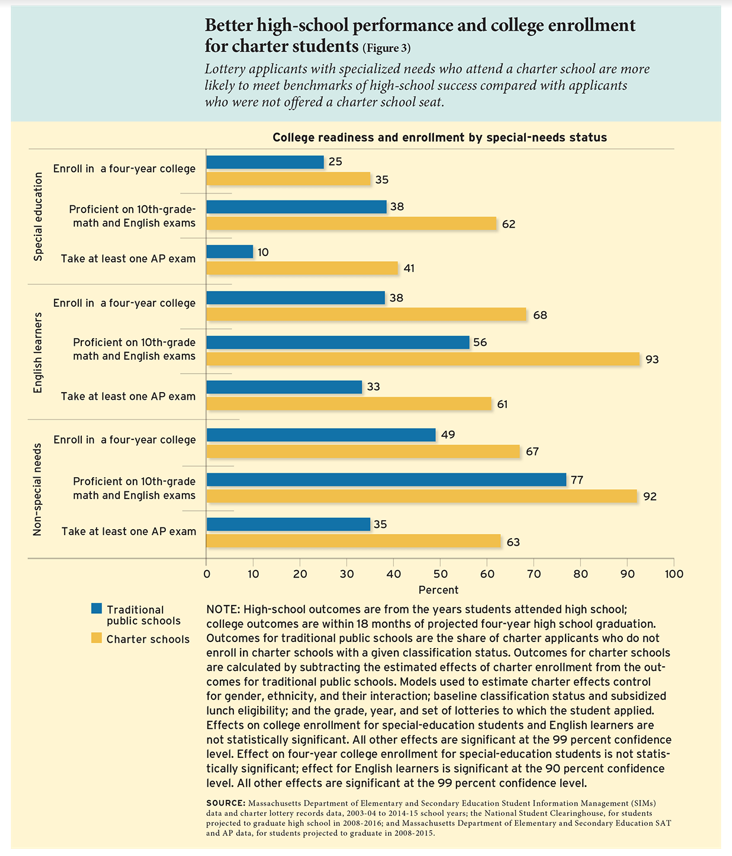
 In 2016, Massachusetts voters soundly rejected a ballot proposition (Question 2) which would have allowed 12 additional charter schools per year. A recent study demonstrates how costly this decision has been, especially for special education and English language learner (ELL) students.
Tufts University Professor Elizabeth Setren analyzed enrollment lottery data for Boston charters in order to compare long-term outcomes for three groups of students: general education students, special education students and ELL students (see above). The random admission process provides confidence that observed differences in outcomes show the impact of the schools.
Professor Setren noted that the Boston district schools spend significantly more on special education than charters, but charter schools see much better results.
I find that charter enrollment at least doubles the likelihood that a student designated as special education or an English learner at the time of the admissions lottery loses this classification and, subsequently, access to specialized services. Yet charter enrollment also generates large achievement gains for students classified at the time of the lottery—similar to the gains made by their general-education charter classmates.
Classified students who enroll in charters are far more likely to meet a key high-school graduation requirement, become eligible for a state merit scholarship, and take an AP exam, for example. Students classified as special education at the time of the lottery are more than twice as likely to score 1200 or higher on the SAT than their counterparts at traditional public schools. English learners who enroll in charters are twice as likely to enroll in a four-year college.
Students with special education and ELL labels at the time of the enrollment lottery are more likely to discard that status in charter schools. They are also more likely to enroll in a four-year college, score proficient on state exams and take an Advanced Placement course. Notice as well that general education students also see large improvements in those same outcomes.
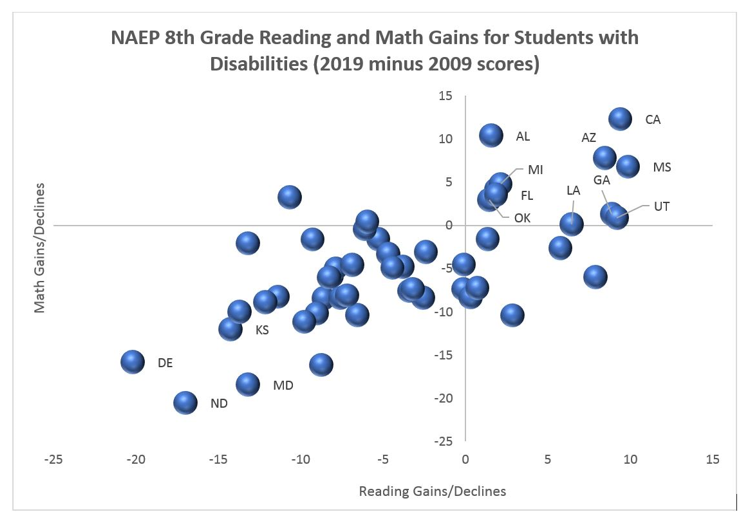
This study seems all the more important given the nationwide decline in NAEP scores for students with disabilities. While there are exceptions, most states saw declines in scores for both eighth-grade math and reading between 2009 and 2019.
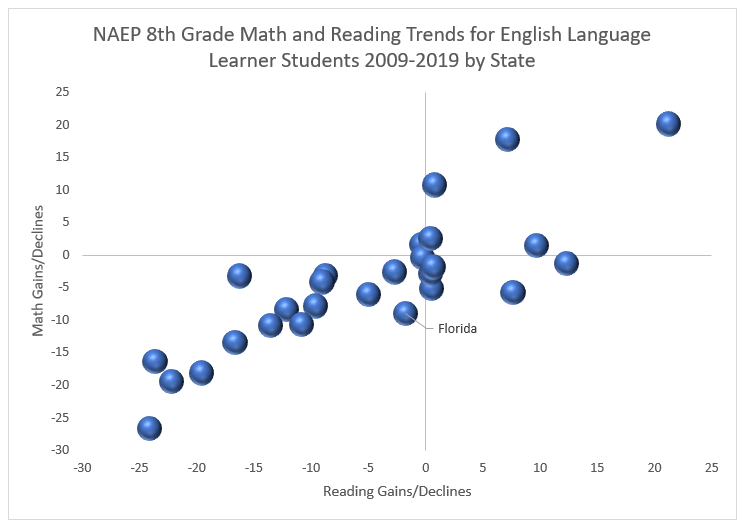
 A similar chart for ELL students during the same period looks even worse.
 So, Boston charter schools just might have a lesson about high expectations and inclusion. The charter school cap in Massachusetts, meanwhile, is limiting the opportunities for both general and special status students.
 PolitiFact on PIRLS. PolitiFact looks into Gov. Rick Scott’s statement about how well Florida fourth-graders fared on the recent PIRLS results. The ruling: Mostly True.
Charter school funding. Palm Beach district officials are upset by state budget proposals that would once again give a modest amount of capital outlay money to charter schools and none to district schools. Palm Beach Post.
Class size reduction. Some Broward school board members are worried the district is pushing more students into AP classes to avoid class-size penalties. South Florida Sun Sentinel.
Economies of scale. The Orange County School District joins with other big districts across the country to buy food together and drive down costs. SchoolZone.
School security. A defense expert gives South Florida teachers a day-long session on how to react to armed intruders in their classrooms, reports the South Florida Sun Sentinel. A Flagler mom pays for an armed deputy to patrol her child's school, reports the Daytona Beach News Journal.
School spending. Refinancing debt could ease Brevard’s budget crisis. Florida Today.
Testing protest. Is anybody in Florida going to kick it up a notch? Gradebook.
Mentors. A Winter Haven program links students with professionals. Lakeland Ledger.
ESE lawsuit. The latest from Hillsborough. Gradebook.
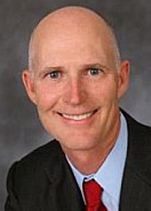 What does Rick Scott want? Orlando Sentinel columnist Beth Kassab on the possibility of Tony Bennett coming to Florida: “Indiana's loss could be Florida's gain. Then again, it will all depend on whether the state board and the governor are looking for somebody to push Florida forward or somebody to soften Scott's image on education reform. There are worrisome signs that Scott is looking for the latter.” Two knocks don’t make a pattern, but this is the second time in a month Scott has been criticized from the reform side.
Joining the chorus. Miami Herald columnist Leonard Pitts says the state Board of Education lowered the bar for minority students when it adopted short-term achievement goals that called for steeper rates of improvement for those students.
Tax credit scholarships and religious schools. The Orlando Sentinel takes a look at a long-established fact - the majority of students receiving tax-credit scholarships attend religious schools – and critics recycle myths about funding and accountability.
State settles with Christian college. From the News Service of Florida: “Settling a federal lawsuit that involved questions about the school's "secular purpose," state education officials will allow students at a Central Florida Christian college to be eligible for a popular grant program.” Complaint here. Settlement here.
Charter school analysis. News outlets continue to highlight UCF Professor Stanley D. Smith’s analysis, which finds that as a group, charter schools in Florida under perform traditional public schools. Smith writes an op-ed for the Tampa Bay Times. The St. Augustine Record uses his findings as a basis for this editorial. (more…)
Hillsborough school district must fix its problems with special education students in the wake of a student’s death, editorializes the Tampa Bay Times. It suggests an outside inquiry would be more appropriate and says of Superintendent MaryEllen Elia, “If there are larger problems with the special needs program, Elia needs to address those too. The review board she empaneled is full of insiders who hardly have an interest in exposing training or operational policies as deficient. Both clearly are.”

Podesta
Podesta to headline Jeb conference. John Podesta, former chief of staff under President Clinton, will be the keynote speaker Nov. 27 at the fifth annual national conference put on by Jeb Bush’s Foundation for Excellence in Education. He chairs the Center for American Progress, widely considered to be a progressive think tank.
Charter school performance. University of Central Florida professor Stanley Smith says his analysis shows charter performance as a whole isn’t so hot compared to district schools, reports StateImpact Florida.
Much anticipated charter in Palm Beach County. After parents clamored for it, construction is set to begin, reports the Palm Beach Post.
Charter dispute in Polk County. The school district and the charter schools in Lake Wales are tussling over student records and recruitment for IB, reports The Ledger.
Florida DOE makes changes to contracting procedures after problems surface in the Division of Blind Services. Tampa Bay Times.

Weatherford
School choice will have its own legislative committee. From the News Service of Florida (subscription required): “Incoming House Speaker Will Weatherford, R-Wesley Chapel, is revamping the House's committee structure, including making changes that will affect education and regulatory issues. The changes, outlined in a memo sent to House members Wednesday, include creating an education Choice & Innovation Subcommittee, which will deal with a wide range of issues such as charter schools, virtual instruction and voucher-type programs.”
A plea on teacher evals. The Florida Education Association asks Gov. Rick Scott to use his authority to postpone the linking of standardized test scores to teacher evaluations, the Orlando Sentinel reports.
More school funding votes. Voters in Seminole said yes to a tax hike, voters in Volusia said no, the Orlando Sentinel reports. Brevard voters also said no, Florida Today reports.
Charter school closing. The Lee County School Board prepares to close a charter school with financial problems, the Fort Myers News Press reports.
About that $155 million verdict for the former charter principal. Nevermind, the Miami Herald reports.
Mounting criticism over student deaths. Hillsborough County parents start facebook pages and have scheduled a protest in response to the deaths of two special needs students, the Tampa Bay Times reports.
From Idaho and Indiana, a message for Jeb Bush? StateImpact Florida.
by Allison Hertog
Hertog
Last spring the U.S. Government Accountability Office issued a study concluding that charter schools enroll a lower percentage of special education students than traditional public schools. Some commentators have questioned this study’s methodology and conclusions, while others believe it confirms what they have seen in practice. Regardless of where you stand on that debate, charter schools have a great opportunity to increase their special education admissions and improve how well public education serves all struggling students.
Charter schools can do this by using a bottom-up model called Response to Intervention, along with the Common Core standards. Response to Intervention can be employed in any school – private, public, charter, maybe even virtual – but it is particularly well-suited for implementation and success in charter schools because of their enhanced freedom to enact school-wide reforms.
Response to Intervention (RTI) is a special education reform codified into the 2004 reauthorization of the federal Individuals with Disabilities Education Act. It's designed to decrease the rolls of special education students. Following a dramatic rise of the number of students identified as specific learning disabled (SLD) in the 1990s, researchers from the Progressive Policy Institute and the Thomas B. Fordham Foundation suggested in a landmark 2001 paper, Rethinking Learning Disabilities, that the SLD label was a “catch-all” for low-achieving students which serves as a “sociological sponge that attempts to wipe up general education’s spills and cleanse its ills.” A 2002 report from a presidential commission on special education stated up to 40 percent of children identified for special education weren’t truly disabled, but were simply not taught to read properly. (more…)
Editor’s note: The McKay Scholarship Program for students with disabilities has on occasion been criticized because it does not require that student progress be measured with a standardized test. Robyn Rennick with the Coalition of McKay Scholarship Schools argues that such a policy would be ineffective and counterproductive.
Rennick
The McKay Scholarship is quite different from tax credit scholarships in Florida or other programs that are working with the general student population. All recipients of McKay Scholarships have diagnosed disabilities and had either an Individual Education Plan or 504 Plan in the public school. Therefore, by definition, they are a unique group of students with all types of disabilities from low cognitive functioning, to autism, to learning disabilities.
The issue of requiring standardized testing was thoroughly investigated and discussed prior to crafting the initial legislation to create the McKay Scholarship. Legislators determined it was an inappropriate measure of accountability. The testing issue was brought up again between 2004 and 2006 when the accountability bill for scholarship programs was being crafted. Legislators again saw the inappropriateness of this type of testing and did not place it the legislation. They recognized that the “one size fits all” approach to testing is wrong for this population of students.
How do you test such a diverse population? What standardized test measures the growth of a severely non-verbal autistic child whose progress may be measured in gaining 40 words in a year and in being able to sit appropriately for five minutes? What standardized test measures the progress of a developmentally disabled child who is learning proper hygiene? Placing these children in a standardized test format would never show the immense progress they may have made that year, compared to where they were. It would also be a cruel exercise to make the children follow.
What of the learning disabled students? Shouldn’t standardized testing be used to show their progress? When the Coalition of McKay Scholarship Schools surveyed its members, we found more than 50 percent of the schools did use a standardized test, especially those serving the learning disabled population. However, what is also typical is these students often enter the private schools three or four years behind their peers on standardized test scores. If a student only “gains” a year on the standardized test, they are still behind. Has the school failed?
We have seen the controversy in our public system as to whether “experts” agree that standardized tests really show whether a school is working. From a research basis, for scores to be compared, the population has to be similar. As we have already noted, the McKay population is extremely diverse. Also, the population has to be large enough to develop an aggregate score. Forty-five percent of schools with McKay students have 10 or fewer students. No researcher would validate aggregate scores from such a small group of subjects. Even in a school with 100 students, the diversity of the groups would not allow for a true picture. So to require standardized testing which is reported to DOE, and then to craft a “research report” from that, would be the most flawed research and a tremendous waste of everyone’s effort, time and money.
This is a parent choice program. Parents are the consumers. They can leave if their children’s needs are not being met. (more…)

