TAMPA, Fla. – Shuli Goldenberg didn’t need to see Tampa Torah Academy to know it would be just right for her now 12-year-old son, Yanky. After talking on the phone with a rabbi who co-founded the school, she was sure it was “perfection.”
Still, she had persuaded her husband, Yisroel Aron, to move 1,200 miles from the Catskills in upstate New York; to leave family behind; to start life anew in the Sunshine State – all for a school they’d never seen.
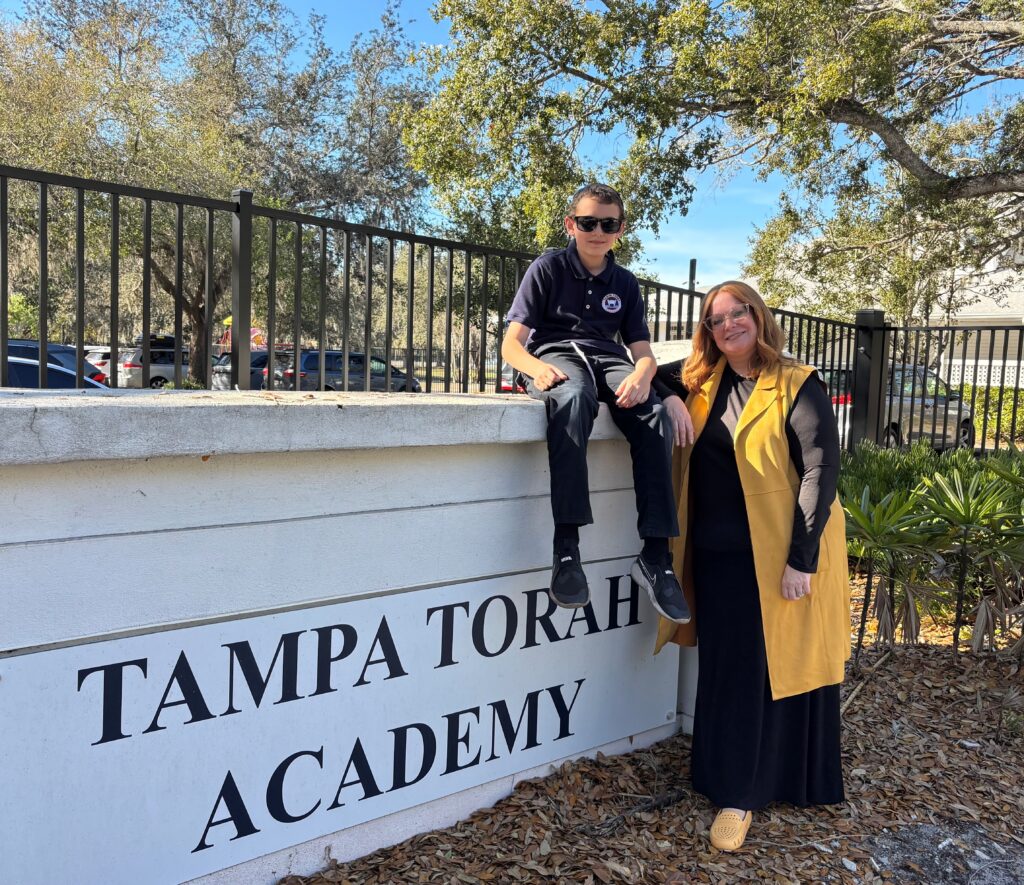
So, when she finally got to see it in person, a few days after the family moved down …
“I stood there with tears in my eyes thinking, ‘I’m home,’ ” Mrs. Goldenberg said. “It was like magic. It was exactly the school I wanted and exactly the school I knew my son would thrive in.”
The Goldenbergs are yet another example of a family drawn to Florida by educational opportunity (see others here, here, and here).
In their case, they represent what is likely the biggest group of “school choice transplants.” Hundreds if not thousands of Jewish families have moved to Florida in recent years, motivated at least in part by booming Jewish schools and the universal availability of state school choice scholarships.
The result: Between 2007-08 and 2022-23, the number of students in Florida’s Jewish schools grew 58%, to 13,379, and the number of Jewish day schools and yeshivas nearly doubled, from 40 to 74.
The Destination Florida pipeline is especially strong from New York to South Florida. But there are growing pockets of Jewish schools emerging in other parts of Florida too, like Tampa.
The why is obvious, said Rabbi Ariel Wohlfarth, co-founder of Tampa Torah Academy.
“School vouchers, no income tax, nice weather; why would you be any place else?” he said.
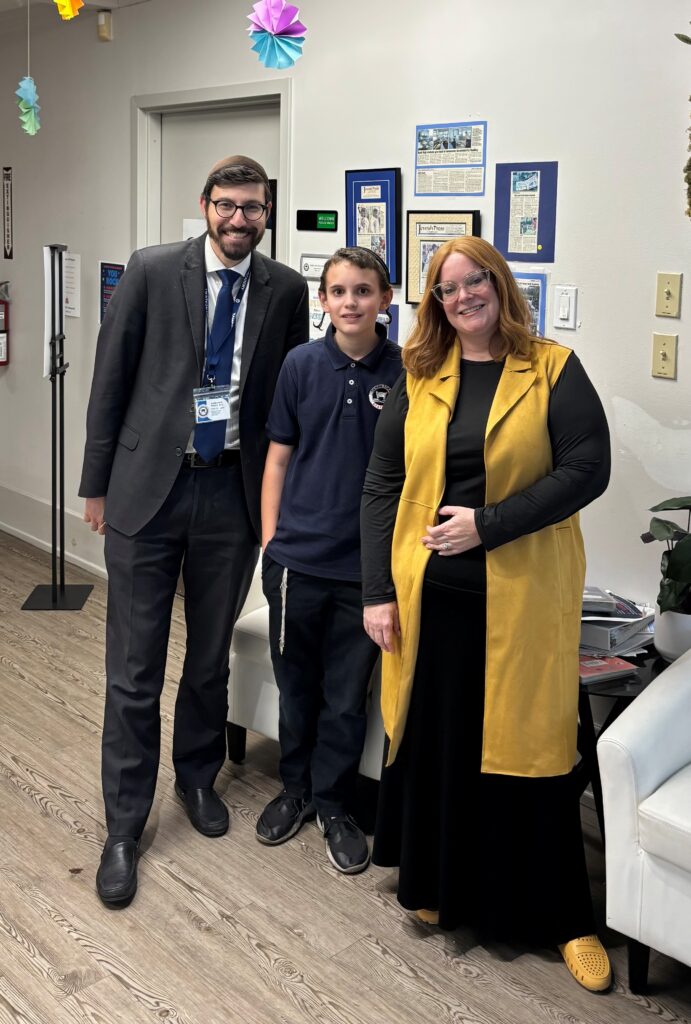
Tampa Torah Academy occupies a former preschool in a polished suburb. The school and its dormer windows and wraparound porch are framed by stately oaks and towering palms, next to a pond with a fountain whose streams arc outward in a circle, like the petals of a giant aquatic flower. An aerial view is the first thing people see when they visit the school website, along with the words, “Experience the Warmth of a Jewish Connection.”
Tampa Torah Academy opened in 2022 with 10 families, eight of whom relocated from New York. In the three years since, it’s tripled in size, from 33 students in grades K-7 to nearly 100 in K-12.
Every student uses a choice scholarship, which averages $8,000 or $10,000 a year, depending on the scholarship type. As of 2023, they’re available to every student in the state.
In New York, Yanky attended Jewish schools before Mrs. Goldenberg pulled him after a bullying incident.
She tried to homeschool him, but it wasn’t easy. She worried he wasn’t proficient enough in some subjects, like math, because of her own academic shortcomings, and that he wasn’t hanging out enough with other kids.
There were a few other Jewish schools in the area. But they were too expensive, too far away, or too big. Yanky, she said, “would have been lost and miserable.”
Thankfully, in the summer of 2022, Mrs. Goldenberg said, a miracle happened.
As word spread about a wave of Orthodox Jewish people leaving New York for schools in Florida, Mrs. Goldenberg got a fundraising pitch for Tampa Torah Academy. She donated, then called, then had a long conversation with one of the co-founders, Rabbi Yirmiyahu Rubenstein.
She was amazed by what she heard. The school promised solid instruction in both secular and religious studies; small class sizes; and teachers who would know each student’s strengths and weaknesses and adjust accordingly.
Everything “was like perfection,” Mrs. Goldenberg said. “I hung up the phone, I went across the house to my husband, and I said, ‘We’re moving to Tampa.’ “
Mr. Goldenberg is a retired businessman who worked in real estate. Mrs. Goldenberg is a former English teacher. Both had familiarity with Florida, having lived near Miami before things, for them, got too congested and hectic.
Neither knew the Tampa Bay area. But seven months after the call with Rabbi Rubenstein, they settled in Wimauma, a suburb 30 miles south of Tampa where a Jewish community is growing and former pastures are sprouting subdivisions.
“I thought Florida had flamingos, but we have cows next door,” Mrs. Goldenberg said.
Odds are high that more out-of-state families will be joining the Goldenbergs soon.
Tampa Torah Academy has room for 170 students – and it’s actively informing families in other states about what’s available in sunny Florida. Families in New York, New Jersey, and California, all states without private school choice programs, are among them.
As one indicator of the interest level, Rabbi Wohlfarth pointed to a recent, online “community fair” that connected Jewish communities nationwide to Jewish families interested in moving. Nearly 150 families visited the Tampa booth; more than 30 indicated serious interest.
The choice scholarships, Rabbi Wohlfarth said, are a powerful draw.
Jewish families are generally familiar with private school choice programs, “but they don’t know the amounts,” Rabbi Wohlfarth continued. When they hear what Florida provides, their ears perk up, he said. “They’re like, ‘I didn’t realize it was that much.’ “
Even without the scholarships, tuition at Tampa Torah Academy was more reasonable than similar schools up North, Mrs. Goldenberg said. The scholarship made it better still.
Without it, she said, paying for the school “would have been an enormous amount of stress.”
Tampa Torah Academy provides Yanky everything he needs to be successful, she said. It’s strong in both general academic subjects, what Orthodox families call “English,” and Jewish religious studies, often called “Judaics.”
“I wanted him to have both. That’s very important,” Mrs. Goldenberg said. “At Tampa Torah Academy, they also have a high school division now, so they can prepare to send the kids to the best colleges.”
Yanky said he’s happy with his new school and state. For top Florida amenities, he listed 1) “It’s not cold,” 2) theme parks, 3) Top Golf.
Mrs. Goldenberg said the only downside is the family’s two older children – a son and a daughter and their four grandchildren – are still in New York.
Otherwise? The people of Tampa Bay are “lovely,” she said, and the pace of life just right: “not as rush-y” as South Florida but more energizing than the Catskills. “There’s always something to do,” she said.
The cherry on top is the school, and the tight-knit community that revolves around it.
“Oh my God I love it. I feel like all of us are thriving,” she said. Meanwhile, friends up North are “buried under 27 inches of snow.”
TALLAHASSEE, Fla.– Amanda Thompson said she will be the president of the United States.
Not wants to be or hopes to be but will be.Amanda Thompson said she will be the president of the United States.
Not wants to be or hopes to be but will be.
Just like she will be the attorney general of Florida, the governor of Florida, and the United States attorney general before reaching the Oval Office.
“That’s the plan,” she said. “I’m going to get there.”
Of course, there is some prep work to be done before she begins a career of service to her state and country.
First, Amanda, 17, is set to graduate this May from St. John Paul II Catholic High School (JPII), where she will be class valedictorian. She attends the parochial school in Tallahassee with the help of a Florida education choice scholarship managed by Step Up For Students.
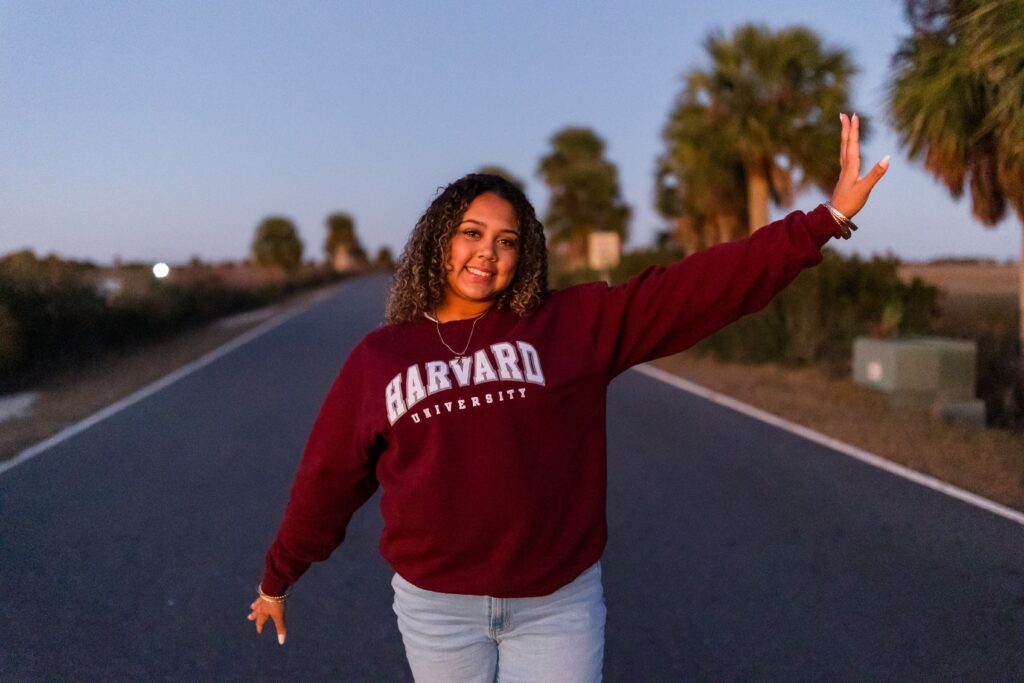
Then it’s off to Harvard University, where she plans to double-major in government and history and earn a degree from its prestigious law school. Along the way, Amanda will pitch for the Crimson softball team with designs on leading the program to its first appearance in the Women’s College World Series.
As that unfolds, Amanda is determined to play softball in the Olympics. She has attended tryouts for Team USA and is a member of the United States Virgin Islands national team.
Taken separately, any one of her goals is ambitious.
But combined?
“She has very, very high expectations,” said JPII Principal Luisa Zalzman. “She’s a go-getter, a high achiever. She has a drive that is very mature for her age.”
“She's done everything she's ever put her mind to,” said Amanda’s mother, Ashley Williard. “She said she wanted to be valedictorian, and I said, ‘OK, go be valedictorian.’ And she did it.”
Amanda is a bundle of energy and confidence. On the softball field, she has a running dialogue with everyone – teammates, opponents, coaches, umpires. In the classroom, she’s involved in every class discussion.
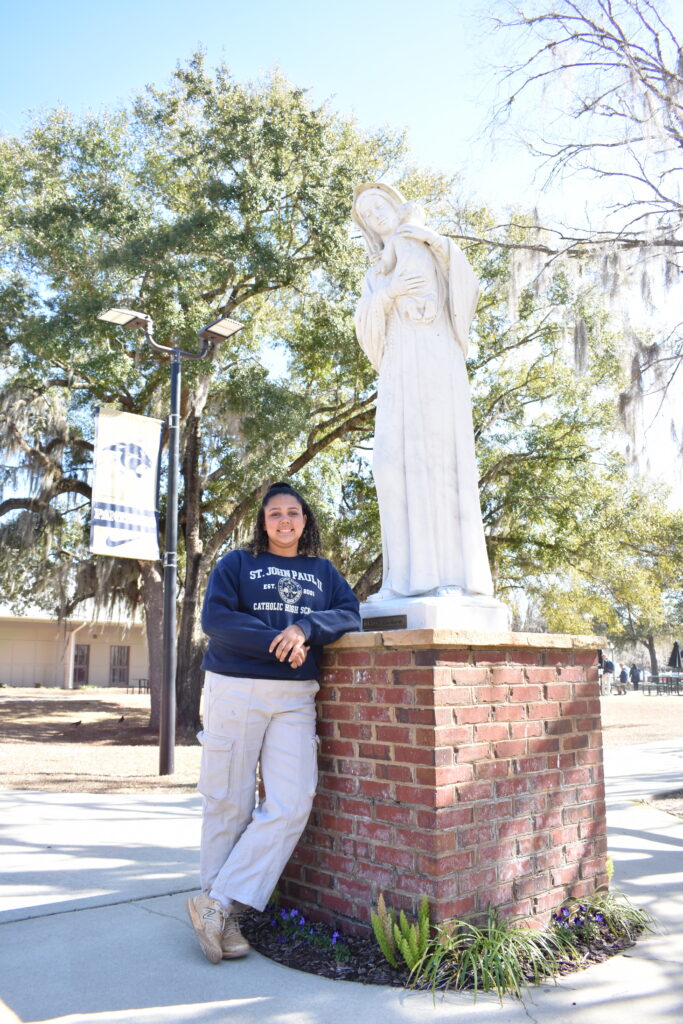
If you had approached her in August 2022 as she took the initial steps of her high school journey and told her she would graduate first in her class and be a member of Harvard Class of 2030, she would have been stunned.
“I would have said, ‘You got the wrong person.’ The difference between me then and me now is astronomical, and I think it’s because I attended this school,” she said. “It has to be.”
Amanda was a star as she rose through the ranks of the Tallahassee youth softball programs. Her parents, Ashley and James Thompson, envisioned their daughter earning an athletic scholarship to college. They were thinking of a high-end academic university like Duke or Notre Dame. That’s how Amanda, who attended her district schools until eighth grade, landed at JPII.
“We wanted a high school that was college-focused,” Ashley said. “Education is what we were looking for, and we could not have done it without Step Up For Students. No way could we afford to put her in that situation.”
There were “little things,” Amanda said, that shaped her academic future.
Her freshman English teacher encouraged her to write outside the margins during tests and essays.
“He said, ‘You don’t have to stay within this box. If you know more, write more on the paper.’ That stuck with me,” Amanda said.
Her freshman world history teacher announced to the class that Amanda scored the highest on the first test of the year.
“He congratulated me,” she said. “I thought that was insane.”
Midway through that semester, Amanda realized she had A’s in all her classes. That’s when she began to believe in herself as a student. Future valedictorian?
“Why not?” she said.
Amanda took AP World History as a sophomore and aced the AP test.
“That’s the class where I learned to learn,” she said.
Also, her love of history and government was born in that class, Amanda said. She can name all the countries of the world, tell you where they are located, and identify the flags.
“I’m working on my capitols,” she said. “It’s my hobby.”
Amanda took Spanish I and II in middle school and passed each, but not with grades that would stand out on a high school transcript. Sara Bayliss, JPII’s college advisor, suggested that Amanda retake those courses.
“She said the grades weren't good enough, that I could do better,” Amanda said.
Amanda retook both classes. She asked Principal Zalzman, a native of Venezuela, for tutoring help. The result was a pair of grades that fit proudly on the transcript Amanda sent to Duke. Duke was her dream school for education and softball.
And then Harvard called.
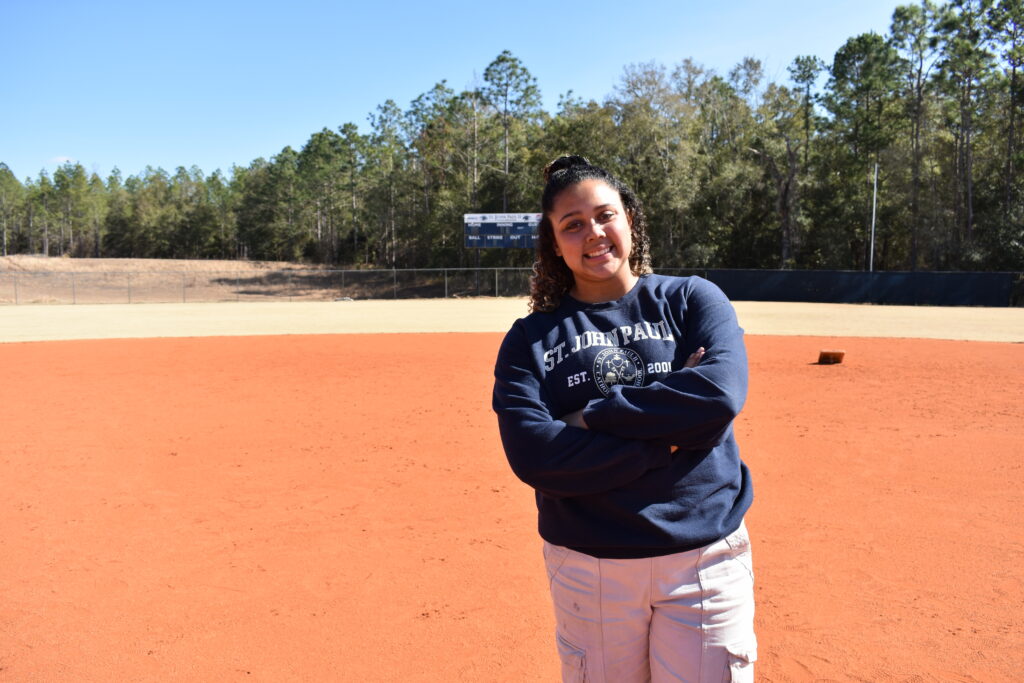
At midnight on Sept. 1 of her junior year – the first day college coaches can contact 11th graders – Amanda received a phone call from the Harvard softball coach.
“I didn’t even know they had a softball program,” Amanda said.
Intrigued, Amanda accepted a recruiting visit to the university located just outside of Boston. That trip marked the end of her Duke dreams.
“I want to make a difference in this world, and I think Harvard is the perfect school for me,” she said.
Terrence Brown, JPII’s softball coach, has watched Amanda emerge as an Ivy League student and a Division I softball player good enough to attend Team USA tryouts and earn a spot on the national team of a small territory with Olympic ambitions.
“She’s goal-oriented, and she doesn’t let anything get in the way of achieving those goals,” he said. “She’s worked very hard to get to where she’s going.”
Ashley and James are proud parents, but Ashley said they won’t take too much credit for Amanda’s success.
“We have nothing but pride,” Ashley said. “She is self-driven, self-motivated. We try to provide motivation. She’s missed proms and dances because of softball travel and schoolwork, and that was all her decision.
“There are a lot of sacrifices made to go along with this. She’s not afraid of hard work. She says she’s going to do something, and she goes out and does it.”
PALATKA, Fla. — All Risa Byrd wanted to do was start a little preschool. That’s it. But then the former public school teacher got swept up in one of the most epic education stories in American history. Now her fast-growing school is the latest example of what’s possible when school choice is the new normal.
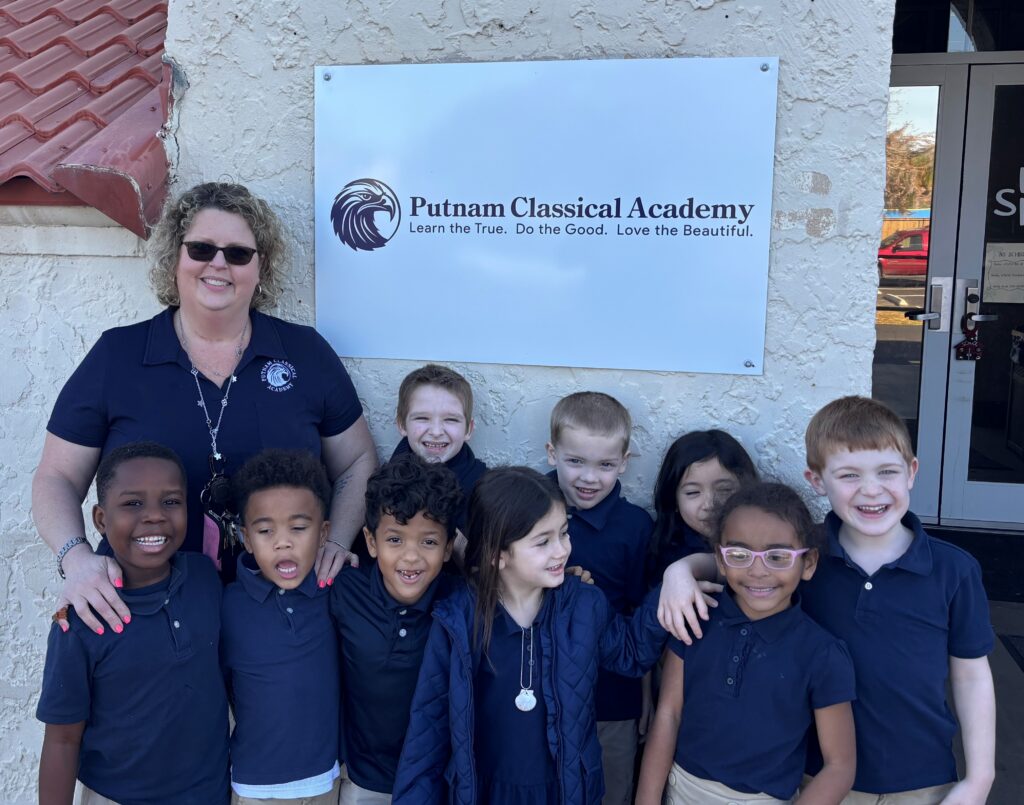
In 2022, Byrd retired from a 26-year teaching career to start Little Sprouts Learning Center. The goal was modest: Get her granddaughter’s academic journey off on the right foot.
A few months later, though, Florida lawmakers passed, and Gov. Ron DeSantis signed, one of the most sweeping school choice bills of any state, ever. Suddenly, every student in Florida was eligible for a state-supported choice scholarship.
Byrd didn’t realize it at first. But her school had caught a wave.
In the fall of 2023, Byrd added kindergarten and first grade, starting with eight students in those grades. She called the school for the higher grades Putnam Classical Academy.
By the fall of 2024, Putnam Classical had 50 students in grades K-5.
By the fall of 2025, it had 234 students in grades K-6, in addition to 60 in preschool.
Now Byrd’s looking for a whole other building to house a separate middle school. When she announced plans via Facebook, 111 students signed up in three days.
“Parents are desperate for their kids to be well educated,” Byrd said, particularly those from underserved communities. “They’ve been written off.”
Byrd is one of hundreds of former public school teachers who have leveraged Florida’s choice scholarships to create their own learning options. They can be found in every corner of the state, even in rural and semi-rural counties like Putnam, where a paper mill is the biggest private employer, the biggest town has 10,000 people, and the best-known landmark may be a blast-from-the-past diner.
The parents driving demand aren’t looking for anything exotic, Byrd said. They just want safe schools with top-quality academics, high expectations, and no drama.
“Parents got the word that we don’t play. That’s the biggest draw,” Byrd said. “They’re fed up. They know kids can’t learn, and teachers can’t teach, if there’s sheer chaos in the classroom.”
Byrd’s story may be a particularly dramatic example of what’s happening in Florida, and particularly symbolic.
More than half of Florida’s 3.4 million students are now enrolled in something other than their zoned neighborhood schools, and more than 1 million are enrolled outside of district schools entirely. Perhaps it’s fitting, then, that Putnam Classical leases a century-old building that once served as the local school district’s headquarters.
Despite the name, Putnam Classical isn’t truly classical yet. Byrd said she and her staff, which includes 20 teachers, will transition to a more recognizable “great books” curriculum within two years.
The first order of business is to establish a higher rate of basic literacy.
A self-described “data nerd,” Byrd is a “science of reading” adherent and a huge fan of Natalie Wexler, author of “The Knowledge Gap” and a leading proponent of using a content-rich curriculum to boost vocabulary and comprehension.
For the early grades, Putnam Classical uses an explicit, evidence-based phonics curriculum developed by the University of Florida. For the higher grades, it uses the highly regarded Core Knowledge curriculum for language arts, science, and social studies.
“If you teach these kids to read, you will change the trajectory of their lives,” Byrd said. “Then they can be an astronaut, a chef, anything they want to be.”
Byrd said as a public school teacher, she earned a reputation for working well with struggling readers, so more and more were sent her way. It became obvious, she said, that many students acted out because they couldn’t read well.
One time, she said, she stopped a 10th grader from disrupting her classroom, then took her out to the hallway to talk. The girl broke down and told her, in between sobs, “I’d rather everyone in that room think I’m a b---- than think I’m stupid.”
In three years, Byrd said she’s expelled two students. The school isn’t orderly because it’s draconian about discipline, she said. It’s orderly because kids are achieving academically and are proud of themselves. “When you learn to read,” Byrd said, “school becomes a lot more fun.”
About half of the students at Putnam Classical are Black or Hispanic; about 75% would be eligible for free- or reduced-price lunch in public school. The school does not charge tuition beyond the amount of the choice scholarship, which averages about $8,000 statewide and is far less than what districts spend.
Most of the students who switched to Putnam Classical were not reading at grade level when they arrived, Byrd said. Some incoming second graders didn’t know their letter sounds.
But now?
Now more than 60% are showing average or better growth compared to their peers nationwide, according to the STAR reading assessment Putnam Classical uses. In other words, students who were previously losing ground in their prior schools are now catching up and starting to get ahead.
Dalton Crews chose Putnam Classical for his 5-year-old, Delilah. He said he attended a private elementary school before moving on to public school and thought it built a good foundation for academics and character. He wanted the same for his daughter, and thankfully, he said, choice made it possible.
“I love the teachers. They communicate really well. They always tell me what’s going on,” said Crews, who installs fire sprinklers for a living. “They tear up when the kids leave. That’s love. They’re good people.”
Shentae Roberts said her 10-year-old granddaughter, Ja’Zyiah, was receiving good grades in her prior school, even though it was obvious to her family that she was struggling with basic material.
Her daughter tried contacting the school to get more information, she said, but never got a response. That’s why, in 2024, her daughter switched Ja’Zyiah and younger brother, Hakiem, to Putnam Classical.
“Best thing she did,” Roberts said.
Roberts said her granddaughter initially struggled at Putnam Classical, too. But the teachers gave her the attention and instruction she needed, she said.
The result: Ja’Zyiah “came back 10 times stronger,” Roberts said. “All the staff get to know the children, and they’re responding to them. They’re pulling the children to the next level.”
Byrd said more good things are ahead, not just for her school.
Even though Florida has been a national leader in private school choice for a quarter century, Byrd said she didn’t know much about it until HB 1, the landmark legislation Gov. DeSantis signed in 2023. Now, though, she realizes the game-changing potential not just for families but for teachers.
“Every public school teacher says, ‘If I were the boss, I would do it this way,’ “ Byrd said.
Well, now’s their chance.
By Lauren May and Ron Matus
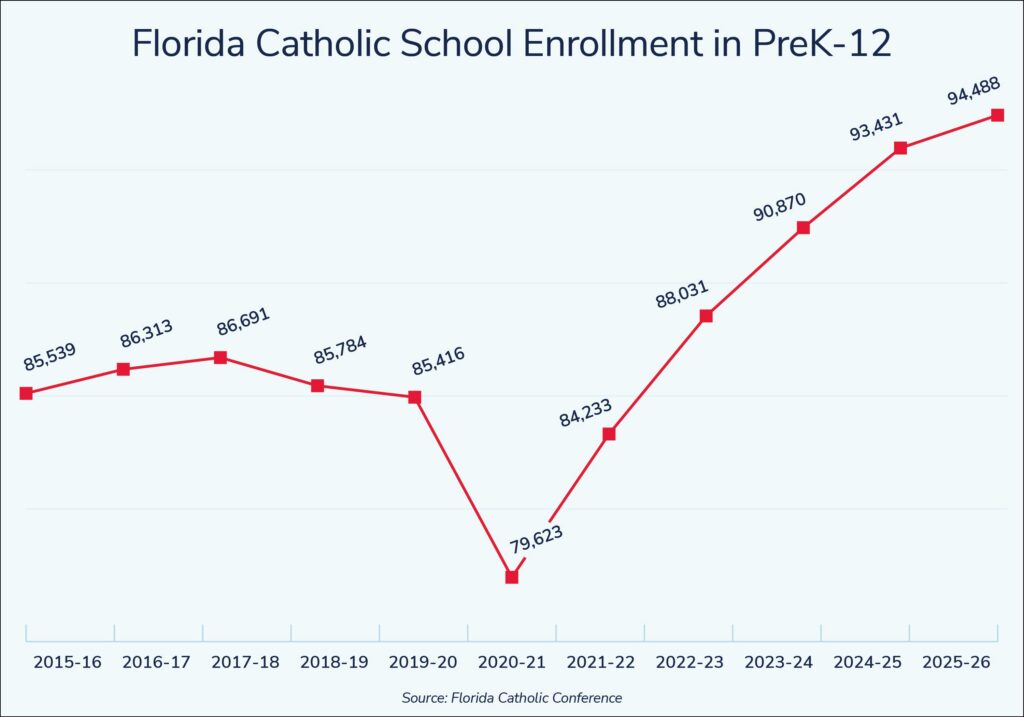
Catholic school enrollment in Florida is up again this year, rising 1.1% to 94,488 students, according to the latest numbers from the Florida Catholic Conference.
The continued growth is likely to bolster Florida’s reputation as the national standout in Catholic schooling. Through last year, Florida Catholic school enrollment was up 12.1% over the past decade. Nationally, it was down 13.2%.
To spotlight the trend lines, we published a special report in 2023, “Why Catholic Schools in Florida Are Growing: 5 Things to Know,” followed by update briefs in 2024 and 2025.
In that spirit, here are five things to know about the 2025-26 numbers:
The trend continues. This year marks five years of consecutive growth. Since 2020-21, when enrollment dipped in the wake of the pandemic, Catholic school enrollment in Florida is up 18.7%.
Special needs surge. Students with special needs are a leading factor. This year, Catholic schools in Florida are serving 13,482 students who use the state’s Family Empowerment Scholarship for Students with Unique Abilities. That’s up 19% from last year and triple the number from five years ago. FESUA students now encompass one in seven of all Catholic school students in Florida.
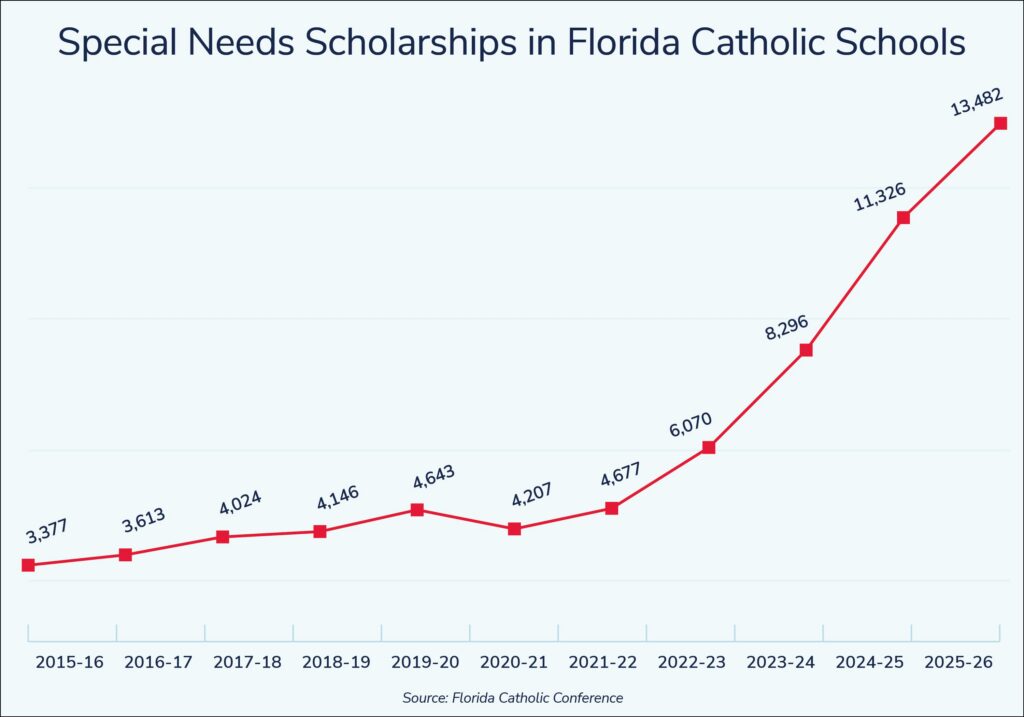
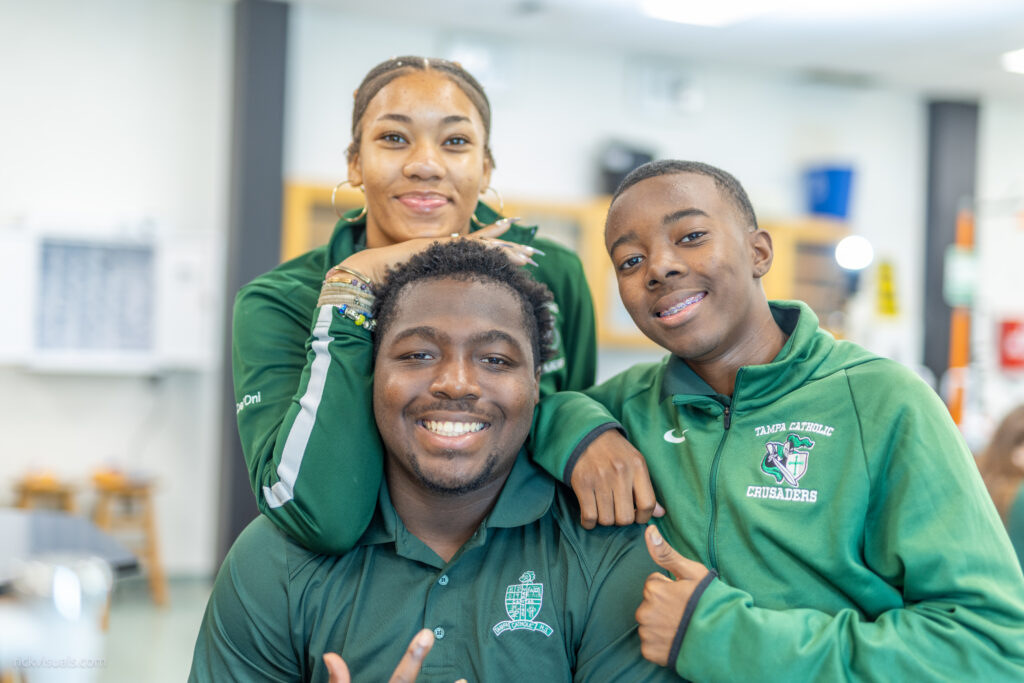
Non-Catholic students. Catholic schools have a long history of serving a diverse array of students. This year, 20% of students in Florida Catholic schools are non-Catholic, up from 14% a decade ago.
Choice scholarships are critical. In 2022-23, the year before choice in Florida became “universal,” 47.2% of all Catholic school students in Florida used choice scholarships. This year, 92.1% use them.
Context for the trend line. This year’s enrollment increase is smaller than any of the past five years. Time will tell whether that’s an anomaly. But it’s worth noting that except for a la carte learning, K-12 enrollment in Florida is slowing all over:
It’s likely that demographic shifts, including falling birth rates and declining immigration, are significant factors here. With private schools, it’s also possible that barriers such as zoning and building codes are preventing supply from better meeting demand. Last year, a Step Up For Students survey of parents who were awarded choice scholarships but didn’t use them found one in three said there were no seats available at the schools they wanted.
One final note: This post, not to mention our reports on Catholic education in Florida, wouldn’t be possible without the Florida Catholic Conference. FCC Director of Accreditation Mary Camp has been carefully tracking the enrollment and scholarship data for years. We are grateful to partner with the FCC and particularly indebted to Mary.
About the authors
Lauren May is Vice President and Head of the Federal Scholarship Tax Credit Program at Step Up for Students and a former Senior Director of Advocacy at Step Up For Students. As a proud graduate
of the University of Florida, she received her bachelor’s degree in special education
and her master's degree in early childhood education. She then completed another
master's degree in educational leadership from Saint Leo University. A former
Catholic school teacher, early childhood director, and principal, she was honored with
University of Florida’s “Outstanding Young Alumni” award in 2018. As a believer
that parents are the first and best educators of their children, Lauren loves working
with families across the state and beyond to ensure they can find and make
use of the best educational options for their children.
Ron Matus is Director, Research & Special Projects, at Step Up For Students. He
joined Step Up in 2012 after more than 20 years as an award-winning journalist,
including eight years as the state education reporter for the Tampa Bay Times, the
state’s biggest and most influential newspaper.
Updated Feb. 27, 2026
Record breaking interest continues with more than 400,000 students who have applied for Florida’s K-12 education choice scholarships for the 2026-27 school year.
Step Up For Students, the nonprofit organization that administers 98% of the state’s scholarships, opened applications for the 2026-27 school year on Feb. 1. A record 200,000 applied during the first three days.
By mid-day Feb. 10, a total of 300,106 students had applied for scholarships, which represents an 11.7% increase over the same 10-day period last year. By Friday morning, Feb. 27, a total of 401,507 students had applied.
Step Up For Students CEO Gretchen Schoenhaar said last week that the organization’s team and systems were ready for the surge of interest. Step Up’s technology systems processed 15% more applications on the first day this year than at the same time last year. Of the families who called for assistance, more than 90% reported being “satisfied” or “very satisfied” with the support they received.
“Another record number of applications on our opening weekend shows that Florida families increasingly value options in their children’s education,” Schoenhaar said. “Step Up For Students smoothly processed the higher demand and is prepared to support families every step of the way.”
During the 25-26 school year, more than 525,000 students have been funded on Florida’s K-12 scholarship programs to access learning options of their choice. If these students were counted as a single school district, it would be the largest in the state and third largest in the country. That makes Florida the national leader in education options.
However, not all students whose families apply end up being awarded or funded.
Step Up is focused on supporting growth. By the end of the year, Step Up expects to process 3 million reimbursements and a total of 3 million MyScholarShop e-commerce transactions.
Current scholarship families have until April 30 to renew their scholarships for the next school year. All families who want a PEP scholarship must also apply by April 30.
Private School and Unique Abilities Scholarship applications will be available through Nov. 15 for families who want a new scholarship.
Applications and more details are available here.
We will continue to update the numbers in this post until applications close.
A Tampa Bay area morning TV show kicked off National School Choice Week by highlighting a family who benefits from a state K-12 scholarship.

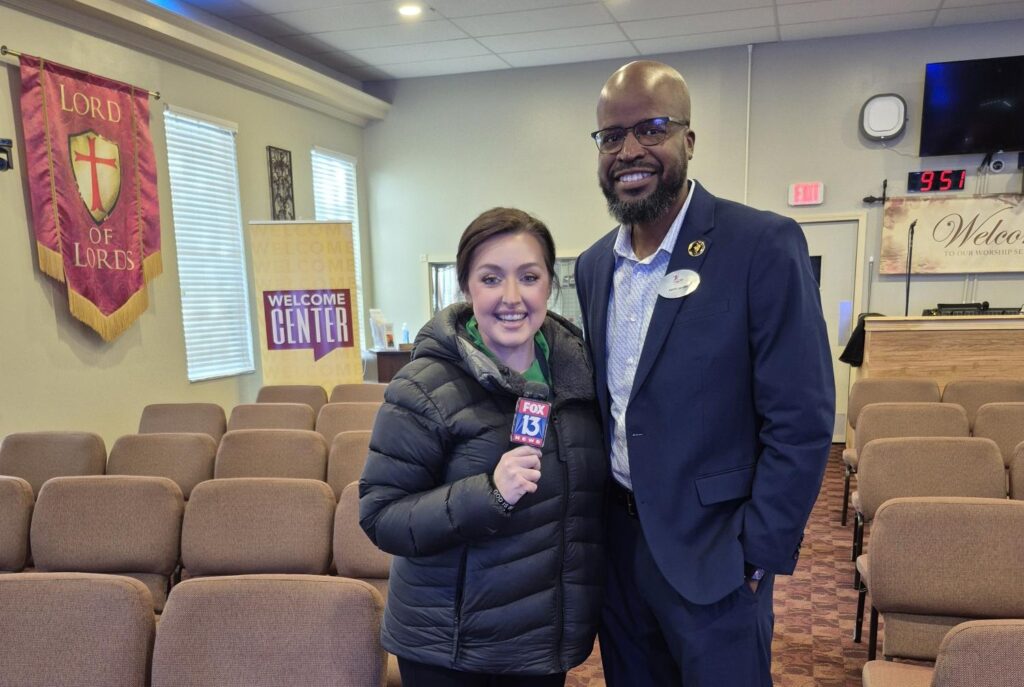
Arielle Frett appeared on Fox 13’s “Good Day Tampa Bay” program on Monday with her son, AnyJah, a ninth grader at The Way Christian Academy in Tampa. She said she moved to Florida from St. Thomas, Virgin Islands, in 2017 to find better educational opportunities for AnyJah, who has severe autism.
“No teachers were able to work with him on his level,” Frett told Fox 13 reporter Heather Healy. “Most of his learning in English and math are on fifth and sixth grade levels now.”
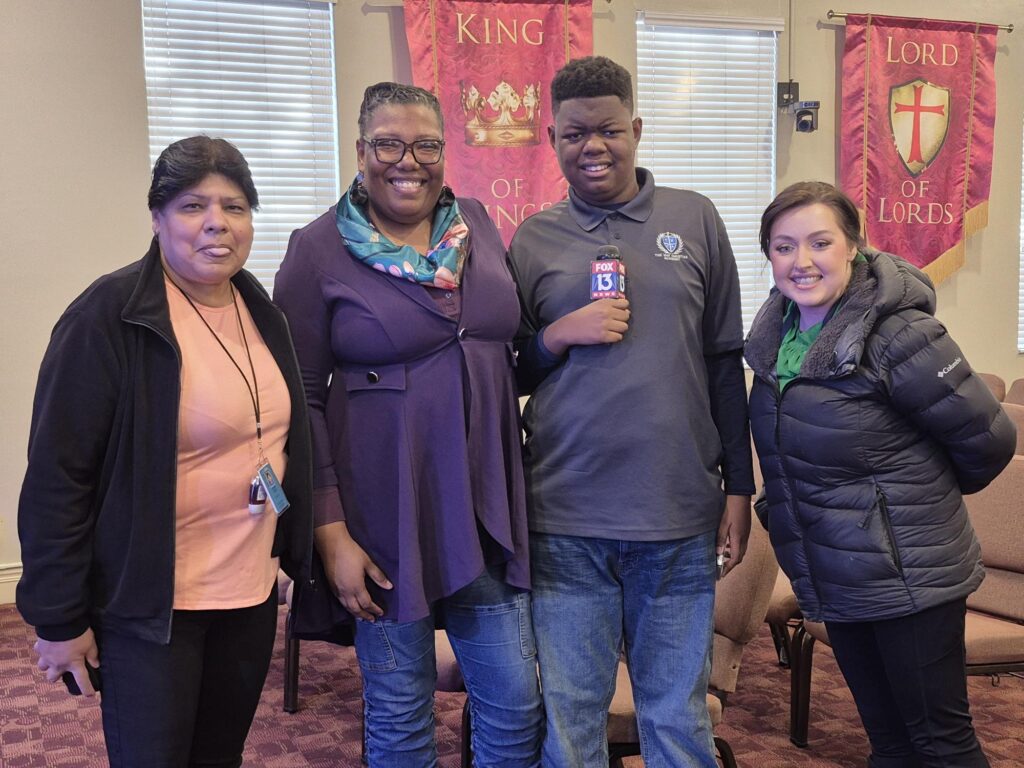
A U.S. military veteran and single mother of two, Frett said she would not have been able to afford a private school for her son without the scholarship.
She said AnyJah, who receives the Family Empowerment Scholarship for students with Unique Abilities, is “loved, protected, and thriving” at his school, where class sizes of 10 to 12 students allow for more individual attention. He can also receive his therapies during school.
The segment also featured information about Florida’s robust education choice options. Those include traditional public schools, district magnet schools, charter schools, private schools, microschools, homeschools, virtual schools, and customized education programs that allow parents to mix and match.
“We’ve gone from education and funding through the system to now empowering families by putting the money in their hands and allowing them to make the most appropriate educational decisions for families,” said Keith Jacobs, director of provider development at Step Up For Students, which administers most of the state’s education choice scholarships.
Jacobs has spent the past year working with school districts to provide individual courses to scholarship families whose students do not attend public or private school full time, paid for with scholarship funds. About 70% of Florida school districts are participating.
The scholarship application season for the 2026-27 school year begins Feb. 1. Visit Step Up For Students to learn more and apply.
JACKSONVILLE, Fla. – Four years ago, Phil and Cathy Watson were distressed and desperate. Their daughter Mikayla, then 12, was born with a rare genetic condition that led to physical and cognitive delays. With her school situation getting worse by the day, they needed options, now.
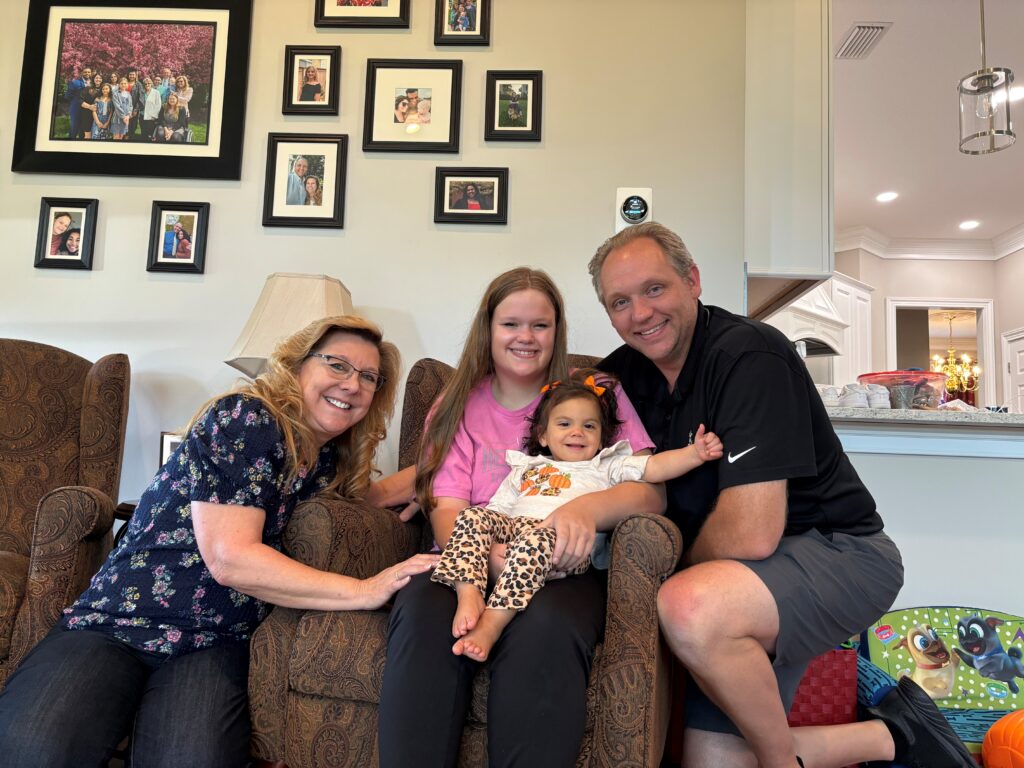
The Watsons were open to private schools. But they couldn’t find a single one near their home in metro D.C. that met Mikayla’s needs. They even looked in neighboring states. Nothing.
One day, though, Phil varied his keyword search slightly, and something new popped up:
A school for students with special needs that had low student-to-staff ratios, transition programs to help students live independently, even an equine therapy program.
The Watsons feared it was too good to be true. Even if it wasn’t, it was 700 miles away.
A destination for education
Florida has always been a magnet for transplants. It’s tough to beat sunshine, low taxes, and hundreds of miles of beach. But as Florida has cemented its reputation as the national leader in school choice, the ability to have exactly the school you want for your kids is making Florida a destination, too.
In South Florida, Jewish families are flocking from states like New York to a Jewish schools sector that has nearly doubled in 15 years. But they’re not alone. Families of students with special needs are making a beeline for specialized schools, too. The one the Watsons stumbled on has 24 students whose families moved from other states – about 10% of total enrollment.
The common denominator is the most diverse and dynamic private school sector in America, energized by 500,000 students using education choice scholarships.
According to the most recent federal data, the number of private schools in Maryland shrank by 7% between 2011-12 and 2021-22. In Florida, it grew by 40%.
“What Florida is offering is just mind blowing compared to Maryland,” Phil said. “If a story like this ran on the national news, people would be beating the door down.”
‘The kid who never spoke’
Phil and Cathy Watson have six children, all adopted. They range in age from 1 to 39. All have special challenges.
“God picked out the six kids we have,” said Cathy, who, like Phil, is the child of a pastor. “We feel very strongly that we were called to do what we do. Our heart says we have love to give and knowledge to share. These kids need that, so it’s a match.”
Mikayla is their fourth child. She was born with hereditary spastic paraplegia, a condition that causes progressive damage to the nervous system.
She didn’t begin walking until she was 18 months old. Even then, her gait continued to be heavy-footed, and she was prone to falling. Her speech was also, in Phil’s description, “mushy,” and until she was 12, she didn’t talk much.
In many ways, Mikayla is a typical teen. She loves steak and sushi and Fuego Takis. Her favorite books are “The Baby-Sitters Club” series, and her favorite movies include “Beauty and the Beast” and “Beverly Hills Chihuahua.” Many of her former classmates, though, probably had no idea.
In school, Mikayla was “the kid who never spoke.”
Checking a box
As Mikayla got older, she and her parents grew increasingly frustrated with what was happening in the classroom. “She was being pushed aside,” Phil said.
Teachers would tell her to read in a corner. Between the physical pain from her condition and the emotional turmoil of being isolated, she was crushed. Sometimes, Phil said, she’d come home and “unleash this fury on my wife and I.”
The pandemic made things worse. In sixth grade, Mikayla was online with 65 other students. Then, three days before the start of seventh grade, the district said it no longer had the resources to support her with extra staff. Instead, she could be mainstreamed without the supports; enroll in a private school; or do a “hospital homebound” program.
The Watsons chose the latter. Three days a week, a district employee sat with Mikayla, going over worksheets that Phil said were “way over her head.”
“All it was,” he said, “was checking a box.”
Just in the nick of time, the school search turned up a hit.
Florida, the land of sunshine and learning options
What surfaced was the North Florida School of Special Education.
“From just the pictures, I’m thinking, ‘This looks legit,’ “ Phil said. “Both of us are like, ‘Wow.’ “
When the Watsons called NFSSE, as it’s called for short, an administrator answered every question in detail. This was not the experience they had with some of the other private schools they called.
At the time, Phil owned a home building company, and Cathy worked for a counseling ministry. They lived comfortably. But they were also paying tuition for another daughter in college.
Thankfully, the administrator told them Florida had school choice scholarships. For students with special needs, they provided $10,000 or more a year.
The Watsons couldn’t believe it. They were familiar with the concept of school choice but didn’t know the details. Maryland does not have a comparable program.
The administrator also told them NFSSE had a wait list. But the Watsons had heard enough.
A fortuitous phone call
A few weeks later, they were touring the school.
The facilities were stellar. Even better, the administrator leading their tour knew the name of every student they passed in the hallways. “We were blown away,” Phil said. “They truly care. “
At some point, the staff ushered Mikayla into a classroom. As her parents watched from behind one-way glass, another student greeted Mikayla with a flower made of LEGO bricks.
For years, Mikayla had been withdrawn around other students. Not here. The shift was immediate. She and the other students were using tablets to play an interactive academic game, and “you could see her turn and laugh with the kids next to her,” Phil said.
Minutes later, he and Cathy were in the administrator’s office, “bawling our eyes out.”
“We said, ‘We’re all in. We have to be here. We’ll be here next week if that’s what we have to do.’”
Days later, the Watsons were at Disney World when NFSSE called. Unexpectedly, the family of a longtime student was moving. The school had an opening.
New friends, improved skills and boosted confidence
Even without the choice scholarship, the Watsons would have moved. At the same time, the scholarship was invaluable. The cost was not sustainable in the long run, Phil said, especially because he had to re-start his business.
The Watsons rented a long-term Airbnb and then an apartment before buying a house in Jacksonville. They uprooted themselves completely from Maryland, including selling their dream home.
“That was hard,” Cathy said. “You’re leaving everything you love.”
Mikayla’s turnaround, though, has made it all worthwhile.
Mikayla was reading at a first-grade level when she arrived at NFSSE; now she’s at a seventh-grade level. She loves the new graphic design class. She won an award for completing 1,000 math problems. “When she got here, she couldn’t add two plus two,” Phil said.
Her verbal skills have blossomed. She eventually told her parents something she didn’t have the ability to tell them before: In her prior school, she didn’t talk because other students laughed at her.
At NFSSE, the “kid who never spoke” speaks quite a bit.
One day, she served as “teacher for the day” in her personal economics class, delivering a lesson on how to make change.
Mikayla is kind and quick to smile. She is surrounded by friends and admirers. “Mikayla is my best friend,” said a chatty girl with pigtails who waited by her side in the hallway.

One boy held the door for Mikayla as she headed to her next class. A second hung her backpack on the back of her wheelchair. A third walked her to P.E.
Mikayla’s confidence is growing outside of school, too.
In the past, she wouldn’t say hi or order in a restaurant. But at Walmart the other day, Phil needed a card for a friend’s retirement, so Mikayla went to find a clerk. She came back and told him, “Aisle 9.”
Mikayla has a bank account and a debit card. She tracks the money she earns from chores. She routinely uses the notes app on her phone to mitigate challenges with short-term memory.
NFSSE, Cathy said, is constantly reinforcing skills and strategies to foster independence. It “pushes for potential,” just like the families do.
Mikayla “sees that potential now; she’s excited now,” she said.
Before NFSSE, the Watsons didn’t think Mikayla could live independently. Now they do.
The school and the scholarship, Phil said, have “given Mikayla an opportunity for her life that we didn’t know existed.”
He credited the state of Florida, too, for creating an education system where more schools like NFSSE can thrive.
If only every state did that.
The story: After two court victories in the 1990s, Wisconsin, the national birthplace of modern-era school choice, now faces a court challenge that, if successful, could send more than 60,000 students back to the state’s district schools.
This time, a brewery owner, former congressional candidate and super PAC founder is funding a case that argues the state’s four scholarship programs and independent charter schools, which are authorized by organizations other than school districts, are a “cancer” with a funding method that has put school districts into “a death spiral.” The case, brought on behalf of eight Wisconsin residents, is going straight to the state Supreme Court.
School choice supporters say the lawsuit is an attempt to capitalize on this year’s Wisconsin Supreme Court election, which gave liberals a 4-3 majority for the first time in 15 years. The high court has not announced whether it will hear the case.
Flashback: In 1990, Wisconsin launched the nation’s first K-12 school choice program, empowering low-income parents to remove their children from failing Milwaukee schools and enroll them in the city’s private schools. The scholarship allowed up to 1,000 students to attend a non-sectarian private school of their families’ choice.
The ink on the bill was barely dry before it ended up in a legal challenge that made it to the Wisconsin Supreme Court. Opponents argued that the legislation was a special interest program and that lawmakers approved it improperly. An appeals court struck down the program, but state supreme court upheld it in a 4-3 ruling, saying in the majority opinion that the program’s limited scope “is not an abandonment of the public school system.”
The programs survived a second court challenge in 1998 when the state supreme court ruled that the state’s expansion to let religious schools participate did not violate the federal Establishment Clause. The U.S. Supreme Court declined to hear the appeal.
State of play: Today, four school choice programs serve Wisconsin families, including three for lower-income families and one for students with special needs. The state also Wisconsin Institute for Law & Liberty (WILL), a public interest law firm, recently filed a brief outlining why it thinks the court should decline the request to consider the case. The state also offers independent charter schools as another option.
The organization has also filed a motion to represent 22 families as intervenors if the high court agrees to hear the case. WILL attorney Cory Brewer sat down with NextSteps to share some details. Responses have been edited for clarity and brevity.
Q. The state supreme court has already upheld Wisconsin’s school choice programs twice in the 1990s. Why is this happening now?
A. We think this petition is politically motivated based on the recent shift in the makeup of the court. A primary backer of the case is Kirk Bangstad, who owns the Minocqua Brewing Company and runs the Minocqua Brewing Super PAC. The Super PAC has a history of supporting liberal candidates and has been telegraphing aspects of this case for weeks on Facebook. The state’s educational establishment is lining up to attack choice and charter schools with this case. The state teachers union has expressed support for the case. One of the petitioners is Julie Underwood, the former dean of the School of Education at the University of Wisconsin—Madison.
Q. So, what is the new argument the petitioners are making about the programs’ constitutionality?
A. The lawsuit brings three claims as to why each of those four programs is illegal. Those claims are:
The fourth claim they raise in the lawsuit challenges “revenue limits” which impose a cap on how much money each school district is allowed to generate per pupil from all sources (this is a way to control property tax expenses, and revenue limits have been in place since the 1990s).
Q. What allows the petitioners to take this directly to the state Supreme and bypass lower courts?
A. The Wisconsin Constitution provides the Wisconsin Supreme Court with so-called original jurisdiction. This gives the court the power to hear cases that have not first been heard by the lower courts. Sometimes, a quick and definitive answer to a legal question serves the public interest. The court has historically been fairly sparse on original actions over the years, and cases requiring complex and intensive factual development are not appropriate for original action. Normally, when deciding whether to accept a case as an original action, the court errs on the side of caution.
Q. Does the Supreme Court usually agree to hear direct petitions?
A. A Marquette professor studied this issue a few years ago. According to him, from the 2003-04 term through the 2020-21 term, there were 103 original action petitions denied and 15 granted, seven of which were in the 2019-20 term. Each year, the court hears about 50 to 60 cases total, so original actions do not constitute a significant part of its workload.
Q. How are the public schools actually doing in Wisconsin? The plaintiffs say in their petition that the scholarship programs have put school districts in a “death spiral” and say that for every scholarship student funded, the district lose the equivalent of funding for five students. What is your response?
A. We don’t believe petitioners’ claims are rational or factually accurate. Public schools continue to receive additional funding every year, and frankly school choice is very popular with the voters of Wisconsin. Also, school districts in Wisconsin are funded through a combination of state and local aid, and the local aid means that public schools get substantially more than the voucher in most every case. Inflation-adjusted spending is far higher today than when school choice began in 1990.
Q. If these petitioners prevail and the programs are shut down, what would that mean for school choice families in Wisconsin? Also, how would it impact district schools that must absorb many of these students?
A. The stakes could not be higher. Over 60,000 students could see their education options go away if the relief sought by the petitioners were to be granted. We believe this would have a massive negative impact, including on public schools. Not only do public schools benefit from the competition, but we do not believe they have the capacity to absorb all the displaced students. As for practical implications, school choice enrollment (Milwaukee Parental Choice Program, Racine Parental Choice Program, Wisconsin Parental Choice Program and the Special Needs Scholarship Program) is 54,949 for the 2023-24 school year. Independent charters enroll another 10,802 students. Demographically, school choice is disproportionately used by students from minority backgrounds. According to data from the state report card, approximately 32% of participating students are African American, 28% are Hispanic, 32% are white, and the remainder are something else.
Perun, the rock star of Australian defense economists doing awesome hour-plus hour PowerPoint presentations on YouTube, recently did two such presentations on “game-changing” weapon systems in the ongoing Ukraine-Russian war. Perun observed:
It seems like every time a new weapon system, be it Russian or Western, is sent to Ukraine, there are always going to be at least some voices in the media that amp this thing up as the next great game-changer, the system that will finally change the dynamics of this long and bloody war. For some systems the hype dies out, whereas for others it builds and builds until eventually the system arrives in Ukraine, and reality and expectations finally collide.
Some get to Ukraine and turn out to be utter disappointments. Others turn out to be solid, useful performers that do the job they were intended to do, but don’t exactly quickly or efficiently move the needle. And others swing in like a damn wrecking ball and on their first day of operations wreck two Russian airfields and deal the Russian aerospace forces their worst single day defeat since they were the Soviet Air Forces during the Second World War.
Inspired by the great Perun, we will here rank policy interventions designed to increase family options in K-12:
Magnet Schools: Introduced in the 1970s in the hopes of reducing racial segregation in public schools. Below is a placement of every magnet school in the nation with data included in the Stanford Educational Opportunity Project on Grades 3-8 academic growth:
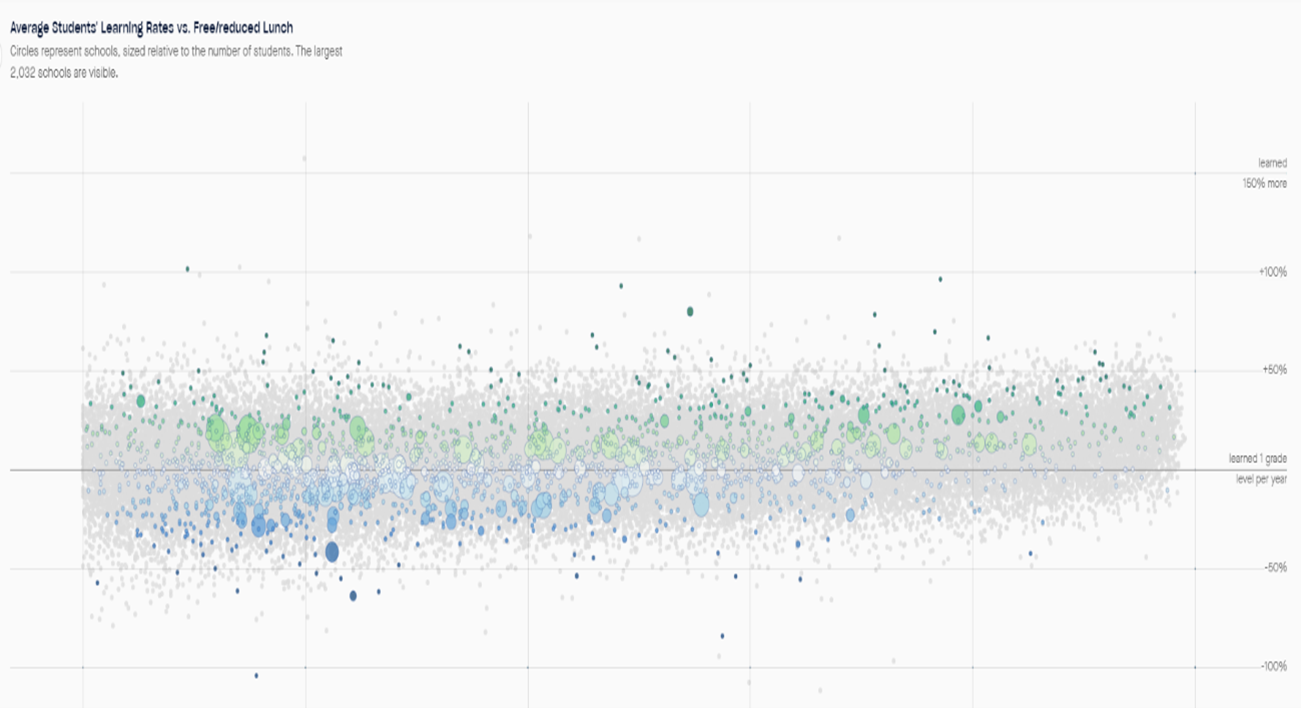
That’s a lot of schools, but their average rate of academic growth is approximately equal to the nation as a whole (half above and half below the “learned one grade level in one year” line. There are many fantastic magnet schools, but the system suffers from a fatal flaw: the schools are ultimately under the control of elected school boards. Many magnet schools have waitlists of students, but districts, for the most part, do not replicate or scale high-demand schools. Unless someone can demonstrate otherwise, let’s assume that Political Science 101 is controlling here and the people working in other district schools don’t want to scale high-demand magnet schools for the same reason they dislike other forms of choice: they view it as a threat. RANKING: TAME HOUSE PET
Charter Schools Introduced in the early 1990s by Minnesota lawmakers, charter schools eventually overtook magnet schools in numbers of schools, as you can see in the same chart as above for charters nationally:
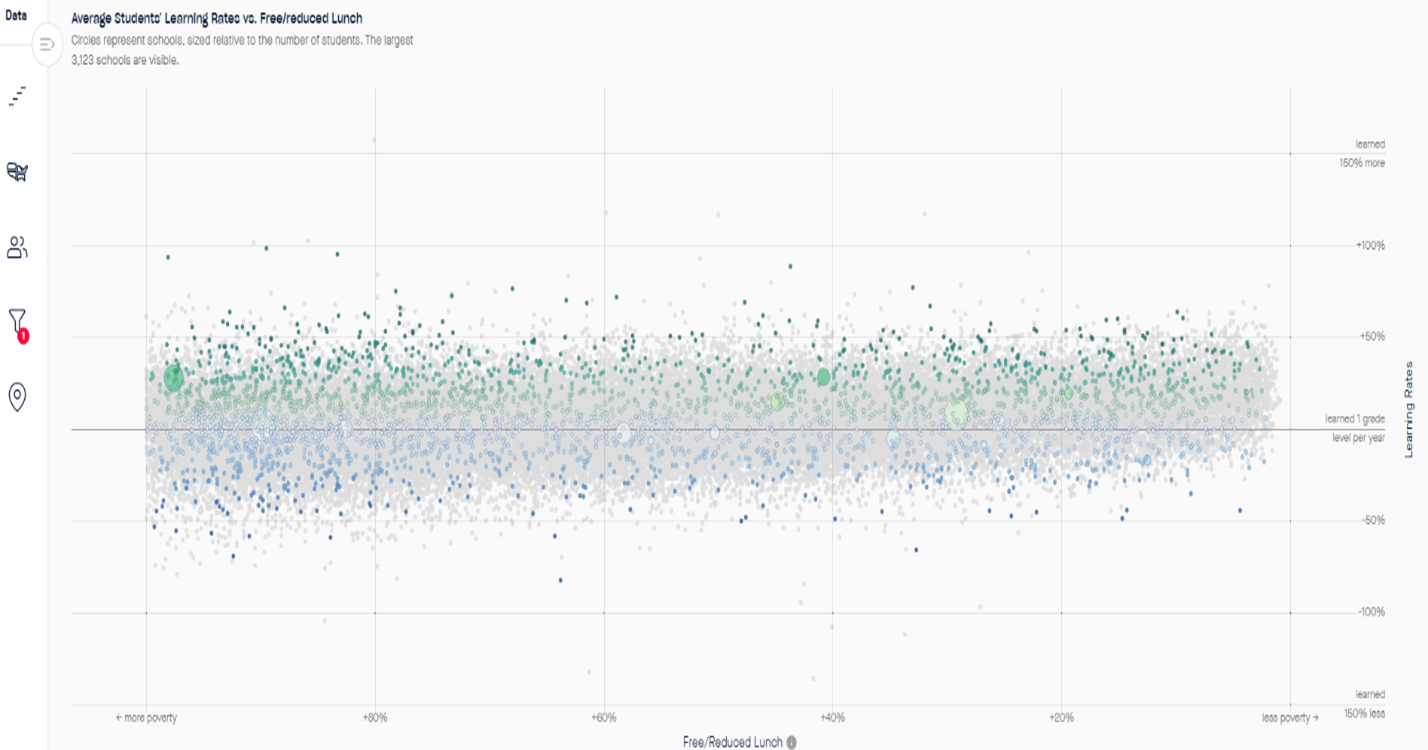
Charters were the leading form of choice for years after their debut, but more recently, it has become sadly clear that they suffer from a problem not terribly dissimilar from magnet schools: a political veto on their opening. Sometimes this veto is delivered by the same districts that fail to replicate high-demand magnet schools, in other instances, it happens because of Baptist and Bootlegger coalitions controlling state charter boards. What the Baptist and Bootleggers started, higher interest rates, building supply chain issues and the death of bipartisan education reform seems to have finished. RANKING: Varies by state but mostly TAME HOUSE PET
District Open Enrollment: Potentially an immensely powerful form of choice, but one which only realizes that potential if other forms of choice create the necessary incentives to get districts to participate. In most places, it looks far too much like this:
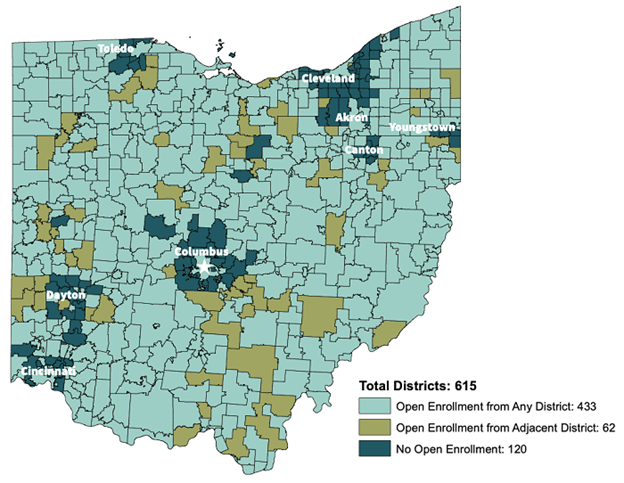
See any fancy suburbs willing to take urban kids in this map? Me neither. RANKING: Varies by state but mostly TAME HOUSE PET, could grow to become much, much more
School Vouchers/Scholarship Tax Credit: The modern private choice movement debuted in Wisconsin in 1990, the year before the first charter school law passed in 1991. Voucher adoption proceeded more slowly than charter school laws, and one of the accomplishments of the voucher movement may indeed have been to make charter schools seem safe by comparison. Scholarship tax credits, first passed in Arizona in 1997, expanded around the country more quickly than vouchers. While lawmakers passed several voucher and scholarship tax credit programs, few of them were sufficiently robust to perform critical tasks such as spurring increased private school supply, which requires either formula funding or regular increases in tax credit funding.
Scholars performed a tremendous amount of research on voucher and tax credit programs, and those programs led directly to the creation of education savings accounts (discussed next). Overall, however, these programs did not in and of themselves move the needle, although at times, the deployment of strong private and charter school programs did move the needle. RANKING: Vital Intermediate Step

Education Savings Accounts: First passed by Arizona lawmakers in 2011 and going universal only in Arizona and West Virginia in 2022, ESA programs remain a work in progress. The flexibility of accounts contains the prospect of a less supply-constrained form of choice, less dependent upon the creation of one-stop shopping bundles known as “schools.” The largest first-year private choice programs have all been recently passed ESA programs, which seems promising. ESAs, however, have yet to become a teenager, and the technologies necessary to administer them at scale remain an evolving work in progress. RANKING: Promising but To Be Determined
Barely Off the DRAWING BOARD PLATFORM
Personal Use Refundable Tax Credits: Older but tiny programs exist that deliver small amounts of money and accomplish little. Oklahoma passed a more robust program of this type last year, but it remains far too early to draw any conclusions. RANKING: Totally TBD
Homeschooling:
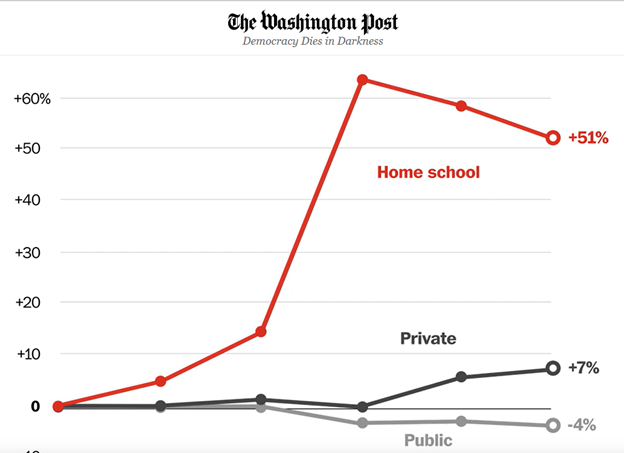
The homeschool movement has grown quickly is sufficiently organized to make lawmakers think long and hard before starting a quarrel with its supporters and has become more accessible with the advent of homeschool co-ops, which provides a measure of custodial care. RANKING: Wrecked two Russian airfields on the first day of deployment, unclear how high the ceiling will reach.
Conclusion: You should be seeking a combined arms operation in your state rather than a panacea-like super-weapon system that will deliver instant victory. You will know you are winning when your fancy, suburban districts start taking open-enrollment students. You will never achieve this with means-tested or geographically restricted private or charter school programs.
Legislation: Universal school choice is a top priority of House Speaker Paul Renner and Rep. Ralph Mussullo, chair of the House Education and Employment Committee, supports multiple education bills, including changing high school start time to no earlier than 8 a.m. The 2023 legislative session begins this week. Florida Politics. Sen. Bryan Aliva is backing several new bills this legislative session, including one that would revamp the teacher recertification requirements and cut down the time it takes teachers to complete the process. Florida Politics. A series of proposed laws would transform the state's public K-12 education system. Critics say the state has too much control over the classrooms. Tampa Bay Times. Politico. Washington Post.
Opinions: Paula Montgomery of the League of Women Voters of the Pensacola Bay Area opposes charter schools and school vouchers, claiming that charter schools are not required to employ certified teachers, that private schools accepting vouchers are not required to test students and that public schools must accept everyone. However: Charters schools are required to employ certified teachers unless the school is approved under the "Schools of Hope" law that passed in 2017. Private schools have been reporting scholarship student test scores to state researchers since 2007-08. Finally, public schools can exclude students from attendance through zoning and deny students due to lack of accommodations for children with special needs. Pensacola Daily News Journal. Could chatbots be part of the future of education? Anne Trumbore, the Chief Digital Learning Officer at the Sands Institute for Lifelong Learning at the University of Virginia believes that chatbots could be effective and affordable private tutors. The 74. Teacher pay could be higher, says Chester E Finn, Jr. but the teacher unions and parents want smaller classrooms instead. Education Next. Parental backgrounds can have major impacts on their children's educational trajectory. For example, children living in a one-parent household are significantly more likely to be suspended from school or required to repeat a grade. Anna J. Egalite, a professor at North Carolina State University, offers some policy prescriptions to help students overcome these disadvantages. Education Next.
Book bans: Collier and Lee County public schools have banned or restricted 42 books. Naples Daily News published a list of these books. Flager County public schools will hold a hearing today over the request to ban or restrict Patricia McCormick's book "Sold." Flagler Live. Students in Pinellas County Public Schools are pushing back against efforts to ban books in school libraries. WUSF. Alachua County Public Schools says it has catalogued books in the libraries for years and has already established a process for parents to express concerns about books. Gainesville Sun.
Elections: Florida Republicans are looking to oust several school board members in 2023. WPTV.
Sarasota: The Sarasota County School District removed Duane Oakes, the chief of the district's police department from his role late Friday afternoon. No reason for the abrupt departure was given. Herald-Tribune.
Palm Beach: A Lake Worth High School AP math teacher was removed from the classroom after posting pictures of three students and comparing their skin color to shades of coffee. Palm Beach Post.
Polk County: A Lakeland mom wants Spessard L. Holland Elementary School renamed. She says the school is named after a man who supported racial segregation in schools. Bay News 9.

