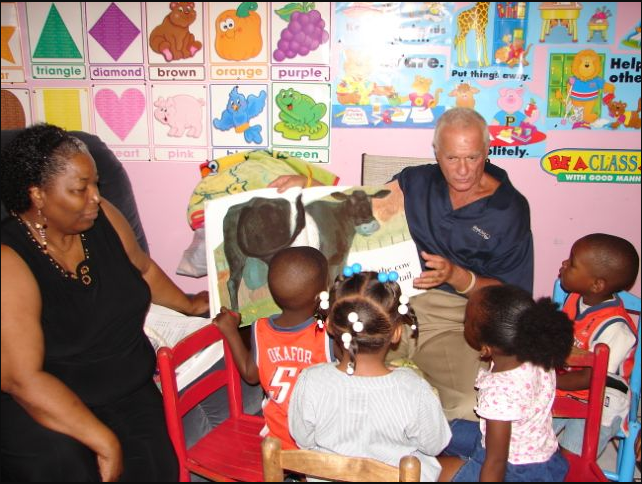
Orlando hotelier and philanthropist Harris Rosen, pictured here at one of the 10 preschool programs his foundation funds, saw a need to improve educational outcomes for young children in an impoverished area of his community.
A public school district in the Hoosier State that is seeking to expand education opportunities to its youngest learners has drawn inspiration from a privately funded program in Florida that has changed its community for the better.
Fort Wayne Community Schools recently sent a team of six to visit the Tangelo Park Program in Orlando, Florida. Created in 1993 by hotelier and philanthropist Harris Rosen, the program offers free preschool for children ages 2 through 4 living in the Tangelo Park area. It is funded through Rosen’s nonprofit organization, Rosen Foundation.
The nonprofit also provides resources for parents and full scholarships to college or vocational school to all of the area’s high school graduates.
Fort Wayne Superintendent Mark Daniel described the Orlando program as delivering “unbelievable results” during a recent school board meeting, according to the Fort Wayne Journal Gazette.
Before the program began, Tangelo Park, a community near International Drive in the shadow of the area’s theme parks and resorts, was plagued by overt drug dealing and use, poor school attendance, declining test scores and dropout rates of about 25%. Most of neighborhood’s 2,500 residents came from low socioeconomic backgrounds.
Rosen, who owns eight hotels and resorts in the Orlando area, was looking for a way to give back to his community when an Orange County commissioner told him about Tangelo Park. He began meeting with community groups whose members were also seeking to improve the neighborhood.
The result was the three-fold program that includes free, mostly home-based preschools for small groups of children as well a resource center that offered training to parents, along with the scholarship program that covers tuition, fees, textbooks, and housing for neighborhood students who earn high school diplomas and go on to college or vocational school.
The program also allows middle and high school students access to resources that aid in navigating public schools and college admissions.
Since its inception, Rosen has donated more than $12 million to the program, which also has received support from many Orlando groups including the Orlando Magic and the Edyth Bush Charitable Foundation.
As a result of those investments and the work of community partners such as the Tangelo Park YMCA, Tangelo Park Elementary School, Tangelo Baptist Church and the Tangelo Park Civic Association, Tangelo Park experienced a dramatic turnaround.
Today, virtually 100% of the Tangelo students graduate with a regular diploma – 98% since the program’s inception. Grade point averages have steadily increased and are predicted to exceed 3.0 in the coming years. The program has produced more than 160 college graduates since it began.
Property values have risen from an average of $45,000 to $150,000. Rosen’s program also has made the neighborhood desirable to parents who want the educational benefits for their children.
In 2010, University of Western Ontario economics professor Lance Lochner conducted a study on the program and determined that crime had been reduced by 63% and drug dealing has been essentially eradiated. He calculated that every dollar invested by the Rosen Foundation in Tangelo Park results in a return of $7 to society.
“We have a lot of students who grew up in the community, and they’re returning,” said JuaNita Reed, a retired guidance counselor at Dr. Phillips High School, who now oversees the college scholarship program for the Rosen Foundation. “They now have families, and they want their families to take advantage of this program.”
(You can listen to a podcast featuring Rosen, Reed and program statistics coordinator Chuck Dziuban of the foundation here.)
Rosen says the foundation has become more of a safety net as more students excel in school and earn scholarships on their own. He has begun encouraging other communities to replicate the program, which was expanded in 2017 to the Parramore community near downtown Orlando.
For Fort Wayne, the biggest challenge will be funding. The U.S. Census Bureau estimates Fort Wayne has more than 18,000 children younger than 5. With 908 students, the school system has the largest pre-K class statewide this academic year.
The Hoosier State relies on federal Title I funds which are limited to schools that serve children living in high poverty areas, as well On My Way Pre-K, a state program for students who meet income guidelines. But Stockman said the money is designed to help students attend established programs, not start new ones.
The district also offers preschool at two magnet schools, a Montessori school and an early childhood center, and funds those programs through the district budget. Officials say access to those programs is limited.
Fort Wayne officials hope to find their community’s own version of Harris Rosen.
“We are identifying and meeting with potential partners, including neighborhood associations,” district spokeswoman Krista Stockman said.
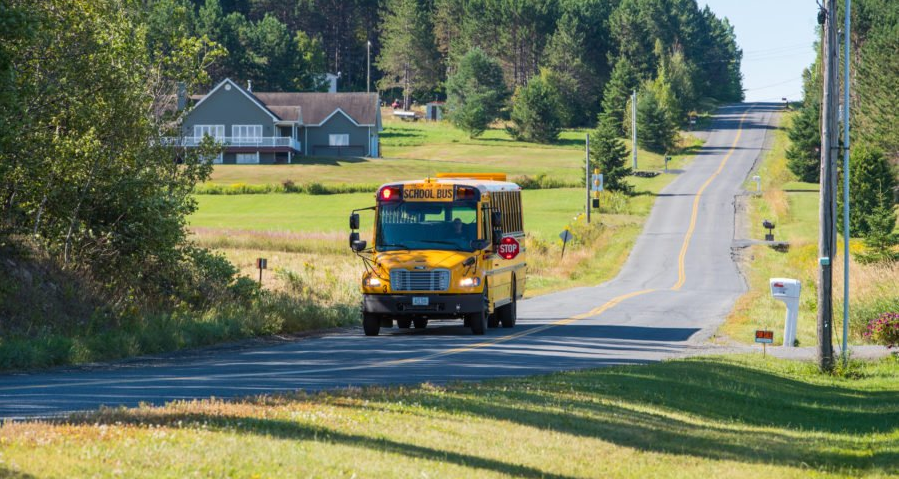 Editor’s note: reimaginED welcomes its newest guest blogger, Garion Frankel, with this post on a viable education choice alternative for rural families.
The past two years have seen an unprecedented string of victories for parental choice advocates. After the events of the COVID-19 pandemic, more than two dozen states now offer some form of voucher program.
But amid this expansion of school choice, the concerns of rural Americans are often overshadowed. Millions of American students attend a rural school, and many families interpret vouchers of any kind as a threat to their way of life. This resentment often influences policy.
For example, the Texas House of Representatives, based on the support of rural Republicans, added an amendment banning the use of vouchers to the state budget, which will be in effect until 2023.
"The reality is we have plenty of options and choice within our public schools,” said state Rep. Dan Huberty, a Republican who has long opposed voucher-driven school choice.
Rural concerns are valid. Anyone who has ever seen an episode of Friday Night Lights knows what the local public schools can mean to a rural community. Rural schools can employ half a town, and the other half will pack the bleachers for a high school football game.
These are institutions that can’t simply be overlooked. Furthermore, it’s true, at least historically, that rural access to voucher programs has been poor.
But there is now an option that can adequately serve both a single mother from Baltimore and a family with deep roots in rural Wyoming. Education savings accounts can satisfy the needs of all Americans, and arguably strengthen rural schools in the process.
Like traditional vouchers, ESAs enable parents to withdraw from their traditional public school and receive a deposit of public funds into a state-authorized savings account. Families can usually access this account via a debit card, and the money may be used for limited, but varied uses, such as private school tuition and supplemental instruction.
The difference, however, comes in the breadth of ESAs. They are not really vouchers. Instead of being specifically directed towards private schools, ESAs allow families to effectively design an educational program from scratch. In some cases, as with West Virginia’s Hope Scholarship Program, some students can use ESAs to support their public education.
In addition, ESAs can actually increase public school per-student spending. When families elect to participate in an ESA program, they receive only the state-allotted portion of their education. Sure, the public school district wouldn’t receive that portion of their funding, but it would be able to keep the locally sourced revenue that would normally have gone toward serving that student. As such, school districts can increase their per-student spending when ESAs are available.
For rural school districts, this extra spending would be particularly important. Before and during the COVID-19 pandemic, rural schools struggled to provide adequate internet services as well as the technology to access them. ESAs could open the door for higher-quality internet or laptops for students to use during class.
On the other hand, those rural families who do want something different would be able to pursue other options without feeling like they are destroying a pillar of their community. Nobody should feel guilty for doing what they think is best for their child’s future, and with ESAs, that choice could ever enhance their community.
There is no time like the present to implement school choice measures, and with ESAs, rural communities could comfortably join the broad, nationwide coalition of parental choice advocates.
There are no more excuses for blocking school choice efforts. Standing against ESAs is neither conservative nor acting in the interest of preserving communities; it is merely selfish and narrow-minded.
Rural communities arguably are the heart and soul of American culture and identity. That should apply to school choice too.

Graduates in university degree graduation,The background image is blue sky.
Editor’s note: This opinion piece from the editorial board of the Washington Post appeared Thursday on the online edition of that publication.
For 17 years, a federally funded K-12 scholarship program has given thousands of poor children in D.C. the opportunity to attend private schools and the chance to go on to college. And for many of those 17 years, the program has been in the crosshairs of unions and other opponents of private school vouchers. Their relentless efforts unfortunately may now finally succeed with House Democrats and the Biden administration quietly laying the groundwork to kill off this worthy program.
In its report approving the D.C. spending bill for fiscal 2022, the House Appropriations Committee said it expects the administration to phase out the D.C. Opportunity Scholarship Program — allowing current students to continue but not allowing new students to enroll. The measure is likely to pass the House, setting up a potential fight in the Senate where bipartisan support for the program has helped to stave off past efforts to abolish it, including by the Obama administration.
The cost of the program is modest and well-spent: $17.5 million per year. That is part of a federal funding deal that also directs money to the District’s traditional and charter public schools. Nearly 11,000 scholarships have been awarded since the program was founded in 2004, and at least 91 percent of the graduates are accepted to two- or four-year colleges or universities.
That compares with 39 percent of D.C public high school students. Most of the recipients — 92 percent — are African American or Hispanic, and the average annual income for families participating in the program in the 2020-2021 school year was $23,668.
To continue reading, click here.
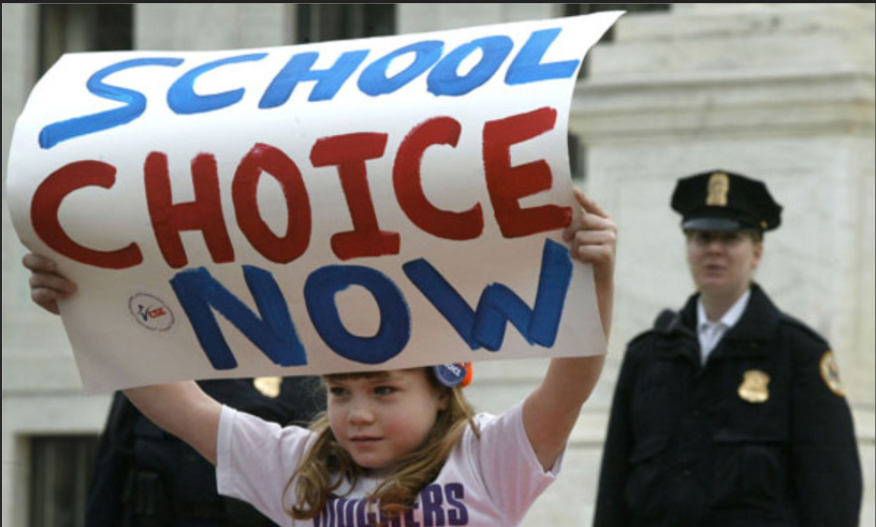 Families who attend faith-based schools in Maine received good news today when the U.S. Supreme Court agreed to hear a potentially landmark case that could settle the issue of whether families can be barred from using education choice scholarships to send their children to religious schools that conduct religious activities.
The case, Carson v. Makin, involves a town tuition program that grants school choice scholarships to families who live in towns where no district high schools are located. The state, however, will not allow families to choose religious schools that teach religion or conduct religious activities.
The case has been moving through the court system for three years, with the U.S. Circuit Court of Appeals in the 1st Circuit siding with the state in October. A three-judge panel said that the program’s limited scope separated it from other programs in which courts ruled that those bans were unconstitutional.
Maine’s ban, they said, was based on the schools’ use of state aid for religious activities, not merely the school’s status. The U.S. Supreme Court settled the status question last year when it ruled in Espinoza v. Montana that a school could not be barred from participating in a state scholarship program simply for being a religious school.
(For an analysis of each case, see here and here.)
Attorneys for the plaintiffs praised the court’s decision to hear the case.
“By singling out religion—and only religion—for exclusion from its tuition assistance program, Maine violates the U.S. Constitution,” said Senior Attorney Michael Bindas of the Institute for Justice, which is representing the Carson family and other plaintiffs. “The state flatly bans parents from choosing schools that offer religious instruction. That is unconstitutional. The Supreme Court now has the opportunity to hold that such religious ‘use’ discrimination in student-aid programs is just as unconstitutional as the religious ‘status’ discrimination it held unconstitutional in Espinoza.”
“In student-aid programs like Maine’s, parents—not the government—choose the schools their children will attend,” said IJ Managing Attorney Arif Panju. “If parents believe a school that aligns with their faith is best for their child, the state should not be allowed to deny them that choice.”
“The Court’s decision to hear this appeal is a tremendously important development not only for Maine families, but for all families who simply want access to the schools that will best serve their children’s needs,” added Bindas. “If a family believes that a school that provides religious instruction is the best option for their child, they should be permitted to choose it, just as they should be permitted to choose a school with a strong STEM curriculum, language immersion classes or a robust arts program.”
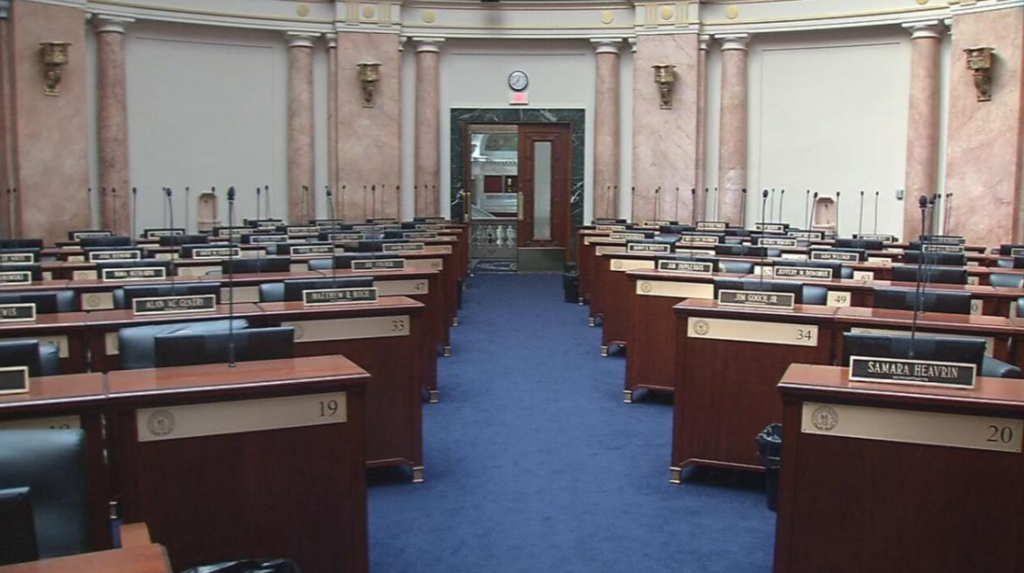 A lawsuit filed last week in Kentucky challenging the constitutionality of legislation that would give low-income families the financial means to choose the educational tools they need for their children could derail that opportunity before it gets off the ground.
Filed on behalf of public school boards and a group of Kentucky parents, the suit claims that House Bill 563, set to become law at the end of this month, is a scheme to move state revenue through a private grant program, impermissibly funding private schools.
The legislation provides an incentive in the form of a state tax credit to individuals and businesses that make donations to organizations that disperse funds to qualifying students for educational services. The tax credit is capped at $25 million annually.
Qualifying families may earn up to 175% of the federal income threshold for reduced-price lunch, but priority must be given to those most in need, initially those whose income does not exceed the threshold for reduced-price lunch.
The accounts can be used by public and non-public school children for services such as special-needs therapies, tutoring, summer programs, dual college credit courses and other educational services. In counties where the population exceeds 90,000, students also can use the funding for tuition assistance to attend non-public schools.
In response to the lawsuit, the Institute for Justice, a non-profit firm that has defended school choice laws around the country and before the U.S. Supreme Court, has filed a motion to intervene on behalf of parents who support the law.
“The lawsuit’s arguments echo arguments made in many other unsuccessful legal challenges to school choice programs throughout the country,” according to an Institute for Justice news release.
Andrew Vandiver, associate director of the Catholic Conference of Kentucky, said that Kentucky families from both public and non-public schools will be adversely affected if the law is delayed.
“There are parents right now trying to plan their children’s education and now they’re looking at this lawsuit,” Vandiver said. “The stakes are high. There are thousands of students who may not get the help they need next year.”
 See! A disenchanted nation
Spring like day from desolation;
To Truth its state is dedicate,
And Freedom leads it forth, her mate;
-- Percy Bysshe Shelley, “Prometheus Unbound”
Shelley got it right; truth and freedom are inseparable. And, when it comes to schooling, the two join in the long-established freedom of parents to decide the specific medium of truth for their own child.
And yet, it is the national reality that we have imposed the unchosen medium – the specific “public” school – upon the lower-income family; such parents have no voice in the matter. Billy’s school will be assigned to him by a completely impersonal system, one that lacks any plausible, or even intelligible, justification beside the welfare and power of the union chiefs who profit from it.
Will the empowerment of non-rich parents ever become a reality? Will these mothers and fathers one day be offered the dignity of making that fateful decision for their own child – that power and freedom that the rest of us so cherish?
Given his very specific and humbled submission to the teachers union by our most plausible next president, the federal government seems an unlikely champion of the poor for the near future. Yet, today, in a number of states, we watch politicians adjusting to signs of an awakening civic conscience; of course, it helps that the polls show a mounting preference for choice among all parents, the comfortable as well as the poor. The subsidized mother and father have become a spreading vision among our people.
When and if choice comes to be in a sustainable way, it will most likely do so in a variety of legal and economic forms from state to state. Vouchers that would subsidize and empower lower-income parents to exercise their legal right by paying tuition are merely the most simple and obvious remedy.
And, of course, we have already created the harbinger of parental empowerment in our well-functioning and very popular charters. Aside from their superior test scores, we can be confident that they work simply by watching the frantic (and too often successful) effort of union chiefs to minimize their numbers and/or to shrink the operating liberty of these precious quasi-public latecomers in our history.
Tuition vouchers for ordinary and poor families will be the simplest form for the subsidizing of choice. Imagine the real freedom for families that need financial help to decide for themselves if both vouchers and charters were to become available to them.
That will depend entirely upon the prudence and resilience of their current union overseers to transform themselves and, for the first time, rise to meet the competition in a free market.
In short, they would have to become worth choosing. Is that too much to ask?
 “There are more things in heaven and Earth, Horatio, than are dreamt of in a test score analysis …” Shakespeare by way of Ladner
Learning to read proficiently and to understand math are two jolly important goals for our schools. They are by far, however, not the only goals.
Americans want students equipped with the academic knowledge and training for success, but they also aspire to broader types of success in the formation of character – the ability to exercise citizenship responsibly and to function as productive members of society, for instance.
A new study from Patrick Wolf, a professor of education policy at the University of Arkansas, and Corey DeAngelis of the Reason Foundation, published in the Journal of Private Enterprise, tracks long-term outcomes associated with the Milwaukee Parental Choice Program. The MPCP makes low-income students eligible to receive a voucher to attend a private school.
The authors carefully construct a comparison group and analyze the long-term social welfare effects on students who have been offered a voucher after controlling for a variety of student background characteristics. They found that exposure to the MPCP is associated with a reduction of about 53% in drug convictions, 86% in property damage convictions and 38% in paternity suits. Effects tend to be largest for males and students with lower levels of academic achievement at baseline.
So, in addition to academic benefits of the program, including a higher high school graduation rate, MPCP participants also have lower criminal conviction rates and less time in family court. The average MPCP voucher was worth $7,943 in 2018-19 while the average total spending per pupil in the Milwaukee Public Schools was $15,250 in 2017-18.
Just imagine what Milwaukee students might do if they got equitable funding, and if their families could utilize that funding for educational benefits beyond private school tuition. There would almost be enough money left over to pay for the sort of enrichment activities that the top decile American families pay for things like summer camps and tutors.
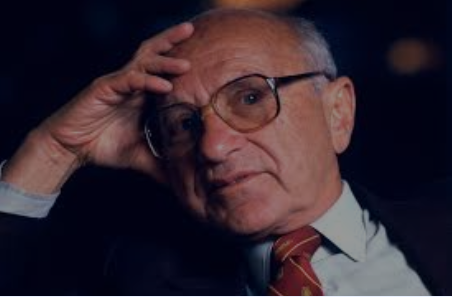
The modern school choice movement was born in the “intellectual hot house” of free-market economist Milton Friedman. His support for school choice led him to found the Friedman Foundation for Educational Choice, later renamed EdChoice.
“School choice is a political hobby of the rich.”
So goes a common indictment of the effort to subsidize parents’ preference of a specific school for their own child. Sadly, there has been a wee dash of truth to the charge.
The modern movement for choice did not originate in a widespread concern for the low-income family. It was born, rather, in the intellectual hot house of the free market missionary Milton Friedman. The professor of economics saw the flabbiness of our systems of protected “free” public schools available to all families living in each defined neighborhood. Competition from tuition-based private schools was, for most parents, reduced to near zero.
The public school monopoly is grossly inefficient. The obvious solution: Offer the parents a “voucher” for tuition at the school of their choice. Let the market decide which schools survive and prosper, thus lifting the quality of the entire system. More, competition would diminish every state’s investment in school bureaucracy, reducing the load on the taxpayer.
That message sounded good to free market minds, especially those who had already experienced success in business. Thus, in the 1970s, conservative money began to settle upon these new organizations formed to bring Friedman’s ideal into political realty. The problem with the concept soon became apparent. It proved to be very hard for most Americans to embrace a completely free market of the Friedman design.
Buying a seat in a school is not like purchasing tomatoes. Whatever the good intentions of these now well-financed activists and their corporate supporters, there seemed to many citizens a disregard for an obvious need to design the new order with specific concern for lower-income families.
For example, parents who had long been financially unable to choose would, for some time, need a system of information guaranteeing a minimum of sophistication as they are introduced to this new responsibility and opportunity. Participating private schools would also be asked to comply with an admissions routine ensuring some places for the poor. In addition, the vouchers would need to be accepted as full tuition (or nearly so) from such families.
Proposals for such lightly regulated systems proved threatening to Friedman himself, his intellectual descendants, and most of the wealthy donors to pro-choice non-profits. Thus, the cheerleaders for the idea of a subsidized choice that is focused upon the lower-income family have had to make do with comparatively feeble political resources.
One consequence: Critics like the teacher unions have been encouraged to portray the concept as precisely what it need not be – another government bonus for the well off.
So, hail to the market, but empower us all to choose and encourage the schools to play fairly with those among us who will most treasure this new responsibility to our children. Choice need not be either left nor right, but at the center.
I think I see signs of hope.
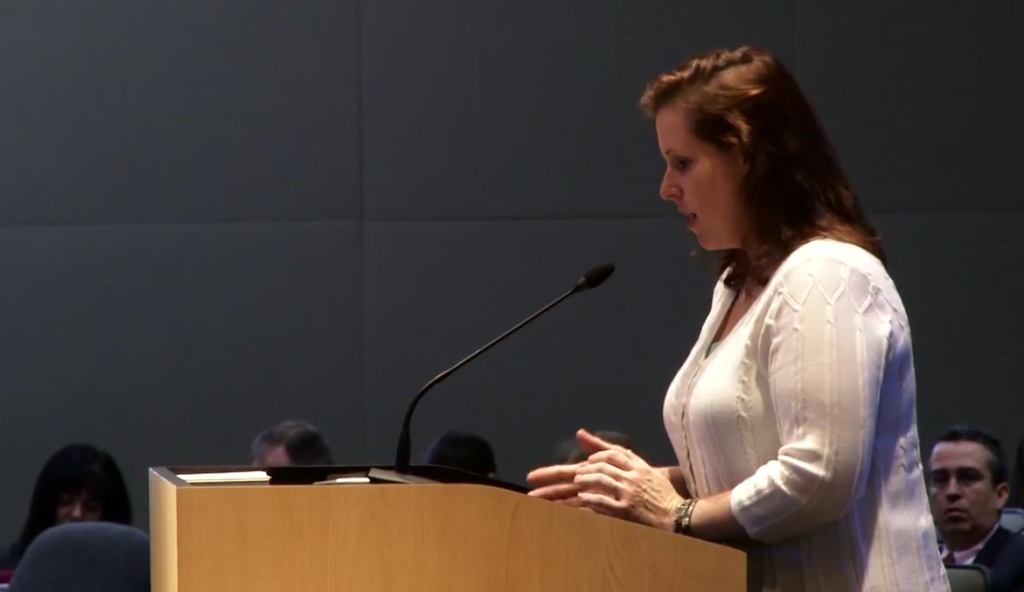
Katie Swingle, mother of a child with autism, spoke before the Florida Senate Education Appropriations Committee in March 2015, imploring lawmakers to expand education choice options for children with special needs.
If you need to make a choice between reading this post or watching the video featuring the mom pictured above, please watch the video. Katie Swingle explains why families with children with special needs require and deserve access to education choice. Her story demonstrates why depriving them of choice is a terrible thing.
Sadly, there is an effort underway in Arizona to do exactly that.
Arizona’s Save Our Schools group has proposed a statewide ballot initiative that would create an overall participation cap on Arizona’s Empowerment Scholarship Program of 1 percent of the total student enrollment of the public school system. Once that cap is reached, students other than those with disabilities, including Native American children, those who have been in the foster care system, are zoned for D- or F-rated public schools, orphans and dependents of active duty military service members among others, would be purged from participating.
Upon completion of this purge, the program would lack the ability to serve additional special needs students. Last week, I noted that 1.7 percent of the total public school enrollment in Florida makes use of private choice programs for children with disabilities. I should further have noted that Florida has a waitlist of students with disabilities for the ESA program.
Historical program data allows us to assess the length of time it would take for the proposed cap to deny access to disadvantaged students if something like it were to be applied in Florida. As a thought experiment, imagine Florida’s multiple-choice programs debuting as a state-funded program in the same year that the McKay Scholarship program debuted.
This next part will require you to suspend your disbelief. Imagine a group of advantaged urban Floridians who exercise choice in their own families managing, from the outset of choice, to implement a cap in Florida for disadvantaged students. Floridians, of course, would find it nearly impossible to live with such a level of moral hypocrisy.
In Florida’s actual experience, lawmakers created a voucher program for students with disabilities and one for children in failing schools, followed by a tax-credit scholarship program for low-income students. Our thought experiment involves envisioning Florida following closer to the Arizona ESA experience: a single program starting with students with disabilities. A few years into the program, the Florida lawmakers of our thought experiment add low-income students into the eligibility pool for the state-funded program. Okay. So, how long would it have taken for the SOS cap to have purged disadvantaged students in Florida?
Let’s look first at the McKay Scholarship program for students with disabilities.
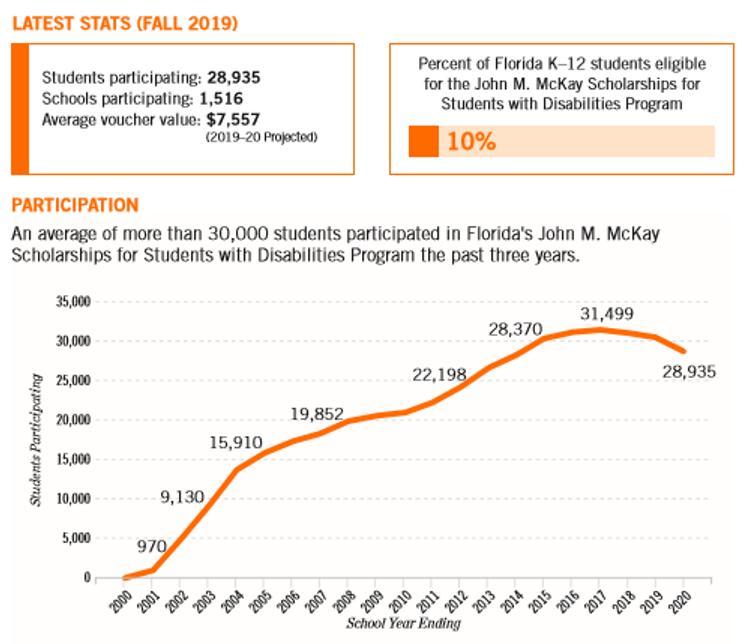
If the McKay Scholarship program had been the only choice program created, it would have exceeded the 1 percent cap by itself in 2013. After 2013, additional special needs children would have been denied access. Of course, it wasn’t the only program; Florida lawmakers also made low-income students eligible to participate in choice.
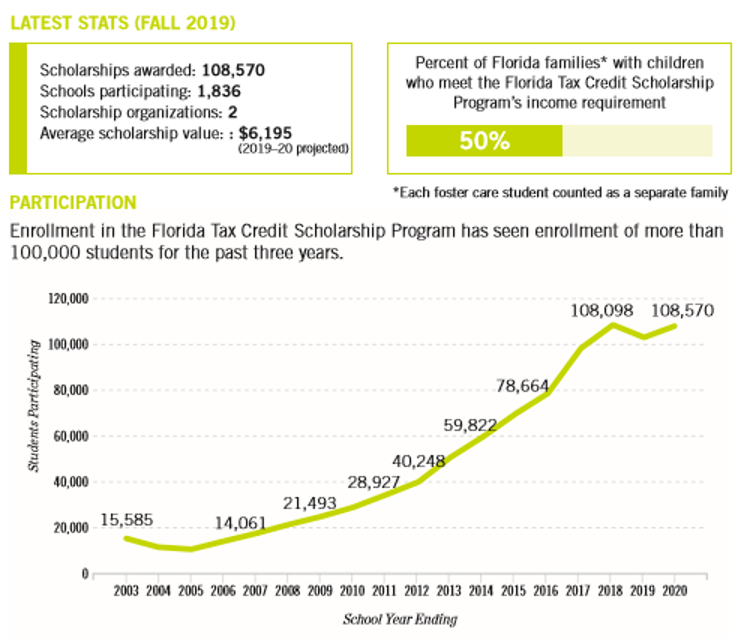
The combination of McKay and the tax credit program would have exceeded the SOS cap around 2004. “Let them eat cake,” the cap supporters would tell the tens of thousands of low-income families piling onto waitlists.
This isn’t the end of the story, however. Florida also created a special needs ESA program in 2015. This is the program used by the all-too-real mom in the video.
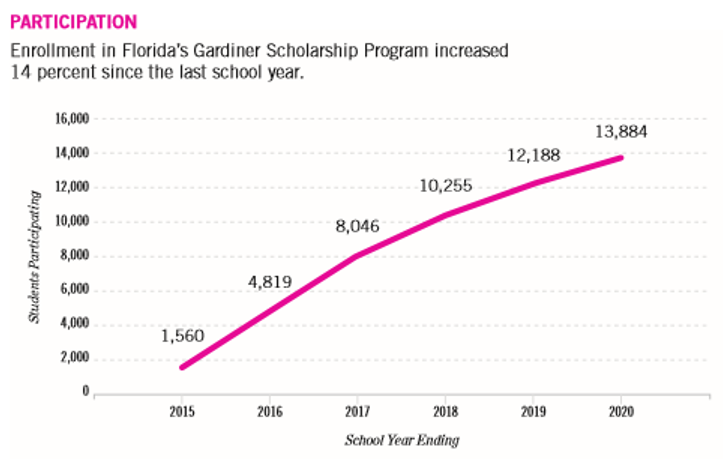
Every single one of these families, including the Swingle family, would have been denied choice under an SOS cap. Arizona’s ESA program is only a few years of growth away from reaching the proposed cap.
Supporters claim the cap will not impact current beneficiaries, but it clearly will. Moreover, there are thousands of Arizona students with disabilities today, and many more yet unborn, who would be denied access through the proposed cap.
 The Senate Education Appropriations subcommittee voted 5-3 today to bolster and align two state scholarship programs that provide education choice to economically disadvantaged students.
SB 1220, a bill that spells out rules for teacher training and qualifications, also includes provisions aimed at aligning policies between the new Family Empowerment Scholarship, adopted last year and serving 18,000 students, and the Florida Tax Credit Scholarship, created in 2001 and serving 108,000 students.
Both scholarship programs serve students from lower-income and working-class families. The primary difference is that the Florida Tax Credit Scholarship is funded by corporations that receive a 100 percent tax credit, and the Family Empowerment Scholarship is funded directly from the state education budget.
The bill adopted today included an amendment proposed by Education Committee Chairman Manny Diaz, R-Hialeah, that would increased the allowed enrollment growth in the Family Empowerment Scholarship. Under current law, the program can grow by up to 0.25 of total public school enrollment each year, which is roughly 7,000 students. His amendment increases the amount to 1 percent, or roughly 28,000. It also maintains the current income eligibility rules for Florida Tax Credit Scholarship. In that program, household incomes must not exceed 260 percent of the federal poverty level. An earlier version of the bill increased that percentage.
Other changes include:
Diaz said the new bill seeks to continue what last year’s Legislature started: eliminating the wait list.
Present to speak in favor of the amended bill were stakeholders, including several parents and Elijah Robinson, a scholarship student from Jacksonville, who said the scholarship allowed him to escape the constant bullying at his public school that drove him to attempt self-harm.
“My life has completely changed from a year ago,” said Robinson, who will graduate this year from The Foundation Academy. “Please vote for this bill so that students like me can get help and not be forgotten.”
Michelle Porter, a mother of seven from Miami with three children on the Florida Tax Credit Scholarship, said she couldn’t imagine her life without the scholarship. One of her daughters was born with a rare disease and often was bullied at her public school.
“She would come home crying every night,” Porter said. “I wanted her to feel safe.”
Her daughter is now enrolled at a Catholic school, “where she is treated as an equal.”
Opponents called the bill an attempt to create a parallel state education system and expressed concern about possible discrimination. The Rev. Dr. Russell Meyer, executive director of the Florida Council of Churches, said he opposes allowing any public money to be used at religious schools, period.
“No public funds should be used to teach your religion,” he said. “If you continue to give a voucher so that households can go to any school, that any school meet all criteria and make sure no discriminatory beliefs prevent them from attending that school or harming their consciences while they are there.”
Sen. Jason Pizzo, D-Miami, who voted against the bill, said he didn’t think it was unreasonable to insist on “a baseline discrimination policy” for participating schools. He also said he thinks more emphasis should be placed on allowing families to have access to different public schools.
That’s already the case, Diaz responded.
“The Legislature passed an open enrollment policy that puts that decision squarely in the hands of the district,” he said. “It’s totally local control.”
Diaz also noted the scholarship program is small compared with the number of students educated statewide – 2.8 million.
“We’re trying to provide an opportunity for 28,000 kids,” Diaz said.
He said parents, not the government, are responsible for ensuring their children are in the learning environment that is best for them.
“At the end of the day, what they’re looking for is freedom and opportunity,” he said.
The bill now heads to the Senate Appropriations Committee. A similar bill, HB 7067, is scheduled to be heard today by the House Appropriations Committee, its final stop before heading to the House floor.

