
EdChoice has an interesting survey question comparing what sort of school parents would prefer (district, charter, private or home) and comparing the results to actual enrollment patterns. In 2024 it looked like this:

There is a lot happening in that chart, starting with the apparent desire of approximately 50% of the parents of district students to have their students somewhere else. Of course, a great many legal and practical constraints stand between preference and reality, which is why we have an education freedom movement and why we find so much opposition from the insecure K-12 reactionary community. Taking the surveyed demand as a part of a thought experiment around “what would it take to give families what they want?” can be illuminating. Of course, in the real world, these things change only gradually. Arizona has the highest percentage of students in charter schools at 21% or so, but it took three decades to get there for all kinds of reasons, including the need to have school space, which involved a great deal of construction and debt. We live in a world of charter and private school scarcity relative to demand, and keeping up the previous (inadequate) pace of construction may prove difficult.
Using my advanced skills acquired in the Texas public school system between 1972 and 1986, I have used this surveyed demand to calculate an implied demand for an additional 1.1 million charter school spaces. Don’t hold your breath waiting for them. It took almost three and a half decades to reach 3.7 million, and if you’ll now take a look at the first chart above, you’ll see that most of that three-and-a-half-decade period involved relatively low and almost continually declining long term interest rates between 1991 and 2021.
After 2021, both interest and building costs went up for charter school construction. Interest rates of course could go down, but they could also (gulp) go further up. A slowdown in the rate of new charter openings happened before the increase in interest and construction costs:

The little green force mystic taught us “always uncertain the future is,” but it appears to me that circumstances will require the rise of different school models that create seats sans debt. The old expression holds that God doesn’t close a door without opening a window, and the recent rise in interest rates happened almost simultaneously with the rise of pandemic pods and a la carte learning.

Keith Jacobs II, affectionately called "Deuce," with his parents, Keith and Xonjenese Jacobs. Photos courtesy of the Jacobs family
When our son Keith — affectionately known as “Deuce” — was diagnosed with autism spectrum disorder at age 3, we were told he might never speak beyond echolalia (the automatic repetition of words or phrases). Until age 5, echolalia was all we heard.
But Deuce found his voice, and with it, a unique way of seeing the world.
He needed to find the right learning environment, with the assistance of a Florida education choice scholarship.
Deuce spent his early academic years in a district public school, supported by an Individualized Education Plan (IEP). Despite the accommodations, learning remained a challenge. We realized that for some, a student’s success requires more than paperwork. It requires community, compassion, and collaboration with the parents.
Imagine having words in your head but lacking the ability to communicate when you need it most. That was Deuce’s experience in public school. His schools gave him limited exposure to social norms and rigor in the classroom. Additionally, through his IEP, he always needed therapy services throughout the school day, which limited his ability to take electives and courses he enjoyed.
His mother and I instilled the importance of having a strong moral compass and working hard toward his social and academic goals. Although we appreciated his time in public school, we knew a change was needed to prepare him for post-secondary education. We applied and were approved for the Family Empowerment Scholarship for Students with Unique Abilities.
Knowing the potential tradeoffs of leaving public school and the IEP structure behind, we chose to enroll Deuce at Bishop McLaughlin Catholic High School in Spring Hill, about 35 miles north of Tampa. We believed the nurturing, faith-based environment would help him thrive. It was the right decision.
Catholic school provided Deuce with the support he needed to maximize his potential. Despite his autism diagnosis, he was never limited at Bishop. He was accepted into their AP Capstone Program. This was particularly challenging, but Bishop was accommodating. The school provided him with an Exceptional Student Education (ESE) case manager dedicated to his success, and he received a student support plan tailored to his diagnosis and learning style. The school didn’t lower expectations; instead, it empowered him to take rigorous coursework with the right guidance.
Any transition for a child with autism will take time to adjust. On the first day, I received a call: Deuce had walked out of class. This was due to his biology teacher using a voice amplifier. The sound overwhelmed Deuce’s senses, and he began “stimming”— rapidly blinking and tapping his hands. Instead of punishing him or ignoring the issue, the staff immediately reached out.
Together, we crafted a Student Success Plan tailored to Deuce’s needs, drawing from his public school IEP without being bound by it. His plan included preferential seating, frequent breaks, verbal and nonverbal cueing, encouragement, and clear direction repetition. For testing, he was given extended time, one-on-one settings, and help understanding instructions.
These adjustments made all the difference.
Throughout high school, Deuce maintained a grade-point average of over 4.0 while taking honors, AP, and dual enrollment courses. Additionally, he was inducted into the National Honor Society and Mu Alpha Theta Math Honor Society while also playing varsity baseball. Because of his success at Bishop, he will continue his educational journey at Savannah State University, where he will major in accounting and continue to play baseball.

Deuce Jacobs earned an academic scholarship to Savannah State University, where he plans to major in accounting and continue playing baseball.
Catholic schools in Florida increasingly are accommodating students with special needs. The state’s education choice scholarship programs have been instrumental in making Catholic education available to more families. Over the past decade, during a time when Catholic school enrollment has declined across much of the nation and diocesan schools have been forced to close, no state has seen more growth than Florida.
At the same time, the number of students attending a Catholic school on a special-needs scholarship has nearly quadrupled, from 3,004 in 2014-15 to 11,326 in 2024-25. Clearly, many families are choosing the advantages of a private school education without an IEP versus a public school with an IEP.
So, I’m puzzled why federal legislation being considered in Congress, the Educational Choice for Children Act (ECCA), includes a mandate that that all private schools provide accommodations to students with special education needs, including those with IEPs.
Although more and more students with special needs are accessing private schools, not every school can accommodate every student’s unique needs (which is also true of public schools). And, as I learned with Deuce, some schools can accommodate students more effectively if they aren’t bound by rigid legal mandates and have the flexibility to collaborate with parents who choose to entrust them with their children’s education.
If the IEP mandate passes, it would prohibit many schools from accepting funds through a new 50-state scholarship program, undermining the worthy goal of extending educational choice options to more families. The U.S. Conference of Catholic Bishops has called it a “poison pill” that would “debilitate Catholic school participation.”
Bishop McLaughlin’s willingness to partner with me as a parent not only allowed Deuce to succeed academically but also gave him the dignity and respect every child deserves. IEPs work for many. For others, like Deuce, it takes something more like collaboration to build a path forward together.
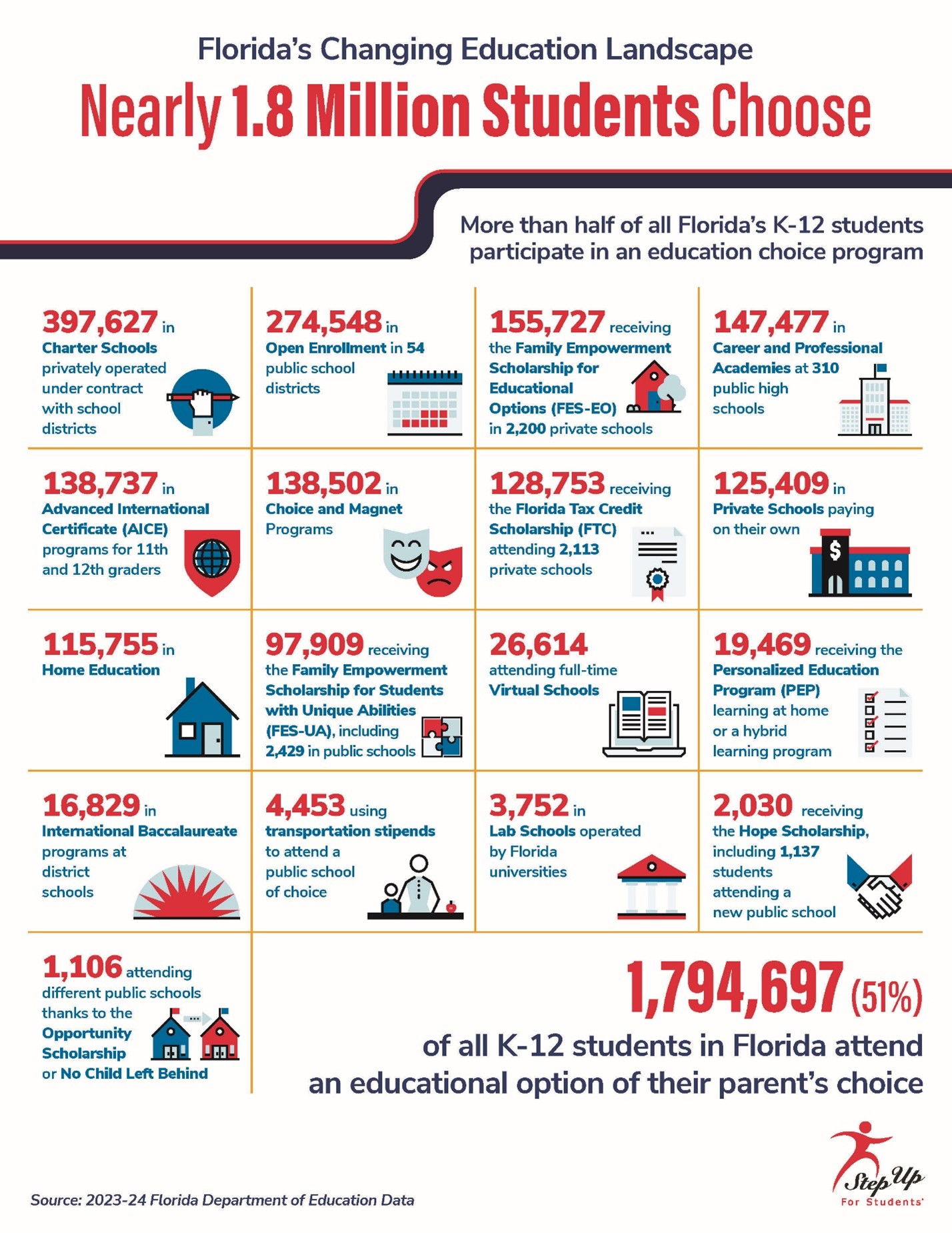 For the first time in Florida’s history, more than half of all K-12 students are enrolled in an educational option of choice. During the 2023–24 school year, 1,794,697 students, out of the state’s approximately 3.5 million K-12 population, attended schools outside their zoned neighborhood assignment.
Since the 2008–09 school year, Step Up For Students, in collaboration with the Florida Department of Education, has tracked enrollment across a variety of choice programs. While methods and program structures have evolved, 2023–24 marks a milestone: more than 50% of Florida’s students are now learning in environments selected by their families.
The Changing Landscapes report draws from Florida Department of Education data and removes, where possible, duplicate counts to provide a clearer picture of school choice participation. For example, it adjusts for home education students supported by the Family Empowerment Scholarship for Students with Unique Abilities (FES-UA) and eliminates double-counted students in career and professional programs. It also excludes prekindergarten students in FES-UA and programs like Voluntary Pre-Kindergarten (VPK), as the report focuses solely on K–12 education.
While many families still choose their neighborhood public schools, Florida’s education system now offers a broad range of options to meet diverse student needs. Public school choice remains dominant, occupying four of the top five spots in overall enrollment. Charter schools are the most popular option, followed by district open enrollment programs, career and professional academies, and Advanced International Certificate of Education (AICE) programs for upperclassmen.
On the private side, the 2023–24 school year marked a historic shift: For the first time, a single scholarship program now serves more students than all private school families who pay tuition out of pocket.
In total, over 116,000 additional students enrolled in choice programs compared to the prior year. The Family Empowerment Scholarship for Educational Options (FES-EO) and the Florida Tax Credit Scholarship (FTC) saw the greatest growth, along with AICE and FES-UA. Altogether, scholarships for private and home education increased by approximately 142,000 students, while private-pay and non-scholarship home education enrollment declined, likely due to the expanded availability of financial aid.
Among public-school options, magnet and district choice programs saw slight declines, with 28,000 and 8,447 fewer students, respectively. Still, public-school choice remains strong: 1.1 million of Florida’s 2.9 million public school students (40%) are enrolled in a choice-based public option.
Altogether, nearly 1.8 million students attend a school chosen by their parents or guardians. This shift reflects a fundamental transformation in Florida’s educational landscape—one where families are increasingly empowered to find the best fit for their children.
But with so many students opting for alternatives to their zoned public schools, it raises an interesting question: What about those who stay? If families are surrounded by options and still choose their assigned public school, isn’t that a choice, too? In that light, Florida may already have a 100% choice system, because staying is just as much a decision as leaving.
Rather than a battle between public and private education, Florida is showing how both sectors can coexist and thrive, working together to provide high quality learning opportunities for all students. The future of education isn’t one-size-fits-all; it’s about ensuring every family has access to an option that fits their child’s unique needs. In Florida, that future is already here.

June 1, 2025, marked the 100th anniversary of the United States Supreme Court’s ruling in Pierce v. Society of Sisters- effectively the first victory of America’s school choice movement.
In 1922, the voters of Oregon had passed a ballot proposition, Measure 6, which required public school attendance for school age students, creating fines and jail sentences for non-compliance. Supported by the Ku Klux Klan and other nativist groups, the measure passed by a margin of 53% in favor, 47% opposed. Measure 6 took effect in 1926, but in the meantime, the Society of Sisters of the Holy Names of Jesus and Mary took the state of Oregon to court.
The Klan wanted all Oregon children to attend public schools so that they would be educated in a Klan-approved way in the hope of turning immigrant children into what the Klan considered “real Americans.” Wait…oh dear…hold on…I have a bucket and a towel for you…

When your retching subsides, do keep reading, as this story has a happy ending! The United States Supreme Court ruled unanimously in favor of the Society of Sisters and against the 53% of Oregon voters who endorsed illiberalism. The unanimous ruling read:
The fundamental theory of liberty upon which all governments in this Union repose excludes any general power of the State to standardize its children by forcing them to accept instruction from public teachers only. The child is not the mere creature of the State; those who nurture him and direct his destiny have the right, coupled with the high duty, to recognize and prepare him for additional obligations.
One hundred years on, the education freedom movement owes a great debt to the Society of Sisters. We should, like the court, oppose any general power of the state to standardize children. Families should have the right to opt between a broad universe of meaningfully diverse schools and educational methods. People can voluntarily adopt standards as a part of selecting schools and service providers.
A century after Pierce vs. Society of Sisters, we have a great deal of work ahead of us.

Jason Bedrick and I published a piece at the Daily Signal about the Roosevelt Elementary School District in South Phoenix. The Roosevelt district has experienced enrollment loss for decades, and the school board of the district has announced plans to close five schools.
I first learned of Roosevelt Elementary School district some 20 years ago when a Roosevelt student brutally assaulted a co-worker’s child. The staff’s response was far less than satisfactory, but at the time, it was difficult to locate mid-year transfer spots for my co-worker’s children, even after we enlisted the aid of a person who specialized in such situations.
I’m happy to report that in 2025, it is less difficult for desperate parents to execute a mid-year transfer.

Multiple factors explain the decline of Roosevelt’s enrollment, including a nationwide baby bust that began around 2007. Students living in the boundaries of Roosevelt but attending other public schools, both districts and charters, outnumber ESA students approximately 10 to 1. So, Arizona’s open enrollment and charter statutes deserve more credit than the ESA program. An examination of the reviews of Roosevelt Elementary schools left by students, parents and staff on private school navigation websites made my co-worker’s experience from 20 years ago seem to be far from an isolated, unfortunate incident. Here are some examples:
“Please do not take your children here. Almost every child is bullied, and the staff won't do anything. If you truly care about your kid's school experience, don't sign them up.”
“This school makes kids act out by tolerating relentless bullying and cruel treatment by teachers for special needs kids.”
“The kids get bullied, my son got a Black eye the 1st day of school and they told me that because he didn't know who the kid was there was nothing they could do.”
“This school should be shut down.”
“…They don’t take care of bullies; they just ignore the problem and leave the kids (to) fend for themselves; it seems that this is a safe place for bullies not for other kids. I would recommend that you should never enroll your kid here, and if you do, be prepared to endure what seems to be a never ending bully problem, and its not only the teachers that don't do anything about bullies.”
“I would rate it ZERO stars. This school is not SAFE NOR ORGANIZED. Roosevelt school district needs to step up their game or close this school down.”
“Students are constantly fighting or involved in some type of confrontational altercation with each other. Teachers behave more as peers than educators. My grandchild has attended this school for the past five years. I have seen very little improvement. If it were my choice, they would not attend.”
People who work for school districts have organized, and they use the fact that Americans dislike school closures. I would submit, for your consideration, that it is not wicked legislators or dastardly choice supporters who have forced the looming closures of Roosevelt schools. Rather, it has been due to the action of thousands of families who live in the boundaries of the district, who desire safe schools that will equip their children with the knowledge, habits and skills necessary for success. They have chosen to prioritize the long-term interests of their children over the short-term preferences of Roosevelt staff in increasing numbers for decades.
This is a thumbs up for Roosevelt students, whose interests the community has collectively put first, more than a thumbs down for the district schools. Roosevelt district schools will remain the best funded option on a per-pupil basis and might just stage a comeback if they can secure the confidence of families regarding safety and academics. Some of my friends in Arizona’s K-12 reactionary community would prefer that Roosevelt schools receive unconditional immortality. It is difficult to view these folks as engaged in anything other than macabre traffic in other people’s children. Perhaps I judge too harshly; the Phoenix area K-12 industrial lobbying complex is probably large enough to delay the need for difficult decisions in Roosevelt. If they are willing to enroll their own children in Roosevelt schools through open enrollment or otherwise, they might be able to stave off the need for safety and academic improvements.
Opponents of choice in Phoenix have been avid users of choice. One of your humble author’s children graduated from a South Phoenix charter school just a few miles away from Roosevelt. He attended with the children of two gubernatorial nominees who campaigned against choice (including Gov. Katie Hobbs), a child of the president of the Arizona Education Association and a co-founder of Save Our Schools Arizona, among others. Rather than choosing safe and academically performing charter and district schools, this community could instead put their families where their mouths are and lead the renaissance of Roosevelt district schools by enrolling their own children and grandchildren.
While this noble project gets off the ground, we in the Arizona choice community will continue to prioritize the interest of families above those institutions.

Blossom Montessori School for the Deaf has served students for more than two decades. Photo courtesy of Blossom Montessori School for the Deaf
CLEARWATER, Fla. – More than 20 years ago, Julie Rutenberg and Colette Derks harnessed some of the first private school choice programs in America to create a bespoke little school they knew their community needed. All these years later, Blossom Montessori School for the Deaf continues to show what kind of diverse, ever-expanding options are possible when education choice is in the mix.
Rutenberg founded Blossom in 2003. Derks, now the associate director, helped stand it up. As the name suggests, the PreK-6 school serves students who are deaf or hard of hearing (along with their siblings) and the children of deaf adults. Occasionally, Blossom also serves students who do not have any hearing loss because their parents want them to have more one-on-one attention. Over the years, nearly every one of its 250-plus students used a state-funded choice scholarship.
Rutenberg and Derks were working at a community center for deaf people when they got the idea for the school. They thought the hands-on, self-directed, mastery-based approach of Montessori offered a good alternative to the students they saw having a tough time in traditional schools.
“They’re able to move around the manipulatives when they’re working out their (math) problems, when they’re building words for reading, working with writing skills,” Derks said. “We really love how Montessori just kind of gets the whole body involved when learning.
“You’re not just sitting at a table looking at a paper or a book all day, (where) everybody’s on the same level,” she continued. “It really helps the student to be able to kind of grow and develop at their own pace.”
Rutenberg and Derks praised the public-school programs in their area that are serving similar students. Offering an option, they said, is not a knock on them.
“We’re just a different way of learning,” said Rutenberg, who attended Montessori schools as a child. “We’re not always going to be the right fit, either. Our goal is just to make sure the child comes first.”
Blossom got its start using three rooms inside another Montessori school. But for most of its existence, it’s been housed in a trim, beige building in an eclectic office park, right next to an ice-skating rink.
Most of the families it serves are working class. Most live in the immediate area. Some, though, drive an hour or more each way so their kids can attend. Others have moved from as far as Daytona Beach – on the other coast of Florida – because they wanted the school that much.

Quinten Caroline, 7, in costume as Leonardo DaVinci as part of a school project on Italy. Photo courtesy of Blossom Montessori School for the Deaf
“It’s nothing but positive with everything they do. They see the kids as perfect the way they are,” said Anastasia Caroline, whose son Quinten, 7, attends Blossom. “In a normal school, you’re not always going to get that love, that acceptance.”
Blossom represents so many choice-fueled trend lines. It’s a microschool. It’s a Montessori school. It’s a school for students with special needs. In Florida, where choice is the new normal, all those options are growing.
Microschools are so much of a thing now, they’re routinely showing up in local news stories (like this one and this one). I don’t know if anybody has a good handle on the total number, in part because there isn’t an official definition. But Microschool Florida, an excellent resource, puts the number at 156 and counting.
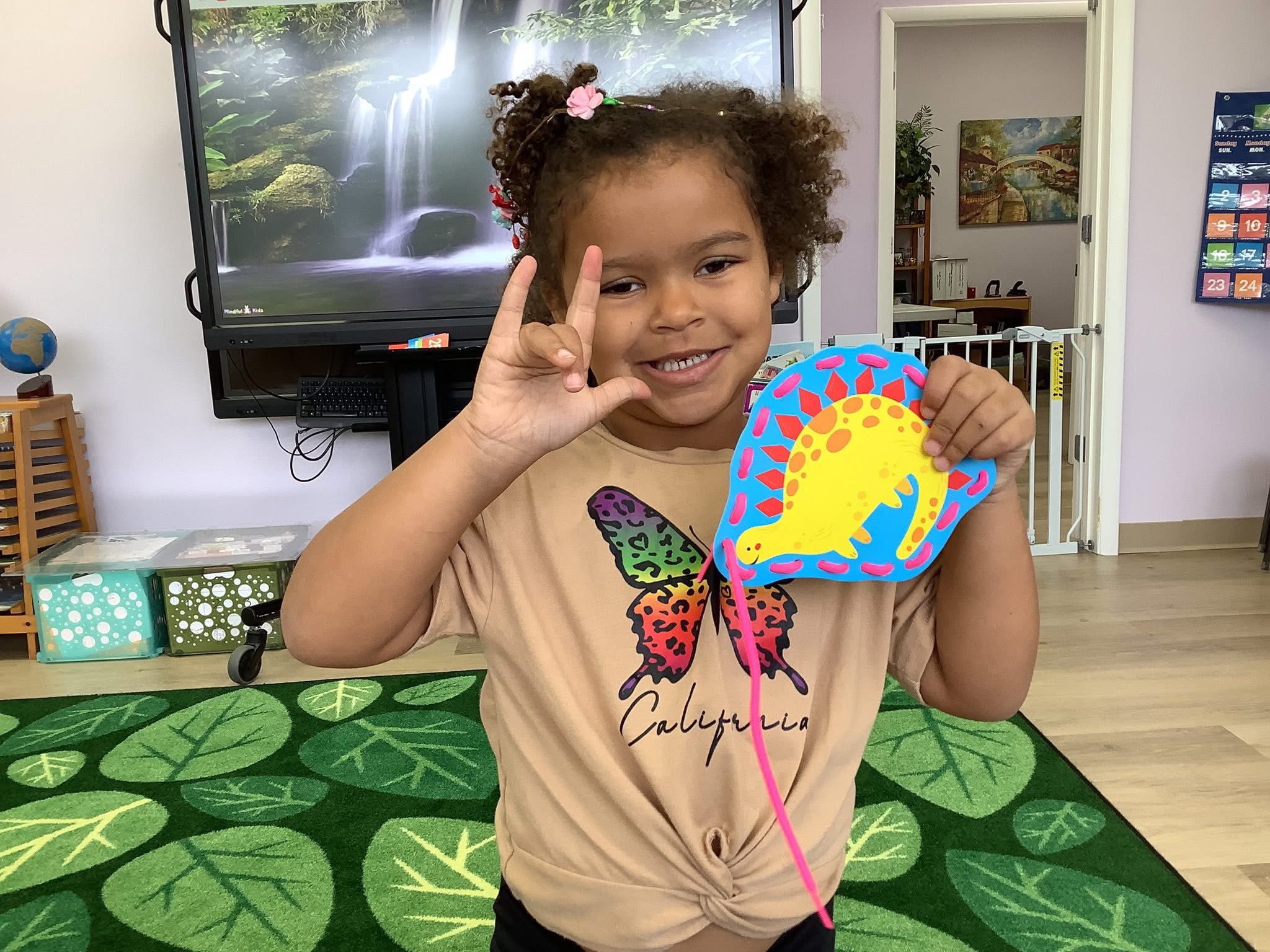
A student says "I love you" in American Sign Language. Photo courtesy of Blossom Montessori School for the Deaf
Meanwhile, there are at least 150 private Montessori schools participating in Florida’s choice programs. I say at least because that’s how many are listed in the state’s private school directory with Montessori in their name.
To be sure, there are plenty of Montessori-influenced private schools that don’t have Montessori in their names (like this one, this one, and this one). There are also plenty of school-like entities, like this hybrid operation in Tampa, and this homeschool co-op in South Florida, that are Montessori influenced, but aren’t official private schools, and aren’t tracked in any kind of official way, yet are funded in part by parents using flexible, state-funded education savings accounts.
Finally, there are more options for students with special needs. There’s more inclusion because more families can now afford schools that were once out of reach. (Check out, for example, the trend lines for scholarships for students with unique abilities in our white paper on Catholic schools.)
At the same time, there are more specialized schools, because, with choice, education entrepreneurs can more easily create them. Not far from Blossom, schools like this one, this one, this one, and this one, are all thriving.
“We would not be here today if we didn’t have the opportunity to use the choice scholarships,” Derks said. “It really is so important because the world today tries to fit everybody into the same box. (But) we’re all individuals, and we’re all our own person, and we learn differently, and we grow differently.”
Caroline, who works as an office manager at a medical practice, secured choice scholarships for both her sons, Quinten, and Silas, 10. She said private school would not have been possible otherwise.
Both use the Family Empowerment Scholarship for Students with Unique Abilities, an ESA Florida created in 2014. Once called the Gardiner Scholarship, it now serves 122,000 students. (Prior to the FES-UA Scholarship, Florida had a scholarship for students with special needs called the McKay Scholarship. It was merged with the FES-UA Scholarship in 2022.)
Caroline said she chose Blossom because she wanted Quinten immersed both in a sign language program and in the tight-knit deaf community. The school provides the warmth, structure, and positive reinforcement he needs, she said.
“They don’t allow bullying. They don’t put kids down. They just celebrate their growth and watch them blossom,” Caroline said. “It’s completely an amazing school for my child.”

Longtime NextSteps readers know that your humble author has been holding forth on the Baptist and Bootlegger problem that helped throttle the growth of the charter school movement. The term “Baptists and Bootleggers” comes from economics and references prohibition, which Baptists supported out of religious conviction, and bootleggers supported to limit competition in their manufacture and sale of alcohol. In the context of charter schools, it describes how elements of the charter school movement, in this case large charter management organizations, or CMOs, partnered with the anti-charter usual suspects to limit competition through 900-page applications and charter laws hewing closely to sponsored “model” bills that mysteriously produced few charter schools. This, of course, was not the only problem to afflict the charter movement in recent years; see Robert Pondiscio’s recent account for example.
In 2024, I sounded the alarm that the private school choice movement was far from immune to this danger. Alas, Bootleggers’ tactics have indeed appeared in recent school choice legislation. For example, Iowa’s “ESA” law requires students who choose to spend their funds on private school to attend an accredited one. The new Texas legislation makes only accredited private schools eligible, and in a late amendment, a provision was added that requires private schools to have been operating for two years before becoming eligible to participate. Competition is apparently good for Texas public schools, but not terribly desirable for established private schools in Texas. Sigh. Stay on the lookout; accredited Texas private schools that have been operating for more than two years might just start selling some illicit liquid products at their bake sales...

There are other examples, but you get the point. Why does this matter? Well, if you stimulate demand for a product but restrict the supply of new entrants, you hang a sign on your back that says:

Luckily, this does not need to be the case, but the devil is in the details of bill design. Some make the mistake of assuming any choice program will automatically lead to cost inflation, but this is not the case if supply can rise to meet expanded demand. EdChoice has a new study out on the supply side of school choice, in which they examined the purchasing data from Arizona’s ESA program for years one and two of universal eligibility. Arizona’s ESA program had a very large increase in participation during these years. Without a corresponding increase in schools and vendors, cost inflation could get underway.
Fortunately, Arizona’s program saw a healthy increase in the supply of new schools to accompany expanded eligibility:

Not only did the number of participating schools increase from 510 to 661, but Arizona also saw broad increases in the types of schools accessed by families, including large increases in private religious schools, non-religious private schools, special education focused schools, co-ops and post-secondary schools. Baptist and bootlegger anti-competitive provisions would have prevented this flourishing, but fortunately, Arizona lawmakers wisely avoided it. When the Goldwater Institute examined private school tuition trends after the universal expansion, they found no evidence of a demand induced inflationary spiral.
Arizona vendors other than schools also increased their participation in the program, increasing competition.
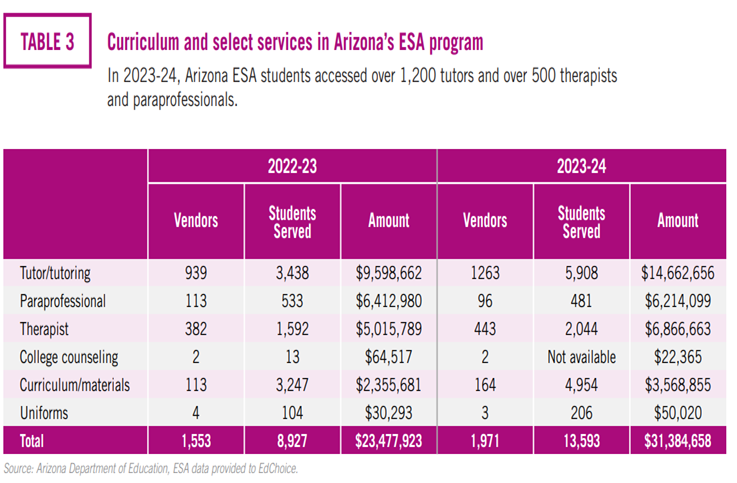
Don't look now, but dance and art studios, dojos and a whole lot more have entered the Arizona ESA chat:
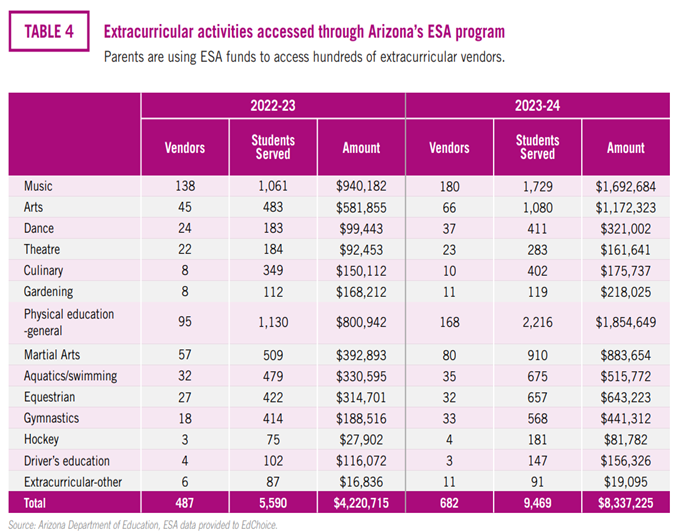
Choice supporters with a vision beyond trying to fill a limited supply of empty seats and/or creating a tuition inflation spiral must create bills allowing supply to increase with demand.
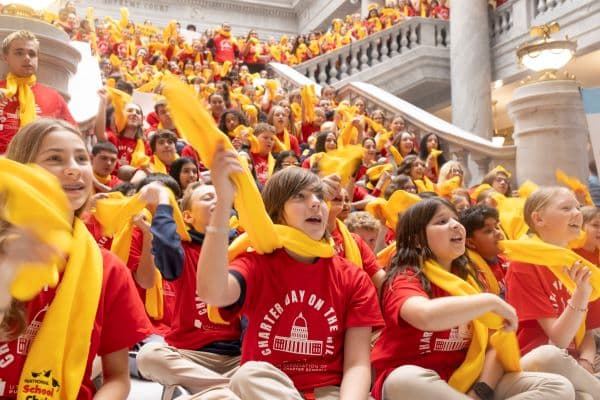
Utah students celebrate National School Choice Week at the state capitol. Photo courtesy of National School Choice Week
In the 1949 Looney Tunes short “Mouse Wreckers,” two mind-manipulating rodents named Hubie and Bertie try to chase award-winning mouser Claude Cat out of his home by driving him crazy. They bang him on the head with a fireplace log, throw a stick of dynamite on Claude’s nap cushion, and even frame him for antagonizing a bulldog, who pummels him.
 The last straw is when the mice nail all the living room furniture to the floor while Claude is napping. Thinking he is stuck on the ceiling, he jumps up to what he thinks is the floor. When he opens a bottle of nerve tonic, all the liquid “rises” to what Claude thinks is the ceiling.
Similar confusion over ceilings and floors is at the heart of a legal battle in Utah, where a trial court judge ruled that the legislature figuratively bumped its head on the state constitution when it passed the Utah Fits All Scholarship Program in 2023.
Third District Judge Laura Scott wrote in her ruling that the state constitutional mandate that the Legislature establish and maintain a public education system is a ceiling. The state cannot create alternatives. If it were a floor, the legislature would have the authority to create other publicly funded education programs in addition to the public school system.
In separate appeals filed last week, the Utah Attorney General’s Office, along with two parents represented by the Institute for Justice and EdChoice Legal Advocates, each say that the judge erred in calling the constitution’s education clause a ceiling. They argue it is a floor.
“The legislature is already meeting its constitutional mandate to provide a free public education system devoid of sectarian control and open to all children. Plaintiffs do not argue otherwise,” the state’s appeal reads. “The district court recognized that Plaintiffs’ Article [X] claim fails as a matter of law if the educational provisions set a floor rather than a ceiling on legislative power.”
However, the lower court “created new limitations on the Legislature out of whole cloth,” according to the parents’ appeal.
The Utah Fits All Scholarship Program took effect in the fall of 2024 and gives eligible K-12 students up to $8,000 a year for private school tuition and other approved costs. In the first year, more than 27,000 students applied for 10,000 available scholarships. Unlike in South Carolina, where families were left scrambling last year after the state Supreme Court struck down its scholarship program, Utah families are allowed to continue using the program while the case is under appeal and will likely to be able to finish out the school year.
One of two cases that the judge relied on was Bush v. Holmes, which the parents’ attorneys called “the sole outlier” on the list of court decisions from other states.
The 1999 complaint challenged the Florida Opportunity Scholarship Program. In it, the Florida Supreme Court ruled in 2006 that the program violated the constitution’s provision requiring a “uniform” system of public schools for all students.
Scott wrote that the Florida provision “acts as a limitation on legislative power” and that in spelling out how something must be done, it effectively forbids it from being done differently.
The Utah parents’ attorneys called Florida’s provision “unique” and different from the broader language in the Utah Constitution.
“But even if Florida had analogous language to Utah’s Education Article — and it does not — Holmes is a singularly unpersuasive decision. One need only compare the majority and dissenting opinions to appreciate how flawed the majority’s reasoning was and how glaring are its many errors.”

Maria Ruiz and thousands of other families could lose their ability to choose schools that best fit their children’s educational needs if the Utah Supreme Court upholds a lower court ruling striking down the Utah Fits All ESA program. Photo courtesy of Institute for Justice
For the thousands of families who relied on the program, the stakes couldn’t be higher as they now find themselves under the shadow cast by the district court’s order just months before a new school year begins.
“In the interest of removing that shadow as soon as practicable so that Utah families can plan for their children’s upcoming academic year without disruption, Parents ask for this Court’s review,” the attorneys wrote in the parents’ appeal.
At the end of Mouse Wreckers, Claude races screaming from the house and clings, trembling, to a tree. The mice roast cheese and congratulate themselves.
“That upside-down room was the pièce de résistance,” Bertie says to a laughing Hubie.
Attorneys defending Utah’s scholarship families hope the state’s high court will flip the state constitution right-side up.

Opponents of education freedom, facing a series of legislative defeats, have responded by going off the deep end with conspiracy theories and crackpot fables. The formula works something like this: start with tortured and incomplete reading of the research on school choice which ignores a large majority of the findings and studies. Add a fabricated history of the K-12 choice movement that ignores the likes of Thomas Paine and John Stuart Mill, and that implicitly requires you to believe that such prominent left of center luminaries such as Daniel Patrick Moynihan, Jack Coons, Stephen Sugarman and Howard Fuller (among many others) were either knowingly or unknowingly part of a vast right-wing conspiracy. The bards singing this saga also want you to ignore the fact millions of Black and Hispanic families have voluntarily entrusted choice schools with the education of their children. This vast right-wing conspiracy is a racist vast right-wing conspiracy meant to destroy public education!
Quite appropriately, neither lawmakers nor teachers seem to be buying much of this double-plus good duck-speak. EdChoice and Morning Consult released conducted a national survey of K–12 teachers. In addition to hopeful signs of optimism regarding the teaching profession and some signs of improvement in student behavior and absenteeism, the survey found strong support for ESA policies:
 Public school teachers send their children to private schools at approximately twice the rate of the general public. Little surprise there, as they have a front row seat to district dysfunctionality. The Ed Choice survey also shows strong support for vouchers, charter schools and open-enrollment policies. Despite a non-stop agit-prop effort by unions, most teachers support families having options.
 Julius Caesar led Roman forces to victory in the decisive battle of the conquest of Gaul at Alesia. Having pursued the Gauls to a fortified city, Caesar first surrounded the city with a wall (to keep the Gauls trapped in Alesia) and then a second wall (to keep Roman forces protected from a relief army). Having completed these and other siegeworks, Caesar began the process of starving a surrender out of Alesia. Vercingetorix, the commander in Alesia, forced his non-combatants (women, children and elderly men) out of the city and into the no-man’s land between the city wall and the newly built interior Roman wall. The cruel decision had two aims- first to stretch the supply of food for the defenders, and second to convince the Romans to stretch their own limited supplies.
Vercingetorix, who had previously been running a guerrilla-style campaign attacking Roman supply lines, underestimated Caesar. Caesar was only willing to leave a single way out for his opponents. Caesar refused the refugees, and when a huge Gallic relief army attacked the outer Roman wall while Vercingetorix’s forces assaulted the inner wall, Caesar defeated both forces. After multiple failed assaults, the relief army withdrew, and Vercingetorix surrendered.
Why the trip down historical memory lane? In a Vercingetorix-like move, a bill in Oklahoma proposes to cast more than 1,400 Oklahoma students out of the state’s personal use tax credit program. Oklahoma’s potentially revolutionary refundable personal use tax credit inspired your humble author to write a study on the promise of the approach. Oklahoma has by far the most potent personal use tax credit, but improvement opportunities include eliminating or lifting the statewide cap on funding and the limiting of participation to accredited private schools. The accreditation requirement puts any new private school in the position of competing with established private schools whose students can access the credit for years as they seek accreditation.
As noted in the study:
“Oklahoma covers 68,577 square miles in land area, so 160 participating private schools is only one for every 480 square miles in the state. The state’s population of course is not distributed evenly throughout the state, but for context: Oklahoma has more than 1,700 public schools. The relative scarcity of private schools in the state makes the onboarding of new private schools crucial to the success of the program. Educators could create new private schools, especially in areas in which demand exceeds supply. Unfortunately, lawmakers did not design the Oklahoma Parental Choice Tax Credit Act in a fashion that recognizes the need for additional private schools.”
In other words, a requirement for private school accreditation that does not provide an onramp for new school supply looks like a visit from our old nemesis, the Baptist and Bootlegger coalition.

A reasonable approach adopted by multiple states to address this issue allows new schools to participate in choice programs while in the process of seeking accreditation. Unfortunately, legislation currently pending in the Oklahoma legislature would tighten accreditation requirements, eliminate 30 schools with private accreditation from participating, and upend the education of 1,400 students in the process. In short, it fails to address one major shortcoming of the Oklahoma program and makes another one worse. Several school choice and religious liberty groups have communicated their opposition.
The legislation includes a trade: grandfathering credit participants from year to year in return for tightening accreditation. The cap created the possibility that families might not be able to participate from year to year; eliminate the cap, eliminate the problem. While everyone should feel sympathy for families unable to continue participating in the credit because of the cap, the interests of students whose education solutions lie in startup schools stand as no less worthy. In fact, grandfathering will have the effect of casting other students out.
Balancing the demand and supply side of the choice equation will be vital to developing a truly flourishing education space.

