
Jason Bedrick and I published a piece at the Daily Signal about the Roosevelt Elementary School District in South Phoenix. The Roosevelt district has experienced enrollment loss for decades, and the school board of the district has announced plans to close five schools.
I first learned of Roosevelt Elementary School district some 20 years ago when a Roosevelt student brutally assaulted a co-worker’s child. The staff’s response was far less than satisfactory, but at the time, it was difficult to locate mid-year transfer spots for my co-worker’s children, even after we enlisted the aid of a person who specialized in such situations.
I’m happy to report that in 2025, it is less difficult for desperate parents to execute a mid-year transfer.

Multiple factors explain the decline of Roosevelt’s enrollment, including a nationwide baby bust that began around 2007. Students living in the boundaries of Roosevelt but attending other public schools, both districts and charters, outnumber ESA students approximately 10 to 1. So, Arizona’s open enrollment and charter statutes deserve more credit than the ESA program. An examination of the reviews of Roosevelt Elementary schools left by students, parents and staff on private school navigation websites made my co-worker’s experience from 20 years ago seem to be far from an isolated, unfortunate incident. Here are some examples:
“Please do not take your children here. Almost every child is bullied, and the staff won't do anything. If you truly care about your kid's school experience, don't sign them up.”
“This school makes kids act out by tolerating relentless bullying and cruel treatment by teachers for special needs kids.”
“The kids get bullied, my son got a Black eye the 1st day of school and they told me that because he didn't know who the kid was there was nothing they could do.”
“This school should be shut down.”
“…They don’t take care of bullies; they just ignore the problem and leave the kids (to) fend for themselves; it seems that this is a safe place for bullies not for other kids. I would recommend that you should never enroll your kid here, and if you do, be prepared to endure what seems to be a never ending bully problem, and its not only the teachers that don't do anything about bullies.”
“I would rate it ZERO stars. This school is not SAFE NOR ORGANIZED. Roosevelt school district needs to step up their game or close this school down.”
“Students are constantly fighting or involved in some type of confrontational altercation with each other. Teachers behave more as peers than educators. My grandchild has attended this school for the past five years. I have seen very little improvement. If it were my choice, they would not attend.”
People who work for school districts have organized, and they use the fact that Americans dislike school closures. I would submit, for your consideration, that it is not wicked legislators or dastardly choice supporters who have forced the looming closures of Roosevelt schools. Rather, it has been due to the action of thousands of families who live in the boundaries of the district, who desire safe schools that will equip their children with the knowledge, habits and skills necessary for success. They have chosen to prioritize the long-term interests of their children over the short-term preferences of Roosevelt staff in increasing numbers for decades.
This is a thumbs up for Roosevelt students, whose interests the community has collectively put first, more than a thumbs down for the district schools. Roosevelt district schools will remain the best funded option on a per-pupil basis and might just stage a comeback if they can secure the confidence of families regarding safety and academics. Some of my friends in Arizona’s K-12 reactionary community would prefer that Roosevelt schools receive unconditional immortality. It is difficult to view these folks as engaged in anything other than macabre traffic in other people’s children. Perhaps I judge too harshly; the Phoenix area K-12 industrial lobbying complex is probably large enough to delay the need for difficult decisions in Roosevelt. If they are willing to enroll their own children in Roosevelt schools through open enrollment or otherwise, they might be able to stave off the need for safety and academic improvements.
Opponents of choice in Phoenix have been avid users of choice. One of your humble author’s children graduated from a South Phoenix charter school just a few miles away from Roosevelt. He attended with the children of two gubernatorial nominees who campaigned against choice (including Gov. Katie Hobbs), a child of the president of the Arizona Education Association and a co-founder of Save Our Schools Arizona, among others. Rather than choosing safe and academically performing charter and district schools, this community could instead put their families where their mouths are and lead the renaissance of Roosevelt district schools by enrolling their own children and grandchildren.
While this noble project gets off the ground, we in the Arizona choice community will continue to prioritize the interest of families above those institutions.

Blossom Montessori School for the Deaf has served students for more than two decades. Photo courtesy of Blossom Montessori School for the Deaf
CLEARWATER, Fla. – More than 20 years ago, Julie Rutenberg and Colette Derks harnessed some of the first private school choice programs in America to create a bespoke little school they knew their community needed. All these years later, Blossom Montessori School for the Deaf continues to show what kind of diverse, ever-expanding options are possible when education choice is in the mix.
Rutenberg founded Blossom in 2003. Derks, now the associate director, helped stand it up. As the name suggests, the PreK-6 school serves students who are deaf or hard of hearing (along with their siblings) and the children of deaf adults. Occasionally, Blossom also serves students who do not have any hearing loss because their parents want them to have more one-on-one attention. Over the years, nearly every one of its 250-plus students used a state-funded choice scholarship.
Rutenberg and Derks were working at a community center for deaf people when they got the idea for the school. They thought the hands-on, self-directed, mastery-based approach of Montessori offered a good alternative to the students they saw having a tough time in traditional schools.
“They’re able to move around the manipulatives when they’re working out their (math) problems, when they’re building words for reading, working with writing skills,” Derks said. “We really love how Montessori just kind of gets the whole body involved when learning.
“You’re not just sitting at a table looking at a paper or a book all day, (where) everybody’s on the same level,” she continued. “It really helps the student to be able to kind of grow and develop at their own pace.”
Rutenberg and Derks praised the public-school programs in their area that are serving similar students. Offering an option, they said, is not a knock on them.
“We’re just a different way of learning,” said Rutenberg, who attended Montessori schools as a child. “We’re not always going to be the right fit, either. Our goal is just to make sure the child comes first.”
Blossom got its start using three rooms inside another Montessori school. But for most of its existence, it’s been housed in a trim, beige building in an eclectic office park, right next to an ice-skating rink.
Most of the families it serves are working class. Most live in the immediate area. Some, though, drive an hour or more each way so their kids can attend. Others have moved from as far as Daytona Beach – on the other coast of Florida – because they wanted the school that much.

Quinten Caroline, 7, in costume as Leonardo DaVinci as part of a school project on Italy. Photo courtesy of Blossom Montessori School for the Deaf
“It’s nothing but positive with everything they do. They see the kids as perfect the way they are,” said Anastasia Caroline, whose son Quinten, 7, attends Blossom. “In a normal school, you’re not always going to get that love, that acceptance.”
Blossom represents so many choice-fueled trend lines. It’s a microschool. It’s a Montessori school. It’s a school for students with special needs. In Florida, where choice is the new normal, all those options are growing.
Microschools are so much of a thing now, they’re routinely showing up in local news stories (like this one and this one). I don’t know if anybody has a good handle on the total number, in part because there isn’t an official definition. But Microschool Florida, an excellent resource, puts the number at 156 and counting.
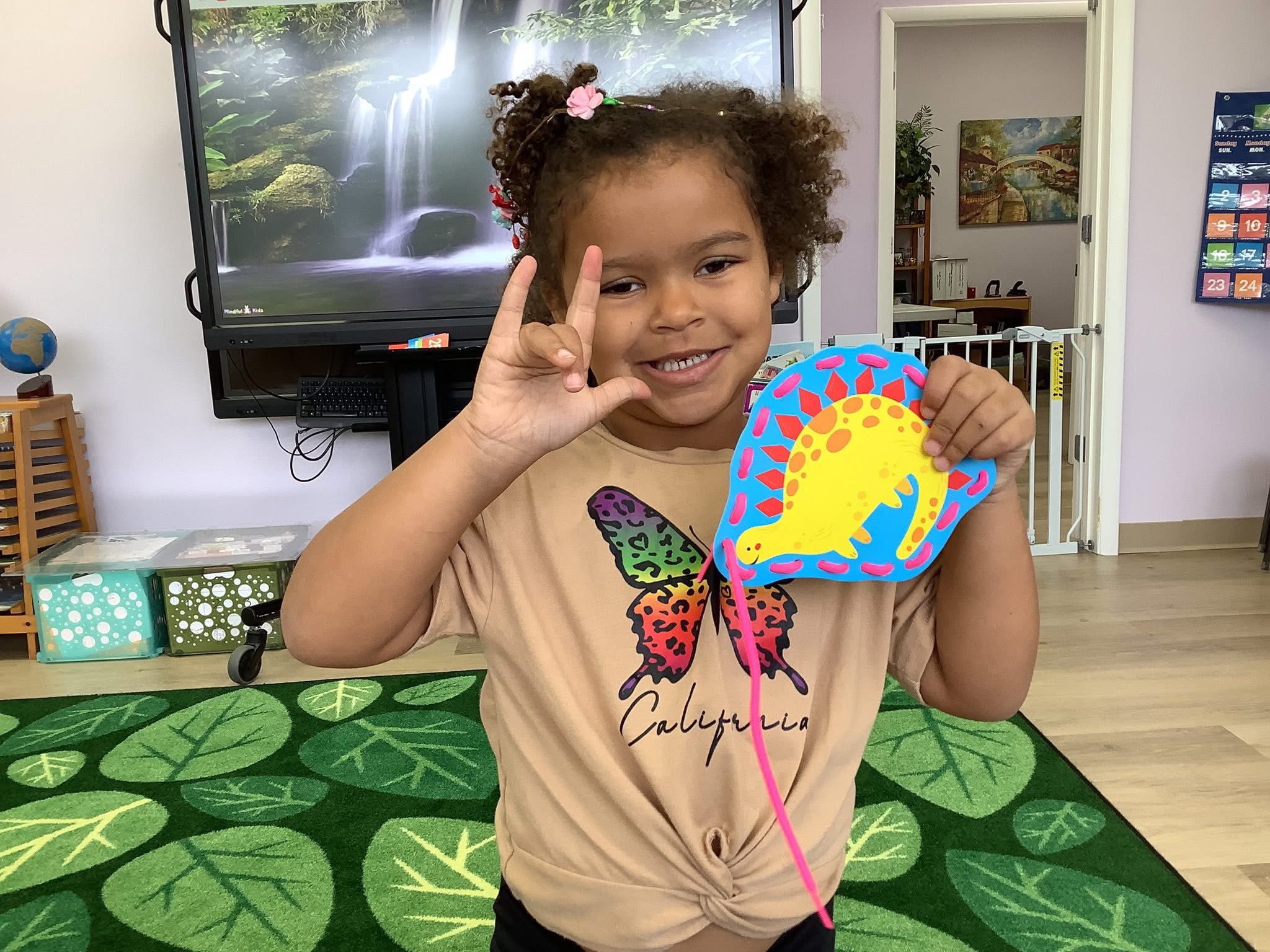
A student says "I love you" in American Sign Language. Photo courtesy of Blossom Montessori School for the Deaf
Meanwhile, there are at least 150 private Montessori schools participating in Florida’s choice programs. I say at least because that’s how many are listed in the state’s private school directory with Montessori in their name.
To be sure, there are plenty of Montessori-influenced private schools that don’t have Montessori in their names (like this one, this one, and this one). There are also plenty of school-like entities, like this hybrid operation in Tampa, and this homeschool co-op in South Florida, that are Montessori influenced, but aren’t official private schools, and aren’t tracked in any kind of official way, yet are funded in part by parents using flexible, state-funded education savings accounts.
Finally, there are more options for students with special needs. There’s more inclusion because more families can now afford schools that were once out of reach. (Check out, for example, the trend lines for scholarships for students with unique abilities in our white paper on Catholic schools.)
At the same time, there are more specialized schools, because, with choice, education entrepreneurs can more easily create them. Not far from Blossom, schools like this one, this one, this one, and this one, are all thriving.
“We would not be here today if we didn’t have the opportunity to use the choice scholarships,” Derks said. “It really is so important because the world today tries to fit everybody into the same box. (But) we’re all individuals, and we’re all our own person, and we learn differently, and we grow differently.”
Caroline, who works as an office manager at a medical practice, secured choice scholarships for both her sons, Quinten, and Silas, 10. She said private school would not have been possible otherwise.
Both use the Family Empowerment Scholarship for Students with Unique Abilities, an ESA Florida created in 2014. Once called the Gardiner Scholarship, it now serves 122,000 students. (Prior to the FES-UA Scholarship, Florida had a scholarship for students with special needs called the McKay Scholarship. It was merged with the FES-UA Scholarship in 2022.)
Caroline said she chose Blossom because she wanted Quinten immersed both in a sign language program and in the tight-knit deaf community. The school provides the warmth, structure, and positive reinforcement he needs, she said.
“They don’t allow bullying. They don’t put kids down. They just celebrate their growth and watch them blossom,” Caroline said. “It’s completely an amazing school for my child.”

Longtime NextSteps readers know that your humble author has been holding forth on the Baptist and Bootlegger problem that helped throttle the growth of the charter school movement. The term “Baptists and Bootleggers” comes from economics and references prohibition, which Baptists supported out of religious conviction, and bootleggers supported to limit competition in their manufacture and sale of alcohol. In the context of charter schools, it describes how elements of the charter school movement, in this case large charter management organizations, or CMOs, partnered with the anti-charter usual suspects to limit competition through 900-page applications and charter laws hewing closely to sponsored “model” bills that mysteriously produced few charter schools. This, of course, was not the only problem to afflict the charter movement in recent years; see Robert Pondiscio’s recent account for example.
In 2024, I sounded the alarm that the private school choice movement was far from immune to this danger. Alas, Bootleggers’ tactics have indeed appeared in recent school choice legislation. For example, Iowa’s “ESA” law requires students who choose to spend their funds on private school to attend an accredited one. The new Texas legislation makes only accredited private schools eligible, and in a late amendment, a provision was added that requires private schools to have been operating for two years before becoming eligible to participate. Competition is apparently good for Texas public schools, but not terribly desirable for established private schools in Texas. Sigh. Stay on the lookout; accredited Texas private schools that have been operating for more than two years might just start selling some illicit liquid products at their bake sales...

There are other examples, but you get the point. Why does this matter? Well, if you stimulate demand for a product but restrict the supply of new entrants, you hang a sign on your back that says:

Luckily, this does not need to be the case, but the devil is in the details of bill design. Some make the mistake of assuming any choice program will automatically lead to cost inflation, but this is not the case if supply can rise to meet expanded demand. EdChoice has a new study out on the supply side of school choice, in which they examined the purchasing data from Arizona’s ESA program for years one and two of universal eligibility. Arizona’s ESA program had a very large increase in participation during these years. Without a corresponding increase in schools and vendors, cost inflation could get underway.
Fortunately, Arizona’s program saw a healthy increase in the supply of new schools to accompany expanded eligibility:

Not only did the number of participating schools increase from 510 to 661, but Arizona also saw broad increases in the types of schools accessed by families, including large increases in private religious schools, non-religious private schools, special education focused schools, co-ops and post-secondary schools. Baptist and bootlegger anti-competitive provisions would have prevented this flourishing, but fortunately, Arizona lawmakers wisely avoided it. When the Goldwater Institute examined private school tuition trends after the universal expansion, they found no evidence of a demand induced inflationary spiral.
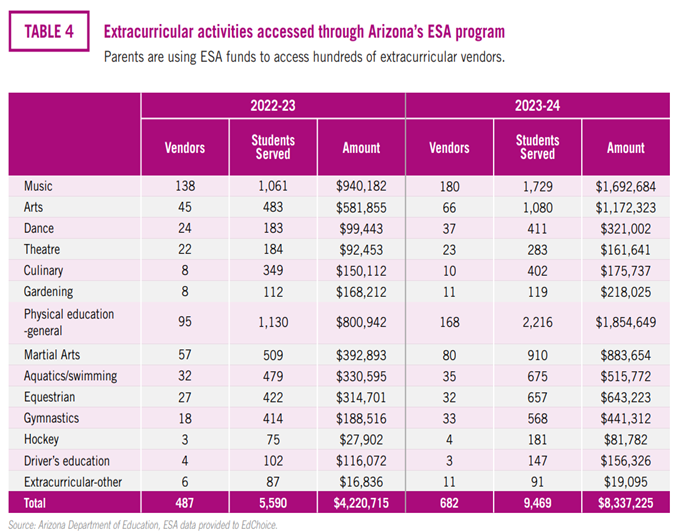
Arizona vendors other than schools also increased their participation in the program, increasing competition.
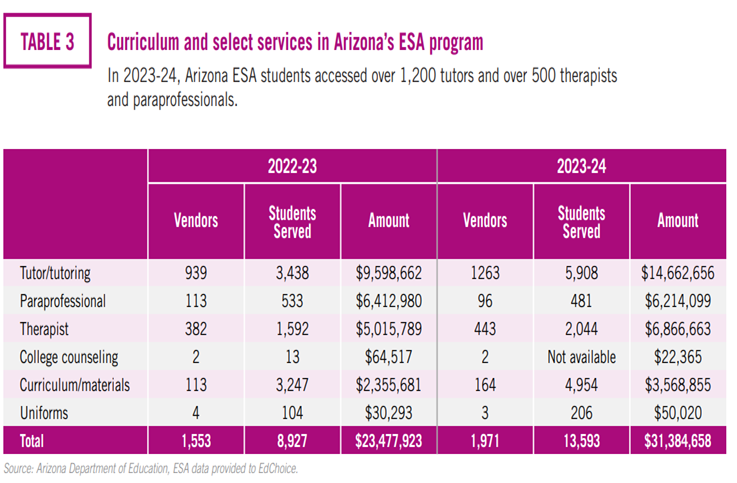
Don't look now, but dance and art studios, dojos and a whole lot more have entered the Arizona ESA chat:
Choice supporters with a vision beyond trying to fill a limited supply of empty seats and/or creating a tuition inflation spiral must create bills allowing supply to increase with demand.
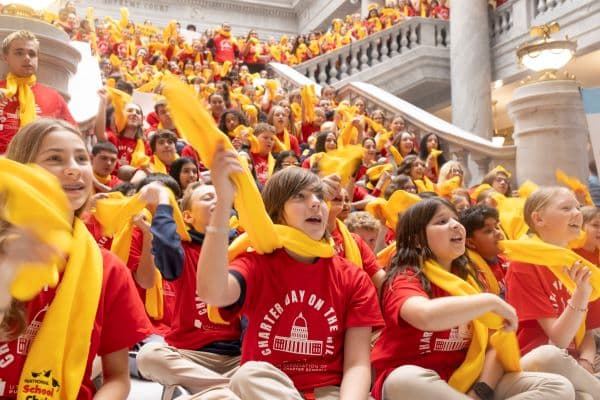
Utah students celebrate National School Choice Week at the state capitol. Photo courtesy of National School Choice Week
In the 1949 Looney Tunes short “Mouse Wreckers,” two mind-manipulating rodents named Hubie and Bertie try to chase award-winning mouser Claude Cat out of his home by driving him crazy. They bang him on the head with a fireplace log, throw a stick of dynamite on Claude’s nap cushion, and even frame him for antagonizing a bulldog, who pummels him.
 The last straw is when the mice nail all the living room furniture to the floor while Claude is napping. Thinking he is stuck on the ceiling, he jumps up to what he thinks is the floor. When he opens a bottle of nerve tonic, all the liquid “rises” to what Claude thinks is the ceiling.
Similar confusion over ceilings and floors is at the heart of a legal battle in Utah, where a trial court judge ruled that the legislature figuratively bumped its head on the state constitution when it passed the Utah Fits All Scholarship Program in 2023.
Third District Judge Laura Scott wrote in her ruling that the state constitutional mandate that the Legislature establish and maintain a public education system is a ceiling. The state cannot create alternatives. If it were a floor, the legislature would have the authority to create other publicly funded education programs in addition to the public school system.
In separate appeals filed last week, the Utah Attorney General’s Office, along with two parents represented by the Institute for Justice and EdChoice Legal Advocates, each say that the judge erred in calling the constitution’s education clause a ceiling. They argue it is a floor.
“The legislature is already meeting its constitutional mandate to provide a free public education system devoid of sectarian control and open to all children. Plaintiffs do not argue otherwise,” the state’s appeal reads. “The district court recognized that Plaintiffs’ Article [X] claim fails as a matter of law if the educational provisions set a floor rather than a ceiling on legislative power.”
However, the lower court “created new limitations on the Legislature out of whole cloth,” according to the parents’ appeal.
The Utah Fits All Scholarship Program took effect in the fall of 2024 and gives eligible K-12 students up to $8,000 a year for private school tuition and other approved costs. In the first year, more than 27,000 students applied for 10,000 available scholarships. Unlike in South Carolina, where families were left scrambling last year after the state Supreme Court struck down its scholarship program, Utah families are allowed to continue using the program while the case is under appeal and will likely to be able to finish out the school year.
One of two cases that the judge relied on was Bush v. Holmes, which the parents’ attorneys called “the sole outlier” on the list of court decisions from other states.
The 1999 complaint challenged the Florida Opportunity Scholarship Program. In it, the Florida Supreme Court ruled in 2006 that the program violated the constitution’s provision requiring a “uniform” system of public schools for all students.
Scott wrote that the Florida provision “acts as a limitation on legislative power” and that in spelling out how something must be done, it effectively forbids it from being done differently.
The Utah parents’ attorneys called Florida’s provision “unique” and different from the broader language in the Utah Constitution.
“But even if Florida had analogous language to Utah’s Education Article — and it does not — Holmes is a singularly unpersuasive decision. One need only compare the majority and dissenting opinions to appreciate how flawed the majority’s reasoning was and how glaring are its many errors.”

Maria Ruiz and thousands of other families could lose their ability to choose schools that best fit their children’s educational needs if the Utah Supreme Court upholds a lower court ruling striking down the Utah Fits All ESA program. Photo courtesy of Institute for Justice
For the thousands of families who relied on the program, the stakes couldn’t be higher as they now find themselves under the shadow cast by the district court’s order just months before a new school year begins.
“In the interest of removing that shadow as soon as practicable so that Utah families can plan for their children’s upcoming academic year without disruption, Parents ask for this Court’s review,” the attorneys wrote in the parents’ appeal.
At the end of Mouse Wreckers, Claude races screaming from the house and clings, trembling, to a tree. The mice roast cheese and congratulate themselves.
“That upside-down room was the pièce de résistance,” Bertie says to a laughing Hubie.
Attorneys defending Utah’s scholarship families hope the state’s high court will flip the state constitution right-side up.

Opponents of education freedom, facing a series of legislative defeats, have responded by going off the deep end with conspiracy theories and crackpot fables. The formula works something like this: start with tortured and incomplete reading of the research on school choice which ignores a large majority of the findings and studies. Add a fabricated history of the K-12 choice movement that ignores the likes of Thomas Paine and John Stuart Mill, and that implicitly requires you to believe that such prominent left of center luminaries such as Daniel Patrick Moynihan, Jack Coons, Stephen Sugarman and Howard Fuller (among many others) were either knowingly or unknowingly part of a vast right-wing conspiracy. The bards singing this saga also want you to ignore the fact millions of Black and Hispanic families have voluntarily entrusted choice schools with the education of their children. This vast right-wing conspiracy is a racist vast right-wing conspiracy meant to destroy public education!
Quite appropriately, neither lawmakers nor teachers seem to be buying much of this double-plus good duck-speak. EdChoice and Morning Consult released conducted a national survey of K–12 teachers. In addition to hopeful signs of optimism regarding the teaching profession and some signs of improvement in student behavior and absenteeism, the survey found strong support for ESA policies:
 Public school teachers send their children to private schools at approximately twice the rate of the general public. Little surprise there, as they have a front row seat to district dysfunctionality. The Ed Choice survey also shows strong support for vouchers, charter schools and open-enrollment policies. Despite a non-stop agit-prop effort by unions, most teachers support families having options.
 Julius Caesar led Roman forces to victory in the decisive battle of the conquest of Gaul at Alesia. Having pursued the Gauls to a fortified city, Caesar first surrounded the city with a wall (to keep the Gauls trapped in Alesia) and then a second wall (to keep Roman forces protected from a relief army). Having completed these and other siegeworks, Caesar began the process of starving a surrender out of Alesia. Vercingetorix, the commander in Alesia, forced his non-combatants (women, children and elderly men) out of the city and into the no-man’s land between the city wall and the newly built interior Roman wall. The cruel decision had two aims- first to stretch the supply of food for the defenders, and second to convince the Romans to stretch their own limited supplies.
Vercingetorix, who had previously been running a guerrilla-style campaign attacking Roman supply lines, underestimated Caesar. Caesar was only willing to leave a single way out for his opponents. Caesar refused the refugees, and when a huge Gallic relief army attacked the outer Roman wall while Vercingetorix’s forces assaulted the inner wall, Caesar defeated both forces. After multiple failed assaults, the relief army withdrew, and Vercingetorix surrendered.
Why the trip down historical memory lane? In a Vercingetorix-like move, a bill in Oklahoma proposes to cast more than 1,400 Oklahoma students out of the state’s personal use tax credit program. Oklahoma’s potentially revolutionary refundable personal use tax credit inspired your humble author to write a study on the promise of the approach. Oklahoma has by far the most potent personal use tax credit, but improvement opportunities include eliminating or lifting the statewide cap on funding and the limiting of participation to accredited private schools. The accreditation requirement puts any new private school in the position of competing with established private schools whose students can access the credit for years as they seek accreditation.
As noted in the study:
“Oklahoma covers 68,577 square miles in land area, so 160 participating private schools is only one for every 480 square miles in the state. The state’s population of course is not distributed evenly throughout the state, but for context: Oklahoma has more than 1,700 public schools. The relative scarcity of private schools in the state makes the onboarding of new private schools crucial to the success of the program. Educators could create new private schools, especially in areas in which demand exceeds supply. Unfortunately, lawmakers did not design the Oklahoma Parental Choice Tax Credit Act in a fashion that recognizes the need for additional private schools.”
In other words, a requirement for private school accreditation that does not provide an onramp for new school supply looks like a visit from our old nemesis, the Baptist and Bootlegger coalition.

A reasonable approach adopted by multiple states to address this issue allows new schools to participate in choice programs while in the process of seeking accreditation. Unfortunately, legislation currently pending in the Oklahoma legislature would tighten accreditation requirements, eliminate 30 schools with private accreditation from participating, and upend the education of 1,400 students in the process. In short, it fails to address one major shortcoming of the Oklahoma program and makes another one worse. Several school choice and religious liberty groups have communicated their opposition.
The legislation includes a trade: grandfathering credit participants from year to year in return for tightening accreditation. The cap created the possibility that families might not be able to participate from year to year; eliminate the cap, eliminate the problem. While everyone should feel sympathy for families unable to continue participating in the credit because of the cap, the interests of students whose education solutions lie in startup schools stand as no less worthy. In fact, grandfathering will have the effect of casting other students out.
Balancing the demand and supply side of the choice equation will be vital to developing a truly flourishing education space.
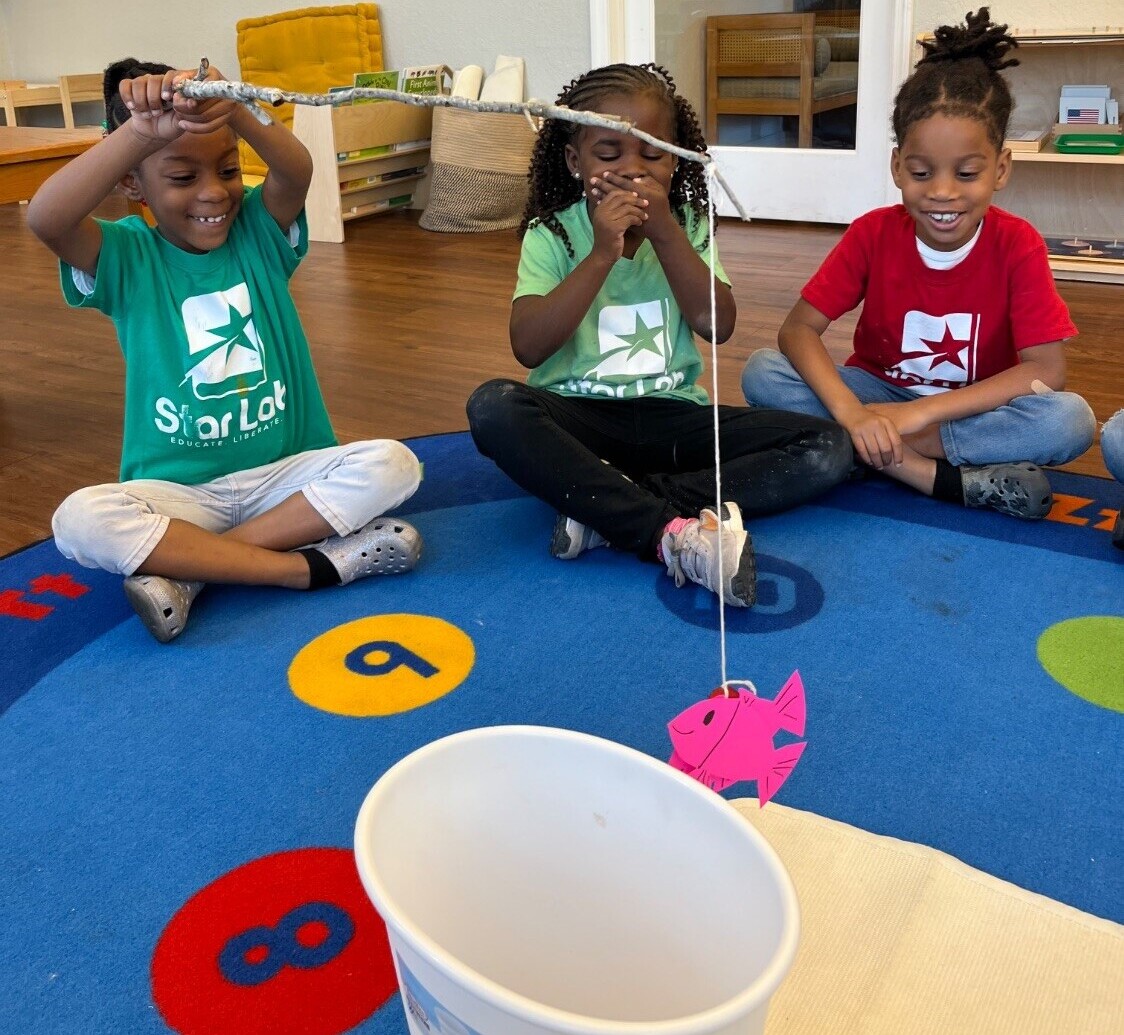
Star Lab students learn through creative activities like this fishing game. Photo courtesy of Star Lab.
SARASOTA, Fla. – Alison Rini thought her destiny was to be the principal at a traditional public school. She had been the principal at a charter school, the assistant principal at a Title I district school, and the assistant principal at a magnet school for gifted students.
But in the wake of Covid, Rini began to feel “adrift.” The system, in her view, proved incapable of helping students, particularly low-income students, overcome the academic and behavioral deficits left by distance learning. Some students were being promoted, even though they weren’t ready. Others were being labelled disabled, even though they weren’t.
“My path wasn’t leading to where I thought it would,” Rini said. “It felt like they just wanted me to grease the wheels to keep them turning. And people were getting chopped up in the gears.”
“I just felt there’s got to be a better way.”
In 2023, Rini took a leap of faith, one that is becoming common for public school teachers in school-choice-rich states like Florida.
She decided to start her own school.
For other recent examples, see here, here, here, here, and here.
With help from The Drexel Fund, a philanthropy that helps promising new private schools start and/or grow, Rini took a year to plan. She visited successful schools across the country; acquired deeper knowledge about the business side of running a school; and mapped out exactly what she wanted to create. Her vision was based on 20-plus years of learning the best approaches from teaching in all types of schools, from New York City to the Virgin Islands to the Gulf Coast of Florida.
The result is Star Lab, a private microschool that opened last fall with a handful of kindergartners and is now set to expand. It’s housed in the recreation center of an oak-graced public housing complex in Newtown, a historic Black neighborhood in Sarasota.
Watching students walk up on the first day of school in their Star Lab shirts was “an out of body experience,” Rini said.
“It was just such a dream come true,” she said. “And this year has been such a joy, to behold the power of just tailoring something around kids – not around adults, not around the system.”
Star Lab is a rich blend of philosophies and practices that reflect Rini’s background in education and neuroscience. (Rini earned a bachelor’s degree in neuroscience and behavior, and master’s degrees in elementary education and education leadership, all from Columbia.)
Star Lab’s approach to reading instruction is grounded in “science of reading” research. It employes hands-on Montessori materials to help students better grasp some academic concepts at their own pace. It embraces the Finnish approach to student movement, which sees frequent play breaks as optimal for learning. It also emphasizes individualized lessons, mastery learning, lots of direct instruction, and progress monitoring via a custom-built dashboard.
“We're not just educating,” the school website says, “we're preparing future leaders, innovators, and global citizens who are as healthy and mindful as they are intellectually empowered.”
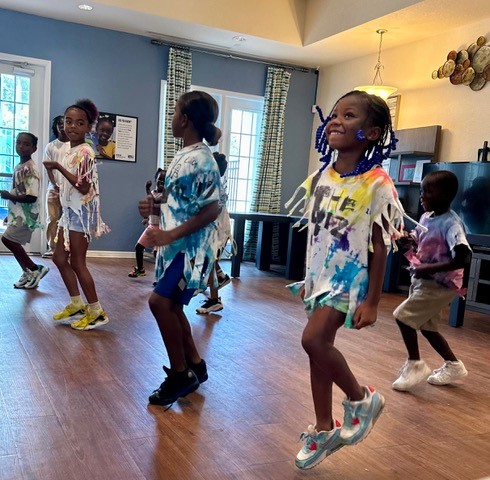
Exercise and mindfulness are an important part fo the daily routine at Star Lab. Photo courtesy of Star Lab
Every morning at Star Lab starts with 25 minutes of exercise and five minutes of “mindfulness” activities. Monday through Thursday, the students are immersed in core academics. Fridays are for group activities like drama, field trips, and guest speakers.
Rini guarantees parents that Star Lab students will perform at or above grade level in reading and math. Most of the students in the neighborhood are not at that level, which is why Rini chose to be here. According to the most recent state stats, 38% of Black students in Sarasota County are reading at grade level, compared to 68% of White students.
“I just felt drawn to it,” Rini said of Newtown. “Super wealthy people already have school choice.” But all families deserve the ability to choose, Rini continued.
Every student at Star Lab uses a state choice scholarship and there are no other fees.
Rini could be a poster child for the wave of education entrepreneurs who are rising in Florida and other choice-rich states – both for the promise they represent, and the pitfalls they continue to face.
Due to fire-code complications, Star Lab could only serve five students this year. Rini didn’t learn about the snag until two weeks before school opened, and the remedy – a $97,000 sprinkler system – wasn’t financially possible. A local philanthropy recently stepped forward to help the housing authority pay for the sprinkler system. But Rini’s case isn’t an isolated one, as stories like this one and reports like this one highlight.
With the stars finally lined up at Star Lab, 14 students have already enrolled for this fall, and more are expected.
The draws are many.
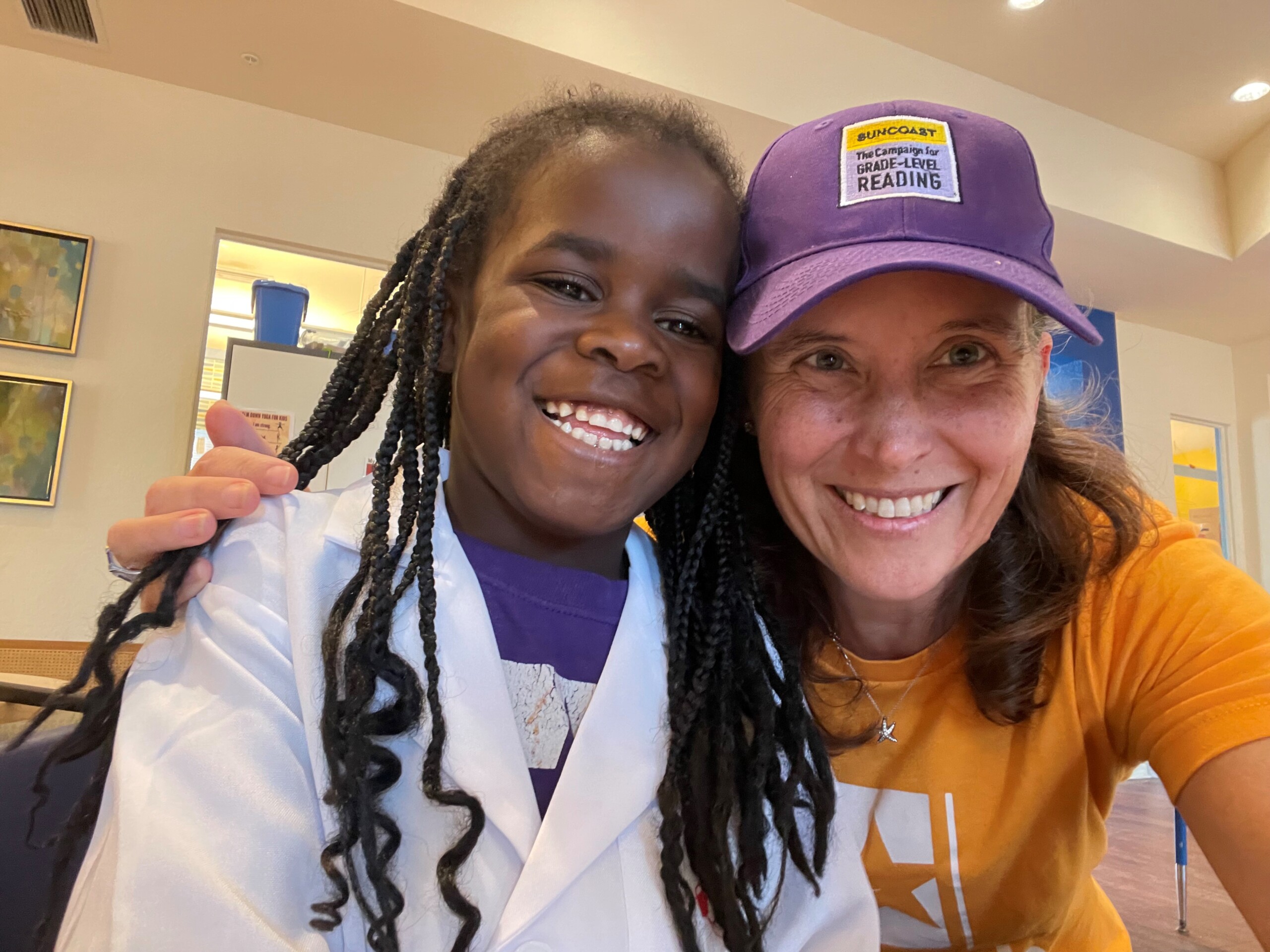
Star Lab founder Alison Rini, right, takes a few minutes for a selfie with a student.
For families who live in the complex, the school couldn’t be more convenient. The individual attention is tough to match. (Besides Rini, there’s another teacher and an assistant.) And it’s clear the school is enmeshed in the community. 
Last month, the school hosted a “design lab” with local college professors and more than a dozen parents in the neighborhood, so the parents could discuss the educational needs of their children and how they could be better met. A few days later, Star Lab students built a float for the Newtown Easter Parade. In early May, the school hosted an international food festival for the neighborhood, so the students, their families, and their neighbors could, in Rini’s words, “travel the world through their taste buds.”
It’s not just families who are benefiting from the emergence of distinctive new schools like Star Lab.
“If you are not happy at your job, I would say don’t accept that as your fate,” Rini said, referring to other educators. “There are options, and some of them are already out there. And some of them don’t exist yet, but they might be in your head or in your heart.”
With choice, they don’t have to stay there.

Tim DeRoche featured the tale of an Arizona boy named Brayden in a Time Magazine piece on the shortcomings of open enrollment practice and law for students with disabilities:
"In May 2022, an Arizona mom named Karrie got a heartbreaking message from the local public school: Her son Brayden wouldn’t be allowed to return as a second-grader in the fall. The reason? Brayden had been diagnosed on the autism spectrum, and the school claimed that it didn’t have any more room for kids with disabilities."
Brayden’s family had moved outside the Tanque Verde district attendance boundary but had remained enrolled through the open enrollment statute. After Tanque Verde Unified officials went through the process of drawing up an Individual Education Plan with Brayden’s family, however, other Tanque Verde officials kicked him to the curb. They were able to do so because of a canard promoted by Arizona districts known as “program capacity.” The claim essentially is that while the district may have empty seats, it lacks “program capacity” to serve students with disabilities. Arizona districts thus prevent students with disabilities from participating in the state’s largest form of K-12 choice.
Time out! Important nerdy context: Arizona funds the education for students with disabilities by a weighted formula that is imperfect but goes up to ~x6 basic state aid. Charter schools are required to admit students by lottery; districts have a more recent lottery requirement that has a de facto “program capacity” loophole not allowed by the Arizona State Board for Charter Schools (equal protection challenge anyone?) Students with disabilities are overrepresented in Arizona’s ESA program, and there is, in addition, a scholarship tax credit program exclusively for students with disabilities. While districts claim to have “programs,” their SWD populations vary from year to year, as does their staffing.
Okay, time back in! Recently, Ben Scafadi performed an analysis of open enrollment in Kansas. In Kansas, as is generally the case, districts decide their capacity to accept open enrollment students. Scafadi decided to compare the number of seats made available through open enrollment to the overall enrollment trend in those same districts since 2019. Scafadi called this the “Change-in-Enrollment Method” to identify open enrollment capacity. Obviously, districts occasionally close schools, etc., but for the most part, the logic is unavoidable: if you were educating X number of students in 2019, there is every reason to view that as a floor for enrollment in 2024, absent unusual circumstances. Scafadi found discrepancies: 
Naturally, when I saw the Scafadi study, I thought, “Why not apply the ‘Change-in-Enrollment Method’ to Arizona School Districts for students with disabilities?” I filled a hat with the names of Arizona school districts, and purely by chance drew Tanque Verde Unified out of the hat. In 2019, the National Center on Education Statistics put the enrollment for students with disabilities for the Tanque Verde Unified School District at 286. The Arizona Department of Education put the 2025 enrollment for students with disabilities at 206. Thus, the special education “program” at Tanque Verde Unified shrank by 28% between 2019 and 2024, in small part because they purged Brayden.
The basic logic of the Scafadi change in enrollment method applies: if Tanque Verde’s special education “program” was 29% larger in 2019 than in 2025, why was there a need to disenroll Brayden? Moreover, an examination of school district enrollment trends for students with disabilities in Arizona districts generally show more districts losing enrollment for students with disabilities than those gaining.
Tanque Verde Unified is not alone. Collectively, the 10 Arizona school districts with the largest enrollment of students with disabilities in 2019 lost 1,786 students with disabilities since 2019, but there is approximately a 0% chance of a student with a disability accessing any of these districts through open enrollment. Two paths can be pursued to end the discrimination against students with disabilities in open enrollment. First, an enterprising attorney could explore whether the Arizona court system is willing to uphold the “Equal Privileges and Immunities” clause in the Arizona Constitution. Second, lawmakers could pass legislation defining district “program capacity” for students with disabilities as having an enrollment floor not less than their enrollment with students with disabilities at a past date (2010 is a nice even number) and require the districts to make spots available until reaching that enrollment figure.
“Brayden’s Law” has a nice ring to it.
The story: With less than a week to go before the U.S. Supreme Court hears arguments about the constitutionality of religious charter schools, supporters and opponents are making wildly different predictions about the possible effects.
Supporters, who include advocates for religious education, are framing a win for their side as a victory for religious freedom and a logical extension of recent rulings that affirmed faith-based schools’ right to participate in publicly funded programs.
“This is a way of getting new choice options in the context of performance accountability,” said Andy Smarick, a senior fellow at the Manhattan Institute, during a recent debate about religious charter schools sponsored by the American Enterprise Institute. “A small number of religious organizations might apply to run charter schools, and I think that’s wonderful and not going to change the world.”
The Manhattan Institute is among the organizations weighing in on the side of religious charter schools.
Opponents, which include the National Alliance for Public Charter Schools, are sounding the alarm over what they say could cripple a movement that began more than 30 years ago to launch innovative new public schools.
The other side: The National Alliance for Public Charter Schools warned that a ruling allowing religious charter schools could carry “catastrophic consequences” for the nation’s existing charter schools.
For religious charter schools to exist, they argue, the high court would have to redefine charter schools as private. That would overturn laws in 46 states, plus Washington, D.C., and Puerto Rico, that define charters as public and thus threaten their ability to be funded under the same per-pupil formulas as school districts.
Yes, and: Charter supporters also point out the potential for ripple effects, such as charter schools losing facilities funding, questions about teacher participation in state benefit programs, or more drastically, calls to halt the approval of new schools or even funding of existing ones.
“This could lead to the destruction of chartering or limiting of chartering,” said Kathleen Porter-MaGee, a managing partner at Leadership Roundtable, an organization that brings together laity and clergy to support the Catholic church.
Instead of extending charters to religious groups, she encouraged a doubling down on private K-12 scholarship programs, which are now established in 29 states, with Texas poised to become the 30th.
Expanding scholarship programs for private education would let faith-based schools maintain instructional and employment practices that align with their beliefs, free from government interference, while allowing them to serve families who would not have access without private funding.
Catch up: The legal and political battle rocketed to the Supreme Court shortly after two Catholic dioceses won approval from Oklahoma’s statewide virtual charter review board in 2023 to open St. Isidore of Seville Catholic School, an online charter school that would include the same Catholic teachings as the church’s in-person schools.
The fight pitted Republicans against one another, with the current Oklahoma attorney general taking a position opposite his GOP predecessor and filing a lawsuit. It also divided the charter school movement, with national groups forcefully opposing a legal argument that could redefine their status as public entities and some charter schools arguing they would welcome the change.
While Oklahoma has a refundable tax credit that pays up to $7,500 per child for private school tuition, the program was not available until January 2024, about six months after St. Isidore applied for charter school authorization.
Possible upsides of a win for St. Isidore:
“Catholic schools have been doing things on the cheap for far too long,” Smarick said. “This is the opportunity to say you can remain private for as long as you want…but if you think you can do more for your mission in the charter school context, you can.”
Possible downsides:
Charter groups preparing: In case the court rules in favor of St. Isidore, advocates of established charters are working on model legislation that would allow states to maintain funding. A finding that says charter schools are not state actors also raises many questions, such as whether the ministerial exception, a legal doctrine that shields religious organizations from non-discrimination laws in the hiring of staff with ministerial duties, would apply to faith-based schools.
“No one knows what the court is going to say,” Smarick said. “State legislatures need to step up fast and answer these questions.”
Tune in: The U.S. Supreme Court has scheduled oral arguments in the case for 10 a.m. April 30. Audio will be livestreamed.
Maria Ruiz calls the Utah Fits All Scholarship Program 'a rich blessing' for her family and is one of two parents fighting to protect the program from being shut down. This week a district judge ruled it unconstitutional. Photo courtesy of the Institute for Justice
Editor's note: This story has been updated with the outcome of the status hearing on April 23.
When Utah officials defended a union-backed court challenge to its Utah Fits All Scholarship Program, they relied on cases in five other states in which courts upheld similar programs as constitutional.
However, in her ruling against Utah’s scholarship program last week, Third District Judge Laura Scott noted the absence of a Florida case: Bush v. Holmes.
The 1999 complaint challenged the Florida Opportunity Scholarship Program. In it, the Florida Supreme Court ruled in 2006 that the program violated the constitution’s provision requiring a “uniform” system of public schools for all students.
On page 31 of the 57-page order in the Utah case, Scott cited Florida Chief Justice Barbara J. Pariente’s opinion, which said that the Opportunity Scholarship Program “diverts dollars into separate, private systems…parallel and in competition with the free public schools” and funds schools “that are not ‘uniform’ when compared with each other or the public school system.”
Scott wrote that the Florida provision “acts as a limitation on legislative power” and that in spelling out how something must be done, it effectively forbids it from being done differently.
Scott used that reasoning, along with a 2001 Utah Supreme Court ruling that dealt with the legislature’s authority to grant the state board of education the power to approve charter school applications, to form the basis for her ruling that declared the Utah Fits All program an unconstitutional overreach.
Because Utah’s Education Act does not mention any other duties except “establish and maintain a public education system which shall be open to all children of the state, and a higher education system, which shall be free from sectarian control,” it is a ceiling and not a floor.
“Accordingly, the court concludes that the legislature does not have the plenary authority to create a publicly funded education program that is outside of the public school system that is neither open to all the children of Utah nor free.”
An attorney representing two scholarship parents trying to protect the program, said the judge based her ruling on a flawed interpretation of the state constitution.
“The district court abandoned the plain text of the Education Clause and read in a restriction on legislative power where none exists,” said Arif Panju, senior attorney for the Institute for Justice. “In state after state, state supreme courts have had to reverse trial courts in these cases.”
Lawmakers approved the Utah Fits All program in 2023. It took effect in fall of 2024 and gives eligible K-12 students up to $8,000 a year for private school tuition and other costs.
In the first year, more than 27,000 students applied for 10,000 available scholarships. Among them is Maria Ruiz, a restaurant manager and mother of two whose husband has battled serious health problems and amassed a large medical debt. The scholarship program has allowed her to afford private school tuition and keep her son and daughter in the schools that she has determined provide the best educational fit.
If the court shuts down the program, “I wouldn’t be able to pay,” she told NextSteps last month.
Scott’s ruling didn’t say if or when the program would be halted. State officials say they plan to appeal to the Utah Supreme Court. The Institute for Justice, which represents two parents seeking to protect the program as intervenors, say they also plan to appeal.
The district court abandoned the plain text or the Education Clause and read in a restriction on legislative power where none exists. In state after state, state supreme courts have had to reverse trial courts in these cases.
This isn’t the first time that issues like those raised in Bush v. Holmes have surfaced in challenges to education choice programs in other states. Last summer, education choice opponents sued the state of Arkansas over its Education Freedom Accounts program that provides state funds for approved educational expenses. The program, passed in 2023, is being phased in over three years, with universal eligibility in the third year.
The complaint, filed in circuit court, says the Arkansas Supreme Court has “consistently upheld the constitutional requirement that public school funds may not be used for non-public purposes.” It also says the law will “drain valuable and necessary resources from the public school system and create a separate and unequal school system that discriminates between children based on economic, racial and physical characteristics and abilities.”
The case is pending.
Though the Florida Supreme Court sided with choice opponents, legal experts criticized the 2006 ruling as flawed and politically inspired. The Harvard Law Review said the court based its decision on “adventurous reading and strained application” of the Florida Constitution.
Where things stand

