
Last week, the Heritage Foundation released a study from yours-truly called From Mass Deception to Meaningful Accountability: A Brighter Future for K–12 Education. The basic argument: the good intentions of the No Child Left Behind era were completely undermined by opponents, who both defanged state rating systems and tamed charter school laws. On the first assertion, I offered charts like:

Ooof, and even worse this comparison between Arizona’s school grades in Maricopa County and GreatSchools private ratings for schools within 15 miles of Phoenix (the closest approximation on the GreatSchools site) after converting the GS 1-10 ratings onto a A-F scale:
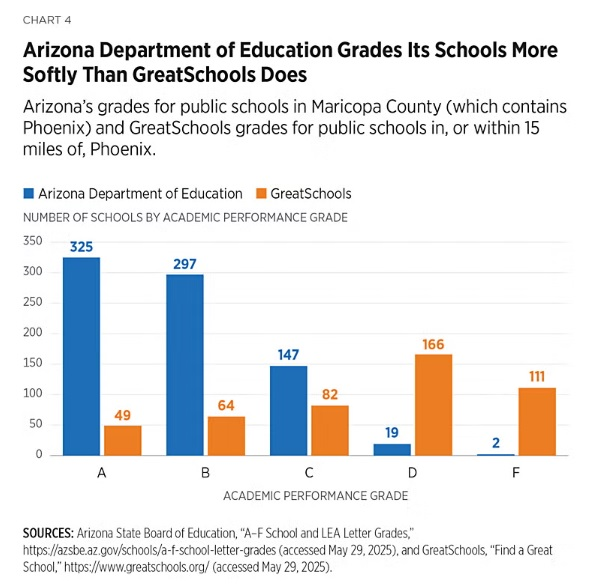
Charter schools always and everywhere had waitlists, ergo, accountability amounted to “trophies for everyone” state systems and charter school sectors that never matched demand with supply. Take a look at the above chart, however, and you’ll see that GreatSchools is a much, much tougher grader than the state of Arizona. The usual suspects have a much tougher time undermining private rating organizations, and they gather reviews (which research shows families value). Ergo the backgrounder makes the argument that we should not rely upon state rating systems in preference to the already superior, more trusted and versatile private efforts. Furthermore, we should expand rating systems into the broader universe of education service providers active in today’s ESA and robust personal use tax credit programs, specifically to gather reviews accessible to families for purposes of navigating the wide world of choice, which we need much more of.
Okay so a couple of reader requests. First, I was asked if I could create something like the Phoenix chart for a district in Florida. I chose Miami:

So not as much of a contrast as Arizona but…if I were looking for a school in Miami, I would look at GreatSchools.
Next, I received a request about this chart from Sandy Kress:

Putting the NAEP improvement numbers in context: In the 2024 NAEP, the total across the four mathematics and reading exams between the highest scoring state (MA) and the lowest scoring state (New Mexico) was 10%. So, the nation-leading 5% improvement in Mississippi scores should be seen as meaningful. Sandy asked me to look at an earlier period from the mid-1990s until 2011 rather than the 2003 to 2019 period, as his contention was that that period saw a lot more academic improvement before the federal law was defanged on a bipartisan basis during the Obama administration.
All states began taking NAEP in 2003, so stretching back to the 1990s loses a number of states. Also, 1996 didn’t include the two reading tests, so I substituted 1998. Nor can we automatically attribute the trends exclusively to standards and accountability (other things also going on), but Sandy is correct that NAEP showed a lot more academic improvement during those earlier years:
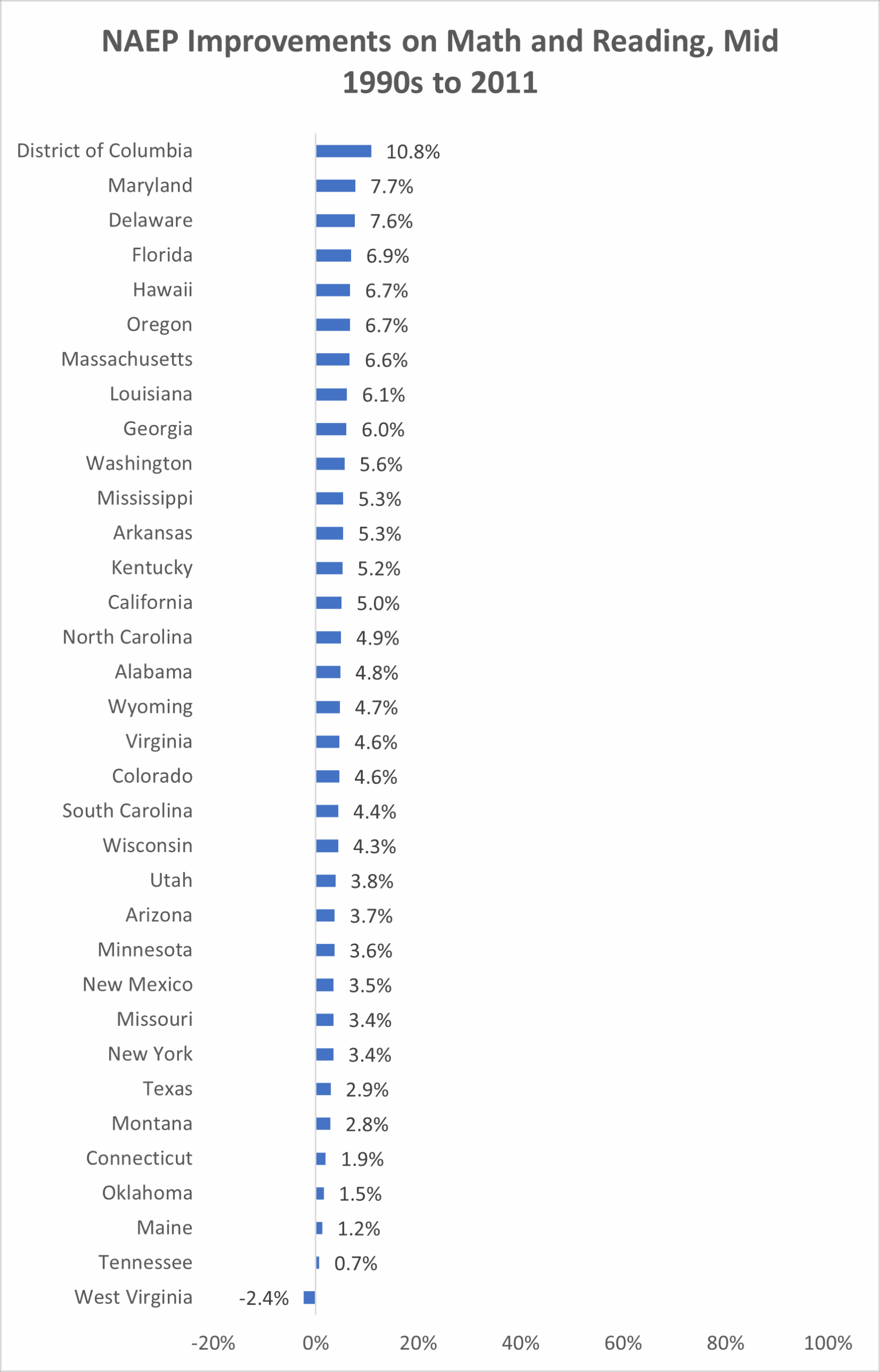
Accountability hawks/the federal government may have indeed coaxed more productivity out of the public school system. Then on a bipartisan basis, Congress removed federal pressure (passed the Senate 85-12 and the House 359-64). Subsequently a large majority if (perhaps?) not every single state merely went through the motions of “accountability” with trophies for (almost) everyone. Kress can justifiably look at these data to claim, “the juice is worth the squeeze” and I can look at the same data to say, “academic transparency is too important to leave to politicians and their appointees.”
Franklin Roosevelt noted ““It is common sense to take a method and try it. If it fails, admit it frankly and try another. But try something.” Every state in the union remains entirely free to adopt tough accountability practices, but apparently few if any have chosen to do so. The next something to try in my opinion are enhanced private rating systems and robust choice programs. Temporarily semi-tough accountability systems run by states and charter school waitlists ultimately proved to be a strategy with limited political sustainability.
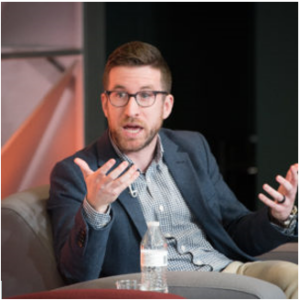 On this episode, Ladner speaks with the director of national research at EdChoice about the latter’s new report entitled, “The Accountability Myth.” The report takes aim at the commonly argued position that traditional public schools are a superior education option because they are held financially, democratically, and educationally accountable to the public.
McShane argues that the public education system suffers from a lack of accountability by those three measures: They are not financially accountable due in part to opaque school spending formulas that make data difficult to obtain; they are not democratically accountable due to institutional bureaucratic dysfunction and off-cycle school board elections; and they are not educationally accountable due to a lack of consequences when the system delivers low-performing results for many students.
Ladner and McShane discuss potential reforms that could help improve accountability in public education.
“We're always going to argue about education – as long as we've had recorded thoughts, it's been people arguing about how to raise kids. There's no system getting rid of that … We should talk about what schools teach and how they teach it. But there are ways to channel it to more productive ends."
EPISODE DETAILS:
Superintendent Carvalho
by Alberto Carvalho
It is not lost to anyone these days that when it comes to educational accountability and more specifically, assessment, public opinion is being influenced by a number of factors and entities that, in some cases, merit consideration, understanding, and acceptance, and, in others, outright rejection.
First, we need to recognize that assessment, as a legitimate tool of accountability, exists only to inform and improve the teaching and learning process. Its use beyond that most legitimate purpose lends itself to misinterpretation of results, erroneous conclusions, perversion of the system itself, and potential harm to students, teachers, schools, and communities. These potentially unintended consequences are accentuated further when the accountability system itself is not inclusive of factors that intuitively and scientifically influence student and teacher performance.
Florida is currently one of many states facing educational reform debates, seen by some as driven too far by policy and ideology more imbedded in influential think-tank pronouncements than in common sense and peer-reviewed, research-based findings. Like a pendulum swung too far, the bounce back from that intentional push is now being felt with equal vigor and repercussion. In question here is nothing less than the validity, reliability, and even viability of the state's accountability system.
The litany of changes in just a few years with irresponsible and uninformed implementation, devoid of consideration for the multi-stacked impact of so many simultaneous modifications, has left the public confused about the true performance of students. Meanwhile, educators at all levels are concerned, doubtful, and skeptical about both policy and its rollout timeline. The recent disconnect between reports of sinking school-grade performance, alongside improved student outcomes, has only added to the confusion and the heartbreak; particularly as it is the result of a simplistic view of student achievement amidst implementation of new standards, scale and cut scores, and end-of-course exams, all either introduced or deliberately modified with predictable consequences.
Some, in an expected defensive position, will say this is a necessary evolution for the sake of educational and economic competitiveness. Others will even suggest the push back is driven by special interest, or fear of change. To that, I submit that what is in question is not the need for better and more complex standards, or assessments better aligned with the needs and demands of the new economic reality. The debate is not reform, but the form and vehicle of this reform, and even the agents behind it. If there ever was a case of the "ends justifying the means," or better, "by all means necessary," one would find it through an honest observation of the educational policy, standards implementation, and assessment decisions made in Florida over the past few years. Simply put, the “What” has trumped the “How” with dramatic and unfortunately, avoidable consequences.
So, on the eve of the most dramatic shift since the inception of the FCAT or the transition to FCAT 2.0 in terms of standards and assessment, we ought to pause. We need to take time to honestly reassess previous and recent decisions and their consequences and have the courage to proceed on a path that is student- and teacher-centric. A path that can and must be a both and not an either-or proposition, unlike what the for-hire pundits say. A path that excludes politics, influence, ignorance, and extremism.
How shall we proceed then? Abandon accountability and assessment altogether? (more…)

McShane
Editor's note: This is the second post in our series on the future of parental choice and accountability.
by Mike McShane
As Kathleen Porter-Magee wrote in National Review earlier this year, for almost three decades conservatives have pursued a two-pronged strategy for education reform. One prong relies on standards and accountability, holding schools and teachers accountable for their results. The other relies on school choice, using the pressures of the marketplace to encourage improvement.
As school choice grows around the country, there are increasing calls for the prongs to twist into each other, with schools of choice (and the teachers within them) being held to the same or similar benchmarks as their counterparts in traditional public schools.
This manifested itself in numerous state Race to the Top applications. From New York to South Carolina, states promised that their new teacher evaluation systems would apply to public and charter schools alike.
It has also been a flash point in debates about school voucher programs. In Indiana, Louisiana, and Wisconsin, students participating in voucher programs have to take the same tests as their public school peers, and their schools are held accountable in ways similar to traditional public schools.
Many choice advocates and school leaders push back against this development. But such a stance begs the question: How can someone advocate for standardized test-based school and teacher accountability systems in traditional public schools while at the same time advocating for a parallel system free from any such oversight? It’s a fair question.
One answer: If we’re going to have a system that residentially assigns students to a school free from any competitive pressure, and we’re going to make attendance at that school legally compulsory, we have an obligation to regulate it (This is not a new argument, by the way; Jay Greene has made a variation on it for a while now).
At the same time, conservatives and their school choice allies can work to create a new and better system. This system, driven by parental choice and flexibility in funding, does not have to play by the same rules as the old system. In fact, it shouldn’t. Expecting a policy tool that was designed to do one thing—regulate a monopoly—to do another thing entirely—regulate a marketplace—is unreasonable. Rather, we should develop a new regulatory framework, and work to build capacity in the new system so more and more students can transfer into it.
So what does such a regulatory framework look like? I think it would be guided by a couple of big principles.
Carrots are better than sticks
There has been much sturm und drang around the smaller numbers of students with specials needs and English language learners served in schools of choice. As a result, numerous efforts are underfoot to require that charter schools and schools receiving vouchers serve some predetermined share of these students.
The problem? There is no nefarious explanation for why many schools of choice, particularly private schools in voucher programs, serve fewer students with special needs. Schools don’t get any extra money to serve them. In programs like Florida’s McKay Scholarships, where additional funds are apportioned to compensate for the increased cost, hundreds of schools respond to the need.
Rather than regulate on the back end what students schools are required to serve, let additional dollars for harder-to-educate students follow them into the schools of their choice. If money follows students in a way commensurate with the cost to educate and schools still choose not to serve them, then think about regulations.
Floors creep towards ceilings
When it comes to regulating a marketplace, one goal is to establish floors for quality that prevent harm for consumers. We regulate restaurants to make sure people don’t get food poisoning. We regulate automobiles so that they don’t fall apart at 70 miles an hour. Other than these minimal standards, regulators try to get out of the way and provide as wide a set of choices for consumers as possible.
In this same vein, it makes sense to ensure that schools are providing some educational program for students if public dollars are going to flow into them.
The problem is that too often floors creep upward and start to define more and more of what organizations do. Automotive regulations designed to ensure a basic level of crash protection have come to essentially mandate airbags and plastic bumpers. School accountability designed as a check against the lowest-performing schools has pushed more and more schools into maxing out time and energy on reading and math instruction.
Overzealous regulators, even those with the purest of intentions, can needlessly stifle diversity.
This should give advocates pause whenever they hear someone promoting “smart” regulations. This implies there are regulations insulated from the pressures of politics, economics, or overzealous do-goodery. There aren’t.
Performance Contracts
One concrete step (whether this is for individual course providers that participate in education savings account programs or course choice programs, or whole schools participating in voucher, tax credit, or charter school programs) is to use performance contracts to push providers to achieve desired results. (Andy Smarick offers one vision of what this might look like in his book “The Urban School System of the Future”.) Providers could negotiate with authorizers on the set of metrics that will be used to judge performance and a set amount of time to reach those goals. They would not have to be narrowly defined by standardized test scores. The process would be transparent and public record, and offer those who think the standards are too low and those who think the standards are too high the chance to hash it out.
But I’m just a guy looking at this from the outside. If I were to offer advice, the best course of action should be to get school leaders, choice advocates, and policymakers together for a frank conversation about what regulations help and what regulations hinder. If advocates and school leaders can come forward with a positive agenda, rather than continually having to beat back new encroachments, they would have the opportunity to shape the regulatory environment in a productive way.
Michael Q. McShane is a research fellow in education policy studies at the American Enterprise Institute.
Coming Wednesday: Robin Lake, director of the Center on Reinventing Public Education.

Petrilli
Is parental choice alone accountability enough for private schools that accept students with vouchers and tax credit scholarships?
The pro-school-choice Fordham Institute says no. In a policy toolkit released this week, it again made the case for some measure of regulatory accountability – and promptly drew fire from other school choice stalwarts at the Friedman Foundation, the Cato Institute and elsewhere (see here and here).
To continue the debate, Fordham Executive Vice President Mike Petrilli will be our guest next week for a live, hour-long chat.
The chat is like a press conference, only it’s in writing and open to anyone with a good question. To participate, just come back to the blog on Tuesday. We’ll start promptly at 10 a.m. All you have to do is click in to the live chat program, which you’ll find here.
In the meantime, you can send questions in advance. Either leave them here in the comment section, send them to rmatus@sufs.org, tweet them to @redefinEDonline and/or post them on our facebook page. See you next week!
 Florida got mixed news from the latest results on the “nation’s report card,” which looked at student achievement in some of the nation’s biggest, urban school districts.
On the one hand: Flat scores.
On the other: Top-tier scores.
Released Wednesday, the 2013 math and reading scores on the closely watched National Assessment of Educational Progress didn’t budge much for the two Florida school districts, Miami-Dade and Hillsborough, that were among 21 that participated nationwide. The tests are given every other year to representative samples of fourth- and eighth-graders.
Six districts saw statistically significant increases in math scores in at least one grade level since 2011, the last time they took part. Five scored higher in at least one grade level in reading. Miami-Dade and Hillsborough, which includes the city of Tampa, were not among them. The Washington D.C. district was the only one with gains in both subjects and both grades.
On the upside, the Florida districts outpaced most of the others with results for black, Hispanic and low-income students and students with disabilities.
Hillsborough’s students with disabilities ranked No. 1 on all four tests. Their counterparts in Miami-Dade finished No. 2, No. 3, No. 3 and No. 4, respectively. Those eligible for free- and reduced-price lunch in Hillsborough scored in the top four on all four tests, while those in Miami-Dade did so on three of four.
"With Hillsborough and Miami Dade students far outpacing other urban districts across the country, it's clear that our teachers and schools are continuing to succeed," Gov. Rick Scott said in a written statement. "This is just the latest in a number of national comparisons that demonstrate our teachers and schools are helping to make Florida the nation's best place to pursue the American Dream."
The percentage of poverty in the 21 districts varies considerably, with the number of students eligible for free- and reduced-price lunch averaging 73 percent. In Miami-Dade, it’s 74 percent; in Hillsborough, it’s a second-best 58 percent.
Florida has been a national leader in NAEP gains for the past 15 years, an era marked by tough, top-down accountability measures like school grades and an explosion in school choice options. At the same time, its overall proficiency rates remain cause for concern.
The same goes for the districts. (more…)

Smarick
Few people in the field of education bring the kind of credibility to a debate on faith-based schools that Andy Smarick brings. So his keynote speech Tuesday to the American Center for School Choice’s Commission on Faith-based Schools in New York was all the more riveting for his decision not to preach to the choir. His message – that to reverse the decline, faith-based educators need also to look in the mirror – amounted to a family intervention.
“Without putting too fine of a point on it,” Smarick said, “an H.G. Wells quote seems particularly fitting: ‘Adapt or perish, now as ever, is nature’s inexorable imperative.’ ”
Smarick criticized faith-based schools – and private schools in general – for not adapting to a new educational environment driven by regulatory accountability and performance measures, and for not being more transparent about their academic performance. He challenged a passage in the commission's report:
“The following paragraph from your report is particularly instructive: 'America is losing a valuable national asset — not because it has become obsolescent, not because the demand for it has disappeared, not because the need for it has been satisfied by other entities, but because we have a misguided public policy … '
“It is my humble contention that these policies are misguided as much because of our behavior as anyone else’s. I’m sad to say, most believe we currently don’t deserve better policies. Our elected officials are understandably making education decisions based on the conditions of 2013, and we’re acting like it’s 1963.”
The public and charter sectors are transparent in ways that better inform parents and satisfy the demands of those in government who pay the bills, Smarick told the audience. So private schools that want to constitute a viable third sector need to embrace the reality seen in most Western nations: (more…)

“I’m not sure if we’re going to walk out of here with consensus,” interim Commissioner Pam Stewart told reporters during a break. But “we pulled the right stakeholders into the room … and we’re listening to everyone.”
Even for Florida, a state that has put education policy on overdrive for 15 years, Monday’s summit was remarkable: Three dozen education leaders, business leaders and lawmakers, all but locked in a room to hash it out over the state’s contentious approach to standards, testing and accountability.
Gov. Rick Scott called the three-day event at St. Petersburg College after a tough summer for those who back Florida’s current vision of education reform. The goal, if reachable, might be even more remarkable: A common road map for an education system that has generated some of the biggest academic gains in the nation over the past 15 years yet has also been subject to relentless criticism and, more recently, self-inflicted wounds.
The participants, who also included teachers, parents, superintendents and school board members, politely hinted at the divisions during introductions.
Florida’s accountability system “has had a great deal to do with rising student achievement,” said Sen. John Thrasher, R-St. Augustine, who was House speaker when the heart of the system was installed under former Gov. Jeb Bush. “I hope we don’t take a step backwards.”
“Florida has been on the right course,” said Miami-Dade Superintendent Alberto Carvalho. But “it doesn’t mean we’ve done everything right.”
Now, he continued, we have the opportunity to fix the rest.
The state's fledgling teacher evaluation system, one of four areas targeted for discussion, also surfaced as a sore point.
Teachers "don't trust the system," said Joanne McCall, vice president of the Florida Education Association.
But Keith Calloway, with the Professional Educators Network of Florida, said teachers were not uniformly opposed. "There are many of us teachers out there right now that like the evaluations," he said.
It remains to be seen whether parties long at odds can agree on meaningful steps in the short term, let alone stick together on common ground for the long haul. History suggests it will be tough. (more…)
Tuthill
In today's chat, we talked with Doug Tuthill, president of Step Up For Students in Florida.
Readers asked him about everything from Common Core and private schools, to whether the value of tax credit scholarships should be increased, to the right balance between school choice and government regs when it comes to accountability.
Step Up is the largest private school choice program in the country. It’s expected to serve 60,000 students this fall. And as recent news stories have pointed out, it continues to experience strong growth. (Step Up also co-hosts this blog with the American Center for School Choice. As we noted in the advance post, we strive not to be self-promotional but in this case thought it was appropriate to feature Doug.)
Before joining Step Up in 2008, Doug had been a college professor, a classroom teacher, the president of two teachers unions and a driving force behind the creation of Florida's first International Baccalaureate high school.
You can replay the chat here:
Catholic schools. Yet another Catholic school closes, this one in Palm Beach County, with many students turning to charter schools. South Florida Sun Sentinel.
 Charter schools. One in east Hillsborough will close after multiple issues, reports the Tampa Tribune. Dayspring Academy in Pasco, co-founded by state Sen. John Legg, wants to expand to two more campuses, reports the Tampa Bay Times.
Virtual schools. A struggling teen in Hernando takes 10 online courses in a comeback surge to graduate on time. Tampa Bay Times.
Accountability. Florida has taken steps to prevent gaming of the system. EdFly Blog.
Common Core. The Council of Chief State School Officers opposes delays in accountability requirements as states adjust. StateImpact Florida.
Teacher pay. Pasco Superintendent Kurt Browning says the Leg didn't increase funding enough to give teachers the raises that Gov. Rick Scott envisioned. Gradebook.
Teacher conduct. A Polk teacher who said she and her father were dying was apparently lying so she could skip school. WFTV. (more…)

