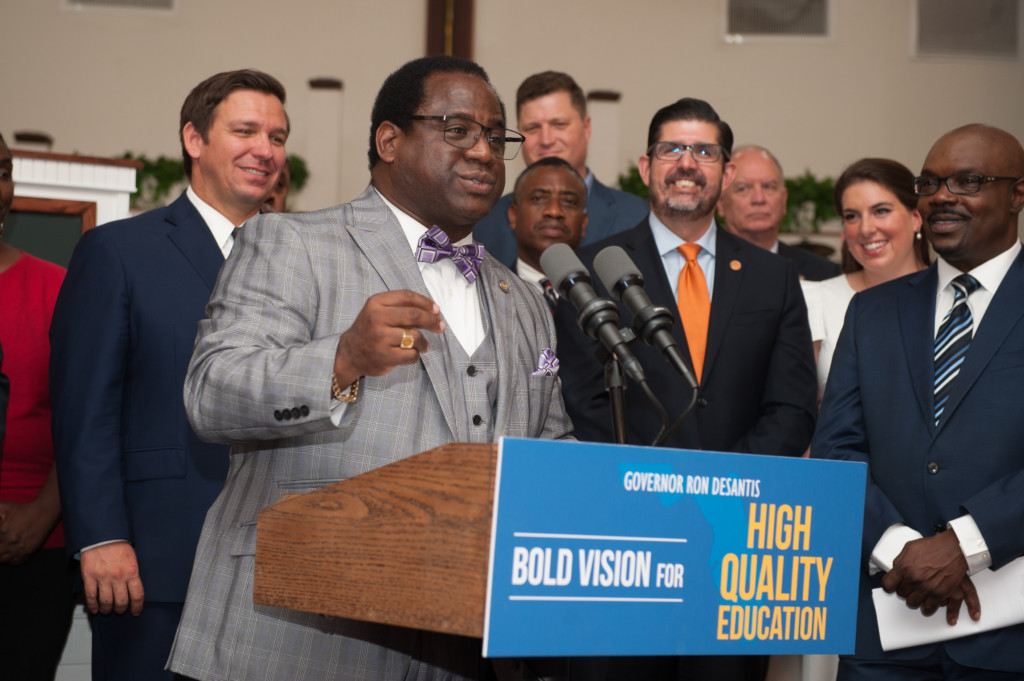
Rep. Wengay Newton, D-St. Petersburg, addresses a group of education choice supporters at Mt. Moriah Christian Fundamental Academy, one of three stops Gov. Ron DeSantis made Thursday to tout the new Family Empowerment Scholarship. Also pictured is DeSantis, behind Newton; and from left to right beside Newton, former Rep. Frank Peterman Jr. (D-St. Petersburg), Sen. Jeff Brandes, (R-St. Petersburg), Sen. Manny Diaz Jr. (R-Hialeah), Sen. Ed Hooper (R-Clearwater), Rep. Jennifer Sullivan (R-Mt. Dora) and Pastor Robert Ward.
Last Thursday was a wonderful day for students in Florida, especially students living in undervalued neighborhoods and desperate for educational options. Gov. Ron DeSantis traveled the state promoting the belief that those children, not just those from families of means, should be in great schools.
As executive director of Florida Parent Network, I manage a team of professional organizers who planned and arranged these events, and at the last one, in Miami, DeSantis signed a bill that officially created the Family Empowerment Scholarship.
This scholarship will help 18,000 students get off scholarship waiting lists and into schools they couldn’t otherwise afford.
It was a long, rewarding day.
At every stop, our champions in the Legislature joined the governor to talk about this year’s legislative session. They thanked each other, and supporters, for getting this bill past the finish line.
Most of our champions are Republicans, and despite the fact I’m more to the left than anyone in any room I’m in, I stood and applauded them for doing the right thing by our kids. Even when some gave speeches with the usual “government doesn’t know best” theme, I understand that’s their thing.
They gotta do them.
The few Democrats brave enough to stand up to school districts and teachers’ unions have a special place in my heart. Six of them in the Florida House of Representatives did just that this legislative session.
We must acknowledge and appreciate that it is never easy to withstand tribal pressures, and these days it’s more difficult and rarer than ever before.
That’s why Rep. Wengay Newton’s speech at the St. Petersburg event made my day.
I don’t want to hear from folks who’ve never needed assistance that government programs don’t work. They do work. They work quite well.
Government programs work best when constituents of all income levels have choice, options and power.
Newton talked about specific programs that helped his family while he was growing up. Government programs made it possible for him to learn, thrive and ultimately serve his neighbors in the state legislature.
He has a certain “authenticity” to which almost no one else that day could lay similar claim.
“The school to prison pipeline is real,” he said. “It’s not a charter school to prison pipeline. It’s not a private school to prison pipeline. It’s a public school to prison pipeline.”
Can we take a moment and think about the wisdom and experience behind this viewpoint? Democrats who gather around a table to bash school choice hardly ever acknowledge that they themselves have never for one moment entertained the thought of allowing their children to attend substandard schools.
Those who are against educational options always seem to have them.
They deserve to be shamed for denying others that from which they benefit.
Newton said he never – never – sees many black males when he goes to successful high schools during the Great American Teach-In.
“But when I go to county jails and juvenile facilities,” he continued, “I see a lot of black males. You’re well-represented.”
Democrats opposed to educational options support a system that benefits white upper-class children at the expense of everyone else. They back a system that is good at one thing and one thing only: securing the jobs of the people who work there.
Newton encouraged the students in attendance to work hard.
“Cause if you don’t do it, they’ve got plans for you on the other side.”
I’ve heard supporters apologize for educational options, pretending that empowering parents isn’t the end all, be all. I disagree. Choice might not be the only great idea, but it’s the best one.
“You’re provided an opportunity,” Newton said. “Not a guarantee, but an opportunity.”
That is what we can give our kids.
He reminded the audience that the area in which they were sitting was home to “failure factories,” a powerful reminder to those who believe in only one educational delivery system. That one delivery system has been failing minority children for decades.
“If you know all the secret codes to Play Station 4, that tells me your brain is working just fine,” Newton said.
In other words, don’t believe that you can’t succeed. That you can’t learn.
Those who can’t teach will blame everything -- parents, poverty, salaries, etc. But the truth is that children of lesser means can learn. They just can’t learn from a single system or the teachers who flock to it.
Newton also reminded the students that he and they come from the same place.
That’s the most powerful message of all. Every single child from impoverished neighborhoods has potential. And shame on any system that allows an ideology to shine, instead of a child.
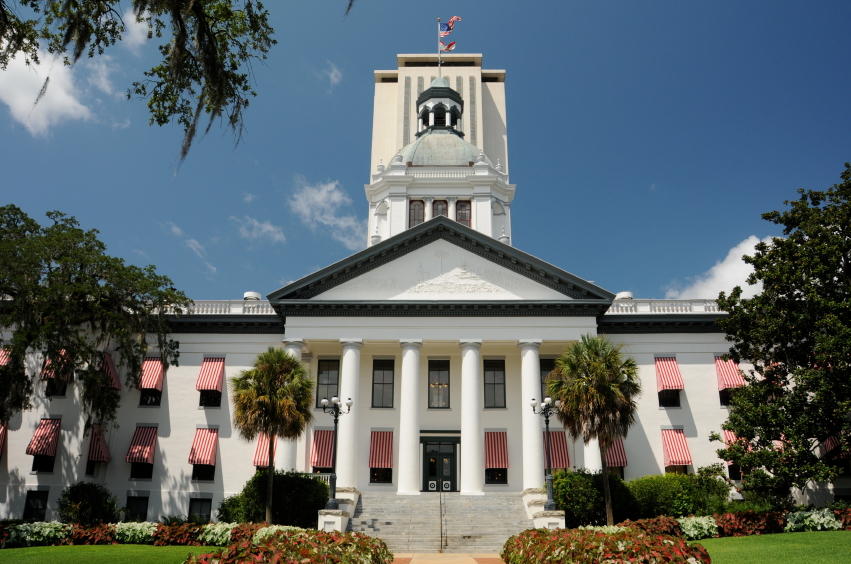
SB 7070 establishing the Family Empowerment Scholarship passed the Florida House Tuesday. Its next stop is Gov. Ron DeSantis' desk.
After a lengthy, contentious hearing that lasted parts of two days, the House of Representatives on Tuesday sent to the governor a bill creating a new state-funded K-12 scholarship for 18,000 low-income and working-class students.
Senate Bill 7070, which survived 24 failed Democratic amendments on Monday, passed 76-39 with the support of all Republicans and six Democrats. It creates the Family Empowerment Scholarship, an attempt to address the unmet demand for the 18-year-old Florida Tax Credit Scholarship, which serves 100,512 students this year and is funded by corporate contributions that receive dollar-for-dollar state tax credits. The rate of contribution growth slowed this year, producing a waiting list of 13,000 students.
Unlike the Florida Tax Credit Scholarship, the new program would be funded with tax dollars through the Florida Education Finance Program (FEFP), which is the operational formula for traditional public schools.
The new scholarship targets 18,000 students in the first year and roughly 7,000 additional students in future years. It also slightly increases the eligible income from 260 percent of poverty ($66,950 for a household of four) in the current Florida Tax Credit program to 300 percent of poverty ($77,250) in FES.
The bill, which is expected to be signed into law by Gov. Ron DeSantis, gives priority to students with household incomes up to 185 percent of poverty ($47,637).
Rep. Jennifer Sullivan (R-Mount Dora), who chairs the House Education Committee and directed the House version of the bill, brought the two-day hearing to an emotional close.
“For those on the waiting list, we have been listening to you,” Sullivan said. “This is not about public versus private schools, this is about our students, their future and what is best for them – not protecting an institution. We’re giving parents real choice in this bill. … Data sheets don’t show you a (school’s) culture, atmosphere, relationships and intentionality. Parents can see those things.”
John Kirtley, chairman of Step Up For Students, which administers the Florida Tax Credit Scholarship and hosts this blog, praised Sullivan and other lawmakers who steered the bill through a lengthy legislative process.
“Today is a historic day for low income and working class Florida families who want the power to choose the best learning environment for their children,” Kirtley said. “I want to thank Chair Sullivan, Chair Donalds, Chair Latvala and Speaker Oliva for their leadership in passing this bill. I also want to thank the six brave Democrats who stood up for their constituents to give them the power they so desperately desire.”
Demand for the scholarship remains strong. More than 153,000 students have started applications for the 2019-20 school year, with 105,000 of them already determined as eligible.
Former Gov. Jeb Bush, who was instrumental in creating Florida’s first voucher program 20 years ago, was in the House chamber during the vote.
In debate, Rep. Joe Geller (D-Dania Beach) called the measure unconstitutional, citing the Florida Supreme Court’s 2006 Bush v. Holmes ruling. The court at that time invalidated the Opportunity Scholarship Program but did not address the McKay Scholarship, a 20-year-old voucher that is financed, like the new Empowerment Scholarship, from the state FEFP education fund.
“I’ve practiced law for a long time in this state,” Geller said. “I believe in the legal system and believe that judges do their duty. There’s a very clear precedent that says this law is unconstitutional. The notion that the very clear Florida Supreme Court precedent is going to be disregarded just because new justices are on the court, honestly, is an insult to all these new justices, as if they don’t care what law or precedent dictates.
“If you want to send kids to private schools go right ahead, feel free, but the problem with these voucher programs is all of the other tens of hundreds of thousands of children who for whatever reason will never have this opportunity. The great leveling factor for advancing people of humble of origins is our system of free public schools.”
Rep. Ralph Massullo (R-Beverly Hills) cited the academic success of students on the Florida Tax Credit Scholarship, including performance on standardized tests and higher college attendance rates.
“What we’re doing works, it works well,” Massullo said. “Isn’t it ironic that (the bill’s opponents) are trying to take freedoms the Bill of Rights gave people and put it back in government’s hands? Our duty is to our people, our students. We want to empower (parents) with the ability to pick the education they want for their children.
“… By empowering those less fortunate, we sow the seeds of responsibility and hope. That’ll change our society, perpetuate our society and help us reach our goals. I’ll press the green button for that all day long.”
Also in favor of the bill was Rep. Chris Latvala (R-St. Petersburg), who cited recent findings of an Urban Institute study that showed the mostly minority students using the Florida Tax Credit Scholarship are 43 percent more likely to enroll in four-year colleges than like students in public schools, and up to 20 percent more likely to earn bachelor’s degrees.
The study showed that outcomes are even stronger for students who use the scholarship four or more years, Latvala said. Those students are up to 99 percent more likely to attend a four-year college than their public school peers, and up to 45 percent more likely to earn bachelor’s degrees.
Few Democrats were swayed. But Reps. Kimberly Daniels (D-Jacksonville) and Rep. James Bush (D-Opa Locka), both of whom are African-American, spoke in favor of school choice and voted for the bill.
“School choice is not the demon I believe it’s been presented to be,” Daniels said. “There’s room for all types of schools and educational choices.”
SB 7070 establishing the Family Empowerment Scholarship has cleared all its committee hurdles and is headed to the Senate floor.
The Senate Appropriations Committee on Thursday advanced a bill that would create a new state-funded program to eliminate a waiting list of 13,000 for the Florida Tax Credit Scholarship for lower-income families.
SB 7070, which would establish the Family Empowerment Scholarship, previously passed two other committees. But the Appropriations Committee approved a significant “strike-all” amendment by the bill’s sponsor, Education Committee Chair Manny Diaz (R-Miami).
The changes include increasing the income eligibility limit for families to 300 percent of the federal poverty level ($77,250 for a family of four), up from the previous version’s 260 percent, while giving priority to those families with household incomes up to 185 percent of the poverty limit ($47,637 for a family of four). That puts the Senate bill in line with the income limits in a similar bill, HB 7075, being considered by the House.
The Senate bill also raises the cap on the number of students served to 18,000 in the program’s first year, up from 15,000. The number would expand each year by 1 percent of the state’s total public school enrollment. The House bill would accommodate 28,000 students in the first year.
Diaz told committee members Thursday that the bill prioritizes the lowest-income, neediest families.
“I will stand up here and defend that all night long,” Diaz said. “At the end of the day, these students deserve the same chances as every student who goes to a great public school, or whose parents can afford to put them in a private school.”
Sen. Bill Montford (D-Tallahassee) praised the bill as “a historic piece of legislation” but voted against it, saying he couldn’t reconcile using money from the Florida Education Finance Program (FEFP) to fund the measure.
“I know we did it with the McKay (Scholarship for students with special needs), and it worked extremely well,” Montford said. “But this is a huge leap. If there’s a way to work with you on that one piece, I’d like to.”
In response to a question from Sen. Perry Thurston (D-Fort Lauderdale), who voted against the bill, Diaz said the measure “takes no money from the FEFP,” saying that students on the scholarship are educated at 95 percent of district average.
“The district keeps 5 percent for each student they’re not educating,” Diaz said.
Several people spoke in favor of the bill. Among them was Carletha McGuire, who worked more than 20 years with special needs students as a paraprofessional in Miami-Dade public schools. McGuire is raising two grandchildren and a nephew, each of whom have been on the scholarship.
She said her nephew Corey used the tax credit scholarship to attend Kids Learning Center for two years, which boosted him academically so he could qualify for the magnet program at Coral Reef High School in Miami. He is taking dual enrollment classes and is expected to graduate this year with an associate’s degree. Her older granddaughter, Martina, graduated from Grace Christian Preparatory and now attends Bethune-Cookman University on a partial academic scholarship.
Her younger granddaughter, Monique, started at Kids Learning Center on the scholarship but was on the waiting list this year. McGuire had to transfer her to a public school for fifth grade, and her grades have slipped.
“She tells me every morning, ‘I just want to go back to Kids Learning Center’,” McGuire said. “So I am asking you: Let all our kids off the waiting list by creating the Family Empowerment Scholarship. There are so many who are being left behind. Let’s help these kids get what they need so their parents and grandparents don’t have to worry.”
Nicolette Springer, legislative advocate with League of Women Voters of Florida, was among the bill’s opponents. She called the legislation unconstitutional because it would allow public dollars from the FEFP to be spent at private schools
“My heart goes out to the children here today,” Springer said, referring to scholarship recipients and those on the waiting list. “Opportunities would be in their neighborhoods if public dollars had not been stripped.”
In response to a question from Sen. David Simmons (R-Longwood), Springer said the League of Women Voters would not support any bill that takes public money from public schools.
Later, in response to those arguments, Diaz said: “When this discussion comes up, there’s always an argument about do we spend enough money, money being diverted [from public schools]. I always ask this question: What is the right amount? When is enough enough?”
He noted the maximum number of students who would receive a Family Empowerment Scholarship would 129,000, out of 2.8 million public school students statewide.
“Public education is about the education of the children, and not about the institutions,” Diaz said.
The Florida Tax Credit Scholarship serves more than 100,000 students statewide with an average annual family income of $25,751. But this year, for the first time in 14 years, a slowing rate of growth in fundraising resulted in fewer students served than the prior year.
Demand for the scholarship remains strong. More than 148,000 students have started applications for the 2019-20 school year, and more than 90,000 scholarships have been awarded. About 55,000 are new applicants, up 45 percent from this time last year.
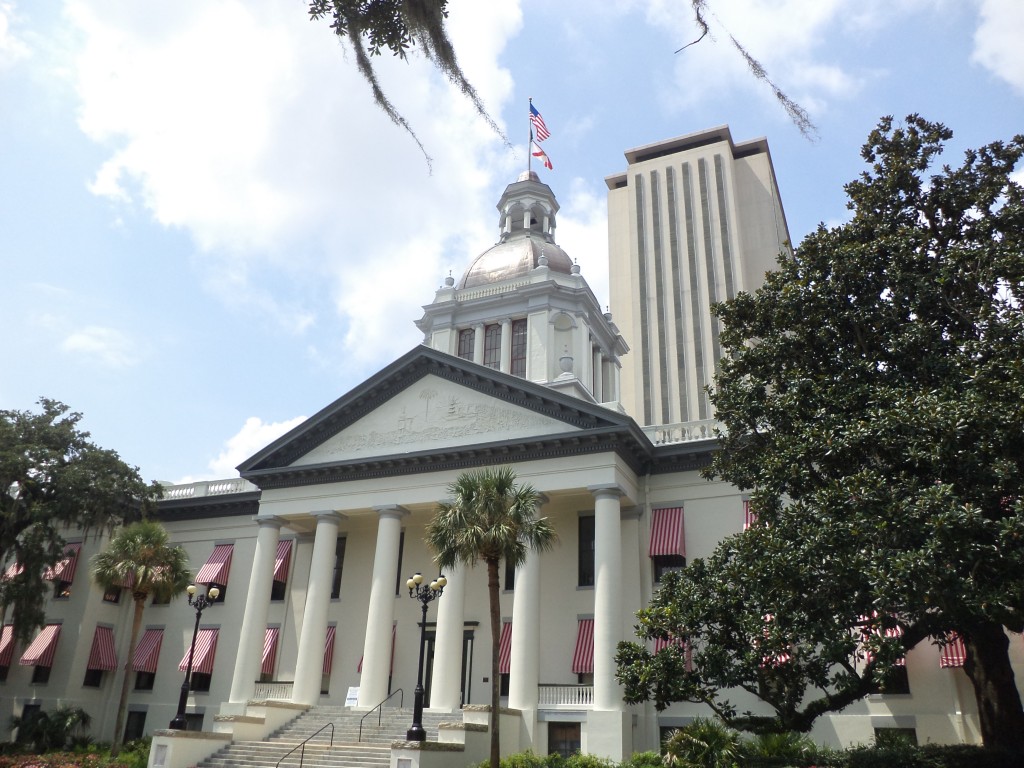
The first major education bill of the 2019 legislative session cleared committee Wednesday morning
TALLAHASSEE – In a 5-3 party-line vote, the Senate Education Committee on Wednesday approved a bill that would eliminate a waiting list for the Florida Tax Credit Scholarship for lower-income families.
The bill, SB 7070, creates the Family Empowerment Scholarship program. It includes other provisions related to a teacher bonus program and funding for social services at public schools.
“What we’re doing is trying to find common balance and make sure all students have the best education possible,” said committee chair Manny Diaz (R-Hialeah).
Diaz expressed concern that the definition of public education “keeps getting twisted.”
He added: “The reason we created public education in this country to begin with was because we had to have a populace that was educated and civic-minded that could be entrusted in continuing our republic. Our duty is to educate the children. Our duty is not to where they’re educated.”
Diaz said that philosophically, parts of the bill “bring us out of the 19th century” and allow parents to provide direction for each child.
Unlike the Florida Tax Credit Scholarship, which is funded with donations from corporations that receive tax credits, the proposed Family Empowerment Scholarship program would be funded through the Florida Education Finance Program (FEFP).
The value of the scholarships would be 95 percent of the district average per-student funding in the FEFP. Like the Florida Tax Credit Scholarship, eligibility would be limited to students whose household income levels do not exceed 260 percent of the federal poverty level ($62,650 for a family of four). The program would be capped at 15,000 students in 2019-20. That cap would increase with the annual growth of public school students in the state.
“This bill (allows) us to address the waiting list for tax credit scholarships for parents who want to make the (proper decisions) for their child but can’t because of the waiting list,” Diaz said.
Sen. Janet Cruz (D-Tampa) spoke against the measure, saying funding is being diverted away from public schools.
“The struggling traditional public schools need funding to improve,” she said.
Ninety percent (of Florida families) choose to attend public schools. Where is the funding for what they choose?”
Cruz added: “We don’t need a new voucher program. The (state) constitution says we have to provide for public education, which the Legislature ignores year after year. I will not support dismantling funding for the public school system, and I think this bill is just that.”
Sen. Kelli Stargel (R-Lakeland) disagreed, saying the bill will benefit parents, students and school districts.
“It doesn’t oppose public schools in any way,” she said, adding that the program would give parents the choices they need to put their children in the right educational environment.
Sen. David Simmons (R-Longwood) voted for the bill but expressed reservations about funding the new scholarship program through the FEFP, a concern shared by Sen. Bill Montford (D-Quincy), who opposed the bill. Simmons suggested wait-list families can be accommodated a different way.
“All we need to do is simply provide a credit,” he said. “Because there’s another $2.6 billion in taxes for which a credit can be given. All we need to do is say, ‘Certify that amount,’ and then that credit can be given.”
Several parents spoke in favor of the bill. Among them was Giselle Gomez of Ocala, a Realtor and single mother of Arturo Gomez III, 6, who currently is on the Florida Tax Credit Scholarship waiting list.
Gomez chose to pay out of pocket for Arturo to attend Redeemer Christian Academy, a private school, because she feared her son’s behavioral problems could not be properly addressed in a public school. While Arturo is happy and his behavior has improved at Redeemer, Gomez struggles to pay tuition.
“Being unable to make payments is embarrassing,” she said. “It makes me feel really bad as a mom.”
Gomez said that unlike many families who have the means to live near a neighborhood school that works for them, or who can afford a private school, she does not have those choices.
“I implore the Senate to end the waiting list so I and other moms don’t have to go through this,” she said. “A scholarship would make a world of difference to my son.”
Yahayra Marte, founder and administrator of Sunrise Academy in Orange City, told committee members it’s vital that the Legislature end the waiting list. Marte said she has waived tuition for 52 students and has reduced fees for 15 other waitlist students.
“That includes removing the requirement in the Senate bill that students on the current Florida Tax Credit Scholarship waiting list must have attended a public school in the prior year in order to qualify for the new scholarship program,” she said. “Otherwise, it won’t benefit my 67 waitlist students.”
Among the public speakers who criticized the bill was Sally Butzin, vice president of the League of Women Voters of Tallahassee, who said the new program would benefit only a “fortunate few” and divert money from public schools.
“I call this ‘education triage,’ ” Butzin said. “It’s a train bill, a take-it-or-leave-it, rather than (encouraging) debate. We oppose it, because it gives revenue for private and religious schools with no transparency, which is unconstitutional. It’s unconstitutional, undemocratic, flawed logic and diverts resources to benefit only a few children.”
Enrollment in the Florida Tax Credit Scholarship program dropped for the first time in 14 years in 2018-19. In the preceding 13 years, the average annual enrollment increase was 20 percent. The dip was due to slower growth in corporate contributions, according to the state Department of Revenue. (The program is administered by non-profits such as Step Up For Students, which hosts this blog.)
Demand for the scholarship remains strong. Parents of more than 170,000 students had started applications by the time Step Up For Students halted the application process in June. Step Up already has awarded more than 85,000 scholarships for 2019-20, approximately 20,000 students ahead of last year. New students are starting applications at a rate of more than 1,000 a day.
Gov. Ron DeSantis last month proposed a state-funded “Equal Opportunity Scholarship” to eliminate the Florida Tax Credit Scholarship waiting list. The House has yet to release its bill that addresses the problem.

