ST. PETERSBURG, Fla. – Life, it’s often said, is what happens when you’re making other plans.
Tasia Mathis planned on joining the U.S. Navy Reserve. Then her grandmother, with whom Tasia and her younger brother Jeremiah lived with, died suddenly from complications of kidney failure.
“The papers were signed, but I wasn’t able to go through with it,” Tasia said. “I had to make sure he was OK.”
Tasia, 20 at the time, became her brother’s guardian.
While Tracy Crawford’s passing in June 2023 ended Tasia’s goal of joining the Navy, it didn’t end her goal of a bright future for herself and Jeramiah.
For that, she credits Florida's private school scholarships managed by Step Up For Students.

The scholarships enabled Tasia, now 22, and Jeremiah to attend Academy Prep Center of St. Petersburg for middle school and allowed Jeremiah, 15, to continue his private school education at Admiral Farragut Academy in St. Petersburg, where he is a sophomore this year.
“(The scholarship) gave us the opportunity to go to a school that we probably wouldn't be able to go to,” Tasia said. “It gave us the opportunity to expand our knowledge so good things can come into our lives.”
Tasia is studying to become a phlebotomist and works as a teacher at the Academy for Love and Learning in St. Petersburg.
Jeremiah would like to attend the United States Air Force Academy and work in cybersecurity.
The two, who share an apartment in St. Petersburg, have goals and are working toward them with a determination forged by Tracy Crawford, their grandmother, and reinforced by their years at Academy Prep.
“They don’t let you give up,” Tasia said when asked what she liked about attending Academy Prep. “Even if you had issues, they never let you give up.”
Could you blame them if they did?
Tasia was 8 and Jermiah was three weeks old when their mom died. Staci Crawford was only 34 when she suffered a heart attack. That left the children in the care of their grandmother, whose failing health forced Tasia to find work as a counselor at the Police Athletic League when she was 14.
“I had to help out with the bills,” she said. “By the time I was 16, I was cooking, washing everybody's clothes, helping my grandmother out the best I could.”
So, when asked what it’s like to have his sister as his guardian, Jeremiah said, “It’s kind of all I’ve known.”
Tracy wanted Tasia to attend a school that would challenge her academically and offer a safe environment. That’s why she used the private school scholarship to send her to Academy Prep.
At first, Tasia said, it wasn’t a good match. She was not a fan of the school’s long days (7 a.m. to 5 p.m.) or the fact that she had to wear a uniform.
“It took her a while to buy in, and then once she did, she was a high-achiever, and she set the tone for the other kids,” said Lacey Nash Miller, Academy Prep’s executive director of advancement.
For that, Tracy gets a big assist.
“She made sure my grades were straight, my attitude was straight,” Tasia said. “By seventh grade, it all came together.”
For high school, Tasia attended her assigned school because it offered a BETA (Business, Entrepreneurial, Technology Academy) program that interested her.
Jeremiah attended his assigned elementary school, but Tracy wasn’t a fan of his assigned middle school.
“It wasn’t up to her standards,” Tasia said. “She wanted to challenge him.”

So, like his sister, Jeremiah headed crosstown to Academy Prep, where he said he benefited from the school’s academic environment and the self-discipline the teachers try to instill in the students.
Jeremiah said he became more extroverted during his years at Academy Prep.
“I was naturally a quiet person. I didn’t talk much,” he said. “Now, I talk to people. I try to start conversations.”
He also credited his teachers, specifically Zack Brockett, a science teacher, for guiding him toward being a young adult.
“He pushed us to grow up, so that we can go into high school as mature students,” Jeremiah said.
His teachers at Academy Prep describe Jeremiah as a quiet student who completed his assignments on time, helped out around campus, and amazed them with his drawing ability.
“Jeremiah is very self-driven,” Britanny Dillard, Academy Prep’s assistant head of school, said. “He’s one of those people that you kind of underestimate because he's so quiet that you don't even truly realize the talents that he actually has. He’s not the first to raise his hand, but he knows the answer.”
Jeremiah was a member of the school’s track team. He threw the shot put and discus. At graduation, Jeremiah received the Priscilla E. Frederick Foundation, worth $1,500 toward the balance of his freshman year tuition at Admiral Farragut. Frederick is a former Olympic high jumper who competed for Antigua and Barbuda in the 2016 Summer Games. Her foundation awards scholarships and grants to students raised in single-parent households. Jeremiah was the first Academy Prep student to earn that scholarship.
He is a soft-spoken, unassuming young man with a growing vinyl record collection and an interest in graphic novels and comic books. He will participate in track and field this year and will take an aviation class, which he feels will benefit him when he gets to the Air Force Academy.
Jeremiah spends his high school volunteer hours at Academy Prep. He helps grade papers, organize classrooms, and move supplies around campus.
Jeremiah and Tasia are spoken highly of at Academy Prep. Both Dillard and Nash Miller said they were “heartbroken” when they learned of Tracy’s death, and both admitted they were worried for the future of the siblings.
“They only had each other, and I think it speaks highly of Tasia that she was willing to accept that role,” Dillard said.
Said Nash Miller: “The news that her grandmother passed just gutted me. She had all these plans, and she just cancelled them to be her brother’s primary caregiver. What a superhero to put her brother’s needs ahead of her own.”
MIRAMAR, Fla. — William Ivins moved his family to South Florida ahead of his retirement from the United States Marine Corps and enrolled his children at Mother of Our Redeemer Catholic School, hoping they would reap the same rewards as he did from a faith-based education.
But, as William and his wife, Claudia, would soon learn, that was easier said than done.
A lawyer for much of his 20-year career in the Marines, William needed to pass the Florida Bar Exam before he could enter the private sector. It was a long process that left him unemployed for 19 months.
“It was a struggle,” he said. “My retirement income was not enough to pay for the cost of living and tuition for my children.”
The Ivins' faced a few choices: continue with the financial struggle, homeschool their children, send them to their district school, or move out of state. None were appealing to the Ivins, and fortunately, they didn’t have to act on any.

Florida's education choice scholarships managed by Step Up For Students allow his four children to attend Mother of Our Redeemer, a private K-8 Catholic school near the family’s Miramar home.
“It was a perfect storm of having to retire from the Marines and not really having a job lined up,” William said. “The transition was more difficult than I thought it would be. The income just was not available for us to continue our kids’ education in the way we wanted. Had the scholarship not been there, we would have been forced to move out of state or homeschool them or move them to (their district) school.”
In July 2020, the Ivins moved to South Florida from Jacksonville, N.C., where William had been stationed at Camp Lejeune. William contacted Denise Torres, the registrar and ESE coordinator at Mother of Redeemer, before making the move. She told William the school would hold spaces for his children. She later told him about the education choice scholarships managed by Step Up For Students.
“That was a big relief for him,” Torres said.
At his mother’s urging, William began attending Catholic school in high school.
“That was a life-changer for me,” he said.
He converted to Catholicism and vowed if he ever had children, he would send them to Catholic school for the religious and academic benefits.
Rebekah graduated in May from Mother of Our Redeemer. She had been an honor roll student since she stepped on campus three years ago.
“Rebekah likes to be challenged in school, and she was challenged here,” Claudia said.
Rebekah, who received the High Achieving Student Award in April 2022 at Step Up’s annual Rising Stars Awards event, is in the excelsior honors program as a sophomore at Archbishop McCarthy High School.
“She's an amazing, amazing student,” Torres said. “It’s incredible the way she takes care of her brothers. She's very nurturing. Every single teacher has something positive to say about her.”
Rebekah’s brothers, Joseph (seventh grade) and Lucas (fourth grade), do well academically and are active in Mother of Redeemer’s sports scene, running cross-country and track. Nicholas, the youngest of the Ivins children, is in second grade. He was allowed to run with the cross-country team while in kindergarten, which helped build his confidence.

William had been in the Marines for 20 years, eight months. He served as a Judge Advocate and was deployed to Kuwait in 2003 for Operation Iraqi Freedom, to Japan in 2004, and then to Afghanistan in 2012 for Operation Enduring Freedom.
He retired in May 2021 but didn’t find employment until December 2022. The Florida Bar Exam is considered one of the more challenging bar exams in the United States. He took the exam in July 2021 and didn’t learn he passed until September. It took William more than a year before he landed a position with a small law firm in Pembrook Pines.
Claudia, who has a background in finance, works in that department at Mother of Our Redeemer Catholic Church, located next to the school.
“They have really become part of our community,” Principal Ana Casariego said. “The parents are very involved and are big supporters of our school and church.”
In Mother of Our Redeemer Catholic School and Church, Willian and Claudia found the educational and faith setting they wanted for their children.
“It is a small community environment where you know all the teachers and staff by first name,” William said. “My kids have received a wonderful education in an environment where they don’t have to worry about bullying, and they can really strive to grow and do their best academically.
“The scholarship kept us in the state and kept our kids in the school system that we wanted them to be in. It’s been a great blessing to us.”
TAMPA, Fla. — Amelia Ramos recalls her oldest child’s first school experience after moving to the Grant Park neighborhood in 2018.
“It was not a good fit,” she said. “She lasted about four months.”
In addition to academics, Ramos cited safety as a big concern.
“You couldn’t even ride a bicycle down the street,” she said.
Ramos found hope after learning about Grant Park Christian Academy, a private school affiliated with the Faith Action Ministry Alliance. The nonprofit organization’s stated mission is “to strengthen neighborhoods through meaningful engagement, collaboration, and strategic partnerships.”

Grant Park Christian Academy prides itself on its record of providing strong academics and spiritually based character development. Ramos learned from the school’s principal about a state education choice K-12 scholarship program administered by Step Up For Students that would help cover the tuition.
With that, Ramos was sold.
Her daughter thrived at Grant Park and now attends a district high school. Her son and twin daughters now attend the private school, which serves 70 students in grades K-8.
“We love the school and the staff,” she said, adding that she appreciates the assurance of knowing that her children are safe when she leaves them at Grant Park Christian Academy.
“If only they had a high school,” she said.
Although there are no plans to add a high school, an expansion will soon more than double the school's capacity, located inside a gated property owned by a non-denominational church.
The project is just one example of a broader statewide trend resulting from the Florida Legislature’s passage of HB 1 in 2023. The landmark legislation made all K-12 students eligible for education choice scholarships regardless of their household income and gave families more flexibility in how they spend their students’ funds.
Putting parents in the driver’s seat supercharged the demand for more learning options.
In the 2023-24 school year, after Gov. Ron DeSantis signed HB 1, Florida saw the largest single-year expansion of education choice scholarships in U.S. history. That growth continued in 2024-25. Recent figures from the Florida Department of Education show that more than 500,000 Florida students were using some type of education savings account.
The expansions at Grant Park Christian Academy and other schools across the state, such as Jupiter Christian School in Palm Beach County, couldn’t come at a better time. The latest figures from Step Up For Students show that the number of approved private schools has surpassed 2,500. That figure doesn’t include a la carte options, including those now being offered by public schools. State figures show 41,000 parents received scholarships in 2024-25 but never used them. According to a survey by Step Up For Students, a third of the 2,739 parents who responded said there were no available seats at the schools they wanted.
The Rev. Alfred Johnson, who founded the ministry alliance and Grant Park Christian Academy in 2014, said the school is just one of the ways the ministry works to support and improve the neighborhood. A look outside the window once a month will show teams of alliance volunteers in neon yellow vests cleaning up roadside trash. Johnson estimates that over the past three years, the group has cleared 70 tons of garbage, including old mattresses, furniture, and household appliances.
Johnson and his volunteers regularly knock on doors and survey residents and business owners about community needs. They also host events; the annual Fall Fest offers families a safe and fun alternative to Halloween trick-or-treating.
“I know what they do to really make a change in this community,” said Hillsborough County Commissioner Donna Cameron Cepeda, a Republican who represents District 5 and the county at large. She said she had known Johnson for years before she ran for office. “You can see the lives, how they have been changed because of the environment they are able to be in now.”
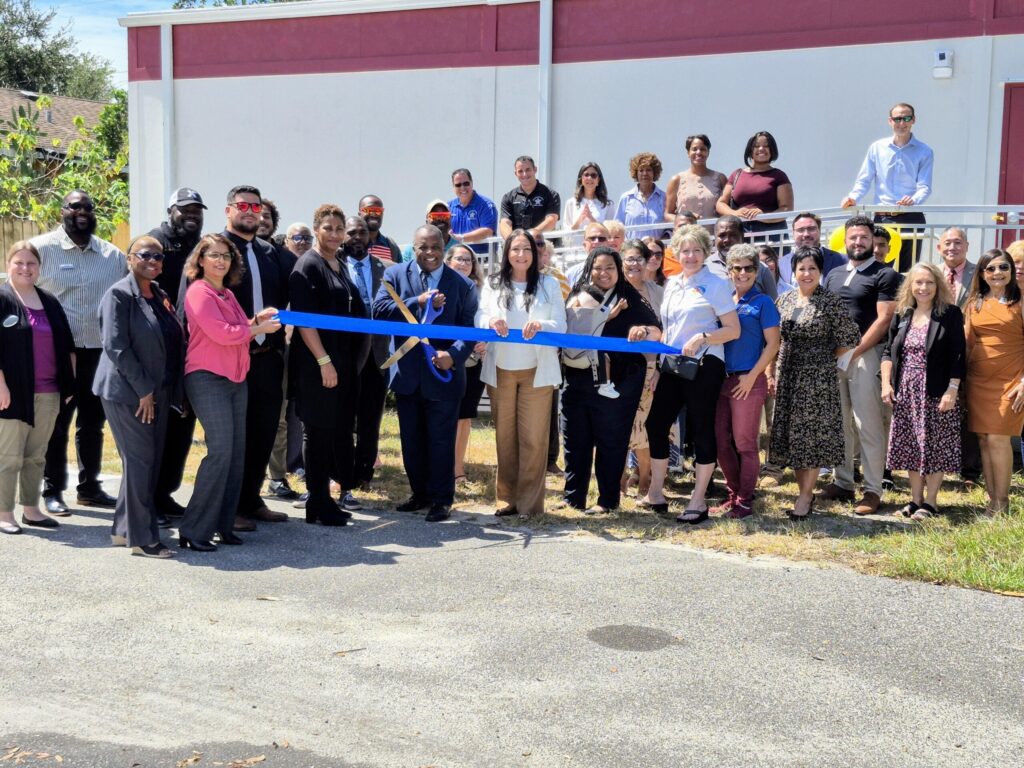
She was among a group of 50 community members at a recent ribbon-cutting ceremony for a new 2,660-square-foot modular building that will open after crews add the finishing touches.
Those attending the event represented a broad swath of community leaders, from local law enforcement officers to staffers at the Temple Terrace Uptown Chamber of Commerce, who brought the ceremonial oversized scissors. A representative of the Hillsborough County Clerk’s Office also attended. So did a group of leaders and students from Cristo Rey Tampa Salesian High School, which has some Grant Park Christian Academy alums.
Hillsborough County Commissioner Gwen Myers, a Democrat whose district includes Grant Park, joined her Republican colleague in praising the alliance and the school. The two commissioners also presented Johnson with a commendation honoring his contributions to the community.
“Our children are our future leaders, and when we can give them the basic foundation of education, they are going somewhere,” Myers said. “Just remember where they got their start, right here in Grant Park. What you’re doing is being a true public servant. Thank you for your vision.”

A husband, father of six, and grandfather of 12, Johnson refers to the students at Grant Park as “our babies” and describes the school as a haven of safety and peace.
“We hardly ever have any fights here,” he said. The school day starts at 7:30 a.m. After-school care is available until 5 p.m. Grant Park also offers summer camp, tutoring, mentoring and career preparation programs for the community, where the median household income stands at $32,216, and 72% of households make less than $50,000 per year. About 20% of the population did not graduate from high school. Although the area still has crime, Johnson said it has decreased over the past five years. Educational opportunities such as Grant Park Christian Academy and adult education and training play a role in improving the area’s quality of life, he said.
Johnson said he has seen many students turn their lives around. He told guests about a boy who was put outside the room for disrupting class on his first day.
“I don’t like this school,” he snarled.
“Give us a chance,” Johnson replied. He encouraged the boy to focus on his studies and respect his teachers. “You’re going to be a great leader and a great man.”
By the second year, the boy’s attitude completely changed. Test results that year showed he had the highest reading score in the school.
“That’s just one of the stories,” he said. “We have a plethora of them.”

States with recent education choice lawsuits involving EdChoice Legal Advocates and the Institute for Justice.
As education choice options expand for families across the nation, opponents are stepping up their fight to preserve the status quo.
Observers say these conflicts are examples of growing pains that come when a society undergoes transformational change.
 “It’s just part of the cost of doing business,” said Michael Q. McShane, director of national research at EdChoice, a national nonprofit think tank. “Educators are not alone in challenging policies they don’t like. New laws get passed; people who can’t do things democratically try to do things through the courts.”
Michael B. Horn used a famous quote (often misattributed to Mohandas Gandhi) to describe the spate of lawsuits: “First they ignore you, then they laugh at you, then they fight you, then you win.”
“I think we’ve entered the fight stage,” said Horn, the co-founder, distinguished fellow, and chairman of the Clayton Christensen Institute and an author of several books on disruptive innovation. “Education choice has gotten big enough that the entrenched interests dedicated to preserving the status quo are starting to see it as a threat.”
Legal fights over education choice began in the 1800s when Catholic families opposed the Protestantism taught in public schools. In 1925, the U.S. Supreme Court ruled in Pierce v. Society of Sisters that parents had the right to put their children in private schools. In 2002, the high court issued another landmark decision, Zelman v. Simmons-Harris, which upheld an Ohio scholarship that allowed parents to spend the money on religious schools. The high court found that when the parent controls the expenditure, the state has no role in determining whether the parent will choose to use funding at a religious or secular school.
With the Zelman ruling settling that question, choice opponents began trying to insert race-based arguments using the language of state constitutions. Michael Bindas, a senior attorney at the Institute for Justice who argued the landmark case Carson v. Makin before the U.S. Supreme Court, outlined that shift in a paper published in the Syracuse Law Review. According to Bindas, common arguments center on education clauses requiring states to maintain uniform or common public school systems. Education choice opponents, he said, take that a step further and claim that private scholarship programs could upset racial balances that state constitutions require state governments to maintain. They also argue that the requirements that states maintain public school systems bar them from establishing concurrent private education choice programs. Lower court judges in Ohio and Utah recently cited this argument in striking down choice programs. Ohio plaintiffs also raised the issue of racial balance argument, which the judge rejected.
McShane and Horn say the spate of lawsuits won’t stop education choice programs from becoming the norm in public education. However, they will delay the transition.
“Yes, these cases are a headache and can delay implementation, but school choice has a good track record,” McShane said. “It will take numbers and time, and it’s going to tip over into a different mindset.”
Where things stand
Montana: Families are waiting on a judge to rule on a lawsuit brought by opponents of a 2024 education savings account program for students with special needs. Plaintiffs argue that the law allowing reimbursements for $6,800 per child violates several provisions of the state constitution and redirects tax dollars to private institutions at the expense of students with special needs who remain in public schools. The judge denied the plaintiff’s motion for a temporary halt to the program, allowing families to continue using their ESAs while the case is pending.
Ohio: The state has appealed a lower court’s ruling that declared the state’s $700 million Educational Choice Scholarship Program (EdChoice) unconstitutional. In siding with the coalition of school districts and other choice opponents, the judge said that the program was not a subsidy program, as the state argued, but a separate system of schools in violation of the state constitution. However, the judge rejected the plaintiffs’ argument that the program violated the state constitution’s education clause by creating racial imbalances in the district schools. The 10th District Court of Appeal is expected to hear the case in 2026.
Utah: Families are continuing to receive funds from the Utah Fits All scholarship program while a district court ruling in favor of a teachers union-backed lawsuit is under appeal to the state Supreme Court. A district judge ruled that the state constitution prevents lawmakers from using tax revenue to fund education programs other than public education, higher education, and services for people with disabilities. The judge rejected the state’s argument that it had met its funding obligations to public education and that nothing in the law prohibited it from funding a separate program to support families choosing private or home education.
Wyoming: Families seeking to use Steamboat Legacy Scholarship ESAs had to find other options for the 2025-26 school year after a trial judge blocked the state from distributing funds in July at the request of the Wyoming Education Association and other plaintiffs until the judge rules on their lawsuit against the program. The judge recently denied a motion by state officials and attorneys for two families to dismiss the lawsuit based on their argument that the plaintiffs lacked legal standing.
Missouri: Education choice advocates scored a win last month when a judge denied the teachers union’s request to freeze payments to the MOScholars K-12 scholarship program as their lawsuit continues. MOScholars began in 2021 as a tax credit program supported by private donors. Earlier this year, the state allocated $51 million to the program, prompting the Missouri Education Association to file the complaint, which contends that the allocation unconstitutionally diverts taxpayer funds to private schools.
Arkansas: The state’s Education Freedom Account program is being fought on two fronts. In June 2024, opponents sued in state court, arguing that the program illegally diverted tax dollars from the public school system to benefit private schools. The judge denied the state’s motion to dismiss the complaint, so state attorneys are appealing to the state Supreme Court.
The same plaintiffs filed another lawsuit a year later in U.S. District Court. It argues that the program violates the Establishment Clause of the First Amendment because “it aids in the establishment of religion” by providing state funding to private schools operated by religious organizations. The state refutes that by arguing that the money can go to schools representing a wide variety of faiths, as well as secular schools.
They also argue that the program violates the Equal Protection clause of the 14th Amendment because it discriminates against low-income families, families in rural areas where there are fewer private schools and students with disabilities, because private schools are exempt from the federal Individuals with Disabilities Education Act. The program is also discriminatory, according to the complaint, because private schools are not held to the same standards as public schools. The state attorney general has filed a motion to dismiss the case, arguing that the plaintiffs lack standing.
Kentucky: The Kentucky Supreme Court heard arguments on Sept. 11 about whether the state’s charter school funding law violates the state’s constitution. Charter schools have been legal in the Bluegrass State since 2017, but there was no state funding mechanism. Lawmakers passed House Bill 9, which allocated money to charter schools, which are publicly funded but independently managed. A trial court judge ruled in 2023 that the law violated the state constitutional ban on the use of tax dollars to support non-public education and the constitutional requirement for “an efficient system of common schools.”

Choice opponents have been known to throw contradictory arguments out against private choice programs. One moment they will claim that the majority of kids using universal choice programs were already going to private schools. A few moments later they will claim such programs are draining district schools of students and money. The irony of these mutually exclusive claims will often escape the person making them, and you can see hints of both in this New York Times podcast titled Why So Many Parents are Opting Out of Public Schools.
Sigh
Choice opponents make all kinds of claims, but not many can withstand even a modicum of scrutiny. Let’s take for instance a widely repeated fable- that Arizona’s universal ESA program has “busted” the state budget.
If you actually examine state reports like this one for district and charter funding and also this one for ESA funding, you wind up with:
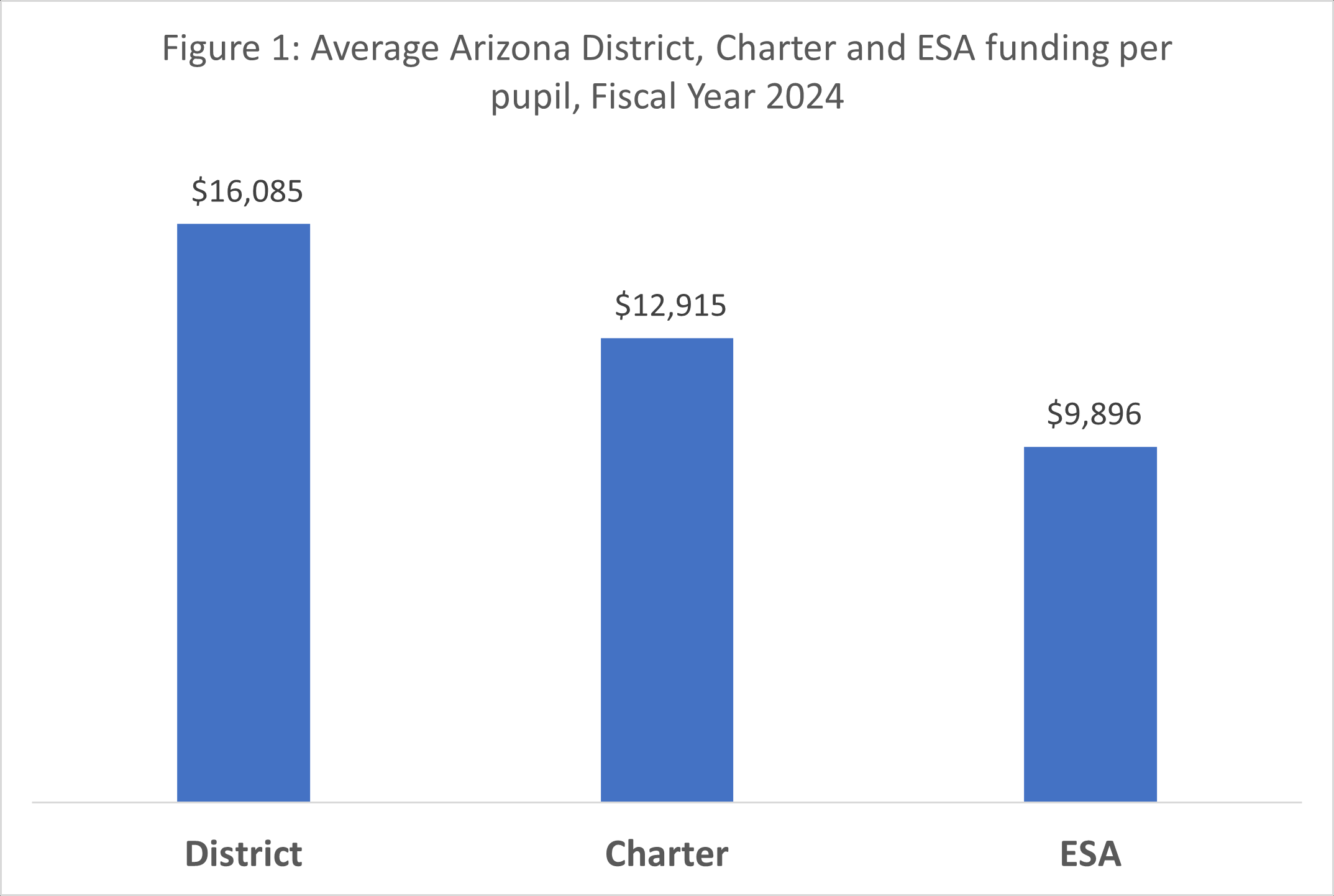
Arizona districts have exclusive access to local funding among other things and are by far the most generously funded K-12 system in the state. Districts, charters and ESAs all use the state’s weighted student funding formula, and ESAs get the lowest average funding despite having a higher percentage of students with disabilities participating than either the district or charter sector.
If you track the percentage of students served by the district, charter and ESA sectors respectively, and the funding used by each as a percentage of the total, you get:

So, there you have it; supposedly the sector educating 6% of Arizona students for 4% of the total K-12 funding is “bankrupting” the state of Arizona. Meanwhile the system, which generated an average of $321,700 for a classroom of 20 ($16,085*20), is “underfunded.”
A group of 20 ESA students receiving the average scholarship amount receive $123,780 less funding, but they are (somehow) “busting the budget.” The fact that a growing number of Arizona students opt for a below $10k ESA rather than an above $16k district education tells us something about how poorly districts utilize their resources. So does the NAEP.
There is a school sector weighing heavily upon Arizona taxpayers, but it is not the ESA program.

**SPOILER ALERT! DO NOT READ IF YOU ARE UNDER THE AGE OF 8**
Western cultures, for some strange reason, involve rituals where we pretend that various “fairy creatures” exist, particularly with children: the Tooth Fairy, a jolly old elf with flying reindeer who brought me an awesome Big Wheel in 1973, egg and goody hiding rabbits, etc. When I became a parent, I played along with these rituals, but then at some point questioned why I was doing it. On the one hand, I didn’t want my children to be those killjoy types who went around bursting the bubbles of other kids. On the other hand, I did not want to train my children not to trust me. I decided to allow the “fun” to go on until they each reached a certain age, then to explain to them that these things are traditions and that it would be best to allow their friends to figure it out on their own.
So, dear reader, I assume that you have reached a certain age and that you are prepared to know the truth about the last fairy creature. Belief in this one tends to persist much longer than the others and is alas, more detrimental. Sorry to be a killjoy, but here goes:
Philosopher kings are not real.
This was my main thought upon reading Mike McShane’s recent entry in a debate about school choice regulation. Go read it. I’ll wait here.
Go on…
Okay, good. My favorite part involved the Gilded Age meat baron, but McShane made several crucial points. Local school boards, state governments and the federal government all regulate public schools in a very active fashion. I could produce multiple graphs from NAEP, PISA, etc., showing what a pig’s breakfast American academic achievement has become, but you have already seen them, so I will spare you. Why are American schools so wretched despite so much regulation? Oh well, that is simple: regulation is not made by philosopher-kings but rather by politics. Politics has an amazingly consistent record of fouling things up.
The philosopher-king fairies, invented by Plato, are a specially trained and educated aesthetic elite who, disinterested in fame or wealth, love only wisdom and justice. Having thus earned the right to rule over us lesser mortals, we proles should feel deferential and deeply grateful for their sacrifice. Again, sorry to burst your bubble, but these people do not exist in the real world. Out here in the real world, mere humans with all kinds of motivations (political and otherwise), limits to their knowledge, greed, stupidity and other normal human failings create regulations. Those of us fortunate enough to live in a democracy get the chance to throw the bums out when we’ve had enough. Just in case you haven’t noticed, a major subtext of politics these days involves bums that voters can’t throw out.
Politics, not philosopher-kings, runs regulation, and politics runs on self-interest far more than on benevolent technocratic wisdom. Choice programs must cope with powerful organized interests that yearn to use regulation as a tool to domesticate choice opportunities and find it in their self-interest to do so. The default position of choice supporters should therefore be to view the calls for regulation with a deep skepticism; it is not paranoia when people really are out to get you.
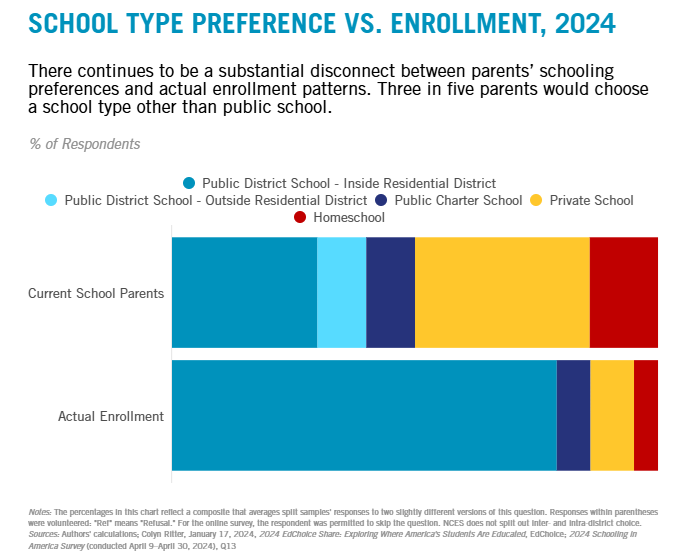
None of this is to say that it is possible to pass choice legislation without regulation; it is not. I am not aware of any program anywhere that operates without some degree of regulation. American parents, however, want a radically different K-12 system than the one government forces them to pay for (see above). The way forward is to allow families to partner with educators to sort through new schools and education methods. Heavily regulated choice systems might get to something close to the K-12 system parents want and deserve before the heat-death of the universe, but then again, they might not.
America’s founders fought a grueling war against the most powerful country in the world based upon what was then a radical idea, that people could live better without royalty to boss them around. The divine right of kings was another myth humanity needed to grow up and discard, and that should include philosopher-kings.

Last week, I had the opportunity to make a presentation about how lawmakers can support teachers who want to start their own schools. The four key features:
2. Formula funding/demand-driven funding: Whoever applies for a choice program should receive funding if eligible.
3. Avoidance of anti-competitive accreditation requirements: Don’t ask your startup schools to operate without funding from the choice program while incumbent/accredited schools receive choice funding.
4. Exempt private schools from municipal zoning: Old hat for charter schools, needed for private schools as well.
Florida is the only state your humble author is aware of that has taken all four of these steps. This makes Ron Matus’ new study "Going With Plan B” all the more important. Despite a statewide increase of 705 private schools, 41,000 Florida families applied for, received, and ultimately did not use an ESA. Matus surveyed thousands of these parents to learn why.

The lack of school space was the No. 1 reason Florida families found themselves as non-participants. Reasons two and three were related to costs, which can also be thought of as a supply issue.
The “Going with Plan B” study is very interesting and should be studied carefully by Florida policymakers. For now, however, let us focus on the other states with choice programs that lack the four critical elements listed above. If FLORIDA has a supply issue, your state, sitting at one out of four, or two out of four, should take note: It is likely to be even worse in a state near you.

It's hard to find an athlete as exuberant as Caleb, who celebrates at the finish line of each of his races with a choreographed dance and high-fives for everyone. (Photo provided by the Prewitt family)
JACKSONVILLE, Fla. – David Prewitt was worried.
His wife, Karen, wasn’t.
“He can do it,” she said.
Their son Caleb, 13 at the time, was participating in his first open-water swim, something he needed to conquer if he was going to complete his first triathlon.
One thing you need to know about Caleb: He has Down syndrome.
Another thing you need to know about Caleb: It has never held him back.
“When we came home (from the hospital) with Caleb, we said he’s not going to be your typical young man with Down syndrome. We’re going to push him, and so we've always tried to raise him as a typical child,” Karen said.
That meant chores around the house, being active in sports, attending school, and making friends inside and outside of the Down syndrome community.
“We kind of upped the ante when we got into sports,” Karen said.
She coaxed Caleb into running a 5K on Thanksgiving of 2020 by using the Couch to 5K app that gradually built up his endurance. Now, Caleb was training for a triathlon – a 300-meter open-water swim, a 12-mile bike ride, and a 5K race.
He had learned to ride a bike. He had swum in a pool plenty of times. But what concerned David was that Caleb, with assistance from a volunteer partner, was now swimming in a lake to see if he had the strength and stamina to finish that leg of the race.
Turns out, he did.
“He comes out of that water, and he's just laughing,” David said. “And I thought to myself, ‘You’ve got to change your attitude,’ because this kid can do things.”
***
Caleb is now 18. He has completed 119 races in the past five years. Included are 44 triathlons of various distances, five half-marathons, and two Spartan Races.
The Guinness Book of World Records recognizes Caleb, 16 at the time, as the youngest person with II2 (Intellectual Impairment, including those with Down syndrome) to run a half marathon (13.1 miles). Caleb’s goal is to add his name to that book again in October by becoming the youngest person with II2 to run a marathon (26.2 miles) when he and his mom run the Chicago Marathon.
Stephen Wright was Caleb’s partner during the early part of Caleb’s running career. He’s amazed at all Caleb has accomplished.
“I don't think people realize, most 14- 15-, 16-year-old kids aren't doing that,” he said. “So not only does he have things he's trying to overcome and prove he can do things, but most kids his age aren't doing the things he's doing. It’s incredible, because I wasn't doing that stuff at his age.”
***
Deb Rains is the assistant head of school at the North Florida School of Special Education (NFSSE) in Jacksonville, where Caleb attends on a Unique Abilities Scholarship managed by Step Up For Students.
Rains called Caleb the school’s “Mr. Mayor.”
“He’s so outgoing,” she said. “He’s friends with everybody.”

Caleb will enter the North Florida School of Special Education's transition program this year.
Rains said Caleb’s always-in-a-good-mood personality and can-do spirit come from the support he receives from Karen and David. More than a decade later, she vividly recalls her first meeting with them when they visited NFSSE to see about enrolling Caleb.
“I will never forget this. They came in and they had his mission statement,” Rains said.
It read:
“We built everything around that,” Karen said.
It is important to the Prewitts that Caleb has friends outside of school because, as is often the case when students graduate, friends from school scatter to live their own lives.
Caleb has friends from school. Luke, a classmate, is his best buddy. But Caleb has friends outside of school, too. He belongs to four running clubs. He has friends from Planet Fitness, where he works out, and friends from Happy Brew, a Jacksonville coffee house that sells Caleb’s homemade cookies. (More on that shortly.)
They want Caleb to have a job and be self-sufficient. He graduated in May from NFSSE and will enter the school’s transition program, where he will learn employment skills.
“We're very thankful for that,” David said. “He's got a lot of things that he can look forward to, because he's pretty well known in the community.”
Caleb is eager to hit the job market. He’d like to work at Happy Brew, Planet Fitness, or Publix. David, now retired, worked as a store manager for Publix. Caleb’s sister, Courtney Tyler, works in a Publix bakery.
He’s getting a jump this summer on a possible job at Happy Brew by attending NFSSE’s barista camp.
“As an organization, you have a mission statement and a vision statement, but to take that and place that intentionality on their son's life just showed me that they were not limiting him because of his disability,” Rains said.
“I was very impressed by that. There was a statement to not just me, the school, but to the community, that they expected nothing less from their son than they would their daughter, who's neurotypical.
“That just created the path for him. Since they didn't put any boundaries or limitations on Caleb, there was none for him to be impacted by.”
***
The mood surrounding a child born with Down syndrome isn’t positive, David said. Parents are informed of all the things their child won’t be able to do – ride a bike, run, swim, get a job.
“We were on a mission to prove them all wrong,” Karen said.
Along the way, Caleb has become a role model for the Down syndrome community. He has advocated at the state capital in Tallahassee for the expansion of what is now the Family Empowerment Scholarship for Students with Unique Abilities, which he receives. Karen has written newspaper op-ed columns and spoken to legislative committees in Tallahassee in support of the scholarship.
“If we didn’t have the scholarship, we would have had a tougher journey,” she said.

Caleb has more than 26,000 followers on Facebook and more than 44,000 followers on Instagram. Karen said parents comment on the posts, saying they have more confidence in their child’s abilities after seeing what Caleb has achieved.
Caleb has appeared on NBC’s “Today” show during a segment featuring children with unique abilities who cook or bake. Caleb bakes. Currently, he’s baking the cookies sold at Happy Brew.
It started during the COVID-19 pandemic when Caleb began helping his dad in the kitchen. That led to their cooking show, “Fridays at Four,” that were posted to Facebook. They were hugely popular.

Caleb and Stephen Wright stand on the podium after finishing the triathlon at the Special Olympics.
Now, Caleb bakes 20 dozen chocolate chip and sugar cookies a month and delivers them to Happy Brew. The sugar cookies are a hit.
“We can’t keep them on the shelf,” owner Amy Franks said.
Caleb’s “Mr. Mayor” personality is in full force when he visits the coffee shop, Franks said.
“He'll walk in, he'll immediately step behind the counter and start making a smoothie, or he'll hop on the point of sale, like he owns the place, and we just let him do his thing, like go for it,” Franks said. “His work ethic is incredible. He never stops.”
Caleb often wears a T-shirt bearing the slogan, “No Limits.” He wrote that on top of his mortarboard at graduation.
Running, cooking, working out at the gym, Caleb has yet to encounter a limit.
And he does it all with a smile.
“The joy inside of him is so meaningful for us,” Franks said.
***
In 2021, Stephen Wright volunteered to be a partner for a special needs athlete and was paired with Caleb for a triathlon in Sebring.
He remembers how excited Caleb was before the race, and how concerned he was about how Caleb would react to the competition, the crowd, the long swim, which is the first leg.
“There was one point (during the swim) where I turned around and he wasn't there, and I started panicking,” Wright said. “He was actually underwater, trying to tickle my feet. And I was like, ‘All right, man, I can see how the rest of this day is going to go.’ We got out of the water, and everyone cheered for him.”
The two were dead last when they transitioned from the bike ride to the run. At one point, Wright couldn’t see any other runners. He wondered if the race was over.
What he didn’t know was that at the finish line, the race director was rounding up the younger runners who were waiting for the awards presentation and told them to go to the finish line and cheer on this young man who was running his first triathlon.
David and Karen were among those waiting for Caleb.
“That finish line,” Karen said, “was one of the best experiences of my life.”

Recent Clearwater Central Catholic High School graduates (from left) Jan Mistak, Ian Galloway, Nancy Dolson, and Paige Daily each earned National Merit Scholarships.
CLEARWATER, Fla.– They are honor students and athletes.
Volunteers in the community and student ambassadors at school.
One is a champion sailor who has competed in the national and international regattas in places like Canada, Argentina, and Poland.
One is a state champion cheerleader. There is an Eagle Scout who won a district championship in the high jump. There is a three-sport athlete who was voted homecoming king.
They have grade point averages north of 4.0 and PSAT and SAT scores that are the envy of nearly every high school student who has taken the tests.
They are four students who graduated this spring from Clearwater Central Catholic High School, united by the same unwavering drive to excel academically.
And that drive led them to this: a National Merit Scholarship.
Paige Daily, Nancy Dolson, Ian Galloway, and Jan Mistak are among the 6,870 winners nationwide out of the 50,000 students from the Class of 2025 who qualified. The scholarship covers nearly all college costs. All four attended CCC with the help of a private school scholarship managed by Step Up For Students.
“Having college paid for is huge, and the recognition is nice,” Paige said. “You work hard (academically), and it’s nice for people to appreciate that.”
Paige will attend Florida State University and major in finance.
Nancy, CCC’s valedictorian, was accepted to the University of Florida’s honors program and will major in construction management.
Ian is headed to Florida State, where he will major in biomedical engineering.
Jan (pronounced Yon) will major in physics and continue his sailing career at the Massachusetts Institute of Technology (MIT).
Since 2021, CCC has identified high-academic-achieving freshmen and, using the Ray Dass college-readiness program, guided them through the steps necessary to achieve a National Merit Scholarship. Ray Dass includes preparation for the PSATs and SATs with live, online tutoring.
CCC has had at least one National Merit Scholarship winner every year since then. It can add to that total next spring, since five members of the Class of 2026 are National Merit Qualifiers.
Meet the 2025 winners:
Paige Daily
 Paige and her teammates on the cheerleading team raised a state championship banner after claiming the Class 1A title in Competitive Cheer in January. Banners are a family thing. Her dad, Chris, and his brothers won state soccer titles for CCC.
“It was cool to see her put a banner up in the gym with me and her uncles,” Chris said.
Paige was born and raised in Atlanta, Georgia. She and her parents moved back to Pinellas County when she was in the eighth grade. She found herself surrounded by strangers during the start of her freshman year at CCC, but quickly set about changing that.
Paige played lacrosse as a freshman and joined the cheerleading team as a sophomore. She was a member of Peer Ministry; Water 4 Mercy, which raises funds to help bring sustainable water to rural villages in sub-Saharan Africa; and Morning Star Amigos, where she spent time with students at Morning Star Catholic School, which educates children with unique abilities in Pinellas Park.
“We appreciate them and recognize them,” Paige said.
She was also involved in the Fashion Upcycle Club, which collects and donates formal dresses to students in Pinellas County who can’t afford a dress to wear to their prom.
“When I came here, I really pushed myself to try a lot of new things, things I would never have done before, because I would be too afraid of failing, and I would rather just stay in my bubble than push myself,” Paige said. “But it just helped me be a lot more confident and want to try new things and experience new things, and that's kind of what high school is all about.”
Nancy Dolson
There’s nothing like a sibling rivalry to drive ambition, especially for the youngest in the family. Nancy’s older brother Richard was an Eagle Scout. Nancy became an Eagle Scout. Richard attends the University of Florida. Nancy was accepted into UF’s honors program and will attend the university on a National Merit Scholarship.
“Every time I do something, I try to surpass him a little bit,” Nancy said.
 Nancy was one of the first girls to join the Boy Scouts when it became coed in 2019. She became the first female in her Boy Scout district to achieve Eagle Scout when she refurbished the outside entrance to the St. Vincent De Paul Community Kitchen in Clearwater. She built four earth boxes, repaired existing planters, and pressure-washed the area.
“It was pretty gloomy,” said Nancy, who helps serve breakfast there on Sunday mornings.
Nancy was captain of the cross-country team as a senior. She was the president of the Student Ambassador club and the student chaplain for Peer Ministry. She helped start CCC’s Math Club and was a member of the Model United Nations Club.
Nancy has served as a summer counselor at Boy Scouts camps across the country. She even participated in her Ray Dass classes while at camp in New Mexico.
“Nancy is a doer,” said her mom, Barbara. “She does great things every day that make me proud of her. I’m so thrilled to call her my daughter.”
Nancy will major in construction management but hasn’t decided on a career path.
“I have a lot of goals that aren't career-based,” she said. “I'm still trying to work out the career stuff.”
One of her goals is to hike the Appalachian Trail.
“That's a big one for me,” she said. “Probably after I graduate.”
Ian Galloway
Ian is the second National Merit Scholarship winner in the family. His sister, Taylor, who graduated from CCC in 2022, also earned one. Taylor recently completed her junior year at Florida and has applied to medical school.
“She’s on her way. She's crossing off goals, and she's doing very well,” Ian’s mom, Amanda Galloway said, “and I do think that she was a motivating factor for Ian to go after this scholarship.”
 Ian’s father, Michael, is a pediatric oncologist, and Amanda is a radiation therapist.
“I come from a family that’s really, really interested in health sciences,” Ian said.
He will major in biomedical engineering with an eye on a career of “helping people from a different approach,” he said.
Ian was a member of the Model United Nations Club and Peer Ministry. He was a student ambassador and helped start the Marauders Meadow Club, a club designed to grow plants around campus.
He played basketball and soccer and ran cross country and track. He was the homecoming king as a senior. He wore a bald cap and performed a takeoff on the character “Eleven” from the Netflix series “Stranger Things” for the senior class movie during homecoming week.
“I was kind of a comic relief character,” Ian said. “I got to see myself look goofy on the big screen.”
“He was very good,” Nancy Dolson said.
The seniors won.
“He’s smart. He’s athletic. He fits into a lot of different places,” Amanda said. “He's kind of an oddball, but in a lot of good ways, so I'm excited to see where life takes him.”
Jan Mistak
Jan began sailing when he was 7 and started racing sailboats when he was 11. He’s raced in theYouth World Championship in Poland and Argentina. This summer, he will participate in the Youth World Championship in San Pedro, California.
“My dream was to combine competitive sailing with top-tier education focused on technology and science. I am thrilled to have made that dream a reality by being accepted to MIT and their varsity sailing team” he said.
 Sailing in Poland represented a homecoming of sorts for Jan. His parents, Agnes and Gus, originally from Poland, have worked in real estate since early 2000.
“Hard work brought us to where we are today, and we wanted to model that for our children,” Agnes said.
When the children were young, they would go on family walks that took them past CCC. Gus and Agnes hoped that one day it would be possible for the kids to attend this school. They wanted the faith-based education and the high academics that CCC provides.
Maggie completed her freshman year at CCC, while Julia will be an eighth-grader at St. Paul Catholic School in St. Petersburg.
The honor of achieving the National Merit Finalist status definitely set a high standard for his sisters to follow.
“It's great to see that the hard work paid off for Jan, and he's an inspiration for his sisters,” Agnes said.
In addition to sailing internationally, Jan was busy during his four years at CCC.
At CCC he was a member of Water 4 Mercy, Catholic Relief Services, the Entrepreneurs Club, and Peer Ministry. He served as his homeroom representative for the student government, was a student ambassador, and competed in the newly created Math Competition club. He participated in various school-wide fundraisers.
Jan, like the others, earned a National Merit Scholarship by studying – he logged on to the Ray Dass classes wherever he was, even during his sailing travels. Yet, like the others, it wasn’t all just studying, studying, studying.
All four had a variety of interests and talents that they used to their fullest.
“Obviously, academics are important,” Chris Daily said. “But there's a lot more to it, which is great. It's the whole person that CCC looks at, which is really neat.”
TITUSVILLE, Florida – Coach Mustard did it.
Not the deed that formed the plot of the Temple Christian School’s production of “Get a Clue.” That might have been Scarlett Starr. Or not. The play is a mystery.
On the surface, Coach Mustard helped solve the mystery. But there was something else going on with Coach, and it wasn’t revealed in any of his 181 lines. It went unnoticed by those who attended one of the ensemble’s two performances in the winter of 2023.
Coach Mustard was played by Joseph Garvin, a 10th grader at the time, and what portraying the well-liked but stern physical education teacher did to Joseph was turn the shy sophomore into an outgoing, confident young man who’s no longer afraid to challenge himself for fear of failure.
Joseph, 19, a straight-A student throughout high school, recently graduated from Temple Christian as the school’s valedictorian. He attended the K-12 private, faith-based school in Titusville with the help of a Florida Tax Credit Scholarship, supported by corporate donations to Step Up For Students.

Joseph Garvin maintained a 4.0 GPA during his four years at Temple Christian School in Titusville.
He plans to attend Liberty University in Lynchburg, Virginia, and study nutrition with an eye toward a career as a health coach or a nutritionist.
“I have thanked God many, many times for allowing my children the means to attend this school,” Joseph’s mom, Leanna Garvin, said. “Joseph’s life would be so very, very, different without it. It has allowed him to really flourish, as evidenced by the many awards and glowing accolades given by his administrators, teachers, pastor, and even the City of Titusville.”
Joseph wrote about his journey to and through Temple Christian in his college admission essay, “From Snowed in to Sunny Side.”
“Snowed in” refers to his childhood in Larimore, North Dakota, a no-McDonald's, dot-on-the-map town of a little more than 1,200 located less than 100 miles from the Canadian border. Joseph said it was big news when the Dollar General opened.
He spent his winters building snowmen, having snowball fights, and sledding down the hill of the local park.
“Snow was a huge aspect of my life,” he said. “We even made this snow cream, we called it. We took fresh snow and put vanilla, milk, and sugar in it.”
Joseph attended school at his local church, where, depending on the year, the number of students in his grade fluctuated between four and six. The school closed during the COVID-19 pandemic.
Without a school to attend, Joseph and his sister Rebekah, now a rising senior at Temple Christian, were homeschooled.
But Leanna suffers from myalgic encephalomyelitis/chronic fatigue syndrome (ME/CFS), Fibromyalgia and Raynaud's Disease. Fibromyalgia causes pain and tenderness throughout the body, while ME/CFS causes chronic fatigue. Raynaud's reduces the blood flow to her extremities, a condition worsened by the bitter North Dakota winters.
“She has a very low energy threshold, so she runs out of energy very fast, and then she can, we call it, ‘crash,’” Joseph said.
That made homeschooling a struggle for Leanna, forcing her to look for another educational option.
So, Leanna moved the family south to Titusville to be close to her parents and enrolled her children at Temple Christian. Joseph entered as a ninth grader.
“Temple Christian was the perfect school for my kids,” Leanna said. “They needed the structure of being back in school after struggling through a year of homeschooling, and Temple Christian is a place where structure, standards, and expectations are blended with just the right amount of mercy and grace.
“That is the importance of sending our kids to a Christian school, being able to send them to a place where we know our core values will not only be accepted, but taught, encouraged, and enforced. What we teach at home will be upheld and reinforced by the school, like an extension of us.”
Joseph described the move to Florida as a “culture shock.” In addition to sand replacing snow and humidity replacing wind chill factors, Joseph’s new school was bigger than the one he attended in Larimore.
“It was just like, ‘Whoa, there are so many people.’ It felt so weird to not know everybody,” Joseph said.
Moving from North Dakota to Titusville was a shock for Joseph, but he adjusted well.
His metamorphosis began then. He started eating healthier and lost 45 pounds. He learned about the direct correlation between a person’s diet and their physical and mental well-being. It’s the reason why he wants a career based on nutrition.
He joined the basketball team and played for two seasons, leaving the squad after taking a part-time job.
In the 10th grade, he tried out for the school’s production of “Get a Clue!” Written by Megan Orr, the play mirrors the popular board game and 1985 movie, “Clue.”
There are differences. For one, the dignified and dangerous character with a military background, known as Colonel Mustard, is now a popular gym teacher.
“I pushed myself to try out for that play,” he said. “I was constantly on stage, practicing, talking. It taught me how to memorize, and it taught me how to articulate words better, so that people can understand me better. It taught me not to be afraid, to have confidence.”
Joseph was at times required to run across the stage and do push-ups. Some of his lines were a few words. Some were longer.
He loved every minute of it.
“I definitely think that was a turning point for him,” Temple Christian Administrator Andrea Stoner said. “He gained confidence. He realized he could accomplish things.”
Joseph said that until then, his lack of self-confidence had always held him back.
“I kind of had this mental block in my childhood, thinking that I just couldn't do things. ‘Oh, I can't do that. I'm not capable of doing something like that. I can't improve.’ For some reason, I had the belief that if I wasn't good at something, I would never improve,” he said.
Pushing himself beyond his comfort zone for the play was a pivotal moment during Joseph’s high school years. But there were others.
Joseph said that by “truly placing his faith in God” as a 10th grader played a big role, as did the teachers and administrators at Temple Christian.
He developed time-management skills by working two jobs – at an ice cream shop near his home and doing yard work and odd jobs on weekends.
Working at the ice cream shop injected Joseph with the self-confidence that comes from working with others and serving customers.
He challenged himself academically by enrolling in a college-level anatomy course at Temple Christian during the 12th grade. He aced it while maintaining a 4.0 GPA in a course load that included several honors courses. It’s no surprise that Joseph graduated first in his class.
“I reach into my memory and think about who all influenced me to become the better version of me,” Joseph said. “I just think about how so many things went together, and it was a culmination of all those things that happened that brought me to where I am now.”
Coach Mustard did it, sure.
But in the story “From Snowed in to Sunny Side,” it’s Joseph who found the answers.

