
Some people claim that there is school choice to blame, but we know, it’s all Randi’s fault.
The nonprofit research organization Northwest Evaluation Association, also known as NWEA, released an analysis recently called Education’s long COVID: 2022–23 achievement data reveal stalled progress toward pandemic recovery showing that students suffered a pronounced slowing of academic growth during the 2022-23 school year. This is incredibly sad but not incredibly surprising; kids that don’t learn to read during their K-3 window tend to fall further and further behind grade level as they age through the system. Such students grow increasingly frustrated and tend to begin dropping out of school entirely starting in late middle school. In addition, following the example of many adults, legions of students seem to have developed the idea that school attendance is optional.
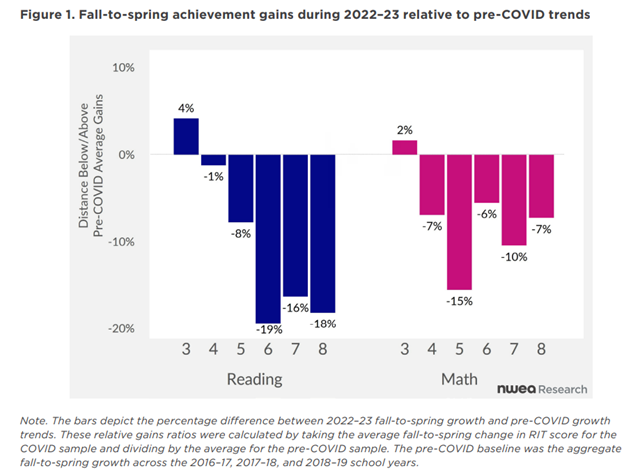
The key thing to appreciate about the above chart would be the school year: 2022-23, post-COVID shutdowns and during the period in which the federal government literally gave schools more money than they could figure out what to do with. If you are waiting for an academic bounce back or delayed reaction recovery, stop being silly: it’s not in the cards. If they create a Pulitzer Prize for understated headlines, the New York Times is in the running with this recent gem:
Schools Received Billions in Stimulus Funds; It May Not be Doing Enough
How are all those billions of dollars in K-12 education funds being spent as un-remediated students fall ever further behind grade level work? The Times very helpfully supplies examples:
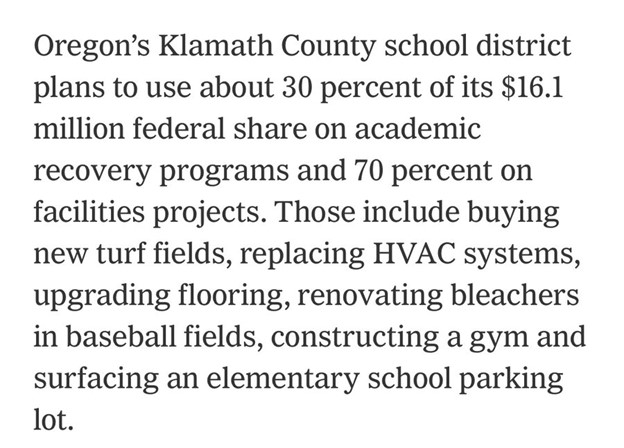
The districts have it coming and going: their ZOOM-school era kids are likely to begin dropping out in higher numbers. Year by year a baby-bust cohort of kindergarteners will replace the diminished cohorts exiting. Enrollment will shrink, but at least we’ll have those new baseball bleachers.
Years ago, a wildly mistaken group of people began talking about “peak oil.” Sometimes you’ll hear someone drop an ideological catchphrase like “late capitalism” as your cue to stop taking them seriously. “Peak school district enrollment” however is a thing, and it is a thing that lies in the past. Ironically, it lies in the past because the unions inflicted it upon themselves.
 This is our first attempt at a weekly compendium of news and insights that provide relevant insight to efforts to transform education.
Abundant Opportunity
One of the most insightful responses to the recent U.S. Supreme Court decision blocking affirmative action policies in university admissions came from NYU Marketing professor Scott Galloway. The solution, he argues, is to create radically more space in top universities.
Rejectionist Nimbyism is a means of transferring of wealth from young/poor to old/rich: skyrocketing value in existing degrees and houses while the cost for young people to attain their dreams has — in lock step — also skyrocketed.
If we can scale companies 40% per year, then we can expand enrollments at our great public universities 6% per year. The system is ready. Remote learning and utilizing campuses during non-peak periods (summer, nights, weekends) could double capacity. Stop building luxury dorms and lazy rivers. Abandon our obsession with four-year liberal arts degrees — we can continue to produce poets and philosophers, but also plumbers and cybersecurity technicians.
Why it matters: So much parental anxiety, and so many barriers to meaningful change to education systems at all levels, trace back to a common problem: Scarcity. Parents perceive, often correctly, that spaces in desirable public schools or sought-after universities are hard to come by. Opportunities should be abundant.
Cheaper and Easier
Technology industry watcher Benedict Evans explains why, like other technological leaps, AI will likely create more jobs than it destroys.
New technology generally makes it cheaper and easier to do something, but that might mean you do the same with fewer people, or you might do much more with the same people. It also tends to mean that you change what you do. To begin with, we make the new tool fit the old way of working, but over time, we change how we work to fit the tool.
Why it matters: In theory, making existing work cheaper and easier should help make opportunities more abundant (e.g., a tutor for every child). Unfortunately, our education system has a history of domesticating new technologies rather than being transformed by them.
Numbers to Know
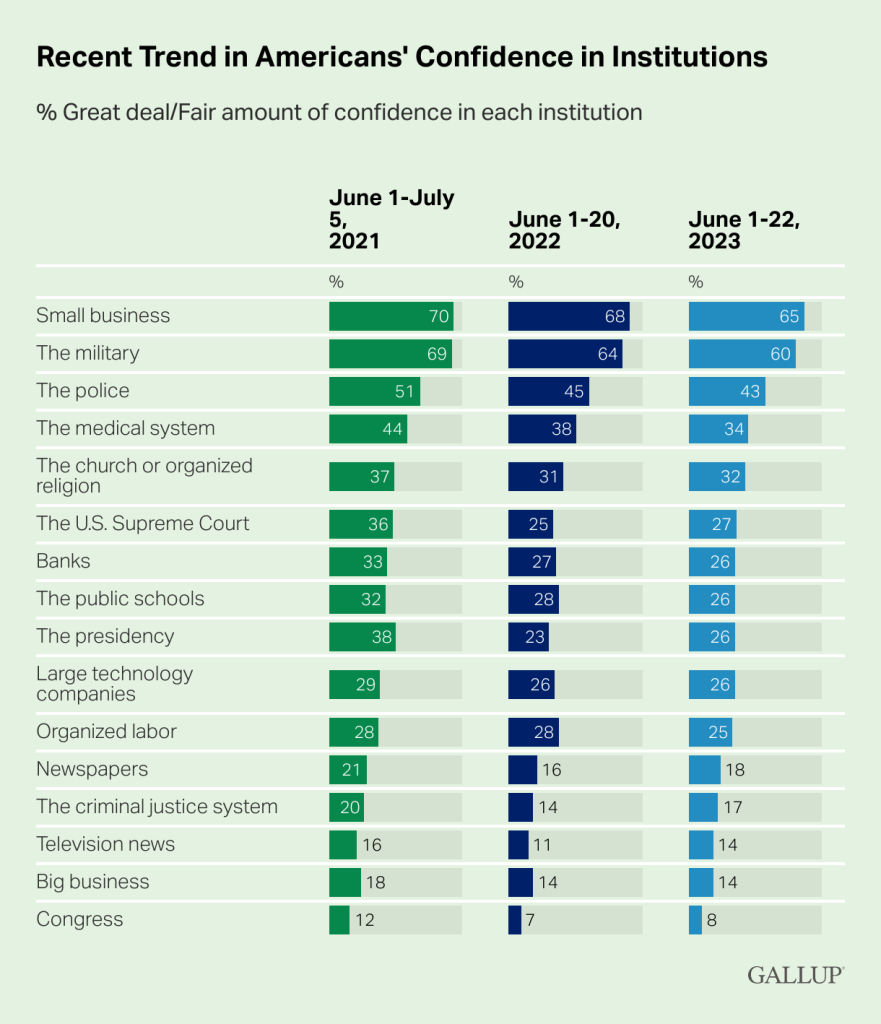
26: Percentage, according to Gallup, of Americans who express at least "a fair amount" of confidence in the nation's public schools.
2,180: Number of Florida students who started homeschooling last year.
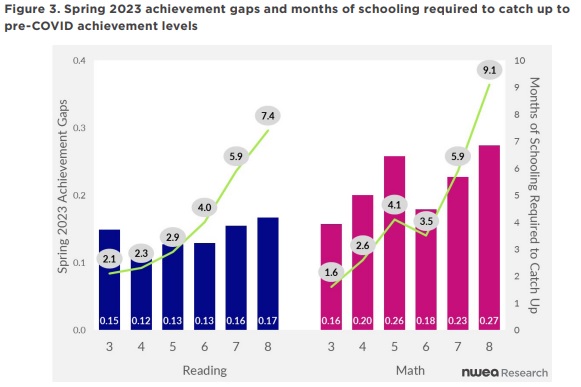
9.1: The number of additional months of schooling the typical U.S. 8th grader would need to return to pre-pandemic achievement levels, according to new estimates by NWEA.
-7: Percentage difference between those 8th graders' academic progress last school year and pre-pandemic growth levels. (Translation: At a time when their learning needs to be accelerating, it's still moving backward.)
33: Percentage of American students estimated to be chronically absent from school in 2022.
The Last Word
The U.S. is in the midst of an unprecedented decline in learning, with students falling far behind over the past few years. So why are the millions of children performing below grade level not in summer school? America is missing a critical opportunity and, sadly, tragic consequences will result.
- Michael Bloomberg, writing in The Wall Street Journal.
By Dr. Lauren Barlis
 My wish is that a more thoughtful approach to standardized testing through expanded educational choice can make academic success stories – for parents and teachers – more common.
Here’s one example of what I mean.
Barbee Day, a teacher at Holy Family Catholic School in St. Petersburg, Fla., became a mother of three overnight when she adopted her nieces and nephews from foster care. They now attend Barbee’s school thanks to a Florida Tax Credit Scholarship.
Barbee feels the power of choice every day. She chose to both teach at and send her kids to the same private school. And there’s more. As a teacher, she feels strongly about her school’s choice to use a standardized test that gives her more information as a mother, and gives her children’s teachers more opportunities to customize their students’ learning.

“If you were an educator like me,” Day said, “you would have endless questions about your new children’s educational histories. All I had [when I adopted them] were some past years’ report cards that told me little about what they actually knew or learned in the classroom.”
Often the only information that parents receive on their children’s academic achievement are report cards and standardized test data. Private schools in Florida that participate in the Florida Tax Credit, Gardiner Scholarship, or Hope Scholarship programs must annually administer a test to monitor the progress of those students.
Typical standardized test data is sometimes referred to as “autopsy” data. Since these tests are designed to measure mastery, they are given at the end of the year. Often the scores are not received until after the students have left for the summer, and the information cannot be used to drive instruction. The scores often get mailed to parents and stuffed in a file cabinet.
Step Up For Students (a non-profit that administers the private school scholarships and hosts this blog) and its Office of Student Learning wanted something different for the schools we support. That’s why we partnered with Northwest Evaluation Association (NWEA) to connect our schools with the Measures of Academic Progress (MAP) Growth assessment, a computer-based adaptive test that is offered three times per year and designed to measure growth and achievement.
In 2016, 39 private schools in Florida volunteered to participate in a pilot study of the MAP Growth assessment. In 2017, another 200 schools chose to join the partnership. For the 2018-19 school year, the number has grown to almost 400 schools.
Unlike with top-down accountability, in which educators often bristle at academic measurements being imposed on them, the ability to choose to participate in MAP Growth creates a sense of buy-in for the stakeholders. That can produce better outcomes.
For example, even though the Florida Catholic Conference has required all Catholic schools to use the TerraNova standardized achievement test once per year, Holy Family chose to join the SUFS/NWEA MAP Growth partnership. Having choices for testing is empowering for schools like Holy Family, just as educational choice empowers parents and students to be in the learning environments that best suit them.
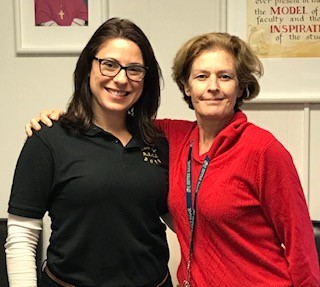
Barbee Day and Abby Rudderham
Principal Abby Rudderham said that choosing to use MAP Growth data is improving their instruction and supporting them in meeting the needs of their students.
“Each testing cycle (fall, winter, and spring) allows them to create goals with students, and it drives their instruction. We are also using the MAP Growth data to pull kids out of their normal classes and group them by the skills they are ready to learn, regardless of grade level, using a program called Power Hour during the last hour of school every Monday,” Rudderham said.
Schools in the SUFS/NWEA Partnership using Power Hour have increased the growth of their student population dramatically by targeting directly the skills that each student is ready to learn. On average, schools using Power Hour and other programs designed to use MAP Growth data to inform their instruction have increased the percentage of their students making a year’s worth of growth or more by 40%.
Holy Family saw 68% of their students meet or exceed their growth targets in Math during the 2017-18 school year. The majority of their students are on grade level or above in Math, and 32% of their students attend Holy Family on a Florida Tax Credit Scholarship.
“I am so thankful that my principal chose to keep using MAP at our school,” Day said. “Since we’ve implemented MAP, I’ve used it to drive my own classroom instruction, and now my own children’s. By having MAP data available, I can make the transition from teacher to teacher-mom more confidently, knowing that I am serving all the children I work with to reach their fullest potential.”
Dr. Lauren Barlis is director of learning management in Step Up For Students’ Office of Student Learning.
Editor’s Note: This is the sixth in a series of posts where various members of the education choice world share an #edchoice wish. For yesterday’s post, CLICK HERE.
COMING MONDAY: Keith Jacobs, manager of the Charter School Initiative for Step Up for Students wishes for equitable funding for education choice.

