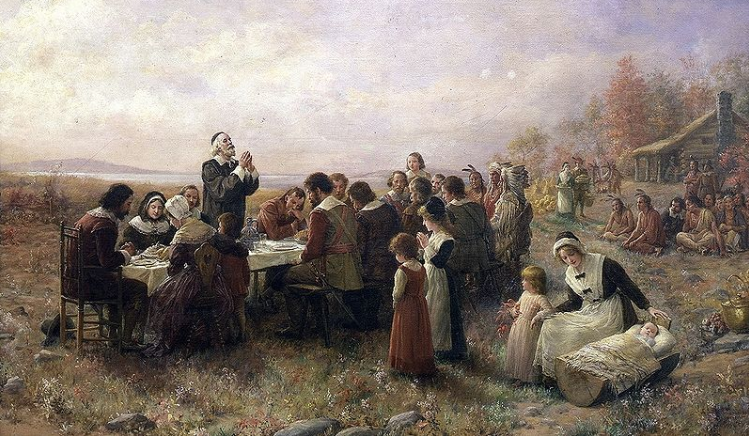
"The First Thanksgiving at Plymouth" by Jennie A. Brownscombe (1914) presents a typical mythologized scene showing Plymouth settlers celebrating Thanksgiving with Wampanoags, dressed in the garb of Plains Indians.
Editor’s note: redefinED is offering this Thanksgiving Day commentary from Neal McCluskey, director of the Cato Institute’s Center for Educational Freedom, via a Creative Commons republication agreement.
If you know your United States history, you know that the Pilgrims came to North America seeking to practice their religion free from the constraints of the Church of England. If you know your U.S. history well, you know that what many call the beginning of public schooling was the Massachusetts Bay colony’s law of 1647 requiring towns to supply some form of education, lest children fall victim to “that old deluder, Satan.” And if you know your history really well, you know that as public schooling developed it was repeatedly beset by religious conflicts, first as the schools were de facto Protestant, then as they became de facto agnostic.
What am I thankful for this Thanksgiving? That we may be on the verge of tearing down barriers to people directing education funds to schools sharing their religious values, barriers that do not just hurt religious families, but by forcing all to support one system of schools also keep non-religious families from getting what they want. Where religious people are sufficiently numerous, they can sometimes create de facto religious public schools, and where they are not sufficiently numerous to exert outright control educators will often avoid things that upset them.
The barriers I’m speaking of are Blaine Amendments, named after 19th century U.S. Senator James G. Blaine but found in 37 state constitutions. They are being challenged in the U.S. Supreme Court in Espinoza v. Montana Department of Revenue. The case involves a scholarship tax credit program that was struck down by Montana’s supreme court because it would have allowed scholarships to be used at religious schools. Oral arguments are scheduled for January 22, 2020.
These amendments, originally created to keep money in de facto Protestant public schools and out of Catholic institutions, are often interpreted to mean that no government money may go to religious schools even if directed by the free choice of parents. Basically—and as these Cato amicus briefs lay out in greater depth—they force religious people to pay for government schools that legally cannot teach religious beliefs as true, or make policies based on religious convictions. Indeed, the schools often teach things and institute policies that contradict people’s religious beliefs. That violates religious freedom and renders religious people unequal under the law.
The prospects for these amendments being struck down, or at least sufficiently curbed that people can get tax credits for funding religious school scholarships, are good. From Zelman v. Simmons Harris, in which the U.S. Supreme Court established that parents can take state vouchers to religious schools without violating the U.S. Constitution, to the Trinity Lutheran decision that states cannot bar institutions from participating in funding programs simply because they are religious, precedent is on freedom’s side.
For this we should all be thankful. Because more freedom is what America is supposed to be about.
What’s more off the wall? A Christian school teaching students that the Loch Ness Monster is a living dinosaur and proof of creationism? Or science supporters who continue to believe that public schools can significantly boost science literacy?
The Cato Institute’s Neal McCluskey suggests it’s a toss-up. He responded yesterday to the Washington Post’s Valerie Strauss, who predictably skewered vouchers after reports surfaced about some private schools using a biology textbook that says, “Are dinosaurs alive today? Scientists are becoming more convinced of their existence. Have you heard of the ‘Loch Ness Monster’ in Scotland?”
“I can certainly see why paying for this sort of thing would disturb a lot of people … ,” McCluskey wrote. “Let’s, however, use this to confront another, extremely dubious belief that many would never challenge: Government schooling leads to good science instruction.”
McCluskey efficiently lines up the evidence. A Gallup poll this month found only 15 percent of Americans believe human beings evolved without any involvement from God. National test scores show more private school students are proficient in science than public school students. And surveys show many public school biology teachers give short shrift to evolution because it’s too much of a mine field. “The result is that no one, no matter what their beliefs, gets coherent biology instruction,” McCluskey wrote.
I took a whack at this issue a few weeks ago, after a New York Times piece on tax credit scholarships cited examples of creationist teaching in private schools. (more…)

