
Blossom Montessori School for the Deaf has served students for more than two decades. Photo courtesy of Blossom Montessori School for the Deaf
CLEARWATER, Fla. – More than 20 years ago, Julie Rutenberg and Colette Derks harnessed some of the first private school choice programs in America to create a bespoke little school they knew their community needed. All these years later, Blossom Montessori School for the Deaf continues to show what kind of diverse, ever-expanding options are possible when education choice is in the mix.
Rutenberg founded Blossom in 2003. Derks, now the associate director, helped stand it up. As the name suggests, the PreK-6 school serves students who are deaf or hard of hearing (along with their siblings) and the children of deaf adults. Occasionally, Blossom also serves students who do not have any hearing loss because their parents want them to have more one-on-one attention. Over the years, nearly every one of its 250-plus students used a state-funded choice scholarship.
Rutenberg and Derks were working at a community center for deaf people when they got the idea for the school. They thought the hands-on, self-directed, mastery-based approach of Montessori offered a good alternative to the students they saw having a tough time in traditional schools.
“They’re able to move around the manipulatives when they’re working out their (math) problems, when they’re building words for reading, working with writing skills,” Derks said. “We really love how Montessori just kind of gets the whole body involved when learning.
“You’re not just sitting at a table looking at a paper or a book all day, (where) everybody’s on the same level,” she continued. “It really helps the student to be able to kind of grow and develop at their own pace.”
Rutenberg and Derks praised the public-school programs in their area that are serving similar students. Offering an option, they said, is not a knock on them.
“We’re just a different way of learning,” said Rutenberg, who attended Montessori schools as a child. “We’re not always going to be the right fit, either. Our goal is just to make sure the child comes first.”
Blossom got its start using three rooms inside another Montessori school. But for most of its existence, it’s been housed in a trim, beige building in an eclectic office park, right next to an ice-skating rink.
Most of the families it serves are working class. Most live in the immediate area. Some, though, drive an hour or more each way so their kids can attend. Others have moved from as far as Daytona Beach – on the other coast of Florida – because they wanted the school that much.

Quinten Caroline, 7, in costume as Leonardo DaVinci as part of a school project on Italy. Photo courtesy of Blossom Montessori School for the Deaf
“It’s nothing but positive with everything they do. They see the kids as perfect the way they are,” said Anastasia Caroline, whose son Quinten, 7, attends Blossom. “In a normal school, you’re not always going to get that love, that acceptance.”
Blossom represents so many choice-fueled trend lines. It’s a microschool. It’s a Montessori school. It’s a school for students with special needs. In Florida, where choice is the new normal, all those options are growing.
Microschools are so much of a thing now, they’re routinely showing up in local news stories (like this one and this one). I don’t know if anybody has a good handle on the total number, in part because there isn’t an official definition. But Microschool Florida, an excellent resource, puts the number at 156 and counting.
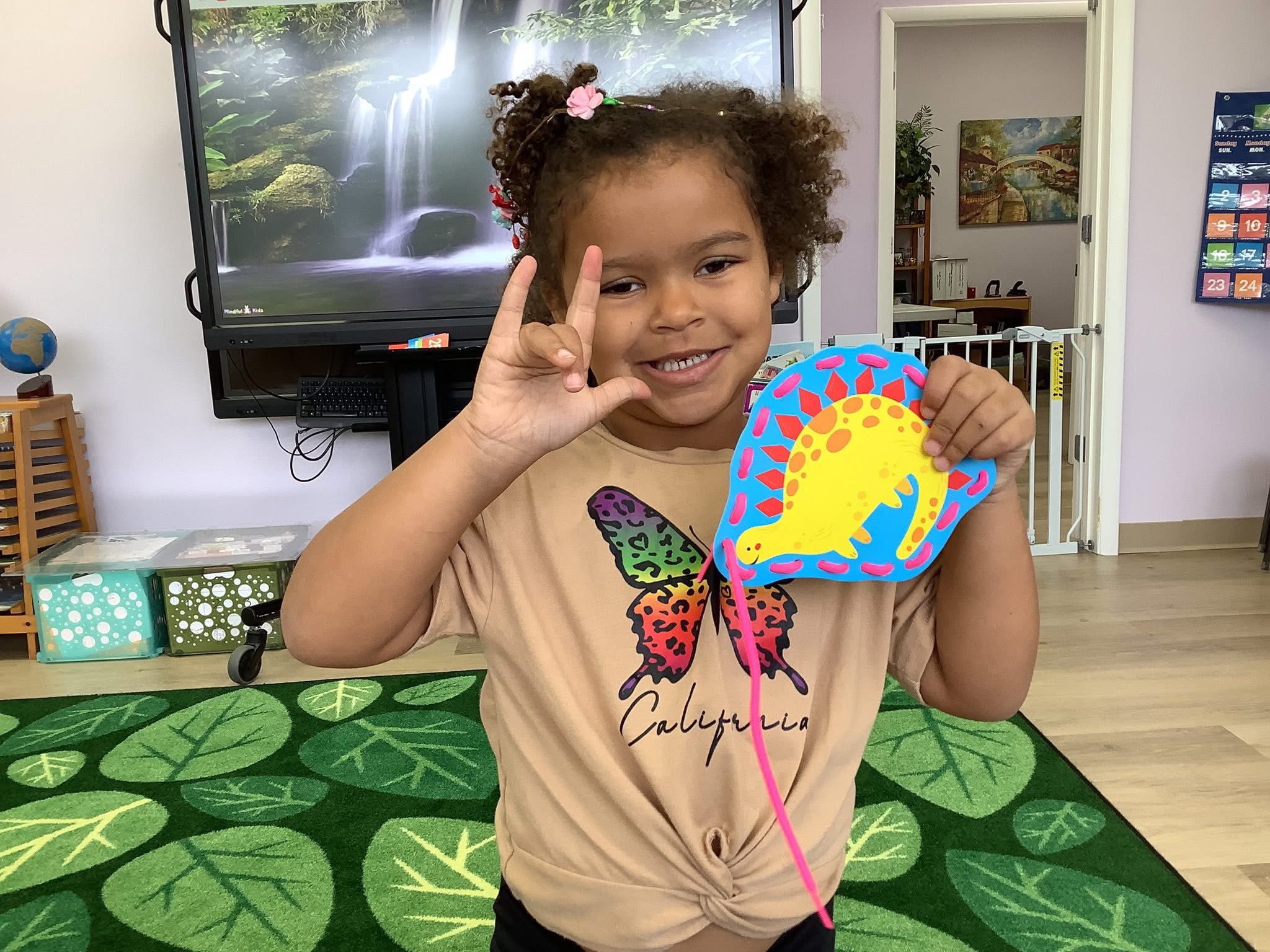
A student says "I love you" in American Sign Language. Photo courtesy of Blossom Montessori School for the Deaf
Meanwhile, there are at least 150 private Montessori schools participating in Florida’s choice programs. I say at least because that’s how many are listed in the state’s private school directory with Montessori in their name.
To be sure, there are plenty of Montessori-influenced private schools that don’t have Montessori in their names (like this one, this one, and this one). There are also plenty of school-like entities, like this hybrid operation in Tampa, and this homeschool co-op in South Florida, that are Montessori influenced, but aren’t official private schools, and aren’t tracked in any kind of official way, yet are funded in part by parents using flexible, state-funded education savings accounts.
Finally, there are more options for students with special needs. There’s more inclusion because more families can now afford schools that were once out of reach. (Check out, for example, the trend lines for scholarships for students with unique abilities in our white paper on Catholic schools.)
At the same time, there are more specialized schools, because, with choice, education entrepreneurs can more easily create them. Not far from Blossom, schools like this one, this one, this one, and this one, are all thriving.
“We would not be here today if we didn’t have the opportunity to use the choice scholarships,” Derks said. “It really is so important because the world today tries to fit everybody into the same box. (But) we’re all individuals, and we’re all our own person, and we learn differently, and we grow differently.”
Caroline, who works as an office manager at a medical practice, secured choice scholarships for both her sons, Quinten, and Silas, 10. She said private school would not have been possible otherwise.
Both use the Family Empowerment Scholarship for Students with Unique Abilities, an ESA Florida created in 2014. Once called the Gardiner Scholarship, it now serves 122,000 students. (Prior to the FES-UA Scholarship, Florida had a scholarship for students with special needs called the McKay Scholarship. It was merged with the FES-UA Scholarship in 2022.)
Caroline said she chose Blossom because she wanted Quinten immersed both in a sign language program and in the tight-knit deaf community. The school provides the warmth, structure, and positive reinforcement he needs, she said.
“They don’t allow bullying. They don’t put kids down. They just celebrate their growth and watch them blossom,” Caroline said. “It’s completely an amazing school for my child.”
DADE CITY, Fla. – LaTania Scott and Kameeka Shirley were former public school teachers who wanted something different when they opened their own school in January 2023.
Something … authentically Montessori … accessible to families from all walks of life … embedded with the autonomy that’s often missing from traditional schools.
The result is Blazing Stars Montessori, another shining example of what’s possible when teachers have more power to create their own models.
“We wanted our school to be a path to peace for our community,” said Shirley.
Blazing Stars is a private microschool. It has 25 students in grades PreK-3, with plans to grow to 47 in grades PreK-6. It’s also intentionally diverse. And in a semi-rural area.
In many states, that combo would make it an anomaly. In school-choice-rich Florida, it’s another one of 1,000 educational flowers in bloom.
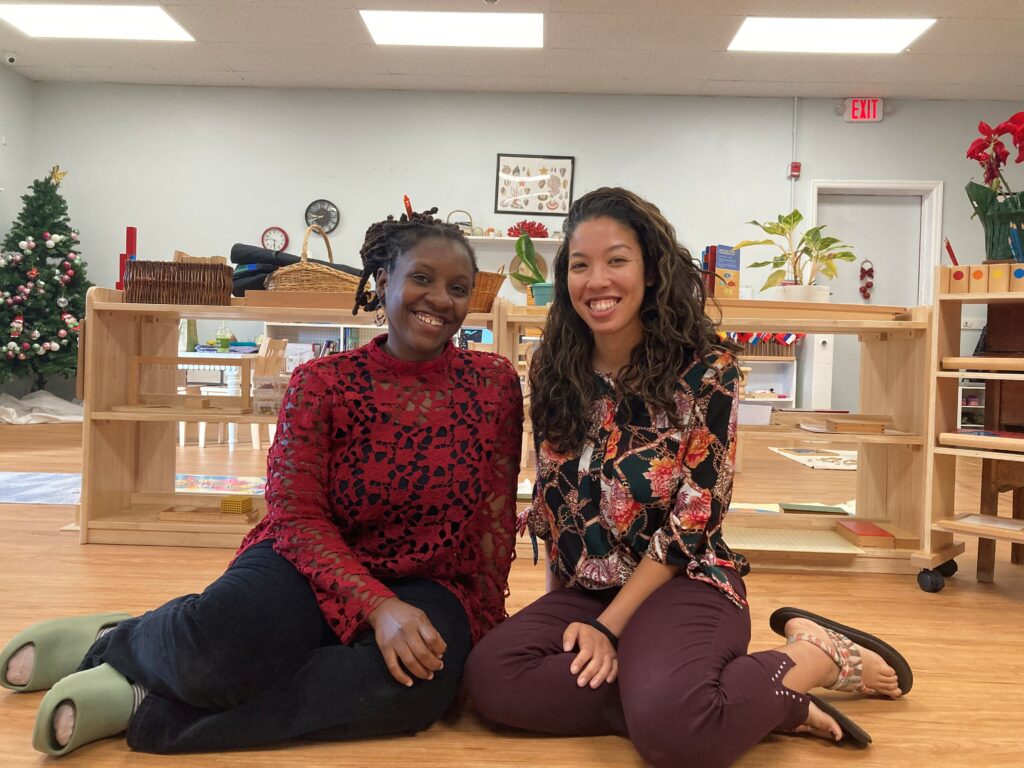
LaTania Scott, left, and Kameeka Shirley, found Blazing Stars Montessori microschool. Photo by Ron Matus
Former public school teachers like Scott and Shirley are behind many of those blooms.
Scott is a 17-year public school veteran. Shirley is a Teach for America alum.
The autonomy they have from creating their own school means they have the power to pivot when their families or students need something different. Or when they do.
“We can’t be our best selves for our children if we’re not taking care of ourselves,” Shirley said. “That was missing from the bigger education space.”
Blazing Stars is affiliated with Wildflower Schools, an acclaimed network of teacher-led Montessori microschools that got its start 10 years ago. Wildflower has since sprouted more than 60 schools nationwide, and expects to hit 200 within five years.
Blazing Stars represents several encouraging story lines that get more pronounced every day.
Teachers of color are a distinctive force among them.
Of the 436 schools in the Black-Owned Schools Directory maintained by Black Minds Matter, 74 are in Florida. A recent survey of those founders by Black Minds Matter and Step Up For Students found 64% are former public school teachers, and one in five created non-traditional models like microschools and hybrid homeschools.
Scott and Shirley said in the wake of the turbulence of the past few years – Scott mentioned COVID-19 and the murder of George Floyd – they wanted a school that would offer a respite for themselves, their children, and like-minded families. That’s the “path to peace” Shirley mentioned.
Like other Montessori schools, Blazing Stars let students learn at their own pace. Photo courtesy of Blazing Stars
Blazing Stars’ founders say they want to connect families who are diverse in multiple ways – not just race and income, but politics and ideology – and offer a learning community that builds bridges. “These are families who otherwise might not come together,” Shirley said. But in the end, “we’re all people who love our children and want them to do well in the world.”
The Montessori way is also key to the Blazing Stars vision of peace.
Scott fell in love with Montessori as an undergraduate at Xavier University in Cincinnati, where she immersed herself in the university’s Montessori lab school. She recalls being awestruck watching students in a learning environment where they had more agency over their own learning.
“They were moving around the space like they were gliding. They were so focused on what they were working on. That for me was the magic,” she said. “No yelling, no screaming, no fighting. No chaos. It was like a beautiful piece of art.”
Scott and Shirley purposely set up in Dade City, a town of 7,275 on the edge of metro Tampa. Their demographic analysis showed the fast-growing area had the multi-faceted diversity they wanted. And with choice scholarships, they knew what they offered would be widely accessible.
Making that leap from working in a school to founding one, though, wasn’t a breeze. “We were terrified,” Shirley said.
They’ve had to overcome some of the same hurdles that often dog other education entrepreneurs.
For example, Scott and Shirley obtained a childcare license for their facility in 2022. They needed that to operate a preschool that can accept the state’s preschool scholarships. But the rules for operating a K-12 private school are different, and those rules required the facility to have a sprinkler system.
The first estimate they got for that system was $97,000. “I fell into a ball of tears,” Scott said.
Without the sprinklers, Blazing Stars couldn’t participate in Florida’s K-12 education scholarship programs as planned. Thankfully, the Black Wildflowers Fund, a sister organization to Wildflower Schools that supports Black teacher leaders, helped Scott and Shirley through the delay, along with other organizations. Then they found a contractor who offered a much better deal. Blazing Stars is now on track to accept scholarship students this fall.
In the meantime, having the power to operate a school the way they and the families they serve want, without being constrained by somebody else’s agenda, is proving to be well worth it.
Blazing Stars “is a happy safe place for our kids,” Shirley said. “And for us too.”
Magnet schools. Hernando students bid farewell to visitors from China. Tampa Bay Times.
 Charter schools. Manatee County charter schools reach an agreement with the school district on transportation costs. Bradenton Herald. Breakdown here.
Montessori Schools. Bradenton students head to Switzerland for a model UN competition. Bradenton Herald.
Superintendents. The Hernando superintendent's evaluation becomes contentious. Tampa Bay Times.
Attendance. Pinellas schools look for ways to get kids to come to class. Tampa Tribune.
Kindergarten. Orlando Sentinel columnist Beth Kassab reflects on her daughter's first year of school.
Entrepreneurship. Duval students plan a food truck specializing in healthy burritos. Florida Times-Union. Collier students pitch competing business proposals. Naples Daily News.
Contracts. The Hillsborough school district has a $1.5 million relationship with the state fair. Tampa Bay Times.
Employment. Pasco schools expect job vacancies. Gradebook.
Employee conduct. A Marion schools employee is accused of pawning district property. Ocala Star-Banner.
 For the last month, the North Carolina legislature has been debating whether to create a scholarship program to help low-income families pay the tuition and fees at qualified K-12 private schools. Since this proposal closely parallels Florida’s tax credit scholarship program, I’ve traveled to Raleigh three times in recent weeks to discuss what we’ve learned in Florida about school choice over the last 10 years and how these lessons might apply to the North Carolina program.
Below are the lessons learned I’ve shared with supporters and opponents:
Virtual school. Florida Virtual School supporters fear a tweak in how per-course funding is calculated will result in big cuts. The Buzz and Tallahassee Democrat.
Charter schools. A Palm Beach County charter school is appealing the school board's decision to close it, saying the district didn't do enough to help it, writes the Palm Beach Post. Converting a Lake County Montessori school into a charter would be a good thing, writes Orlando Sentinel columnist Lauren Ritchie.
School security. Gradebook: "A bill that would require Florida schools to have an armed officer on campus unless a principal designates an employee with a concealed carry permit to have a weapon has passed its first hurdle in the state House." More from The Buzz, Miami Herald Sarasota Herald Tribune, Associated Press.
The Florida model. South Carolina should pay attention to what Florida is doing; the Palmetto State spends more per student and yet its average performance for all students is below the average for low-income students in Florida. Charleston City Paper.
Diploma options. The House Education Committee likes the idea. StateImpact Florida. (more…)

