Studies have repeatedly found that competition from charter and private schools drives small but meaningful improvements in public schools' performance. But most of those studies look at individual states or school districts, so the Thomas B. Fordham Institute has made a laudable effort to gauge competitiveness nationally.
The think tank's new report crunches state and federal data to see which large districts across the country face the most competition from private and charter schools, as measured by the number of students in each district's geographic area enrolled in non-district options.
The data demonstrate dynamics we've covered on this blog for years: Florida school districts like Miami-Dade County Public Schools face heightening competition from charter schools and private school scholarship programs. And they've responded by improving outcomes and creating new options for their students.
As Fordham's Amber Northern and Mike Petrilli write in their foreword, "the whole 'school choice versus improving traditional public schools' debate presents a false dichotomy; we can do both at the same time. Indeed, embracing school choice is a valuable strategy for improving traditional public schools."
The Fordham data are disaggregated by race, and they show that while there is still unequal competition for students of different backgrounds, all students have gained access to more options.
In most parts of the country, charter schools have been the largest source of new competition, as they've grown rapidly while private school enrollment has stagnated. That's even true in Miami-Dade, the largest district in a state with the nation's largest private school scholarship programs.

It's true for students in Miami-Dade on average, but it's not true for all groups. Private schools have driven the increase in competition to serve specific groups of students, including Black students.

This jibes with a point that researchers David Figlio, Cassandra Hart and Krzysztof Karbownik made in a recent study of the impact of charter schools on competition in Florida: The "competitive forces induced by the presence of charter and private schools appear to be complementary," at least for some student outcomes. It's possible schools in different sectors cater to different groups of students.
There is a key limitation of Fordham's approach. The number of students who opt out of district schools is an imperfect indicator of competition. Private schools are booming in the San Francisco Bay area, but there's little evidence that districts are scrambling to compete for their students.
On the other hand, while Florida's private schools have grown slightly over the past two decades, the share of students using educational choice scholarships has grown faster. In other words, the mix of private-school students has shifted, and some students attending private schools now would have lacked the means to do so a decade or two earlier.
Studies detailing the resulting impact on public-school performance have shown that as Florida's scholarship programs scaled up, performance improved faster in schools that served more low-income students, and thus had to compete for students whose enrollment they could previously take for granted. In other words, an ideal measure of competition may not be the share of students who have left district schools, but the share of students who could leave, and who districts feel compelled to serve more effectively as a result.
 Editor’s note: This commentary from Travis Pillow, editorial director for the Center on Reinventing Public Education and former managing editor for redefinED, appeared April 25 on the CRPE website.
On March 13, Florida schools announced an extended spring break, which would be followed by a statewide shutdown extending into April—and now, through the end of the school year.
The initial closure order came on a Friday. The following Monday, the state’s largest school district, and the fifth largest in the nation, went live with its distance learning plan.
The initial effort in Miami-Dade Public Schools had its flaws. It took until the end of the first week to distribute thousands of technology devices and mobile hotspots to students. Teachers and students reported difficulty logging onto online learning platforms. Some online systems crashed. And the plan continues to evolve. The district didn't start taking attendance until April 6.
Still, the district has consistently been ahead of its peers nationally in assuring that instruction would continue even though schools were closed. Miami-Dade’s position near the head of the pack might not come as a surprise. The district is becoming a national darling, thanks to rising student achievement, its proliferation of educational options, and its flamboyant superintendent.
But other Florida districts moved almost as quickly. A week after distance learning began in Miami-Dade, Duval County Schools returned from spring break and quickly went live with a detailed virtual learning plan that, unlike most remote plans in other parts of the country, called for teachers to deliver instruction and offer feedback on student work.
In early April, CRPE’s analysis of remote learning efforts in 82 school districts across the country showed that 6 of the 19 districts offering a combination of formal curriculum, instruction, and academic progress monitoring were in Florida. Half of the 16 districts tracking student attendance were in the Sunshine State.
The sample is not random, so it’s hard to draw clear conclusions about response efforts in different states (though CRPE will bring new data to bear on those questions in the coming weeks).
Still, Florida’s fast, fairly consistent rollout of remote learning highlights some unsung policy and leadership achievements that deserve more attention—from its sophisticated approach to virtual education to the skill and longevity of superintendents in some of its largest urban districts.
Since schools first closed in mid-March, Richard Corcoran, the state's education commissioner, consistently asserted that schooling in Florida would continue, albeit virtually, while his peers in other states waffled or stayed quiet.
Education Reform Now's analysis of state responses flagged Florida as one of the first states to accelerate remote learning from zero miles per hour to 65. But Florida schools didn't start from a dead stop. They were already rolling, thanks in part to a series of policies put in place over the past decade. Since mid-March, school and district leaders have stepped on the gas.
A national leader in virtual learning is right in the backyard
Florida is home to the nation’s largest public virtual school. Headquartered in Orlando, Florida Virtual School (FLVS) functions like a school district, with a state-appointed board. But it also behaves like an independent enterprise, offering courses to students all over the world and partnering with schools—including districts, private and charter schools, even homeschooling cooperatives—to help them offer virtual courses using its technology and, in some cases, its teachers.
Corcoran and other state officials are tapping this resource in their crisis response. The virtual school is allowing tens of thousands more students to enroll in more than 100 courses, without diverting any funding away from the school districts these students normally attend.
There's no question the presence of FLVS will help support Florida students through the move to remote learning. It’s also offering online education resources to parents and educators.
But the statewide virtual school has also played an underappreciated role helping districts across the state build out their own virtual learning programs.
Every school district in the state has some virtual learning capacity
For most of its 23-year history, FLVS never competed directly with school districts for funding. It was funded through a standalone line item in the state budget. Districts didn't lose any revenue if a student enrolled in an FLVS course, and frequently referred students to FLVS for enrichment, summer learning, or classes they couldn't offer themselves—such as electives, foreign languages, or Advanced Placement.
A growing number of districts began using FLVS technology and know-how to operate their own virtual schools.
The landscape shifted in 2013 when state lawmakers passed an overhaul of virtual learning funding and policy. The new law pitted districts and FLVS competition for students and funding. It also required every district in the state to offer a suite of online learning options—some of which would be operated by well-known online learning companies, such as K12.
The increased competition for students and funding encouraged more school districts to promote their own virtual schools, often FLVS franchises, to compete for virtual students. Almost every large or midsize district in the state now operates a virtual school that employs a local principal and local teachers. Most small districts are members of rural consortia that do the same.
This might not have prepared the state's brick-and-mortar classroom teachers for the rapid shift to virtual learning. But it meant that nearly every district in the state had educators and administrators on staff with experience running virtual schools.
As Kevin Hendrick, associate superintendent for Pinellas County Schools, told the Tampa Bay Times before remote learning began: “We have some teachers who do this every day. We have the model. … It’s just a matter of taking it out to the masses.”
Fast-moving, high-capacity districts helped pave the way for others
Two days before schools closed all over the state, the Miami-Dade school district had already inked a plan with its local teachers union green-lighting the shift to remote learning.
As Superintendent Alberto Carvalho recently recounted, the district had been monitoring the crisis and planning in advance. The district published the first iteration of its instructional continuity plan before schools closed and encouraged others to borrow its ideas.
Other large districts also had a jump start. Rob Bixler, the associate superintendent for curriculum and digital learning at Orange County Public Schools, noted that the Orlando school district’s initial remote learning plan came together in the course of a week.
The district already had practices in place—including one-laptop-per-student policies in all of its middle and high schools, as well as partnerships with companies that provided mobile hotspots—that simply needed to be consolidated in one document.
And since the department in charge of instructional technology also writes curriculum, the district office can share its low-tech solutions—such as lesson packets mailed to tens of thousands of elementary school families—with teachers so they can prepare in advance to help students with their work.
“We are constantly adjusting, troubleshooting and brainstorming to support our students, teachers and parents,” Bixler wrote in an email.
Orange and Miami-Dade Counties were among the first large urban districts in the country to carry out remote learning plans that called for teachers to deliver instruction and monitor their students’ academic progress. Florida’s remaining large urban districts (Broward, Duval, Hillsborough, and Palm Beach and Pinellas Counties) joined them near the head of the pack.
Other districts in the state borrowed elements of the early movers’ plans and swapped ideas behind the scenes, at times with the help of groups such as the Florida Association of District School Superintendents, which often serves as a hub for problem solving among the state’s 67 district leaders.
After the frenetic first few weeks, Florida districts have begun to stabilize. Miami-Dade rolled out version 2.0 of its remote learning plan earlier this month. It included plans to track student attendance, which has revealed what Carvalho has called “digital deserts,” where students from low-income and immigrant communities struggle to connect with their schools. Moving quickly allowed these districts to discover barriers quickly, and start working on solutions.
What other states can learn from Florida's example
Some of the policies that helped normalize virtual education across Florida might not be worth replicating. The state requires every public school student to take an online course before they graduate—a requirement that’s come under criticism and seen some changes.
But some of the policies and leadership decisions that helped Florida districts respond quickly to this crisis could be useful elsewhere.
Among them:
· Assertive state leadership articulated a clear expectation that instruction would continue, albeit remotely, when school campuses were closed, but gave districts flexibility to figure out many of the details.
· The state has intentionally fostered organizations, such as FLVS, that are designed to drive innovation—by serving students directly, partnering with other schools, and serving as a statewide resource.
· Rather than cede the online learning market to an oligopoly of large virtual charter schools with questionable business practices, poor outcomes, and ill-conceived oversight, Florida’s virtual education policy has encouraged a diffusion of virtual education expertise into school districts, and enables competition between different providers—including FLVS, local district programs, well-known national players such as K12 and Connections Academy, charter school organizations such as Academica (which came quickly out of the gate with its own remote learning effort), and other online providers. The framework is far from perfect but has produced a more diverse array of online learning options than exist in other states.
· High-capacity leaders in large districts proactively prepared for a disruption and shared their plans with the state Department of Education and counterparts in other districts.
All of these conditions helped enable the rapid rollout of remote learning in Florida—and could enable faster disaster responses or more diverse online learning ecosystems in other states.
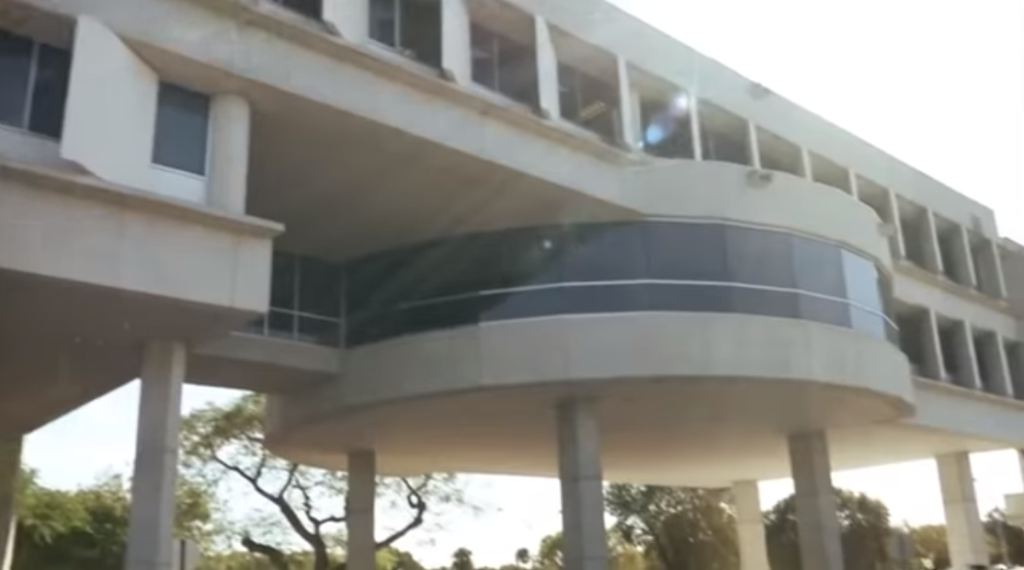
School for Advanced Studies, a collegiate high school in Miami, was named fourth-best high school in the country this week by U.S. News & World Report.
Miami-Dade County Public Schools, where nearly three-quarters of students are enrolled in choice programs, led Florida once again on U.S. News & World Report’s annual list of the nation’s best public high schools released earlier this week.
School for Advanced Studies, the top public high school in Florida, was the fourth-best high school in the nation, improving upon last year’s rankings of No. 2 and No. 26, respectively. The school is a combined effort of Miami-Dade County Public Schools and Miami-Dade College that allows students to complete their last two years of high school while attending the state college and earning credit toward an associate degree.
Five other Miami-Dade schools, all either selective magnets or charter schools, ranked in the top 10 in Florida and top 100 nationally: Young Women’s Preparatory Academy, No. 3 in Florida and No. 52 nationally; Design and Architecture Senior High, No. 6 in Florida and No. 72 nationally; Archimedean Upper Conservatory Charter School, No. 7 in Florida and No. 74 nationally; International Studies Charter High School, No. 8 in Florida and No. 83 nationally; and Jose Marti Mast 6-12 Academy, No. 9 in Florida and No. 94 nationally.
“M-DCPS continues to demonstrate that our district … is a leader in academic performance, and that includes providing our students with a remarkable range of educational opportunities,” superintendent Alberto Carvalho said in a news release issued by the school district.
All six schools have minority populations between 74 and 96 percent. The percent of students who qualify for free and reduced-price lunch, generally an indicator of poverty, ranges from 36 percent to 74 percent, with two schools – International Studies Charter High School and Jose Marti Mast 6-12 Academy – qualifying for Title I funds.
Carvalho, a long-time supporter of education choice, decided years ago to embrace rather than fight the opportunities that come with customization. Unlike other school districts that have resisted efforts to establish charter schools or have opposed programs that provide scholarships to private schools, Miami-Dade chose to be leaders in the movement and provide robust choice within the public school system.
“We recognized … that the choice tsunami was upon us,” Carvalho told redefinED in a podcast last year. “And I was not going to do what lot of my colleagues did. Which is, ‘Let’s hope and pray it doesn’t hit us. Or let’s just allow this to go through. Like all things, this is a fad that will go away.’”
Instead, Carvalho anticipated the policy shift taking place in Florida and throughout the country.
“And we were right,” he told redefinED. “It has, quite frankly, materialized exactly as we predicted. But rather than being a spectator, or a victim of it, we were an active participant in it.”
School of Advanced Studies principal Omar Monteagudo said the U.S. News rankings are a reflection of the work educators at the school have undertaken to elevate rigor and accountability.
“Truly, it comes down to all stakeholders committed to the school core values – working collectively and intentionally – on providing our students with a first-rate education,” Monteagudo said.
Each year, U.S. News & World Report publishes the rankings of 18,000 public high schools based on a review of 24,000 schools in all 50 states and the District of Columbia. The magazine analyzes schools relative to college readiness, math and reading proficiency and performance, underserved student performance, college curriculum breadth, and graduation rate.
This year, all top 100 schools were either specialized, magnet or charter schools.
Other Florida schools making the top 100 were Pine View School in Sarasota, No. 24; Westshore Junior/Senior High School in Melbourne, No. 53; Stanton College Preparatory School in Jacksonville, No. 62; and Edgewood Junior/Senior High School in Merritt Island, No. 95.
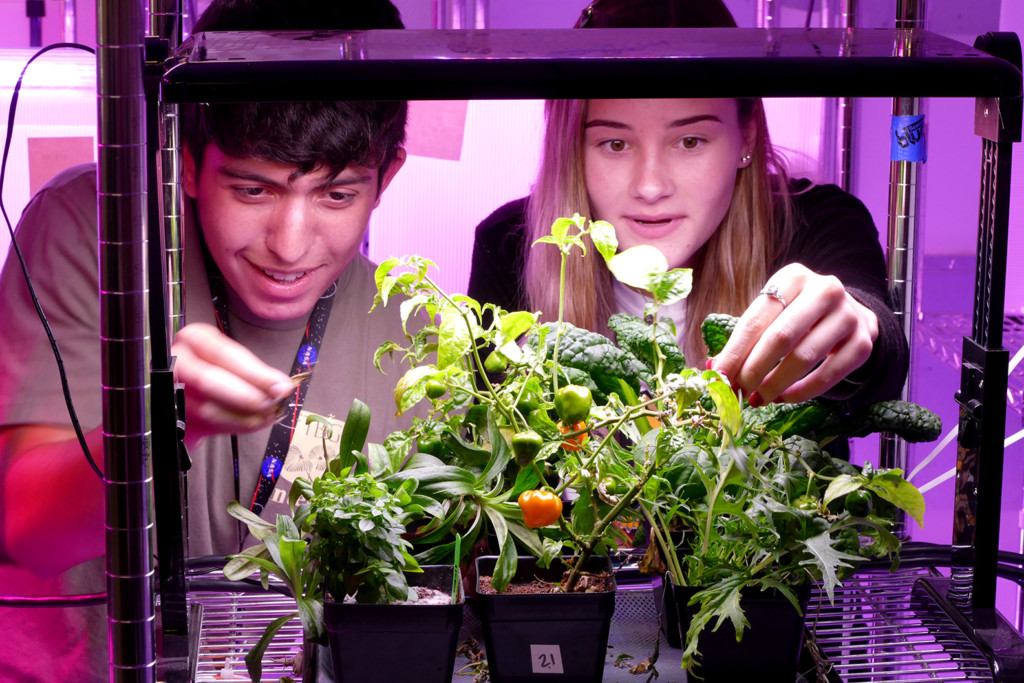
Christopher Bermudez and Peyton Ecklund, both 17, engage in a classroom-based citizen science project at BioTECH High in Miami. The school allows students to pursue authentic scientific research studies that may result in publication in peer-reviewed scientific journals and presentations at local, national and international conferences. PHOTO: Lance Rothstein
MIAMI – Christopher Bermudez likes plants. Like, really likes plants. The thought of reviving a droopy sprig of mizuna inspired the 17-year-old to riff: “When you kind of have faith in the plants, and you keep taking care of it, and you see it spring back up to life, that’s one of the biggest fulfilling feelings ever.”
How gratifying for Bermudez that he gets to pair that infatuation with real-world research. Among other projects, he and his classmates at BioTECH High School are helping scientists with a mammoth, years-long venture to determine which cultivars of edible plants will make the best crops for – no joke – space travel.
“Our research helps supplement their research,” said Bermudez, who’s aiming for a career in experimental horticulture. “You’re kind of helping the future of our species.”
BioTECH and its lovable science geeks make for a compelling narrative. So does the back story.
First pan to Florida, which has expanded charter schools, private school scholarships, education savings accounts and other varieties of educational choice as much as any state in America. Then zoom in to Miami-Dade County, home to a forward-thinking school district that chose to surf this “tsunami of choice” rather than fight it. The result is a rich, evolving, educational ecosystem where a slew of new educational cultivars are vying to find their niches.
If the theory holds, ever more students will choose from ever more options – including district choice options like BioTECH – to find the one that fits their needs and fuels their passions.
Daniel Mateo is principal at BioTECH High, the nation's only high school specializing in conservation biology. To hear an interview with Mateo, click on the video link at the end of this story. PHOTO: Lance Rothstein
“Choice is very important in human nature, right? And I think that for students, choice is of utmost importance,” said BioTECH principal Daniel Mateo, a chemist by training. “When you force a child to do something, it never really works out quite the way you think it’s going to work out. But when you give them the flexibility of choice, you allow them to select what it is they want to do based on that natural affinity that they have for that particular subject. It’s a given. They’re going to perform.”
BioTECH, all of five years old, is a magnet school and the nation’s only high school specializing in conservation biology. Its aim: to develop successive generations of researchers who will apply their ingenuity and training to the conservation of life on Earth.
Heady stuff. Which makes it all the more remarkable, maybe, that BioTECH has no entrance requirements; serves a student body that is mostly low-income; and shares a campus with a once-struggling middle school.
Richmond Heights Middle, 14 miles southwest of gleaming downtown Miami, was perpetually C-rated by the state. Over the years, scores of school choice options mushroomed around it – and parents responded accordingly. Enrollment fell by half.
In turn, the Miami-Dade school district responded accordingly. It considered what academic programming students and parents wanted; what college degrees and jobs were hot; what community partnerships it could forge or strengthen. With help from a $10 million federal magnet schools grant, BioTECH was born.
The middle school is home base. But BioTECH’s 400 students spend big chunks of time doing research at three partner institutions: Zoo Miami, Everglades National Park and Fairchild Tropical Botanic Garden. Their lab equipment is college-caliber. Half their teachers are working scientists. They’re expected to shoot for publication in a scientific journal by the time they graduate.
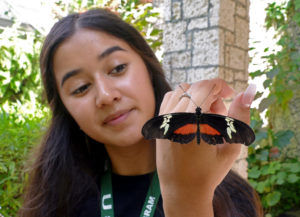
Andrea Medina, 17, a senior at BioTECH High, wants to pursue a career in the medical field when she graduates from college. PHOTO: Lance Rothstein
Some of BioTECH’s “junior scientists” are studying the intestinal flora of spider monkeys to develop diets that make captive monkeys less prone to stomach problems. Others, like Bermudez, are doing research for Growing Beyond Earth, a partnership between Fairchild and NASA. Still others work in micropropagation labs at Fairchild, growing rare orchids that can be reintroduced into slices of South Florida where they once thrived.
“Who thought plants could be so fun?” said senior Peyton Ecklund.
Ecklund, 17, who plans to pursue botanical research in college, chose BioTECH over other high-performing schools in Miami-Dade. She liked that it was “trying to do something special” and emphasized student-driven learning. “We have to make the projects from scratch. And we have to figure out what works and what doesn’t,” she said. “If you learn how to be independent and figure it out on your own now, who knows what you can do in the future?”
Judging by demand, BioTECH is a smash. Last year, it reeled in 600 applications for 150 seats. So far this year, it’s on pace for 1,000 applications for 100 seats.
It’s no surprise the school took root in Miami. Miami-Dade has the highest rate of charter school and private school students of any urban district in Florida. It has one of the highest rates of students exercising district choice. More than 60 percent of Miami-Dade students are now enrolled in hundreds of district options, from magnet schools and career academies to international programs and K-8 centers.
“We recognized … the choice tsunami was upon us,” Superintendent Alberto Carvalho said in April. “And I was not going to do what lot of my colleagues did. Which is, ‘Let’s hope and pray it doesn’t hit us.’ “
BioTECH earned an A from the state this year. (Richmond Heights earned a B.) Its demographics mirror the district’s. Eighty-nine percent of its students are non-white (it’s 93 percent for the district). Sixty-three percent are eligible for free- or reduced-price lunch (it’s 66 percent for the district). Forty-two percent, meanwhile, receive special education services or accommodations.
“That’s 100 percent by design,” Mateo said. “It’s not about having elite students … If you have a passion (for science), we can cultivate that.”
The district does not provide transportation to BioTECH. That’s not a plus for equity. But HVAC repairmen and nursing assistants find a way to get their kids there just like radiologists and military officers do.
Daniella Lira, 17, a junior at BioTECH, said her parents left poverty in Peru for a better life in the U.S. A love for animals and a desire to be a veterinarian led her to the school. Diving into hands-on science has her considering other possibilities.
“Being part of the research and being treated as an actual scientist has opened my eyes,” Lira said.
BioTECH should open some eyes, too. There’s no end to the variety that can sprout in choice-rich soil.
https://www.youtube.com/watch?v=gDmOT7P-Aso&feature=youtu.be
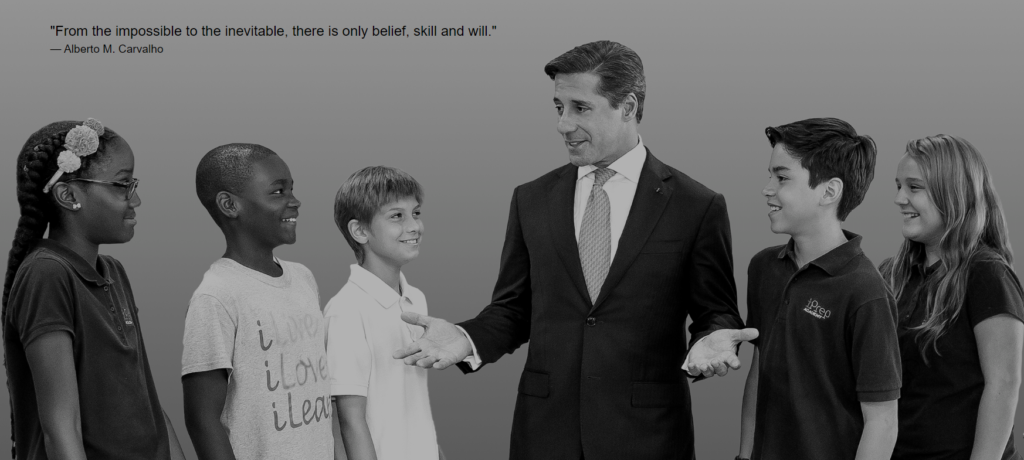
Alberto Carvalho has served as superintendent of Miami-Dade County Public Schools since 2008. The district is the fifth-largest in the United States with more than 350,000 students, nearly three-quarters of whom are enrolled in choice programs. PHOTO: Miami-Dade County Public Schools
You can be forgiven for thinking, given the vivid “tsunami of choice” metaphor used by Miami-Dade County Public Schools Superintendent Alberto Carvalho, that America’s fifth-biggest school district saw the rapid expansion of charter schools and private school choice a decade ago and concluded, If you can’t beat ’em, join ’em.
 But listen to Carvalho for a few minutes and you might arrive at a different take – that Miami-Dade sized up the forces of choice and customization re-shaping public education and decided they’d beat competing sectors at their own game.
“I think it would be fair to say that I am by nature a reasonably competitive guy, and my team is as well,” Carvalho told me in a recorded interview in April, as I was putting together a paper on Miami-Dade for the Education Cities conference at Harvard. “But I can also tell you that we stopped trying to out compete others long ago. And now we’re in a phase of work where really we’re trying to outperform ourselves.”
“It really was a transition,” Carvalho continued. “We have seen the growth of the charter school movement in our community. But we’ve seen an even more aggressive … growth of public school choices within the previously-known-as traditional schools in Miami-Dade. So yes, I would credit in part our success, and the explosive nature of choice programs in our system, to, at least in part, to competition. But it was strategic competition. It’s not just to win the gold medal in anything. It was actually competition to deliver choice at much higher levels, being strategic in the deployment of choice programs, by analyzing their existence by zip code, across the district, and filling in the gaps.”
We at redefinED converted the interview into a podcast to complement the paper on Miami-Dade, which Education Next published this week. Among other points Carvalho makes about educational choice:
Resistance is futile. “We recognized … that the choice tsunami was upon us. And I was not going to do what lot of my colleagues did. Which is, ‘Let’s hope and pray it doesn’t hit us. Or let’s just allow this to go through. Like all things, this is a fad that will go away.’ … I could anticipate the policy shift in the state of Florida and across the country. And we were right. It has, quite frankly, materialized exactly as we predicted. But rather than being a spectator, or a victim of it, we were an active participant in it.“
More choice, better outcomes. “It’s not disputable that students that are enrolled in these choice programs usually perform academically better than those who are not. I think we ought to celebrate that. But the celebration should not last very long. We ought to replicate the success and continue to amplify through equitable access to the same opportunity that’s now being granted to 70 percent of our kids, but needs to be granted to the rest of them.”
You ain’t seen nothing yet. “Ten to 20 years from now, how will we be teaching kids in America? In Miami-Dade? … The most honest answer to that question is, we don’t know. And I say that because I think the mode and model of educational work will be significantly different from anything we know and understand today, as a result of three powerful forces: digitization, automation and artificial intelligence. You put those three forces together and you have to anticipate a dramatic shift, perhaps the most powerful shift we’ve seen in education in the history of mankind.”
Enjoy the podcast, and read last week's redefinED post about Carvalho here.

