by Gerard Robinson
Florida has long been a national leader in the field of educational choice. From the introduction of charter schools and the Florida Virtual School in 1996 and 1997, to the creation of the McKay Scholarship program for students with disabilities and the Florida Tax Credit Scholarship program for low-income families in 1999 and 2001, Florida continues to offer its families more choices than ever.
While critics have argued that such programs are harmful to our traditional public school system, our experience in Florida shows the opposite is true. The effect of providing other educational options to our students has benefited not only the students who have participated in these choice programs, but the vast majority of students who have chosen to remain in our traditional public schools as well.
The positive effect of increased educational options is evident in the continuous upward surge in student performance in our public schools over the past 15 years. Although still only a small percentage of the population of our traditional public schools, the choice programs have created a healthy competitive environment that has contributed to the improvement of our traditional public schools’ existing educational programs. They have also helped motivate the introduction of new programs to meet the educational needs of public school students.
From magnet schools to career academies, controlled-open enrollment and Advanced Placement, Florida school districts have introduced numerous new programs and schools that provide unique learning opportunities tailored to the interests and aptitude of their students. In fact, the latest data provided by school districts indicates that of the 2,682,214 students who attend K-12 public schools, nearly 30 percent attend schools other than the one to which they were assigned.
But more than providing competition among the providers of education in our state, school choice is about giving parents, rather than geographic boundaries, control over their child's educational opportunities. School choice is not so much about one type of school being “better” than another as it is about empowering parents and helping them learn how to become active participants and decision-makers in finding the best educational environment for their child. While thousands of parents will continue to make the choice to keep their children in the public school to which they’ve been assigned, the very fact that they have a choice contributes to the type of parental engagement that is so important to the education of our children.
As the number of educational options available to Florida’s children continues to grow in both the public and private sector, there are two important goals that need to be at the forefront of how our state effectively manages this growth. (more…)
Editor's note: After redefinED posted Howard Fuller's comments about universal school choice, we asked the Cato Institute's Andrew J. Coulson for a response, which we published last week. To keep the debate going, we asked Matthew Ladner, senior advisor of policy and research at the Foundation for Excellence in Education, for his take. He generously offered the following.
 My friends Howard Fuller and Andrew Coulson started a needed discussion regarding the direction of the parental choice movement. Dr. Fuller has been quite outspoken in his opposition to universal choice programs in recent years, and Coulson raised a number of interesting and valid points in his redefinED piece. The parental choice movement has suffered from a nagging need to address third-party payer issues squarely. It’s a discussion that we should no longer put off. The example of American colleges and universities continues to scream a warning into our deaf ear regarding the danger of run-away cost inflation associated with education and third-party payers.
Howard Fuller and Andrew Coulson also indirectly raise a more fundamental question: where are we ultimately going with this whole private school choice movement? Dr. Fuller supports private choice for the poor and opposes it for others. He has concerns that the interests of the poor will be lost in a universal system. I’m sympathetic to Howard’s point of view. I view the public school system as profoundly tilted towards the interests of the wealthy and extraordinarily indifferent to those of the poor. We should have no desire to recreate such inequities in a choice system.
Andrew makes the case that third-party payer problems are of such severity that we should attempt to provide public assistance to the poor through a system of tax credits, and have other families handle the education of their children privately. Andrew’s proposed solution to the very real third-party payment issues is in effect to minimize third-party payment as much as possible, and to do it as indirectly as possible through a system of tax credits.
Despite the fact that Howard comes from the social justice wing of the parental choice movement and Andrew from the libertarian right, they agree that private choice should be more or less limited to the poor.
My own view is different from both Howard and Andrew’s. I believe the collective funding of education will be a permanent feature of American society and that it should remain universally accessible to all. I believe Howard’s real concerns over equity and Andrew’s real concerns over third-party payment can be mitigated through techniques other than means-testing. (more…)
Some of us at redefinED will be at the American Federation for Children summit tomorrow and Friday, where there will be lots of discussion about school choice and education reform. As good a time as any, we thought, to offer a snapshot of where Florida stands. Check out these numbers, which Doug Tuthill, the president of Step Up for Students and a redefinED host, shared last week with business leaders at a Leadership Florida event:
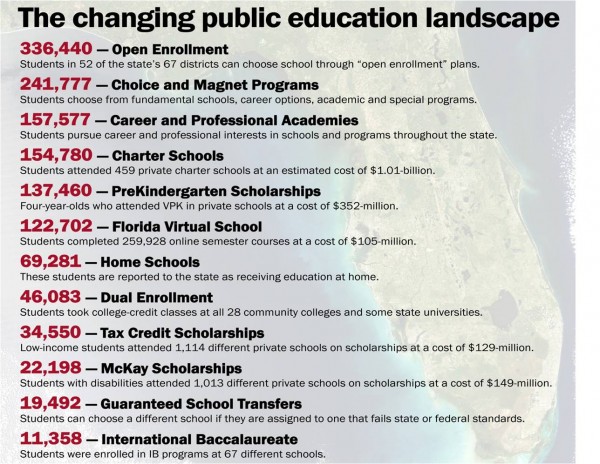
The numbers (carefully compiled by Jon East, vice president for policy & public affairs at Step Up) are from 2010-11 and we know in many cases the current figures are even higher. Charter school enrollment, for example, topped 175,000 this year, and the tax credit scholarship program serves more than 39,000 students. Altogether, the numbers underscore two things we emphasize at redefinED: School choice - the kind that allows parents to go beyond their neighborhood school - is becoming mainstream in Florida. And the lines between "public" and "private" are more blurred here than in any other state.
The AFC conference agenda includes Louisiana Gov. Bobby Jindal, New Jersey Gov. Chris Christie, Newark Mayor Cory Booker and an all-star line up of choice experts and advocates. We're hoping to have a little time to update you on what's going on with blog posts and tweets. For the latter, follow us at @redefinEDonline.
 Editor's note: We're going to try something new today - "blog stars," an occasional round-up of material from other blogs that we think is worth spotlighting. Some of the most illuminating commentary/analysis about education issues nowadays is found not in traditional media like newspapers, but in the blogosphere. As with everything else we do, we'll emphasize posts that touch on school choice, parental choice and common ground in education reform. Here goes:
Dropout Nation: Embrace the Power of Families
The move today by Louisiana’s legislature to approve the expansion of the state’s voucher program can only be seen as a success for children in that state. The centerpiece of Gov. Bobby Jindal’s school reform efforts, the proposal — which would transform the program from one that just serves 3,000 students in New Orleans — will likely help as many as 300,000 more children get out of the Bayou State’s failure mills and dropout factories.
But the passage of the plan, along with one that would allow for the opening of more charter schools, is another reminder of the important shift that is happening, not only within Louisiana’s public education system, but throughout American public education as a whole. Families once relegated to the sidelines are taking more-powerful roles in shaping education decisions decision-making. It’s past time for this to happen. It is absolutely immoral and unacceptable to deny families, especially those from the poor and minority households, the ability to reshape education for their kids and keep them out of the worst education in this nation has to offer.
As Dropout Nation has reported over the past few years, more families are realizing that they can no longer assume that their children will fare well in just any school. Thanks to the work of the school reform movement — including the work of standards and accountability advocates and civil rights-based reformers in advancing the array of measures that would eventually come together in the No Child Left Behind Act — parents know more about the abysmal quality of teaching and curricula endemic in both the worst urban districts and mediocre counterparts in suburbia. And this data, along with the first wave of school choice efforts that started in the early 1990s with Milwaukee’s school voucher program and the first charter schools opened in Minnesota, have allowed families, especially those from low-income backgrounds, to realize that they don’t have to take anything that is given by traditional districts. Full post here.
Choice Words: 10 years after Zelman, challenges still loom for voucher advocates
Ten years after the U.S. Supreme Court upheld the constitutionality of the Cleveland voucher program, state judges are still sending conflicting signals about the viability of private school choice. The latest setback for choice proponents took place last week in Oklahoma, where a Tulsa County judge ruled that a voucher for students with special needs violated the state’s constitutional prohibition of public money for sectarian institutions. (more…)
A couple weeks ago, Scott Jensen, the senior governmental affairs advisor for the American Federation for Children, came down to the Sunshine State to offer glowing praise for the state's backing of parental choice. "Florida leads the pack," he gushed at a state Board of Education workshop. But at the tail end of his presentation, Jensen politely singled out one program for coming up short.
The McKay voucher for students with disabilities had been a trailblazer, he said. But it could use a little more oversight.
"I want to thank the board here for taking a look at adding more accountability to this program," he said. "We believe that more accountability will make the program stronger and even more of a national model to people around the country."
Jensen essentially got an I'll-second-that a few days ago from Adam Emerson, who got redefinED rolling before becoming the school choice czar at the Fordham Institute last month. (more…)

