As Florida senators get their first look today at a new private school scholarship for economically disadvantaged students, some familiar taunts about academic results for the existing Tax Credit Scholarship have resurfaced. Be wary of rhetorical flourish.
Yes, the low-income scholarship students are not required to take the Florida Standard Assessment administered in traditional public schools. But they are required to take state-approved nationally norm-referenced tests whose academic validity is not in dispute.
So those who claim “Floridians have no idea if private schools are succeeding,” as one South Florida newspaper wrote recently, are ignoring 10 years of testing data to the contrary. They also neglect extraordinary new independent research that shows scholarship students are more likely to attend and graduate from college.
The testing trend line
Students in grades 3-10 on the Florida Tax Credit Scholarships have been required since 2006 to take a standardized test, and most take the Stanford Achievement. In the most recent report, their average percentile ranking in reading was 48 and in math was 46. That’s basically average, which is made more encouraging by the fact that these students are among the poorest in the state (and were the lowest performing from public schools they left).
The more important measure is whether the students are learning, and the bottom line has been almost identical each year: These low-income students have achieved the same annual gains as students of all income levels nationally.
Test score gains for individual schools with at least 30 tested scholarship students are also reported annually. In the most recent report, 342 schools were listed.
Comparisons with public school students
When budget cuts removed norm-referenced portions of the state test in 2011, researchers were no longer able to make a direct comparison between scholarship and public school students. In that 2011 academic findings report, though, researcher David Figlio concluded that scholarship students outperformed their peers in public schools, even though the public school students had higher incomes.
Figlio wrote of what he viewed as increasing gains: “These differences, while not large in magnitude, are larger and more statistically significant than in the past year's results, suggesting that successive cohorts of participating students may be gaining ground over time.”
Students who enter and leave the scholarship
From the earliest years, state researchers have found that scholarship students who come from public schools were among the lowest academic performers in schools that themselves had disproportionately low test scores. That’s no slight on the public school. It’s intuitive. If a student is doing well in his or her current school, why change?
Similarly, scholarship students who return to public school are among the lowest performers in the private school they leave behind.
This recurring fact has been stretched in the current debate to imply that scholarship students who return to public schools have learned essentially nothing. That’s not what test results show, and, further, Figlio addressed that question head-on in his 2013 report. He looked at students who had switched twice – from public to private and back to public. In those cases, the state public test scores remained essentially the same.
Wrote Figlio: “FTC participants who return to the public sector performed, after their first year back in the public schools, in the same ballpark but perhaps slightly better on the FCAT than they had before they left the Florida public schools. The most careful reading of this evidence indicates that participation in the FTC program appears to have neither advantaged nor disadvantaged the program participants who ultimately return to the public sector.”
Beyond test scores
In February, the respected Urban Institute released perhaps the most significant research in the scholarship program’s history. The report was a followup to work released in 2017 and was directed again by the Institute’s Director of Education Policy, Matthew Chingos, who has a PhD in government from Harvard University. His team matched data between roughly 89,000 scholarship and public school students from 2003 to 2011, representing the largest study of its kind in the nation.
The institute found that scholarship students are more likely than their public school peers to attend and graduate from college. The difference is striking.
Scholarship students as a whole were up to 43 percent more likely to attend college, a difference that rose to 99 percent for those on the scholarship at least four years. Similarly, scholarship students as a whole were up to 20 percent more likely to get a degree, a difference that rose to 45 percent for those on the scholarship for at least four years.
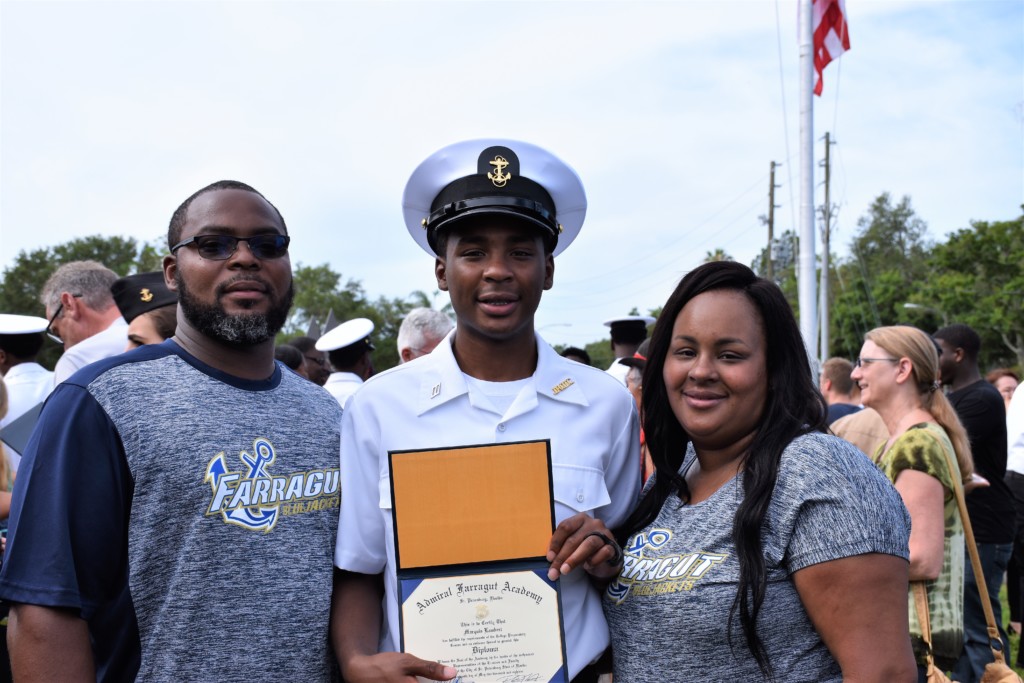
Marquis Lambert at Admiral Farragut Academy graduation with parents Mark Lambert and LaTaura Blount. A new study by the Urban Institute shows how much the Florida Tax Credit Scholarship helps students like Marquis graduate and attend college.
The largest private school choice program in America got more solid evidence of its effectiveness Monday.
The lower-income, mostly minority students using the Florida Tax Credit Scholarship to attend private schools are up to 43 percent more likely to enroll in four-year colleges than like students in public schools, and up to 20 percent more likely to earn bachelor’s degrees, according to a new study released Monday by the Urban Institute.
The outcomes are even stronger for students who use the scholarship four or more years. Those students are up to 99 percent more likely to attend a four-year college than their public school peers, and up to 45 percent more likely to earn bachelor’s degrees.
The new findings build on a 2017 study that was the first of its kind, but also more limited. The previous study found scholarship students were more likely to enroll in college and earn associate degrees, but not significantly more likely to earn four-year degrees. However, the 2017 study only included data from public colleges in Florida, and the researchers cautioned that, as a result, “our results may understate the true impact of FTC participation on college enrollment and degree attainment.”
This time, researchers Matthew M. Chingos, Tomas Monarrez and Daniel Kuehn included private colleges and colleges outside of Florida. They also included college enrollment data through 2018, resulting in a much bigger pool of students to examine.
The researchers reported the outcomes for two groups of students: those who began using scholarships in grades 3-7, and those who began using scholarships in grades 8-10. The scholarship students in both groups posted better results, across the board, than their non-FTC counterparts.
Students who began using the scholarship in grades 3-7 were 12 percent more likely to enroll in any college, and 16 percent more likely to enroll in a four-year college. For students who began using the scholarship in grades 8-10, the corresponding figures were 19 percent and 43 percent.
Those students were more likely than non-FTC students to earn bachelor’s degrees, too. Those who began using the scholarship in grades 3-7 were 11 percent more likely. Those who began using the scholarship in grades 8-10 were 20 percent more likely.
The study also found, as did the 2017 report, that long-term outcomes improved the longer the students used the scholarship. For example, students who began using the scholarship in grades 8-10, and used the scholarship four or more years, were 99 percent more likely to enroll in four-year colleges and 45 percent more likely to earn bachelor’s degrees.
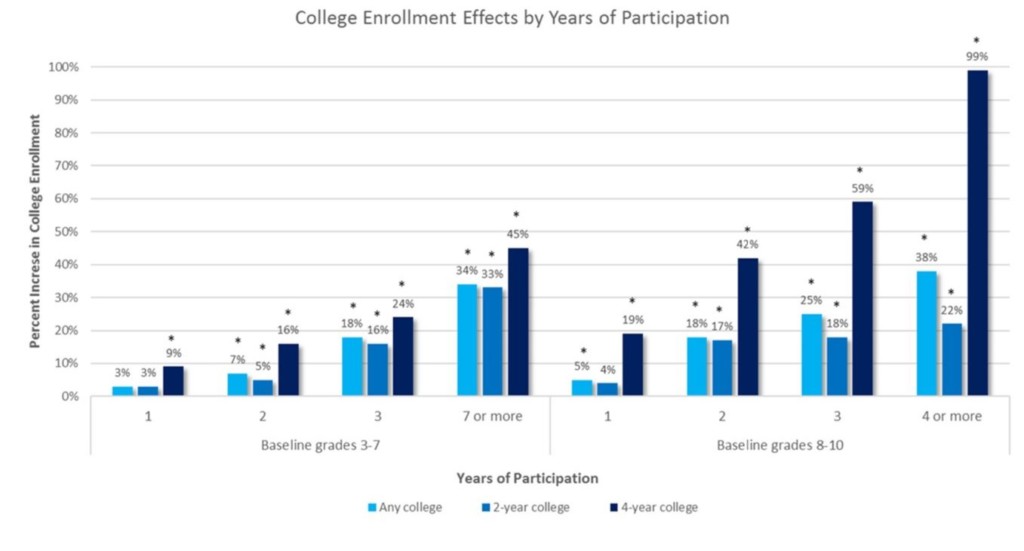
Enrollment effects based on amount of years in the FTC program (click to expand)
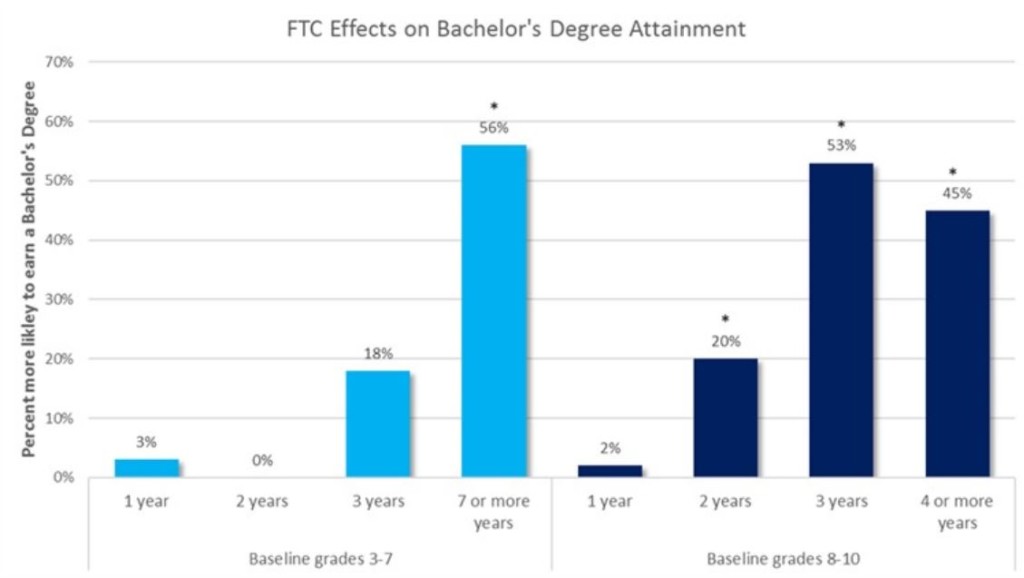
Effects of degree attainment by amount of years in FTC program (click to expand)
The latest findings are sure to add to the debate about the best way to drive quality in public education.
Critics often argue that private school choice programs are not “accountable” enough. In Florida, for example, private schools participating in state-supported choice programs are not required to be accredited (though many are), or to have state-certified teachers (though many do). Supporters, by contrast, have pushed for what they consider a more effective balance between accountability through regulations, and the accountability that comes when parents have the power, via portable scholarships, to stay or leave.
The Florida Tax Credit Scholarship, created in 2001 and funded through corporate contributions, now serves 99,453 students in 1,799 private schools. It’s administered by nonprofits such as Step Up For Students, which hosts this blog.
Sixty-eight percent of FTC scholarship students are black or Hispanic, their average family income is about $25,755 a year, and a decade’s worth of standardized test scores shows they were typically the most struggling students in their prior public schools. According to the most recent funding comparison across education sectors, the value of a tax credit scholarship is 55 percent of average per-pupil spending in Florida district schools.
The Urban Institute researchers used data from the Florida Department of Education and Step Up to match scholarship students to public school students with a list of similar characteristics, including age, grade, race, language, disability status, free lunch participation, and math and reading scores. “However,” they cautioned, “it still leaves open the possibility that participants and non-participants differ in unmeasured ways, such as parental engagement, family religiosity, or experience in the public school.”
Other studies that gauged long-term outcomes for private school choice programs also found encouraging evidence. Students in the D.C. Opportunity Scholarship Program were significantly more likely to graduate from high school, for example, while voucher students in Milwaukee were more likely to enroll and persist in college.
Step Up For Students research manager Dava Hankerson Fedrick contributed to this post.
Like other school choice programs where supply is overwhelmed by demand, the school district in Pinellas County, Fla. offers an option that causes plenty of joy and heartache. Some kids win the “fundamental school” lottery. Some kids lose. Some go on to the high-performing fundamentals, where they’re surrounded by peers with super-engaged parents. Others go to neighborhood schools that struggle mightily.
Are their outcomes different? Matthew Chingos, a respected researcher at the Brookings Institution, is aiming to find out.
Last week, the district agreed to give Chingos the data he requested so he could examine the impact of fundamental schools on math and reading scores. Once he gets the data, he expects to issue findings within a year, according to his research application.
His study is worth watching because it involves a school choice option offered by a school district, not by private schools or charter schools.
The fundamental schools in Pinellas stress parental involvement and student accountability. Students who fall short on academic, behavioral and dress code requirements can be reassigned to neighborhood schools. Ditto if their parents fail to meet requirements, including attending monthly meetings.
The 104,000-student Pinellas district created its first fundamental school in 1976, but expanded them rapidly in recent years. It now has more than 7,000 students in 10 full-fledged fundamental schools and two “school-within-a-school” fundamental high schools.
The schools boast some of the district’s highest test scores and lowest disciplinary rates. They also cause a fair amount of angst. (more…)

