 A new survey of likely voters in five key swing states commissioned by the Manhattan Institute found that respondents, especially nonwhite Americans, tend to favor expanded school choice options.
The poll surveyed about 5,000 likely voters in Pennsylvania, Ohio, Wisconsin, Michigan and North Carolina between late August and Early September and found that between two-thirds and three-quarters of voters in those states support publicly funded K-12 school choice.
Key findings:
· Between 51% and 62% of respondents said they support state-funded charter schools as an alternative to district-managed public schools.
· Support for publicly funded school choice programs was higher among Black respondents in every state except North Carolina.
· Only about one-fifth of voters surveyed said they believed giving parents more choice in their children’s education would lower educational quality.
To read more, click here.
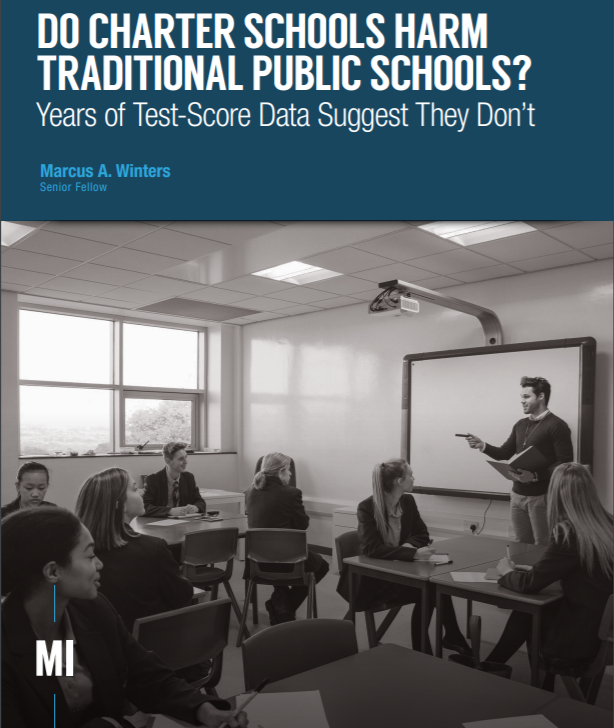 A new study from a national group focused on domestic-policy areas has found evidence rebutting the argument that charter school exposure over a meaningful period of time produces declines in the performance of traditional public schools.
The study, conducted by Marcus Winters, senior fellow at the Manhattan Institute, indicates a small but positive relationship between the proportion of students within a geographic district who attend a charter school and test-score growth for students enrolled in traditional public schools in the same district.
Winters used school-level test-score data across the United States made available by Stanford Education Data Archive for students attending a charter school as of 2009 and the test-score growth for students enrolled in traditional public schools in the same district over the following seven years.
As of 2009, charter schools served at least 10 percent of students in 91 of the 947 U.S. school districts with at least 10,000 students.
One important insight to be gained from the study according to Winters is that among districts with very high charter exposure, some did make meaningful gains while others saw declines. Similarly, among districts with little or no charter exposure, similar numbers made increases or decreases.
Winters acknowledged the results of his analysis should not be construed as proof that charter school expansion does not affect traditional public school outcomes, nor that the analysis can rule out other factors that potentially have systematically influenced the test-score outcomes of districts in areas with more or less charter school exposure. However, Winters says, even if it were true that charter school exposure did hamper public schools, his analysis suggests that in practice, public school systems have responded in ways that counterbalance that negative impact.
Bottom line: The analysis finds that charter exposure has either no influence or a positive influence on public school outcomes. According to Winters, the burden of proof remains on those who argue that expansive charter school sectors hurt students in traditional public schools.

