A call for reform: Legislators and local school officials are calling for better oversight of private schools that get millions of dollars from the state's three scholarship programs. A series in the Orlando Sentinel last week detailed how some of those schools hired uncertified teachers with criminal backgrounds and submitted falsified  fire reports for years without the state taking action against them. State Sen. David Simmons, R-Altamonte Springs, remains a supporter of the tax credit, Gardiner and McKay scholarships, but agrees that "there's some place between no regulation and over-regulation.” Step Up For Students, which hosts this blog, helps administer the tax credit and Gardiner scholarship programs. Orlando Sentinel.
Teacher pay: Gov. Rick Scott has pushed for higher teacher pay in the past, but now is saying that the decision is out of his hands. "The way our system is set up in our state those decisions are made at the local level," Scott said during a discussion with teachers. "What I tell everybody is, 'You have to be active with your school board members, your superintendents.' " Associated Press. Scott did say that his budget proposal will include $63 million for teachers to help buy classroom supplies, an increase of $18 million over last year. That would bump the $250 a year teachers receive for supplies to $350. WTLV.
'Schools of hope': The Knowledge is Power Program (KIPP) charter school network is working on establishing a "school of hope" in the Liberty City area of Miami. The tentative agreement calls for the Miami-Dade County School Board to provide KIPP Miami with a facility, and KIPP would receive a state grant to help disadvantaged students and share its training programs with the district. The "schools of hope" program was set up by the Legislature to offer financial incentives so charter companies could move into neighborhoods with persistently struggling schools. KIPP is the nation’s largest nonprofit charter school network. redefinED.
A new "school of hope" could soon be coming to the cradle of Florida's charter school movement.
On Oct. 11, the Miami-Dade County School Board approved an item laying the groundwork for a collaboration with KIPP Miami.
The plans would bring the nation’s largest nonprofit charter school network to Liberty City. It would be KIPP’s second Florida location. The first operates in Jacksonville.
The school board documents consummate a grant program the state Department of Education launched three years ago. The Miami-Dade school board agreed to recruit a nationally recognized charter school operator. It would receive a state grant, backed by national philanthropists. And the district and the charter would work together to help disadvantaged students.
Plans call for the district to help the charter school with a facility. It would have access to unused space at Poinciana Park Elementary School. The district would get access to KIPP training programs for select teachers and administrators.
"This Partnership would be the first of its kind in the State of Florida and can serve as a model for such collaboration nationally," the school board documents say.
The school board plans to approve a charter contract at its November meeting, the documents say. The new KIPP school is slated to open its doors to as many as 400 students in 2018.
Daisy Romero Chavarria was taking finals at the University of Pennsylvania and found it increasingly hard to concentrate. She worried her parents would face deportation in Texas.
The U.S. Immigration and Customs Enforcement Agency were arresting undocumented immigrants in the state.
Then, in May, Texas legislators passed a law allowing police officers to question the immigration status of anyone during routine stops. The law will go into effect in September.
“We learn to live with fear and uncertainty,” Chavarria said at a national gathering of charter school advocates in the nation's capital. “I went to a mentor's office to vent. I couldn’t talk to my parents about it. I did not want them to think I was worried.”
Chavarria said living in fear becomes a way of life.
“We don’t talk about it because we learn to live with it,” she said.
Chavarria is protected under DACA, the Deferred Action for Childhood Arrivals — a program that provides a two-year work permit and temporary protection from deportation to young adults who arrived in the U.S. illegally as children. She said she worries the program will be rescinded.
The concerns of students like Chavarria animated discussions at the National Charter Schools Conference this week in Washington.
Some prominent figures in the charter school movement have advocated for undocumented students, arguing the children they serve should be protected. That advocacy has transcended the usual political divides over the future of public education. (more…)
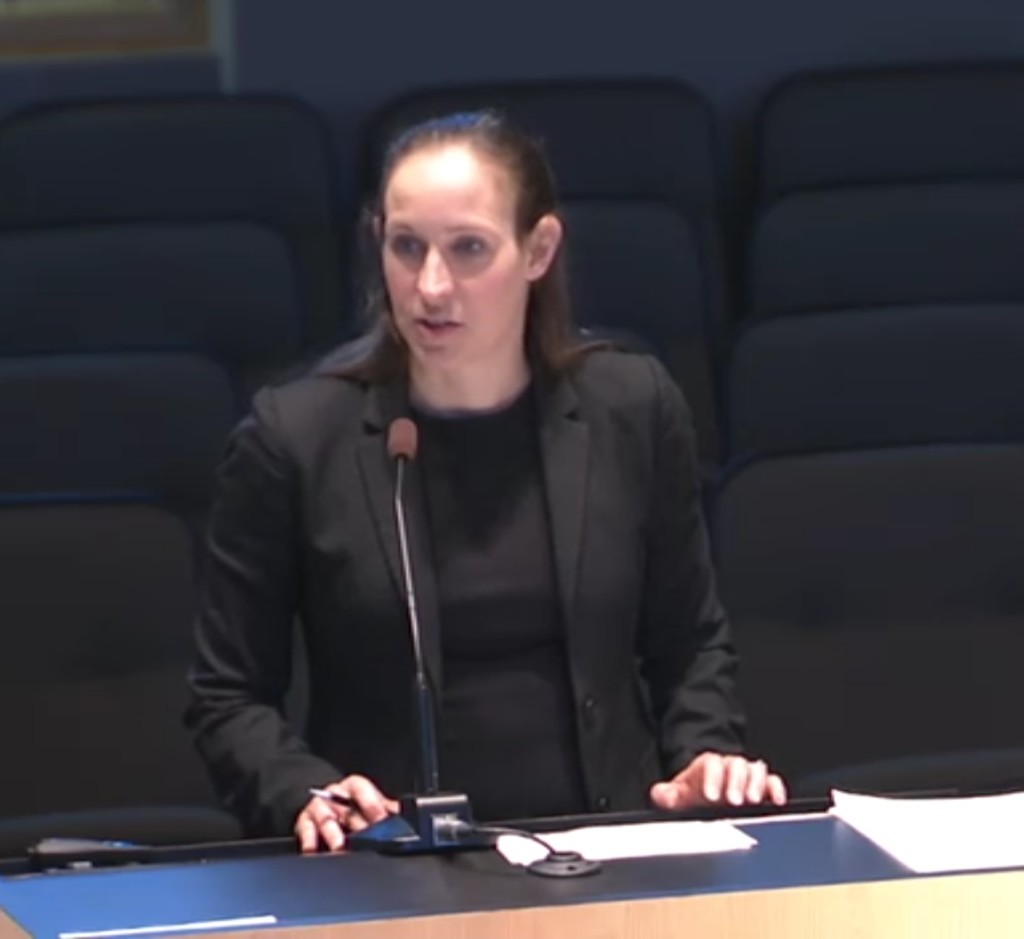
Trisha Coad of KIPP addresses the Florida Senate Education Committee.
When top charter school networks consider moving into new community, they don't just look at funding or charter school laws. They look at the whole "educational ecosystem."
That was the message a KIPP representative brought to a Florida Senate panel looking at charter school legislation.
Trisha Coad is the director for new site development for the Knowledge is Power Program, which operates 200 charter schools, including three in Jacksonville.
She told the Senate Education Committee the charter network is eyeing expansions in Florida — especially Miami. It's looking at some predictable factors: Community demand, affordable school facilities, adequate public funding, respect for charters' autonomy.
KIPP also looks for "strong authorizing, where charter schools are held to high expectations," Coad said. (more…)
For its first hearing of the year, the Florida House's Education Committee heard from leaders of several out-of-state charter school networks. The theme, according to Mike Bileca, R-Miami and chair of the committee, was "schools that have taken excellence and scaled."
Florida education officials have pushed for years to bring more nationally well-regarded charter schools to the state. Bileca has long supported those efforts.
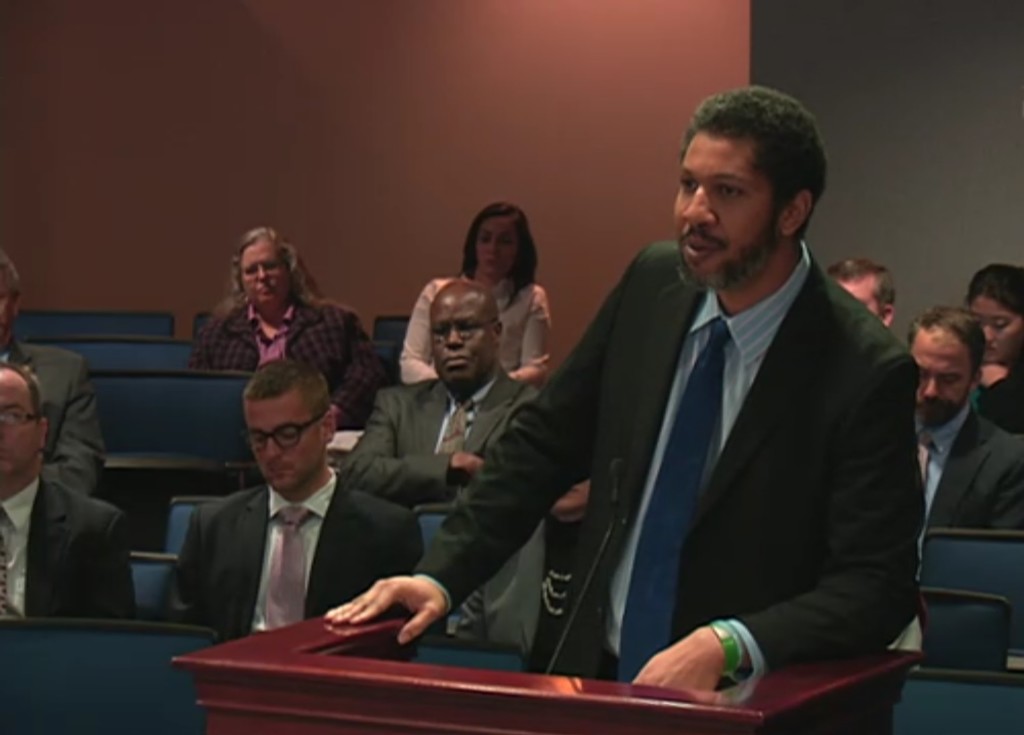
KIPP Foundation executive Quentin Vance addresses the Florida House Education Committee.
Quentin Vance, an executive at the KIPP Foundation, pushed back against the idea that there's "a trade-off between charter schools and public schools, and this is a competition." His organization, one of the largest charter operators in the country, has started a network of schools in Jacksonville, and is now in the early stages of a formal collaboration with the Duval County school district there.
An excerpt from his comments is below, lightly edited for length and clarity.
Nationally, what we've seen in growing schools in so many different cities across the country is that when there is increased choice for kids, where families can become consumers and the only metric of deciding where they want to go to school is what's going to be best for their kids it creates an environment in which everyone gets better.
(more…)
Tampa Bay Times columnist John Romano, a frequent charter school critic, published an even-handed column in this morning's paper. He congratulated local charters for their performance in recent A-F grades, but questioned why they don't serve as many disadvantaged students as district-run schools.
Charters, which are publicly funded but privately run, have a much higher proportion of middle-class and non-minority students than traditional schools on the Suncoast.
The percentage of students attending traditional schools in Pasco County who receive free or reduced lunches, a predictor of low test scores, is 58.2. For the charters, it's 36.2 percent.
In other words, that ratio is exactly the opposite of what should be happening.
He's right. Studies have found that in other states, charter schools frequently serve more disadvantaged students than other public schools, in part because they tend to concentrate in academically struggling urban areas. In Florida, on average, the opposite is true.
The reasons for this are complicated. It may be worth noting that 80,000 of the state's most disadvantaged children enroll in private schools with tax credit scholarships (Step Up For Students, which publishes this blog, helps administer the program.) In states that don't have their own version of the nation's largest private school choice program, many children in similar circumstances may opt for charter schools instead. (more…)
Sass
Florida's charter schools might not raise students' reading and math scores a whole lot, on average, but attending one may increase a student's chances of reaching college, or earning more money later in life, newly published research suggests.
We first highlighted the working paper more than two years ago. An updated version appeared Monday in the Journal of Policy Analysis and Management.
The researchers (Tim Sass of Georgia State University, Kevin Booker and Brian Gill of Mathematica Policy Research, and Ron Zimmer of Vanderbilt University) looked at students who attended Florida charter schools in eighth grade between the 1998-99 and 2001-02 school years. They compared those who went on to attend charter high schools with those who enrolled in traditional high schools.
They found the charter high school students were about 9 percent more likely to enroll in college, and had an earnings advantage of nearly $2,300 by their mid-20s.
"The positive relationships between charter high school attendance and long-term outcomes are striking, given that charter school students in the same jurisdiction have not been shown to have large positive impacts on students' test scores," they write.
The authors caution "unobservable" differences between charter and non-charter students could affect the results, and that Florida's charter school landscape has changed a lot in the 14 years since the students in the study finished middle school. But they probed their results using a variety of statistical techniques, and concluded they appear "robust." (more…)
Three large school districts along Florida's I-4 corridor are angling for grants that could help them draw nationally recognized charter school networks to low-income neighborhoods.
The Orange, Polk and Hillsborough County school districts applied this month for $2.5 million in funding from round two of the Florida Department of Education's district-charter collaboration program.
The three districts are among the ten largest school systems in the Florida, and the top 30 in the country. Their proposals, published here for the first time, describe how they would use chartering to combat persistent academic struggles in high-poverty areas.
The potential collaborations break from the charged politics that often dominate the headlines. They represent an approach to charter schools that's still new for many Florida school districts.
As Polk County schools officials write in their proposal:
The Polk Charter Compact will turn charter school management in Polk from a compliance and coping exercise to purposeful tool for improved student performance in high-need areas where students are not currently receiving adequate educational services.
The department earlier this year awarded grants to Miami-Dade, Duval, and Broward Counties, but Broward's school board rejected the money, creating an opening for other districts to apply.
Three other districts — Palm Beach, Pinellas, and Pasco — were eligible to apply, but didn't. Pinellas is the only district that was eligible to apply for a grant in both rounds, but showed no interest.
Around the country, education reformers trying to help more districts and charters work together. They're also looking at the factors that can draw top-performing charter schools to low-income neighborhoods. With that in mind, the three latest collaboration proposals are worth a closer look.
Bridging the gap in Hillsborough
Hillsborough officials say they want to bring a new high-impact charter school to Tampa's urban core, where middle school proficiency rates are roughly 40 percent lower than elsewhere in the district.
The district says it wants to share know-how with the charter organization, and help with teacher recruitment and facilities, in a collaboration that could "serve as a replicable model for other districts around the nation." (more…)
A new report looks at a key aspect of the Catholic school renaissance we've explored before on this blog: The rise of private school management organizations — which, it turns out, are not confined to Catholic schools.
 The report, from the Friedman Foundation for Educational Choice, looks at the rise of these private school networks, which borrow some features from their cousins in the charter school world.
Charter management organizations like KIPP and education management organizations like Charter Schools USA now run a third of America's charter schools, providing financial backing, back-office support and other advantages to schools in their networks.
According to the report, new organizations are starting to do similar things for private schools.
These budding private school management organizations (PSMOs) are independent entities that operate or help operate three or more private schools. They are a potentially important innovation in the supply of private schools.
The authors — Kelly Robson, Juliet Squire and Andy Smarick of Bellwether Education Partners — tracked down 14 organizations that meet their definition, which means they exist outside the government or existing church structures. Eight of the organizations have some kind of church affiliation. Most of those, including the two that are active in Florida, are Catholic. There's also a network of Lutheran schools. (more…)

