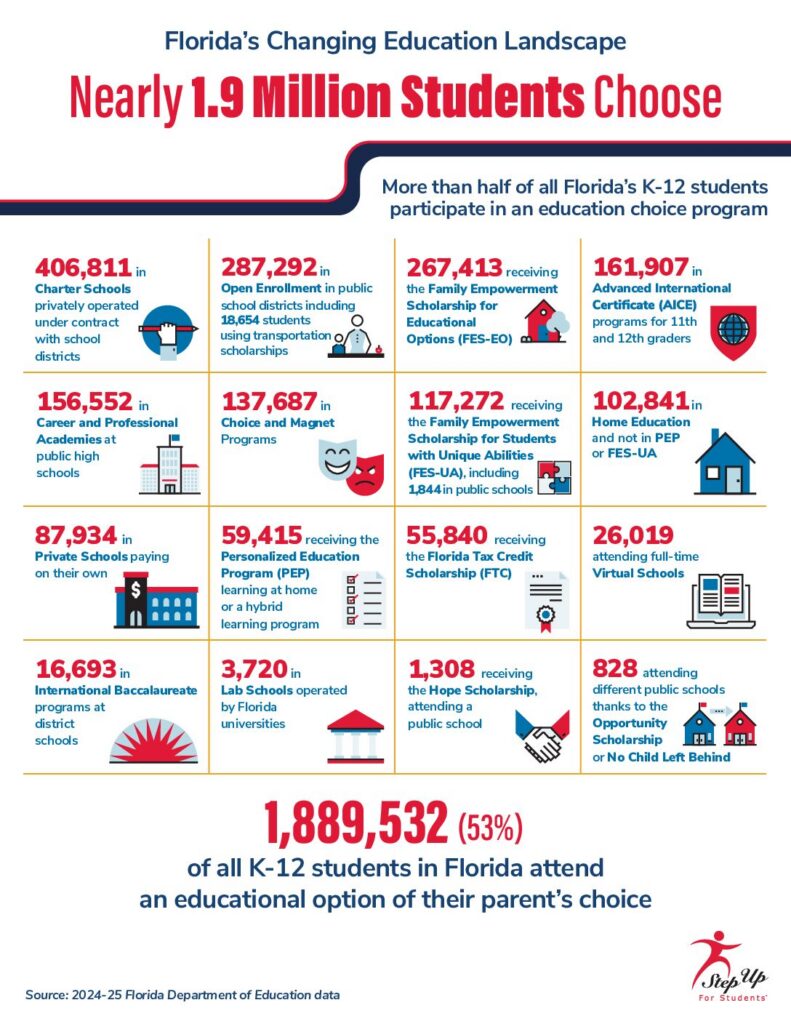
Florida’s K–12 education landscape continues to shift toward choice. During the 2024–25 school year, 53% of all K–12 students — 1,889,532 children — attended a public, private, or home education option of their parents’ or guardians’ choice. Just one year after crossing the 50% threshold for the first time, Florida’s school choice participation grew by nearly 100,000 additional students.
“Each year, Florida families have made it clear that they want more options for their children’s education,” said Gretchen Schoenhaar, CEO of Step Up For Students, the Florida non-profit that administers the state’s education choice scholarship programs.
“Increasingly, parents and guardians are willing to mix and match private and public resources to choose the ones that work best for their family.”
Since the 2008–09 school year, Step Up For Students, in collaboration with the Florida Department of Education, has tracked enrollment across a variety of choice programs. The 2023–24 school year represented a historic milestone: the first time more than half of all K–12 students in the state attended a school of choice. The 2024–25 school year continued that upward trend.
The Changing Landscapes report draws from Florida Department of Education data and removes, where possible, duplicate counts to provide a clearer picture of school choice participation. For example, it adjusts for home education students supported by the Family Empowerment Scholarship for Students with Unique Abilities (FES-UA) and eliminates double-counted students in career and professional programs. It also excludes prekindergarten students in FES-UA and programs such as Voluntary Pre-Kindergarten (VPK), as the report focuses solely on K–12 education.
While many families still choose their neighborhood public schools, Florida’s education system now offers a broad range of options to meet diverse student needs. As in past years, public school choice remains dominant, occupying four of the top five spots in overall enrollment. Charter schools are the most popular single option, followed by district open enrollment programs, the Family Empowerment Scholarship for Educational Options (FES-EO), career and professional academies, and Advanced International Certificate of Education (AICE) programs for upperclassmen.
The largest increases in enrollment occurred in the FES-EO program, which has merged with the Florida Tax Credit Scholarship program, and the Personalized Education Program (PEP), a scholarship that helps fund education at home.
Among public school options, AICE enrollment grew nearly 17%, career and professional academies grew 6.2%, and open enrollment grew 4.6%. While overall district enrollment appeared to decline slightly, these public school choice options still grew more than charter schools (independent public schools), which grew just 2.3%. This may suggest that school districts could benefit from expanding their own menu of diverse school options to better retain families.
Choice remains strong within Florida’s public school system. More than 1.2 million of the state’s 2.9 million public school students attended a school of choice, while another 688,000 students outside the public system enrolled in private schools or home education programs.
A newer option to keep an eye on is district schools offering classes and services to students on an education choice scholarship, paid for with their scholarship funds. Currently 37 of Florida’s 67 districts have been approved as providers with Step Up For Students, and another 11 are in the process of being approved. These arrangements further blur the line between public and private and emphasize that the focus remains on the individual needs of students.
With so many options available, Florida’s education system has entered a new phase. Choice is no longer an alternative; it is the norm. Families routinely evaluate multiple pathways, and whether they select a different option or remain in their assigned public school, they are making an active choice. The result is an education landscape in which public, private, and home education options coexist and evolve together, reflecting the reality that students and families have different needs, and that those differences matter.
By Keith Jacobs
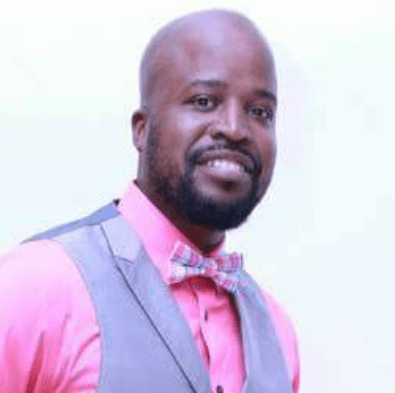
Keith Jacobs credits the IB program, an early form of education choice, as breaking him from a cycle of poverty.
Always look a man in the eyes. Stand up and give a firm handshake. Remember your manners. These simple yet effective rules instilled by my parents have been a pillar in my overall success. I am blessed to work in a field I love and to help raise two beautiful children who are reaping the benefits of hard work and education.
But how did this journey begin? My success is a product of how school choice provides opportunities for low-income families to escape the clutches of generational poverty.
I am the second youngest of six kids. I was raised to believe that the key to success is education. What was missing was an example of what this success looked like. Both of my parents worked three jobs, and neither of them attended college. Growing up in a low-income household in Tampa, I was not afforded the same opportunities as my peers. While they were focused on new clothes and shoes for school, I was focused on whether I was going to wear clothes that were too small, or if my brother had any clothes that he could hand down to me.
You see, education was an idea, a philosophy. It was not a tangible reward that I could see and understand given my surroundings. As a young, black male, the statistics would say I had a greater chance of being dead or in jail than graduating and going to college. I saw drugs, alcohol, and crime that plagued the streets around my middle school and wondered if there was a way to escape this reality.
Thankfully, the school choice movement that began brewing in the 1980s and ‘90s offered a lifeline: magnet schools. During this time, magnet schools were viewed as competition to traditional schools because they provided an opportunity for students to attend a school outside their neighborhood that met their individual needs.
My parents noticed my intellectual abilities but did not think they had options for me to excel in a high school. For low-income families like mine, the opportunity to attend the best schools seemed unattainable without the financial resources. There was no scholarship program that would have provided me with a quality education outside my ZIP code. This all changed with school choice.
Going into my freshman year, I applied for an International Baccalaureate (IB) program at a magnet school that was 10 miles away from my house and was accepted. This gave me a chance to experience what I would not have otherwise been exposed to in a traditional curriculum.
The thing about growing up in poverty is that even though I viewed school with the same enthusiasm as my peers, the difference laid in my ability to understand and adhere to cultural norms that were necessary to succeed in school. Poverty is a societal ill that is rectified with innovative ways to provide quality education for all students.
Today, these choices come in many forms: magnet schools, charter schools, vouchers and scholarship programs, education savings accounts, even virtual schools and micro-schools. They have proved popular with families. In Florida alone, some 1.7 million students – about 46 percent of all PreK-12 students – attend a school of choice.
Through school choice, I not only graduated from the IB program, I also was able to attend one of the most rigorous universities in the nation, the University of Florida, becoming the first college graduate in my family. It allowed me to pursue a master’s degree. Ultimately, it helped me provide a better quality of life for my children and end the cycle of poverty.
While legislators are debating who is cheating whom in education, there are millions of low-income children like I was who just want an equal chance to succeed. School choice gives them what they lack due to their economic circumstances -- ownership.
Keith Jacobs is manager of the Charter School Initiative for Step Up For Students.
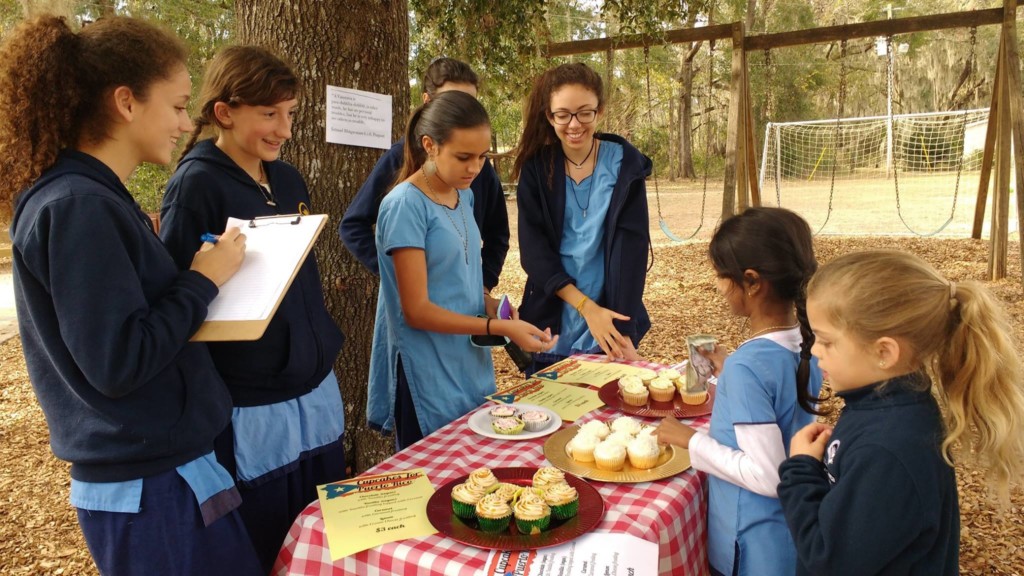
The new International Baccalaureate program at Bhaktivedanta Academy will provide a rich academic environment emphasizing global citizenship and purpose in the world.
The latest Florida school to join the ranks of International Baccalaureate may turn heads.
Bhaktivedanta Academy, a high-performing Hare Krishna school just north of Gainesville, is private, religious and enrolls more than half its student body through a state-supported scholarship for economically disadvantaged students.
But Bhaktivedanta principal David Aguilera said the motivation was simple. His team wanted to provide the richest possible academic environment for a diverse school. Six years of preparation paid off last month when the Hare Krishna school was designated an International Baccalaureate World School for the Middle Years Programme for grades 7-10.
Bhaktivedanta serves 88 students, of which 55 are on the Florida Tax Credit Scholarship. Step Up For Students administers the scholarship program and this blog.
“As a school we favor the ability to have a diverse, socioeconomic enrollment and without the scholarship we wouldn’t be able to do that,” Aguilera said. “This is providing opportunity that students wouldn’t normally have.”
The IB program has a reputation for high standards of teaching and student achievement. Students take a rigorous battery of tests before leaving high school that allows them to receive college credit.
“It ensures that students coming out of this program are prepared for the demands of higher education because the thing with IB is it deemphasizes the concepts of rote learning and reemphasizes students applying knowledge to different situations and looking at themselves as global citizens and having a real purpose in the world,” said Aguilera.
Bhaktivedanta joins 69 other schools in the Middle Years Programme in Florida. In total, there are only 176 IB diploma programs in the state, making up 12 percent of high schools, according to the Florida Association of IB World Schools. There are nearly 5,000 schools in the world that offer such a program.
Jaya Kaseder, middle years program coordinator at Bhaktivedanta Academy, said the classes taken with the IB designation are akin to a student taking an honors course.
Once students graduate from the Hare Krishna academy, they can join an IB diploma program to finish high school or take dual enrollment courses at Santa Fe College, Kaseder said.
“It is preparation for life in any direction that they may go because it is concept-based, not just content-based,” said Kaseder. “It requires more of the student. It doesn’t allow them to sit back and be passive in their learning. It requires them to be active, engaged learners.”
For example, Kaseder said, students in design class, one of IB’s core eight subjects, are required to develop an idea, create a solution and reflect on the process. So, several students marketed their own soda brand and determined how to improve it for the future.
Aguilera said the IB program is accessible to all students.
“It requires students to deeply think about subject manner and apply it to real world situations,” he said. “It is not easy in that sense, but it is not beyond the capability of any student.”
 Guns, recess in schools: A majority of Floridians support trained staff carrying guns in schools, and an overwhelmingly number back a requirement of 20 minutes of daily recess for elementary students, according to a USF-Nielsen Sunshine State survey. Villages-News. Politico Florida. Sunshine State News. WJXT. News Service of Florida.
New superintendent: Todd Bowden, the 45-year-old executive director of Career, Technical and Adult Education for Sarasota County and director of Suncoast Technical College, is chosen to be Sarasota County's next school superintendent. He will succeed Lori White, who is retiring in February. The school board preferred Bowden to Brennan Asplen III, the superintendent for Academic and Student Services in St. Johns County, and Mark Porter, superintendent in Monroe County. Sarasota Herald-Tribune. Bradenton Herald.
Board squabbles: The Duval County School Board's discussion of disappointing test results by the district's International Baccalaureate classes students turns angry, with a 20-minute recess called to break up the shouting. Several members say the poor test results at non-magnet IB programs could be a result of inexperienced teachers, while others think the board is making excuses for the poor results. At one point, board member Becki Couch told fellow member Cheryl Grymes to quit staring at her. Florida Times-Union.
Teacher complaints: Broward County teachers tell the school board that they are overworked and bullied. Teachers made the appearance to protest the district's $300,000 proposal to buy software that will train them on a new instructional method. The program is voluntary, but teachers worry it will be made mandatory. Sun-Sentinel. (more…)
Discrimination query: The U.S. Department of Education's Office for Civil Rights launches an investigation into the Pinellas County School District's treatment of black students. The investigation will determine if the district is denying black student access to special programs and quality teachers, school leaders and support staff. Tampa Bay Times.
Standardized testing: State education officials, responding to complaints from parents that school districts are threatening students with retention if they don't take the Florida Standards Assessments tests, say test results alone are never the sole reason for promotion or retention. Gradebook. Less than 1 percent of Manatee County third-graders opted out of Florida Standards Assessments testing, district officials say. Just 5 of the 3,100 students chose not to take the tests. Bradenton Herald.
Athletics changes: Athletic directors around the state are split on the effects of a bill that would allow athletes to transfer schools and be eligible to play sports immediately. Some think late changes to the bill mitigate the potential problems. Gov. Rick Scott has until April 14 to sign the bill into law. Miami Herald.
Emphasis shift: The emphasis of the Legislature next year will shift from K-12 to higher education, incoming Senate President Joe Negron, R-Palm City, says in a memo to senators. Gradebook.
IB programs: Lake County school officials are considering adding an International Baccalaureate curriculum to Leesburg and South Lake high schools. Orlando Sentinel. Fewer incoming kindergarten students are applying to attend Frances Wakeland Elementary School, the Manatee district's only International Baccalaureate elementary school. Bradenton Herald. (more…)
 Arts. A conservatory school bucks a trend of stagnant or declining enrollment in Palm Beach. Palm Beach Post. Collier students get lessons from a professional musician. Naples Daily News.
International Baccalaureate. Students at a Tampa high school excel. Tampa Tribune.
Tax credit scholarships. U.S. Sen. Marco Rubio mentions the program in a column about combating poverty. Miami Herald. Step Up For Students, which co-hosts this blog and employs the author of this post, helps administer the scholarships.
Budgets. A Pasco teacher pleads with the district not to cut staff at her school. Gradebook.
Leadership. Broward superintendent Robert Runcie gets a mostly positive evaluation from the school board. Sun-Sentinel.
Safety. Teachers should generally avoid physically breaking up fights among students, union leaders say. Sarasota Herald-Tribune. (more…)
STEM. Students in Orlando's Pine Hills neighborhood experiment with growing bioluminescent mushrooms. Orlando Sentinel. These 20 public elementary schools excel in science instruction for disadvantaged students. Bridge to Tomorrow. Students at a Lakeland Christian school learn about robotics during a summer workshop. Lakeland Ledger.
Budgets. Miami-Dade school officials plan to lower the property tax rate slightly. Miami Herald. Local districts await state information on property tax revenues for schools. Tallahassee Democrat.
Private schools. A Bradenton Montessori school plans to expand into a new location. Bradenton Herald.
Charter schools. Palm Beach's new superintendent plans a forum for charter school parents. Sun-Sentinel.
Digital learning. Florida schools seem likely to to receive state digital classrooms funding despite uncertainty caused by a line-item veto. Tampa Bay Times. A parent writes an open letter to Palm Beach's superintendent on digital learning. Context Florida.
International Baccalaureate. A St. Petersburg student gets rare perfect scores on her college-credit exams. Tampa Bay Times. (more…)

