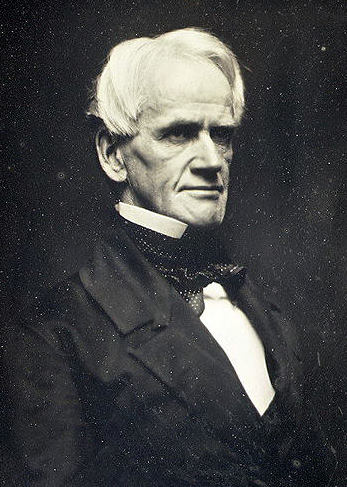
Horace Mann (Source: Wikimedia Commons)
The first-ever state supreme court ruling finding charter schools unconstitutional continues to stir debate all over the country, and has inspired some choice opponents to raise questions about other charter school laws, including the nation's oldest.
While there is little reason to think the Washington State Supreme Court's legal reasoning could spread to many other states, it is the latest illustration of how an idealized past that never was continues to create barriers to a 21st-Century education system.
Opponents try to cast a romantic vision of free, universal public education as a foil against school choice, relying on a mythical conception of "common schools" that has rarely squared with reality.
Getting American common schools to serve all students required more than a century of political turmoil, countless lawsuits and no shortage of attempts — from Dust Bowl-era California farm towns to the Freedom Schools launched by the Civil Rights Movement — to create separate educational opportunities for religious and ethnic minorities who were excluded from, or under-served by, traditional public school systems.
In many ways, the fight for inclusion and equity continue to this day.
“[P]eople too frequently forget that those schools were at different times not open to blacks, religious minorities, or, until the 1970s, students with special needs and disabilities,” Andrew Rotherham and Richard Whitmire wrote in a recent piece for The 74.
Common schools were first popularized in the mid-1830s by Massachusetts education reformer Horace Mann. The idea spread through out the U.S. over the next few decades during a time when anxiety over waves of immigrants, many of them from Ireland and other predominately Catholic countries. (more…)
From redefinED co-host Doug Tuthill: Milton Friedman and Jack Coons were intellectual giants in their respective disciplines (Friedman in economics and Coons in law) and strong school choice advocates. But their rationales differed and this led to many interesting - and often contentious - debates. Despite their differences, their debates were always courteous and civil. So when Dr. Friedman died in 2006, his foundation asked Jack to write a chapter in a book honoring Dr. Friedman’s memory, and he agreed. Today is Dr. Friedman’s 100th birthday, so we again asked Jack to share some thoughts on Dr. Friedman, and again he agreed.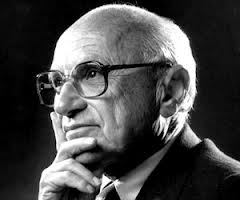
Milton Friedman was an economic libertarian of singular intellectual purity. I am less pure, and to me Friedman’s way of modeling the ideal educational triangle of parent, school and child has seemed a simplification limiting our perception of the social implications and, thus, of the politics of choice. I have said all this before. Why, then, do I gladly join this chorus of praise for what I have criticized?
It is not from mere personal fondness for the man. It is, rather, because it was Friedman’s specific application of free market dogma to schools at a particular historical moment that made it possible for a vigorous critique of the American model even to begin. His cry in the night may not have been the first; nor was it the sufficient cause of the great awakening—but it was probably necessary.
Our national mind had long been frozen in admiration of an arrangement comfortable to the middle class, but incapable of realizing education in a democratic way. There is no version of our historic district model of school assignment, even with charter schools, that can in practice achieve what the Europeans honor under the cumbrous but useful title “subsidiarity.” That word warns us to keep authority over the lives of persons either in their own hands or as close to the individual—and in as small a group—as possible. If bowling were our subject, few of us might prefer bowling alone, but neither would we wish to be directed by government to bowl with the people next door.
Left to themselves, humans cluster freely in diverse ways, most of which are innocent and some even creative; their clumps and hives are generally the better for having been chosen. And, if diversity and the smaller unit can serve the purpose, let us lodge the power there.
Subsidiarity could be realized only in a corrupted way by our old district systems. True, some of us can choose to bundle in Beverly Hills, but…and you know the rest of that story; it is daily thrust in our face by the media, and it is true. Many among us just can’t choose Beverly Hills. So at government command my child must learn whatever ideas happen to get taught and whatever behavior gets encouraged in Berkeley.
It was Milton Friedman who in our time rediscovered and announced that this fate of the have-not child was neither efficient nor necessary. A lot of people heard him. Most who did were at first shocked that this sacred cow of democracy, the public education system, had been labeled as a clumsy, self-defeating, anti-social monopoly. But some did begin to listen. And in spite of the system’s sputtering and posturing, they still do. Friedman’s defamation of the schools has begun to stick.
I think he actually underplayed his hand. (more…)

