As America prepares to celebrate its 250th birthday, Step Up For Students today marks the 25th anniversary of Florida’s landmark education choice scholarship program.
The Florida Tax Credit Scholarship (FTC) went into effect July 1, 2001, after House Speaker Tom Feeney and Senate President John McKay shepherded the bill through the Florida Legislature, and Gov. Jeb Bush signed it into law. The program gave corporations credit for redirecting their state tax obligations to help low-income families send their children to the private schools of their choice.
In its first year, the FTC funded scholarships for 15,585 students. Step Up For Students had 41 donors who contributed $45.2 million. Those modest beginnings sparked a revolution in empowering families to choose the learning environment that works best for their children.
Today, Florida is the national leader in education choice, with over 540,000 students using one of four K-12 choice scholarships administered by Step Up For Students, the largest non-profit scholarship funding organization in the nation. Since its inception in 2002, Step Up has administered more than 3 million scholarships.
This year, 164 Step Up donors contributed over $656 million to the FTC program. All told, 750 donors have contributed $9.2 billion over the last quarter-century.
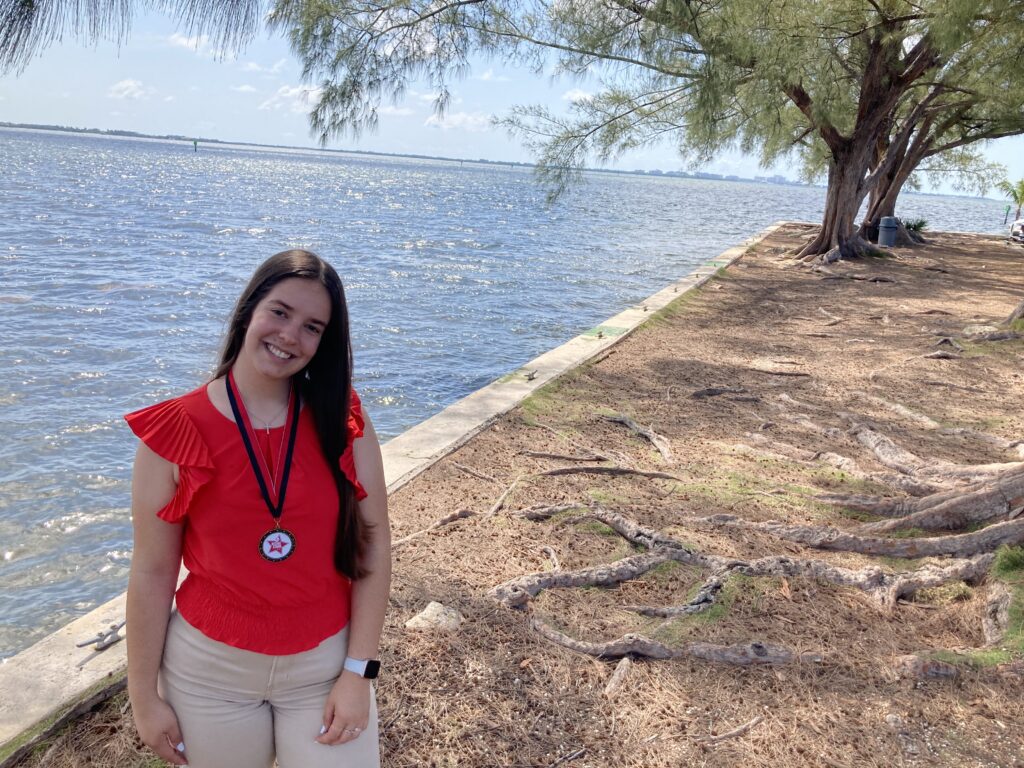
“It has been an honor of a lifetime to work with thousands of dedicated people who helped Florida move to a new definition of public education: low-income parents, educators, civil rights leaders and legislators. They all played critical roles,” said John Kirtley, founder and chairman of Step Up For Students. “Under this new definition, we empower Florida families to choose, or even create, the educational experience that will maximize their children’s chances for success.”
Since 2023, every program has operated as an education savings account (ESA), giving families flexibility in how they spend their children’s funds. They can use them not only to pay for tuition and fees at private schools, but also textbooks, curriculum, digital materials, tutoring, therapies and other approved educational expenses for home education or other learning environments.
As a result, more than 150,000 students on a Step Up scholarship are not enrolled full time in a private or public school and are choosing learning options in an “a la carte” fashion. This has created a burgeoning education marketplace of providers and innovators to meet families’ needs. Step Up has over 160 product vendors on its MyScholarShop online platform offering over 80,000 educational products, 7,500 businesses (not counting private schools) and 19,000 individual service providers.
“We are thrilled to have set the national standard in offering families the diverse learning options they deserve,” said Gretchen Schoenhaar, CEO of Step Up For Students. “We continue to innovate in technology and refine our processes that define the customer experience, encourage more providers to enter the marketplace and transform education.”
More than half of the state’s K-12 students – nearly 1.9 million – use an education option of their parent’s or guardian’s choosing other than their assigned district school. That includes magnet schools and career academies, charter schools, private schools, home education, and hybrid options, such as part-time microschools and co-ops. Plus, 52 of Florida’s 67 school districts have partnered with Step Up to offer fee-based classes and services to home education students on choice scholarships, paid for with scholarship funds – the only state to provide that.
Beginning in 2027, the Step Up Step Further Scholarship Fund plans to administer the new federal Education Freedom Tax Credit Program. Individual taxpayers will receive a dollar-for-dollar tax credit of up to $1,700 when they donate to a Scholarship Granting Organization (SGO) of their choice. The scholarships will provide eligible K-12 families in both public and private schools additional resources for tuition, tutoring, technology, and educational resources.
As Florida leads, the nation follows. The branch of the FTC planted 25 years ago continues to bear fruit. Step Up For Students looks forward to a year-long celebration of this milestone.
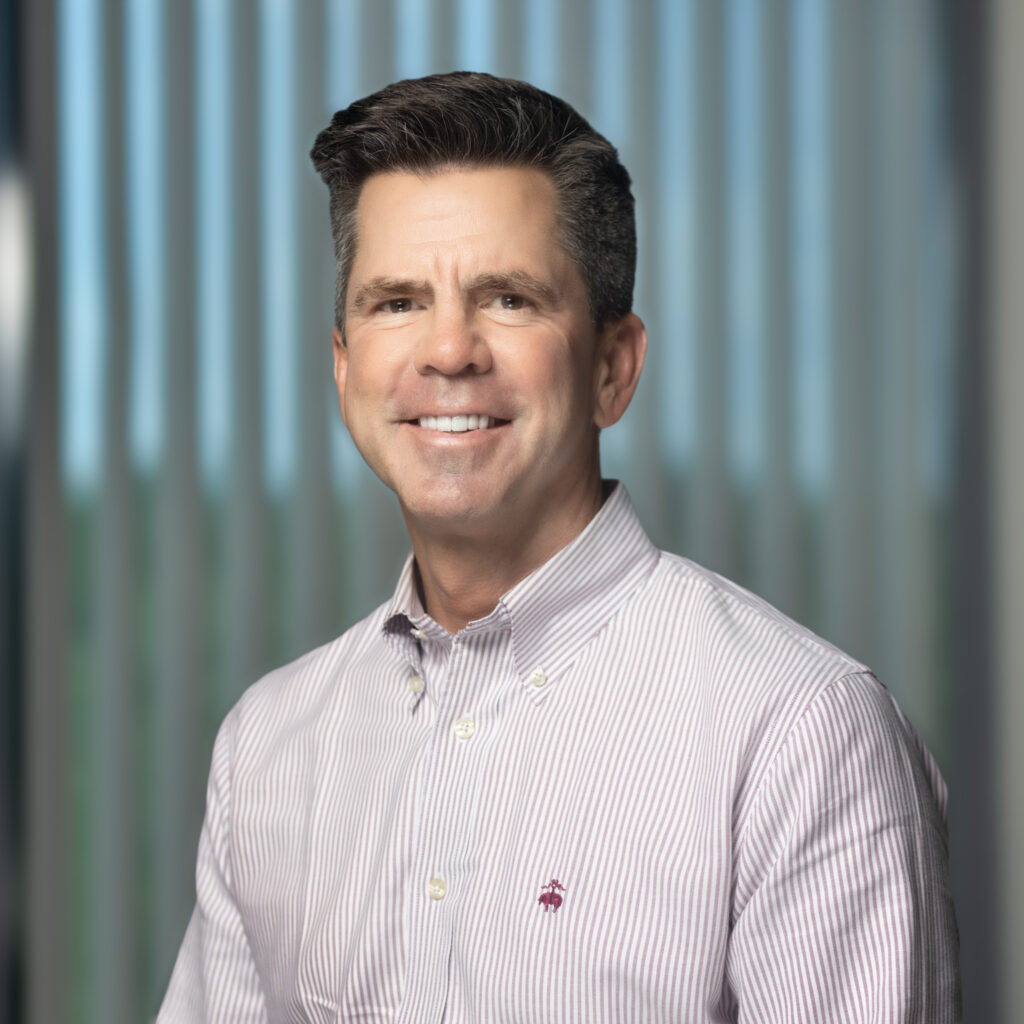
Editor’s note: Harvard University Program on Education Policy and Governance devoted its annual spring research conference to helping policymakers assess education choice: What is and is not working, the trade-offs involved in different programs, and the long-term effects. John F. Kirtley, the founder and chairman of Step Up For Students, the nation’s largest nonprofit scholarship funding organization, told attendees in a keynote address about his home state of Florida, where 30 years of robust education choice across the district, charter, and private sectors are not only working but have set a national standard for the other states taking their first steps on the journey. His remarks are summarized below. You can read the entire speech here. To learn more about Harvard’s Emerging School Models conference, scheduled for Sept. 17 and 18, go here.
Redefinition of public education
Growth of choice programs
Supply-side developments
Impact on rural and district schools
Educational outcomes and research

Editor’s note: This commentary from former Florida Gov. Jeb Bush appeared last week on miamiherald.com.
Like all parents, Jeni and Neal Schoenbach want the best for their children, and each year they assess how their children are doing and what type of school would serve them best. Their kids attend both private school and homeschool, and much of the cost of their education has to be paid out of pocket.
But Arizona’s expanded Empowerment Scholarship Program would allow the Schoenbach children to receive a publicly funded education regardless of whether they’re enrolled at the local public school, private school, or home school. Education savings accounts are a modern form of public education funding — but better. They are customizable, flexible and can pay for costs ranging from school tuition to tutoring, online courses and therapy.
Making these choices doesn’t categorically mean there’s anything wrong with their traditional school — just as it doesn’t mean there’s anything wrong with a private or charter school when parents choose the traditional option. It’s all about what the Schoenbach family fully understands: finding the best fit for each child.
That’s why it’s irresponsible and misleading to have the director of an Arizona organization opposed to school choice describe the state’s newly improved scholarship as a “nail in the coffin” for public schools. Separately, an Arizona Democrat opposed to the program said it was “designed to kill public education.”
Nonsense. It’s a false dichotomy to believe that using public funds for a child to attend a school other than a traditional public school is anti-public education.
The very point of public education funding is to fund every child’s education. It’s not to fund only one type of school and mandate that all children must enroll in that school, regardless of whether it serves their needs. Here’s where the reasonable argument for public funding of school choice gets ugly for those who oppose it. During the pandemic, it became increasingly clear that the one-size-fits-all school model failed.
Traditional systems simply did not have what it takes to serve all families. And the horrendous impact on student learning is becoming more and more evident.
To continue reading, click here.
 You, dear reader, look as though you could use some distraction from the viral apocalypse. Like many good stories, this one flashes back to the past to inform the present.
A decade ago, while an analyst at the Goldwater Institute, I participated in a debate concerning choice versus curriculum reform. Yes, people were confused about whether those things were mutually exclusive a decade ago, as they are today. (Spoiler alert: choice helps curriculum reform).
In any case, the debate prompted me to ask myself which states had done a lot of both choice and testing accountability. This in turn led me to look closely at the NAEP scores of Florida and to consider that former Gov. Jeb Bush had aggressively sought to improve literacy instruction by creating a variety of public and private choice mechanisms.
Staring at fourth-grade NAEP scores by race/ethnicity on my computer screen, here is what I discovered.
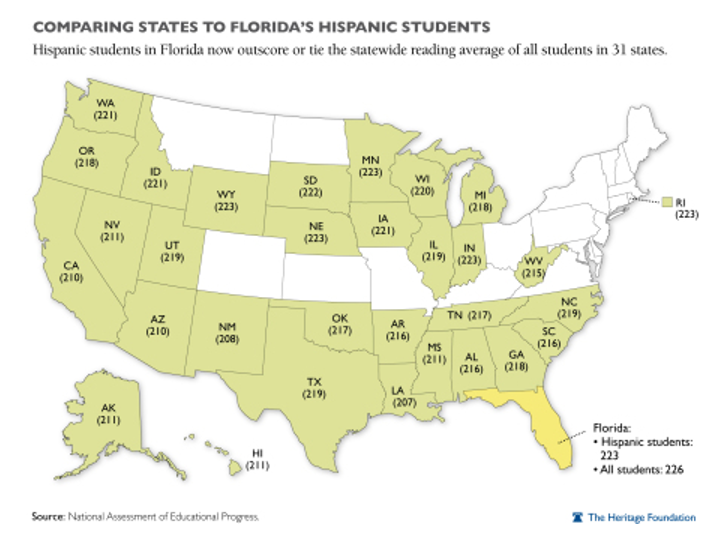
The conversation around K-12 in Arizona at the time frequently involved an “if you control for student demographics, we are kind of average” story. This was part of a fable with a thousand faces; you will hear different versions of it in different states. In Arizona, the story involved kids immigrating from Mexico who were unable to read Spanish. In Minnesota, I’ve heard tales told in hushed voices about Hmong kids. In more than one southern state, I’ve heard allusions to scores of white kids scoring quite high when they weren’t anything of the sort. The details vary, but the moral is always the same: “We here in state X, we’ve got the really hard-to-educate kids.”
The fact that Florida’s Hispanic students were reading approximately a grade level higher than the average for all students in Arizona required the development of a new rationale. That new rationale was the magic Cuban theory. Florida’s Hispanics are Cubans, the story went, and they are wealthy. “Obviously we can’t expect to do that with our Hispanic students,” the theory concluded.
I related the magic Cuban theory to an audience at the first ExcelinEd conference held in Orlando. Given the advantage of local knowledge held by many audience members, the crowd laughed out loud at the absurdity of the stereotype. Despite living in a distant patch of cactus, I had spent enough time in the Florida Keys with my grandfather to develop a lifelong taste for ropas viejas and to know better.
The magic Cuban theory could never survive scrutiny. First off, Florida’s Hispanic community is vastly more diverse than appreciated by distant stereotypes, with Cubans constituting a minority among Hispanics. Second, Florida saw large increases in literacy among multiple ethnic groups. Magic Haitian theory anyone?
Finally, buried deep in the data explorer, NAEP has a variable that allows you to break down Hispanics by subgroup. NAEP, alas, discontinued this variable, but we do have it for both 1998 (the year before Jeb Bush took office) and 2002. It would have been great to have data from additional years, but note that the 2002 NAEP came before the adoption of the third-grade retention policy. Between 1998 and 2002, Florida policymakers had adopted major education reforms, but not all the reforms.
Here is what the gains looked like during the 1998 to 2002 period.
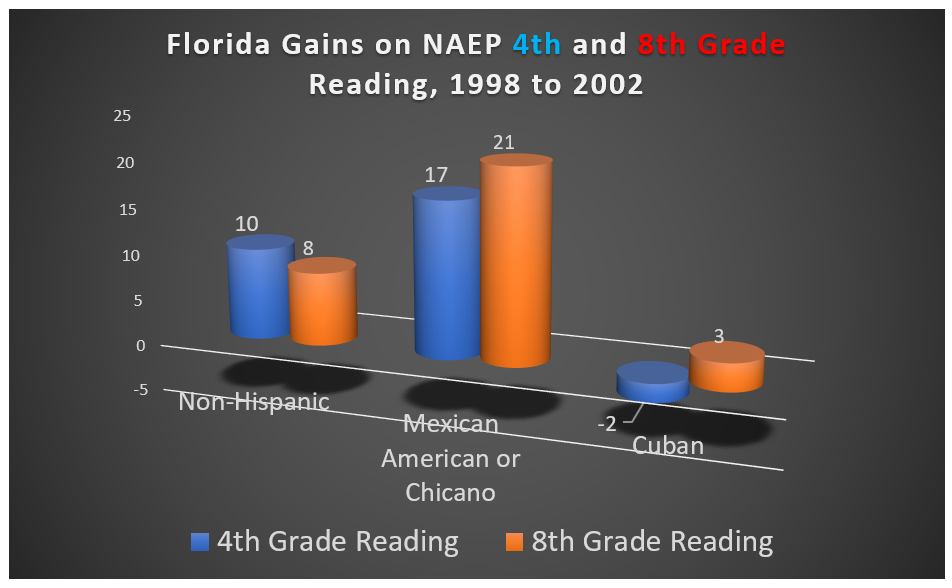
Florida’s Cuban-Americans scored well, but they were not driving gains. As a rough rule of thumb, 10 points on NAEP exams approximately equals an average grade level’s worth of progress. In other words, we would expect a group of fifth-graders given the fourth-grade test to do about 10 points better. The Mexican-American gains were very large, very meaningful and very statistically significant.
By the way, those eighth-graders from 2002 are approaching their mid-30s now. With all of today’s troubles, and considering those around the bend, Florida chose wisely in not succumbing to the soft bigotry of low expectations, instead making an all-out effort to teach literacy. Life is hard, but life is really hard if you can’t read.
 Within an hour of Fifth Third Bank's announcement via a press release that it will continue to fund scholarships for Florida's most disadvantaged students, state lawmakers took to social media to thank the bank for reconsidering its decision to fund the Florida Tax Credit Scholarship program.
Those lawmakers included Rep. James Bush III, D-Miami, who posted: "The return of Fifth Third as a donor to the Florida Tax Credit Scholarship program is a victory for the more than 100,000 low-income students who need options in their education."
Rep. Kimberly Daniels, D-Jacksonville, referenced the pressure exerted upon Fifth Third by activists who came out in force this week to support the scholarship program and urged others to tweet @Fifththird to thank the bank for continuing its support.
Several other lawmakers, including Rep. Chris Sprowls, R-Palm Harbor, applauded Fifth Third for "coming back to the table" and listening to all voices. "This decision means that thousands of underprivileged, minority children will not have to give up their dream of a better future," Sprowls tweeted.
Rep. Patricia Williams, D-Pompano Beach, tweeted: "I celebrate the announcement by Fifth Third Bank, which will bolster education opportunities for those who need it most -- low-income, minority students."
Rep. Chris Latvala, R-Clearwater, and Rep. Byron Daniels, R-Naples, also weighed in, with the latter thanking Fifth Third for "doing the right thing" in resuming its corporate donations.
Meanwhile, Rep. Al Lawson, D-Tallahassee, commended the bank for supporting equal education opportunities for all children. "Our great state will be the better for it," Lawson tweeted.
Adding their voices to the praise chorus were two national figures.
Former Florida Gov. Jeb Bush, who signed the Florida Tax Credit Scholarship program into law in 2001, thanked Fifth Third and tweeted, "Great to see @FifthThird continuing to support Florida's families seeking a better education for their children."
And U.S. Sen. Marco Rubio commended the bank, tweeting "Great job by the bipartisan coalition that made this possible."
Rubio made headlines earlier this week when he called Fifth Third's decision to cease donations, along with Wells Fargo's, a "publicity stunt aimed at earning 'wokeness' points with the radical left."
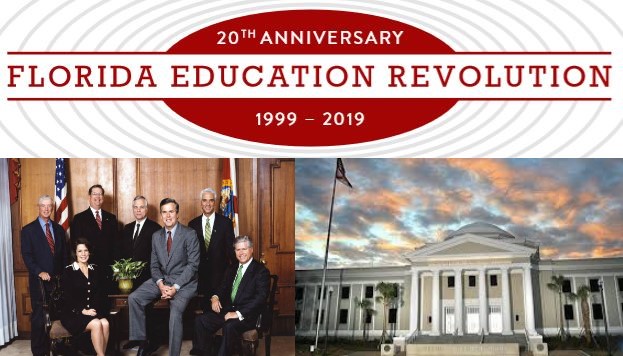
Gov. Bush's "A+ Plan" for accountability faced a long road of legal battles as soon as it began 20 years ago.
Editor’s note: March 2 marked the 20th anniversary of the legislative session in which Florida Gov. Jeb Bush launched a number of K-12 reforms that transformed education throughout the state. With the start of the 2019 legislative session earlier this month, redefinED embarked upon a series of articles that examine aspects of Bush’s K-12 education revolution and how it continues to reverberate. Today’s piece is the second of two retrospectives that chronicle the plan’s legislative roller coaster ride. You can read Part I here.
The critics strike back
With vouchers deemed constitutional by the First District Court of Appeal and with an appeal rejected by a 4-1 vote by the Florida Supreme Court, state leaders not only began to improve the A+ Plan; they birthed an entirely new scholarship program.
In the summer of 2001, Florida created the Florida Corporate Income Tax Scholarship, later renamed the Florida Tax Credit Scholarship, for low-income students. The prior year, the state had created the McKay Scholarship for students with special needs. Both programs swelled in size immediately, dwarfing the embattled school voucher, the Opportunity Scholarship Program (OSP). McKay served 8,000 students with special needs in 2002, while more than 55,000 low-income students applied for 15,000 corporate tax scholarships in its first year.[1]
The Florida Tax Credit Scholarship would eventually grow to become the largest private school scholarship program in the nation, serving 100,512 students in the 2018-19 school year. (The program is administered by non-profits such as Step Up For Students, which hosts this blog.)
The state also revised the A+ Plan’s accountability system in December 2001. Previously, schools were evaluated only on fourth-grade reading, fifth-grade math, and both tests in eighth and 10th grades. New rules based school grades on both math and reading tests in all grades between third and 10th. The new grading scale also gave a substantial weight to learning gains, with bonus points for significant gains for low-income students.
With the new rules in place, more schools received “F” grades, and enrollment in the OSP soared to 557 students in the next school year. Enrollment peaked at 788 students in 2004-05.
After a year away from the courtroom, the lawsuit resumed in the Leon County Circuit Court under a new judge, Kevin Davey, in the summer of 2002. Voucher opponents now argued the programs violated Florida’s “Blaine Amendment,” a constitutional ban on direct or indirect aid to religious institutions.
Voucher supporters were eager to argue the case as the U.S. Supreme Court just two weeks prior to the hearing had ruled an Ohio voucher program did not violate the U.S. Constitution’s “Establishment Clause.”
On Aug. 5, Judge Davey issued his ruling. “The language utilized in this provision is clear and unambiguous,” he wrote regarding Article I, Section 3 of the state constitution. Known as the “No Aid” clause, it bans “direct and indirect” aid to any church, or sect, or sectarian institution.[2]
School choice supporters appealed, claiming the ruling also threatened other religiously affiliated organizations such as several non-profit hospitals operating in the state.
The First District Court of Appeal would uphold the ruling 8-5 on Nov. 12, 2004. Scholarship supporters appealed to the Florida Supreme Court, knowing a loss could still be appealed to the U.S. Supreme Court.
Lawyers for both sides argued on the “No Aid” clause before the Supreme Court on June 7 2005. Lawyers representing parents argued the aid was to the student, not the school, as U.S. Supreme Court had reasoned in its 2002 Zelman decision.
On Jan. 5, 2006 the Florida Supreme Court in a 5-2 vote ruled the voucher program was unconstitutional, but for entirely different reasons than anyone expected.
The OSP "diverts public dollars into separate private systems parallel to and in competition with the free public schools that are the sole means set out in the Constitution for the state to provide for the education of Florida's children,” wrote the majority in a decision that completely contradicted its own ruling five years earlier.
Back in 2001, Justices Charles Wells, Harry Lee Anstead, Barbara Pariente and Fred Lewis voted 4-1 (against Peggy Quince) to decline jurisdiction on the case, which allowed the Circuit Court of Appeal decision to stand. That ruling found nothing within Article IX Section 1 of the state constitution prohibited vouchers or any other educational alternative created by the Legislature.
But with all other avenues of ruling the program unconstitutional now defeated or in jeopardy of being appealed to the U.S. Supreme Court, the Florida court suddenly reversed course. Not comfortable with its own ruling, the court invented its own definition of “uniformity” and declared vouchers “inevitably harmed” public schools without examining a single piece of evidence.
Clark Neily, a lawyer representing scholarship parents, condemned the decision as “among the most incoherent, self-contradictory and ends-oriented court decisions in recent memory.”
Chief Financial Officer Tom Gallagher agreed, called the ruling “a results-oriented decision.”
But Steve Gey, a law professor at Florida State University, believed the ruling “adhered closely to the text of the Constitution.”[3] Gey had co-authored a friend of the court brief in March 2005 entirely on the “No Aid” clause in support of the teachers union’s lawsuit.
Many legal critics, including the Harvard Law Review, would criticize the ruling.
While legal experts debated its merits, the impact of the ruling hit families the hardest.
Barbara Cruz used the scholarship to send her daughter to La Progresiva Presbyterian School in Miami. Her daughter would graduate using the scholarship, but Cruz still described the court ruling as, “so, so bad.”[4]
Many others were in limbo.
“I think [the ruling is] going to hurt a lot of students and their parents who can’t afford it, and they are forced to go to these public schools,” said Bobby Evans, whose daughter, Kiara, attended St Paul’s Catholic School in Jacksonville on the scholarship for the sixth and seventh grades. Kiara would finish out the year on the scholarship, but whether she could remain at St Paul’s remained unknown.[5]
School choice supporters worried the ruling might be used to target other programs.
“One of the attorneys for the plaintiff made it very plain,” said Sen. John McKay, sponsor of the state’s McKay Scholarship. “If they succeeded with this case, they will be going after children with disabilities next.”
Opponents celebrated.
“I think this spells the end of this diversion of public monies to private education programs in Florida,” said Ronald Meyer, the lawyer representing the teachers union in the case.
When asked about challenging the tax credit scholarship or McKay Scholarship, Meyer told Education Week, “The significance of this travels well beyond the state of Florida.” He hinted that the ruling could help overturn vouchers in other states as well.[6] A few months later, Meyer would deny that the teachers union had any interest in challenging either scholarship program.[7]
Bush promised to save the program.
In mid-February, Gov. Bush stood before a rally of thousands of parents and students, most of them black, wearing t-shirts stating “Save Our Students,” and promised to get a constitutional amendment passed to rescue the voucher program.
“This is a fundamental right, this is a civil right, this is American as apple pie,” Bush said to a cheering crowd.[8]
Bush and Senate President Tom Lee moved to pass a constitutional amendment that would save the OSP and protect other private scholarship programs. The amendment would need to pass the Senate and the House by three-fifths votes before being approved by voters in November 2006.
Those efforts collapsed when Sen. Majority Leader Alex Villalobos, Sen. Nancy Argenziano, Sen. Dennis Jones, and Sen. Evelyn Lynn joined Democrats to oppose the amendment. Bush came up one vote shy of the three-fifths threshold. Villalobos would be stripped of his power as a result.[9] Today, Villalobos works for the legal firm headed by Ronald Meyer, the teachers union’s lead counsel.
Bush and Sen. Lee brushed off the defeat and moved to a new plan, passing a bill to allow the remaining OSP students to transfer to the tax credit scholarship program.[10] Tensions were high with just a few days left in the session. Democrats’ best hope for defeating the bill was to stall. Senate Democratic Leader Les Miller demanded the full text of bills be read aloud, a parliamentary trick that brought the legislative process to a grinding halt.[11] The House eventually ran out of time to vote on the bill.[12]
The OSP’s private scholarship was finally dead.
The end
Although the legal case that ended the OSP, known as Bush v. Holmes, faced considerable criticism from legal experts at the time, scholarship supporters worried that copycat lawsuits would upend voucher programs around the country.
But the case was never successfully duplicated. And despite threats from the teachers’ union, the case even failed to overturn significantly larger scholarship programs in Florida. At the time of the Holmes ruling, the tax credit scholarship enrolled more than 14,000 low-income students in private school, while the McKay Scholarship enrolled more than 15,000 children with special needs. Combined, both programs cost $136 million that year.[13]
The Opportunity Scholarship’s private option ended in 2005-06 with 734 students. During the program’s seven-year lifespan, the state spent a mere $11.2 million for 2,848 scholarships. Ninety-five percent of the students on the program were black or Hispanic, and 70 percent participated in the free or reduced-price federal lunch program.
None of the worries conjured by critics, including Sen. Betty Hozendorf’s claim the scholarship was a “lynching of the civil rights movement,” ever proved true.
The Opportunity Scholarship Program continues today, though students may only choose to attend another public school. Enrollment and the students who are eligible fluctuate annually. OSP enrollment peaked with 4,424 students attending new public schools in 2011-12 and had a low of 1,280 in 2008-09. In 2017-18, the latest data available, the program served 3,074 students.
Despite its small size, the OSP started a massive fight over how to educate Florida’s students. Today, its history is half-forgotten and half-confused, but its legacy reshaped Florida’s educational landscape forever.
[1] Balona, Denise-Marie. “Tax Vouchers Trigger Rush; More than 15,000 Kids Received Private-School Scholarship From Corporate Taxes; Many Children Are On Waiting List,” Orlando Sentinel, March 21, 2003.
[2] Flannery, Mary Ellen and Kimberly Miller. “Judge Rejects School Vouchers,” Palm Beach Post, August 6, 2002.
[3] Matus, Ron and Steve Bousquet. “Court throws out vouchers,” St Petersburg Times, January 6, 2006.
[4] Matus, Ron and Steve Bousquet. “Court throws out vouchers,” St Petersburg Times, January 6, 2006.
[5] Mitchell, Tia. “Student’s life in limbo with end of vouchers; the Florida Supreme Court ruled Opportunity Scholarships violated the state Constitution,” Florida Times-Union, January 9, 2006.
[6] Richard, Alan. “Florida Supreme Court Finds State Voucher Program Unconstitutional,” Education Week, January 6, 2006. https://www.edweek.org/ew/articles/2006/01/05/18voucher_web2.h25.html (accessed 3.25.19)
[7] Klas, Mary Elen, “Senate moves to keep vouchers; The state Senate advanced a proposal to fix the constitutional weakness of Florida’s first voucher program. It comes up for a vote today,” Miami Herald, May 3, 2006.
[8] Follick, Joe. “Thousands rally to push lawmakers on vouchers,” Sarasota Herald-Tribune, February 16, 2006.
[9] Cotterell, Bill. “Party-switching votes doom tuition vouchers,” Tallahassee Democrat, May 2, 2006.
[10] Klas, Mary Elen, “Senate moves to keep vouchers; The state Senate advanced a proposal to fix the constitutional weakness of Florida’s first voucher program. It comes up for a vote today,” Miami Herald, May 3, 2006.
[11] Kennedy, John. “Democrats try to stall revival of vouchers,” Orlando Sentinel, May 4, 2006.
[12] Kaczor, Bill. “Bush’s Prized School Voucher Plan Looks to Be Out of Time; House Has No Plans to Vote On Program,” Sun Sentinel, May 6, 2006.
[13] Stockfish, Jerome and Marilyn Brown. “Court Rejects School Vouchers,” Tampa Tribune, January 6, 2006.
 Charter district: The Jefferson County School Board agrees to turn over operations of the district's struggling schools to the charter school company Somerset Academy. The proposed deal will be taken to the Florida Board of Education today for approval. If the deal is approved, Jefferson would become the first charter district in the state. In its application, Somerset said it will operate an elementary, middle and high school on a single campus led by a single principal, bring in a rigorous curriculum, including Advanced Placement classes, pay teachers 7 percent more than they can get in surrounding counties, pay competitive benefits, and work to bring students attending the alternative school back into the traditional schools. redefinED. WFSU.
Testing debate: The debate over the state's standardized testing intensifies at a Senate Education Committee meeting Tuesday. Supporters of former Gov. Jeb Bush are backing a moderate revision of the current system, while others want more significant changes, including fewer tests. Sen. Wilton Simpson, R-Trilby, who is leading the committee in the medical absence of Chairwoman Dorothy Hukill, R-Port Orange, said no decision has been made on what direction the bills will take, and that Hukill will make that call. News Service of Florida.
Help for home-schoolers: Students who are home-schooled would have greater access to college classes and career education courses offered by school districts in a bill approved by the House PreK-12 Innovation Subcommittee. Districts also would be required to accept home-education registrations as long as parents and their children meet the state's requirements. redefinED.
Religious expression bill: The Florida Senate moves the so-called "religious expression" bill to a third and final reading. If approved, the bill would be sent to the House, which has a slightly different version. The bill would give students more freedom to express religious thoughts in public schools. Gradebook. News Service of Florida. (more…)
Testing reforms: Under the proposed "Fewer, Better Tests" bills filed Wednesday in the Legislature, all K-12 assessment testing would take place in the final three weeks of the school year, starting in the 2017-2018. S.B. 926 and H.B. 773 would also require results be returned to teachers within a week of testing, and that an understandable report be sent to parents. It also directs the education commissioner to study the feasibility of replacing the Florida Standards Assessments with the SAT or ACT. If the changes are approved, the state would also have to renegotiate its contract with testing vendor American Institutes for Research. Bill sponsors Sen. Anitere Flores, R-Miami; Rep. Manny Diaz Jr., R-Hialeah; and Rep. Chris Sprowls, R-Palm Harbor, say the goal of the bills is to reduce stress and anxiety among students, parents and teachers. Miami Herald. Orlando Sentinel. News Service of Florida.
Per-student funding: Florida's spending per student ranks well below the U.S. average among states, according to a report by the National Center for Education Statistics. In the 2013-2014 school year, Florida spent $8,714 per student. The U.S. average was $10,936. Miami-Dade County spent the most per student among districts, $9,106. Gradebook.
Teaching incentives: Senators on the Florida PreK-12 education budget committee react coolly to Gov. Rick Scott's $58 million proposal for incentives to recruit and retain teachers. Specifically, senators criticized Scott's proposal for $10 million in hiring bonuses for new teachers who score in the top 10 percent in their subject-area exam. "It concerns me that we continue to look for the best performers in college -- and not the best teachers," said Sen. Doug Broxson, R-Gulf Breeze. Miami Herald.
Gun-free zones: Bills filed in the Legislature this week are aimed at ending gun-free zones in Florida - including at K-12 schools. Sen. Dennis Baxley, R-Ocala, and Rep. Don Hahnfeldt, R-Villages, filed S.B. 908 and H.B. 803 to eliminate all restrictions on where people with concealed-carry permits can take their guns. Miami Herald. (more…)

