Greater collaboration is being credited for a dramatic decrease this year in the number of Florida K-12 scholarship students experiencing scholarship funding delays because their names were also found on public school rolls.
According to the latest state figures, the rate of matched students in the Family Empowerment Scholarship for Educational Options was less than 1%, while the rate of students applying for the Family Empowerment Scholarship for students with Unique Abilities Scholarship was about 5%. Officials attributed the higher match percentage for FES-UA to that group’s greater mobility, given the various services available through the public school system.
In the latest quarter, fewer than 6,000 scholarship students were reported in public schools compared with 27,000 in the quarter that included the start of the 2025-26 school year.
The improvements occurred after officials at the Florida Department of Education worked with the state’s 67 school districts and Step Up For Students to improve the crosscheck process and pinpoint more students who were being double counted.
During the 25-26 school year, there are six crosschecks where the Florida DOE compares Step Up’s list of students who are on scholarship with school districts’ lists of students who were reported as attending a public school. If a student appears on both lists, Step Up For Students immediately freezes the student’s funds to ensure that public tax dollars are spent properly.
Step Up then contacts the families of these students and requests documentation showing that they were not enrolled in a district school, which is sent to the DOE. These students are funded on the scholarship only after the DOE clears them.
All scholarship accounts that were frozen from 2024-25 and the first two quarters of 2025-26 due to students appearing in a public school crosscheck have been resolved.
TALLAHASSEE, Fla.– Amanda Thompson said she will be the president of the United States.
Not wants to be or hopes to be but will be.Amanda Thompson said she will be the president of the United States.
Not wants to be or hopes to be but will be.
Just like she will be the attorney general of Florida, the governor of Florida, and the United States attorney general before reaching the Oval Office.
“That’s the plan,” she said. “I’m going to get there.”
Of course, there is some prep work to be done before she begins a career of service to her state and country.
First, Amanda, 17, is set to graduate this May from St. John Paul II Catholic High School (JPII), where she will be class valedictorian. She attends the parochial school in Tallahassee with the help of a Florida education choice scholarship managed by Step Up For Students.

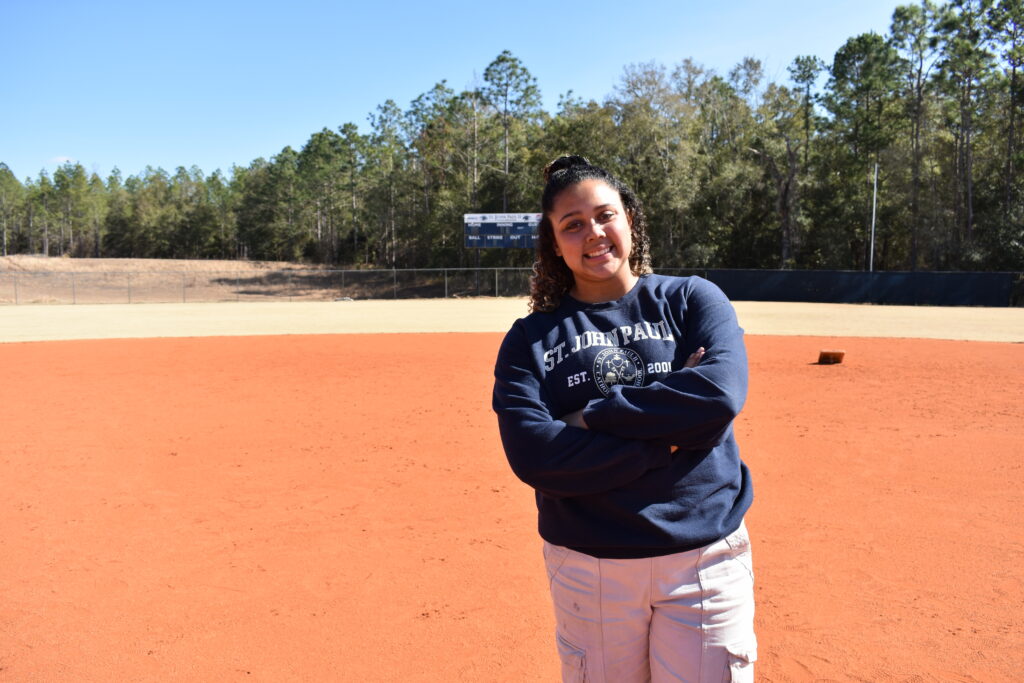
Then it’s off to Harvard University, where she plans to double-major in government and history and earn a degree from its prestigious law school. Along the way, Amanda will pitch for the Crimson softball team with designs on leading the program to its first appearance in the Women’s College World Series.
As that unfolds, Amanda is determined to play softball in the Olympics. She has attended tryouts for Team USA and is a member of the United States Virgin Islands national team.
Taken separately, any one of her goals is ambitious.
But combined?
“She has very, very high expectations,” said JPII Principal Luisa Zalzman. “She’s a go-getter, a high achiever. She has a drive that is very mature for her age.”
“She's done everything she's ever put her mind to,” said Amanda’s mother, Ashley Williard. “She said she wanted to be valedictorian, and I said, ‘OK, go be valedictorian.’ And she did it.”
Amanda is a bundle of energy and confidence. On the softball field, she has a running dialogue with everyone – teammates, opponents, coaches, umpires. In the classroom, she’s involved in every class discussion.
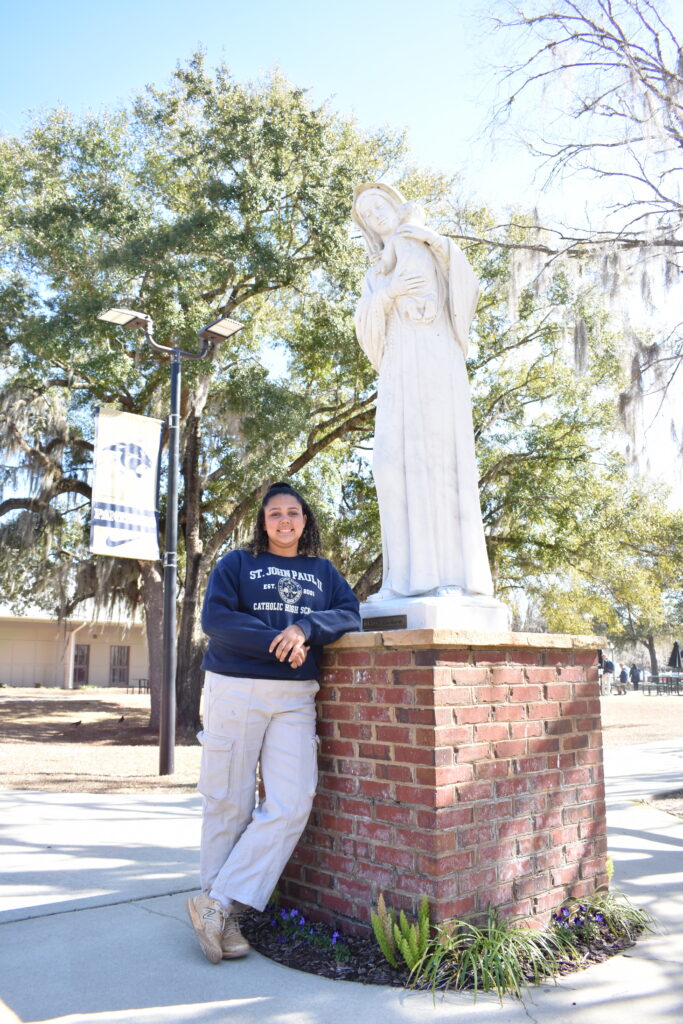
If you had approached her in August 2022 as she took the initial steps of her high school journey and told her she would graduate first in her class and be a member of Harvard Class of 2030, she would have been stunned.
“I would have said, ‘You got the wrong person.’ The difference between me then and me now is astronomical, and I think it’s because I attended this school,” she said. “It has to be.”
Amanda was a star as she rose through the ranks of the Tallahassee youth softball programs. Her parents, Ashley and James Thompson, envisioned their daughter earning an athletic scholarship to college. They were thinking of a high-end academic university like Duke or Notre Dame. That’s how Amanda, who attended her district schools until eighth grade, landed at JPII.
“We wanted a high school that was college-focused,” Ashley said. “Education is what we were looking for, and we could not have done it without Step Up For Students. No way could we afford to put her in that situation.”
There were “little things,” Amanda said, that shaped her academic future.
Her freshman English teacher encouraged her to write outside the margins during tests and essays.
“He said, ‘You don’t have to stay within this box. If you know more, write more on the paper.’ That stuck with me,” Amanda said.
Her freshman world history teacher announced to the class that Amanda scored the highest on the first test of the year.
“He congratulated me,” she said. “I thought that was insane.”
Midway through that semester, Amanda realized she had A’s in all her classes. That’s when she began to believe in herself as a student. Future valedictorian?
“Why not?” she said.
Amanda took AP World History as a sophomore and aced the AP test.
“That’s the class where I learned to learn,” she said.
Also, her love of history and government was born in that class, Amanda said. She can name all the countries of the world, tell you where they are located, and identify the flags.
“I’m working on my capitols,” she said. “It’s my hobby.”
Amanda took Spanish I and II in middle school and passed each, but not with grades that would stand out on a high school transcript. Sara Bayliss, JPII’s college advisor, suggested that Amanda retake those courses.
“She said the grades weren't good enough, that I could do better,” Amanda said.
Amanda retook both classes. She asked Principal Zalzman, a native of Venezuela, for tutoring help. The result was a pair of grades that fit proudly on the transcript Amanda sent to Duke. Duke was her dream school for education and softball.
And then Harvard called.
At midnight on Sept. 1 of her junior year – the first day college coaches can contact 11th graders – Amanda received a phone call from the Harvard softball coach.
“I didn’t even know they had a softball program,” Amanda said.
Intrigued, Amanda accepted a recruiting visit to the university located just outside of Boston. That trip marked the end of her Duke dreams.
“I want to make a difference in this world, and I think Harvard is the perfect school for me,” she said.
Terrence Brown, JPII’s softball coach, has watched Amanda emerge as an Ivy League student and a Division I softball player good enough to attend Team USA tryouts and earn a spot on the national team of a small territory with Olympic ambitions.
“She’s goal-oriented, and she doesn’t let anything get in the way of achieving those goals,” he said. “She’s worked very hard to get to where she’s going.”
Ashley and James are proud parents, but Ashley said they won’t take too much credit for Amanda’s success.
“We have nothing but pride,” Ashley said. “She is self-driven, self-motivated. We try to provide motivation. She’s missed proms and dances because of softball travel and schoolwork, and that was all her decision.
“There are a lot of sacrifices made to go along with this. She’s not afraid of hard work. She says she’s going to do something, and she goes out and does it.”
PALATKA, Fla. — All Risa Byrd wanted to do was start a little preschool. That’s it. But then the former public school teacher got swept up in one of the most epic education stories in American history. Now her fast-growing school is the latest example of what’s possible when school choice is the new normal.
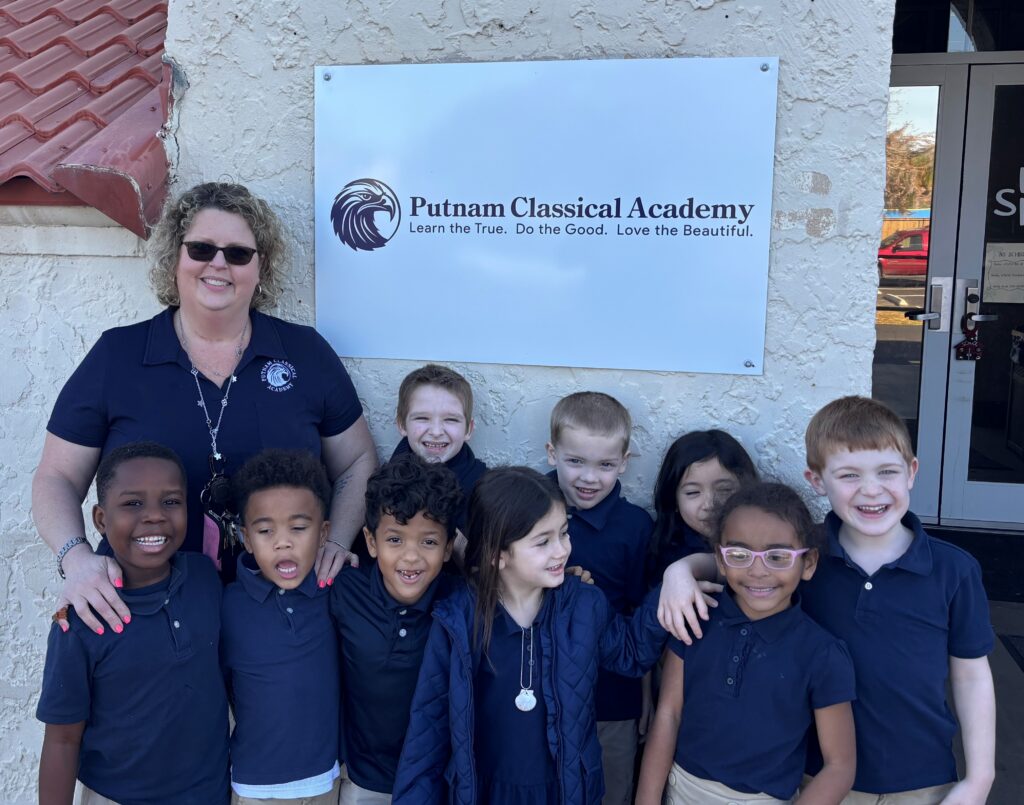
In 2022, Byrd retired from a 26-year teaching career to start Little Sprouts Learning Center. The goal was modest: Get her granddaughter’s academic journey off on the right foot.
A few months later, though, Florida lawmakers passed, and Gov. Ron DeSantis signed, one of the most sweeping school choice bills of any state, ever. Suddenly, every student in Florida was eligible for a state-supported choice scholarship.
Byrd didn’t realize it at first. But her school had caught a wave.
In the fall of 2023, Byrd added kindergarten and first grade, starting with eight students in those grades. She called the school for the higher grades Putnam Classical Academy.
By the fall of 2024, Putnam Classical had 50 students in grades K-5.
By the fall of 2025, it had 234 students in grades K-6, in addition to 60 in preschool.
Now Byrd’s looking for a whole other building to house a separate middle school. When she announced plans via Facebook, 111 students signed up in three days.
“Parents are desperate for their kids to be well educated,” Byrd said, particularly those from underserved communities. “They’ve been written off.”
Byrd is one of hundreds of former public school teachers who have leveraged Florida’s choice scholarships to create their own learning options. They can be found in every corner of the state, even in rural and semi-rural counties like Putnam, where a paper mill is the biggest private employer, the biggest town has 10,000 people, and the best-known landmark may be a blast-from-the-past diner.
The parents driving demand aren’t looking for anything exotic, Byrd said. They just want safe schools with top-quality academics, high expectations, and no drama.
“Parents got the word that we don’t play. That’s the biggest draw,” Byrd said. “They’re fed up. They know kids can’t learn, and teachers can’t teach, if there’s sheer chaos in the classroom.”
Byrd’s story may be a particularly dramatic example of what’s happening in Florida, and particularly symbolic.
More than half of Florida’s 3.4 million students are now enrolled in something other than their zoned neighborhood schools, and more than 1 million are enrolled outside of district schools entirely. Perhaps it’s fitting, then, that Putnam Classical leases a century-old building that once served as the local school district’s headquarters.
Despite the name, Putnam Classical isn’t truly classical yet. Byrd said she and her staff, which includes 20 teachers, will transition to a more recognizable “great books” curriculum within two years.
The first order of business is to establish a higher rate of basic literacy.
A self-described “data nerd,” Byrd is a “science of reading” adherent and a huge fan of Natalie Wexler, author of “The Knowledge Gap” and a leading proponent of using a content-rich curriculum to boost vocabulary and comprehension.
For the early grades, Putnam Classical uses an explicit, evidence-based phonics curriculum developed by the University of Florida. For the higher grades, it uses the highly regarded Core Knowledge curriculum for language arts, science, and social studies.
“If you teach these kids to read, you will change the trajectory of their lives,” Byrd said. “Then they can be an astronaut, a chef, anything they want to be.”
Byrd said as a public school teacher, she earned a reputation for working well with struggling readers, so more and more were sent her way. It became obvious, she said, that many students acted out because they couldn’t read well.
One time, she said, she stopped a 10th grader from disrupting her classroom, then took her out to the hallway to talk. The girl broke down and told her, in between sobs, “I’d rather everyone in that room think I’m a b---- than think I’m stupid.”
In three years, Byrd said she’s expelled two students. The school isn’t orderly because it’s draconian about discipline, she said. It’s orderly because kids are achieving academically and are proud of themselves. “When you learn to read,” Byrd said, “school becomes a lot more fun.”
About half of the students at Putnam Classical are Black or Hispanic; about 75% would be eligible for free- or reduced-price lunch in public school. The school does not charge tuition beyond the amount of the choice scholarship, which averages about $8,000 statewide and is far less than what districts spend.
Most of the students who switched to Putnam Classical were not reading at grade level when they arrived, Byrd said. Some incoming second graders didn’t know their letter sounds.
But now?
Now more than 60% are showing average or better growth compared to their peers nationwide, according to the STAR reading assessment Putnam Classical uses. In other words, students who were previously losing ground in their prior schools are now catching up and starting to get ahead.
Dalton Crews chose Putnam Classical for his 5-year-old, Delilah. He said he attended a private elementary school before moving on to public school and thought it built a good foundation for academics and character. He wanted the same for his daughter, and thankfully, he said, choice made it possible.
“I love the teachers. They communicate really well. They always tell me what’s going on,” said Crews, who installs fire sprinklers for a living. “They tear up when the kids leave. That’s love. They’re good people.”
Shentae Roberts said her 10-year-old granddaughter, Ja’Zyiah, was receiving good grades in her prior school, even though it was obvious to her family that she was struggling with basic material.
Her daughter tried contacting the school to get more information, she said, but never got a response. That’s why, in 2024, her daughter switched Ja’Zyiah and younger brother, Hakiem, to Putnam Classical.
“Best thing she did,” Roberts said.
Roberts said her granddaughter initially struggled at Putnam Classical, too. But the teachers gave her the attention and instruction she needed, she said.
The result: Ja’Zyiah “came back 10 times stronger,” Roberts said. “All the staff get to know the children, and they’re responding to them. They’re pulling the children to the next level.”
Byrd said more good things are ahead, not just for her school.
Even though Florida has been a national leader in private school choice for a quarter century, Byrd said she didn’t know much about it until HB 1, the landmark legislation Gov. DeSantis signed in 2023. Now, though, she realizes the game-changing potential not just for families but for teachers.
“Every public school teacher says, ‘If I were the boss, I would do it this way,’ “ Byrd said.
Well, now’s their chance.
A Tampa Bay area morning TV show kicked off National School Choice Week by highlighting a family who benefits from a state K-12 scholarship.

Arielle Frett appeared on Fox 13’s “Good Day Tampa Bay” program on Monday with her son, AnyJah, a ninth grader at The Way Christian Academy in Tampa. She said she moved to Florida from St. Thomas, Virgin Islands, in 2017 to find better educational opportunities for AnyJah, who has severe autism.
“No teachers were able to work with him on his level,” Frett told Fox 13 reporter Heather Healy. “Most of his learning in English and math are on fifth and sixth grade levels now.”
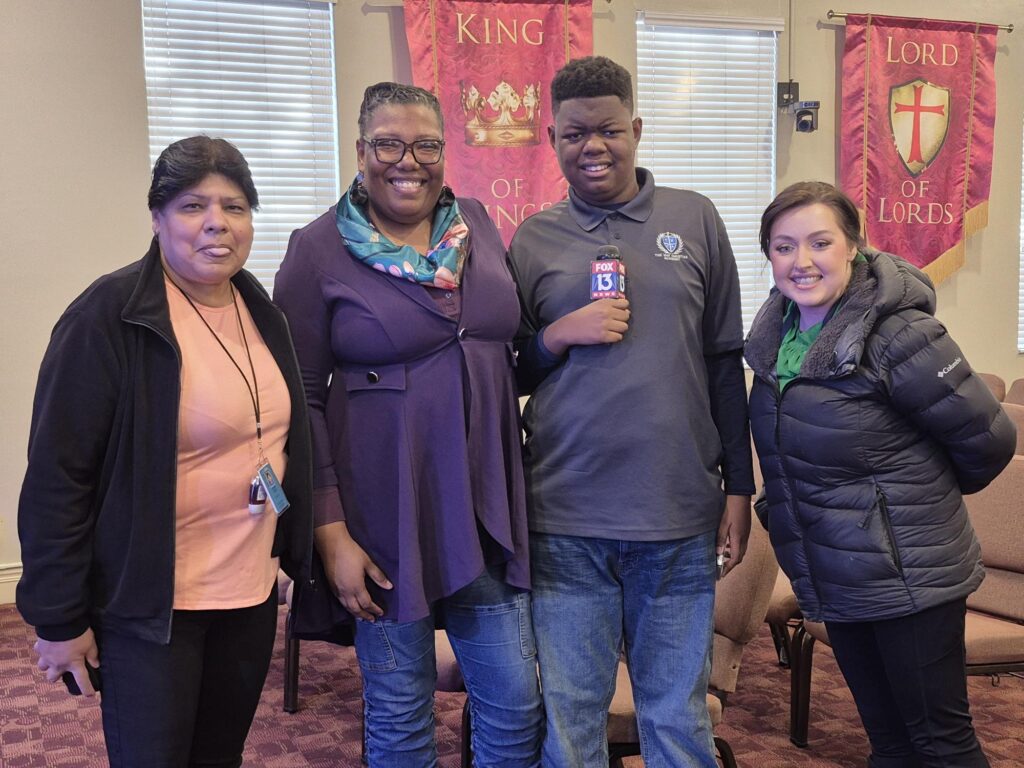
A U.S. military veteran and single mother of two, Frett said she would not have been able to afford a private school for her son without the scholarship.
She said AnyJah, who receives the Family Empowerment Scholarship for students with Unique Abilities, is “loved, protected, and thriving” at his school, where class sizes of 10 to 12 students allow for more individual attention. He can also receive his therapies during school.
The segment also featured information about Florida’s robust education choice options. Those include traditional public schools, district magnet schools, charter schools, private schools, microschools, homeschools, virtual schools, and customized education programs that allow parents to mix and match.
“We’ve gone from education and funding through the system to now empowering families by putting the money in their hands and allowing them to make the most appropriate educational decisions for families,” said Keith Jacobs, director of provider development at Step Up For Students, which administers most of the state’s education choice scholarships.
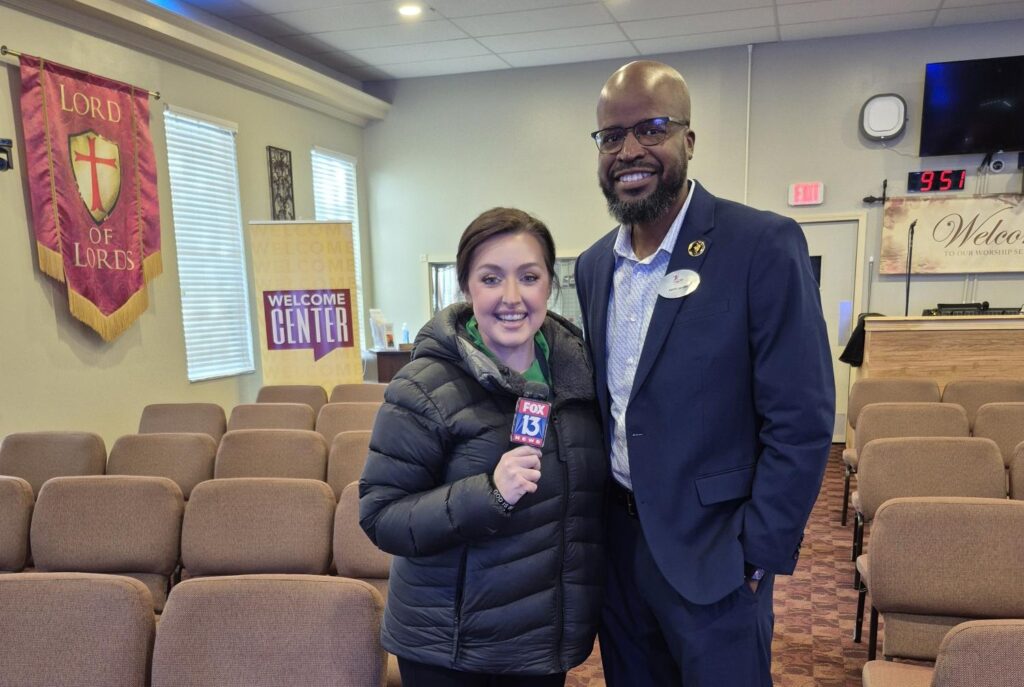
Jacobs has spent the past year working with school districts to provide individual courses to scholarship families whose students do not attend public or private school full time, paid for with scholarship funds. About 70% of Florida school districts are participating.
The scholarship application season for the 2026-27 school year begins Feb. 1. Visit Step Up For Students to learn more and apply.
TAMPA, Fla. — The words on the trophy read “Future Philanthropist,” and Mrs. Finley, who taught fifth grade that year, cried when she presented it to Andrew Weber during graduation.
Andrew smiled at the memory.
“It was one of the highlights of my elementary school career,” he said. “Mrs. Finley said I was one of her favorite students. That meant a lot to me.”
So did receiving the trophy, which still holds a place of honor on his nightstand.
“It made me realize my potential and how I can help others,” Andrew said.
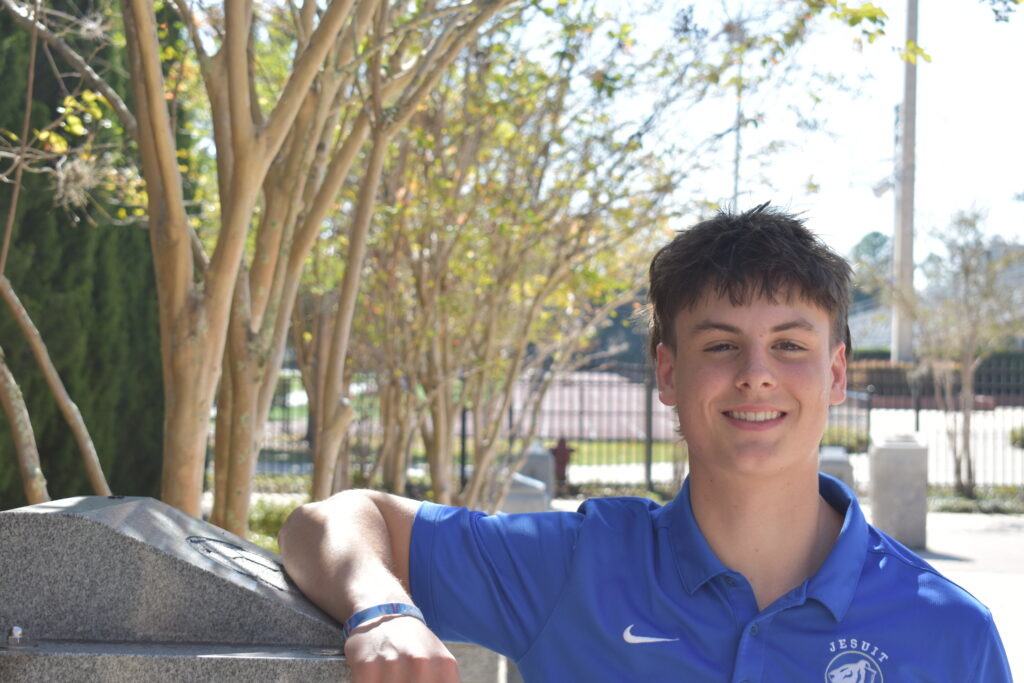
Almost seven years later, Andrew, a 17-year-old senior, is nearing another graduation, this time from Jesuit High School, the Catholic school in Tampa he attends with the help of a Florida education choice scholarship.
The altruistic nature Mrs. Finley saw in Andrew when he was in elementary school blossomed during the ensuing years.
Jesuit’s mantra is “Men for Others,” and Andrew embodies that.
“He does 100%,” said Andy Wood, Jesuit’s athletic trainer and track and field coach, and the school’s former director of community service. “Andrew is one of our top students. And when you talk about a total package, including his community service work, being a student athlete, he's what we envision our seniors being at graduation.”
Andrew volunteered for eight service organizations while in high school.
He made two trips to an orphanage in Guatemala with his Jesuit classmates, feeds people at Metropolitan Ministries, and delivers Meals on Wheels with his mother, May.
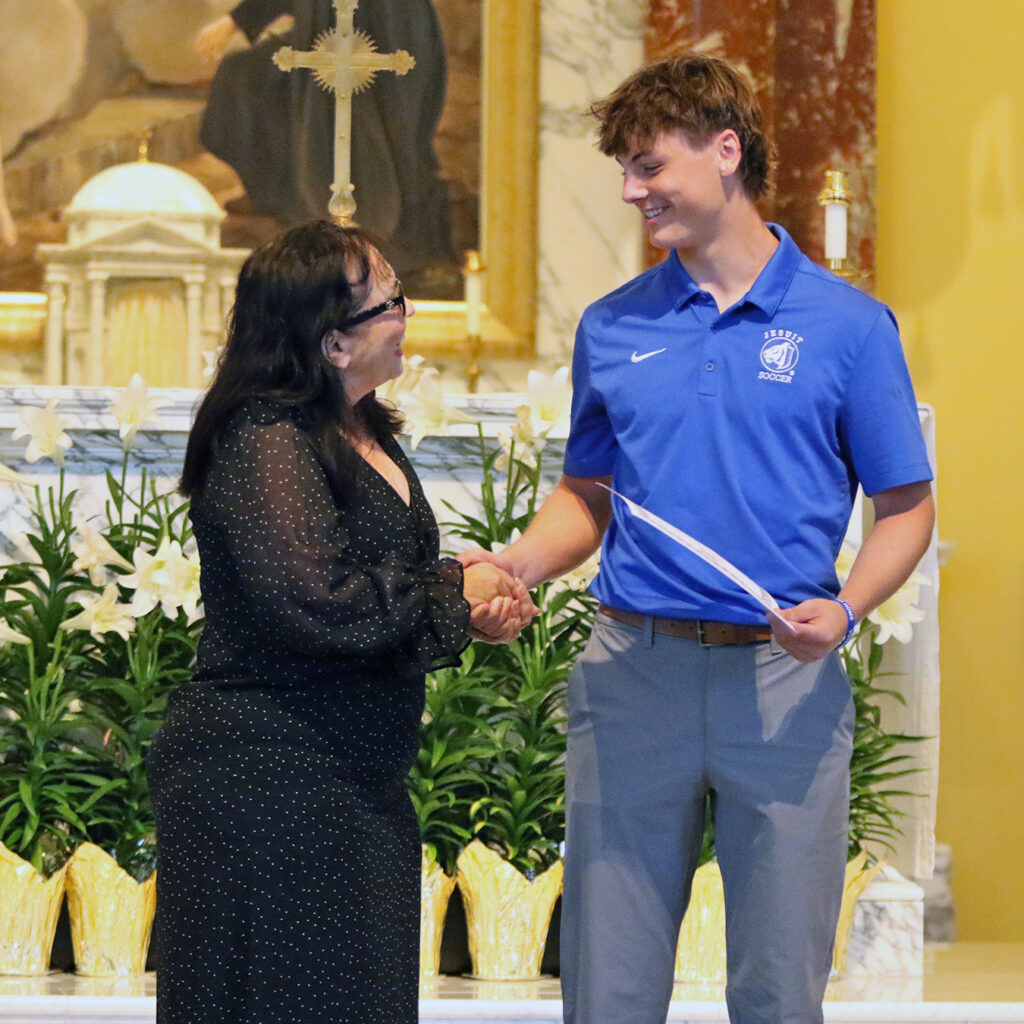
He’s volunteered for the Faith Café, the Young Men’s Service League, Teens United Florida, the Leukemia and Lymphoma Society, and the Ryan Nece Foundation, a non-profit founded by a former Tampa Bay Buccaneer that empowers teens to become leaders through volunteering.
Andrew traveled to Asheville, North Carolina, last June with the Ryan Nece Foundation to help families with home repairs still needed after the flooding caused by Hurricane Helene.
He is a pole vaulter on the track and field team, and in his spare time, he plays the piano at a local nursing home.
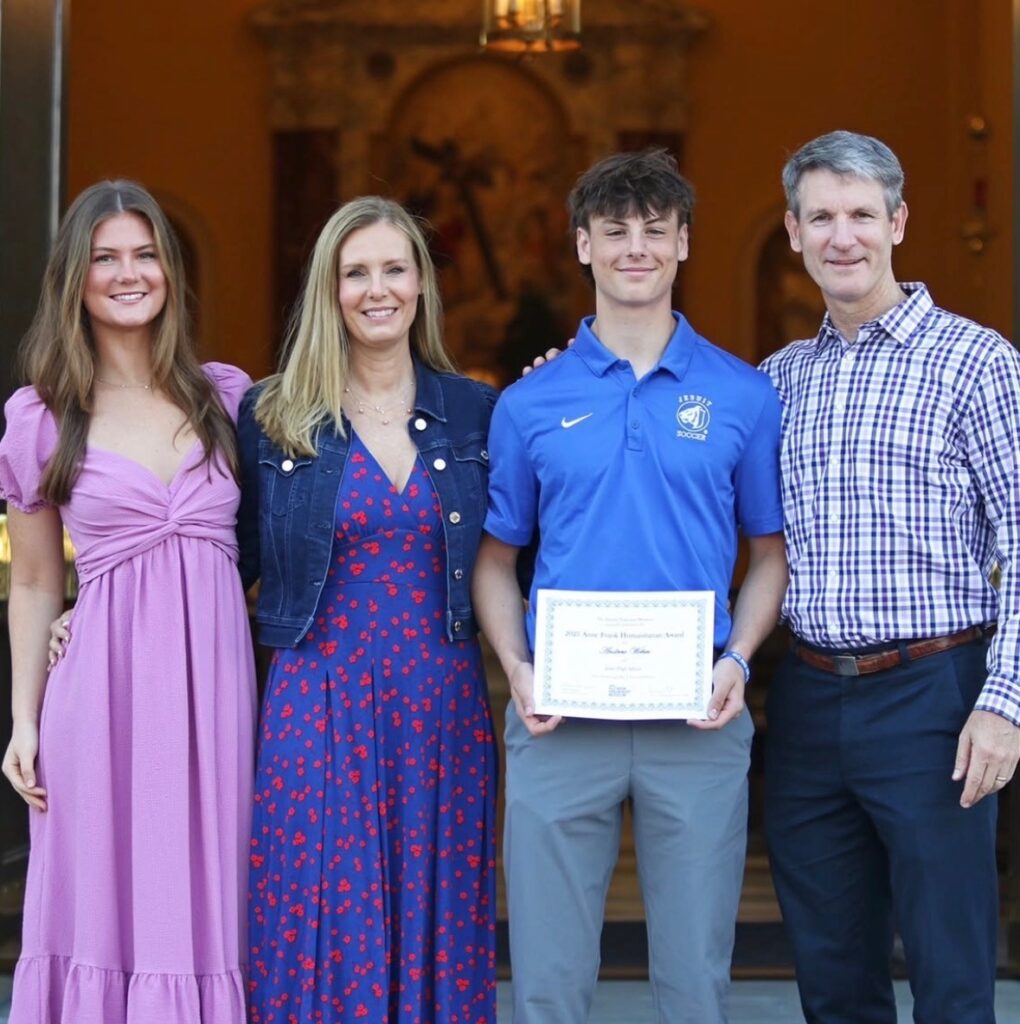
As a junior, Andrew received the Anne Frank Humanitarian Award from the Florida Holocaust Museum in Tampa for his outstanding humanitarian efforts.
Andrew’s parents, May and Tim, raised him and his older sister, Elise, to be community-minded. Elise, now a sophomore at the University of Georgia, also volunteered for the Ryan Nece Foundation while in high school.
“As his parents, we always wanted Andrew to be very involved in a lot of things and explore different passions, and luckily for him, many of those passions really stuck,” May said.
Andrew set the foundation in elementary school when he sold lemonade, handmade crafts, and rocks (crystals and gems) from a stand in the front yard of the family’s Tampa home. He said he would raise maybe $100 over several weeks and donate the money to charities such as Dogs Inc (formerly Southeastern Guide Dogs).
“I was 8,” he said. “I felt the money could benefit other people more than it could benefit me.”
“His heart was always generous,” May said.
For a teenager as service-oriented as Andrew, he certainly found a home at Jesuit, where students are required to complete a minimum of 150 hours of community service during their four years. Andrew, though, has accrued more than 500.
Yet, the decision to attend Jesuit was not easy.
“It was a very hard decision,” Andrew said.
His options were these: his district school, where Elise was a rising junior and where a lot of his friends were headed, or Jesuit, an all-male parochial school with demanding academic standards.
For help, Andrew turned to his role model: his big sister.
“She said, ‘Andrew, if you pass up this opportunity, you might regret it for the rest of your life.’ So I said, ‘I'm going to listen to you,’” Andrew said.
Thinking back on it now, Andrew added, “She was right.”
He has no regrets.
Andrew’s two trips to Orfanato Valle de Los Angeles (the Valley of the Angels orphanage) outside of Guatemala City with his classmates opened his eyes to how fortunate he is to live in America.
The orphanage did not have air conditioning, and hot water was spotty at best.
Wi-Fi? Yeah, right.
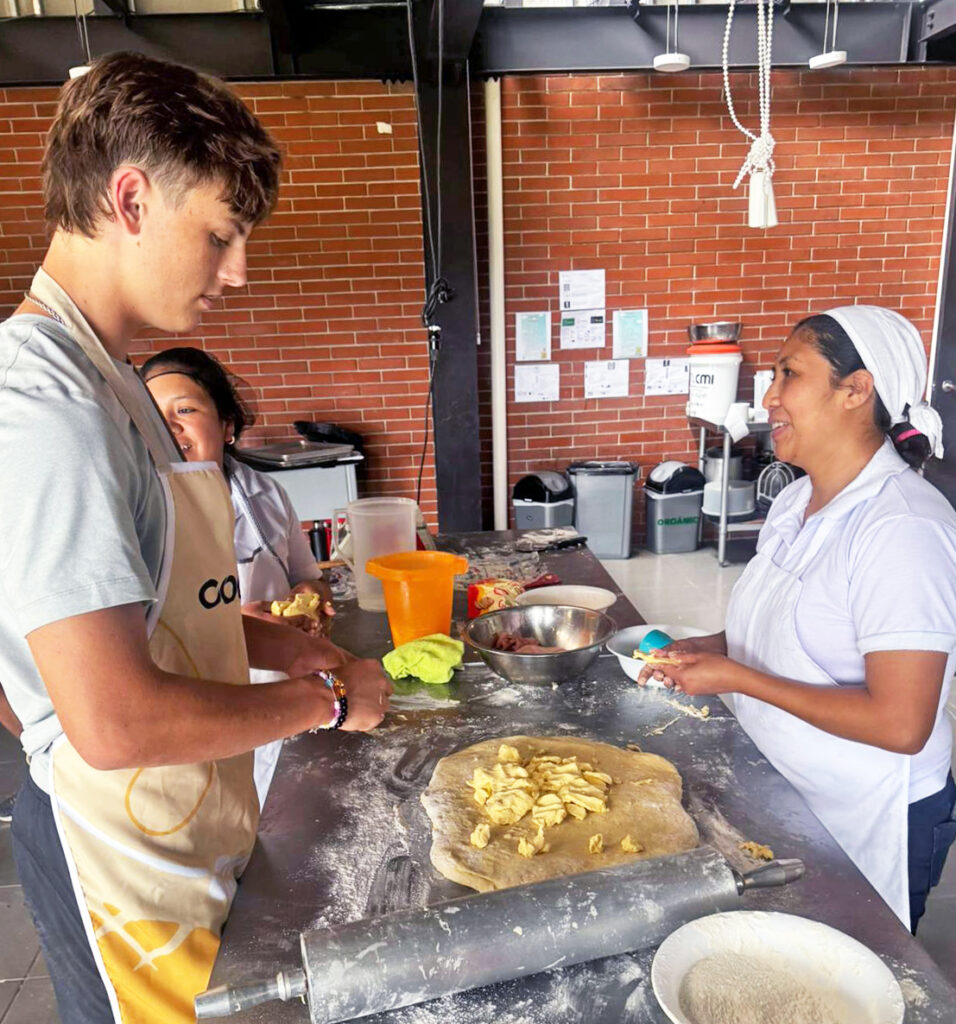
“I just put down my phone and started living in the environment, living how these kids live, and I realized that life can be fun,” Andrew said.
The Jesuit students spent nine days with at-risk children, teaching them English and about their faith.
Andrew called the experience “life-changing.”
“In Tampa, we really live in a bubble,” he said. “There are things I don’t take for granted anymore.”
Like AC, hot water, and a strong Wi-Fi signal.
And how a simple act of kindness can make a world of difference in someone’s day.
During the summers, he and his mom deliver Meals on Wheels to older adults and others unable to leave their homes without difficulty. It’s a bonding moment between the two, quality time spent together for a mom and her son.
“It's probably my favorite thing that we have done together,” May said.
“It’s the favorite thing that I do,” Andrew said.
They don’t rush through their route. Instead, they spend a few minutes at each stop, checking on the people receiving the meal, making small talk, and letting them know they matter.
When they first started delivering the meals, May told Andrew: “We’re probably the only people they're going to talk to that day, so even though this is sort of a blip on your radar, this is their day; this is their weekend; this is their week. So, make it count.”
Andrew took that lesson to heart.
A man for others.
“I feel like if I were in that situation where I needed help, I obviously want someone to do the same thing for me,” he said. “Spreading Jesuit’s values across what I do is a big part of why I do it. What I've learned here, it really propels me to do what I do in such a great way.”
Andrew wants to major in business in college. Where? He hasn’t decided. His choices are the University of Georgia, the University of Tennessee, Boston College, and Florida State University.
Where will that major lead him? He’s not sure.
“I can tell you it will be with people,” May said. “Whether it's finance or accounting, marketing or entrepreneurship, his love is working with people. I think it's just what comes naturally to him. He motivates people and makes people feel better about themselves. So, that’s my prediction.”
ST. PETERSBURG, Fla. – Life, it’s often said, is what happens when you’re making other plans.
Tasia Mathis planned on joining the U.S. Navy Reserve. Then her grandmother, with whom Tasia and her younger brother Jeremiah lived with, died suddenly from complications of kidney failure.
“The papers were signed, but I wasn’t able to go through with it,” Tasia said. “I had to make sure he was OK.”
Tasia, 20 at the time, became her brother’s guardian.
While Tracy Crawford’s passing in June 2023 ended Tasia’s goal of joining the Navy, it didn’t end her goal of a bright future for herself and Jeramiah.
For that, she credits Florida's private school scholarships managed by Step Up For Students.
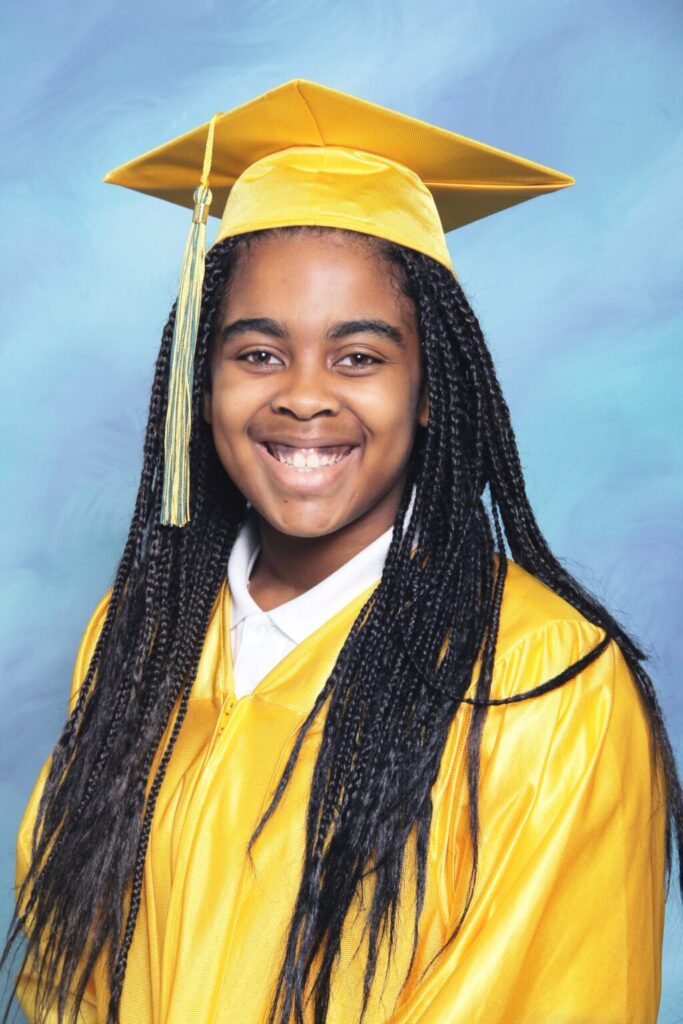
The scholarships enabled Tasia, now 22, and Jeremiah to attend Academy Prep Center of St. Petersburg for middle school and allowed Jeremiah, 15, to continue his private school education at Admiral Farragut Academy in St. Petersburg, where he is a sophomore this year.
“(The scholarship) gave us the opportunity to go to a school that we probably wouldn't be able to go to,” Tasia said. “It gave us the opportunity to expand our knowledge so good things can come into our lives.”
Tasia is studying to become a phlebotomist and works as a teacher at the Academy for Love and Learning in St. Petersburg.
Jeremiah would like to attend the United States Air Force Academy and work in cybersecurity.
The two, who share an apartment in St. Petersburg, have goals and are working toward them with a determination forged by Tracy Crawford, their grandmother, and reinforced by their years at Academy Prep.
“They don’t let you give up,” Tasia said when asked what she liked about attending Academy Prep. “Even if you had issues, they never let you give up.”
Could you blame them if they did?
Tasia was 8 and Jermiah was three weeks old when their mom died. Staci Crawford was only 34 when she suffered a heart attack. That left the children in the care of their grandmother, whose failing health forced Tasia to find work as a counselor at the Police Athletic League when she was 14.
“I had to help out with the bills,” she said. “By the time I was 16, I was cooking, washing everybody's clothes, helping my grandmother out the best I could.”
So, when asked what it’s like to have his sister as his guardian, Jeremiah said, “It’s kind of all I’ve known.”
Tracy wanted Tasia to attend a school that would challenge her academically and offer a safe environment. That’s why she used the private school scholarship to send her to Academy Prep.
At first, Tasia said, it wasn’t a good match. She was not a fan of the school’s long days (7 a.m. to 5 p.m.) or the fact that she had to wear a uniform.
“It took her a while to buy in, and then once she did, she was a high-achiever, and she set the tone for the other kids,” said Lacey Nash Miller, Academy Prep’s executive director of advancement.
For that, Tracy gets a big assist.
“She made sure my grades were straight, my attitude was straight,” Tasia said. “By seventh grade, it all came together.”
For high school, Tasia attended her assigned school because it offered a BETA (Business, Entrepreneurial, Technology Academy) program that interested her.
Jeremiah attended his assigned elementary school, but Tracy wasn’t a fan of his assigned middle school.
“It wasn’t up to her standards,” Tasia said. “She wanted to challenge him.”
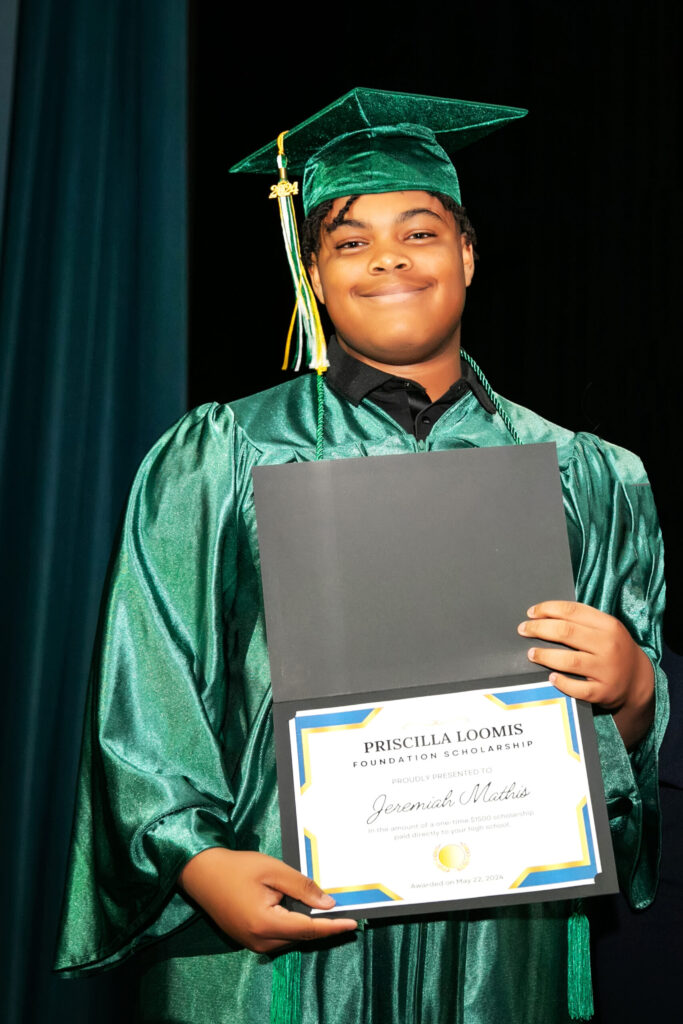
So, like his sister, Jeremiah headed crosstown to Academy Prep, where he said he benefited from the school’s academic environment and the self-discipline the teachers try to instill in the students.
Jeremiah said he became more extroverted during his years at Academy Prep.
“I was naturally a quiet person. I didn’t talk much,” he said. “Now, I talk to people. I try to start conversations.”
He also credited his teachers, specifically Zack Brockett, a science teacher, for guiding him toward being a young adult.
“He pushed us to grow up, so that we can go into high school as mature students,” Jeremiah said.
His teachers at Academy Prep describe Jeremiah as a quiet student who completed his assignments on time, helped out around campus, and amazed them with his drawing ability.
“Jeremiah is very self-driven,” Britanny Dillard, Academy Prep’s assistant head of school, said. “He’s one of those people that you kind of underestimate because he's so quiet that you don't even truly realize the talents that he actually has. He’s not the first to raise his hand, but he knows the answer.”
Jeremiah was a member of the school’s track team. He threw the shot put and discus. At graduation, Jeremiah received the Priscilla E. Frederick Foundation, worth $1,500 toward the balance of his freshman year tuition at Admiral Farragut. Frederick is a former Olympic high jumper who competed for Antigua and Barbuda in the 2016 Summer Games. Her foundation awards scholarships and grants to students raised in single-parent households. Jeremiah was the first Academy Prep student to earn that scholarship.
He is a soft-spoken, unassuming young man with a growing vinyl record collection and an interest in graphic novels and comic books. He will participate in track and field this year and will take an aviation class, which he feels will benefit him when he gets to the Air Force Academy.
Jeremiah spends his high school volunteer hours at Academy Prep. He helps grade papers, organize classrooms, and move supplies around campus.
Jeremiah and Tasia are spoken highly of at Academy Prep. Both Dillard and Nash Miller said they were “heartbroken” when they learned of Tracy’s death, and both admitted they were worried for the future of the siblings.
“They only had each other, and I think it speaks highly of Tasia that she was willing to accept that role,” Dillard said.
Said Nash Miller: “The news that her grandmother passed just gutted me. She had all these plans, and she just cancelled them to be her brother’s primary caregiver. What a superhero to put her brother’s needs ahead of her own.”
If anyone needs more proof that the future of education is in Florida, take a look at the winners of Thursday night’s Yass Prize Awards. Seven Florida-based providers, including two finalists who took home $250,000 each, were among the 23 honored for their innovative and scalable programs.

One of the finalists, Pepin Academies, is a charter school network with three campuses in the Tampa Bay area. It offers students with learning disabilities in grades three through 12 an inclusive environment where academics and essential therapies happen together in real time.
“I have always rejected the principle that we have to think outside the box for students with disabilities,” said Jeff Skowronek, executive director of the 25-year-old network. “A truly inclusive society is one that understands how to make the box bigger.”
Pepin stands out for its small class sizes, ESE-certified teachers, and onsite specialists, including mental health counselors, social workers, speech-language pathologists, occupational therapists, ESE specialists, and registered nurses, according to Yass Prize offices. This ensures their children receive individualized attention throughout the entire school day. In addition to its schools, Pepin operates a transition program for young adults ages 18-22.
According to Yass Prize officials, the award empowers Pepin Academies to serve students earlier, expand their transition program, and bring their therapeutic model to more families seeking a school that understands and supports exceptional learners at every stage.
The other finalist, WonderHere, is a network of child-centered microschools that focus on play-driven, project-based learning and personalized education to let children learn at their own pace.
“We are so excited and grateful to the Yass family and the Center for Education Reform for selecting WonderHere as a finalist,” said Tiffany Thenor, who opened the first campus in Lakeland after spending seven years in the public education system. She opened WonderHere to challenge the norms of schooling and prove that learning can be more joyful, flexible, and deeply human. A second location opened later in Anderson, South Carolina, and a third is planned for Davenport, Florida, near the original location.
Thenor said the prize money will help her find a permanent location for the Davenport campus and create more space for families to experience the “project-based, family-centered, wonder-filled learning environment” that WonderHere offers.
The following Florida providers were named semi-finalists and received $100,000 each: Archimedean Schools of Miami; Space Florida, Merritt Island; Ecclesial Schools, Oviedo; American High School, a national online program headquartered in Plantation that serves youth in the justice system, and GuidEd, a Tampa-based bilingual program that provides free, unbiased information about educational choices to help families determine the best fit for their children.
“GuidEd looks forward to using our Yass award money to enhance our call center capabilities to provide more sophisticated and personalized 1:1 support for families and to reach new families who may be entering the education freedom marketplace for the first time," said Kelly Garcia, who founded GuidEd with her brother-in-law, Garrett Garcia.
The Yass Prize, often called the “Pulitzer of Education Innovation,” began in 2021 to recognize innovative educators who delivered top-tier learning during the COVID-19 pandemic. Philanthropists and education choice champions Jeff and Janine Yass established the award and continue to fund the program.
The top winner takes home a $1 million prize. This year, it went to Chesterton Schools Network, a national network of classical high schools rooted in Catholic values. Though headquartered in Minnesota, Chesterton has Florida schools in Orlando, Pensacola, Sarasota, and Vero Beach, with a fifth set to open in 2027 in Melbourne. Primer Microschools, which began in Florida and has expanded to other states, won the grand prize in 2024. That year, it announced the establishment of Primer Fellowship, which provides paid training for edupreneurs seeking to open Primer Microschools in their communities.
TAMPA, Fla. – It was July 2024, and Jack Canterbury celebrated a birthday. His 14th. That led to a question he had been waiting a while to ask his mother.
“Can I get a job?”
Maria Canterbury had promised her son he could start working when he reached that age, and Jack had some employment opportunities in mind. Making subs at a sandwich shop. Busing tables at a restaurant. Playing in the NBA, but he knew he was too young for that.
Well …, said Maria.
Jack, who has Down syndrome, was about to enter the seventh grade at Morning Star School. He attended the K-8 Catholic school in Tampa for students with learning disabilities on a Family Empowerment Scholarship for Students with Unique Abilities (FES-UA), managed by Step Up For Students.

Jack stands next to SNacks by jACK 321, his legacy at Morning Star School in Tampa.
Morning Star does not have a cafeteria, so the only food available to students and staff during the day is whatever they bring for lunch.
After some thought, mom and son had what Maria described as a “bright idea.”
How about a vending machine at the school that sells healthy snacks and drinks? They have a close family friend who is in the vending machine business. Surely, he could help them out.
“Jack loved it,” Maria said.
But would anyone else? Would Morning Star Principal Eileen Odom go for the idea? Would parents, ever mindful of what their children eat, allow them to buy a snack out of a machine?
The answer to both questions was a resounding yes.
Odom knew of an empty space in a mid-campus hallway that was just the right size for a vending machine. Her maintenance staff agreed, saying they would do whatever it took to make it work.
“The spot couldn’t have been more perfect,” Maria said. “It was just waiting for a vending machine. It was meant to be.”

The family friend gave them a deal on a used vending machine, and SNacks by jACK 321 opened for business early in the 2024-25 school year.
“It’s been a nice treat for our students,” Odom said. “We started small, because we didn’t know how parents would react to snacks at school, but it just took off.”
Maria said the whole family came up with the name of Jack’s business – She and her husband Jason, Jack and his sister, Kate.
The capital letters spell “snack,” and 321 is for Trisomy 21, which is the medical term for Down syndrome. Also, March 21 (3/21) is World Down Syndrome Day.
SNacks by jACK 321 is stocked with Funyuns and Sun Chips. Skinny Pop and Barnum’s Animal Crackers. Gatorade, iced tea, sparkling water, and lemonade. And Diet Coke, but that’s only for the teachers.
The snacks and drinks cost between 50 cents and $1.25, and customers can pay with coins, credit cards, and Apple Pay. Jack donated 10% of the proceeds to Morning Star.
Jack is learning about running a business one box of animal crackers at a time. He has to track inventory and handle money. On weekends, he and his parents head to Sam’s Club for supplies. Jack and Maria restock the machine at least once a week.
“I think this is an amazing thing for Jack,” Odom said. “He has a real entrepreneurial spirit.”

Vanessa Florance, who taught Jack last year at Morning Star, said Jack’s side hustle turned into a learning experience for his schoolmates. She watched students learn to count change before making a selection and learn which number on the number pad corresponds with which snack. There was also a writing pad on the wall opposite the machine where students could leave suggestions for additional snacks, which they did.
“It was all these little lessons for everybody,” Florance said.
Jack said his first year as an entrepreneur was fun.
“And I like spending time with my mother,” he added.
Jack is one of the more personable students at the school. Also, one with deep faith. He carries a copy of the Ten Commandments in the small satchel he wears at all times, and while not Catholic, he participates in school-wide mass and is very inquisitive about the Bible verses he learned in religion class.
“He always made sure to greet me in the hallway, saying ‘Good morning,’ or ‘Good afternoon,’” said Morning Star teacher Jennifer Almedia. “And if I didn’t see him for some reason, he would make it a point to come and find me and make sure I saw him. He never misses an opportunity to greet his teachers.”
Maria and Jason have not treated Jack differently because he has Down syndrome. He’s expected to do his share of chores around the house and is allowed to dream as big as he wants. One of Jack’s dreams is to be an NBA superstar.
“We anticipate him going through high school, going to college of his choice, with specific programs,” Maria said.
They have already looked into ClemsonLIFE, a program at Clemson University for students with intellectual disabilities.
“He knows expectations are for him to further his education outside of high school,” Maria said. “Now, if you ask him, he wants to drive, join the military, get married, and have kids. Not sure he'll be able to do all of those things in that order, but that's what he envisions himself doing, and we don't tell him any differently.”
One thing Jack won’t do, though, is graduate from Morning Star, the school he attended in the sixth and seventh grades.
Because the school only goes through grade eight, Maria and Jason would have to look for a high school that can accommodate Jack’s needs. In the spring, they entered a lottery for a charter school near their Wesley Chapel home, and, to their surprise, Jack was accepted. The school is grades 3-12 and has a post-high school transition program.
“We absolutely love Morning Star,” Maria said. “We wish they went through high school, but unfortunately, they do not at this moment in time.”
Jack will remain on the FES-UA scholarship, using the education savings account to pay for his therapies.
While Jack will no longer attend Morning Star, his vending machine will remain. Jack and his mom will stop by every week to check the inventory, keep it stocked, and check the notepad for any suggestions.
“Jack’s not technically leaving,” Odom said.
“SNacks by jACK lives on.”
FORT LAUDERDALE, Fla. – Zori Brown was in the sixth grade when she made a plan for her future that was concise and to the point:
“I don’t know of any sixth-graders who have a life plan,” said Zori’s mom, Endea Mathis.
Endea said she was raised in a home where education was stressed above all else, and she passed that on to her only child.
“It was taught to her at a young age that you're a student first. We pride ourselves on that,” Endea said. “But she took it to a whole other level.”
Six years later, the plan is still in play.
Zori, 17, is set to graduate in May near the top of her class from St. Thomas Aquinas High School (STA) in Fort Lauderdale. She will continue her education at Dartmouth College, an Ivy League school in Hanover, New Hampshire, where she received a volleyball scholarship. She will major in finance.
The end goal hasn’t changed – become a CFO, possibly on Wall Street.
“She’ll be something someday, that’s for sure,” Lisa Zielinski, STA’s volleyball coach, said.
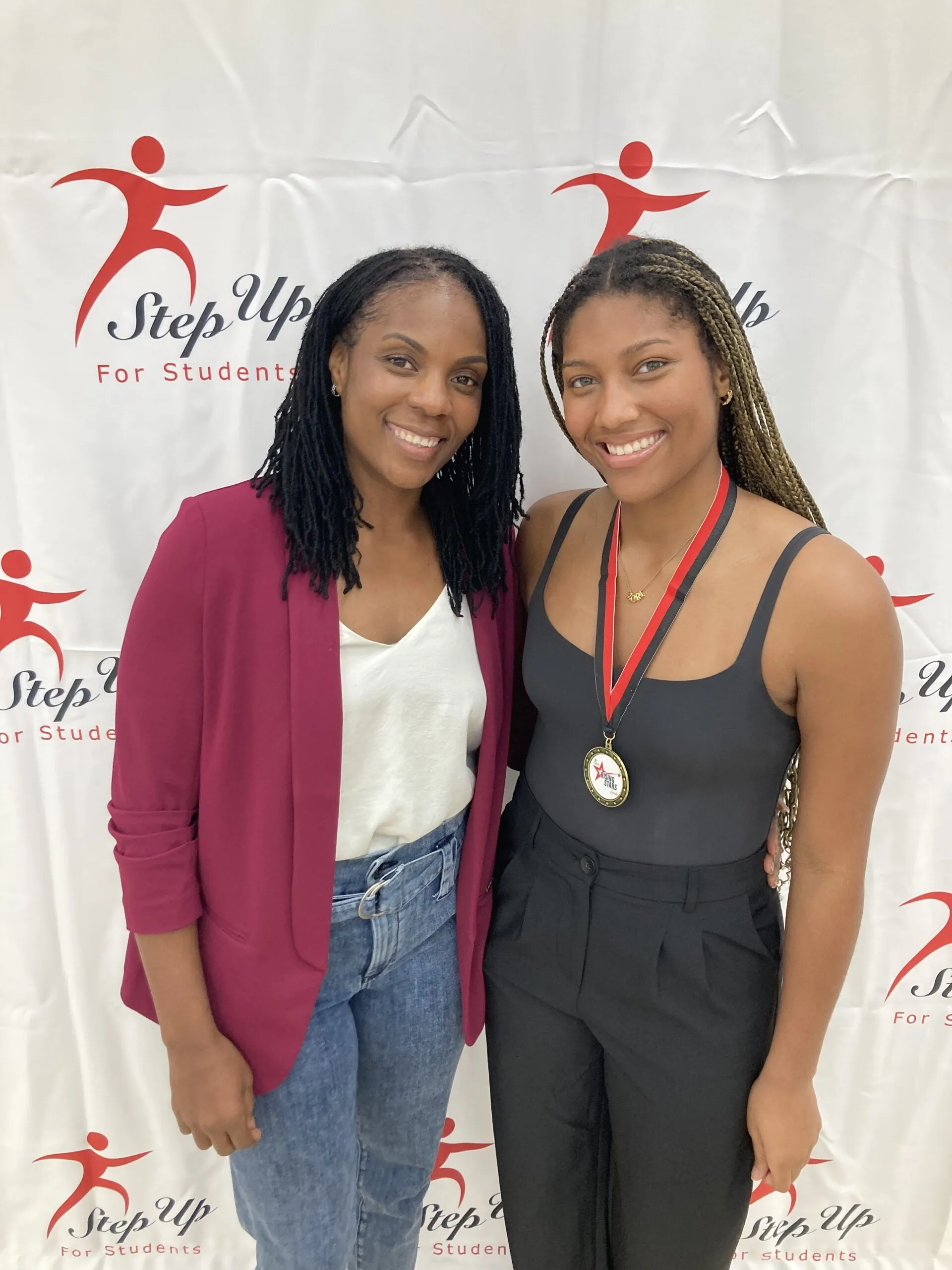
Endea and Zori, after Zori received the Super Senior Award at the Rising Stars Awards event in February.
Ambitious goals like these and the means to reach them are what attracted Zori to STA. She attends the academically and athletically competitive private Catholic high school with the help of a Family Empowerment Scholarship for Educational Options (FES-EO). The scholarship is managed by Step Up For Students.
“If it wasn’t for Step Up, she wouldn’t be able to attend St. Thomas, her dream school, because I couldn’t afford it,” Endea said. “The scholarship has been tremendous for us.”

As a senior, Zori was team MVP, all-Broward County first team, and a member of the American Volleyball Coaches Association's third team. (Photo provided by Zori Brown)
Zori attended a charter school near her home in Pembroke Pines, which is a half hour south of STA. She enjoyed her time there and felt she was pushed academically. But for high school, she wanted something more.
Athletically, Zori joined one of the top volleyball programs in Florida. She finished her high school career as a captain of a team that won back-to-back state titles. As a senior, Zori was team MVP and first-team all-Broward County. She was also named to the American Volleyball Coaches Association's third team.
In volleyball, college coaches recruit players from the AAU national circuit. Zori gained attention playing for the Wildfire Volleyball Academy’s national team, playing weekend tournaments in Atlanta, Kansas City, and Indianapolis, as well as Orlando and South Florida. Dartmouth coaches first approached her when she was in the ninth grade.
“Volleyball has impacted my life a lot,” Zori said. “It’s brought so much joy into my life, and I’m going to a great college through volleyball. I'm so grateful for it.”
Her academic life is equally important. She pushes herself just as hard in the classroom as she does on the volleyball court.
Athletically, Zori joined one of the top volleyball programs in Florida. She finished her high school career as a captain of a team that won back-to-back state titles. As a senior, Zori was team MVP and first-team all-Broward County. She was also named to the American Volleyball Coaches Association's third team.
In volleyball, college coaches recruit players from the AAU national circuit. Zori gained attention playing for the Wildfire Volleyball Academy’s national team, playing weekend tournaments in Atlanta, Kansas City, and Indianapolis, as well as Orlando and South Florida. Dartmouth coaches first approached her when she was in the ninth grade.
“Volleyball has impacted my life a lot,” Zori said. “It’s brought so much joy into my life, and I’m going to a great college through volleyball. I'm so grateful for it.”
Her academic life is equally important. She pushes herself just as hard in the classroom as she does on the volleyball court.
“I have to get a high mark, I just challenge myself,” she said. “There may be a class I don't really know much about, but in X amount of months, I'm going to walk out of here, and I'm going to know as much as I can.
I think what keeps me going is thinking about the future and how I want to be successful in life, and I feel by challenging myself academically, that's going to help me get there.”
Zori's play on the court, where she is an outside hitter, drew the attention of the coaches at the Ivy League universities Yale, Brown, and Princeton. She was also recruited by Georgetown University, Stony Brook University and Davidson College.
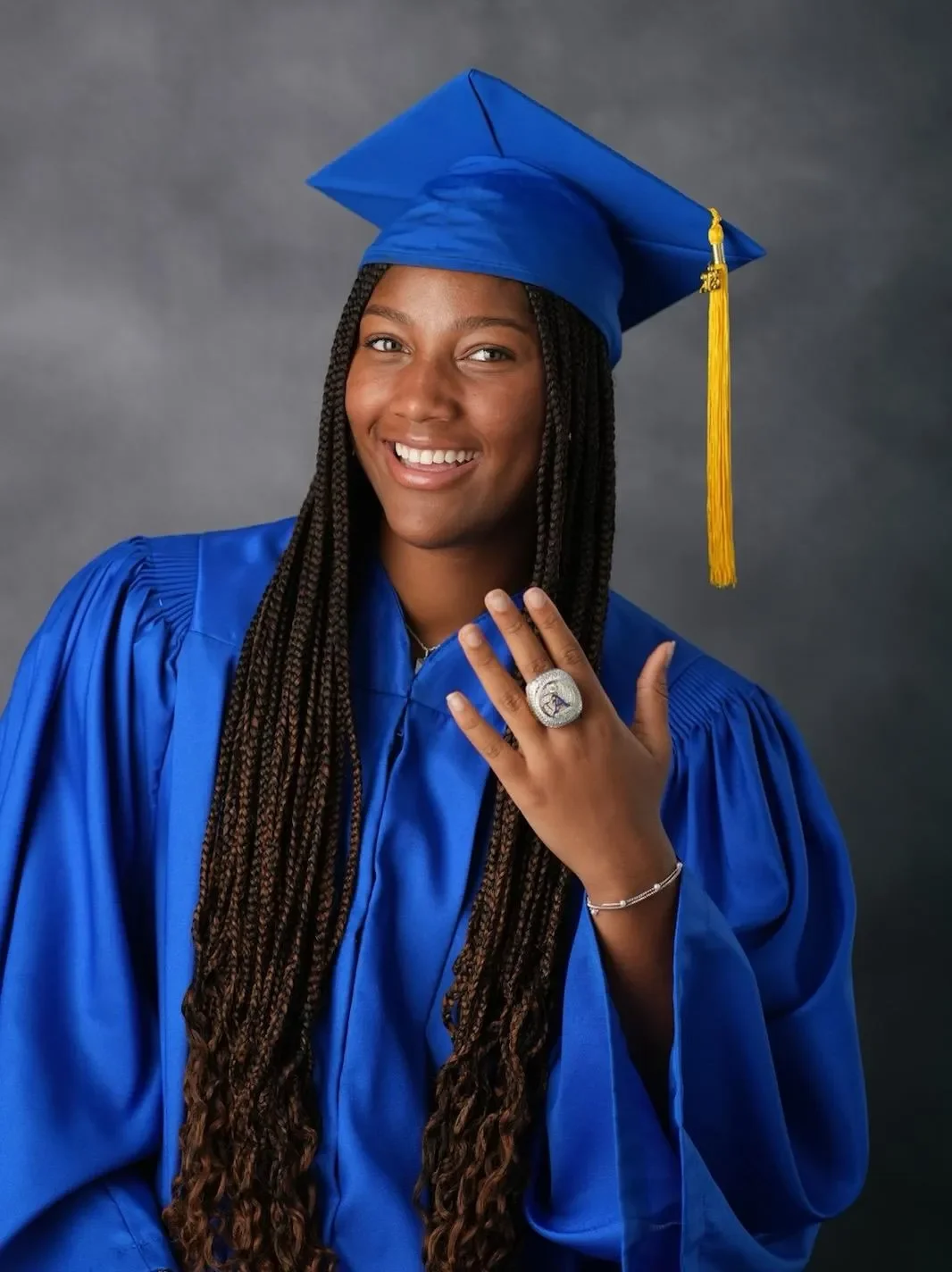
As a senior, Zori was team MVP, all-Broward County first team, and a member of the American Volleyball Coaches Association's third team. (Photo provided by Zori Brown)
As a senior, Zori was team MVP, all-Broward County first team, and a member of the American Volleyball Coaches Association's third team. (Photo provided by Zori Brown
In addition to her athletic prowess, Zori brings leadership and a high moral character to the team, which, Coach Zielinski said, enables her to be successful.
“Once in a while, you get a player who has it all,” Zielinski said. “I know the Dartmouth coaches are going to be happy to have her, because she’s going to contribute to that school and that program. She’ll make a difference. She’ll thrive in that academic setting.”
Endea, who is slowly changing her wardrobe from STA’s blue and gold to Dartmouth’s green, is not surprised her daughter is headed to an Ivy League school, though she was quick to add, “I brag all the time.”
“She’s always been confident, always been competitive,” Endea said. “She always wanted to do well, always wanted to be first in everything. That’s from her upbringing. I always pushed her to be the best she could be. She always wanted more out of life.”
Zori doesn’t feel she would be heading to an Ivy League college without the education she received at STA. The faculty helped her lift her academics to a higher level. That, combined with her competitive nature and her laser-like focus on her future, means she will trade sunny South Florida for some New England winters.
“I know this is really cliché, but you only live once,” Zori said. “I think about that all the time. You have to work hard in this life because you don’t get another one. You have to take advantage of the opportunities you have. The decisions you make now affect your future.”
LAUDERDALE LAKES, Fla.— Khyla Beaujin’s first fashion show as a designer was over, and she described the backstage chaos to her mother.
Where are the models?
Where are their shoes?
Who has the jewelry?
Khyla was frustrated at times and overwhelmed at others because the designers shared models and the models shared shoes, and confusion reigned. But she maintained her composure and pulled everything together, and the models strutted the catwalk with quiet poise, wearing Khyla’s spring collection.
It was a proud night for Khyla, then 12 years old, because she worked hard creating her collection during the months leading up to the event.
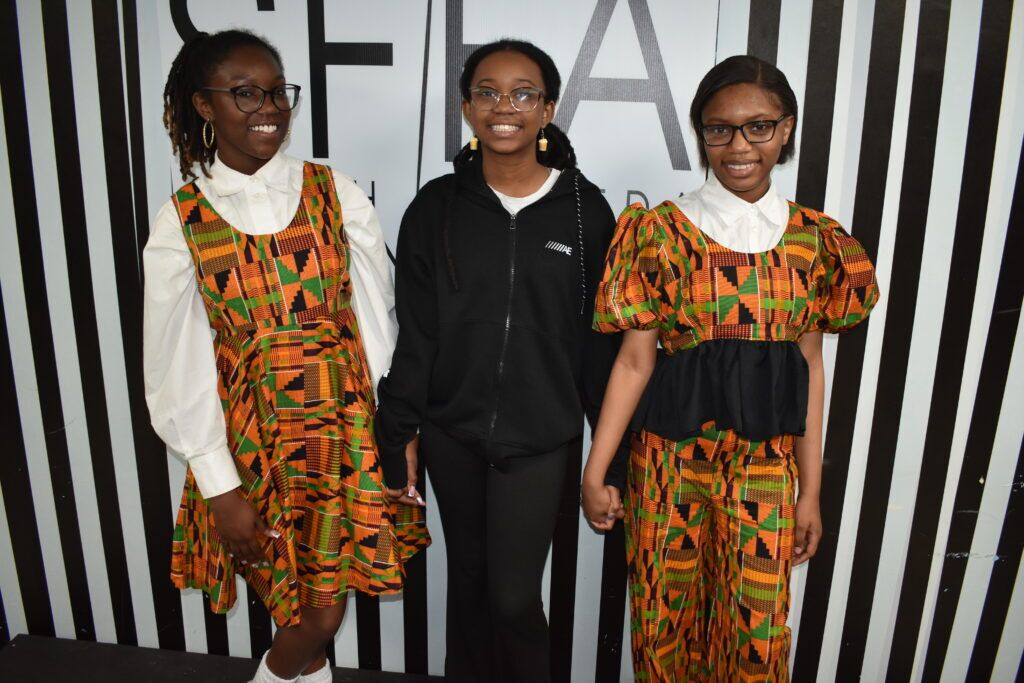
Khyla recounted all this to her mom post-show in a breathless monologue.
“The look on her face, the smile, I'm like, ‘Oh, I love this for you.’” Sheyla Bens Beaujin said.
Year One as a student at the South Florida Fashion Academy (SF/FA) ended that night for Khyla, and Sheyla knew her daughter was where she needed to be, attending a school that would nurture her love for fashion design.
Khyla is now a seventh grader at SF/FA, a private Pre-K-12 school in Lauderdale Lakes that incorporates fashion design, cosmetology, nail technology, barbering, skin care, business, and entrepreneurship with core classes. Khyla attends the school with the help of a Florida Tax Credit Scholarship managed by Step Up For Students and funded by corporate donations to the nonprofit.
“This is her passion,” Sheyla said, “so finding that school was really a life-saving experience. She’s found so much joy and purpose there.”
While Khyla was involved in a number of extracurricular activities and sports at her previous school, Calvary Christian Academy, her interest always returned to fashion design.
It’s something Khyla picked up from her mom at an early age, when Sheyla started her own children’s clothing line – KHYKOUTURE – and used Khyla as a model. Khyla enjoys walking the runway but not as much as she enjoys finding a top and a blanket at a thrift store and using her imagination, a sewing machine, and all the tools in her sewing kit to turn them into a dress or gown.
“I guess seeing my mom make all those outfits for me when I was little inspired me to do the same,” Khyla said.
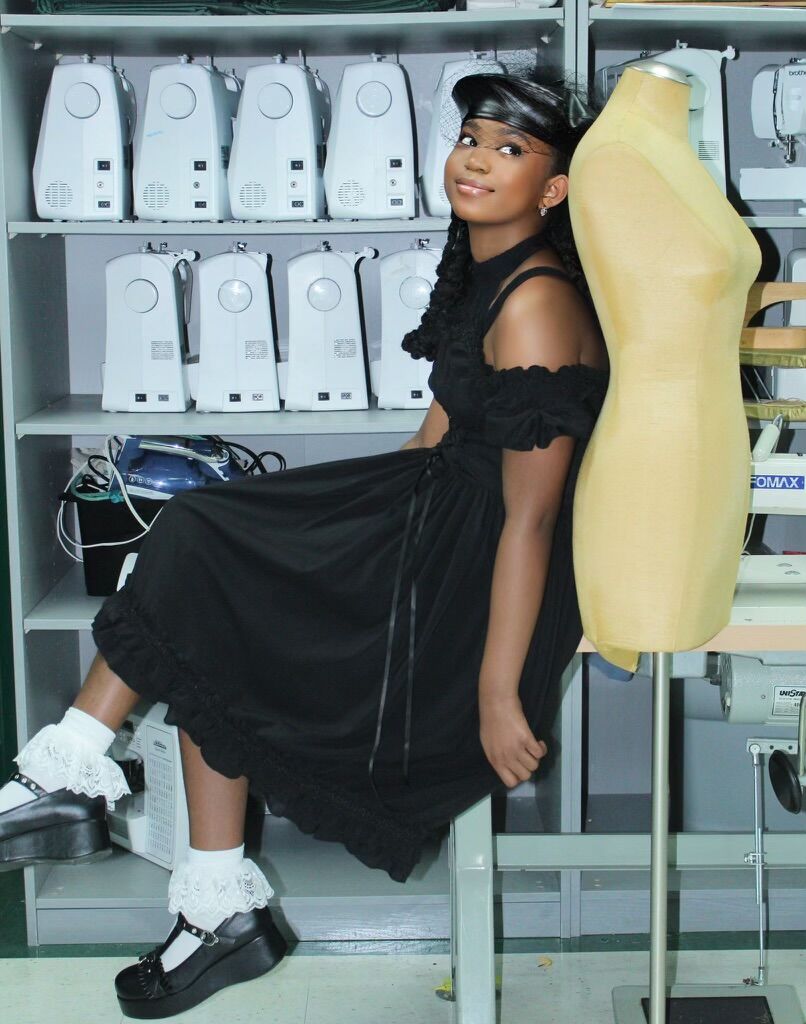
Khyla strikes a pose inside the sewing lab, her favorite room at the South Florida Fashion Academy. (Photo provided by Sheyla Bens Beaujin)
Sheyla learned of SF/FA on social media when Khyla was in the fifth grade. She and Khyla toured the school, which is a 30-minute drive from their Hollywood home. All Khyla had to see was Room 117, which is filled with mannequins and sewing machines, and she was sold.
“Best room in the school,” Khyla said.
She enrolled in the sixth grade for the 2023-24 school year, eager to see what the world of fashion was all about.
Now Khyla talks about attending a fashion school in New York City and having her work featured during Fashion Week in Paris, London, and New York.
“That's why I'm glad I'm going to this school so I can work on my skills,” she said. “I think I'm really going to do this. I'm really going to pursue this dream and stick to it till the end.”
***
In 2018, Taj McGill started a fashion program for students in South Florida that met in a one-room building on Saturdays. By 2021, she realized there was enough interest to start a dedicated school. SF/FA now has 75 students, many of them with dreams as big as Khyla’s.
McGill, who grew up in South Florida, has a degree in fashion design and merchandising. She has worked in various careers within the fashion industry for more than 20 years. She’s attending Fashion Week in those far-off cities. Her students are introduced to a cross-section of people from the fashion industry.
“South Florida isn't really known as a fashion capital although it is beginning to develop. I am intentional about exposing our students to the various careers within the industry and introducing creatives to professionals that inspire them to dream,” McGill said. “They can actually have a job in these specific career fields that we cater to here at SF/FA. They can flourish in those industries.
“If there were a school like this when I was a child, oh, my God, I would have been in heaven. If I was able to complete my core academic classes and then have classes in fashion or beauty or business, it would have been so great for me. So, I essentially created what I wanted as a child.”
In addition to the sewing lab, there is a room with barber chairs for hairstyling and another for nail technology and cosmetology. Students can dually enroll in the fashion program at Saint Thomas University in Miami Gardens, Miami Fashion Institute, or the University of South Florida.
“You don’t get this kind of experience anywhere else,” Khyla said.
Every student is involved in the end-of-the-year fashion show, from the designers to the models, to the cosmetologist to the hair stylist. The photography, video, social media, red carpet, and marketing are all done by students.
***
In nearly two years at SF/FA, Khyla has emerged as one of the school’s top students, with a 4.0 GPA. Her designs allow her to stand out, as well.
“She's determined,” McGill said. “She works really, really hard, and it's important to her to be a leader to her peers.”

Khyla and SF/FA founder Taj McGill. (Photo provided by Sheyla Bens Beaujin)
Last year, Khyla designed three outfits for the fashion show. This year, it could be as many as seven. It will feature a rainbow of princess gowns inspired by the movie “Inside Out 2,” where the emotions of the main character, a teenage girl, are represented by characters of different colors. Anger is red. Envy is green.
“It was a little confusing at first because I knew I wanted to do the theme, but I didn't know what I wanted to make it,” she said. “So, I was like, ‘OK, let me just do princess dresses,’ and I can just do them with the ‘Inside Out’ colors and incorporate them into the designs.”
Sheyla has never seen the movie, so she’s not sure what Khyla is trying to accomplish. But that’s the case with all of Khyla’s concepts.
“When she tells me about them and I don’t get what she’s trying to do, she tells me, ‘Wait till you see where it’s going,’ and then I see the final product and I’m amazed,” she said.
Sheyla took a sewing class in Miami before starting her children’s line. She was the only adult in the class. The rest were students who were homeschooled.
“That stuck with me because I wanted my children to have the same opportunities,” she said.
Now a detention sergeant with the Broward Sheriff’s Office, Sheyla can give Khyla the educational opportunity she wished she had, thanks to Step Up For Students.
“Without Step Up, Khyla would have never gotten the opportunity to be in this school,” Sheyla said. “So, it's a wonderful thing that kids like Khyla can have an opportunity to let their talent flourish while focusing also on her academics.”
At SF/FA, McGill serves as a role model, as do the guest lecturers. The students feed off each other’s creativity and dreams. Khyla talks about attending the Fashion Institute of Technology in New York and having her designs featured at all the big shows in Paris and London.
“That makes me proud,” Sheyla said, “and it allows me to encourage her because I know those dreams are attainable.”

