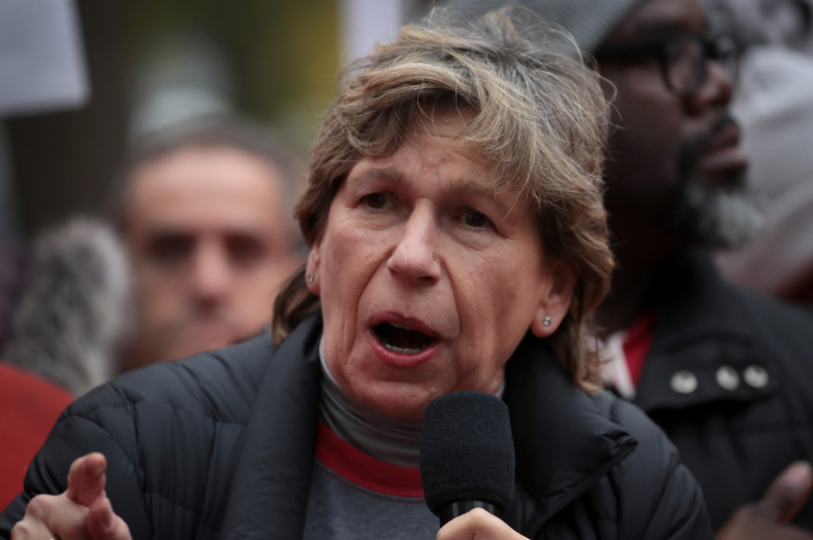
 The rainbow coalition that is the education choice movement would like to welcome its newest member: Randi Weingarten!
Yes, that Randi Weingarten. President of the American Federation for Teachers.
In a fresh interview with The New York Times, Weingarten sounded like Betsy DeVos. She noted she has friends and family who have, according to the Times’s paraphrasing, “pulled their own children out of public schools because remote learning was not working for them.”
“They have a right,” she said in a direct quote, “to look out for their individual children.”
Yes, they do!
And don’t they all?
Choice enthusiasts of all stripes have been saying that for a half century. They’ve also been working to ensure all parents, particularly those whose children are disadvantaged by poverty or disability, have the power to do what Ms. Weingarten’s friends and family just did. That is, to choose the learning options they know are best for their children, instead of being stuck with what the state assigns. Like Ms. Weingarten’s friends and family, they need those options now more than ever.
Teachers unions, of course, have been the big roadblock on the drive to equity. But in her moment of candor, Ms. Weingarten got sucked into the zeitgeist. Poll after poll shows the pandemic has boosted school choice support to new heights, in part because of teachers union resistance to re-opening schools. That growing support includes white, left-leaning, suburban parents who, in terms of choice opposition, are one of the few dominos left to fall.
I appreciate Ms. Weingarten’s timing. Lawmakers in at least 14 states are considering bills to start or expand vouchers, tax credit scholarships and/or education savings accounts. Florida is among them.
SB 48 would simplify the Sunshine State’s patchwork of choice scholarships, merging five into two, and converting four into education savings accounts. (The fifth, the Gardiner Scholarship for students with special needs, is already an ESA. And full disclosure: four of those programs are administered by Step Up For Students, the nonprofit that hosts this blog.) The bottom line is even more parents would have the flexibility they need “to look out for their individual children.”
I never thought I’d see the day when Randi Weingarten would be on the same page, even rhetorically, with choice folks. But truth be told, the choice movement has always had a big tent. I suspect that politically, she’d feel at home with many of the hundreds of thousands of parents, most of them black and Hispanic, whose children use the Florida Tax Credit Scholarship. Or the 1,400+ among them who are school district employees, including teachers like this one.
For what it’s worth, Ms. Weingarten wouldn’t be the first labor leader to embrace choice, either. Cesar Chavez, the legendary founder of the American Farm Workers, was a strong supporter of a Chicano freedom school that bloomed in the California desert in the 1970s – and, more broadly, for alternatives to district schools. Dozens of local union leaders in New York backed a school choice scholarship proposal in that state just a few years ago.
Closer to home, our president here at Step Up, Doug Tuthill, is a liberal Democrat and former president of two local teachers unions. Ms. Weingarten, if you’d ever like to chat about choice and equity and the future of teachers unions, I’m sure Doug would be game. ????
In the meantime, thanks for what you told The New York Times. It’s spot on.
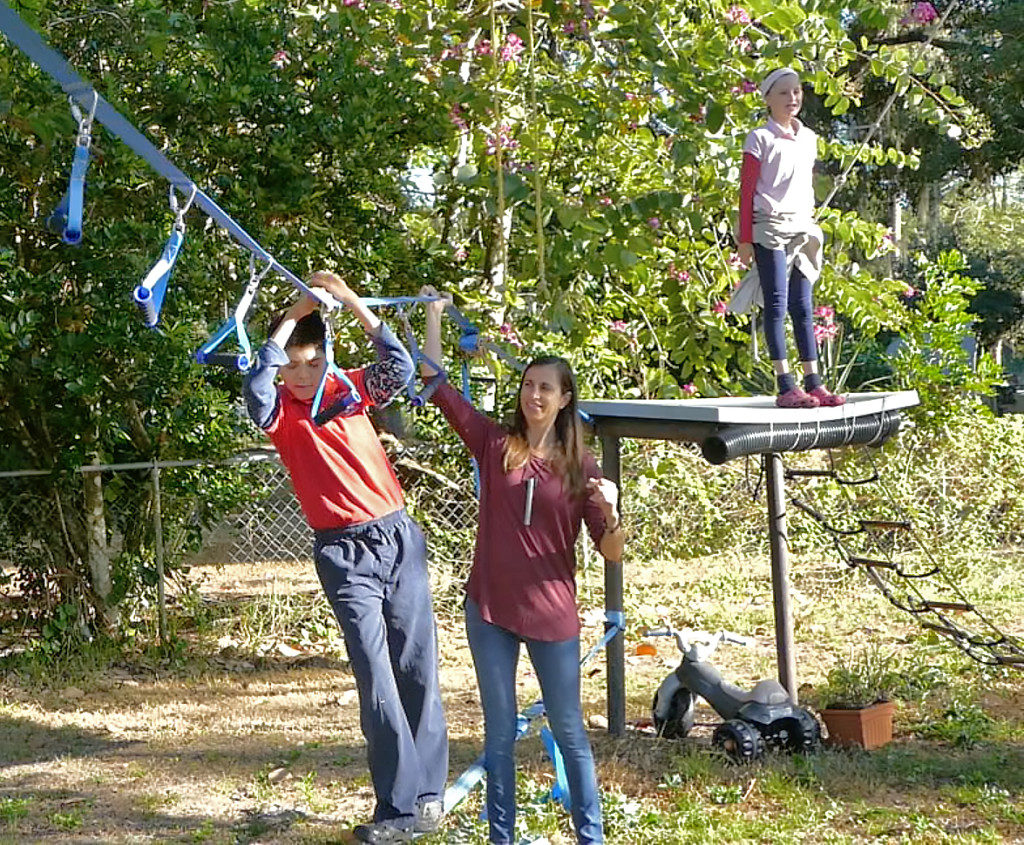
Eli Conner, shown here with his mother, Stephanie Conner, and his sister, Madeline, benefits from the flexibility offered by the Gardner Scholarship, Florida's education savings account for students with special needs.
Editor’s note: This piece from Stephanie Conner, who lives in LaBelle, Florida, first published in the Naples Daily News.
My 14-year-old son Eli has been diagnosed with cerebral palsy and other development delays, and he communicates mostly through sign language. A few years ago, he was anxious and struggling in public school. But then he got a state scholarship that changed everything.
Florida’s Gardiner Scholarship for students with special needs is an education savings account. It gives parents the power to create a learning program that is just right for their child, covering tuition, tutors, therapists, technology, curriculum, etc., in whatever combination works best. My husband and I used it to educate Eli through both home education and private school.
Eli was once far behind his academic potential, but now he is gaining ground, especially in reading. The sensory integration therapy he gets through scholarship funding has made it possible for him to learn in more settings, from field trips to classrooms, including the private school he attends part time.
For Eli, the scholarship has been life changing. And it would be life changing for more children if more families had what we have.
In Florida, that might happen.
In coming months, lawmakers will consider a proposal to convert the state’s school choice scholarships into education savings accounts. That will give tens of thousands of other families the kind of control over their children’s educations that we have. Especially now, in the midst of the pandemic, that ability to create as many options as possible makes sense.
Families like mine are sometimes called education pioneers, but we didn’t set out to be. I’m a former teacher, my husband is a teacher, and he comes from a family of teachers, including his father, a former superintendent in Hendry County. All four of our children use choice scholarships.
Our 10-year-old, Madeline, has been diagnosed with bilateral congenital deafness and also uses a Gardiner Scholarship. Our 6-year-olds, Meizi and Gideon, use the Family Empowerment Scholarship, which is available to low- and middle-income families.
We are grateful for both scholarships, but the flexibility of education savings accounts makes them especially nice. Before the Gardiner Scholarship, we considered moving from Hendry County so we could be closer to the therapists Eli needed. We agonized over that possibility, given all the family we have here. But the Gardiner Scholarship spared us.
Instead of relocating, I take Eli to Orlando several times a year for intensive therapy. The rest of the time, I work with Eli and Madeline at home, using the specialized tools we purchased with scholarship funds.
The scholarship pays for private school tuition too. Being in school is excellent for Eli, but full time would be too much. So, Eli goes part time to a loving school near our home, which is happy to offer part-time services.
Meizi and Gideon attend the school full time, while Madeline goes for PE. Last year, Eli attended for PE, lunch and a science/social studies class. This year, he added a keyboarding class, and the school adjusted tuition accordingly. When education savings accounts become more common, more families and schools will be able to benefit from similar opportunities.
Knowing every child is different, I think it makes sense for every child to have a learning program that accounts for those differences. The scholarships available to my family allow us to create that unique learning program, but they shouldn’t be limited to a few families.
Florida would be an even more beautiful place if more families could do the same.
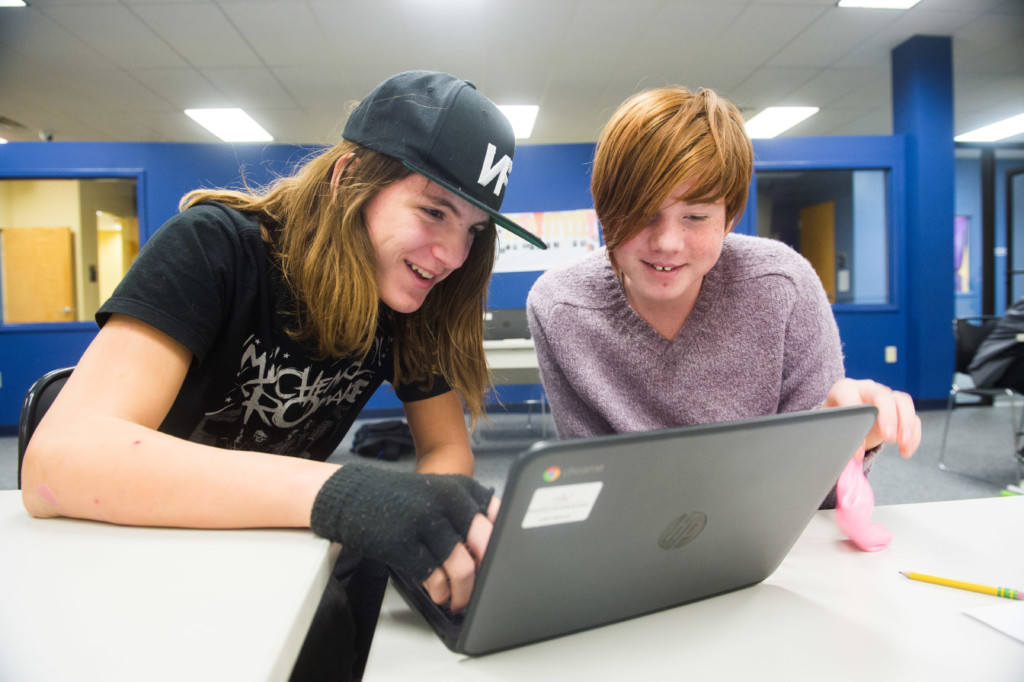
Kasey Drayer, left, and Quinn Krapes work on a project in physical science class at the Albert Einstein Academy in Lakewood, Ohio.
Editor’s note: The Orlando Sentinel published a commentary today that accused the nonprofit scholarship organization, Step Up For Students, of “rainbow washing” by telling the stories of LGBTQ students who have used educational choice programs to find private schools that work better for them. Over the past three years, the newspaper has published nearly 130 news or opinion pieces critical of Florida’s K-12 scholarship programs, including 21 by today’s columnist. Step Up’s director of policy and public affairs, Ron Matus, has researched and written about LGBTQ students who choose private and charter schools. This is his response.
Over the past two and a half years, I’ve interviewed more than a dozen LGBTQ students who benefitted from education choice. In most of those cases, the students told me they are probably alive because of education choice. Some were charter school students. Some were scholarship students.
One had attended a little private school in the boonies of North Florida. He never got a choice scholarship; his parents made too much money. But had it not been for choice scholarships, he said, that little school never would have existed – and instead of being in college, he’d be strung out and homeless. With most of these students, I talked with their parents, too.
In every case, I was up front with the students and parents about private schools in Florida. I told them there were some private schools that were not welcoming of LGBTQ students, and either would not enroll them or would expel them if they knew about their sexual orientation or gender identity.
Not surprisingly, many of them already knew this. Not surprisingly, they were not fans of those policies. I’m not either. But I find this issue far more complicated than how it’s portrayed by opponents of education choice.
For what it’s worth, I take this issue personally. I have friends, family, colleagues, co-workers and neighbors who are members of the LGBTQ community. I wouldn’t stay at Step Up if we were doing anything to hurt them. One of my close friends in college was gay, and he tried to kill himself while I lived with him. One of my girlfriends in college was bisexual, and during the years we hung out, she tried to kill herself. One of my best friends at the student newspaper was gay. He frequently invited me over for dinner, and it was during one of those dinners that I met a drag queen for the first time.
I’m sorry to say I can’t remember her name, but I do remember she liked steak and malt liquor more than I did. My friend was frequently depressed, and while we were both still working for the newspaper, he died in his home under mysterious circumstances. To this day, I fear his death was connected to the inner turmoil he endured, for no good reason, because he was gay. I could go on with the stories, but I’m hoping this is enough to make my point.
One of the things that shocked me as I learned from LGBTQ students in choice schools was the extent to which anti-LGBTQ sentiment is still so prevalent in our schools. Knowing how much progress we’ve made as a society towards LGBTQ acceptance and equality, I had assumed LGBTQ students were in a much better place than they were a generation ago. I assumed wrong.
For far too many LGBTQ kids, school is still an absolute nightmare. The survey data from GLSEN is depressing and infuriating. So are all the stats about LGBTQ youth suicides, and attempted suicides, and substance abuse, and self-harm. I have to wonder: How is this not a bigger story? How can this much pain in plain sight be so overlooked? How many suicides does it take before somebody finally does a “deep dive”?
The survey data is also revealing. All school sectors are falling tragically short in providing safe learning environments for LGBTQ students, but the truth is, district schools are among the worst offenders. I don’t bring this up to point fingers at district schools; we try hard at Step Up not to do that. We know district schools are doing often heroic work for tens of millions of students, including many LGBTQ students. But the survey data can’t be shrugged off.
That backdrop of widespread abuse in district schools is crucial context for why learning options are so important for LGBTQ students, as they are for so many other vulnerable students. The LGBTQ students I met in charter schools and private schools are the faces behind those data points. They told me that unrelenting harassment in district schools is why they left, and why they were so grateful to have options.
I don’t dismiss the issues with private schools that are not LGBTQ welcoming. They’re there. The best evidence I’ve seen shows those schools are a small percentage of private schools. But still, they’re there. I wrestle with it constantly. I try my best to understand it from every angle. I wish there was an easy answer. But … there isn’t one. That’s another piece of vital context missing from this “debate.” Those schools have a right under the First Amendment to participate in government programs.
You can’t just pass a law to bar them from accepting students on scholarship and think it’s over. The law would be challenged and overturned. These constitutional clashes between liberty and equality must grind through the courts, and when it comes to emerging LGBTQ rights, that’s exactly what’s happening. Look at Bostock. Watch what happens with Fulton v. The City of Philadelphia.
I know folks on “both sides” (as if there are only two sides) don’t want to hear that. Nobody wants to be told to be patient when it comes to liberty or equality. But this is complicated. Why do you think there was an exemption specifically for religious schools in the bill to create the Florida Competitive Workplace Act — the bill that was meant to protect LGBTQ citizens in employment and housing, and that drew a ton of Democratic co-sponsors? Drawing that line between liberty and equality takes time.
In the meantime, LGBTQ students desperately need options. Options that for many of them would be life changing, if not lifesaving, because the learning environments they’re in now are that toxic. How can that part of “the debate” be so utterly ignored?
That student from North Florida now lives in a desert town out West. He told me even when it’s scorching hot, he wears long sleeves – because he doesn’t want anybody to see the scars on his arms from where he cut himself. Just like Marquavis, and Elijah, and Kiwie, and the other LGBTQ students I’ve written about, he said the bullying in his district school was horrific.
Initially, he shared the details with me, and told me I could write about it. But the next day he called to say that just talking about what happened to him in high school returned him to a dark place. It would hurt too much to share the story publicly, he said. I told him I understood. He told me to keep telling these stories.
So I’ll tell you one last one: In 2018, I visited a charter school for LGBTQ students near Cleveland. After I toured the school and sat in a couple classrooms, I got to chat in a conference room for a couple of hours with five or six students. They were … the best. They were patient with me, and so kind, and wise, and unbelievably brave. Towards the end of the conversation, we talked about the private schools in Florida that weren’t LGBTQ welcoming.
At the time, by coincidence, there had been some scrutiny about Florida’s Hope scholarship. Again, they weren’t surprised. Again, they weren’t fans. But their views were far more thoughtful and nuanced than some of the folks who think they’re speaking for them.
I mentioned I knew of two cases where those schools took in and saved non-LGBTQ scholarship students who were bullied to the brink of suicide in public schools. “Are you okay with those schools saving other kids,” I asked, “even if they wouldn’t save you?”
Maybe it’s because they knew what it was like to be on the brink with no options and no hope. But every one of them said yes.
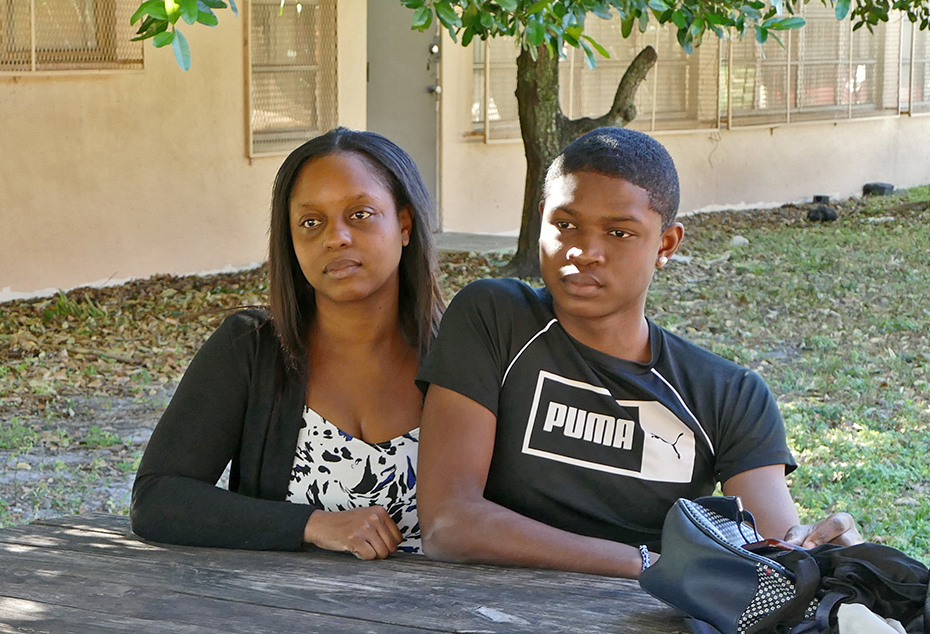
Lamisha Stephens and her son, Marquavis Wilson. PHOTO: Lance Rothstein
Among those who traveled to the state Capitol Wednesday to speak in favor of legislation that will simplify Florida’s education choice programs by merging five scholarships into two and add a flexible spending option was a 16-year-old student from South Florida who knows first-hand the value of education choice.
Marquavis Wilson found a safe haven at West Park Preparatory School after being bullied mercilessly at his former school because of his sexual identity. Marquavis says the Florida Tax Credit Scholarship that made his attendance possible changed his life.
His mother, Lamisha Stephens, says the scholarship saved his life. Without it, Stephens affirms, her son probably would be a dropout. Or maybe he’d be in jail. Perhaps, Stephens says, he would have taken his life.
Please take a moment to watch the video below. And to learn more about SB48, click here.

 “Jeb!” Doc screams, leaping from the time machine. “You’ve got to come back with me!”
“Where?!”
“Back to the Future!” Doc replies as he scrambles through Jeb’s trash. “It’s the kids Jeb, something has got to be done about the kids!”
After completing a hovercar retrofit to his DeLorean in 2015, Doc travels back to 2006 for what he thought would be a relaxing Florida vacation. Instead, he discovers a surprise Florida Supreme Court decision that overturned his friend’s 1999 voucher program, the Opportunity Scholarship.
Having explained the future to Jeb, they would travel to 2001 to create a new scholarship program to evade the flawed but inevitable 2006 ruling.
Of course, this is nonsense, but many school choice opponents make a very similar argument.
But the ruling didn’t kill vouchers,” Frank Cerabino wrote of the 2006 Supreme Court cases in a Palm Beach Post column. “It just made voucher entrepreneurs more crafty and meant that the public dollars being siphoned to private — and often religious — schools would have to be managed with the same bit of clever opacity that drug dealers employ when laundering their riches.”
Somehow, a 2006 Florida Supreme Court ruling caused “voucher entrepreneurs” to get “more crafty” when they created the Florida Tax Credit Scholarship back in 2001.
Florida’s collective memory on Bush v. Holmes apparently has been lost. Here’s what actually happened.
Bush v. Holmes, a widely panned ruling, was decided on Jan. 5, 2006. The ruling struck down the Opportunity Scholarship, a private school voucher that served 734 students, 86% of whom were Black or Hispanic.
The Florida Tax Credit Scholarship, which was known as the Florida Corporate Income Tax Scholarship at the time, was pre-filed by the Florida House of Representatives on January 25, 2001. Gov. Jeb Bush signed it into law on June 13, 2001.
Not only was the program created years before the Florida Supreme Court ruling, but the program was debated and passed at a time when it was 100% constitutional!
In fact, school choice opponents actually were losing in court.
On Oct. 3, 2000 (114 days before the tax-credit scholarship was pre-filed with the House), the Florida Court of Appeal overturned Judge Smith’s lower court ruling. In a unanimous decision, the justices declared, “Article IX does not unalterably hitch the requirement to make adequate provision for education to a single, specified engine, that being the public school system.”
This was a rejection of the future Supreme Court’s 2006 ruling that the state’s paramount duty to public education meant the Legislature could provide no alternatives.
Best of all, the Florida Supreme Court actually agreed.
On April 24, 2001, by a 4-1 decision, it declined to hear the case and allowed the Court of Appeal ruling to stand. That was 10 days before the Florida Legislature passed the scholarship bill and 50 days before Jeb Bush signed it into law.
Ironically, Justices Pariente, Wells, Anstead and Lewis were the majority in 2001. Five years later, they’d make a surprise reversal by declaring the program unconstitutional on the very same constitutional issues they rejected years before.
Yes, you read that right.
 The very constitutional issues that overturned the Opportunity Scholarship in 2006 were not even in play when the new scholarship was created because the courts had tossed those arguments out.
Maybe Jeb knew this would happen because the Doc’s mindreading machine actually worked.
But that’s a conspiracy for another day.
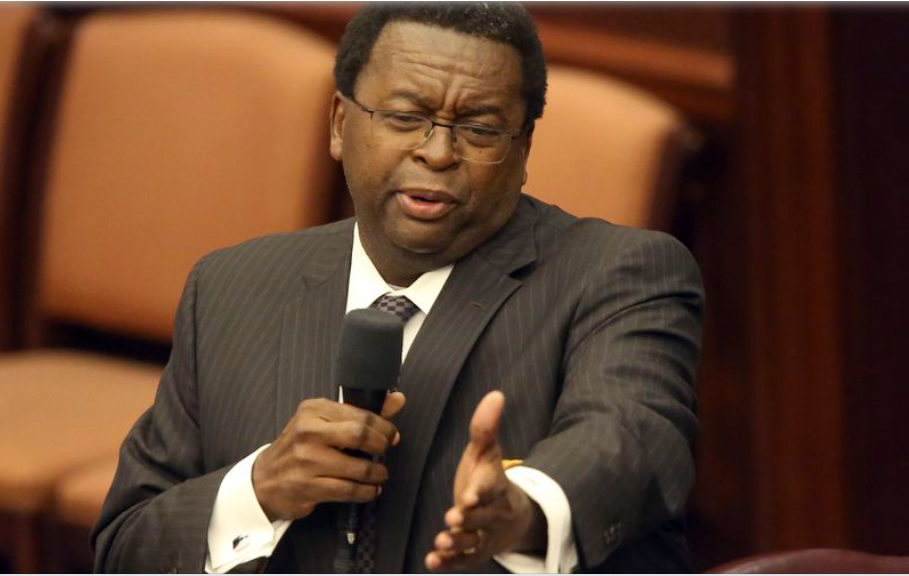 Editor’s note: Following Osceola County School Board member Jon Arguello’s heartfelt testimony Wednesday morning in favor of SB48, Sen. Perry E. Thurston Jr., D-Fort Lauderdale, questioned him on points he made. Here is the exchange between Thurston and Arguello.
Thurston: As the school board member for Osceola County, are you saying that your county and your school board can’t provide the needed school materials and educational criteria for the students in your district?
Arguello: Senator, thank you for your question. What I’m saying is that every parent should be allowed to make a decision for their child as to whether or not we are servicing them appropriately. As you heard earlier from other parents, there are some occasions where a traditional setting does not offer the most benefits for the student. I am a supporter of public schools. My children graduated from public schools. I also have experience in private schools. The fact is the parent is the No. 1 educator in every instance. It’s their No. 1 responsibility to be the educator for their child and they should also be the No 1 decider of the best education environment for their child.
Thurston: Mr. school board member, I’ll get to the parents in due time. My question to you is, as the school board member for Osceola County, can you, is your school board not in a position to provide the protection and the education for the students in Osceola County to learn and strive?
Arguello: Senator, the best way I can answer that question is to say, for the school to say it can satisfy every need of every student is the same as having you say that you can satisfy the needs of every voter in your district. Public schools are not set up to address every student’s particular need. They are set up to educate the community on a whole, the best way they can. Sometimes the best way they can is by allowing that parent a different option which will in some of these cases challenge someone’s child more, or in some cases will provide them with services they cannot get in a regular traditional class setting.
The answer, Senator, no, we can do a great job in Osceola County, we are doing a great job in Osceola County, but we cannot provide the best situation for every single student across the board. No one can. But the parent can do that for their own child by having the opportunity to take that child and take their money and take their investment that they put in and then go to a school of their choice.
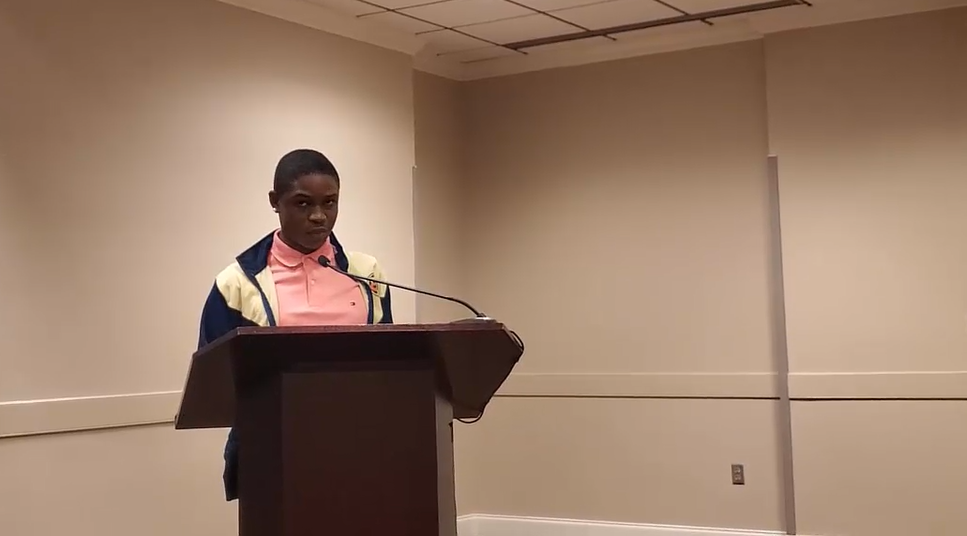
Marquavis Wilson, 16, who was bullied so badly at his district school that he wanted to end his life, spoke in favor of Senate Bill 48, which would assist families desiring education choice options for their children.
A bill that would simplify Florida’s education choice programs by merging five scholarships into two and add a flexible spending option cleared the Florida Senate Education Committee today.
By a vote of 6 to 4 along party lines, members approved SB48, which would transfer students receiving the Florida Tax Credit Scholarship Program (FTC) to the Family Empowerment Scholarship (FES), which was signed into law in 2019, and sunset the 20-year-old FTC.
The bill’s sponsor, Sen. Manny Diaz Jr., R-Hialeah Gardens, explained that the bill’s purpose is to consolidate programs and simplify the process for families, as well as give parents greater control over their children’s education.
“A lot of what is in this bill is in current law,” Diaz said.
Donors would still be allowed to contribute to the program through a newly created state trust fund. However, donations would go to serve K-12 education generally in the state, rather than pay for scholarships. Both the FTC and the FES are income based and serve students whose families meet financial eligibility rules.
The bill does not materially change the eligibility criteria for any of the scholarship programs, and actually reduces the currently allowable statutory growth in some of the programs.
The bill also would merge the McKay Scholarship Program for Students with Disabilities and the Gardiner Scholarship Program, creating a new program for students with unique abilities called the McKay-Gardiner Scholarship Program.
That program would allow families in all state scholarship programs to have flexible spending accounts, also known as education savings accounts, or ESAs. Currently, only students enrolled in the Gardiner program have such flexibility.
The accounts allow families to spend their money on pre-approved services and equipment in addition to private school tuition. Approved expenditures include electronic devices, curriculum, part-time tutoring programs, educational supplies, equipment, and therapies that insurance programs do not cover. The bill would expand eligible services for McKay-Gardiner students to include music, art, and theater programs, as well as summer education programs.
The scholarship programs are also available to homeschool students and those enrolled in eligible private schools.
In addition, victims of bullying at district schools who transfer to private schools as part of the Hope Scholarship Program would also be served by the Family Empowerment Scholarship Program and receive the same spending flexibility.
(See more details of the bill here.)
One student and five parents whose children have benefited from school choice scholarships spoke in support of the bill.
Lamisha Stephens, of Hallandale Beach, credited a scholarship with saving the life of her 16-year-old son, Marquavis Wilson, who was bullied so badly because of his sexual identity that in fifth grade he wanted to end his life. The transfer to a private school enabled him to escape the torment and thrive.
“That changed everything, she said. “Now, Marquavis is safe. And he can be himself. And he’s learning again like he’s supposed to.”
Marquavis also expressed his gratitude for the scholarship.
“At my old school, I was fighting all the time,” he said. “At my new school, everything was different,” he said. “I know they care about me. And I know I can be myself.”
Simone Arnold said her first-grade son, Ayden, who is on the autism spectrum and has trouble with his speech and comprehension, has made tremendous progress at his private school thanks to a Gardiner Scholarship.
“I want to thank Sen. Diaz for this bill that would benefit families by simplifying the scholarship programs, and by making them more flexible to meet each child’s individual needs,” Arnold said.
Also speaking in favor of the bill was Jon Arguello, a member of the Osceola County School Board, who said district schools do an outstanding job, but choice is necessary so that every student’s individualized needs can be met.
“As a policymaker I know this bill counts,” Arguello said. “As a father of five and a member of my community, I know this bill helps.”
He called education choice scholarships “a godsend” to parents and students with a need that cannot be met in a traditional environment.
“Public schools are not set up to address every single particular need of every student,” he said. “Every parent should be able to make the decision for their child whether we are serving them properly.”
After the meeting, Diaz thanked his colleagues who supported his efforts to help families.
“We look forward to our continued work streamlining Florida’s robust school choice options. Our aim is to make it easier for parents to navigate the process and assure that all students have the opportunity to access an educational option that works for them.”
The bill’s next stop is in the Senate Education Appropriations Subcommittee.
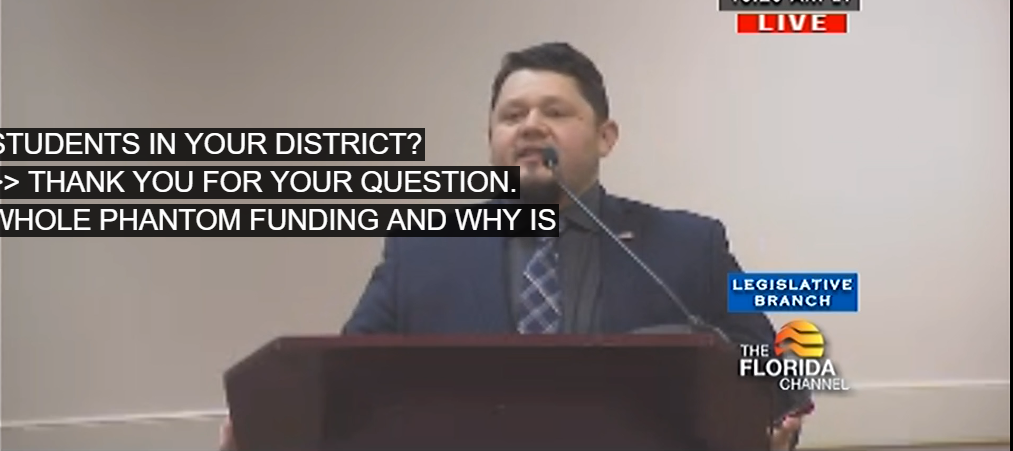
Editor’s note: A bill to simplify Florida’s education choice scholarship programs cleared its first committee hurdle earlier today in a 6-4 vote along party lines. Among those speaking in favor of the bill was Osceola County School Board member Jon Arguello. Here are his remarks.
Good morning, Chair Gruters, members of the committee. I appreciate the opportunity to be able to address you this morning in support of this bill. I am Jon Arguello, Osceola County School Board member representing District 3.
I represent a heavily left-learning, minority-majority county. I can with confidence say that the community I represent is in support of this bill. The issues this bill addresses are directly related to the shortcomings and challenges school districts and families are facing. I know this as it was a large part of our discussions at our board meeting last night.
As a policymaker, I know this bill counts. As a father of five and a member of my community, I know this bill helps. The advancement of this bill is not just a consolidation but an enhancement that helps our children not only attend these schools but succeed with the resources necessary to achieve academic excellence. In other words, words it’s a refinement that extends the scholarships’ intent, reduces the social-technology gap, and increases the opportunity for true equity.
The bottom line is that these scholarships, and school choice in general, are a godsend to parents with needs that are not, or cannot, be met by the traditional environment.
To delay the passage of this bill is to delay an immeasurable number of educational opportunities for children. I ask that you continue to fight and bring this bill home where it will convert to brighter futures for thousands of deserving but disadvantaged students, not only in the county of Osceola, but in the entire state.
Thank you, Chair Gruters and members of the committee.
 Editor’s note: National Catholic Schools Week, celebrated this year as Celebrate Catholic Schools Week from Jan. 31 to Feb. 6, is an annual celebration of Catholic education in the United States. In today’s post, Michael Barrett, Associate for Education for the Florida Conference of Catholic Bishops, explains why, in his view, Catholic schools remain an excellent school choice option for families.
 For years, the Catholic Church has promoted school choice and has advocated for the right of parents to choose the educational option that best suits the needs of their child. Today, Florida is on the cutting edge when it comes to providing families with real educational options. But among these options, what sets Catholic schools apart?
I would like to highlight two aspects of Catholic education. The first is community.
One of the most striking aspects of an excellent Catholic education is authentic community – not merely a community of students and teachers effectively receiving and imparting knowledge, but a network of families and individuals who know and care for one another deeply.
While this community begins at school, it is not limited to regular school hours or confined to the school building.
Growing up in Brandon, Florida, I remember experiencing this in my own Catholic grade school. I recall a real sense of sharing life with other families from my school. My friends and I not only attended the same school; we sat next to each other at Sunday mass and we carpooled together to school sporting events. Our moms served lunch in the cafeteria and our dads worked the food and drink tents at the annual school fair.
Our families ate dinner together, attended parties together, and supported one another through various triumphs and tragedies. By attending Catholic school, our families became immersed in a particular Catholic school community.
Both Catholics and non-Catholics alike have encountered and have been enriched by this distinctive experience of Catholic school community. And indeed, this is by design.
As Archbishop J. Michael Miller, secretary for the Vatican’s Congregation for Catholic Education, has stated, Catholic grade schools should “try to create a community school climate that reproduces, as far as possible, the warm and intimate atmosphere of family life … This means that all involved should develop a real willingness to collaborate among themselves. Teachers … together with parents and trustees, should work together as a team for the school’s common good and their right to be involved in its responsibilities.”
Therefore, Catholic schools are called to be communities, not only for students and teachers, but for the entire family.
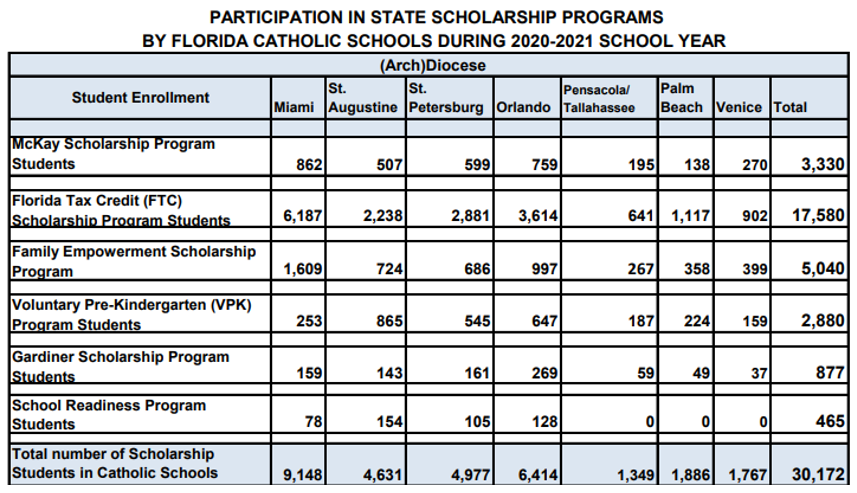
Throughout Florida, 239 Catholic schools serve 79,623 students. Just under 40% of these students participate in one of Florida’s K-12 scholarship programs.
A second aspect of Catholic education is that Catholic school communities are grounded in a particular understanding of human nature and of human love. This understanding of human nature informs and influences the relationships that make up the Catholic school community.
The Catholic Church, and therefore Catholic schools, teach that each and every person has great dignity and worth because he or she is made in the image and likeness of God. Furthermore, Catholic school communities understand love to be a “self-gift,” or charity, best exemplified by Christ’s gift of himself to us on the cross.
This, of course, does not mean that Catholic school communities are perfect. Nor does it mean that every student who walks into a Catholic school must be Catholic. It certainly doesn’t mean that every student must walk out of a Catholic school as a Catholic.
However, it does mean that Catholic schools will be Catholic, and that this particular view of human nature and love will be proposed, taught, and thoughtfully discussed – which, in turn, hopefully will influence and guide the entire school community.
When this is done well, Catholic schools offer distinctive communities and learning environments that exist as a wonderful educational option for Florida’s students and their families.
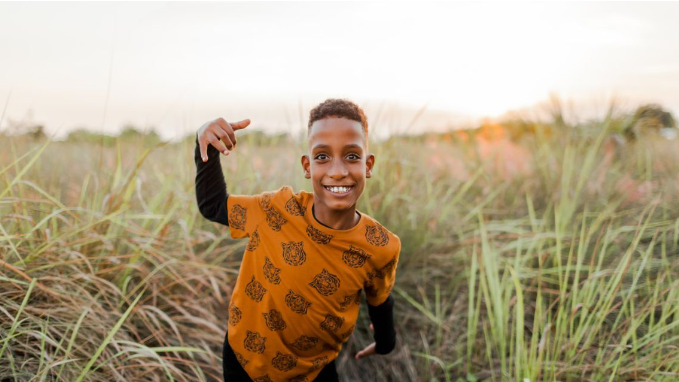 Editor’s note: This opinion piece from Kamden Kuhn, who lives in Tampa with her family, appeared this morning on the Tampa Bay Times.
When we adopted our son Malachi from an orphanage in Ethiopia five years ago, we didn’t fully understand the depth of the challenges a child with special needs faced.
Florida’s Gardiner Scholarship and its flexible spending has helped us overcome some of those obstacles.
Born with spina bifida, Malachi had limited access to both health care and education in Ethiopia. His caregivers did the best they could with what little they had.
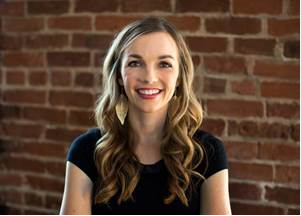
Kamden Kuhn
Blessed with plenty, my husband and I wanted to play a very small role in Ethiopia’s orphan crisis by helping just one child, Malachi, receive the education, the health care and the family that he deserved.
Along our journey, we’ve encountered a community of support — sweet friends, family, doctors, nurses, therapists and teachers who have invested their time and resources to help Malachi. The Gardiner Scholarship — an education savings account program for students with special needs — has been a significant piece of that support system.
The Gardiner Scholarship gives families control over a flexible spending account which can be used to pay for tuition, fees, tutoring, curriculum, assistive technology and more.
A bill in the Florida Legislature would extend those opportunities to more families by turning all the state’s education choice scholarships into flexible spending accounts similar to Gardiner. Imagine the possibilities of matching resources chosen by parents to the specific needs we see in our children.
Continue reading here.

