MIAMI BEACH, Fla. – Thirteen years ago, Katy Horowitz and her family moved from London to Miami, where she promptly secured a job at a charter school. But when the charter school abruptly decided to move an hour away, Horowitz decided to give her own school a shot: An unassuming little day care.
Horowitz said she never had plans for anything big. But “it snowballed.”
The day care began with five students in her home. Soon, it became a day care in a synagogue. The day care grew into a pre-school, Gan Katan Miami. Then the pre-school pulsed into Pardes Day School.
Nudged by parental demand, Horowitz and co-owner Sharon Eichberg have been adding a grade a year, and in August they welcomed their inaugural seventh-grade class.
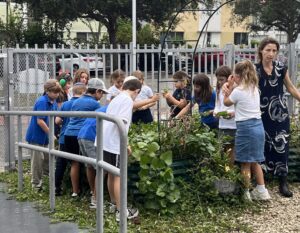 Together, the two schools now serve 220 students. And Horowitz said she and Eichberg could serve twice as many if they could only find a suitable building in Miami Beach, where 90 percent of the students live.
“We’re always looking to see what’s out there,” she said. “But it’s either totally unaffordable. Or it’s not big enough. Or we can’t zone it.”
Gan Katan and Pardes Day School are typical examples of what’s happening with Jewish schools in Florida.
On the one hand: Accelerating growth.
On the other: Speed bumps, just ahead.
A new report from Teach Coalition and Step Up For Students sets the scene well.
Over the past 15 years, the report shows, the number of Jewish schools in Florida has nearly doubled, boosted by growing numbers of parents using state school choice scholarships, and bolstered by the migration of families from other states, particularly New York.
Between 2007-08 and 2022-23:
 All of this was before 2023-24, the year every student in Florida became eligible for choice scholarships.
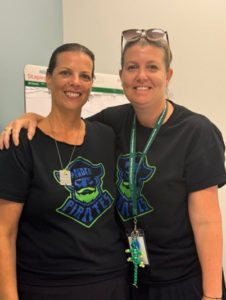
Sharon Eichberg, left, and Katy Horowitz, right, founders of Gan Katan schools.
Horowitz said she’s really never had time to stop and think about her school’s growth. “But every once in a while,” she said, “I get this moment of whoooosh, I can’t believe this is a thing.”
“Every year this school has evolved,” she continued. “It’s beautiful, but tiring. It’s this shapeshifting, ever-evolving craziness. I can’t explain. But somehow it always comes out right.”
The same could be said for the growth of Florida’s Jewish schools overall.
At the same time, though, the Teach Coalition and Step Up report makes clear that limits on growth are looming, due to restrictive zoning codes, rising real estate values, and increased competition with other private schools.
The vast majority of newer Jewish schools in Florida are on the smaller side, with fewer than 250 students. That’s not a function of parental preference, the report suggests, pointing to data showing robust growth in larger Jewish schools. Instead, the limitation seems to lie with restrictive local zoning laws.
“With Florida’s existing Jewish schools at or near full capacity, more effort is needed to source suitably sized school buildings,” said Danny Aqua, director of special projects at Teach Coalition, which advocates for Jewish schools. “Without legislative and regulatory action to reduce the hurdles to opening new schools, the lack of school building space may throttle growth in Florida’s Jewish day schools.”
Gan Katan and Pardes Day School were able to expand in 2021, when Horowitz and Eichberg lucked into two, long buildings that once housed a charter school. Prior to that, the buildings had been an apartment complex in a snug neighborhood graced by oaks and figs and bright splashes of hibiscus.
“It was like finding a needle in a haystack,” Horowitz said. “We called it our unicorn.”
The unicorn worked for a while, but it’s not ideal. The buildings now house the pre-school and elementary school, while the synagogue, less than a mile away, houses the sixth- and seventh-graders. Meanwhile, Horowitz and Eichberg can’t grow more space, but they have installed walls to create more rooms. Stacks of books and school supplies, including in Horowitz and Eichberg’s office, hammer home the reality that the school is maxing out.
“We thought the school was going to be small,” Eichberg said. “This,” she said, gesturing around the office, “was not the plan.”
Horowitz estimates 10 percent of the families they serve are recent transplants from out of state. Some from New York and California. Some from Israel and France. The biggest cluster came from Montreal.
Dayna Westreich and her family moved from Manhattan to Miami Beach in 2021. All four of her children attend Jewish schools using choice scholarships, two of them at Pardes Day School.
Florida just had more going for it, Westreich said – better cost of living, better quality of life, fewer headaches in the wake of the pandemic, and more economic opportunity. Choice scholarships were “an added bonus,” she said, and she was “over the moon” with Pardes.
“My daughter was instantly happy there, and it made the transition easier,” she said. “The school’s like a big hug.”
Florida was already hard to beat with good weather and a reputation as a safe haven, Horowitz said. Now that the scholarships are universal, it’s even more so.
Before last year, 25 to 50% of the students at Gan Katan and Pardes Day School were using the scholarships, she said. Now all of them are – and word is definitely getting around.
“When a group from a certain place finds a new place, they bring all their friends with them,” Horowitz said. “They send the carrier pigeons back home and say, ‘Come to Florida!’ “
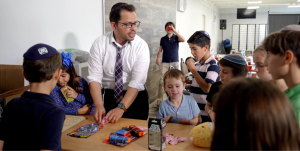
The number of Jewish schools in Florida nearly doubled over the past 15 years, boosted by parents using state school choice scholarships and the migration of families from New York, according to a new report from Teach Coalition and Step Up For Students.
Student enrollment between 2007-08 and 2022-23 rose 58 percent, from 8,492 to 13,379, while the number of Jewish day schools and yeshivas grew from 40 to 74, the report shows.
Over the same span, the percentage of Jewish school students using choice scholarships increased from 10 to 60 percent.
 The growth of Jewish schools in Florida is historic and unmatched anywhere else in America. The analysis is also likely to understate the trend lines, given it does not cover the 2023-24 school year, the first year every student in Florida became eligible for a choice scholarship. (The data for 2023-24 is not yet available.)
On a cautionary note, the report also points to increasingly pressing issues that could limit future growth – and not just for Jewish schools.
The vast majority of newer Jewish schools are on the smaller side, with fewer than 175 students. That’s not a function of parental preference, the report suggests, but the result of challenges schools face in navigating restrictive local zoning laws to find adequate and affordable facilities.
“With Florida’s existing Jewish schools at or near full capacity, more effort is needed to source suitably sized school buildings,” said Danny Aqua, director of special projects at Teach Coalition. “Without legislative and regulatory action to reduce the hurdles to opening new schools, the lack of school building space may throttle growth in Florida’s Jewish day schools.”
Full report here.
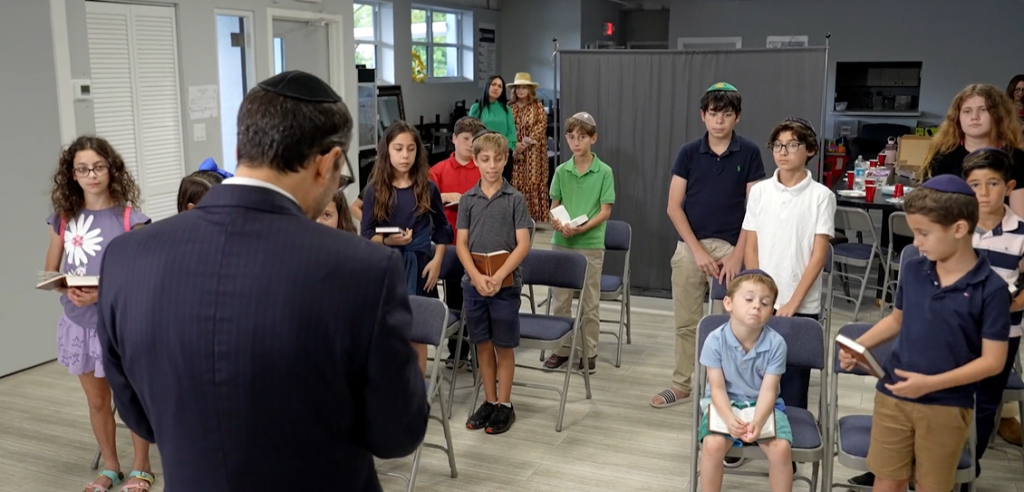
An outgrowth of more than two decades of strong secular and Jewish education leadership, Shorashim Academy prioritizes low tuition, premier learning, a warm family feel, Jewish identity and a strong connection with the State of Israel.
Rabbi Isaac Melnick likes to call it “the holy grail.”
Though the Orthodox Jewish leader and founder of Shorashim Academy doesn’t intend it as a religious reference, it serves an apt metaphor for what education entrepreneurs cite as their most difficult challenge: finding and securing a home to carry out their dream.
“A saying from one of our great sages of the last 100 years is that to start a yeshiva, or a Jewish school, you have to have a certified ‘Meshugener,’ a crazy person to take this on themselves,” Melnick said. “Because on paper this doesn’t make sense. If someone wants to be an entrepreneur, this is probably one of the riskiest, diciest ways to start a business. It’s just fraught with uncertainties.”
Melnick’s quest began last year after he was named a fellow in the Founders Program of the Drexel Fund, a national non-profit organization with a mission of equipping entrepreneurs to start or expand innovative learning programs by providing training and grants.
The fund also provides funding to support the new schools in areas that seek to help students in underserved areas. Florida and other states with robust education choice scholarship programs, provide fertile ground for qualifying founders and startups.
“I’d say that’s probably the biggest hangups,” said Eric Oglesbee, an alumnus of the Drexel Fund founders program who now serves as its director. He said the topic came up at a recent information session in which fellows said the biggest lesson learned over the past seven months had been the difficulty of finding and securing a location.
“It takes forever to find a spot that that can check all the boxes and get all the approvals,” Oglesbee said. “You have to figure out what’s not going to work but also know your model well enough to know what’s going to work.”
Oglesbee said while searching for a site for his River Montessori High School in South Bend, Indiana, three possible locations fell through before he and his team finally landed one. In addition to finding the site, founders must then contend with local government rules regarding zoning, construction and fire codes.
Because the rules are set locally, they often force founders to navigate a patchwork of regulations of varying stringency depending on the location of possible sites. A Utah lawmaker filed a bill this year to create uniform rules for innovative learning communities, often referred to as microschools. But the measure, which had been modeled after laws governing charter schools, failed in the Senate.
“Just because a site is in an area zoned for a school, it doesn’t mean you get approval,” Melnick said. “It just means you get to have a conversation.”
That conversation typically involves a list of responsibilities the entrepreneur must bear, such as a traffic study to make sure the roads can handle the car trips the new school will generate, as well as a list of renovations to bring buildings up to the latest codes.
Those responsibilities also come with a hefty cost that the founders and their team must bear.
Gretchen Stewart, a Drexel Founders fellow from Tampa, Florida, is working to open Smart Moves Academy, a motion-based school that caters to low-income students with learning differences. Since 2021, she has been dealing with myriad challenges posed by her unique model, as well as soaring rent costs and a lack of overall availability in the school’s catchment area.
“It just became clear right away that this was going to be problematic,” said Stewart, a former public school teacher who drew the inspiration for the school while writing the dissertation for her doctorate in special education and educational neuroscience at the University of South Florida.
Stewart said she first considered churches near the east Tampa community she planned to serve, but the spaces were being used by nonprofits providing feeding programs for those facing food insecurity.
“That kind of wiped out the spaces we could have considered,” she said.
She added that larger churches in the area already leased to private schools, and many older churches lacked the space needed for her program, which requires each classroom to be 900 to 1,000 square feet to accommodate physical activity-based learning.
The model also depends on access to enough green space for students to play and learn outside three times a day.
“A lot of schools are in strip malls where kids don’t go outside or are playing on a blacktop portion of a parking lot, which is not something our model can accommodate,” Stewart said.
The same goes for access to natural lighting, which Stewart says is critical to learning and good health.
For now, the program is operating as a summer camp at USF, but even that is not large enough to allow for necessary gym equipment.
If all that wasn’t enough of a barrier, Tampa rents are skyrocketing.
“We looked at one place near USF, and they wanted $35,000 a month, and that’s without utilities and taxes,” she said. “We’re trying to serve families from lower-income communities, families who have historically not had access to private education and allow them to take advantage of Florida’s robust school choice program.”
Stewart has applied for grants and is talking to philanthropists about the needs her school would meet. While she says everyone agrees that it’s a good idea, no one has been willing to donate enough to fully fund it.
Some organizations, like the Cristo Rey Network of Catholic high schools, have been fortunate to secure transformational gifts, like the $7 million donation the Orosz family made to buy a 75,000-square-foot vacant building to start a new school in Orlando.
“Space is our last hurdle,” Stewart said.
Like his fellow Drexel founder, Melnick also failed to land big gifts.
He made pitch after pitch to wealthy individuals in South Florida about buying a building and leasing it to Shorashim Academy, but no one was willing.
“I thought that would be a win-win,” he said, adding that even when an educator entrepreneur finds a lease deal, landlords usually want to collect rent months before the school is able to open and generate revenue to pay the expenses.
“You’ve really got to have the perfect storm, the perfect set of circumstances, in order to execute on that vision,” he said.
Melnick also approached synagogues, but many already hosted schools. One possibility fell through because the synagogue didn’t match the Shorashim Academy leaders’ Orthodox beliefs. The situation seemed so daunting that Melnick and school leaders hit the phones in hopes of finding leads.
“Regretfully, it made me a little bit cynical,” he said.
Their persistence, or what Melnick credits as divine intervention, recently brought good news.
Shorashim Academy will open this fall at the Soref Jewish Community Center in Plantation, Florida.
They have added a coveted new tab to the school’s website: Location.
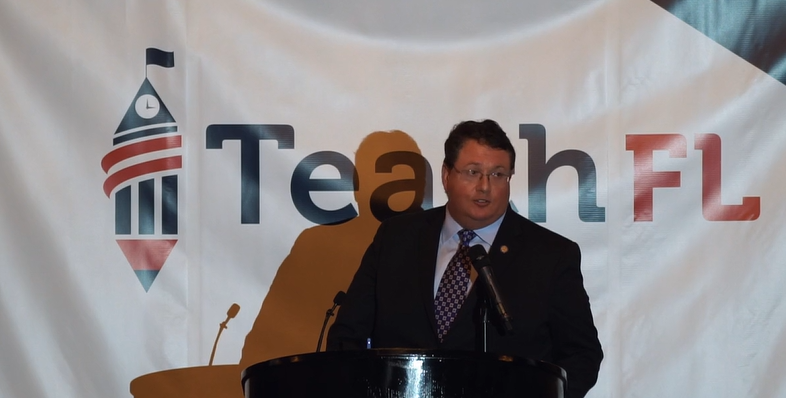
Florida state Rep. Randy Fine reported at the annual Teach Florida breakfast that half of all students attending Jewish schools in Florida receive state scholarships due to the Legislature's recent expansion of the program.
More than 600 people joined Teach Florida’s board and staff for the organization’s annual legislative breakfast this week at the Signature Grand in Davie, Florida.
Attendees included state legislators, elected local officials and members of the Jewish day school communities of Miami-Dade, Broward and Palm Beach counties. The focus of the event, which began in 2017, is to celebrate the organization’s legislative victories in securing government funding for families sending their children to Jewish day schools.
To see a video recap of the event, click here.
Speakers included Allan Jacob, a South Florida physician and chairman of Teach Florida; Daniel Aqua, Teach Florida’s executive director; state Rep. Randy Fine, R-Palm Bay; and Florida Senate President Wilton Simpson, R-Spring Hill; as well as Carol Lasek, a local lay leader, and Rabbi Elie Estrin, a chaplain in the Air Force Reserve and parent of a Florida choice scholarship recipient.
During the event, the organization named Fine its Legislator of the Year and gave Simpson its School Choice Champion Award. Fine sponsored HB 7045, the largest expansion of education choice in the nation. Simpson was a strong supporter of the bill, which the Senate ultimately approved, and Gov. Ron DeSantis signed into law this past spring.
“By fixing our education system, by putting parents in charge, by getting bureaucrats out of the way, we’re not only going to solve the problem of opportunity for our children, but we’re also going to solve the problem of crime and other problems that exist in our society,” Simpson said.
Fine pointed out that thanks to the expansion, 50% of students attending Jewish schools are receiving state scholarships.
Estrin shared the story of his son, Nissi, who was born with life-threatening health issues. Now 6, Nissi is benefiting from a Family Empowerment Scholarship for Students with Unique Abilities.
“Every child deserves a school that can provide him or her with their unique needs,” Estrin said. “Every parent deserves the right to make that choice. We hope that our legislators find inspiration in Nissi’s story and continue increasing educational options for all of Florida’s children.”
Jacob said this year’s event drew supporters from Orlando as well as South Florida. He said Florida’s scholarship programs allow schools to provide high quality education and improve the quality of life for the entire Jewish community.
“We are always giving support to the politicians who advocate for school choice,” he said. “It’s the most significant issue in the Jewish community in Florida.”
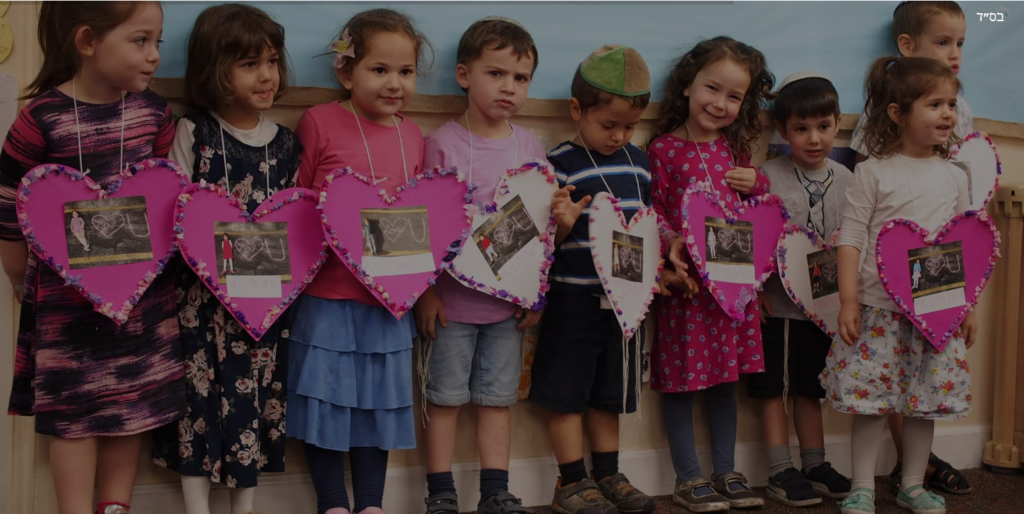
Hebrew Academy Community School began the 2020-21 school at near maximum capacity thanks to an influx of 60 new families, many from out of state.
At Hebrew Academy Community School in the North Broward County city of Margate, students in early childhood classes are learning about germs by spreading glitter glue on their hands and washing it away. In the upper grades, socially distanced students wearing masks are watching out for each other’s health. Meanwhile, school staff members are welcoming new families with care packages of challah bread and wine for the Sabbath.
A recent post on the academy’s Facebook page to launch the 2020-21 year is evidence of a new excitement at the Early Childhood-Grade 8 Jewish school founded in 1987: “From Los Angeles to Crown Heights and beyond, we are thrilled to have so many fresh faces to greet each day!”
Hebrew Academy has good reason to be thrilled. Originally serving four early childhood youngsters in the living room of a young Jewish couple, the school now boasts a 32,500-square-foot main building and a 5,000-square-foot state-of-the-art gymnasium. More than 375 children are enrolled this year, each one benefiting from school leaders’ belief that all Jewish children should have access to Torah learning.
“We’re pretty much at maximum capacity,” said development director Rabbi Shloime Denburg, who enrolled 60 new students this year. “We’re seeing a lot of families from New York and New Jersey. For the first time, we’re also getting calls from California.”
This influx of interest from Jewish families outside of Florida isn’t limited to Hebrew Academy Community School. Even as enrollment plummets at other private schools across the state, Jewish schools are experiencing massive growth, according to Mimi Jankovits, executive director for Teach Florida, part of the national Teach Coalition advocacy organization for Jewish schools.
Jankovits cites a variety of reasons for the expansion: a lower cost of living, less crowding, a better climate. Not to mention the wide variety of Jewish schools available and the fact many participate in the state’s K-12 scholarship program.
“Whatever your philosophy is, there’s probably a school for you here,” Jankovits said, adding that even if some families don’t need the financial assistance state scholarships offer, it’s reassuring to families to know Florida is friendly to school choice.
“We are excited Florida can offer people moving here these opportunities to get scholarships if they need them,” she said.
Brauser Maimonides Academy in Fort Lauderdale started the school year with about 70 new students.
“That’s the most we’ve ever brought in,” said Eli Hagler, executive director of the Modern Orthodox school. In just five years, Hagler said, school enrollment has increased from 350 to 550 students.
A lot of those families have migrated to South Florida from outside the state.
“I’ve spoken to a lot of people from New York and New Jersey. Companies are going virtual and staying virtual, and so people are looking to get out,” he said.
Like Jankovits, Hagler pointed to lower living costs and scholarship opportunities as magnets drawing Jewish families to Florida. He also praised new legislation that allows more families to qualify and no longer requires them to reapply each year for the Florida Tax Credit Scholarship, a program administered by Step Up For Students, which hosts this blog.
“We don’t view private Jewish day school as a choice,” Hagler said. “It’s a necessity.”
Annual tuition at Brauser Maimonides ranges from $9,475 for 2-year-old nursery students to $18,780 for middle school students. That’s significantly lower than tuition at a Jewish day school in New York, which can cost $30,000 per year.
Student enrollment also is up at Hebrew Academy in Miami, a surprise for school leaders who had expected to see enrollment drop due to COVID-19. But more than 70 new families replaced those who decided not to re-enroll.
“All of a sudden we had these New York families,” said dean of admission Ami Eskanos. “They started referring their friends. One of our alums transplanted back down here, and she started showing homes to all of these New Yorkers coming down, and they started referring people. They just kept referring one another.”
Although most Jewish families are relocating to South Florida, other parts of the state also are experiencing an influx of new residents from the Northeast eager to find seats for their children in Jewish schools.
“We started 10 years ago with 12 kids and are almost at 110 this year,” said Rabbi Avraham Wachsman, dean at Orlando Torah Academy, a Jewish preschool and day school serving Orlando and Greater Central Florida.
Wachsman recently has received inquiries from families in New York, New Jersey and Pennsylvania.
“You hear so much about shrinking schools, but we have the opposite,” he said.
Quality of life and lower tuition are among the main factors that are driving relocation, Wachsman said. Along with one additional benefit.
“I’m from Milwaukee,” he said. “I’ve done my 30 years’ time in the snow.”

