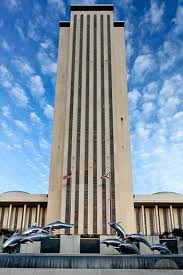
 Editor's note: Another year, another legislative session, another stack of school-choice bills in Florida. Here's a roundup of choice legislation that lawmakers will consider in the annual session that begins today.
Career Academies:
SB 1076 by Sen. John Legg, R-Lutz. Expands the "Career and Professional Education Act (CAPE)," revising requirements for high school graduation and accelerated high school graduation, and allowing students to earn and substitute certain industry certifications for certain course credits. Also requires districts to make digital materials available to students and to use the Postsecondary Industry Certification Funding List in determining annual performance funding distributions to school districts and Florida College System institutions, etc.
Charter Schools:
HB 373 by Rep. Joe Saunders, D-Orlando. Provides that a contract for a charter school employee or service provider may not extend beyond the school’s charter contract, and that the employee or service provider is not entitled to compensation after the school’s closure. (Identical to SB 780 by Sen. Geraldine Thompson, D-Orlando.)
HB 453 by Rep. Victor Torres, D-Orlando. Requires the compensation and salary schedules for charter school employees to be based on school district schedules. (Identical to SB 784- Charter Schools by Sen. Geraldine Thompson, D-Orlando.)
SB 744 by Sen. David Simmons, R-Altamonte Springs. Requires charter school applications to demonstrate the applicant is financially qualified to open and maintain a high-quality charter school, requires the charter to set forth detailed reporting of the financial operations of the school to ensure employees are not paid unreasonable compensation, and requires that the term of the charter must provide for cancellation of the charter if the school becomes insolvent, fails to provide a quality education, or does not comply with applicable law. The bill also clarifies that a charter school system shall be designated a LEA solely for the purpose of receiving federal funds if certain criteria are met.
SB 828 by Sen. Rene Garcia, R-Hialeah. Grants school districts the ad valorem tax exemption given to charter schools, and restricts the use of capital outlay funds for property improvements if the property is exempt from ad valorem taxes. It restricts charter schools or technical career centers having financial problems from certain activities, and grants flexibility to high-performing school choice districts.
HB 1001 by Rep. Karen Castor Dentel, D-Maitland. Prohibits charter schools from requiring, soliciting, or accepting certain student information before student's enrollment or attendance. Also requires charter schools to submit attendance plans to the school district for students enrolled in school; provide funding to the school district in event of student transfers; and report to the school district certain student enrollment and wait-list information.
SB 1092 by Sen. Geraldine Thompson, D-Orlando. Requires charter school to submit attendance information for each student to the school district, and requires the charter school to provide a prorated portion of per-student funding to the school district if a student transfers to another public school in the school district before the last day of the school year.
SB 1164 by Sen. Kelli Stargel, R-Lakeland. Revises the eligibility criteria for extracurricular activities to include students in charter schools, and revises the criteria for bylaws, policies, or guidelines adopted by the Florida High School Athletic Association. (Compare to HB 1279 by Rep. Larry Metz, R-Groveland.) (more…)
Legislative preview. Parent trigger will be a top education issue, reports the Fort Myers News Press.
Common Core. Sen. John Legg files legislation that would require the state to verify that districts have the technological capacity to carry out the switch to Common Core. Gradebook. More from StateImpact Florida.
Charter schools. The Orlando Sentinel takes a closer look at a failed charter in Orange.
Career academies. The number in the Bay County school district will rise from four to 12 next year. Panama City News Herald.
Conspiracy! The Tampa Tribune gets picked up by the Huffington Post.
School security. It'll be an issue during the legislative session. Palm Beach Post.
School recognition funds. Lower grades, less money for Marion schools. Ocala Star Banner.
School closures. A lawsuit backed by the Florida Civil Rights Association says proposed school closures in Brevard would disproportionately affect low-income, minority students. Florida Today.
Restraint. A couple is suing the school board over district officials' repeated use of physical restraints on their autistic son. Palm Beach Post.
Privatization. The union representing custodians and grounds maintenance workers in Volusia is seeking severance pay for 485 workers whose jobs are set to be outsourced. Daytona Beach News J0urnal.
Technology. Some Escambia high schools have BYOD policies. Pensacola News Journal.
Education savings accounts. Bills filed Friday and Saturday would create a new mechanism for funding school choice options. Tallahassee Democrat.
 Charter schools. Some 1,200 students apply for 650 slots at a new charter in Viera, reports Florida Today. An overwhelming majority of parents and teachers vote against the proposed conversion of a Key Biscayne school into a charter, reports Miami Herald. The Palm Beach school district is recommending that its board shut down three charters, reports the Palm Beach Post. The Pepin Academies, a charter that serves disabled students in Tampa, wants to open a campus in Pasco, reports the Tampa Bay Times.
School choice. Pasco Superintendent Kurt Browning is merging the district's choice programs - open enrollment, charters, career academies, etc. - in one department. Gradebook.
Parents. At Jacksonville's first-ever ed summit, Duval Superintendent Nikolai Vitti reiterates that he wants to transform how the district views parents. Florida Times Union.
Common Core. Tampa Bay Times overview of what's coming - and whether it can happen according to schedule. Part one here. Part two here.
Legislative preview. "Reforming school reform." Tampa Bay Times.
New faces. Former Secretary of State Condoleezza Rice and Laurene Powell Jobs have joined the board of directors for the Foundation for Excellence in Education. EdFly Blog. (more…)
 Charter schools. An Orange County charter that served dyslexic students is closing after seven months because of financial problems, reports the Orlando Sentinel. The parents of a charter in Miami-Dade are in limbo after a church decides unexpectedly to end the school's lease, reports the Miami Herald.
Virtual charter schools. In a repeat of last year, the charter school appeals commission sides with the Orange and Seminole school boards in their rejection of applications for Florida Virtual Academy schools. The state Board of Education will make the final call. SchoolZone.
Parent trigger. Two civil rights groups in Florida, LULAC and the NAACP, are opposed. StateImpact Florida.
Magnet schools. Parents plead with the St. Lucie County School Board to not close an arts magnet because of budget cuts, reports TCPalm.com. A new elementary school arts academy is in the works in Okaloosa, reports the Northwest Florida Daily News.
Career and technical. A bill filed by Sen. John Legg, R-Port Richey, would allow students to substitute industry certifications for other graduation requirements, reports Gradebook. More from the Orlando Sentinel. The Pinellas school district plans to create several new career academies for middle schools and put STEM labs in every elementary school in an effort to boost career education, reports the Tampa Bay Times. River Ridge Middle School in Pasco is realigning its curriculum to better reflect career education, the Times also reports. (more…)
I am grateful to Rebecca Sibilia and Sean Gill for their thoughtful response to my blog post encouraging Michelle Rhee to replace her failing schools model of school choice with an approach based on equal opportunity.
Rebecca and Sean defended StudentsFirst’s support of the failing schools model on pragmatic grounds. They wrote: “When state resources are limited or the existing supply of desirable private schools is limited, it also makes sense to prioritize vouchers or scholarships for those low-income children attending a low-performing school or living in low-performing school districts.”
Every community suffers from an insufficient supply of effective schools for low-income students. But in Florida we’ve learned that increasing demand - not limiting demand - is the best way to increase supply.
Access to Florida’s tax credit scholarship program for low-income students, which I help administer, is limited by a state-imposed cap. But our demand is not limited, so it often exceeds supply. This excess demand has not had a negative effect on students or the program. Instead, it has generated political pressure on the state Legislature to allow our cap to rise to meet this additional demand.
In 2010, as a result of excessive demand, the Florida Legislature voted to allow our program to grow 25 percent every year the demand hits or exceeds 90 percent of supply. The result has been extraordinary growth of supply and demand. While we have been awarding scholarships since 2002, 34 percent of our growth has occurred in just the last two years. This school year we added 10,000 more students to the program and had more than 12,000 students add their names to our waiting list after we hit our cap.
We’ve also been adding about 100 new private schools per year to the program, and some have started to expand their physical capacity to serve more students. Had we adopted the StudentsFirst approach of limiting demand when faced with limited supply, this extraordinary growth would not have occurred.
Today, more than 43 percent of Florida’s preK-12 students attend a school other than their assigned district school. Charter schools, magnet schools, virtual schools, career academies, dual enrollment and homeschooling are all growing dramatically. Private schools are already struggling to maintain their market share given all these choices. If we were to limit our scholarships to low-income students in state-designated failing schools, then many private schools serving low-income students might be forced to close - to everyone’s detriment. (more…)
Charter schools. The Tampa Tribune writes up the latest report on charter laws from the National Association of Public Charter Schools and quotes Robert Haag, president and CEO of the Florida Consortium of Public Charter Schools: "You want choices for your child's education, just like anything else in life. You don't want to be stuck just going to Publix. You want to be able to go to Winn-Dixie or Whole Foods or any of those places."
The Pembroke Pines charter school system is battling the Broward school district for funding, reports the South Florida Sun Sentinel. An F-rated charter middle school in Orlando plans to ask the Orange County school district for designation as an alternative school, which wouldn't be graded, reports SchoolZone. The Orlando Sentinel editorial board doesn't like the idea of more construction money for charter schools - or the possibility of a parent trigger.
School spending. The Manatee school district's Fitch bond rating is downgraded from stable to negative, reports the Bradenton Herald. The district posts thousands of documents from the forensic audit into a $3.4 million deficit, the Herald also reports. The documents show a school board member forced former superintendent Tim McGonegal to resign after he learned of the deficit, reports the Sarasota Herald Tribune.
Following Florida: Nevada should adopt Florida's ed reforms, particularly its expansion of school choice options, says this op-ed in Nevada Business Magazine.
Rick Scott. As the governor woos teachers, the Tea Party scratches its head. Tampa Bay Times.
Exposed, again! Another news outlet gives space to the Jeb Bush corporate-connections-conspiracy story.
Teacher evaluations. The Tampa Bay Times offers an update on the Gates-funded effort in Hillsborough. A Flagler teacher will focus on teacher evaluations as a fellow with the Hope Street Group, a national public policy outfit, reports the Daytona Beach News Journal. (more…)
Florida’s new education commissioner is known for his zealous support of charter schools and vouchers and other learning options that some critics see as anti-public school.
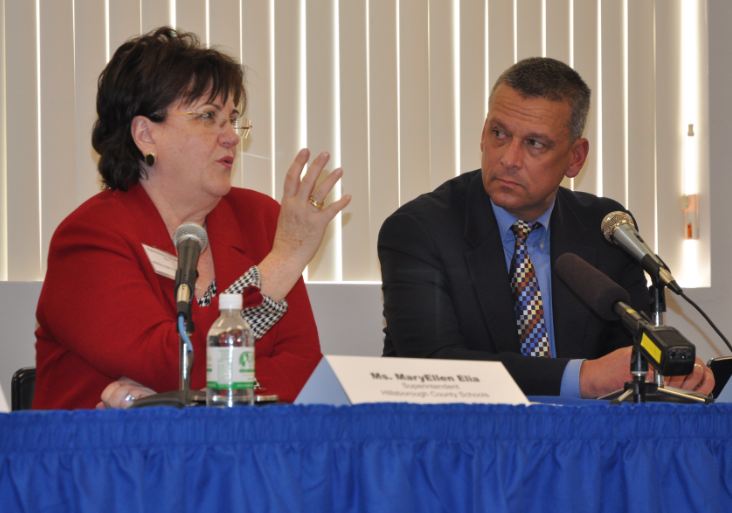
Florida Education Commissioner Tony Bennett and Hillsborough Superintendent MaryEllen Elia were among the panelists at a National School Choice Week event in Tampa. (Photo by Lisa A. Davis/Step Up For Students)
But on Tuesday afternoon, Tony Bennett sat next to Hillsborough County Public Schools Superintendent MaryEllen Elia inside a Tampa magnet school for boys, and praised the growth of choice in district schools across the state.
Florida is transcending the first round of conversations on choice that pit private and charter schools against public schools and virtual schools against “brick and mortar’’ ones, Bennett said during an event marking National School Choice Week. The new conversation, he suggested, isn’t either-or; it’s whatever works to ensure all kids have access to quality choices.
“So we’re now talking about choice – not just private schools and charter schools and virtual schools – we’re talking about public school choice,” he told an audience of about 100 people gathered at the Boys Preparatory Academy. “We’re talking about creative leaders like MaryEllen, like the team here, creating educational opportunities for children within the district - and really going to what we all heard was the purpose of choice to begin with, to provide incubation for innovation for our public schools.”
Tuesday’s event was sponsored by the Florida Alliance for Choices in Education, a coalition that includes a wide swath of school choice groups. Bennett and Elia sat on a panel with representatives from home-schooling, virtual education, magnet schools, career academies, Florida tax credit scholarships and McKay scholarships.
Most were parents who had lived and breathed school choice, starting with their own children. As they shared stories of searching for schools that practiced their faith or fit their child’s academic needs, they offered numbers that shed light on the choice movement’s impact. (more…)
 In 2010, Doug Tuthill took a look around and realized he was living in a new era.
“Florida had this rapidly expanding portfolio of school choice options,” said Tuthill, the president of Step Up For Students, which administers the state’s tax credit scholarship program. “Yet there was little dialogue among the groups representing those choices. We weren’t talking to each other about what was working, what wasn’t, and why.”
Several important players in this bourgeoning movement recognized the need for more collaboration. Florida Virtual School and Step Up For Students, among others, wanted to see the school choice movement united, so they could learn from each other and talk through any differences.
Thus, FACE was born.
Florida Alliance for Choices in Education, or FACE, is comprised of more than 50 members, representing a diverse coalition of organizations dedicated to providing Florida school children with more educational options. Such organizations include National Coalition of Public School Options, Florida Charter School Alliance, Foundation for Florida’s Future, and StudentsFirst - all coming together with the belief that, as the FACE website says, “State policy should enable all parents to be fully engaged in their children’s education and to access those learning options that best meet their children’s needs.”
Step Up For Students (which co-hosts this blog) staffed the initial effort. Three individuals - Wendy Howard, a parent advocate from Tampa; Jim Horne, a former legislator and state education commissioner; and Julie Young, president and CEO of Florida Virtual School - spent a year facilitating outreach and diplomacy, eventually bringing all components of choice together in one organization.
Florida is the first state to do this. (more…)

Bennett begins work today as Florida's new ed commissioner
Tony Bennett. The Orlando Sentinel hopes the new commissioner, who begins work today, “treads with discretion.” The Associated Press recalls his tenure in Indiana and ties to Jeb Bush.
Expand school choice now! Sort of. The Tampa Bay Times means options under district control: “The broader answer to improving public education in Pinellas is not a massive expansion of fundamental schools. It's raising the quality of all schools. But increasing the seats for fundamental schools and popular magnet programs to more closely match demand is a discussion district leaders should begin. Otherwise, they risk losing more families to charter schools and private schools — and further undermining broad support for public education.”
Slow down on charter schools. The Palm Beach Post says in one editorial that the Legislature should prioritize traditional public schools over charters. It says in another that the Palm Beach County district’s decision to transfer a troubled principal into administration will give lawmakers an excuse to continue favoring charters.
Checking out choice. In Alachua County, 600 middle school students turn out to see career academy options, reports the Gainesville Sun. In Duval, magnet students spread the word about their programs to prospective students, reports the Florida Times Union. In Miami-Dade, tens of thousands of parents are expected to apply for hundreds of magnet programs, reports the Miami-Herald. In Manatee, the Rock Your Robot Fair lets parents know about STEM options in public and private schools, reports the Bradenton Herald. (In Collier County, businesses urge students to explore STEM, reports the Naples Daily News.) The Tampa Bay Times annual school search section for Pinellas includes information about public and private options, including tax credit scholarships.
Amendment 8. The ACLU saw the proposed amendment, which despite perception had little to do with private school vouchers, as part of a "wide-ranging assault" on Floridians' rights last year by Gov. Rick Scott and the Republican-led Legislature, reports the Florida Current.
“Sagging schools.” Tampa Bay Times business columnist Robert Trigaux: “Beneath the top tier of students, our schools at all levels are struggling to educate our kids. Businesses need to help more. And the state needs to spend less time bragging about the educational system and admit it needs assistance.” (more…)
 Words such as voucher, privatization, profit and corporation are often used as weapons by individuals and groups who oppose parental empowerment and school choice. Using words as weapons is especially common during periods of significant social change - we all do it - but the practice undermines civic discourse and makes finding common ground more difficult.
“Market” is another term school choice opponents use to connote evil, but our way of life is largely based on markets, and public education is increasingly embracing market processes as customized teaching and learning become more common. Our challenge moving forward is regulating public education markets in ways that maximizes their effectiveness and efficiency.
People access products and services in one of two ways. Either their government assigns them, or they choose for themselves. In the United States, we have historically allowed citizens to choose, and this system of provider and consumer choice is a “market.”
In a goods and services market, providers decide which goods and services they want to sell, and consumers choose those they want to buy. Markets, when implemented properly, are preferable to assignment systems because they better utilize people’s knowledge, skills and motivation. Citizens are allowed to use their own experiences and judgments when making selling and purchasing decisions, and this citizen empowerment maximizes the universe of ideas from which improvement and innovation derive.
When governments assign products and services to their citizens, they rely on a small group of people to decide what to offer. This top-down approach is less open, transparent and effective than the decision-making that occurs in markets, and it discourages creativity. This is why most improvements in goods and services emerge from market systems rather than government assignment systems.
Markets allow providers to learn from consumers. When governments dictate to consumers what goods and services they may have, their citizens’ true wants and needs are not fully considered. The voice of the customer is silent. But when consumers are empowered to choose for themselves, providers learn from these choices and adjust accordingly. In markets, this necessity to meet customers’ needs drives innovation and continuous improvement. (more…)

