
During a 1916 football game between Georgia Tech and Cumberland, Georgia Tech coach John Heisman famously urged his players on to victory- “You're doing all right, team, we're ahead. But you just can't tell what those Cumberland players have up their sleeves. They may spring a surprise. Be alert, men! Hit 'em clean, but hit 'em hard!” Cumberland committed 15 turnovers in the game and had one of their players getting tackled for a six-yard loss on an attempt at an offensive rush declared their “play of the game.” Georgia Tech won the game 222 to 0.
This story has repeatedly come to mind repeatedly over the last decade while reading stories about the competition between surging Florida and floundering New York.
The New York Post reports that New York City Schools will spend $42,000 per student this year. Spending $840,000 on a classroom of 20 fourth graders might seem a bit pricey, especially given that judging on their 2024 NAEP performance, nine of them will be reading at “below basic.” New Yorkers must pay sky-high taxes to support the world’s most expensive illiteracy generator/job programs, which is one of the reasons so many New Yorkers keep becoming Floridians. Now, however, it isn’t just people and companies migrating from New York to Florida; New York’s Success Academy schools are also heading south.
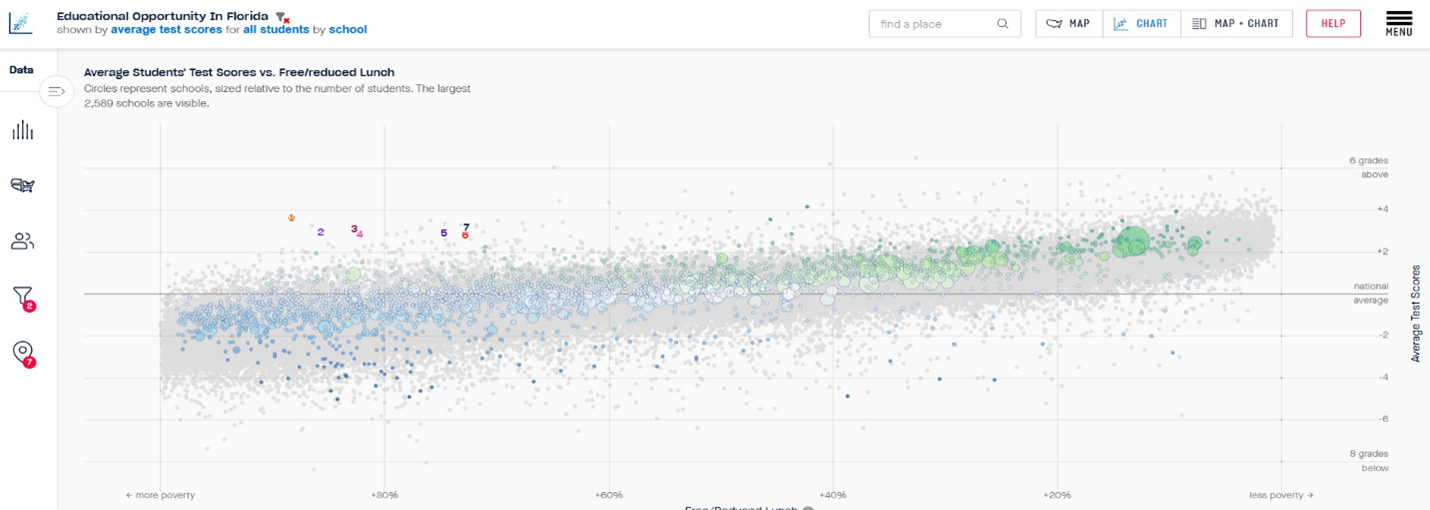
Through the wizardry of Stanford’s Educational Opportunity Project graph generator, I’ve placed New York Success Academies (Marked 1-7) in the graph for the overall state of Florida for academic proficiency. Schools are dots; green dots are higher than average, blue below average, etc.
You don’t see many high-poverty schools (graph runs from low poverty on the right to high poverty on the left) with students scoring 3ish grade levels above average, but that is exactly what Success Academy has consistently delivered in New York.
Being a rational human, you might think that New York policymakers would be falling over themselves to get as many Success Academies operating as possible, but that is just you being silly again. New York lawmakers maintain a statewide cap on the number of charter schools. Apparently, New York lawmakers feel the need to keep safe from, well, learning.
Florida, on the other hand, does not have a cap on charter schools. Rather than treating highly successful schools specializing in educating disadvantaged students as a public menace, Florida is rolling out the red carpet for highly effective school models. Success Academy plans to open 40 schools in Florida over the next 10 years, something which New York law prohibits.
Is it too much? Too much winning? No, Florida, you have to win more! Or to paraphrase Coach Heisman “You're doing all right, Florida; you’re ahead. But you just can't tell what those New Yorkers have up their sleeves. They may spring a surprise. Be alert, men! Hit 'em clean, but hit 'em hard!” Capitalizing on the abject folly of New York policymakers is hitting both clean and hard.
The renowned New York charter school operator Success Academy moved a step closer to opening new schools in Florida, as the state Board of Education approved it as the state's sixth Hope operator.
The designation, created by the 2017 Schools of Hope legislation, allows nationally recognized charter networks with a proven record of raising student achievement to receive startup funding and a streamlined approval process to open schools in areas with low-performing schools or high levels of economic disadvantage.
The network would still have to submit a notice of intent and enter a charter agreement with a school district before it can open schools. If it takes that step, this would be Success’s first schools outside New York.
Success founder Eva Moskowitz told board members that Florida's charter-friendly policies were a major reason why the network considering a Sunshine State expansion.
“I have been doing this in a rather hostile political environment, and one of the things that I’m so impressed with [in Florida] is a desire for innovation and really leading the country,” she said. “This nation needs this kind of innovation, particularly for our poorest and most vulnerable children.”
Success’s credentials are not in doubt. The network is known for serving predominantly low-income student populations that stun the state with their high test scores and college-going rates.
Education Commissioner Manny Diaz Jr. helped pass legislation that created the Schools of Hope Program.
“This is exactly what we were envisioning, to have a charter network to come in and serve those populations that are in need of this kind of academic rigor, this performance,” he said. “Over the next decade, hopefully we’re going to look back and remember this instance where we changed the lives of so many students.”
Board of Education members said they were happy to roll out the welcome mat.
"I think they're going to have greater success in Florida, because they're going to have a willing partner at the state level," Chairman Ben Gibson said.
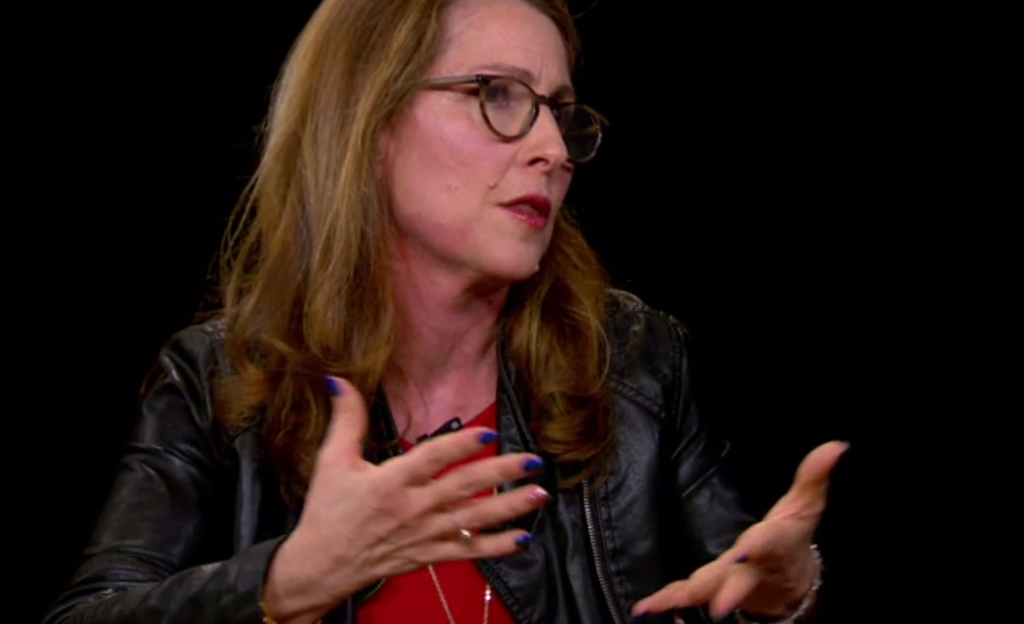
Eva Moskowitz, founder and chief executive of Success Academy Charter Schools, has been a teacher, a college professor, an elected official and chair of the New York City Council’s Education Committee.
Sweet are the uses of adversity,
Which, like the toad, ugly and venomous,
Wears yet a precious jewel in his head;
And this our life, exempt from public haunt,
Finds tongues in trees, books in the running brooks,
Sermons in stones, and good in everything.
I would not change it.
-- As You Like It, William Shakespeare
Brian Greenburg, CEO of the Silicon Schools Fund, produced this graphic to categorize varying levels of proficiency achieved by schools that launched impromptu distance learning at the outset of the COVID-19 pandemic. The graphic accompanied a post Greenburg wrote for EducationNext titled, “What we’ve learned from distance learning and what it means for the future.”
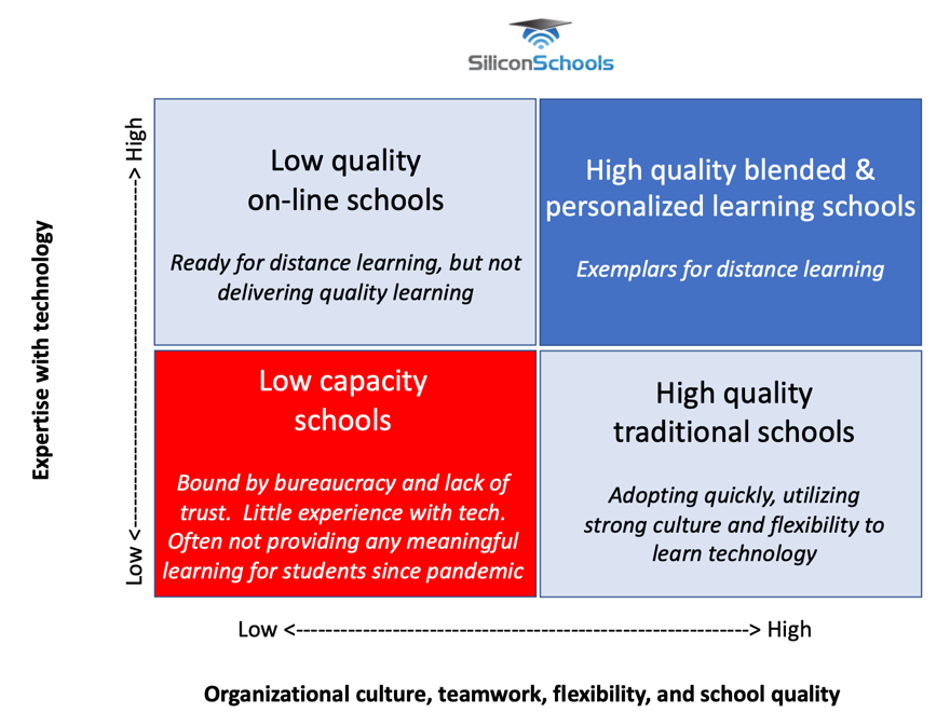 The graphic’s horizontal axis organizes schools by general effectiveness: culture, teamwork, flexibility, quality. The vertical axis organizes schools by expertise with technology, low to high. In the worst-case pandemic scenario, you are a child enrolled in a school system with an ineffective bureaucratic culture and a poor grasp of technology. In the best-case scenario – a highly effective, flexible and technically proficient organization – your school quickly reorganized efforts around distance learning to produce high-quality distance instruction.
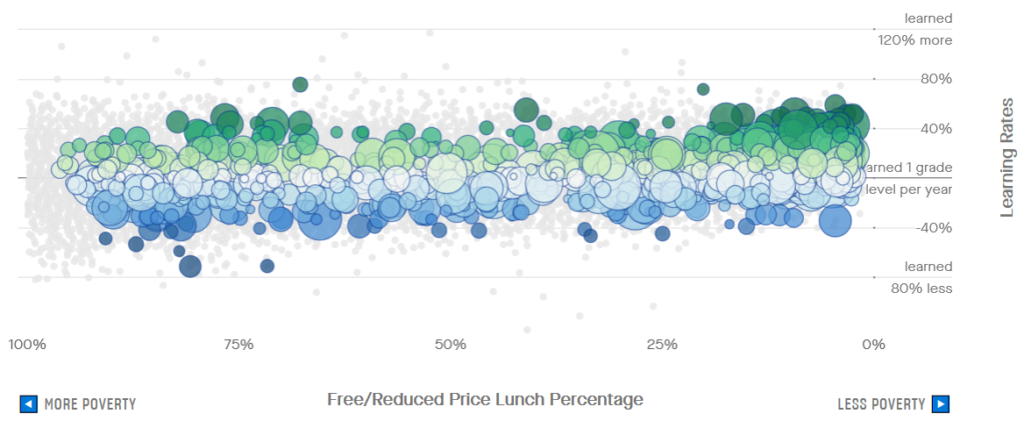
New York’s Success Academy Charter Schools have been lauded for the high levels of academic proficiency achieved by high-poverty students. Stanford University’s Opportunity Explorer, for instance, shows Success Academy schools posting about three grade levels above average in academic proficiency, despite free and reduced-price lunch eligibility in the 74 to 90 percent range. Plotted against all available data in schools nationwide, this means Success Academy is not only breathing some very thin air in terms of performance, but also that it can lay claim to consistent excellent achievement.
The horizontal axis in the Greenburg chart was not an issue for Success Academy, and as it happens, neither was technological dexterity.
How did Success Academy tackle pandemic-induced distance learning? Well, the Philanthropy Roundtable was curious about that, so it interviewed founder and CEO Eva Moskowitz on how the schools rose to the pandemic challenge. You can watch the video here. What Success Academy pulled off seems potentially revolutionary, and Moskowitz is sharing learning resources free of charge.
I’ll give you my CliffsNotes version of the video.
The most effective lecturer in the entire network of schools on any given subject delivered live instructional lectures, while other teachers broke students into smaller groups online to facilitate group discussion and projects. Teachers monitored ongoing assignments to identify students who were falling behind and proactively required students to attend online remedial tutoring sessions.
In other words, Success Academy staff took great effort to keep students on track.
Why is this potentially revolutionary?
Because Success Academy and anyone else mastering these techniques may be able to offer it as an option to both admission lottery winners and losers in the future. It may be possible, for instance, to serve many students currently floundering in the bottom left quadrant in the Greenburg graphic through these techniques.
Exempt from public haunt, and more importantly, the need to provide very costly school space, a new path to quality and scale may beckon.
This crisis version of Success Academy distance learning should be viewed as a mere prototype. Success Academy and others doubtless will improve upon these techniques.
Texas: House lawmakers approve a plan to expand charter schools statewide (Associated Press).
 Pennsylvania: The state's director of open records says charter schools are the No. 1 violator of the law (Pittsburgh Tribune-Review). Philadelphia public school officials recommend closing Discovery Charter School due to a dispute over enrollment caps and other concerns (NewsWorks). The School Reform Commission approved the renewal of five charter school contracts, with all agreeing to abide by a new enrollment cap (The Notebook).
Louisiana: State Superintendent John White warns of the fallout from the recent Supreme Court ruling on voucher funding, revealing the state needs to find an extra $29 million for the current school year (Times-Picayune). White also contends that the ruling will result in a $12 million refund for the public school system (Shreveport Times). More from Education Week. Charter Schools USA and National Heritage Academies look to build four charter schools in the Lafayette Parish (The Advertiser). The education department received applications for more than 100 charter schools (Times-Picayune).
Ohio: Lawmakers introduce a bill that would require Columbus schools’ property-tax dollars be shared with charters, and give the mayor the power to sponsor charter schools (Columbus Dispatch).
Maine: Democrats push bills that impose a moratorium on virtual charter schools and require charter schools function as nonprofit organizations (Bangor Daily News). More from the Kennebec Journal. The Education Committee votes along party lines to reject virtual schools (Portland Press Herald). Gov. Paul LePage wants to allow colleges and universities to authorize charter schools (Maine Public Broadcasting Network).
Florida: A magnet elementary school is considering becoming a charter school to save arts and music classes from district budget cuts (redefinED). A bill that won approval on the last day of the legislative session will open up public school funding to private virtual schools (Tampa Bay Times). Duval County Superintendent Nikolai Vitti says he miscalculated the impact that funding for charter schools would have on next year's school budget (First Coast News). (more…)
Oh how the blog gods have smiled down upon redefinED.
The 2012 Republican National Convention will be held in downtown Tampa this month – six blocks from the building that houses Step Up for Students and our humble blog. I received press credentials to cover the convention. And next week, as a lead-up to the event, we’ll be posting essays from some of the leading voices in school choice and education reform.
Here’s the line up: former U.S. Secretary of Education Margaret Spellings; Chester E. Finn, Jr., president of the Thomas B. Fordham Institute; Robert C. Enlow, president and CEO of the Friedman Foundation for Educational Choice; Joe Williams, executive director of Democrats for Education Reform; Michael B. Horn, executive director for education at the Innosight Institute; and Eva S. Moskowitz, founder and CEO of Success Academy Charter Schools.
With the RNC and November elections as a backdrop, we asked our contributors what – if anything – the federal government can do to promote school choice. It goes without saying that the responses are thoughtful, insightful and informative. They’re also diverse. They’ll give you plenty to think about – and even a few things to laugh at.
First up Monday: Secretary Spellings.
It is irresponsible to equate the values of parental empowerment and school choice today with the ugly history of Jim Crow. But Hazel Dukes, the president of the NAACP's New York State conference, now is fighting back at school closures and charter school expansions in New York City with just such a message.
Dukes announced she would hold a counter protest tomorrow in front of the Harlem Success Academy, whose leaders last week led a rally asking why the nation's oldest civil rights group would fight reforms designed to benefit poor blacks and Hispanics. Dukes said then, as she said today in a press release announcing the protest, that co-locating charter schools and traditional schools would be tantamount to "setting up separate and unequal education."
The NAACP had every reason to be anxious of private school voucher plans and other choice schemes that grew out of the War on Poverty in the 1960s, as some southern school districts made it clear they would take advantage of those policies to resegregate public education in their states. But choice as its proposed in New York City today, as it is in several other states considering or implementing voucher or charter school options, provides options disproportionately to low-income black and Hispanic children that often come from impoverished single-parent households. Hazel Dukes can stand before Eva Moskowitz and appropriately challenge the Success Charter Network's efforts without summoning the ugliest racial injustice in our nation's history. Dukes has used her influential position to tarnish an important policy debate and, more disturbingly, has abandoned a large part of her constituency that is looking to the NAACP for support in this new age of public education.
"Obsession with class size is causing many public schools to look like relics," Success Charter Network founder and CEO Eva Moskowitz writes in the Sunday Washington Post. Small class sizes are no guarantee of success, and a "19th-century school can be transformed into a well-managed 21st-century school by adding just two students per classroom."
As an example, she cites the makeup of the network's crown jewel, the Harlem Success Academy Charter School:
... we’ve gotten some of the best results in New York City ... some classes are comparatively large because we believe our money is better spent elsewhere. In fifth grade, for example, every student gets a laptop and a Kindle with immediate access to an essentially unlimited supply of e-books. Every classroom has a Smart Board, a modern blackboard that is a touch-screen computer with high-speed Internet access. Every teacher has a laptop, video camera, access to a catalogue of lesson plans and videotaped lessons.
Public schools are spending so much to reduce class sizes that there isn't enough left to ensure the development of the teachers they hire, Moskowitz writes. What's worse, she says, human capital is getting more expensive while better technology and intellectual property are getting cheaper.

