The story: Students with disabilities and English language learners were poorly served before the pandemic and will need urgent, long-term help to recover from learning losses, according to a report from the Center for Reinventing Public Education.
The Arizona State University think tank released its annual State of the American Student report today, with a bit of good news but mostly bad news.
“Our bottom line is we’re more worried at this point than we thought,” said Robin Lake, the center’s executive director. “COVID may have left an indelible mark if we don’t shift course.”
The good: Students are bouncing back in some areas. The average student has recovered about a third of their pandemic-era learning losses in math and a quarter in reading.
States and districts nationwide have implemented measures like tutoring, high-quality curricula, and extended learning time, and more school systems are making these strategies permanent. Florida, which offers the New Worlds Scholarship for district students struggling in reading and math, is on a list of states lauded for providing state-funding for parent-directed tutoring.
 Rigorous evaluations confirm the effectiveness of tutoring at helping students catch up.
Education systems across the country – as well as students and families – are starting to recognize the value of flexibility. “As a result, more new, agile, and future-oriented schooling models are appearing.”
That includes microschools and other unconventional learning environments, which are multiplying to meet increasing parent demand.
The bad: These proven strategies aren’t reaching everyone. The recovery is slow and uneven. Younger students are still falling behind. Achievement gaps are also widening with lower-income districts reporting slower recoveries. And the positive studies that show tutoring’s massive boosts to student learning tended to operate on a small scale. Making high-quality academic recovery accessible to every student remains an unmet challenge.
Districts face “gale-force headwinds,” including low teacher morale, student mental health issues, chronic absenteeism, and declining enrollment.
The ugly: The report singled out services to vulnerable student populations for a special warning. The report said this group, poorly served before the first COVID-19 infection, suffered the most. Evidence can be found in skyrocketing absentee rates and academic declines for English language learners.
Special education referrals also reached an all-time high, with 7.5 million receiving services in 2022-23. The report attributed some of this to the pandemic’s effects on young children, especially those in kindergarten who were babies at the pandemic’s onset, but other factors, such as improved identification techniques and reduced social stigma around disability, are also at play.
In short, school systems face larger numbers of students requiring individualized support than ever before.
‘Heart-wrenching struggles’: While some families adapted well, most parents reported difficulty getting services for their children with unique needs. Schools were often insufficient in their outreach. Even the most proactive parents reported difficulty reaching school staff, the report said. Parents who were not native English speakers also had the additional burden of trying to teach in a language they were still learning.
“Many families said schools didn’t communicate often or well enough, and many parents felt blindsided when they found out just how far behind their child had fallen,” the report said.
Recommended fixes: Schools should improve parent communication. The report called for schools to “tear down the walls” by adding schedule flexibility to ensure students’ special education services don’t conflict with tutoring and adding more individual tutoring and small-group sessions. It said schools should also seek help from all available sources, including state leaders, advocates and philanthropists. Schools should also prioritize programs such as apprenticeships and dual enrollment to prepare students for life after graduation.
How policymakers can help: The report urged policymakers to gather deeper data on vulnerable populations so problems can be identified and corrected; provide parents with more accurate information about their children’s progress and offer state leaders a clearer picture of whether those furthest behind are making the progress they need, and help teachers use AI and other tech tools to engage students with unique needs.
The report urged policymakers to place more control in the hands of families by making them aware of their right to compensatory instruction or therapies for time missed during school closures. It also advocated offering parents the ability to choose their tutors at district expense.
The bottom line: Urgent efforts to improve education for students with exceptional needs will benefit all students, the report said. “There can be no excuse for failing to adopt them on a large scale. National, state, and local leadership must step up, provide targeted support, and hold institutions accountable.”
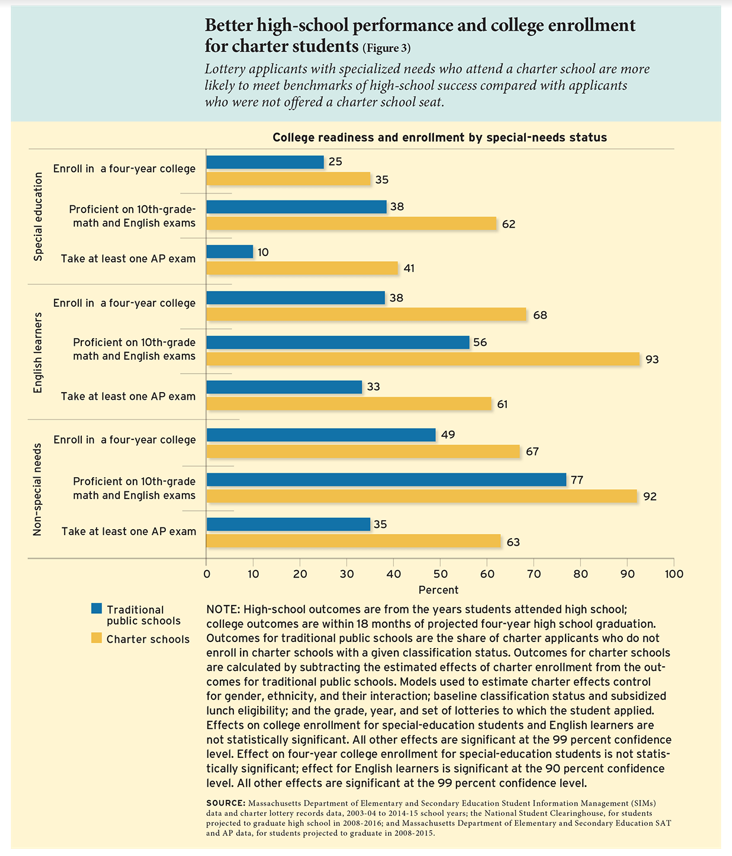 In 2016, Massachusetts voters soundly rejected a ballot proposition (Question 2) which would have allowed 12 additional charter schools per year. A recent study demonstrates how costly this decision has been, especially for special education and English language learner (ELL) students.
Tufts University Professor Elizabeth Setren analyzed enrollment lottery data for Boston charters in order to compare long-term outcomes for three groups of students: general education students, special education students and ELL students (see above). The random admission process provides confidence that observed differences in outcomes show the impact of the schools.
Professor Setren noted that the Boston district schools spend significantly more on special education than charters, but charter schools see much better results.
I find that charter enrollment at least doubles the likelihood that a student designated as special education or an English learner at the time of the admissions lottery loses this classification and, subsequently, access to specialized services. Yet charter enrollment also generates large achievement gains for students classified at the time of the lottery—similar to the gains made by their general-education charter classmates.
Classified students who enroll in charters are far more likely to meet a key high-school graduation requirement, become eligible for a state merit scholarship, and take an AP exam, for example. Students classified as special education at the time of the lottery are more than twice as likely to score 1200 or higher on the SAT than their counterparts at traditional public schools. English learners who enroll in charters are twice as likely to enroll in a four-year college.
Students with special education and ELL labels at the time of the enrollment lottery are more likely to discard that status in charter schools. They are also more likely to enroll in a four-year college, score proficient on state exams and take an Advanced Placement course. Notice as well that general education students also see large improvements in those same outcomes.
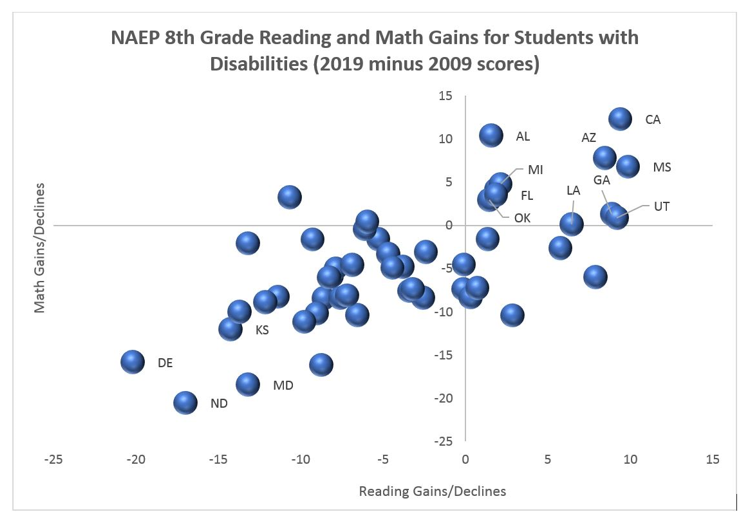
This study seems all the more important given the nationwide decline in NAEP scores for students with disabilities. While there are exceptions, most states saw declines in scores for both eighth-grade math and reading between 2009 and 2019.
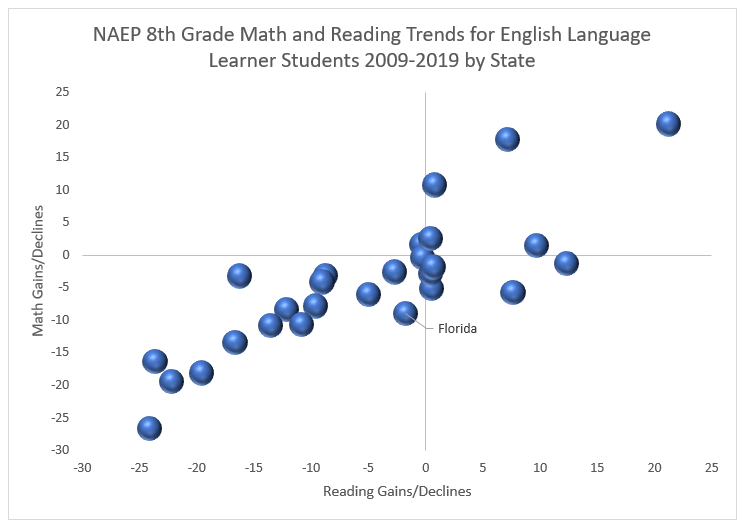
 A similar chart for ELL students during the same period looks even worse.
 So, Boston charter schools just might have a lesson about high expectations and inclusion. The charter school cap in Massachusetts, meanwhile, is limiting the opportunities for both general and special status students.
 Lawsuits. A Sun-Sentinel opinion piece praises the lawsuit challenging Florida's tax credit scholarship program, which is administered by organizations like Step Up For Students, which co-hosts this blog.
School choice. Transferring out of neighborhood schools becomes commonplace, as thousands of Duval students take advantage of school choice programs. Florida Times-Union. Pinellas schools work to lure students with a new marketing campaign. Tampa Bay Times.
Technology. Students are often moving into the digital age ahead of their schools, but that's starting to change. Tampa Bay Times.
Charter schools. A charter school founder and school board member in Collier County wins a state education award. Naples Daily News. The number of applications fell last year, but the approval rate increased. Naples Daily News. A Duval charter on the verge of closure gets temporary reprieve. Florida Times-Union.
Single gender. The New York Times explores the resurgence of single gender programs in Florida.
Magnet schools. A robotics magnet is part of the turnaround plan for a struggling Seminole County school. Orlando Sentinel. A South Florida magnet school's building becomes a lesson in energy efficiency. Sun-Sentinel.
Catholic schools. A new Catholic school is planned in Tampa. Tampa Tribune.
Testing. Florida's third grade retention policy will remain in place during the switch to new assessments. StateImpact. The Palm Beach Post explores the dispute between Florida and federal officials over testing for English language learners.
Arts. The Tampa Tribune profiles a local conservatory.
Lawsuits. The statewide teachers union, school boards association and other groups are preparing to announce the first direct constitutional challenge to Florida's tax credit scholarship program. Times/Herald. Sentinel School Zone. redefinED.
Testing. In clear violation of state law, the Lee County school board votes to "opt out" of all state standardized testing. Fort Myers News-Press. Naples Daily News. Collier schools roll out new end of course exams. Naples Daily News.
School choice. A Palm Beach school board member pushes for more choice options within the district, but meets resistance. Palm Beach Post.
Charter schools. The Northwest Florida Daily News visits a new, collegiate-themed charter high school.
English Language Learners. Gov. Rick Scott criticizes federal accountability rules for students learning English at an event in Miami. Miami Herald. Gradebook. He appears ready to challenge the standards for federal accountability waivers. StateImpact.
Common Core. The standards were not the election driver some expected. Sarasota Herald-Tribune.
Prayer. The Orange County school district's decision not to allow chaplains at football games draws heat from a local pastor. Orlando Sentinel.
Elections. Recounts are coming in Hillsborough and Palm Beach school board races. Palm Beach Post. Tampa Tribune. A winning Indian River candidate faces residency allegations. Indian River Press Journal.
Catholic schools. The latest evaluation of Florida's Tax Credit Scholarship program suggests Catholic schools get impressive reading results. The Thomas Fordham Institute's Ohio Gadfly runs the numbers.
Charter schools. A Palm Beach Post columnist rips charter schools.
Turnarounds. The EdFly highlights a successful effort to turn around a struggling Central Florida school.
Transportation. St. Lucie students who live close to their schools may soon have the option of paying for bus service from the district. St. Lucie News-Tribune. The Pasco school district improves communication with its bus system. Tampa Bay Times.
English language learners. Their treatment in the state's testing and accountability system is the subject of a dispute between Florida and the federal government. Tampa Bay Times.
Reading. The extra hour of reading for 300 struggling schools may be more like a half hour in two Southwest Florida districts. Naples Daily News.
Growth. Hillsborough's enrollment is up. Gradebook.
Charter schools. The Sun-Sentinel castigates charters in an editorial calling for more regulation. The Palm Beach Post looks at a local charter with high test scores.
Tax credit scholarships. The Orlando Sentinel does a Q&A on expanded eligibility.
Home education. A Christian school aims to support parents who homeschool their children with a new part-time program. Palm Beach Post.
Vouchers. The Sun-Sentinel criticizes McKay Scholarships in an editorial calling for stricter regulation.
Discipline. The Tampa Bay Times looks at a federal investigation into Hillsborough's handling of discipline for minority students.
Superintendents. The Tampa Bay Times looks back at the Hernando superintendent's first year. Hillsborough school board candidates focus on current superintendent MaryEllen Elia. Tampa Tribune.
Campaigns. Teachers jump into Volusia school board races. Daytona Beach News-Journal. Voters are split on a Brevard tax referendum. Florida Today.
Corporal punishment. Santa Rosa schools do away with corporal punishment. Pensacola News-Journal. Northwest Florida Daily News.
Administration. A study of effective principal supervisors comes to Broward. StateImpact. A Broward school district attorney worked with a lapsed law license. Sun-Sentinel.
Facilities. The Pinellas school district demolishes Largo High. Tampa Bay Times.
School boards. A Manatee County consent agenda leads to a glitch. Bradenton Herald.
Alternative schools. The Hernando school district prepares to consolidate two academies aimed at struggling students. Tampa Bay Times.
English Language Learners. Polk schools hire 22 bilingual teachers. Lakeland Ledger.
Editor's note: This post originally ran as an op-ed Sunday on VOXXI, in response to an op-ed by Dr. Rosa Castro Feinberg. Julio Fuentes is president and CEO of the Hispanic Council for Reform and Educational Options and a member of the board of directors for Step Up For Students, the nonprofit that administers Florida’s tax credit scholarship program and co-hosts this blog.
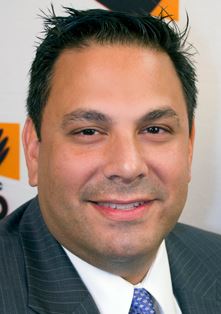
Julio Fuentes
In Florida schools, there is no doubt that English language learners, many of them Spanish speakers, are the most vulnerable and most struggling of our students.
To offer but one sad fact, only 11 percent of ELL (English Language Learners) students last year passed the 10th grade FCAT in reading, the test they must pass in order to graduate from high school. Let me repeat that so the gravity of the number sinks in: 11 percent. That’s compared to 54 percent of students overall, 41 percent of low-income students and 21 percent of students with disabilities. To be sure, standardized test scores should often be taken with a grain of salt. But it’s clear they wave a bigger red flag with ELL students than with any other group. And there is no doubt we must move with greater urgency to do all we can to ensure a brighter future for those students.
Given that backdrop, I must respond to Dr. Rosa Castro Feinberg’s April 24 op-ed, “Students learning ESOL with vouchers might be getting shortchanged.” I have the utmost regard for Dr. Feinberg. I appreciate the expertise she brings to the subject of ELL and ESOL students. And I do think there are some issues involving those students and tax credit scholarships (aka “vouchers”) that are worthy of fair-minded debate. But in this case, I must respectfully say that Dr. Feinberg’s concerns are misplaced, and that she is unfairly tarnishing a tool that can help ELL students.
At the end of the day, what tax credit scholarships do is simply give parents more options. Why in the world would we limit options for students who need help wherever they can get it? Dr. Feinberg listed a slew of things that public schools are required to provide ELL students, including extra funding and extra training for teachers. Many of those policies are well-intentioned and helpful. But the statistics show they’re not helpful enough.
This year, 35 percent of the nearly 60,000 low-income students using tax credit scholarships are Hispanic. Many were not satisfied with public schools, and so they used the scholarships to find something that works better for their children. If the ELL families among them felt their needs were being met in public schools, they wouldn’t have left. There are endless reasons for their frustration, but I have no doubt that the cultural barriers they sometimes face in public schools are among them.
Sometimes Spanish-speaking parents can’t communicate well with the staffs at public schools. At some public schools, there is no one who can help the family because no one at the school speaks their language. I don’t mean this as a knock on public schools, which are too often burdened with the impossible task of being all things to all children. But it’s a fact. It’s also a fact that many private schools serving Spanish students go to great lengths to ensure that even their written communications are in Spanish. I wish I could say the same about public schools, but unfortunately I know more than a few examples where that is not the case.
Perhaps unintentionally, Dr. Feinberg made a case for school choice and parental empowerment in her own op-ed. She suggested to parents, “Visit the school’s ESOL or bilingual classes. Do you think the children are learning English? If the school doesn’t offer these classes, think twice about changing schools.”
We couldn’t agree more. But it’s not in the best interest of ELL students for the parents to limit their visits to public schools. Why not explore all options? (more…)
Parent trigger. Parent trigger is not worth the fuss, writes Orlando Sentinel columnist Beth Kassab: "We're wasting time with political gamesmanship over a bill that both sides are making a bigger stink over than it's worth."
 Tony Bennett. New Indiana Superintendent Glenda Ritz accuses former super Tony Bennett, of wasteful spending on technology. Indianapolis Star.
English language learners. The growing challenge of growing numbers of ELLs. Associated Press.
Teacher retention. Pinellas is looking at ways to better recruit and retain teachers at high-needs schools. Finally. Gradebook.
Teacher evaluations. The Florida Education Association is planning to file suit over the new eval system, with details coming today. Gradebook and Orlando Sentinel.
Teacher pay. Miami-Dade teachers get performance-based bonuses - and cheer. Miami Herald. (more…)
Tutoring oversight. In the first part of a two-part series on a requirement initially mandated by No Child Left Behind, a Tampa Bay Times investigation finds at least 36 of 456 tutoring companies in Florida are headed by people with criminal records. In part two, the Times traces last year's last-minute legislative push to keep the mandate in place.
Educator oversight. Sarasota Herald Tribune: "As Bradenton police investigate allegations that a Manatee High School assistant football coach groped a female student, they are also trying to determine who knew about the girl's claims and why no one notified law enforcement as required by law."
Teacher bashing? A StateImpact Florida story headlined "Teachers Question Why Proposed Pay Raises Come Before Teacher Evaluations" quotes a single teacher who says, “For a while now we’ve been hearing how bad we are. [That] we need to weed out bad teachers, there’s so many bad teachers.” Ocala Star Banner editorial page editor Brad Rogers writes in this column: "There are so many wildly talented, caring and dedicated teachers in Marion County’s schools that unfairly take abuse and blame and criticism for what is wrong with our schools and our society, when in truth they represent what is most right and bright and promising about our schools and our society."
Teacher pay. Sen. Bill Galvano, chair of the Senate Education Appropriations Committee, suggests Gov. Rick Scott's proposal for across-the-board raises clashes with performance pay, reports the Florida Current. The South Florida Sun Sentinel also writes up the debate over proposals for higher teacher pay.
Strange bedfellows. The Florida Education Association plans to join the Florida Department of Education in fighting the Florida Times-Union's request for teacher evaluation data.
Tony Bennett. He talks to North Florida superintendents about teacher evals and notes he encouraged his daughter to become a teacher: "“I don’t want it written on my headstone: ‘Here lies the man that ruined the career his daughter chose.’ ” Tallahassee Democrat.
Teachers unions. The United Teachers of Dade will elect a new leader this week. Miami Herald. (more…)
Common Core. To conservatives: "I suggest you give up the bashing of a critically important reform simply because your political enemy endorsed it." EdFly Blog.
Charter schools. The highly successful Pembroke Pines charter school system says it deserves a share of the Broward school district's capital improvement dollars, reports the Miami Herald. The Pinellas school district will vote yet again Tuesday on whether to shutter the long-troubled Imagine charter school in St. Petersburg, reports the Tampa Bay Times. A Palm Coast charter hopes to bounce back from an F, reports the Daytona Beach News Journal.
Teacher evaluations. Senate President Don Gaetz says the new evals may be too complicated and, combined with other big changes in education, could put the system at risk of imploding, reports the Florida Current. Washington Post ed blogger Valerie Strauss uses Gaetz's comments to tee off on Florida ed reform.
More on teacher pay. Gov. Rick Scott's proposal runs up against competing demands, reports the Tampa Bay Times. It "would provide welcome relief" but doesn't make up for "all of the damage this governor has done to public education," writes the Times editorial board. Cash shows respect, writes Times columnist Dan DeWitt. It'll help show teachers are valued, writes the Pensacola News Journal. Give Scott credit for supporting merit pay and across-the-board raises, writes the Daytona Beach News Journal. His commitment needs to be more than a one-time gimmick, writes the Palm Beach Post. A good thing no matter the motivation, writes the Gainesville Sun. Transparent pandering, writes the Panama City News Herald. "Met with skepticism," reports the Tampa Tribune. Lawmakers should be careful about both teacher raises and a proposal to transform the state retirement system, writes the Ocala Star Banner.
Satanists. They like the school prayer bill Scott signed last year. Really. Coverage from Tallahassee Democrat and Associated Press. (more…)

