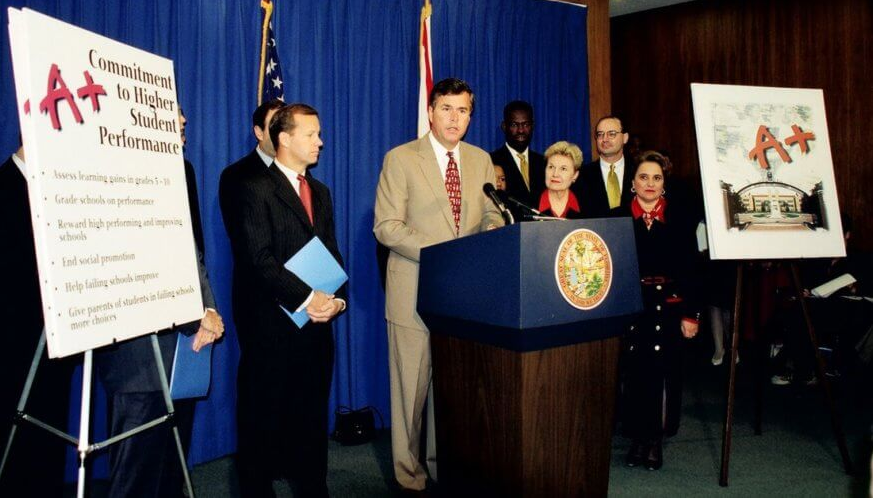
Florida Gov. Jeb Bush signed into law in 1999 the A+ Plan for education calling for greater school and teacher accountability eight years after his predecessor signed the Education Reform and Accountability Act.
In 1991, the Florida Legislature passed, and Gov. Lawton Chiles signed, Blueprint 2000: The Education Reform and Accountability Act. The purpose of Blueprint 2000 was to restructure how Florida’s public education system was managed.
In the late 1980s, Florida was a national leader in experimenting with teacher empowerment and site-based decision making (SBDM). The SBDM movement sought to transfer more decision-making power to schools in exchange for these schools being held more accountable for results. Blueprint 2000 was designed to create a state policy infrastructure that would institutionalize SBDM across all of Florida’s public schools.
Legislative and executive branch leaders, all of whom were Democrats, thought Florida’s public schools were underperforming because they were being micromanaged. Blueprint 2000 was going to change that.
I was one of four teacher union representatives on the state commission appointed in 1991 to develop the Blueprint 2000 implementation plan. In collaboration with the Florida Department of Education and thousands of educators, parents, business leaders, and other citizens, we created new state curriculum standards, a new state assessment system called the Florida Comprehensive Assessment Test (FCAT), established School Advisory Councils (SACs) at every public school, and required schools to implement annual School Improvement Plans (SIPs). We failed to reach consensus on how best to hold public schools accountable for results, a failure Jeb Bush fixed when he became governor in 1998.
Next spring will be Blueprint 2000’s 30-year anniversary. Florida’s public education system has made great improvements using the education reform and accountability infrastructure that sprang from Blueprint 2000. But that infrastructure has aged. Florida’s public education system needs a new blueprint. It is time for Blueprint 2030.
The COVID-19 pandemic is forcing educators and parents to innovate at a pace never before seen in public education. In the period of a month last spring, every district, private, and charter school campus closed and every student became a homeschool student. When school begins this fall, families will choose from a variety of instructional models, including on-campus, virtual, hybrid (i.e., a combination of on-campus and virtual) and homeschooling. In coming years, families will have access to even more choices.
State government has waived a variety of state laws and regulations to allow schools and families to adjust to this new normal. But these waivers are temporary solutions. Our state leaders need to start developing a new public education infrastructure, and Blueprint 2000 provides an approach they could consider emulating.
Similar to what the Florida Legislature did in 1991, the 2021 legislature could pass legislation establishing a commission to develop recommendations for creating a new public education infrastructure. This new infrastructure should be designed to support a more diverse and flexible public education system, one capable of meeting the unique needs of each student.
The largest task for this commission would be improving Florida’s antiquated public education funding system. This funding system is hostile to systemic innovation and the flexibility needed to meet each student’s needs.
The state has created flexible spending accounts for some students with unique abilities/special needs. About 16,000 families will use this spending flexibility this fall to customize their child’s education. Providing all families with access to flexible public education funds is necessary if all children are to benefit from a customized education program.
We also need to reinvent our state assessment and assessment data systems. As students increasingly receive publicly-funded instruction from multiple providers (tutors, virtual school, college via dual enrollment and assigned neighborhood school) we will need to assess the progress students are making with each provider, aggregate their achievement data, and properly share students’ data with those providers.
We also will need to institutionalize better processes for helping families and students pick the most appropriate providers. Well over 10,000 providers are eligible to serve the 16,000 unique abilities/special needs students using flexible spending accounts, often called Education Scholarship Accounts (ESAs). Deciding which of these 10,000 providers is the best fit for a specific learning need is a daunting task.
A Blueprint 2030 commission will have a huge job helping state government, school districts, schools and other education providers create the infrastructure necessary to support an effective and efficient post-pandemic public education system. We are never going back to the pre-pandemic education system.
Planning for the future should begin soon.
 We all know about charter schools, vouchers and tax-credit scholarships. But there is a new kid on the school choice block called “education savings accounts” (ESAs) and they can be used to purchase multiple education options at a time – and even to save for college.
A new Friedman Foundation for Educational Choice report, released Wednesday, provides a detailed look at how the parents in one state are using the accounts.
But first, a quick primer: Maybe one day opponents will call these ESAs “nuevo neovouchers” but today supporters call them “education debit cards,” and for a good reason. The state deposits the funds into an account which can be spent – via a debit card – on private school tuition, fees, curriculum (which would include books and other coursework material), online courses, exam fees and tutoring services. Unspent funds are rolled over to the next year and can even be deposited into 529 college savings accounts to pay for future college tuition. Parents receive disbursements to the account quarterly and are expected to submit expense reports quarterly as well to ensure compliance with the law.
Arizona’s ESA, the “Empowerment Scholarship Accounts,” pays parents 90 percent of the state support (currently worth $2,845). Special needs students receive additional support based on the severity of the disability, with the average special need student awarded $13,600 in 2012. Accounts are currently limited to active-duty military families, foster care children, special needs students, and students in schools rated D or F.
The Friedman Foundation discovered 85 percent of the 316 Arizona families with ESAs in 2011 used them to pay for tuition at a private school, 20 percent to pay for special education or therapy services, and 15 percent to purchase supplemental tutoring. The least utilized services included exam fees (like the AP exam) and online course fees. Overall, approximately 26 percent of the money in the ESA accounts remained unspent at the end of FY 2012-13, allowing the funds to roll over and accumulate in the next school year.
ESAs “open the doors to an education that is uniquely tailored to a child’s individual needs by enabling parents to direct funds to multiple education providers,” writes Lindsey Burke, author of the Friedman report. Indeed, 34 percent of families paid for multiple options – for example, attending a private school while also purchasing supplemental curriculum and tutoring services.
Several state legislatures have explored the ESA concept since 2011 (in Florida, bills were introduced but didn’t get far) but right now they are only available in Arizona.

