School vouchers and tax credit scholarships may not always improve participants' standardized test performance, but a growing crop of studies suggest they are cost-effective when it comes to encouraging economically disadvantaged students to pursue a college education.
Two recent Urban Institute studies, one on Milwaukee and the other on Washington, D.C., continue that trend. The reports follow similar results from a 2017 Urban Institute study of Florida's Tax Credit Scholarship program.
Students in Milwaukee using vouchers to attend private schools were more likely to attend college, while students in Washington were no more or less likely, to attend college than their public-school peers. Past Urban Institute research in Florida showed modest positive college attendance and associate degree gains among school choice participants.
Researchers Patrick Wolf, John Witte and Brian Kisida found Milwaukee voucher students were 6 percentage points more likely to attend a four-year college than their public school peers. Milwaukee choice students were 1-2 percentage points more likely to graduate college, but that difference was not statistically significant.
The researchers conclude, "students in the Milwaukee Parental Choice Program tend to have higher levels of many measures of educational attainment than a carefully matched comparison of Milwaukee Public School students."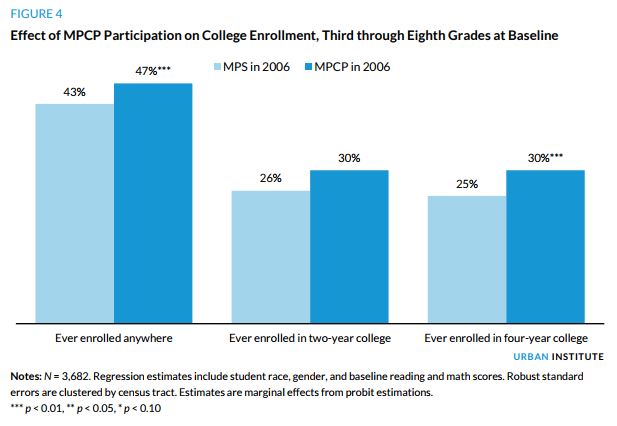
The year of educational choice — which saw a record number of scholarship programs created or expanded in states across the country — came to a disappointing end at the federal level. Last week, Congress approved an omnibus spending plan that leaves a closely watched voucher program in the nation's capital in limbo.
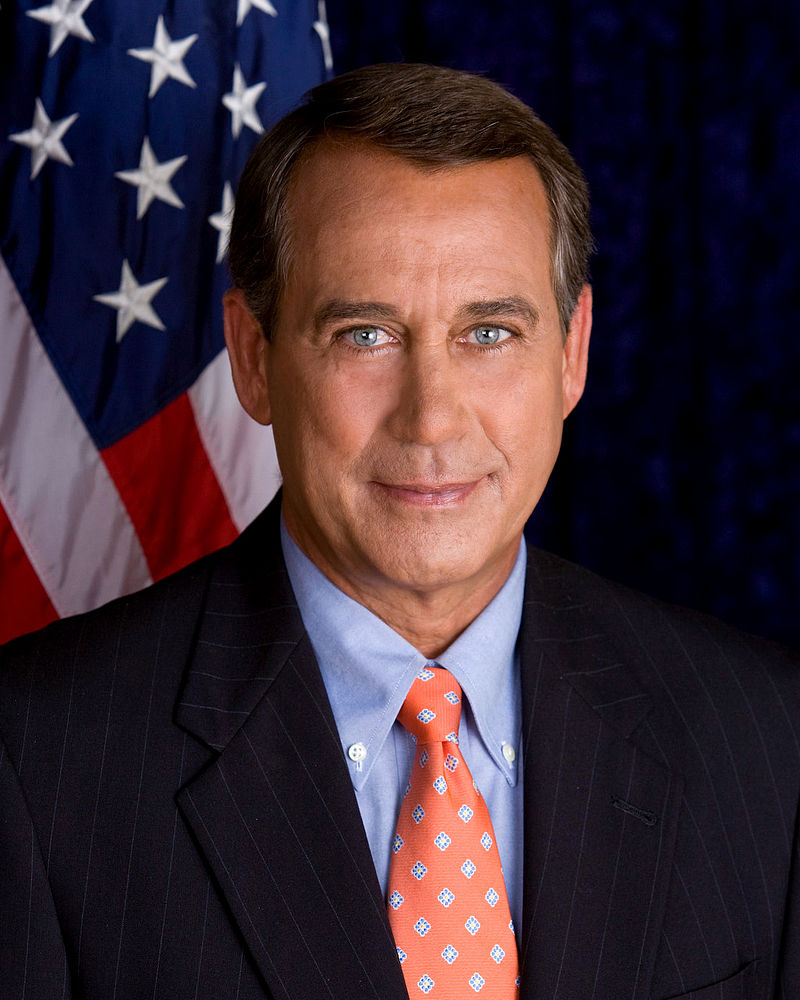
Former House Speaker John Boehner has been a key backer of the D.C. voucher program.
This is far from a fatal blow to the D.C. Opportunity Scholarship Program, since Congress has another year to reauthorize the program before it expires. But it's still a setback for school choice supporters, who will now have to overcome White House objections to vouchers during an election year.
The D.C. voucher program provided scholarships to more than 1,400 disadvantaged children last school year. It may be small compared to some of its state-level counterparts, but past reauthorizations have taken on outsize political importance, in part because the program falls under Congress' jurisdiction.
As the Washington Post noted in an editorial, it's also a shining example of the "three-sector approach" favored by many education reformers.
The program was created in 2004 as part of a three-pronged investment in D.C. public education that funds the vouchers and provides extra allocations of federal dollars to the public school system and public charter schools. Indeed, the three-sector federal approach has brought more than $600 million to D.C. schools, with traditional public schools receiving $239 million, public charter schools $195 million and the voucher program $183 million. The vouchers have allowed thousands of students, predominantly minorities, to attend private schools. Parents of scholarship students have extolled the benefits of school choice and the positive impact of better schooling on their children’s lives. Interest in the program, according to its administrators, has never been higher.

American Federation of Teachers logo. Source: Wikimedia Commons
The Washington, D.C. Opportunity Scholarship program is up for re-authorization in Congress. The voucher program has been shown to help disadvantaged students. But that hasn't stopped the usual suspects from trotting out their usual talking points.
The night before the House voted 240-191 to reauthorize the program, Washington Teachers Union President Emily Davis, blasted out an email to American Federation of Teachers supporters with the standard anti-voucher talking points.
In this alternate universe, vouchers don't lift student achievement (the evidence says they often do, albeit modestly for low-income students), public schools serve all students (not always), private school choice wastes money (scholarships worth up to $12,572, significantly less than what D.C. public schools receive), and the program has been "proven to be ineffective" (research has found it improves high school graduation rates). (more…)

Algie Howell
Algie Howell is a former public school teacher, a former school board member and a Democratic lawmaker from Virginia. He also happens to be a firm supporter of parental school choice – so much so, in fact, that he used a provocative term last week - “brainwashed” - to describe minorities who oppose private options such as vouchers and tax credit scholarships.
“I have a difficult job of selling this (school choice) to people, especially minorities, who have been to some degree brainwashed by unions and other people,” Howell said during a panel discussion at the Excellence in Action summit in Washington D.C.
In a follow-up interview with redefinED, Howell went into more detail, dismissing claims that school choice is an attempt to resegregate schools or that vouchers are a drain on public funding.
“If you have say 20 or 50 students that’s attending a public school, and they are not being provided with what they need in order to learn, and you take them out of there, and put them in a school where they can learn, you have not really lost anything,” he said in the podcast attached below. “You have gained something, because you have 50 students that benefited .... But they can’t see that.”
Howell is among growing numbers of Democratic lawmakers who support publicly funded, private learning options and defy the either/or caricatures perpetuated by school choice critics. He backed a tax credit scholarship bill that was signed into law last summer by Gov. Bob McDonnell. At the same time, one of his top campaign issues was higher pay for public school teachers. “For me, school choice is a strong Democratic value,” he said.
Howell said black churches and black ministers could do more to build support for school choice. He also said he wouldn’t be surprised if President Obama became a more forceful advocate for choice in his second term, including coming down squarely for the D.C. voucher program. “Does he not send his children to private school?” Howell said. “It’s kind of hard to argue, isn’t it?”

Chavous
Kevin Chavous, a senior advisor to the American Federation for Children, criticizes President Obama in this recent Washington Post op-ed for not supporting the Washington D.C. voucher program and suggests a new approach for Term 2:
I have long been a supporter of the president, and I continue to applaud many of his education initiatives, including his embrace of charter schools. But his administration’s opposition to giving low-income families the full slate of educational options — captured when he zeroed out funding for the program in his budget this year, despite the earlier deal in which he agreed to reauthorizing the program for five years — is unacceptable. ...
These roadblocks are part of a long history of the administration’s resolute opposition to the voucher program, from Education Secretary Arne Duncan rescinding 216 scholarships in 2009 to the department ignoring the positive results of a gold-standard study, conducted by its own Institute of Education Sciences, that found that D.C. voucher students graduate at a rate of 91 percent — more than 20 percentage points higher than those who sought a voucher but either didn’t get one or didn’t enroll in the program after being accepted. Because of the delaying tactics of the department, a credible — and federally mandated — new study of the program cannot be conducted unless the program enrolls hundreds of new students next year. ...
On many occasions during his first term, President Obama demonstrated an ability to embrace education reforms that help kids, and I expect that to continue now that he has won a decisive reelection. What’s different about this one? This is an easy one: All he and his Education Department have to do is get out of the way and let a successful program work. Full op-ed here.
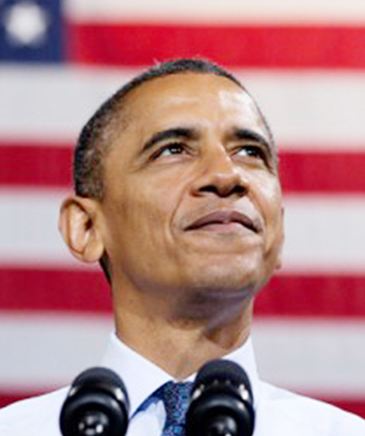 President Obama has often called on us to be true to who we are as a people, as Americans. And in his second term, he has the opportunity to transform the education system back to our core - to where parents are primarily in charge of children’s educations.
We have paid a price for transferring authority and responsibility for educating children from parents to government entities. With mostly though not always good motives (remember Brown v. Board of Education), we allowed the dream of the government-owned and operated common school to live on despite overwhelming evidence that, in reality, it wasn’t working. A child’s educational destiny continues mostly to be a function of his/her zip code and the competence of strangers who sit on local school boards.
For more than three decades, a long, slow correction of this anomaly in American society has been underway. First, intradistrict and interdistrict transfers began to appear that allowed limited parental choice within some parts of the public school system. Then magnet schools surfaced, offering options such as vocational, talented and gifted, and language immersion programs, and responding to more demands. In 1992, charter schools emerged. Today they account for almost 6 percent of all public schools, approaching 6000 total, and the number grows steadily each year because the demand from parents so far is insatiable.
Thanks to my colleague at the American Center for School Choice, Gloria Romero, a new tool has appeared. The parent trigger empowers parents to make changes to their school when they are not satisfied. Already 20 states have considered the approach and seven have adopted laws.
Private school choice programs continue to gain support, too. And they have done so despite fierce opposition from forces that want to defend market share over a parent’s right to choose. Today, 32 such programs operate in the country. And in recent years, many school choice bills have either been passed by legislatures with Democratic majorities or signed by Democratic governors. Just as important, once enacted, these programs have only grown. No state has repealed a program or decided choice does not serve the public well. Moreover, the doomsday scenarios that opponents consistently forecast for public education systems have never happened.
It’s said you can’t argue with a river; it is going to flow. Parents are going to take back the authority and responsibility for educating their children. The river has been flowing for more than 20 years and the current is gaining speed. It’s time for more Democrats to stop arguing as families assert their fundamental and universally accepted American value that they know the best choice for their children. Democrats need to work in positive ways to transform our system. We need good schools and there’s plenty of room for all types - public, charter, and private.
President Obama has the life experience, as well as the political skills and credentials, to lead this transformation, and to make it less jarring and less confrontational. (more…)

Laurie Lee
One of Arkansas’s top school choice advocates, Laurie Lee, is on the road this month in her home state, visiting 28 cities in four weeks to spread the gospel of education reform.
Arkansas ranked No. 5 among states in an Education Week report that gave it a B- overall. The national average was a C.
But look closer at the findings, said Lee in a phone interview, as she headed toward Mountain View. Arkansas netted a D for its K-12 achievement. Its graduation rate is 70 percent. And of those students who do graduate, 18 percent aren’t ready for college coursework, Lee said.
“Overall, our state’s economy is waning,’’ she said. “We’re losing jobs and foreclosure is high. And you can tie it all back to education.’’
That’s what led Lee to organize The Arkansas Reform Alliance or TARA, a grassroots nonprofit coalition that represents parents, educators and community leaders who want to increase school accountability and improve student success.
Expanding school choice is high on its list.
“We need more options,’’ said Lee, the alliance’s executive director. Her daughters were enrolled in public schools before she switched them to private, virtual and home education in search of the best fit.
Arkansas is home to 18 open enrollment charter schools and 14 district-conversion charter schools, public schools that were converted into charter schools, according to the state Department of Education website.
But to Lee’s group and others, that’s nowhere near enough. They want fewer restrictions on public school transfers. They want more charter and virtual programs. And they want tax-credit scholarships and vouchers. (more…)
 Liberal Democrat Michelle Rhee and conservative Republican Jeb Bush shared a stage at the RNC in Tampa today and suggested that despite the hyper partisanship on so many issues, there is increasingly common ground when it comes to education reform.
“This is a chance for a Switzerland,” said Bush, the Republican Party’s standard bearer on education, referring to that country's policy of neutrality in wars.
Bush, who is giving a prime time speech at the RNC Thursday, said Mitt Romney will be a “very good president on education.” But he also praised President Obama and U.S. Secretary of Education Arne Duncan on their education initiatives, including Race to the Top. “This will be very heretic but I’m getting used to being heretical,” Bush said. “The president by picking Arne Duncan did a good thing for the country.”
Rhee, the former Washington D.C. education chancellor who now heads the advocacy group StudentsFirst, said it’s important to continue building bipartisan bridges to counter critics who will continue to try and sow division. “We have to fight really hard against that polarization,” she said.
Comments from the pair came after StudentsFirst sponsored a special screening of “Won’t Back Down,” the soon-to-be-released Hollywood movie about a mother and a teacher who use a parent-trigger-type law to turn around a struggling, inner-city school. They spoke before hundreds at the Straz Center for the Performing Arts along with the film director, Daniel Barnz, producer Mark Johnson and the moderator, former CNN anchor Campbell Brown. (Former Secretary of State Condoleezza Rice was also scheduled to be part of the panel, but could not make it because of the weather.)
Barnz and Brown also contributed to the nonpartisan atmosphere.
“This is not a partisan concern, this is an American concern,” Brown said after noting America’s high dropout rate and middling academic performance among other industrialized nations.
Said Barnz: “The movie makes an appeal for a kind of centrism … What I’d really like to see happen with the movie is to kind of strike a middle road.”
Rhee recalled that in D.C., former Mayor Adrian Fenty, a Democrat, put all of his political capital into backing her hard-charging plans to address low-performing teachers and schools. Fenty lost re-election, and Rhee resigned. Among the lessons learned, she said: critics were organized and able to quickly mobilize while “there was no equivalent political network on the education reform side.”
Both Bush and Rhee offered strong support for expanding school choice. With Bush, that’s no surprise given his longtime backing of private school vouchers, tax credit scholarships and charter schools. But Rhee is better known for tackling reforms like teacher tenure and evaluations. (more…)
Washington D.C.: The Obama administration relents on funding for the D.C. voucher program and okays a deal that will allow a small expansion. (Washington Post)
New Hampshire: Gov. John Lynch (pictured here) vetoes a legislative proposal for tax credit scholarships, but some expect an override. (Concord Monitor)
Florida: Former Gov. Jeb Bush stresses school choice, accountability and common ground in a speech to Latino officials. (Associated Press)
North Carolina: A legislative proposal for tax credits scholarships has been rolled into a broader education reform bill in the state House. (Associated Press)
Pennsylvania: A proposed state budget would expand the tax credit scholarship program from $75 million to $150 million a year at the same time public school funding levels are kept the same. (Associated Press) The state senate passes a bill that would make it easier for traditional public schools to be converted into charter schools in financially troubled districts. (Bloomberg)
Colorado: Debate arises over the validity of a survey that finds a lack of support for the Douglas County School District's voucher program. (Education News Colorado) (more…)
If there were any doubt that Democratic presidential politics drove the Obama administration’s decision Monday to keep D.C. Opportunity Scholarships alive another year, Education Secretary Arne Duncan removed it with his tortured statement by way of public explanation.
“The President and I are committed to ensuring that the education of the children currently in the D.C. Opportunity Scholarship program is not disrupted," Duncan wrote. “We remain convinced that our time and resources are best spent on reforming the public school system to benefit all students and we look forward to working with Congress in a bipartisan manner to advance that goal.”
Unfortunately, this has become the go-to talking point for the secretary when asked to defend his administration’s opposition to a scholarship that is helping struggling low-income students in the District of Columbia. Never mind that Duncan’s own agency has determined that the students who take the scholarship are performing at higher academic levels, that the program has strong support from parents, and that Congress has cushioned even any perceived financial impact on traditional D.C. public schools by giving them an extra appropriation. The president simply won’t cross the teacher unions on vouchers.
Rather than acknowledge the political pickle, Duncan is left tripping over his own words and basic common sense. (more…)

