A venture philanthropy fund that aims to expand private schools that serve low-income and working-class students, has begun making investments in Florida.
One early grant will provide $300,000 over three years to help Cristo Rey Tampa — a Catholic college-preparatory high school — to support its four-year school build-out.
The Tampa school opened its doors to ninth graders earlier this year, and will add one higher grade level per year as it grows to fill a remodeled boarding school that had previously stood vacant.
Initially targeting the states of Florida, Arizona, Ohio, Louisiana, Wisconsin and Indiana, the Drexel Fund has set a long-term goal of raising $85 million to support the creation of 50,000 new spaces for low- and middle-income students in high-quality private schools over eight years. (more…)
 Catholic schools. The Tampa Bay Times highlights the new Cristo Rey Catholic High School that's coming to Tampa.
Testing. State assessments go missing, leaving third graders in limbo. Florida Times-Union.
Technology. A Tampa entrepreneur develops an app to streamline school car lines. Associated Press.
Security. Marion County's tab for school resource officers rises. Ocala Star-Banner.
Administration. St. Lucie Superintendent Wayne Gent poaches principals from Palm Beach, where he previously led the district. Palm Beach Post. Pasco schools make administrative appointments. Gradebook. (more…)
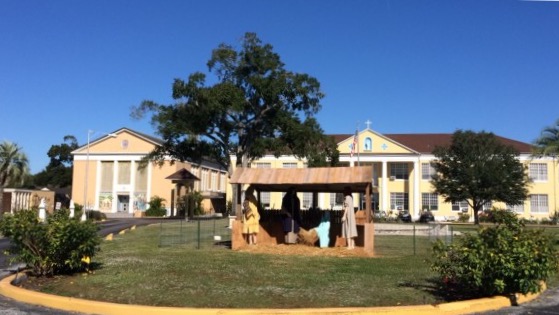
The new Cristo Rey Catholic School will be located at Tampa's Mary Help of Christians Center.
Why would a law firm want to hire a team of fourteen-year-old high school freshmen to work in its office?
Ordinarily, perhaps it wouldn’t. But, like 38 other employers in the region, the Gilbert Garcia Group in Tampa, Fla. has signed up for some new employees to support a unique approach to Catholic education that has made a difference for low-income and working-class students in other cities.
Michelle Garcia Gilbert, the firm’s president and CEO, says she wants employees to engage in “hands-on giving,” which is why she’s signed up to sponsor the soon-to-be-open Cristo Rey Tampa High School.
The new school, set to open this fall, will be the first Florida location for a national network of Catholic schools known for pushing low-income young people toward college, with a signature work-study program that helps cover their tuition and prepare them for the professional world.
Gilbert said she recognizes the potential impact the new school will make on the Tampa Bay community, and that she’s confident students with limited means but no shortage of “ability and interest” will be able to make a contribution at the office.
The college-preparatory Catholic school will be located in an East Tampa ZIP code where one in four residents has not completed high school. This presents a challenge for the network that boasts a 100 percent college acceptance rate for its graduates.
It’s a challenge the school welcomes with open arms, due to its Salesian identity. The Salesian order was founded in 1859 by Don Bosco, a Catholic priest-turned-saint whose mission was to be a friend to at-risk youths. The Salesian identity embraces “preventative” educational methods, which take a holistic approach to discipline by developing the whole person: body, heart, mind, and spirit. (more…)
A new report looks at a key aspect of the Catholic school renaissance we've explored before on this blog: The rise of private school management organizations — which, it turns out, are not confined to Catholic schools.
 The report, from the Friedman Foundation for Educational Choice, looks at the rise of these private school networks, which borrow some features from their cousins in the charter school world.
Charter management organizations like KIPP and education management organizations like Charter Schools USA now run a third of America's charter schools, providing financial backing, back-office support and other advantages to schools in their networks.
According to the report, new organizations are starting to do similar things for private schools.
These budding private school management organizations (PSMOs) are independent entities that operate or help operate three or more private schools. They are a potentially important innovation in the supply of private schools.
The authors — Kelly Robson, Juliet Squire and Andy Smarick of Bellwether Education Partners — tracked down 14 organizations that meet their definition, which means they exist outside the government or existing church structures. Eight of the organizations have some kind of church affiliation. Most of those, including the two that are active in Florida, are Catholic. There's also a network of Lutheran schools. (more…)
Tampa, Fla. may soon become a hub for a new breed of Catholic schools that target disadvantaged students and help them get to college.
The latest sign: The Cristo Rey Network planning to open one of its high schools in the city. The new school is set to open in 2016.
The Chicago-based network operates 28 college-preparatory Catholic schools around the country. Its model for urban faith-based education has been praised for its success with low-income and minority students.
Cristo Rey schools are aimed at students from families earning less than $44,000 year, and proclaim that all of their recent graduates have been accepted to college. Students participate in work-study programs that help cover their tuition costs. They spend one day a week working in professional settings like banks, hospitals and law firms.
While they operate with the blessing of local church leaders, the Cristo Rey's governance and operations are separate from parishes and dioceses that traditionally run Catholic schools. The network's unique organizational structure has gotten the attention of some school choice advocates, who have approvingly likened it to high-impact charter school organizations.
The Cristo Rey Tampa High School is set join another relatively new family of urban Catholic schools that recently set up shop in the region: The Notre Dame ACE Academies.
Both Tampa Bay-area ACE schools serve students up to eighth grade. Like the Cristo Rey schools, they stress college attendance and offer a Catholic education to low-income students from a variety of religious backgrounds (more than 40 percent of Cristo Rey students are non-Catholic).
These schools target states like Florida, Louisiana and Arizona that offer private school tuition scholarships to low-income students. The Florida tax credit scholarship program is one such program. It is administered by Step Up For Students, which co-hosts this blog.
Sonia Sotomayor, Supreme Court justice, might never have blossomed in the Bronx without the help of a faith-based school, a Catholic oasis called Blessed Sacrament. Sotomayor herself says so. Asked by Anderson Cooper if she would have become who she is without the school, Sotomayor said, “Doubtful.”
Sadly, Blessed Sacrament is closing this year, felled by the same social and economic forces – and education policies - that contributed to the shuttering of 1,300 Catholic schools in the past 20 years. There is tragedy and irony in its passing. You don’t have to be religious to feel it.
For most of this country’s history, faith-based schools have been a fundamental part of the American experience. But now, as the nation continues to wrestle with how best to get academic traction with poor and minority kids, its 21,000 religious schools continue to shrink, and continue to be mostly overlooked as a potential piece of the solution.
Here’s the tragic part. Eleven of 12 gold standard research studies find positive academic outcomes for students using vouchers to attend private schools, the vast majority of them religious schools. More recently, William Jeynes, a researcher at California State University, Long Beach, found via a meta-analysis of 90 studies that students in religious schools were on average seven months ahead of their peers in traditional public and charter schools. This was after controlling for race, gender, poverty and parental involvement.
Faith-based schools are a financial bargain, too – for all of us. Average tuition is thousands of dollars less than per-pupil funding for public schools, so collectively, taxpayers are saving tens of billions of dollars a year.
All this isn’t to say faith-based schools are the end-all, be-all. They range in quality just as charter and virtual and traditional public schools do. But in this era of customization, they offer more options, and in this time of desperation, more hands on deck. There is no good reason to bar them from the mix of educational alternatives that is helping parents and educators find the best fit for each and every child. (more…)
 Editor's note: "Blog stars" is our occasional roundup of thoughtful stuff from other ed blogs and sometimes a newspaper or two.
Don't forget course choice
From a Shreveport Times op-ed: Nearly all of us have had an experience where we were stuck in a class in which no matter how many times the teacher explained a concept, we just couldn't grasp it. Our friends around us may have understood, but it just didn't make sense to us. The class whisked along, we fell further behind, and the frustration mounted. What if we had had the chance to take the class online, at our own pace, with concepts explained multiple ways until we grasped it?
Louisiana students now have that option.
Thanks to Act 2, a law that Gov. Bobby Jindal signed into law in the spring of 2012, a student attending one of the state's lowest performing schools — those with a grade of C, D, or F — now has the right and the funding to take courses from any of the 45 state-approved high-quality course providers, so long as the student takes at least one course in her "home" district school. Students at schools graded an A or B will also have the right to take any online course that their local school does not offer, thereby expanding a student's course options, and a district could also decide to allow a student to take any online course through the program. ...
As every parent knows, every child has different learning needs at different times. If we hope to have all children succeed in school and life, then we need a system that can personalize for their different needs. While the world has changed, however, our schools have not. Instead we have an education system that mandates the amount of time students spend in class but does not expect each child to master her learning. The result is that students don't receive the support they need to master each subject before they move on to the next one. This creates gaps in every child's learning — gaps that haunt them later in their schooling. Full op-ed here.
Private schools funded through students jobs
From Jay Mathews' Class Struggle blog: Twelve years ago, I stumbled across a story that seemed too good to be true. A Catholic high school in Chicago ensured its financial survival by having students help pay their tuition by working one day a week in clerical jobs at downtown offices.
This was a new idea in U.S. secondary education. New ideas are not necessarily a good thing, because they often fail. But the creator of Cristo Rey Jesuit High School was an educational missionary named John P. Foley who had spent much of his life helping poor people in Latin America. I was not going to dump on an idea from a man like that without seeing how it worked out.
Now I know. The Cristo Rey network has grown to 25 schools in 17 states, including a campus in Takoma Park, where more than half the students are from Prince George’s County and more than a third are from the District. It is blossoming in a way no other school, public or private, has done in this region. ...
More than 90 percent of the students at the original Cristo Rey school were from low-income families. Few had been subjected to the pressures of big-city offices. But they received proper training for their clerical assignments. As the experiment proceeded, they realized the writing, reading and math skills they were learning in school were relevant to their new jobs — and their work experience would help them find jobs to pay their way through college. Full column here.
Revolution hits the universities
From Thomas L. Friedman at the New York Times: LORD knows there’s a lot of bad news in the world today to get you down, but there is one big thing happening that leaves me incredibly hopeful about the future, and that is the budding revolution in global online higher education. (more…)
The American Center for School Choice, which partners with Step Up For Students to host redefinED, has just established a Commission on Faith-based Schools. Here is the press release announcing its formation.
An ecumenical commission of leaders representing the majority of faiths that operate schools in the U.S. plans to collaborate and inject the importance of full parental choice in education into the national dialogue, the American Center for School Choice announced today. The Center’s newly-established Commission on Faith-based Schools met for the first time last Thursday in New York City.
“It is essential that the right and freedom of parents to choose the best education for their children be recognized and we believe this Commission will make an important contribution toward that goal,” stated Peter Hanley, executive director of the Center.
The Commission’s two immediate tasks will be to: 1) expand public understanding and appreciation of the role of faith-based schools in American education, especially in low-income communities; and, 2) address the need for expanding publicly funded school choice to increase a family’s ability to choose from among a full range of options, including a faith-based school. Over the coming months the Commission will be documenting the characteristics and benefits these schools provide to families and to American education. It will be releasing a report and convening a national conference in spring 2013 to communicate its findings.
“Faith-based schools have served families well since America's earliest years. In recent years, many religious communities have opened new schools, and today faith-based schools are more diverse than ever. Unfortunately, many more have closed, especially in urban areas where they have been a powerful source of hope for many families. Faith based schools are precious assets, not only for the families they serve, but for the nation. Families have a right to choose faith based schools, and a wise nation should support their choice" commented Commission Chairman Michael Guerra, an American Center board member and former president of the National Catholic Educational Association. (more…)
 A chain of Catholic, college-prep high schools that has demonstrated success with low-income students is eyeing two Florida cities for a possible expansion. Tampa and Miami are near the top of the list for the Chicago-based Cristo Rey Network, group president Rob Birdsell told redefinED. The reasons: A good job pool. The availability of tax credit scholarships. A need for more high-quality options for low-income kids. And maybe even some nudging from former Florida Gov. Jeb Bush.
“We very much want to get to Florida,” Birdsell said in a phone interview. “Gov. Bush is a friend of Cristo Rey (and) he is persistent.”
Lauded by education reformers and others for innovative work with Hispanic and African American students (see if you can get through this “60 Minutes” piece without crying), Cristo Rey now operates 24 Catholic high schools in 17 states and the District of Columbia. Its students typically come in two grade levels behind. But 84 percent of those who graduate enroll in college.
The students pay more than half of the $12,000 average tuition through a corporate work study program that gives them real-world experience at banks, hospitals, law firms and other partners. Accessing Florida’s tax credit scholarship program – worth $4,335 per student this fall – would fill out most of the remaining gap. That would take pressure off both the families and the network’s fundraisers. (more…)

