 And these children that you spit on
As they try to change their worlds
Are immune to your consultations
They're quite aware of what they're going through
David Bowie, Changes
A district school superintendent recently told me: “COVID has kicked the education reform can down the road 15 years. I’m not sure we are all aware of the implications yet, but the belief that we are returning to 2019 ‘normal’ is folly.”
Wired reported this month on the increase in homeschooling during 2020:
In 2019, homeschooled students represented just 3.2 percent of U.S. students in grades K through 12, or around 1.7 million students. By comparison, 90% of U.S. students attend public school. But a March 2021 report from the U.S. Census Bureau indicates an uptick in homeschooling during the pandemic: In spring 2020, 5.4% of surveyed households reported homeschooling their children (homeschooling being distinct from remote learning at home through a public or private school).
By fall 2020, the figure had doubled to 11.1% … The U.S. Census Bureau’s survey indicates that homeschooling rates increased across all ethnic groups in the past year, and the greatest shift was among Black families, who reported a 3.3 percent rate of homeschooling in spring 2020 and 16.1% later in the fall.
Tyton Partners made another set of estimates based upon a survey of parents. Nothing looks revolutionary at first glance in these estimates, but look closer and you can feel the earth shift under your feet.
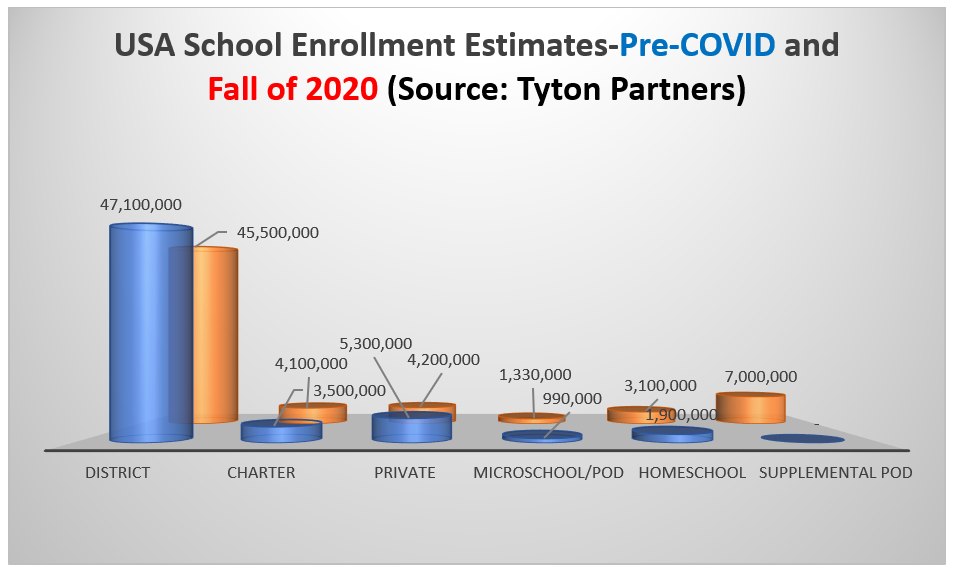
The Tyton estimates show a less profound (but still sizeable) move to homeschooling. You probably shouldn’t get overly attached to either estimate because the situation is very fluid, and we’ll know better in the fall. Even if the Tyton numbers are closer to reality, as the Wired article notes, the ease with which people can homeschool has increased, as have the incentives to do so.
There will be no putting this toothpaste back in the tube.
If the Tyton estimates are accurate, district and private schools will have suffered their largest single-year declines in history while charter schools, micro-schools and homeschools enjoyed large increases in enrollment, and supplemental pods emerged spontaneously to educate 7 million students. We see, for instance, a rate of charter school enrollment almost four times that of the average between 2000 and 2018. The shakeup likely isn’t finished.
The largest decrease in enrollment nationwide came from kindergarten students, with parents choosing to “redshirt” rather than enroll them in fall 2020. A National Public Radio survey of 100 school districts found an average kindergarten enrollment drop of 16%.
Assuming most of those families choose to enroll for fall 2022, schools likely will have to shift teachers out of first-grade assignments (where there will be fewer students) into kindergarten assignments (where there will be more). Which school sector they sort themselves into and at what rate also will be of interest. A back-of-the napkin estimate of the number of redshirted kindergarteners based upon the typical size of recent cohorts and the 16% figure would fall between 500,000 and 600,000 students.
The Wired article contains a point-counterpoint between a representative of the American Association of Superintendents and the Black Family Homeschool Educators and Scholars. The Superintendent’s representative makes the usual worried statements about money for the system. The Black homeschool advocate seems much more focused on the interests of students:
… Ali-Coleman, of Black Family Homeschool Educators and Scholars, warns against over-emphasizing the limitations of low-income families. She says that not all homeschooling families are necessarily financially privileged, either, pointing to Fields-Smith’s research on single Black mothers who homeschool their kids in spite of low-income status.
Moreover, adequately funded public school systems can still harm children of color: More money won’t shield a child from unequal discipline, a biased curriculum, or a pervasive school-to-prison pipeline that disproportionately pushes Black youth out of schools and into criminal justice systems.
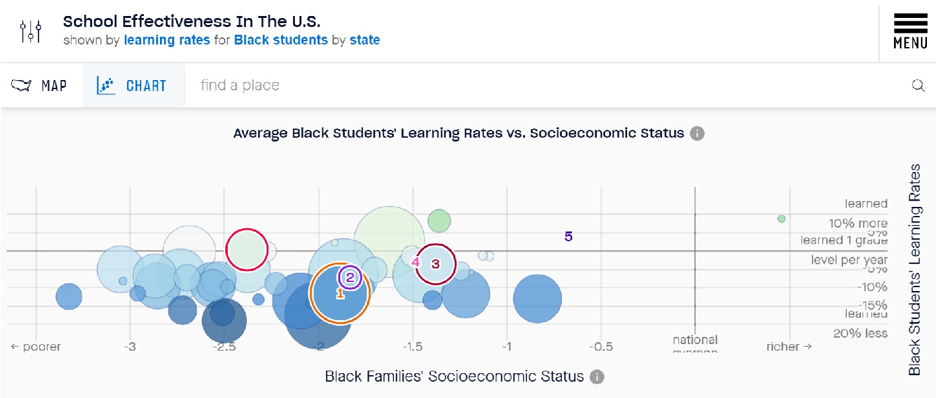
Sure enough, when you plot academic growth for Black students in the top five spending states – in order, New York (1); Connecticut (2); New Jersey (3); Vermont (4); and Alaska (5) – in the Opportunity Project at Stanford University explorer, only Alaska has a rate at or above the national average.
Of greater interest still will be Tyton Partners’ estimated 7 million students who engaged in supplemental pods. These students remained enrolled in another school online but joined small education communities to do so.
The Tyton Partners survey found 15% of parents made shifts in their child’s schooling situation this past fall. More change is likely on the way for this fall. In the medium to long term, the most significant change likely will be the availability of entirely new sectors and methods of education.
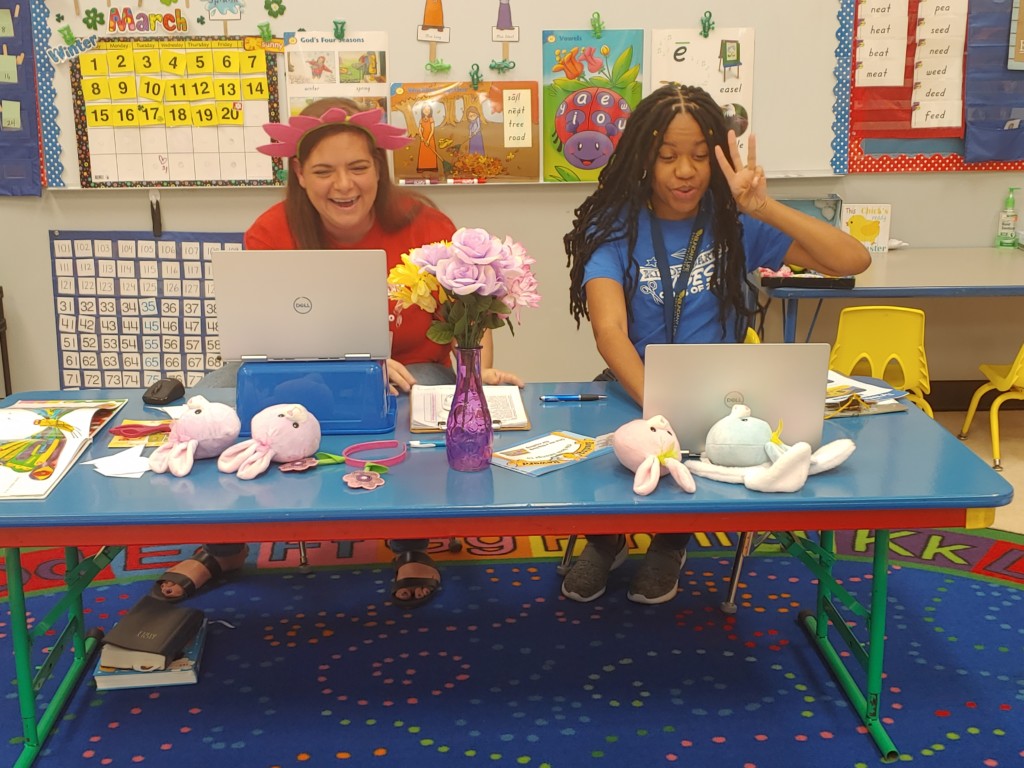
Abundant Life teachers Sarah Hennebery, left, and Carmen Mondesir conduct their end-of-week lesson, which included devotions, circle time, a spelling test and a math lesson.
The past year has been like a wild ride through the wilderness for Abundant Life Christian Academy, a small, faith-based private school about 15 miles northwest of Fort Lauderdale. Think Big Thunder Mountain Railroad, a fast, bumpy, roller coaster-type ride aboard a speeding train through a haunted goldmine in the dark at Walt Disney World Resort in Orlando.
Days before state leaders ordered COVID-19 school closures, principal Stacy Angier knew what was coming. As a member of the Broward Health Board of Commissioners, she had been working with the county’s nonprofit healthcare system to prepare her community for the shutdown.
Taking steps to prepare her students, families and staff for virtual instruction was nevertheless a challenge. The intrepid Angier managed to do it all in three days.
One year later, as the 2020-21 school year comes to an end, she’s breathing a sigh of relief. Despite enrollment declines that threatened the existence of some private schools and resulted in permanent closings of 209 of the nation’s 6,000 Catholic schools, Abundant Life remains intact.
“We have survived,” Angier said. “Most of our kids are back at school, and we’re going to make it.”
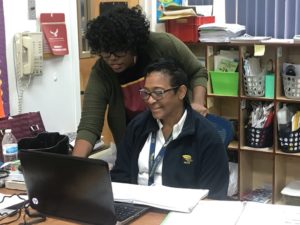
Fourth-grade teacher Jasmine White assists third-grade teacher Sharon Nugent in learning online platforms for remote learning.
Angier reopened Abundant Life to in-person instruction in August while continuing online learning for those who wanted it. Masks, desk shields, daily deep cleaning, social distancing and $320,000 in federal aid made it possible, along with state scholarship programs managed by Step Up For Students, which hosts this blog.
Angier also closely monitored the latest COVID information from Broward Health.
About 60% of the students chose in-person instruction. That number recently rose to 80% as families began feeling more comfortable about sending their children back to the classroom. Abundant Life’s total enrollment stands at 457, about the same as it was during the 2019-20 school year.
Looking ahead, Angier said she expects to see more interest from families whose children attend district schools, thanks to the recent expansion of state scholarship programs and raised awareness among parents.
Angier said positive COVID tests were limited to 26, thanks to safety protocols that included isolating and sending home anyone who appeared to be the slightest bit under the weather. It came to be known informally among the students and staff as the “three-sneeze” rule.
“I had a student tell me a teacher had sneezed three times and ask if they should be sent home,” Angier recalled. “When you can minimize exposure from kids not feeling well and from adults, keeping people who are sick home really does help everybody else.”
She said the school had zero flu cases, which she attributed so the stringent rule enforcement.
Despite the challenges, Angier and her staff managed to maintain a sense of community. They hosted an in-person National Honor Society induction ceremony for students and parents. They also allowed school sports to continue as much as possible.
At the end of the soccer season, the team gifted Angier with a backpack signed by all the team members as a thank you for letting them play.
“We tried to keep things as normal as possible,” she said.
Learning among those who were online proved to be the biggest challenge. Angier said teachers monitored virtual students closely to make sure they were turning in assignments and hitting benchmarks. Those who didn’t were directed to return to campus.
“The ones who have been home all year, unless they had a really focused parent … did not do as well as we wanted,” she said.
To address learning losses, Abundant Life is offering a three-week summer program in July that will be open to all students. Aigner expects those students who were learning at home, especially those with less adult supervision, will benefit the most.
“Those kids are seeing the most learning loss, so we we’re trying to target that to get things made up,” she said. “Some of these kids have lost a year.”
Slowly, things have returned to what used to be, although the school will continue some practices, such as encouraging children to eat lunch at outdoor picnic areas.
This week, Angier and 36 eighth graders, along with chaperones, celebrated the end of a stressful year with a field trip. The trip wasn’t part of her original plan; it evolved after the eighth-grade teachers came to her and told her the students were restless and disappointed that they had not been on a field trip all year.
“Where do you want to go?” she asked the kids. “You guys plan a trip and we’ll see what we can do.”
They chose Walt Disney World, the “happiest place on earth.”
Angier said the hotel staff worked to make it special, allowing the kids to swim one evening until 10. A Michigan couple at poolside asked if this was a school trip. Angier said yes.
“It looks like they’re all family,” the woman replied.
 Award-winning journalist, bestselling author and speaker Eric Weiner noted, “All the golden ages, as we’ve seen in Athens and Hangzhou, contain an element of free for all, a chink in time when the old order has crumbled and a new one is not yet cemented. It’s a jump ball, and that’s when creative genius thrives, when everything is up for grabs.”
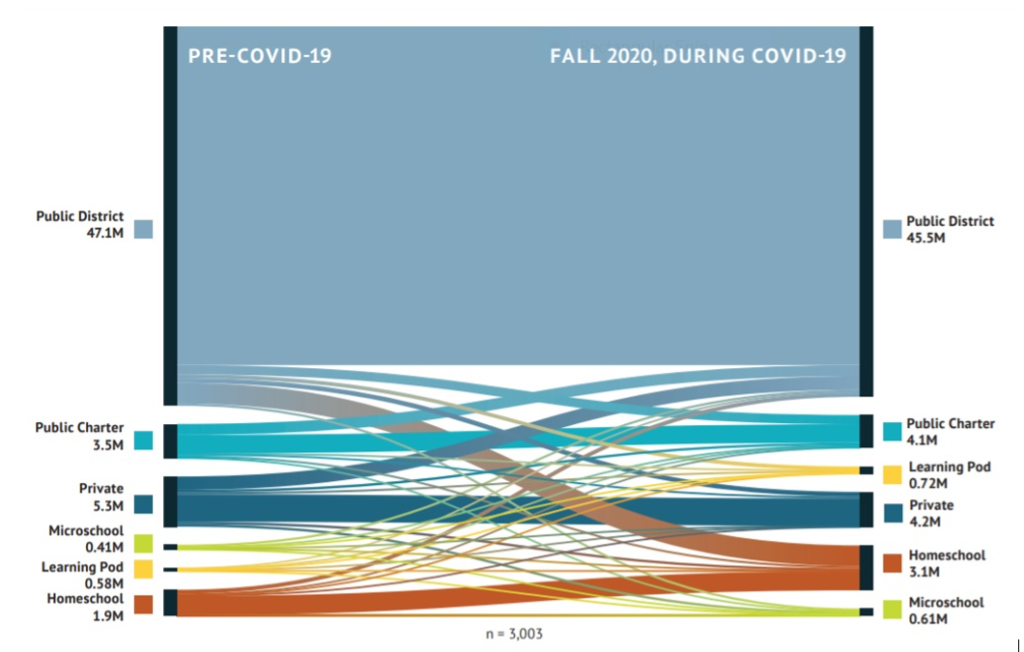
In the chart above from Tyton Partners, a leading investment banking and strategy consulting firm, you see both creative genius and the early stages of a K-12 system that indeed is up for grabs.
Tyton Partners conducted a longitudinal study of K-12 enrollment and family spending, finding interesting trends during the COVID-19 pandemic. Among the initial findings:
· Parents and caregivers took greater responsibility for school decision-making. More than 15% switched their child’s school for the 2020-21 academic year, which is estimated to be 50% higher than behavior pre-pandemic.
· School enrollments shifted with public and private schools experiencing an estimated decrease of 2.6 million in student enrollment; charter schools, homeschooling, learning pods, and micro-schools all realized net increases.
· The pandemic catalyzed growth of supplemental learning pods – defined as cohorts of students gathering in a small group, with adult supervision and outside the framework of their traditional physical or virtual classroom – to learn, explore, and socialize.
· Households spent an estimated $20 billion more on an annualized basis on education-related activities, primarily stemming from the emergence of supplemental learning pods.
· Five activities independently correlated with a parent’s positive perception of his or her child’s learning experience during COVID-19.
· Limited awareness of, and access to, alternative and emerging learning models significantly hindered parent agency, particularly for parents at lower-income levels.
That last point is vitally important, and we will return to it.
According to Tyton Partners’ estimated overall enrollment trends based on schooling decisions of its survey sample, both district schools and private schools lost enrollment from pre-pandemic levels – an estimated 47.1 to 45.6 million public school students; and 5.3 million to 4.2 million private school students.
Every other form of schooling gained enrollment: charter schools (3.5 million to 4.1 million), homeschools (1.9 million to 3.1 million), micro-schools (410,000 to 610,000), and learning pods (580,000 to 720,000).
Additionally, Tyton Partners estimate that almost 7 million students took part in supplemental pods, meaning they remained enrolled in a remote school but participated in an in-person learning pod.
Private schools took the biggest loss in the estimates. The mandatory closures in the spring of 2020, the surge in unemployment, and the uncertainty surrounding the fall of 2021 combined to close many of them. The shape of the post-pandemic world, however, appears much more diverse, with significantly larger charter, home and micro-school sectors.
Many families decided to “red-shirt” their kindergarten-aged students in the fall of 2020 rather than enroll them in “Zoom school.” How these families decide to educate their children will be one of the major shoes to drop in the fall of 2021, with the other being another scramble across sectors. District to homeschool represented the biggest sector jump in the fall of 2020, followed by private to district.
Now back to the equity question raised in that final bullet point.
Micro-schools are schools, and schools require resources to operate. Micro-schools will continue to grow mostly as a form of education that is accessible only to the well-to-do unless lower-income families are able to access their public K-12 funds in education savings accounts.
Some pod operators have been able to access public funding to address equity issues and in a way that empowers families. The battle to empower families continues, as do the possibilities for the empowered.
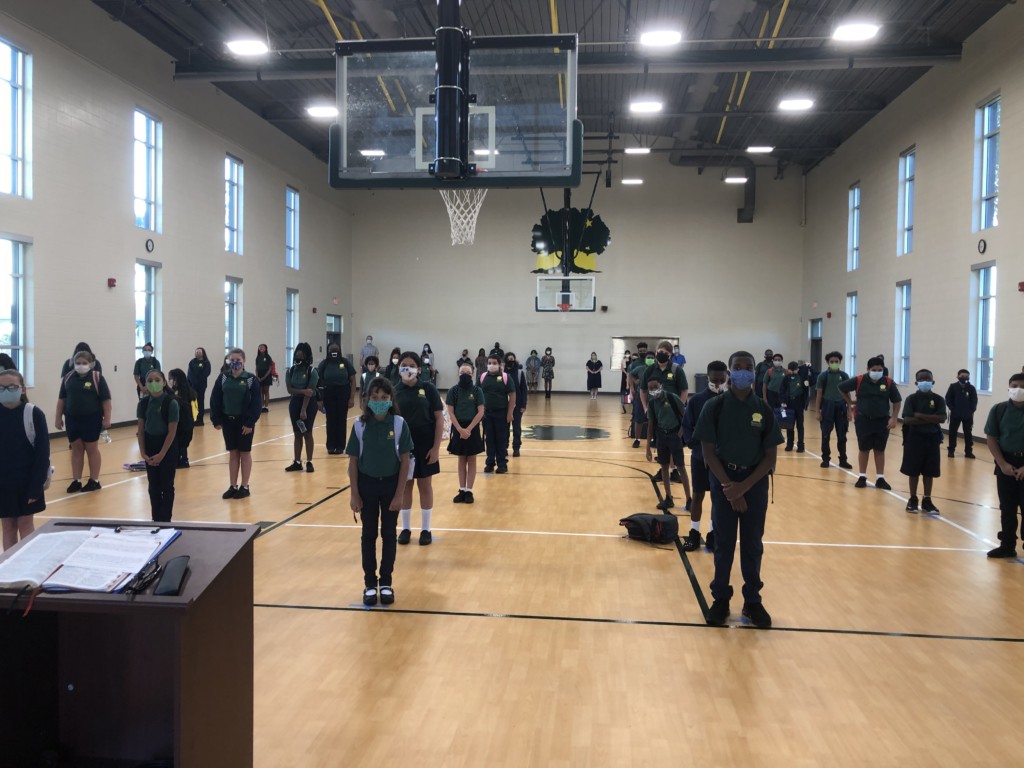
The spacious Lakeland campus of Academy Prep opened to in-person instruction last fall, with online learning available to those wanted it.
Academy Prep Center started the 2020-21 academic year with a unique perspective. Understanding that education is hardly a one-size-fits-all proposition, even in the best of times, school officials allowed the trio of private schools to tailor their reopening plans to parents’ needs, with a different look and feel at each location.
The St. Petersburg school opened entirely online after 100% of the parents requested it. The Lakeland location, which was roomy enough to accommodate social distancing, opened its oak-shaded campus to in-person instruction, with online learning available to those wanted it. The Tampa school offered a hybrid experience, with online instruction and an open campus where students who lacked adult supervision at home could come to participate in online classes.
“We have to all just be more agile and not be afraid to ask for what we need,” L’Tanya Evans, head of school for Academy Prep Center of Tampa said at the time.
As the traditional academic year ends, all but a handful of Academy Prep students are back in person, with Lakeland ending its online program in September. School leaders say they will return to full brick-and-mortar operation for summer programs and continue it when the 2021-22 academic year starts in August.
“I cannot say enough about how inspired I am and how impressed I am by the students we served through the year and our colleagues who serve these students,” said Lincoln Tamayo, head of school for Academy Prep Center of Lakeland. “It is a great testament to our better natures.”
All students who attend Academy Prep, which offers a rigorous program to prepare economically disadvantaged students for college, attend on Florida Tax Credit Scholarships administered by Step Up For Students, which hosts this blog. School leaders went above and beyond to offer all students a safe environment amid the pandemic, including a strict mask policy, social distancing and hygiene rules. Students were organized in cohorts that remained in the same classroom all day, with their teachers changing classes.
Tamayo, who also serves as chief operating officer for the foundation that oversees the three nonprofit middle schools, said that arrangement created the biggest challenge for students who as active middle schoolers weren’t used to staying in one area all day.
The challenge for teachers was having to transporting their materials from classroom to classroom all day. The other big challenge for the adults, Tamayo said, was having to “constantly remind” students to stayed properly masked.
But despite the inconveniences resulting from operating a school during a pandemic, Tamayo called the year an overwhelming success. Of the nearly 70 students at the Lakeland school, only five COVID cases were reported. None of the staff was infected, and only one adult who was not an employee of the school contracted the virus. All infections occurred away from the school, Tamayo said.
“I will say that for the benefit of those we are here to serve, it served our kids extremely well, and we were very happy to engage them in person and through the year the way we are meant to engage as humans,” he said.
He pointed to the school’s first chess championship as a testament to the students’ passion for learning; two-thirds of the student body came out on a Saturday morning to participate.
“That speaks volumes,” said Tamayo, adding that he expects to see gains on standardized tests when results come in.
Seventy percent of students at Academy Prep Center of Tampa returned to in-person instruction after nine weeks of a hybrid arrangement in which a handful of students came to campus each day with to access distance learning, while most accessed distance learning from home.
“We needed that time to get our campus ready,” said L’Tanya Evans, head of school for Academy Prep Center of Tampa.
Gradually, as COVID didn’t pose as much of a threat as initially expected, students and staff returned. Today, 87% of students are learning in person on the Tampa campus, and all faculty members but one are teaching in person.
“We’re feeling pretty familiar,” Evans said.
Like the Lakeland and St. Petersburg campuses, Academy Prep Center of Tampa continues to follow all safety protocols including mask wearing, social distancing, and hand washing.
“We’ve been very blessed that we haven’t had any exposures since January,” Evans said. “We’ve been able to keep exposures and keep students in their cohorts. The students adapted very well. We’ve been proud of what we have been able to do with a Herculean effort.”
Frequent breaks for stretching and movement proved helpful for the students, and Evans has used food to keep her staff motivated, bringing in home-cooked meals three times a week that she prepared herself.
“I wanted to make sure my faculty is being taken care of, and this includes a mental health component as well,” she said. “We wanted to see what things we can do so they can be their best selves for the kids.”
Evans also has worked hard to make sure all 124 seats are full for the 2021-22 school year. Unlike Academy Prep Center of St. Petersburg, which is more of a neighborhood school, the Tampa location draws students from as far away as Riverview in the southern part Hillsborough County and Wesley Chapel, which lies in an adjoining county just across the northern Hillsborough county line.
She has visited area after-school sites such as Boys and Girls Clubs as well as churches and other schools, and the school is sending out 5,000 direct mail pieces to homes in target ZIP codes to make families aware of the school’s mission and invite them to enroll their children.
At Academy Prep Center of St. Petersburg, which opened entirely online in August, in-person classes resumed in late March in rooms with bipolar ionization filters and hand sanitizing stations. Students also stayed in their homerooms with teachers moving from room to room.
“We’re about 80 percent in person and 20 percent online,” said Gina Burkett, head of school for Academy Prep Center of St. Petersburg. “We’re going to finish 80-20, but in the summer, we’re going to be a full in-person campus.”
Though students started the school year online and spent much of the year learning remotely, that didn’t stop them from exceling.
Test results showed no measurable learning loss during the pandemic, and many students improved their scores during virtual learning, Burkett said. The average grade-point average during the pandemic was 3.1, with 40% of students earning academic honors.
Enrichment also continued, with 14 different online programs being offered each quarter.
Meanwhile, enrollment has remained steady at 137, just three seats short of the 140 maximum, with attendance at 99%.
The school is preparing to transition to its summer program, which begins in June. The traditional academy year will begin in August.
Burkett said the St. Petersburg communities that the school serves tend to be more cautious about safety than the communities of the other two schools, so all mask use and other protocols will continue through the summer, with leaders re-evaluating for August.
“We don’t need to make that call right now,” she said.
Fundraising, a critical aspect Academy Prep Center, a nonprofit, has remained strong at all three schools. The Tampa and St. Petersburg schools have each held events this year and exceeded their fundraising goals. The Lakeland campus has a live event, Evening of Stars, set for tonight. It will include an open house and dinner.
“The angels in our communities have been very understanding, sympathetic and empathetic with the changes we have gone through, Tamayo said. “They have really doubled down on their care and consideration for us.”
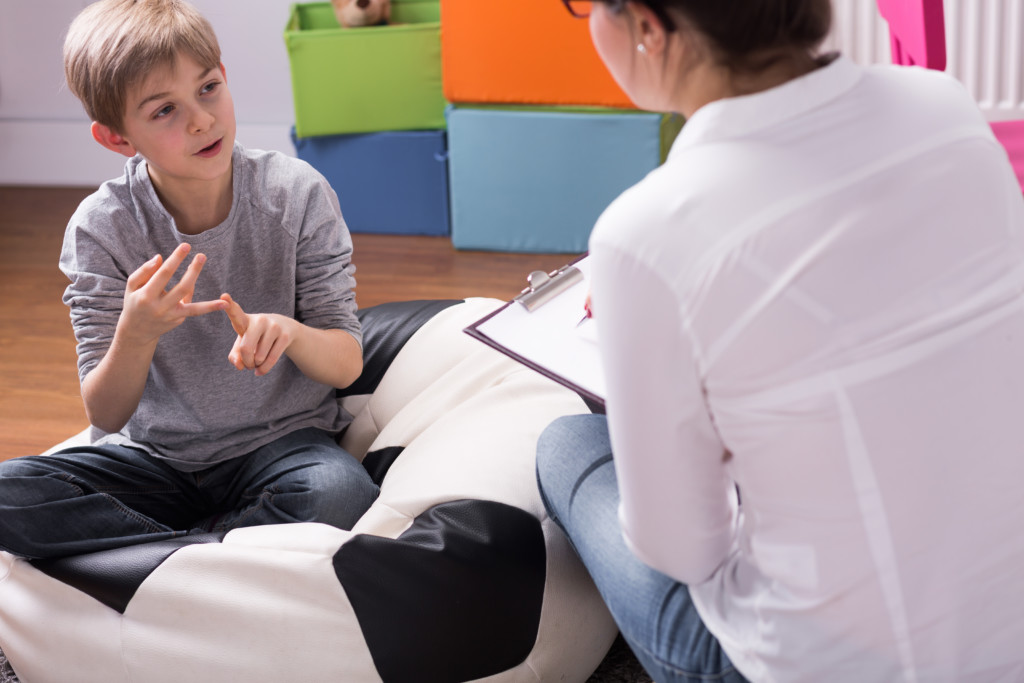
The percentage of homeschool households nationwide more than doubled between spring and fall 2020, growing from 5.4% to 11.1%.
As the coronavirus pandemic began disrupting education around the world, first-year elementary school teacher Emily Brigham faced something she hadn’t expected: an opportunity.
Approached by a few families who were searching for safe, reliable educational options for their children, Brigham made the decision to leave her job at Seaside Charter School in Jacksonville and join the homeschool movement that had served her when she was a student herself.

Emily Brigham
“I just wanted to help kids however I could, seeing what a vulnerable place they’re in,” Brigham, 24, reasoned last summer. “I want to be a friend to them; I want to help guide them. I want to help them learn to love learning and to love discovery.”
Her decision came at a pivotal moment, when homeschooling numbers, which for years had remained steady at about 3% of the nation’s schoolchildren, began soaring as parents who were concerned about their children’s health – and too much screen time – turned to home education.
A recent Census survey shows the percentage of homeschool households nationwide more than doubled between spring and fall 2020, growing from 5.4% to 11.1%. State-by-state results ranked Florida third in the nation with more than 18% of homeschooling households, only behind Alaska and Oklahoma, with nearly 28% and 20%, respectively.
Even as the pandemic challenged families, it provided opportunities for educators like Brigham to re-invent how they earn their living. She envisioned her foray into entrepreneurship as part grand experiment, part great adventure – with a tinge of uncertainty.
How would she adjust from being in the same classroom with the same students all day to working with a variety of students on different platforms? Inspiration came from an unexpected source: her music background.
A music teacher since she was 14, Brigham and her sister grew up performing bluegrass and folk music with family members at coffee houses and farmers’ markets. That background gave her a window into the “gig economy” that’s taken hold in so many industries over the past year, including the education world.
It may account for why she adjusted so well to her new arrangement, which includes one-on-one tutoring for about five local families, sometimes in person and sometimes over the phone or on the Zoom platform. She consults with parents on curriculum and lesson plans and grades student assignments.
She’s been getting rave reviews from the families she serves, including Ashley Frieling, who is brand-new to homeschooling.
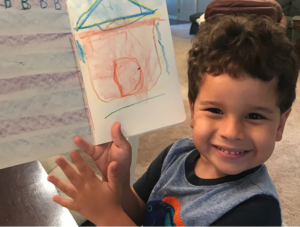
Dean Frieling
“Emily has graciously been there to answer all of my questions about curriculum, child development and so much more, said Frieling, whose 5-year-old son, Dean, learned how to read with help from his mom and Brigham. “It also feels like cheating to have someone who knows my children’s strengths and weaknesses and is a certified teacher to look over my curriculum and help me fill in the gaps.”
Brigham, who also works for an online Christian school in Pennsylvania teaching writing, rhetoric and grammar to students in fourth through eighth grades, said her biggest surprise over the past year has been the long hours she’s logged.
“I worked from 9 a.m. to 9 p.m. and Saturdays as well,” she said. “I was used to a lot of work, being a classroom teacher in the public schools, but going from elementary to middle school, the kind of grading was not what I was used to.”
Another surprise – a pleasant one – was that she’s been able to match the salary she earned as a traditional classroom teacher.
But the best part of last year, she says, was interacting with students. She discovered that younger children and older ones, though different in their levels of sophistication, have a lot in common. Her first graders told her of loose teeth and skinned knees, while her middle schoolers talked about hobbies, homework and how little sleep they got due to homework.
“They’re both very talkative,” she said.
She has no regrets as she wraps up the school year, prepares for the summer term, and looks forward to the start of the 2021-22 school year. Now that she knows what to expect, she plans to cut back on the music lessons to regain more work-life balance.
“I am very happy with what I am doing,” she said. “The experience has been really satisfying in that I feel like I am using what I learned in my education classes (at the university of North Florida) and at Seaside. It’s like taking school choice to a whole new level.”
She offers this advice for other entrepreneurial-minded educators:
“If this is something somebody wanted to pursue, there has to be a willingness to do a lot of different things. No one can support themselves fully on tutoring alone at first, but as more people hear about it that can become the greater part of your income.”
Brigham counts herself fortunate to be living with her parents, who cover her health insurance. Jobs in the gig economy, which don’t come with pension plans, aren’t for everyone.
But for now, she is embracing the opportunity and enjoying it for as long as it lasts.
“This feels like a bridge, she said. “I’ll see where it takes me.”
This is the website image that greets families of Saint Francis Academy in Bally, Pennsylvania, with the closure of the 277-year-old school.
A new report from the Cato Institute finds that no fewer than 132 private schools have announced permanent closure over the past year, at least partially due to economic effects of the pandemic. Additional findings indicate private school enrollment has dropped as much as 5% overall.
Cato’s COVID-19 Permanent Private School Closures tracker shows closures struck hardest at the beginning of the pandemic and climbed steadily each month from April through July, when closures peaked at 35. The hardest hit sector appears to be schools that are disproportionately low-cost.
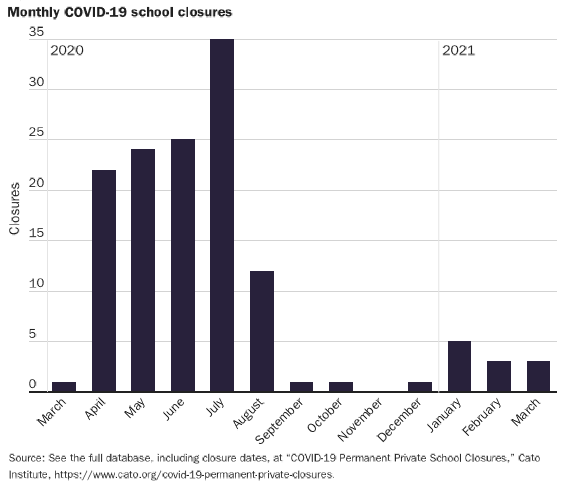 The data show the pandemic impacted schools as young as five years old but also claimed 277-year-old Saint Francis Academy in Bally, Pennsylvania, which was founded in 1743. Only the school’s early-education program remains.
Of shuttered schools, most were Roman Catholic (84%), and most were in the Northeast (66%).
The average tuition at the closed private schools was just $7,066, less than half the cost of the average per pupil spending in American public schools ($14,891). Closed private school tuition was also significantly cheaper than the national average private school tuition of $11,173.
Income data for families sending students to these private school was not available, but Cato used Census data as a proxy.
According to Cato, the median household income for families living near pandemic closed private schools was $89,953, close to the overall national median household income of $88,149.
Private schools that closed were more likely to serve Black or Hispanic students than private schools that remained open throughout the pandemic.
Also noteworthy: 111 of the 132 closed schools already had experienced financial difficulty prior to the pandemic.
Despite the uneven financial playing field between tuition-charging private schools and “free” public schools, private school closures have been lower than expected. Government aid may have been one reason why.
According to Cato, the Paycheck Protection Program made an estimated $4.5 billion in forgivable loans available to private schools. The Coronavirus Aid, Relief and Economic Security (CARES) Act provided an estimated $715 million in “equitable services” provided by local school districts paid for by federal grants.
The Coronavirus Response and Relief Supplemental Appropriations (CRRSA) Act and American Rescue Plan Act (ARPA) will provide another $2.75 billion each in aid to non-public schools. Both programs give priority funding to private schools serving low-income students.
The total aid to private schools will amount to about $2,500 per pupil. Despite this aid, public schools’ financial advantage has grown even larger. According to Cato, public schools will receive an estimated $3,900 per pupil, 56% more than what private schools will receive.
The aid, however, helped private schools remain open for in-person learning, something the Cato report believes reduced the expected enrollment losses as parents shopped for learning options.
The report concludes by celebrating the rise in voucher, tax credit and education savings account legislation, “which would move states closer to a level playing field.”
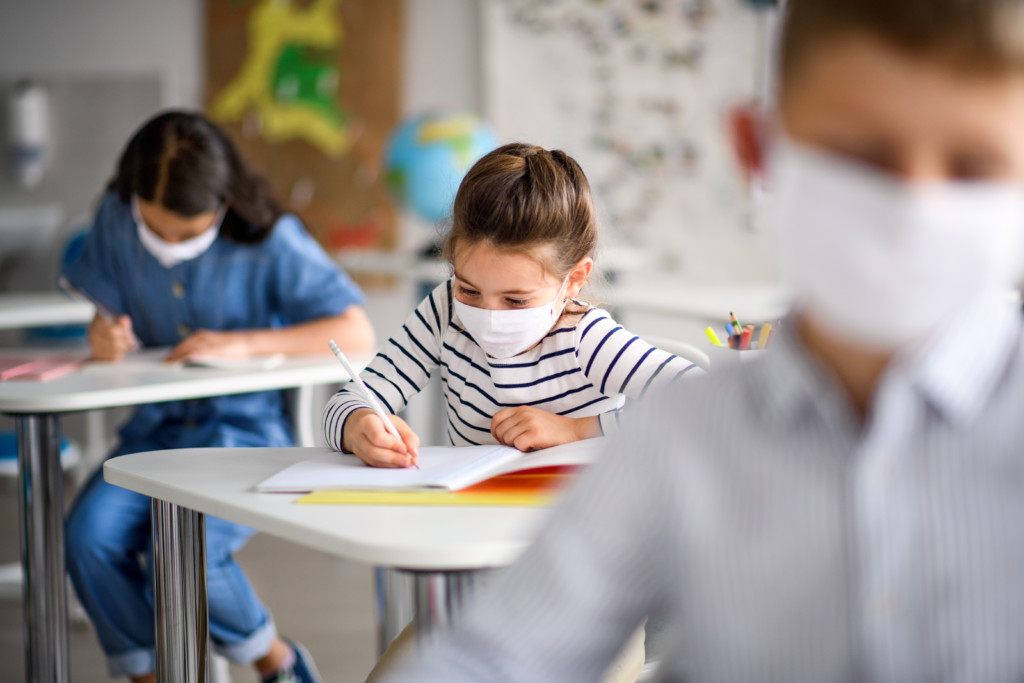 Editor’s note: This opinion piece from Steven Hodas, senior strategic lead for citiesRISE, and Travis Pillow, editorial director at the Center on Reinventing Public Education, suggests it would be a mistake to ignore the hundreds of community-based innovations in teaching, learning, childcare and health and wellness that have sprung up nationwide during the pandemic even as schools return to “normal.”
For nearly a year, schools' unpredictability has created stress and suffering for kids and families, especially in Black and brown communities where jobs and lives are also most at risk from the virus.
We've seen record learning loss, disengagement, depression, and signs of great stress in families.
But just as many schools struggle to serve their families, creative grass-roots responses have risen to fill institutional gaps. Policymakers are understandably eager to return to normal as soon as possible. But it would be a mistake to pave over the hundreds of community-based innovations in teaching, learning, childcare, and health and wellness that have sprung up around the country.
The media has highlighted stories of privileged families spending thousands to create personalized learning "pods." Less well-known is the growth of public pods, also known as learning centers or hubs, set up by community-based organizations, self–organized mutual aid groups, and freelance volunteers.
Pods share an ethos of mutualism with community-based tutoring, homework help, and counseling and mentoring programs. They enable community members to better help one another. And they provide an unprecedented natural laboratory for districts to work with families to codesign the services they need.
While much of this work is happening at organizations outside the traditional fabric of public education, a growing number of school systems have taken notice and begun to shift how they work. We are now collaborating with six of them.
The existential threat of enrollment loss, the unique flexibility of unrestricted federal relief funding, and a painful year of reflection on the subjugation of Black and brown families have led school districts to collaborate in power-sharing partnerships with families, volunteer groups, and community-based organizations.
Already, we are seeing the potential for more flexible, innovative roles for district staff, new talent pipelines into and alongside certificated teaching, revamped pathways between the K–12, higher education, and workforce sectors, and a leveraging of districts’ substantial financial resources to support organizations in their communities.
Indianapolis was one of the first communities where partnerships between the school system and local nonprofits spawned new supports for students learning remotely. The Mind Trust understood that churches and neighborhood groups had deep wells of trust in communities and worked with them to stand up small learning environments before school started last fall.
Leaders at The Mind Trust and Indianapolis Public Schools are now planning for these hubs to become a durable feature of student support, one that persists long after district buildings have reopened.
In North Carolina, Edgecombe County Public Schools opened learning hubs that provide in-person learning and social opportunities to students in the district who have chosen to continue learning remotely. The district is working with principals to design a “spoke-and-hub” approach to schooling that offers more community-based learning projects and uses flexible scheduling to make schooling more compatible with students’ jobs or internships.
Many leaders with whom we speak hope that the structures and services they are building now will persist and fundamentally redefine how they show up for their communities.
Though many kids will do better in regular in-person school, some are thriving with new kinds of adult support and the freedom to pursue ideas that light them up. Long after the COVID-19 pandemic is over, learning pods and arrangements that let schools resume online learning whenever necessary—knowing students can still receive in-person support if they need it—can hedge against possible future disease outbreaks and climate-caused shutdowns.
This is an exciting moment, but experience tells us that the old familiar ways will likely reassert themselves once schools feel out of mortal danger. Innovations will be discarded or wither away, depriving families, communities, and schools themselves of benefits being proven on the ground right now.
The innovations are at risk simply because the old arrangements—kids attending in-person school in large groups, teachers providing all instruction, community assets sidelined—are familiar and serve the interests of the best-organized interest groups. Parents who will want a return to full-time in-person instruction after the pandemic are in the majority. Teachers unions will also want a complete return to the status quo to protect their collective bargaining agreements.
Even well-intentioned relief efforts backed by new federal COVID funding could turn out to be palliatives that relieve strain on the status quo of schooling rather than catalysts to maintain a more diverse array of public support for learning.
For example, some plans for a “national tutoring corps” would require that tutoring be delivered in school buildings during school hours(link is external), often by district employees. This would crowd out grassroots homework-help programs that meet families where they are, at far lower cost and with far more community, parent, and student agency.
To avert the inevitable rush to put things back just as they were before the pandemic, governments and foundations should be building evidence about which innovations—online instructional programs, tutoring programs, pods, and other student support environments—are effective, for which kids and under which conditions.
The window of opportunity to learn from these new arrangements and produce durable changes will likely close in a matter of months.
People must get organized. Families that have come to rely on COVID-era innovations need to start urging school boards and municipal governments to continue them. Nonprofit groups that sponsor innovations must organize now to press state legislators to eliminate strings on public funds and other regulations (seat time and class size requirements, closed-shop arrangements that prevent community-based workers from becoming teachers).
Rather than using this unprecedented funding to double down on the very systems and practices that have failed our communities for decades, state and local advocacy groups should ensure that states and school districts invest stimulus funds in lasting changes that will preserve new educational arrangements that worked for families during the crisis and hold open the space of community-based agency and innovation.
Now is the time not only to invest in helping students recover from the pandemic, but to build an anti-fragile education system that is less brittle, less monolithic, more family-centric and more capable of meeting students’ individual needs—now and in the future.
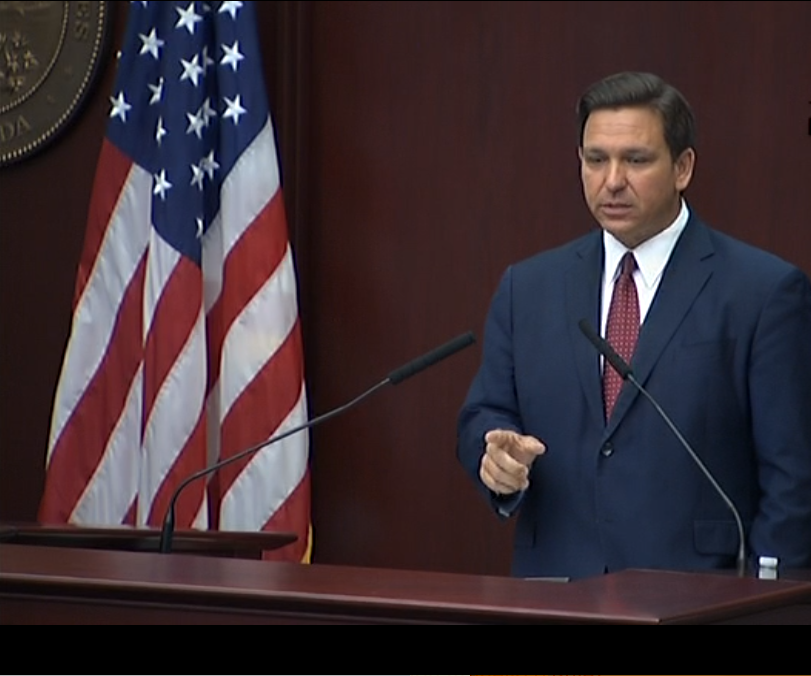 While other states were mandating lockdowns during the coronavirus pandemic, Florida was right to keep the state open, including its brick-and-mortar schools, Gov. Ron DeSantis said in his annual state of the state address today.
“Florida schools are open, and we are only a handful of states in which every parent has a right to send their child to school in person,” DeSantis told House and Senate members who gathered for the opening of the 176th legislative session. “We will not let anybody close your schools; we will not let anybody close your businesses, and we will not let anybody take your jobs.”
The governor also premiered a video that included scenes of happy, masked schoolchildren walking single file down the hall while being led by a happy, masked teacher. He thanked school administrators for their role in making sure campuses opened for the 2020-21 school year safely and smoothly.
In states that closed campuses, DeSantis said, the consequences will be “catastrophic and long lasting.”
Continuing the subject of education, DeSantis added that he hopes to build on last year’s priorities, which included a $500 million boost to raise district schoolteachers’ starting salaries to $47,500, putting Florida in the nation’s top five for teacher pay. He also cited education choice as a priority and congratulated the state for rising to No. 2 nationally in the percentage of graduating seniors passing Advanced Placement exams.
“Florida is leading in education, and we must continue to do so,” he said.
DeSantis’ remarks followed speeches from top legislative leaders delivered from their respective chambers earlier in the day.
State Senate President Wilton Simpson, R-Trilby, spoke specifically about Senate Bill 48, sponsored by Sen. Manny Diaz Jr., R-Hialeah. The bill would streamline the education choice system by combining five scholarship programs into two. It also would convert traditional scholarships to flexible spending accounts to give parents more control over their children’s education.
Simpson said the pandemic amplified the importance of parents’ ability to choose the best learning environment for their children. The scholarship programs, a patchwork system developed over two decades, needs to be simplified and accessible for the more 100,000 families who benefit from the program, which provides equity to lower-income families, he said.
“The fact is, school choice has always existed for wealthy families,” Simpson said. “I believe this option should be available to every family. It is the only way to truly break the cycle of generational poverty.”
You can read more about SB 48 here.
The 2021 legislative session is scheduled to run for 60 days and is expected to take up a number of education issues besides SB 48. These include school funding, dual enrollment affordability for private and homeschool families, career planning and workforce development and early childhood education.
Legislation under consideration includes SB 52, which would allocate $12.5 million to cover the costs of private and homeschooled who participate in dual enrollment programs by taking courses from a partnering college or university. The bill also would allocate $16 million to cover the costs of dual enrollment courses taken during the summer for all Florida students, including those who attend public schools.
The bill and its House companion, HB 281, would fix a glitch that occurred in 2013, when a change in the law shifted the cost of dual enrollment programs from colleges to school districts. Because school districts are state funded, the state picked up the cost. But private schools, which were not allowed pass the cost on to their students, had no alternative but to limit their dual enrollment offerings.
The Florida Conference of Catholic Bishops and the Florida Association of Academic Nonpublic Schools have each endorsed the dual enrollment bills.
 The American economy suffered greatly during the 1970s, with Texas being an exception.
While most of country struggled with unemployment and inflation, Texas struggled with breakneck population growth from people moving in. Drivers experienced overnight traffic jams on Texas freeways, and the classified advertisement section of the Houston Chronicle was an eagerly sought aid to many would-be job seekers nationally.
“Drive fast, freeze a Yankee” bumper-stickers were quite the thing in Texas back in those heady days.
The Texas oil industry didn’t much care for federal price controls on heating oil and natural gas. Milton Friedman famously joked that if you put the federal government in charge of the Sahara Desert in five years there would be a shortage of sand.
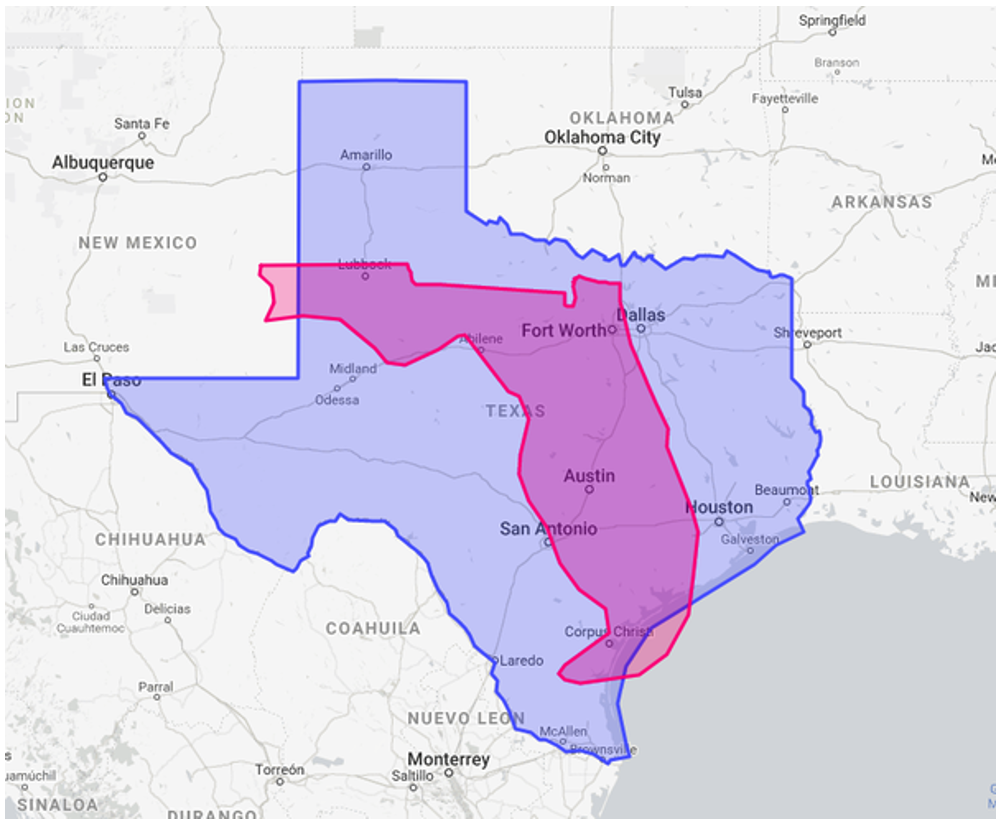
Like clockwork, they did the same for oil and gas outside of Texas, whose internal distribution laid beyond the reach of Congressional interstate commerce authority. Recently, however, it was Texans who froze as their Texas-only power grid failed in the grips of a winter storm. Besides the obvious lesson (karma) Floridians should view the Texas power fiasco as an example not to follow (more on that below) and an opportunity.
The COVID-19 pandemic has been an accelerant of pre-existing trends. If you have anything to say to beloved institutions such as shopping malls and print newspapers, best to say it now.
One of the clearly accelerated trends has been the decline of the state of New York and the rise of Florida and Texas. New York had quite the run as the financial and cultural capital of the United States and then the world as a whole. It has bounced back before, but in a column in last week’s Wall Street Journal, Peggy Noonan laid out a case not to assume it will bounce back this time:
The Partnership for New York City reports 300,000 residents of high-income neighborhoods have filed change-of-address forms with the U.S. Postal Service. You know where they are going: to lower-tax and no-income-tax states, those that have a friendlier attitude toward money making and that presumably aren’t going hard-left. Florida has gotten so cheeky that this month its chief financial officer sent a letter inviting the New York Stock Exchange to relocate to Miami.
New York needs to hold on to the wealthy—the top 5% percent in New York pay 62% of state income taxes—and force down crime. If you tax the rich a little higher, most will stay: There’s a lot of loyalty to New York, a lot of psychic and financial investment in it. But if you tax them higher for the privilege of being attacked on the street by a homeless man in a psychotic episode, they will leave. Because, you know, they’re human.
The New York Stock Exchange in Miami? Might as well follow all the former New Yorkers there.
New York produces bad public services at extremely high costs and it’s been losing population to Florida for decades. Despite New York’s former greatness, as a competitor to Florida, it’s yesterday’s news. Florida and Texas, meanwhile, are rising, and Texas makes for a far more formidable opponent moving forward.
As a Texan living abroad (in Arizona) I will tell you the advantages Florida has over Texas in an Alcibiades-advising-the-Spartans type fashion.
Texas has an abundance of strengths: a huge amount of privately held land (unlike the remainder of the American west), abundant natural resources, a wildly innovative private sector and the friendly attitude towards money-making Noonan referenced.
Texas has access to the ocean and has largely succeeded at making diversity a strength of its growing society. It’s no accident that it was a Texan who revolutionized global energy markets. If you are going to compete with Texas, you had better bring your A-game.
Florida also, however, has many of these strengths, and something that Texas (alas) lacks: a willingness to do the hard work of innovation in the public sector. K-12 reform in Texas, as an example, emphasized testing over setting families free, while the Florida model emphasized both improvement strategies.
Additionally, Texas has no equivalent of the Florida Virtual School, no private choice programs, and caps on enrollment for charter schools.
The Texas effort at improving K-12 outcomes through testing collapsed in 2013, and as far as I can tell, nothing approaching a real strategy is under serious discussion. While Florida lawmakers pioneered allowing children with disabilities to choose private schools through the McKay and subsequently the Gardiner Scholarship programs, the Texas Education Agency shamefully created covert caps on public school students receiving special education services at all.
It’s no exaggeration to say that the former came despite the objections of incumbent interests, and the latter with the complicity of incumbents.
You may recall the academic growth chart for Texas charter schools that accompanied last week’s post. Green is high growth, blue is low growth, and only Texas charter schools are in the chart reprinted below. Now, ask yourself: Does this look like something you want to cap?
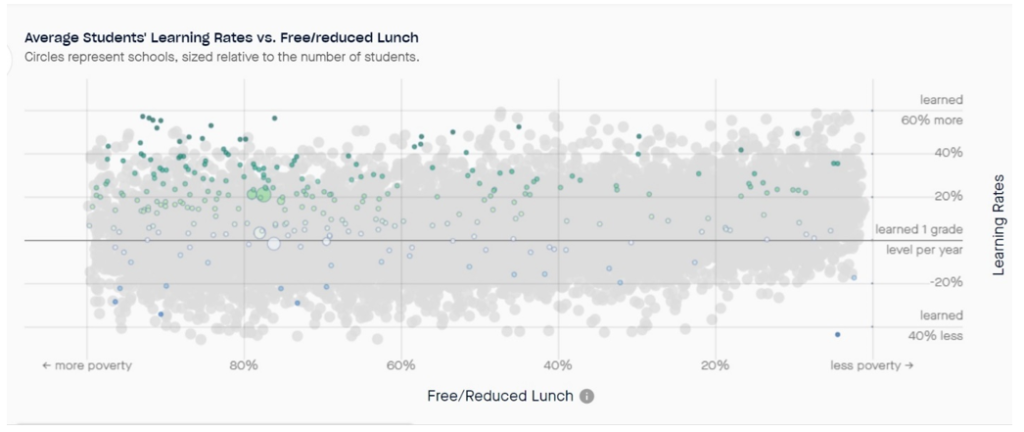 Well, it does if you are a Texas school board or an education union lobbyist. They want to keep Texas charter schools capped regardless of the value they bring to Texas families and taxpayers. They have routinely prevailed in such efforts.
Now, back to the Texas power grid failure.
It was both predicted in advance and entirely inevitable, the result of bad public policy. A legislative effort was made in 2011 to move toward fortifying the Texas grid and energy production against cold weather, but it was blocked (with sad predictability) by incumbent interests.
Incumbent interests also routinely block efforts at meaningful education reform in Texas. The Texas public sector accordingly lacks the vitality of the Texas private sector- more like New York in this regard than Florida.
In an age where states compete not just for companies but also remote workers, innovation in the public sector can be an important advantage. When it comes to expanding education and other freedoms, Florida should drive fast and freeze out the Texans.
Or, as the new Texas Longhorn Football coach Steve Sarkisian puts it, Florida lawmakers should go #AllGasNoBrakes on expanding freedom.
 On this episode, Tuthill speaks with the founder of a Colorado-based organization that works with public and private education organizations to create new opportunities for students to receive education outside the traditional five-days-a-week, 180 days-a-year schooling model.
Tuthill and Parés discuss Colorado laws that allow funding to be portable and how state-sponsored schools can serve students not enrolled full time in district or charter schools. They also discuss the empowerment and business opportunities for teachers and members of local communities to create businesses such as specialized tutoring and learning pods when education funding is portable. Both men believe children are always learning, and that society devalues educational opportunities outside of “traditional” schooling.
"I hope people take the opportunity COVID has provided to reflect on the system that we've had and think about how its reaction only furthered the inequities many of us had already seen and (begin to) wonder how we smooth those inequities out.”
EPISODE DETAILS:
· Parés’ background as a teacher and a disruptor of traditional education models
· Finding state statues that make education funding portable in Colorado and what can be created in other states
· How public-private partnerships can break down false dichotomies about education choice, create win-win solutions and lift all boats
· Small business opportunities for communities and teachers when education funding is portable
· How COVID-19 has reshaped perceptions around traditional schooling and how the experience will shape education’s future
LINKS MENTIONED:

