
Course choice, also known as course access, allows parents and students to select various pre-approved courses beyond what their districts normally offer. The courses, many of which are taught online, can include everything from university classes and SAT preparation to welder training.
Editor’s note: This commentary from Rick Hess, resident scholar at the American Enterprise Institute, appeared today on edweek.org.
The debate over school choice has long featured strident rhetoric about union lackeys and privatizers. But now, after millions of students spent a year or more in off-and-on home schooling and makeshift arrangements like learning pods and virtual camps, many once-stark distinctions have blurred.
Yet, that has helped make other things clear. For one, it’s illustrated how the familiar school choice debate can miss much of what’s important to families.
While there are plenty of families who want to move to a different school, for a variety of reasons, polling also consistently shows that over 70% of parents are satisfied with their child’s school. Of course, this doesn’t mean they like everything about their school. They may want choices that amount to something less than moving from school A to school B.
Even pre-pandemic, parents who liked their school might have still grumbled about its reading program, math classes, or lack of Advanced Placement options. Now, with so many students forcibly acclimated to remote learning—which frequently involved a mélange of academic options, providers, and supports—many parents have asked: Why can’t a student choose to take advantage of such opportunities without changing schools?
Well, they should be able to, and they increasingly can. One tool for extending such incremental choice is “course choice,” state-level legislation that allows families to choose to stay put—while also tapping into instructional options that aren’t available at a student’s school.
To continue reading, click here.
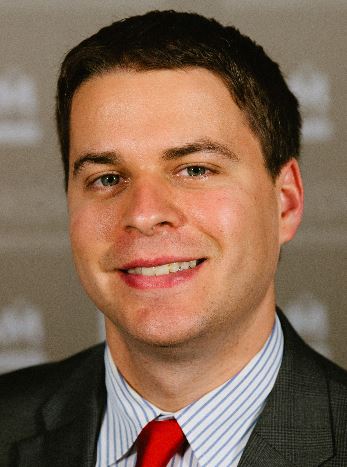
Brickman
Imagine if parents could pick and choose individual courses for their children, from an endless array of different providers, in the same way they now pick and choose other products online. Michael Brickman, the national policy analyst for the Fordham Institute, says that world may not too far in the future, thanks to a budding parental choice trend folks are calling “course choice.”
“Ideally parents and students can sit down at the computer and "shop" online for courses,” Brickman said during a live chat Wednesday with redefinED. “This is so commonplace and mundane when we go on sites like Amazon.com and add items from different sellers from around the world to our virtual shopping cart. Hopefully through (course choice), education can catch up to the rest of the world in this regard.”
A handful of states are moving ahead with course choice, including Louisiana and Wisconsin, where Brickman served as a policy advisor in Gov. Scott Walker’s office before joining Fordham. Florida is among those taking a close look. Brickman recently authored a policy brief that gives education officials a primer on course choice and the challenges ahead.
Course choice is complementary to parental choice options such as charter schools and vouchers, he said during the chat. But it can spur those options to innovate even more.
“I love traditional school choice and think it's nowhere near obsolete as of now,” he said in response to a question. “But one of the frustrating things about these reforms is how similar the schools look to one another. The point of additional flexibility is to INNOVATE. Some charter and private models are off and running with this but many are still lining up 30 desks in each room, putting a teacher in front of the class for 7 hours a day, etc.”
You can read the entirety of the chat in the transcript below.
Brickman
Things are changing so fast with parental choice, charter schools and vouchers are starting to look old school. Before you know it, a lot more parents won’t just be choosing schools for their children, they’ll be choosing individual courses.
It’s called course choice. And to help us all get a better handle on it, we’re having a live chat next week with Michael Brickman, national policy director for the Fordham Institute. Brickman authored an excellent primer on course choice that Fordham released last week.
The chat is open to anyone with a fair question. It’s in writing, so we’ll type in questions, you’ll type in questions and our guest will type in answers as fast as his fingers can fly.
To participate, just come back to the blog on Wednesday, May 28. We’ll start promptly at 11 a.m. Just click in to the live chat program, which you’ll find here on the blog.
In the meantime, if you have questions that you’d like to send in advance, you can leave them here in the comments section, email them to rmatus@sufs.org, tweet them to @redefinEDonline and/or post them on our facebook page. See you then!
The debate about the next wave of educational choice - allowing students to select not just their schools but individual courses - is likely to surface again in Florida, which already has a course choice program on the books.
The Legislature created the Florida Approved Courses and Tests Initiative in 2013. Under the current law, the initiative is set to go live during the 2015-16 school year, but more legislative changes would likely have to be made before then, including a system for funding the courses.
While the effort has gotten a lot of press because it would allow high school students to take Massive Open Online Courses for credit, there's more to it than that. Some Florida school districts have already begun experimenting with MOOCs.
But making the leap from using them as a type of course content (the way some teachers might use Khan Academy lectures) to treating them like a full-fledged education provider, and figuring out how to fund, regulate and hold MOOCs accountable can create a broader platform for course choice.
One of the architects of last year's law, Sen. Jeff Brandes, R-St. Petersburg, said the goal is not just to offer MOOCs for credit. It's to bring in new providers that break the traditional mold.
Imagine students selecting a mix of classes tailored to their interests, some online, some in-person, and moving through them at their own pace. They may be taught by Florida-certified teachers, or adjuncts approved by districts.
"We're moving away from the JC Penney model of education, to the Amazon model," Brandes said. "We have an old institution that now has to respond to the changing marketplace." (more…)
Single-gender. Separate floors for boys and girls are part of the turnaround plan for a struggling Duval County school. Florida Times-Union.
Tax credit scholarships. The statewide teachers union calls on Gov. Rick Scott to veto legislation expanding eligibility for the program while reiterating myths about a failed constitutional amendment and referring to proposed personal scholarship accounts for disabled children as a "new entitlement." Sentinel School Zone.
Charter schools. The Pinellas superintendent outlines a plan to take over a charter school aimed at at-risk students. Gradebook. Tampa Tribune.
Course choice. Virtual education and course choice may hold promise for instruction in physics and other sciences, but policymakers should be aware of potential pitfalls, Paul Cottle writes at Bridge to Tomorrow.
Brown v. Board of Education. Civil-rights activists aim for equity and elimination of achievement gaps on the anniversary of the landmark ruling. Miami Herald.
Special needs. Exceptional education students showcase their talents in Wesley Chapel. Tampa Bay Times.
Funding. Palm Beach voters will have to choose between lower property taxes or funding for arts programs on their fall ballots. Sun-Sentinel. The district plans to spend up to $1 million on bus cameras. Palm Beach Post.
Valedictorians. Broward schools will keep the honorary titles for top high school graduates. Sun-Sentinel. A Palm Beach valedictorian is interested in neuroscience. Palm Beach Post.
Facilities. Leon County's schools superintendent acknowledges an FBI investigation in the wake of reports about the district's allocation of constructions contracts. Tallahassee Democrat. Largo High School may be poised for demolition, but the again building houses a rich history. Tampa Tribune.
Administration. Hillsborough's school district plans improvements after meetings with district employees. Tampa Tribune. Tampa Bay Times. A federal complaint against the Pasco superintendent is thrown out. Gradebook.
Testing. A fourth grader writes a song to rally students for the FCAT. Sun-Sentinel.
School safety. Teenagers are arrested after a gang-related incident on a school bus. Tampa Tribune. The family of a student shown in a video getting kicked by a police officer seeks an investigation. Palm Beach Post.
Employee conduct. A Palm Beach County guidance counselor faces DUI charges after getting stopped on the way to work. Palm Beach Post. Lawsuits dog the Manatee County school district after a criminal case is closed against a former football coach. Bradenton Herald.
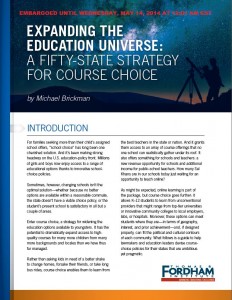
Don’t look now, but a bigger, faster and potentially more far-reaching wave of educational choice is rolling in as we're still grappling with basic questions about vouchers, tax credit scholarships and charter schools. Lucky for us, a new guide from the Fordham Institute offers a heads up on the complications with “course choice” so its promise can be fully realized.
Released today and authored by Michael Brickman, Fordham’s national policy director, “Expanding the Education Universe: A Fifty-State Strategy for Course Choice” arrives as school choice begins to give way to educational choice on a more fundamental level.
“Rather than asking kids in need of a better shake to change homes, forsake their friends, or take long bus rides, course choice enables them to learn from the best teachers in the state or nation,” Brickman writes. “And it grants them access to an array of course offerings that no one school can realistically gather under its roof.”
To some extent, course choice is already happening. Students in many places can take dual enrollment courses. Florida offers a vast course menu through Florida Virtual School. Louisiana adopted a course choice program two years ago. It’s just a matter of time before other states and/or school districts seize the day in a bigger way, and some, like Florida, are already taking a closer look.
The bottom line: students will increasingly be able to choose a course here and a course there, from an exploding number of providers. That will increasingly be true no matter what school they’re in.
That’s the upside. The downside? All kind of prickly questions have to be tangled with, from funding and access to eligibility and accountability. Brickman offers a rundown of five big ones, with potential directions, complications, tensions and tradeoffs. For example:
Who can be a provider: “Parents and kids will naturally want the widest possible range. Districts, however, will tend to favor tighter limits, whether out of concern for quality control or to minimize competition with their own offerings. States will also have to balance the desire to serve more children with the political headache that inevitably comes when ‘controversial’ course providers are included. Or they may leave such decisions to districts or entrust them to third parties.”
Who pays them: “Does the child’s school district pay the cost? Does the state? The parents? Who decides what price is reasonable? How many kids can take how many such courses? Who controls this money? Who generates it?”
Then there’s this fun one: “What if Molly takes all but one or two of her courses from course providers? Is she still a student of Madison High School? Does it still confer her diploma? Is it still the school’s job to determine whether she has truly fulfilled state or district graduation requirements? If not the school, then who?”
And some thought school choice was complicated. 🙂
Alabama: The state's new tax-credit scholarship program has nearly reached the $25 million cap (AL.com). A councilman of Birmingham says the Alabama Accountability Act must be repealed (AL.com).
Alaska: The state should abolish the Blaine Amendment and allow private school vouchers (Daily News Miner).
Arizona: Education reformers plan to rapidly expand the Education Savings Accounts program if the state Supreme Court approves (Arizona Daily Sun). The Arizona Daily Sun editorial board takes a stand against expanding Education Savings Accounts, instead arguing that the state should spend more money on traditional public schools. A Republican state senator owns businesses that have financial dealings with his own tax-credit scholarship organization (CBS 5).
California: Gloria Romero, a Democrat and former state senator, argues school choice is a parent's right (OC Register). Some public schools that convert to charters are seen as charter schools in name only (Seattle Times, Joanne Jacobs). Market competition leads to collaboration in L.A public school choice (EdSource). The California Charter Schools Association calls for the closure of a low-performing charter school managed by UC Davis, Sacramento City College and the Washington Unified School District (Sacramento Bee). Will the state embrace charter schools (San Diego Tribune)? San Diego earns low scores on the Brookings Institution's school choice index (Press Telegram).
D.C.: Thousands of parents attend a school choice convention to find the right school for their child (Washington Post). Democracy Prep, a charter school from New York City, will be taking over an Imagine charter school in the district (Washington Post).
Delaware: A judge blocks the closure of an all girls charter school on 14th Amendment grounds (Education Week).
Florida: Four school districts in the state rank in the top 25 for school choice according to a new Brookings Institution report (redefinED). Virtual charter schools grow (redefinED). The Duval County School District holds an expo to advertise public school choice options to parents (Action News Jacksonville). Legislators propose two competing charter school bills, one creating a standardized contract to make it easier to form charter schools and the other to require surety bonds before a charter school can open (Sun-Sentinel, Tampa Bay Times). Another proposed bill would allow charter schools to share space with district schools (Miami Herald).
Georgia: New rules require charter schools to score as well as or better than the state and district averages on the state's 110 point grading scale, or risk having their charters revoked (Atlanta Journal-Constitution).
Illinois: An op-ed writer says Chicago has too much school choice (Chicago Business). Six Catholic elementary schools are slated to close by next year (Chicago Tribune).
Louisiana: Gov. Bobby Jindal asks the court to reconsider the decision to allow federal monitoring of the voucher program to ensure racial balance (Times-Picayune). The U.S. Department of Justice is asking the court for the power to veto any voucher award (Cato Institute, National Review, Catholic Online). A state panel suggests a new way to fund the Course Choice program (Shreveport Times). New Orleans tops the Brookings Institution's school choice index (Watchdog). School choice empowers parents (Business Report). New Orleans shows how urban districts can create real achievement growth through school choice (US News and World Report). (more…)
 Alabama: The state court will allow three parents to defend the new school choice program against a lawsuit from the Alabama Education Association that seeks to overturn it (Tuscaloosa News).
Arizona: GEICO donates $8 million to the state's corporate tuition tax credit scholarship program (Arizona Daily Star).
Colorado: Education reformers in Douglas County are facing re-election again union backed candidates who want to roll back school choice (Denver Post)
D.C.: Academy of Hope starts a charter school to prepare adults for the workforce (Elevation).
Florida: A high-profile St. Petersburg charter school is facing growing pains while it looks for a new principal and plans to open another campus across the bay in Tampa (Tampa Bay Times).
Indiana: A Columbus area charter school is short $250,000 after an unsuccessful capital campaign, a state funding cut and enrollment drop, and the school may be forced to close (Associated Press). Kevin Chavous, chairman of Democrats for Education Reform, says school choice needs bipartisan support (Indianapolis Star).
Iowa: Joy Pullmann, editor of School Choice News, says Iowa students would benefit from vouchers or expanded tax-credit scholarships (Des Moines Register).
Louisiana: WNBA basketball star and four-time Olympic gold medalist Lisa Leslie is a school choice advocate (The Advocate). The state superintendent of public instruction gets a tour of the new Course Choice virtual school program (The Times-Picayune). Enrollment in the voucher program is up 38 percent despite the U.S. Department of Justice's misguided (and incorrect) lawsuit (The Times-Picayune, Associated Press). The DOJ is trying to prevent parents from defending the school voucher legislation in court (Education Week, National Review). Republican senators question the DOJ lawsuit (The Times-Picayune). A new documentary, "Rebirth" examines the post-Katrina New Orleans school system (Education Week). School performance is up and the number of low performing schools is down in New Orleans (The Times-Picayune, The Advocate). (more…)
 Alabama: The Rev. H.K. Matthews, a civil rights icon now living in Alabama, says school choice is an extension of the civil rights movement (AI.com).
Colorado: The Douglas County School District offers private school vouchers for students but some residents, policymakers and journalists can't see anything but conspiracy theories (Our Lone Tree News). Fifteen new charter schools open statewide for the 2013-14 school year (The Gazette).
Connecticut: State Superintendent of Schools William McKersie wants public school choice and more digital learning for students (Greenwich Post).
Florida: Education leaders urge the governor to overhaul the school grading system again (which also applies to charter schools) (Tampa Bay Times). Florida Virtual School is facing hard times as program revenue drops 20 percent (Education Week). Charter schools are under scrutiny from the Department of Education after a ban on charging additional fees and requiring volunteer hours from parents (Tampa Bay Times).
Louisiana: The U.S. Department of Justice files suit to block the state's new school choice program, arguing it violates court ordered desegregation (Atlanta Journal-Constitution, The Advocate). The Black Alliance for Educational Options and Gov. Bobby Jindal both say the scholarship program provides a vehicle for low-income students to escape failing schools and that the Justice Department should drop the lawsuit (Education Week, Huffington Post, Weekly Standard). The Washington Post editorial board calls the DOJ lawsuit "appalling" (Washington Post). "Course choice" is underway in Louisiana (Education Week).
Arizona: New statistics show the state has the second-highest percentage of students enrolled in charter schools in the nation (Today's News Herald). Gov. Jan Brewer signs off on expansion of school voucher program, adding kindergartners and increasing funding for all students who qualify (Arizona Daily Star).
 Washington, D.C.: New study shows district and charter schools suspended one out of 10 students in the 2011-12 school year (Washington Post). Mayor Vincent Gray talks about blurring the lines in school choice, suggesting elementary charter schools feed into traditional middle schools and vice versa, among other ideas (Washington Post).
Delaware: The state approves three new charter schools, including one that offers its students internships (The News Journal).
Georgia: Atlanta public schools take fight against charter schools concerning unfunded pension liabilities to Georgia Supreme Court (Atlanta Journal-Constitution).
New Jersey: Gov. Chris Christie's administration puts another three charter schools on probation and issues warning to 11 others in a quest to raise standards (NJSpotlight). Some Camden district teachers want to open their own charter schools (Philadelphia Inquirer).
New Hampshire: A judge rules the new education tax credit law violates the state Constitution’s ban on sending public money to religious schools, but the program can continue to provide scholarships for secular schools and homeschooling (Concord Monitor).
Louisiana: Gov. Bobby Jindal signs off on a parent trigger bill that allows parents to petition to shift control from some failing Recovery School District schools back to the local system (Times-Picayune). The state Board of Education approves a new course choice program that will allow public school students to take hard-to-get classes online (The Advocate).
Florida: The woman spearheading a charter conversion in Manatee County has ties to Fund Education Now, an organization that has opposed charter school expansion (Sunshine State News). Rowlett Magnett Elementary will be the first public school to convert into a charter in the past five years (Sarasota Herald-Tribune). A Marion County school board member suggests some cost-saving ideas to save teachers jobs, including shutting down or charging students for the IB program (Ocala Star Banner). Some private schools in Florida are signing up for Common Core training (redefinED). Pembroke Pines agrees not to privatize its charter school system, but teachers will have to take pay cuts (Sun-Sentinel). A tax credit scholarship helps single father send his son to private school (redefinED). Gateway Charter School in Fort Myers tells students to finish up Florida Virtual School online courses, or pay up (Associated Press). (more…)

