Editor’s note: March 2 marked the 20th anniversary of the legislative session in which Florida Gov. Jeb Bush launched a series of K-12 reforms that transformed education throughout the state. (No, I can’t believe it’s been 20 years either.) Beginning today, as the 2019 Florida legislative session is set to open, and continuing for several months, redefinED will examine aspects of Bush’s K-12 education revolution.
-------------------------------------------------------------------------------------------
It was 20 years ago today
When Gov. Jeb Bush taught the ed reform band to play
They’ve been going in and out of style
But they’re guaranteed to get sued at trial
So may I introduce to you
The act you’ve known for all these years
Jeb Bush’s K-12 ed reform band
Twenty years have passed since former Florida Gov. Jeb Bush launched his far-reaching set of education reforms. Those reforms included A-F school grading, school funding incentives, a suite of early literacy efforts, digital learning opportunities and expanded parental choice. Controversy ensued, and indeed, these policies remain controversial today.
The Florida Education Association hated the reform measures so much that its members infamously took out a second mortgage on their Tallahassee headquarters to donate to Bush’s opponent’s campaign. Nevertheless, the recent Florida Supreme Court school finance ruling and a chart from a Stanford-based academic make a very powerful case for just how misguided reform critics have been – and alas, remain to this day.
Before diving into the Florida Supreme Court’s ruling in Citizens for Strong Schools vs. Florida State Board let’s note from the outset that people have varying and deeply held preferences on school funding. There’s nothing wrong with wanting to spend more; lots of folks do. Lawmakers, however, must balance this desire against the desire to spend funds on competing demands for priorities such as heath care, higher education, transportation, criminal justice etc., and within a context of preferred overall levels of taxation. This, in short, is how democracy works. In Citizens a group of petitioners sued the state to have the courts take over education budgeting. After a decade of proceedings, the Florida Supreme Court ruled against the petitioners:
Moreover, Petitioners’ argument flies in the face of the trial court’s detailed findings, none of which Petitioners challenge for lacking a basis in the record. As just a few examples, the trial court found that: “Florida has been a national leader in education reform”; Florida intentionally adopted rigorous standards and set cut scores at a level that places the majority of students below the satisfactory level; scoring a “Level 1 or 2” on the assessment “is not an indication that a student ‘can’t read’ or is illiterate”; the State’s “high performance standards . . . have led to improvement over time”; and Florida “has outpaced the nation in closing” achievement and performance gaps that “exist throughout the country.”
Translation: The trial court made detailed findings that Florida public schools have improved that the petitioners entirely ignored, and this is a large problem for a case urging the courts to take over school budgeting.
The next paragraph is also quite revealing:
While Petitioners’ proposed standard is problematic in and of itself, Petitioners’ own pleadings expose the flaws in their arguments and highlight why Coalition requires that we approve the result reached by the First District. Indeed, what Petitioners seek is for the courts to order Respondents “to establish a remedial plan that . . . includes necessary studies to determine what resources and standards are necessary to provide a high-quality education to Florida students.” (Emphasis added.) In other words, Petitioners do not know what a “high quality system” looks like, how it can be achieved, or what resources and standards are necessary. Instead, they—and presumably the courts—will know an “efficient” and “high quality” system, as well as an “adequate” level of overall funding, when they see a study that shows what it is. Petitioners invite this Court to not only intrude into the Legislature’s appropriations power, see Coalition, 680 So. 2d at 407 (“[P]resumably the Plaintiffs would expect the Court to evaluate, and either affirm or set aside, future appropriations decisions . . . .”), but to inject itself into education policy making and oversight. We decline the invitation for the courts to overstep their bounds.
Translation: the majority was unwilling to suspend normal democracy on K-12 budgeting to begin a process of trying to figure out what to do as an alternative.
Even if we were inclined to accept all of Petitioners’ arguments regarding justiciability and separation of powers, on the record presented here Petitioners still could not prevail. At bottom, Petitioners’ blanket challenge to the educational system is a funding challenge, one rooted in the notion that the Legislature is not providing an adequate overall level of funding and that the lack of funding has resulted in disproportionate outcomes for certain students. That is clear from Petitioners’ allegations, Petitioners’ specific request for relief, and the rest of the record. Indeed, the trial court noted, among other things, that “[t]he primary thrust of [Petitioners’] complaint is that there is a crisis . . . caused by the State of Florida’s inadequate funding of education,” that Petitioners “asserted that more resources were clearly needed to address the problems they identified in their - 35 - complaint,” and “that the evidence was focusing on [Petitioners’] ‘need for more resources’ argument.” But the trial court’s express findings doom Petitioners’ funding challenge and theory of the case. Not only did the trial court find that Petitioners “failed to establish any causal relationship between any alleged low student performance and a lack of resources,” but the trial court found that “the weight of the evidence . . . establishes a lack of any causal relationship between additional financial resources and improved student outcomes.” Petitioners’ failure to establish such a causal relationship provides an independent basis for rejection of their claims.
Translation: bitter experience has taught us that it is entirely possible to infuse public school systems with additional resources without realizing improvement in student outcomes of the sort that Florida has in fact seen.
In essence, the court ruled that the improvement the petitioners claim to seek is already underway, that they can’t quantify what it would take to achieve a high-quality system, and that their preferred remedy (large funding increases) would not necessarily result in improvements in student outcomes. The chart below, produced by Stanford, Harvard and University of Munich scholars, plots academic achievement scores by spending per pupil trends:
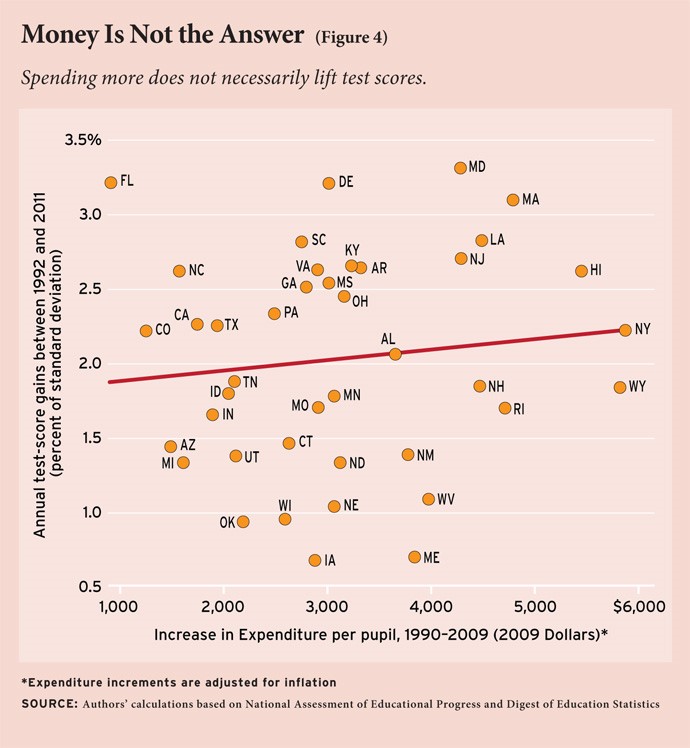
The Florida Constitution states, “Adequate provision shall be made by law for a uniform, efficient, safe, secure, and high-quality system of free public schools that allows students to obtain a high-quality education.” Did New York fulfill this mandate? No. The state increased spending by a huge $6,000 per pupil only to see average academic gains – nothing “efficient” about that, I’m afraid. How about Wyoming? Nope. Once again, there were huge increases in per pupil spending but below-average academic gains for students. The taxpayers of Iowa provided an increase approximately three times larger than Florida, and Maine four times larger. But both states saw academic improvement far less than a third of what Florida’s students achieved.
According to this chart, the state that came closest to providing a uniform, efficient and high-quality system of schools was Florida. The petitioners asked the Florida Supreme Court to take over school funding decisions in order to spend like Maine or Wyoming to achieve the sort of results seen in, ahem, Florida, with modest rather than large increases in per pupil funding. The Florida Supreme Court (wisely, in my opinion) declined.
Gov. Bush’s education reforms aimed to improve student outcomes employing a variety of strategies – including increase in funding – and the available evidence strongly suggests that in tandem, these reforms succeeded in raising achievement, particularly among historically low performing student subgroups. Florida’s taxpayers shouldn’t be surprised that many folks in the education system – those who deserve national recognition for their success – would like to have greater resources. Everyone wants more resources, but those resources are scarce. Public funds are budgeted democratically, and this chart makes it easy to see where the budgetary priorities have been.
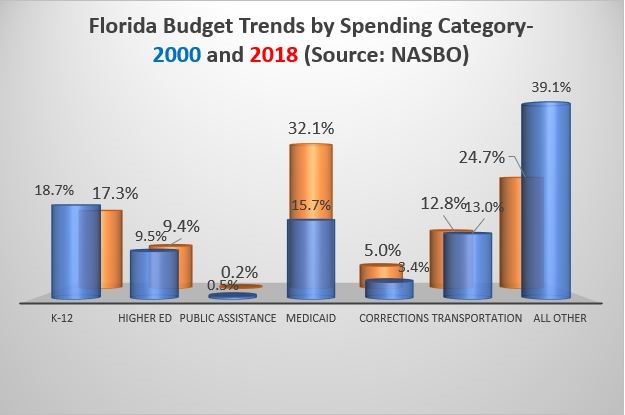
It’s very difficult to imagine large increases in K-12 funding while more than doubling health care spending, even with the federal government picking up half the tab. People care deeply about all kinds of spending in the “All Other” category, and Florida lawmakers have shielded K-12 from Hurricane Medicaid better than most. The potential funds for a Wyoming style surge in K-12 spending, which didn’t do Wyoming students any apparent good by the way, went to pay for health care. The school lobby doesn’t have to like this decision, but both the decision to seek what amount to efficiency gains (more bang for the education buck) and to focus state resources on health care were decided democratically. In other words, not everyone has to like the decisions, but they nevertheless were legitimate.
Lawmakers, moreover, have a moral and in Florida, a constitutional duty to seek an efficient system of schools that maximizes return on investment. Globally, the United States is a very high-spending country with catastrophically poor results for minority students on international exams. The international PISA exams show, for instance, that American Black and Hispanic students score closer to the average scores in Mexico than they do to students in Europe, Asia or indeed to American Anglo students.
Mexico spends but a fraction of what American schools spend in per pupil spending and faces far greater poverty challenges than those in the United States. People can differ on whether to spend more in the United States, but we must close these shamefully low levels of achievement - and that involves getting more out of our already enormous investment.
William Faulkner wrote that the past is never dead, it’s not even past. The health care budgetary pressures are set to accelerate due to the aging of our already elderly population. Nevertheless, Florida policies can empower educators to provide highly appealing school models at reasonable costs in a way that will attract and retain high-capacity teachers and include disadvantaged students. This is mutually beneficial to teachers, parents, students and taxpayers, and is improving and evolving over time through a decentralized process of voluntary exchange. If this process can continue, the best is yet to come in Florida K-12 education.
Florida not only needs to continue this good work on K-12, it needs a leader as effective and fearless as Jeb Bush was on K-12 reform to radically improve the effectiveness of heath care spending, as another couple of decades like the last two threaten to squeeze out other vital priorities.
Gov. Bush and his team took a sad song (the Florida K-12 system of 1999) and made it better. This task now falls to a younger generation of leaders, and most importantly, to you.
The dissent’s cursory review of faulty education data in Citizens for Strong Schools v. State Board of Education could have deprived many Florida families of educational choice.
Do vouchers and charter schools harm public schools, thereby violating the state’s constitutional duty to fund an adequate system of uniform public schools? Until last month’s 4-3 decision in Citizens for Strong Schools v. State Board of Education, the Florida Supreme Court had ignored the empirical question entirely. In Bush v. Holmes (2006), the court majority decided that a theoretical harm, real or not, was enough to declare the Opportunity Scholarship Program unconstitutional.
The three dissenting justices in Citizens for Strong Schools, who all decided on Bush v. Holmes 13 years earlier, finally were forced to examine the evidence. Unfortunately, the dissent’s cursory review of education data focused on some bad statistics. One more vote and shoddy data could have spelled the end of educational options for more than 425,000 children in the Sunshine State.
The dissent prominently featured a USA Today article that ranked education by state.
The article was compiled from Education Week’s Quality Counts “overall” 2017 ranking. That ranking used multiple statistics: graduation rates, public school spending, eighth-grade proficiency in the National Assessment of Educational Progress (NAEP), adults with a bachelor’s degree or above, and the percentage of adults in the state with incomes above the national median.
The ranking is severely flawed for several reasons:
During the trial, lawyers for the Florida Department of Education argued that Florida’s K-12 outcomes were superior to that of New Jersey, a state that lost a funding adequacy lawsuit in 1985 and was forced by the court to greatly increase spending for students in high-poverty school districts.
The dissent pointed to the USA Today article and noted that New Jersey ranked No. 2 while Florida ranked No. 29. But as stated above, the overall USA Today/Education Week ranking biases in favor of wealthier and whiter states, like New Jersey.
Digging deeper into the data, we find that Florida has a larger minority population with black and Hispanic students making up 54 percent of the student body, compared to 42 percent in New Jersey. When comparing NAEP eighth-grade reading and math results, Florida tends to do just as well as New Jersey for black, Hispanic and low-income student populations.
The fact that New Jersey’s low-income districts spend nearly three times as much as Florida and achieve the same results on eighth-grade NAEP tests is telling. If New Jersey is high quality, as the dissent insists, then so, too, is Florida.
Contrary to the insistence of some critics, the court majority correctly rejected the power to determine “adequate” K-12 spending based on platitudes like “efficient” and “high-quality.” The majority also recognized the complexity of education statistics and rejected the argument that school choice makes Florida’s K-12 system perform poorly. In fact, the court recognized that these programs may have a positive effect on public schools.
Whether public schools should be better funded is another story entirely. It’s a debate we should continue to have, but you just can’t use bad statistics to throw Florida’s entire K-12 system, including school choice, under the bus to make your case anymore.
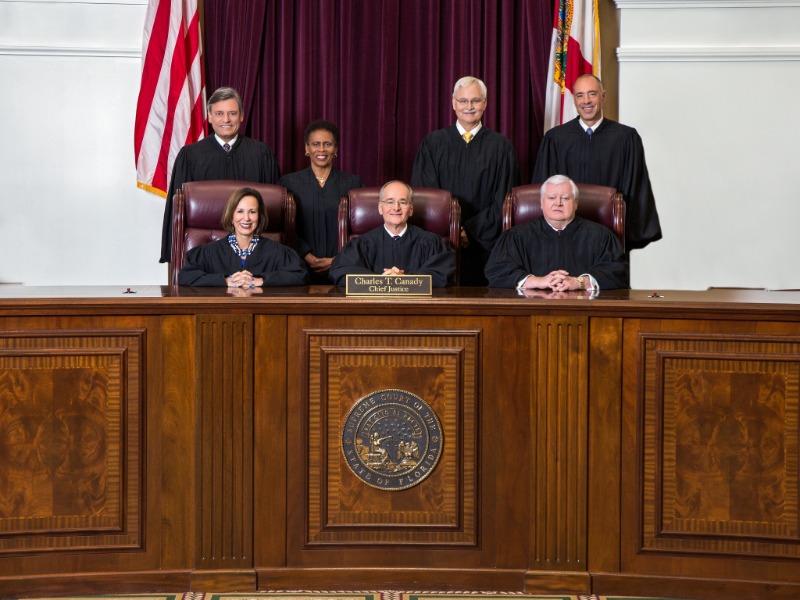
The Florida Supreme Court upheld lower-court rulings in rejecting the education adequacy lawsuit.
Jim Saunders / News Service of Florida
TALLAHASSEE --- A fiercely divided Florida Supreme Court on Friday rejected a nearly decade-long lawsuit that challenged whether the state has properly carried out a 1998 constitutional amendment that called for ensuring a “high quality” system of public schools.
The decision upheld lower-court rulings and focused heavily on the role of the judiciary in addressing sweeping issues such as the quality of public schools. A main opinion shared by Chief Justice Charles Canady, Justice Alan Lawson and Associate Justice Edward LaRose said plaintiffs in the case failed “to present any manageable standard by which to avoid judicial intrusion into the powers of the other branches of government.”
Canady, in a concurring opinion, was more pointed, saying the “manifest goal” of the plaintiffs and three dissenting justices “is to put educational funding and educational policy firmly under the control of the judiciary.”
“The judiciary is very good at making certain types of decisions --- that is, judicial decisions,” wrote Canady, who was joined by Lawson and LaRose in the concurring opinion. “But it lacks the institutional competence --- or the constitutional authority --- to make the monumental funding and policy decisions that the petitioners (the plaintiffs) and the dissenters seek to shift to the judicial branch. And there is not a hint of any manageable judicial standards to apply in making those decisions. Instead, if the petitioners and the dissenters had their way, judges would simply apply their own policy preferences.”
Justice Jorge Labarga sided with Canady, Lawson and LaRose but did not sign on to the main opinion or the concurring opinion. LaRose is a judge on the 2nd District Court of Appeal but was added to the case after Justice Ricky Polston recused himself.
Justices Barbara Pariente, R. Fred Lewis and Peggy Quince joined in two dissenting opinions, with Pariente writing that the court majority “eviscerates” the 1998 constitutional amendment, “contrary to the clear intent of the voters, and abdicates its responsibility to interpret this critical provision.”
“My friends and colleagues in the majority make a very grave and harmful mistake today,” Lewis wrote in another dissent. “Although I understand their good-faith and well-intentioned approach, only time will truly reveal the depth of the injury inflicted upon Florida’s children. The words describing the right to a high quality education and the constitutional concept of protecting that right ring hollow without a remedy to protect the right.”
The 1998 constitutional amendment said it is a "paramount duty of the state to make adequate provision for the education of all children residing within its borders." The amendment fleshed that out, in part, by saying adequate provision will be made for a "uniform, efficient, safe, secure, and high quality system" of public schools.
The group Citizens for Strong Schools and other plaintiffs filed the lawsuit in 2009, arguing that Florida has not properly complied with the constitutional amendment and pointing to issues such as many students not being able to read at grade level. After holding a trial, however, a Leon County circuit judge ruled against the plaintiffs in 2016.
The 1st District Court of Appeal upheld that ruling and said arguments about the state failing to adequately provide for public schools “raise political questions not subject to judicial review.” That prompted the plaintiffs to appeal to the Supreme Court.
During oral arguments in November, plaintiffs’ attorney Jodi Siegel said the case should be sent back to a circuit judge to apply standards that would properly determine whether the state is meeting the constitutional requirements.
“We have current standards and current measurements that are showing significant disparities,” Siegel said at the time. “We had 670,000 children that are failing reading. So this is not a child or two. This is a systemic failure.”
But Rocco Testani, an attorney for the state, told justices that the state has made changes since 1998 that have led to significant improvements in the public-school system.
“It has been successful, it has worked,” Testani said. “It is not a system that anyone should be concerned is broken.”
The opinions Friday shared by Canady, Lawson and LaRose focused on issues such as the separation of powers between courts and other branches of government and the difficulty for judges in deciding such a “blanket” challenge to the education system.
“There is no reason to believe that the judiciary is competent to make these complex and difficult policy choices,” Canady wrote in the concurring opinion. “And there is every reason to believe that arrogating such policy choices to the judiciary would do great violence to the separation of powers established in our Constitution.”
But in her dissent, which was joined by Lewis and Quince, Pariente wrote that, with Friday’s decision, “the majority of this (Supreme) Court fails to provide any judicial remedy for the students who are at the center of this lawsuit --- African American students, Hispanic students, economically disadvantaged students, and students who attend school in poorer school districts or attend persistently low-performing schools.”
“Certainly, I recognize that the task of making adequate provision for a high quality education is primarily for the Legislature. We are not legislators. We are justices charged with enforcing the rights set forth in Florida’s Constitution,” Pariente wrote. “That is why with (the part of the Constitution that includes the 1998 amendment), the citizens of this state intended for compliance --- or noncompliance --- with that provision to be adjudicated by the judiciary when properly brought to the court. Indeed, the task of construing the Constitution and determining whether the state is fulfilling its express obligations required by the Constitution --- and the citizens of this state who approved the relevant constitutional language --- is solely the judiciary’s task.”
 Hope Scholarships: The first two-dozen Hope Scholarships for Florida students who have been bullied or physically abused are being awarded this week. Those public school students may use the scholarships, which range from $6,519 for K-5 students to $7,111 for high school students, to attend a private school or arrange transportation to a different public school. People who purchase or register vehicles can designate $105 of the tax for the scholarship fund, and about $3 million has been raised since Oct. 1. Step Up For Students, which hosts this blog, helps administer the scholarship. Politico Florida.
Change in justices: Florida Supreme Court Justice Ricky Polston recently recused himself from the lawsuit that alleges the state has not fulfilled a 1998 constitutional amendment requiring it to provide a "high quality" system of public schools. No reason was given for the recusal. Chief Justice Charles Canady has temporarily assigned Edward LaRose, chief judge of the 2nd District Court of Appeal, to the case, Citizens for Strong Schools v. Florida State Board of Education. The court heard oral arguments Nov. 8. Two courts have already ruled in favor of the state. News Service of Florida. (more…)
Adequacy review: Plaintiffs are asking the Florida Supreme Court to review a lower court's decision denying their claim that the state doesn't adequately fund public schools and therefore violates the state constitution. The lower court ruled that funding was adequate and that the lawsuit dealt with “political questions not subject to judicial review.” An appeals court agreed. The case, Citizens for Strong Schools v. Florida State Board of Education, was filed in 2009. Orlando Sentinel.
Payments to charters: The Palm Beach County School District's request to block payments to charter schools is denied by a Leon County circuit judge. The district asked the court to temporarily block the provision of the new state education law that requires districts to share money district collect through local property taxes for school construction and maintenance. That law requires the Palm Beach County district to pay county charter schools $9.3 million by Feb. 1. School board chairman Chuck Shaw said, “We will continue to fight to protect local school board constitutional rights to control and operate our schools, and that includes making sure that every penny is properly spent with our oversight and not put into the hands of private property owners and managers." Palm Beach Post. redefinED.
Teachers honored: Nicole Grebosz, a technology special area teacher at Citrus Grove Elementary School in DeLand, is named the Volusia County School District's teacher of the year. Daytona Beach News-Journal. Cynthia Johnson, a music resource teacher for the Brevard County School District, wins the Florida Music Education Association Leadership Award. Space Coast Daily.

