
Sebastian (left) and Alejandro have combined to win more than 60 awards for directing and graphics while working for the Christopher Columbus (High) News Network.
Originally, all Raymond Rodriguez-Torres was expecting was a public service announcement honoring his late daughter.
He – and his daughter’s memory – received more. Much more.
Rodriguez-Torres hoped the multi-media club at Christopher Columbus High School in Miami, his alma mater, could produce a PSA about Live Like Bella, the nonprofit that battles childhood cancer in honor of his daughter Bella, who died in 2013 when she was 10.
Omar Delgado, the teacher who oversees the club at Christopher Columbus, thought Bella’s story warranted more.
“I said, ‘This is a documentary, and I have the perfect guy to do it,’” Delgado said.
That would be Sebastian Broche, who recently graduated from the private Catholic high school after attending on Florida’s Family Empowerment Scholarship for Equal Opportunities (FES-EO) managed by Step Up For Students.
Sebastian led a team of 18 Columbus students that included his brother Alejandro and produced a moving 30-minute documentary. The project earned Sebastian a Suncoast Student Production Award (SSPA) from the National Academy of Television Arts & Sciences for best director and an SSPA for Alejandro for best graphics.
It was also named the best documentary in the nation by Student Television Network.
It is expected to be released on Amazon Prime Video.
“What they put together is beyond what we could have ever been able to conceive, which was telling Bella’s story in the appropriate way. I think it was extremely touching,” Rodriguez-Torres said. “I’m so proud of these kids. It’s difficult for me to put it into words.”
“Live Like Bella” tells Bella’s story from when she was first diagnosed with Stage Four Alveolar Rhabdomyosarcoma, through her six-year fight and ends with her legacy, which is a nonprofit that has raised more than $37 million and provided more than $6.5 million in financial support for families in 49 states and 37 countries since its inception in 2013.
There are interviews with Bella’s family and doctors, videos and pictures of Bella, a clip of LeBron James and Dwayne Wade of the Miami Heat, who wrote #LiveLikeBella on their sneakers during the 2013 NBA Eastern Conference Finals, and pictures of Bella that turned into sketches through the magic of editing. The documentary received a standing ovation from the overflow crowd at the Miracle Theater in Coral Cables after its premiere in March.
“It’s pretty powerful,” Sebastian said. “And that was the goal.”
***
Sebastian and Alejandro, who has attention deficit disorder (ADD) and attends Columbus on a Family Empowerment Scholarship for Students with Unique Abilities (FES-UA), are Miami natives but lived most of their lives in Costa Rica. The boys returned to Florida during their middle school years. By then, their parents had divorced and their dad, Alejandro Sr., had moved to Miami. He wanted Sebastian to attend Columbus. Their mom, Aimée Uriarte, agreed and moved with the boys to Miami.
The FES-EO made attending the private Catholic high school affordable.

Aimée flanked by her talented sons during the "Live Like Bella" premier.
Two years later, Aimée Uriarte wanted the same high-level academic opportunity for the youngest of her two sons, knowing that’s what Alejandro needed to develop his talents and self-confidence. As a single mother, Aimée was able to achieve that with the FES-UA scholarship.
“I think every family deserves the scholarships, regardless of income or their child’s conditions,” said Aimée Uriarte, the boys’ mother. “I think the whole country should emulate Florida.”
Sebastian admitted that the all-male student body, the strict dress code, and the challenging classes at Columbus took some getting used to.
“God works in mysterious ways,” he said. “The fact that I ended up here is probably one of my biggest blessings. It was definitely the school for me. I feel it has given me so many opportunities. It was something that I didn't know I needed at the time, but now looking back, I can’t see myself going anywhere else.
“They make you a man and a man of principles, especially.”
Sebastian will attend Santa Fe College in Gainesville in the fall with the goal of transferring across town to the University of Florida, where he plans on majoring in journalism. His goal is to own a digital media company.
That’s a different career than what he expected when he entered Columbus as a freshman. Back then, Sebastian was interested in art and architecture. But a friend suggested he join Christopher Columbus News Network (CCNN), the student-run broadcast news program. Sebastian did and soon realized his talents included directing and producing programs and videos.
“I found out I was better at broadcasting than drawing,” he said.
Alejandro, 16, followed his brother to Columbus and joined CCNN, as well.
“I think they were both just trying to find their way and they were able to tap into a side of themselves they didn’t know they had,” Delgado said. “As a teacher that's what you want to see. You want to see kids reach their full potential, and I really think that Sebastian and Ale are doing that.”
Alejandro’s plan is to attend Florida State University and pursue a career in film.
“Getting to see the level of national recognitions and not only academic, but also the human quality of teachers and mentors that Sebas and Ale have had access to at Columbus, is something I never imagined in my wildest dreams. Never” Aimée said. “I’m simply in awe and beyond proud of the men my sons are becoming.”
The brothers have combined to win more than 60 awards for directing and graphics. Sebastian earned a $4,500 per semester scholarship from the National Academy of Television Arts & Sciences, received a $7,500 grant from Media for Minorities, and received the Mike Wallace Memorial Scholarship, worth $10,000, funded by CBS News.
***
Raymond Rodriguez-Torres and his wife, Shannah, were approached by several groups, including Netflix, about a documentary on Bella after the clips aired of NBA superstars paying tribute to their daughter. But the couple was uncomfortable with strangers coming to the house and taking videos of Bella’s bedroom.
Rodriguez-Torres is a 1994 graduate of Columbus and was a part of CCNN during its early years. The network of Columbus alumni in South Florida is very tight. It threw its support behind Bella’s fight against cancer and later behind the nonprofit. Word spread through the alumni circle and Rodriguez-Torres found himself meeting with school officials interested in working on his original plan of a PSA. Eventually, he met with Delgado, and Delgado sold him on his vision of a documentary produced by CCNN.
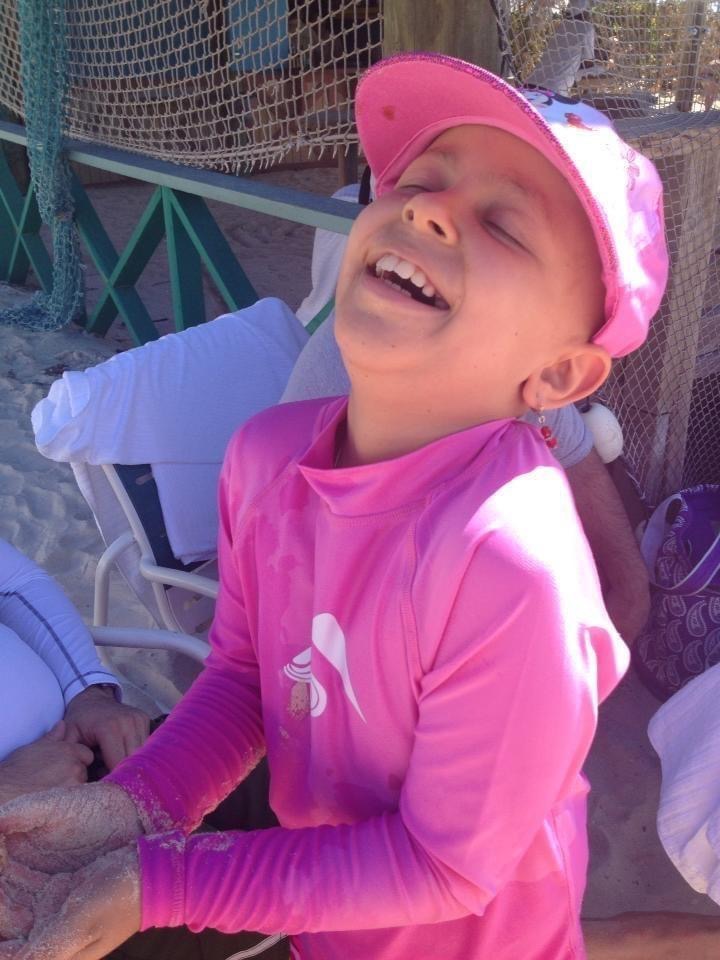
The Live Like Bella foundation has raised more than more than $37 million to fight childhood cancer.
“I knew we had one shot at this,” Rodriguez-Torres said. “Ultimately, I said, ‘This is the way God and Bella wanted it. They want a bunch of high school kids doing something nobody expects.’ Little did I know what was coming.”
Delgado did. Sebastian was the producer and editor. He made the storyboards and came up with the questions to be asked during the interviews. Alejandro worked on graphics and animation.
“He’s a really creative kid,” Sebastian said of his brother. “He’s a lot more creative than I am. Give him a camera and give him an idea, and that kid will blow your mind.”
Sebastian learned of Bella’s powerful story during a meeting with Shannah and Raymond Rodriguez-Torres. Sebastian, who already produced two documentaries for CCNN, knew it would be his biggest challenge. But he said he wasn’t intimidated.
“I knew how strong of a story it was,” Sebastian said, “and during the whole meeting I was thinking, ‘OK, here’s how I want to tell it.’ ”
Nearly six months later, the documentary was ready. Nearly everyone who saw the finished product was amazed that it was produced by a high school senior directing a team of fellow classmates.
Nearly everyone, because Delgado was not amazed.
“Sebastian impresses me every single day,” Delgado said. “To see who he has become in the last four years is something that I am eternally proud and grateful for.
“But to tell you I was surprised, I wish I could because I missed that feeling of being surprised by Sebastian. I don't have it anymore because it’s something I expect from him, because he's such an amazing human being and he just keeps on producing.”
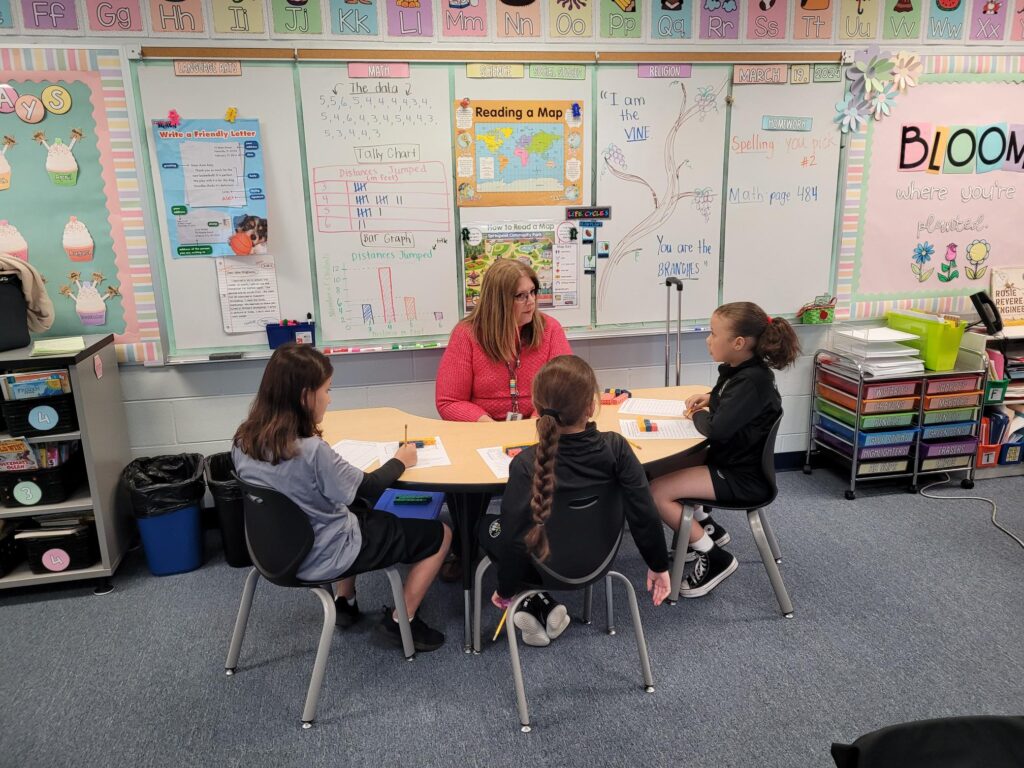
Amy Galloway provides targeted math support to three students as part of Holy Family Catholic School's D.E.N.S. program. D.E.N.S. stands for Differentiation, Enrichment and Needed Support.
JACKSONVILLE, Florida - Math class at Holy Family Catholic School begins with two polls, one in which students share their snack preferences and the other in which they name their favorite animals.
Second-grade teacher Alicia Revels divides the room into two groups of students and assigns each a survey to give the class. The two groups count the votes.
Revels writes the results on the whiteboard. In the snack poll, cookies edged out popcorn six to five, while only one student chose chips. In the animal group, tigers received the most love with six votes. Monkeys got four, while two students preferred elephants.
Revels’ goal when she designed the lesson: teach students how to display and interpret data. “I love it when students can have input when it comes to data, so it makes it more relevant to them,” she said.
After the fun, Revels asks the students to design a bar graph for their poll results and create related equations.
As the students begin work, three girls who were in the animals group break away and head to a small table at the right side of the classroom. Amy Galloway hands each student two worksheets and connecting blocks in red, blue and yellow.
“What do you put first in a bar graph?” Galloway asks. After creating the graph with the blocks, they draw and color it with markers on a graph sheet. They then fill in the numbers 0 through 10 in the left column and the names of each animal in the columns along the bottom row.
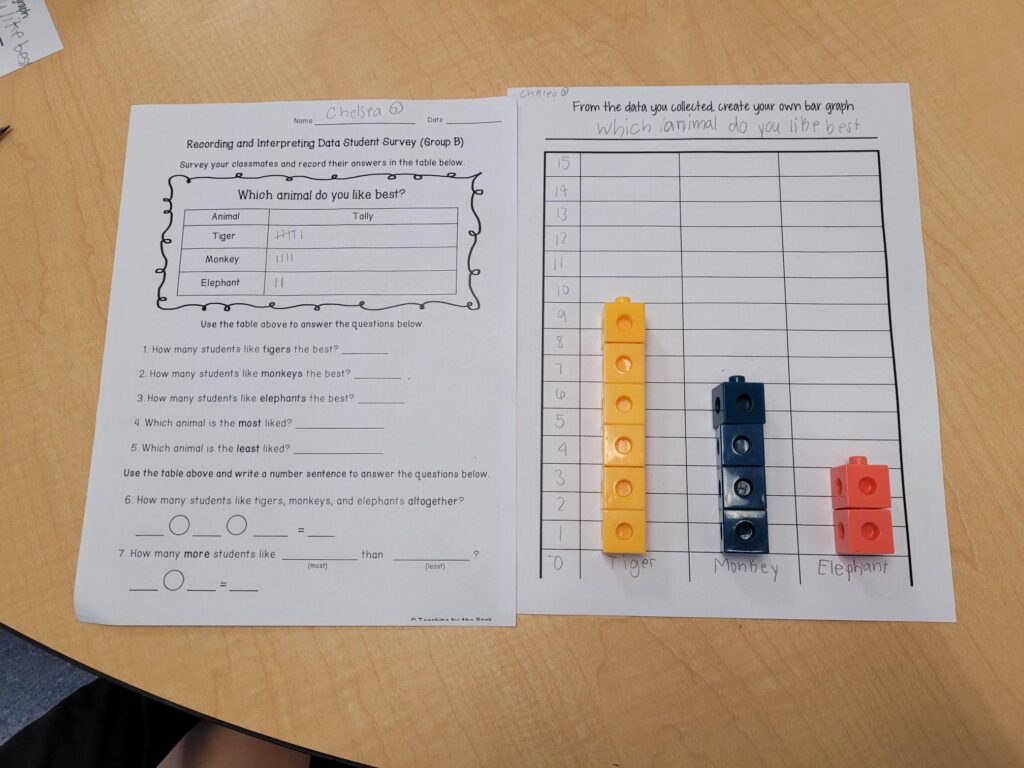
After a math lesson, D.E.N.S. students use these colored blocks to create bar graphs to help them interpret data.
Though the casual observer might not notice, the three students are receiving stealth tutoring. It’s one example of Holy Family’s Differentiation, Enrichment and Needed Support or D.E.N.S. program in action.
It's also another example of how Florida Catholic schools are increasingly trying new approaches to better meet the needs of more diverse students and fuel their growth in the Sunshine State.
“D.E.N.S started as a way to give teachers additional support and create smaller groups in the class to meet student needs,” explained assistant principal Amanda Robison.
The program also includes enrichment for students identified as high achievers to dig deep into non-academic subjects, including religious education. Down the hall from Revels’ class, a small group of third graders in the enrichment program makes small tombs with paper plates and pebbles to expand the lessons taught during the Christian holy week. About 30 to 40 students participate in the enrichment component. A third part of the program, led by the school guidance counselor, offers help dealing with life events and is open to all the K-8 school’s 408 students.
Robison, who joined the staff in August as part of a new administrative team, worked to revitalize the program, which had been scaled back during the pandemic.
Her background in special education and educational leadership helped her transform the program to zero in on specific learning needs and support students who needed targeted help.
The staff started analyzing test scores to see which students were below grade level in certain areas, for example, phonics or math.
The students take the Renaissance Star reading and math assessment for progress monitoring quarterly throughout the school year. This is used for determining which students may need intervention or enrichment. Educators use the results to determine which students have mastered a specific skill on the Florida math standards, such as "Add or subtract multi-digit numbers including using a standard algorithm with procedural fluency."
Those who have fallen behind are assigned to D.E.N.S. for extra help to get them back on track in those specific areas. Students who are in D.E.N.S. take the assessments every six to eight weeks to measure progress and determine whether intervention is still necessary.
The school also uses iXL, a website that delivers personalized learning and diagnostic tests, to verify Star scores and help ensure students get the intervention that best meets their needs. Teachers also use iXL lessons as practice exercises following an in-class lesson.
One advantage of D.E.N.S. is that it infuses differentiated support and enrichment into the school day, so families’ before or after-school schedules are not disrupted. The learning support teachers “push in” to the regular classroom and work with the smaller group at the same time their classmates are learning the same lesson. It also makes receiving extra support seem routine and discourages labeling.
Sessions last for six to eight weeks, and students leave D.E.N.S. when the data show they have mastered the targeted skills. For those who require additional help, temporary pullout programs and one-on-one instruction are also provided.
“It’s really beautiful because the students aren’t having to live in this intervention world,” Robison said. “They are visiting it.”
School data shows the program is working. Of those receiving help in reading, 93% have made progress, and 85% percent getting help have progressed in math. Robison said the program had delivered 100 services in the prior week, though not necessarily to 100 students as some receive multiple services.
The program also benefits more than just those students receiving help by allowing teachers to instruct a diverse group of students while allowing those who don’t need extra support to move forward.
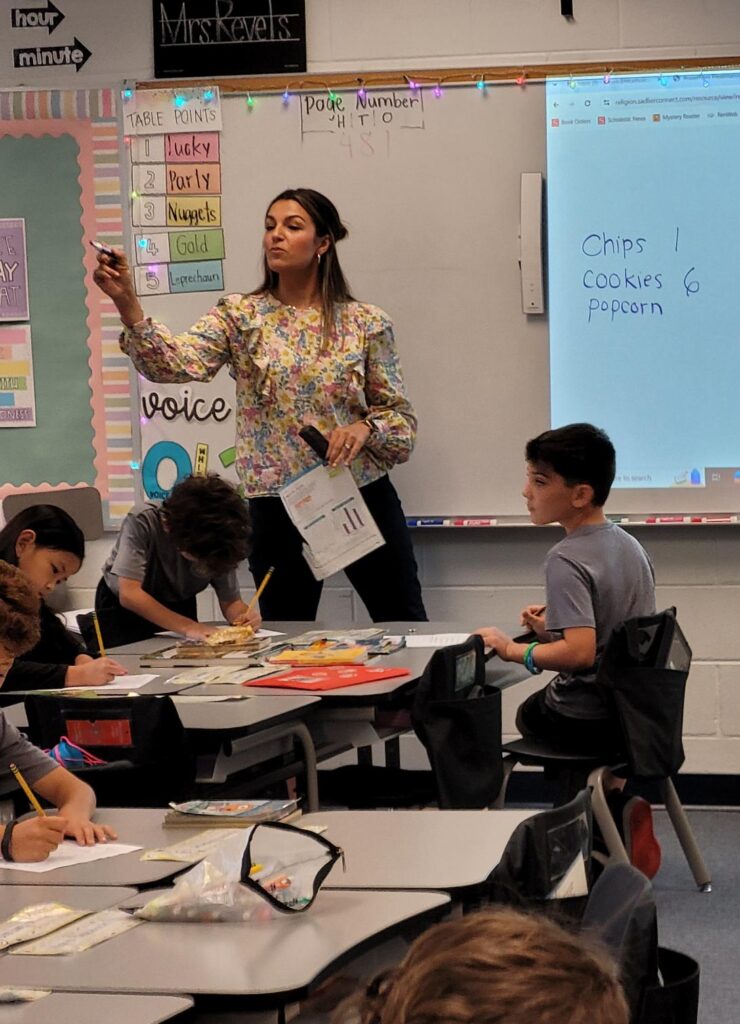
D.E.N.S. allows classroom teachers like Alicia Revels to educate a diverse group of students by offering support to those who need it so she can continue to focus on the rest of the class.
“When my team goes in and works with this targeted group, it gives the teachers in the class the ability to really focus on what the other students need,” Robison said. “It’s really meant to keep the pace of the class instruction continuous and high-achieving and make sure education is getting scaffolded along the way to ensure nobody is left behind.”
After the three D.E.N.S. students finish their math graphs, they grab their electronic tablets and seamlessly rejoin the rest of the class, where all the students are taking their diagnostic tests to measure their skills. An algorithm targets areas are each student needs more practice. It also acts as a D.E.N.S. screener. If some areas stand out as off track, teachers can offer extra practice and do further testing to see if they could benefit from D.E.N.S.
“We can swoop in,” Robison said. “It’s designed in a way to take the stress off the teachers and not have them have to differentiate among several grade levels in their instruction.”

An attorney defending the Oklahoma’s charter school board wasted no time identifying the primary issue before the Oklahoma Supreme Court.
“This is whether the operation of a charter school violates the establishment clause,” said Philip Sechler, representing the Oklahoma Statewide Virtual Charter School Board.
The board’s approval of St. Isidore of Seville Catholic Virtual Charter School last year catalyzed a controversy in the Sooner State that could pave the way for the nation’s first religiously affiliated charter school. That means the case has national ramifications and could reach the U.S. Supreme Court.
The high court sidestepped the issue when it declined last year to review a 2022 appellate court decision that said charter schools were state actors. Other federal circuits have issued conflicting decisions.
Experts have said Oklahoma Attorney General Gentner Drummond’s lawsuit to stop St. Isidore could bring the issue of public schools operated by religious groups back to the nation’s high court to settle.
On Tuesday, the Oklahoma Supreme Court took center stage for a case that has split the state’s top Republicans and frayed relationships within the diverse national charter school movement.
Drummond argued that St. Isidore is a public school and is subject to the same rules as the state’s other charter schools, which include being non-sectarian and tuition-free for families.
Yet in its application to open a new school, it “promises to be “Catholic in every way, Catholic in teaching and Catholic in employment.” Drummond added that the school requires the principal to be a practicing Catholic, while the state’s public schools cannot limit hires to members of one faith.
The Oklahoma Catholic Church and the state, he said, “have formed an actual union” that “eviscerates the separation of church and state” and violates Oklahoma’s constitution and charter school laws. While the U.S. Supreme Court may very well decide someday that public schools can be religious, the state court is limited in this case to a decision based on state law.
Attorneys for the statewide charter authorizer and for St. Isidore, which is intervening in the case, argued that the state does not control charter schools, as Drummond argued. Charter schools are public schools designed to be run by private organizations given autonomy to foster innovation.
“It has its own facilities, its own bank account, its own ability to raise funds and enter contracts in its own name,” Sechler said. “Being a public school does not make St. Isidore a state actor.”
Sechler also pointed out that charter schools hire their own staff, design their own mission statements and academic programs, and determine their own teaching methods. He added that no student is required to attend charter schools.
He said that operating under a state contract said, “does not make it a part of the government.”
Justices peppered the attorneys with questions throughout the arguments, including why using government funds to pay religious hospitals and allowing state scholarships to be used for religious colleges were constitutional.
When justices asked about the recent trilogy of U.S. Supreme Court decisions that struck down bans on religious schools’ participation in state school choice programs, Drummond said those organizations were private, with funding going to families who could choose where to spend it. Justice Dana Kuehn asked if public religious schools should be allowed as counterweights to secular public schools that “expound [ideologies] outside ABC and 123.”
“Does that open the door for a charter school to have a religious component if the public school has an anti-religious component?” she asked.
Justice Yvonne Kauger expressed concern that a U.S. Supreme Court decision in favor of religious charter schools would open the door to many religious organizations seeking to open publicly funded schools.
“When this all comes down – Katie bar the door – everybody would be affected,” she said. “Are we being used as a test case? It sure looks like it.”
St. Isidore attorney Michael McGinley assured the court that St. Isidore was not intended to be a test case but instead was an effort to meet the needs of families. He said many students in rural areas live too far away from in-person Catholic schools.
The state’s existing school choice scholarships, he added, won’t cover the entire cost of education, leaving low-income families to make up the difference. A charter school would solve that problem.
“Voucher programs are wonderful,” he said, “but they’re not perfect.”

The story: All eyes will be on Oklahoma on Tuesday as the state’s highest court hears arguments about the constitutionality of what could be the nation’s first faith-based charter school. The case, which observers say will likely end up in the U.S. Supreme Court, pits top Republicans against each other and threatens to divide the national school choice movement.
State of play: State Attorney General Gentner Drummond sued the Oklahoma Statewide Virtual Charter School Board in October to stop the opening of St. Isidore of Seville, a Catholic virtual charter school approved to open in August 2024. Separately, a group of parents and faith leaders and a nonprofit education organization sued in a lower court. Drummond’s lawsuit reverses his predecessor, also a Republican, who issued an opinion stating that recent U.S. Supreme Court decisions nullified the state constitution’s ban on religiously affiliated public schools. Gov. Kevin Stitt, a longtime school choice advocate, sided with the board to back the school. Drummond filed his petition directly with the state Supreme Court, which is scheduled to hear arguments at 10 a.m. CDT Tuesday. The hearing will be live streamed here.
Why it matters: Charter schools are public schools run by private organizations. Many charter school supporters believe their status as public schools requires them to be non-sectarian and comply with anti-discrimination policies. If St. Isidore is allowed to open, it would be the nation’s first religious charter school. It would also throw the doors wide open to efforts in other states to allow religious organizations to operate public schools.
Yes, but: Catholic leaders, who are now accepting applications for next school year at St. Isidore, say it’s needed to reach students in rural areas that lack in-person Catholic schools. Most of the state’s Catholic schools are concentrated near cities. They also want to help brick-and-mortar Catholic schools by providing access to courses that schools typically can’t offer in-person.
Charter allegiances fraying: Besides stirring controversy among state GOP leaders, the issue has divided the charter school movement. Great Hearts Academies, a network of 40 classical charter schools in Texas and Arizona, took a position opposite the National Alliance of Public Charter Schools in a related case. Great Hearts argued that government funding does not make charter schools state actors. It urged the U.S. Supreme Court to settle the question. The high court declined.
“By design and definition, charter schools are run by independent entities that provide an alternative to government-run education. That independence frees charter schools from bureaucratic and governmental constraints and allows them to offer innovative curricula and environments that government-run schools do not. If charter schools are deemed state actors, that innovation will be stifled,” Great Hearts’ brief said.
The national alliance took the opposite position: “We support preserving the original intent and legal status of public charter schools to protect the constitutional rights of the students and teachers who choose these unique public schools. Charter schools are public schools and are state actors for the purposes of protecting students’ federal constitutional rights,” the group’s recent statement said. The group added that it “vehemently” opposes the Oklahoma board’s approval of the school and pledged to work with partners and advocates to “ensure that all students who wish to attend a high-quality, public school continue to have that option.”
Catholic school enrollment in Florida grew more in the past year than in the previous 10 years combined, while Catholic school enrollment nationally held steady, according to the latest figures from the National Catholic Educational Association.
The longer-term trend lines now show Florida Catholic school enrollment up 9% over the past decade, while it’s down 14% nationally.
In light of the new data, we thought it appropriate to issue this brief update to our paper from August.
“Why Catholic Schools In Florida Are Growing: 5 Things To Know” took a closer look at Florida's upward trends and the leading factors behind them.
Our new brief is meant to supplement that paper. We updated a handful of key charts and graphs using new data from the NCEA and the Florida Catholic Conference, including a year-by-year breakdown of Catholic school enrollment for all 50 states.
We also added a couple of new charts. One highlights the number of students using special needs scholarships in Florida Catholic schools. The other does the same for non-Catholic students. Both are on the rise.
As with the paper, we hope our brief can inspire and inform, and perhaps point to lessons from Florida that might be especially useful to Catholic education supporters in states with new choice programs. Challenges remain, but now the wind is at your back.
Editor's note: Some of the figures in Appendix A in the original update brief were incorrect. The correct version here was put in its place on May 9, 2024.
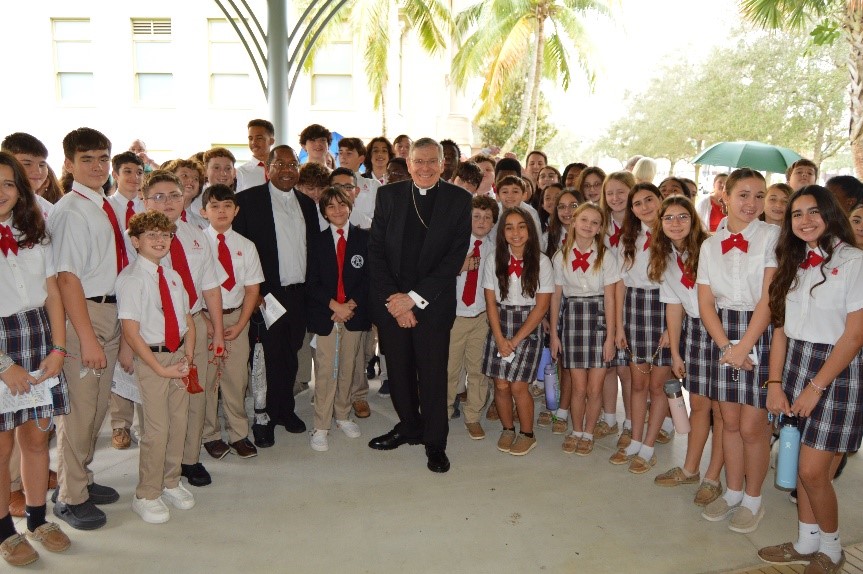
Bishop Barbarito of the Diocese of Palm Beach poses with Reverand Delvard, pastor and students from St. Ann Catholic School in West Palm Beach.
By Ron Matus and Lauren May
The latest national and state-by-state Catholic school enrollment numbers are out – and they amplify the contrast between what’s happening in Florida and most of the rest of America.
Bishop Barbarito of the Diocese of Palm Beach poses with Reverand Delvard, pastor and students from St. Ann Catholic School in West Palm Beach.
Nationally, Catholic school enrollment in PreK-12 held steady, according to the latest annual report from the National Catholic Educational Association, released Wednesday. In 2023-24, 1,693,327 students were enrolled in Catholic schools, virtually the same number as the prior year. (Officially, the 2022-23 number was 1,693,493.)
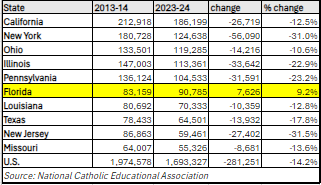
In Florida, enrollment climbed to 90,785, up 5.2% from the prior year.
The NCEA figures for Florida are slightly different than the numbers NextSteps reported in January. That report was based on enrollment figures from the Florida Conference of Catholic Bishops, which includes a broader group of preschool students in its count.
Either way, Florida continues to be an encouraging outlier.
Last August, Step Up For Students published “Why Catholic Schools In Florida Are Growing: 5 Things To Know,” which took a closer look at the Florida numbers and some of the factors behind them.
At that time, Florida was the only state in the Top 10 for Catholic school enrollment to see growth over the past decade – 4.4%. The latest figures show that’s still the case, but strong gains over the past year boost the 10-year increase to 9.2%.
Clearly, Florida’s robust education choice scholarship programs are a difference maker. But it’s also true that in the most competitive educational environment in the country, Florida Catholic schools have found even more ways to stand out to families.
A number of schools have incorporated popular programming, such as IB programs and classical curriculum while keeping Catholic teaching at the core of all that they do. At the same time, some dioceses have embraced – and relentlessly deployed – cutting-edge strategies to raise parental awareness about choice scholarships.
During scholarship application season, the Diocese of Venice, which covers southwest Florida, now sends more than 1 million texts and emails about the scholarships to Catholic families. Not coincidentally, the diocese has the biggest enrollment growth of any diocese in Florida, and all 16 of its schools now have wait lists.
Nationally, Catholic school enrollment is down 14.2% over the past decade, but there are encouraging signs here, too. After a post-COVID dip, the numbers climbed for two years before stabilizing this year. Five of the Top 10 states also showed some year-over-year growth this year. (Florida, Ohio, Pennsylvania, Louisiana, and Texas).
The good news is that there is no reason for Florida to remain the outlier given the growing number of states that have adopted major if not universal choice programs in the past three years. Catholic school supporters across the nation have a golden opportunity to help their schools further flourish and grow.
Ron Matus is Director of Research and Special Projects and Lauren May is Advocacy Director at Step Up For Students, which publishes this blog and administers education choice scholarship programs in Florida.
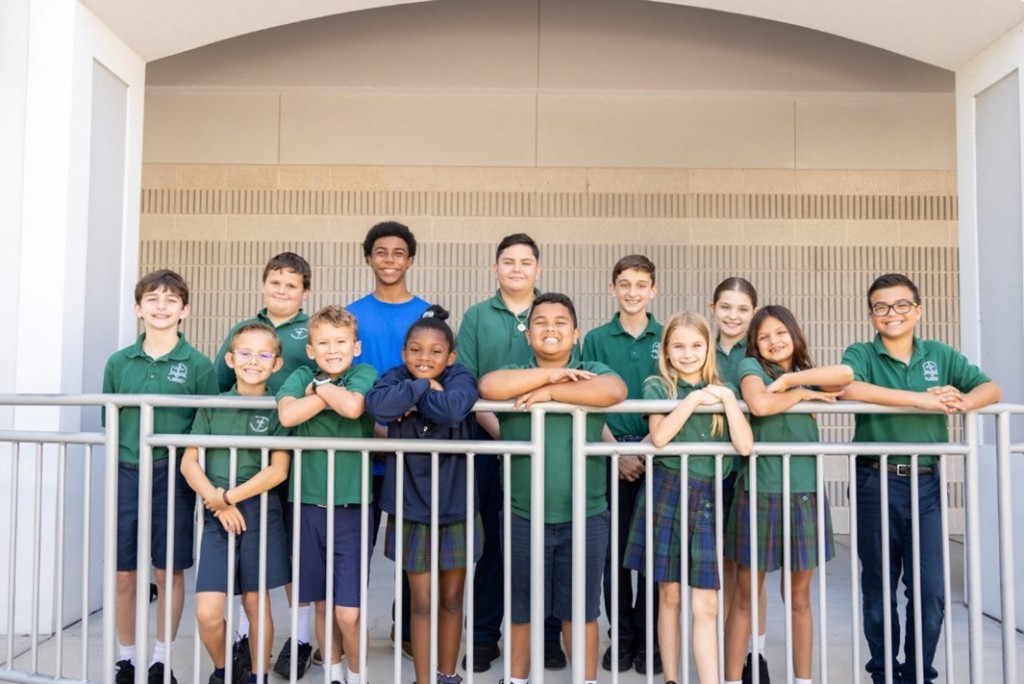
Students at St. Lawrence Catholic School in Tampa brought their bright smiles and are ready to start the school year.
School is back in session for Catholic schools across all seven dioceses in Florida.
This year, each of them is seeing another enrollment increase.
This broad, widespread enrollment growth is part of a longer-term trend that makes Florida stand out on the national landscape.
In a recent report published by Step Up For Students, only 10 states showed growth in Catholic school enrollment over the past decade. Of those 10, Florida is the only state with a significant number of students enrolled in Catholic schools.
These numbers may continue to change as some schools are still enrolling new students, but here is a preliminary look at year-over-year enrollment growth by diocese.
Diocese of Venice – 8%
Diocese of Palm Beach – 6%
Diocese of St. Augustine – 5%
Archdiocese of Miami – 3.5%
Diocese of St. Petersburg – 3.5%
Diocese of Orlando – 3%
Diocese of Pensacola/Tallahassee – 2%
Katie Kervi, Assistant Superintendent for the Diocese of Palm Beach, said that over the last three years enrollment in the diocese’s schools has grown by at least 6%.
“We are excited to see our schools flourishing and look forward to welcoming new students and families into our community,” she said. “Our Catholic schools provide a faith-based education paired with high academic standards. I believe the consistent increases in enrollment can be attributed to these strong foundations and because all families now have the opportunity to choose the educational environment that is best for their children.”
Legislation that went into effect on July 1 made the state’s Family Empowerment Scholarships available to all students who are eligible for K-12 public education.
Alina Mychka’s daughter was awarded a scholarship for the 2023-24 school year by Step Up For Students, which hosts this blog.
Her child started the year at Holy Family Catholic School in Jacksonville, and she says she is thankful she can send her child to a safe environment with a rigorous curriculum that reinforces her values.
Mychka immigrated to America from Ukraine eight years ago. She sends any extra dollars her family can spare back to her relatives in their war-ravaged home country.
Without the scholarship, she says, Catholic school would likely not be an option for her family.
This paper was authored by the Step Up For Students team of Lauren May, director of advocacy and a former Catholic school teacher and principal; Patrick Gibbons, senior manager for public affairs; and Ron Matus, director of research and special projects.
The good news: In the wake of the COVID-19 pandemic, America’s Catholic schools re-opened sooner than the vast majority of public schools and yielded considerably better academic outcomes, particularly for Black and Hispanic students.
The bad news: And yet, in most of the country, Catholic schools continue to fade away. Over the past decade, only 10 states showed growth in Catholic school enrollment. Only one of them – Florida – has significant numbers of students in Catholic schools.
The hopeful news: There’s no reason it has to stay that way.
Our white paper, “Why Catholic Schools in Florida Are Growing: 5 Things to Know,” aims to amplify the success of Florida’s Catholic schools and offer lessons for Catholic education elsewhere. With the recent, remarkable expansion of universal choice in multiple states, the time couldn’t be more right.
Florida’s Catholic schools operate in the nation’s most competitive education market. That they’re growing speaks volumes about the power of choice and the quality of the Catholic school brand.
It also speaks to change. Florida’s Catholic schools grow more diverse by the day, both with the students they serve and the programming they offer.
As choice expands, the future of Catholic schools will hinge on how well they adapt to ever more dynamic environments with ever more options. The experience in Florida suggests they are more than capable.
Editor's note: Some of the figures in Figure 1 and Appendix A in the original report were incorrect. The correct version here was put in its place on June 4, 2024.
On this episode, senior writer Lisa Buie talks with Nina Rees, president and chief executive officer of the National Alliance for Public Charter Schools. Founded in 2005, the alliance’s stated mission is to ensure all children have access to a high-quality public education regardless of their ZIP code.
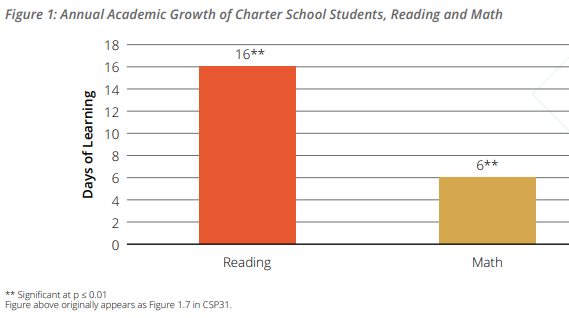
Rees discusses the recent study by the Center for Research on Education Outcomes, also known as CREDO, that showed over time, charter schools outperformed district-run schools in their communities and narrowed the achievement gap.
“If there was ever a doubt as to the effectiveness of charter schools, in their ability to close the achievement gap, this study definitely proves that gap can be closed and it's just a matter of doubling down and investing more in building these great schools in more places.”
Rees also discussed Oklahoma’s recent approval of St. Isidore of Seville Catholic Virtual Charter School, which, if it survives
Nina Rees
a court challenge, would be the nation’s first religious charter school.
Rees’ organization issued a statement disagreeing with the decision, arguing that the law has established that charter schools are public schools therefore required to operate as secular institutions. A coalition that includes Americans United for Separation of Church and State, the American Civil Liberties Union and the Education Law Center filed a lawsuit challenging the virtual charter school, which is set to open in 2024.
Episode details:
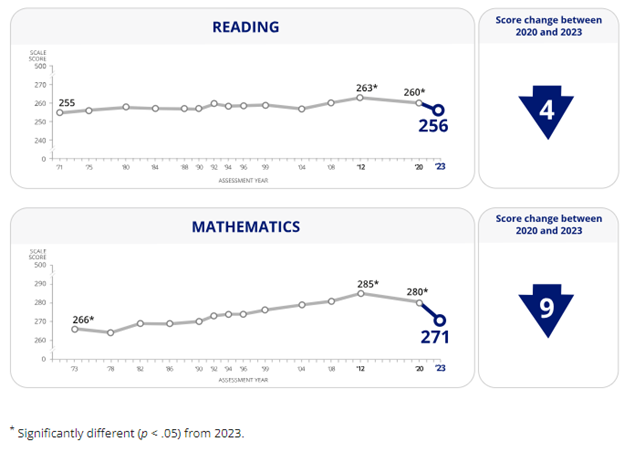
The National Assessment of Educational Progress released Long Term Trend data for 13-year-old students last week. On these exams, 10 points approximately equals a grade level worth of average academic progress. Mathematics achievement has dropped 14 points and reading seven points since 2012. The COVID-19 pandemic accelerated a pre-existing decline. Real spending per student was 160% higher in 2019-20 than in 1969-70, but reading scores are statistically identical (255 in 1970, 256 in 2023). Since 2019, spending has gone to record highs while achievement to near record lows.
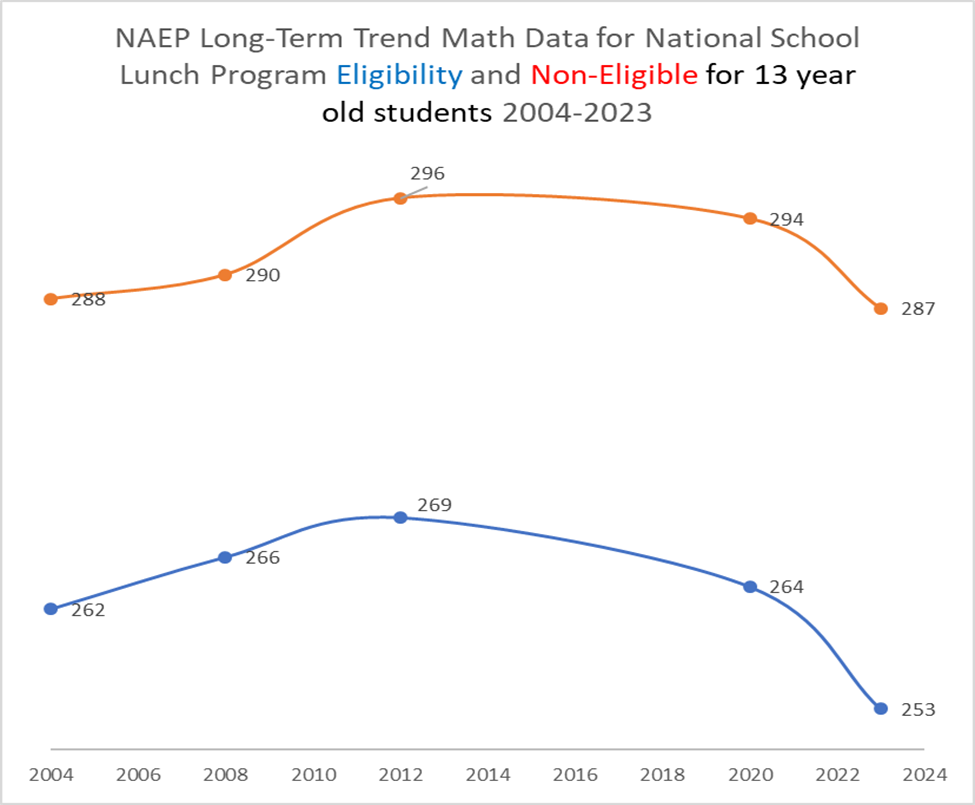
The news gets worse when you examine achievement gaps. The chart below shows the mathematics trend by free or reduced lunch eligibility status. The smallest gap stood at a still appalling 24 points in 2008. In 2023 the gap stood at 34 points, the largest on record.
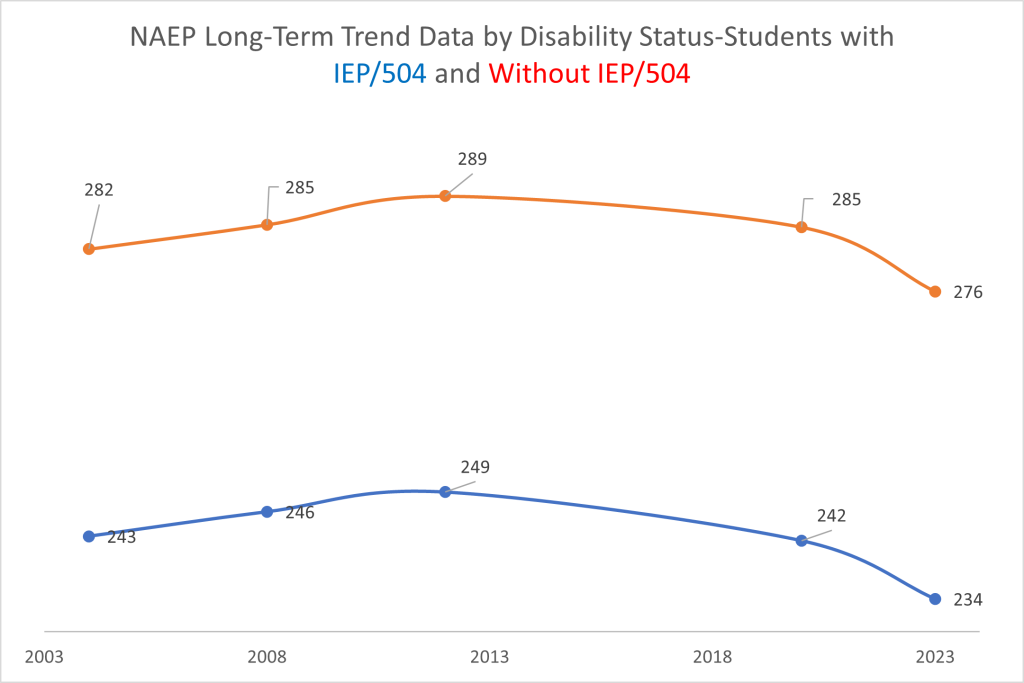
Similar story by disability status- bad for both, worst for IEP/504 plan students.
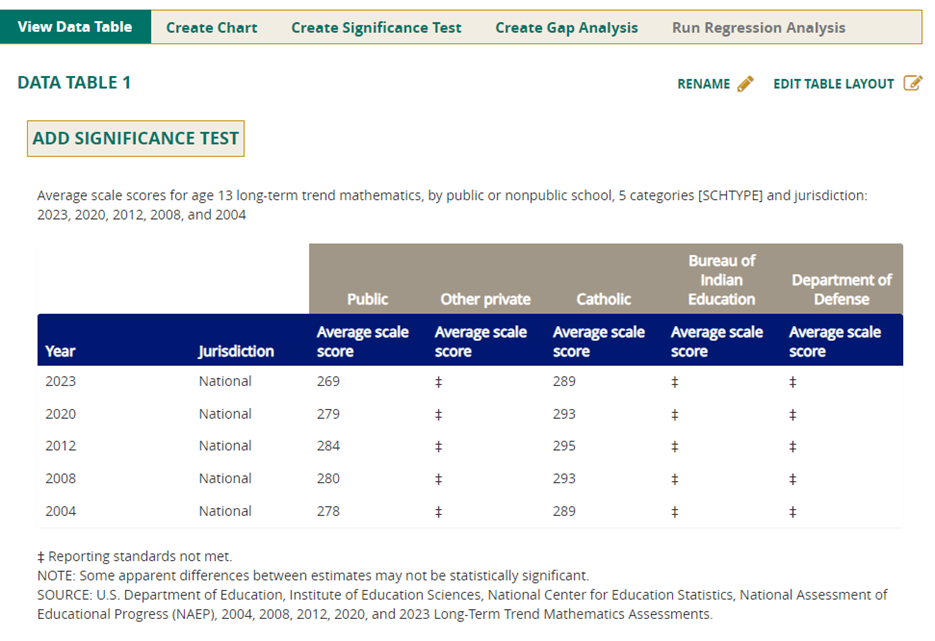
The gap between public school and Catholic school students increased from 11 points in favor of Catholic school students in 2004 to a 20-point advantage in 2023. The advantage for Hispanic students in Catholic schools stood at 23 points higher than their public-school peers.
Now it could be that you are not overly concerned about your child or grandchild learning civics, mathematics or reading. If so the union captured district system has growing numbers of empty seats just for you! As an added bonus, your special little ones can indirectly serve as funding units for some of the most reactionary special interests in American politics today!
Not your particular cup of tea? Well then consider making alternate plans. Millions before you have already done so, and the flight to freedom is just getting warmed up.

