
An attorney defending the Oklahoma’s charter school board wasted no time identifying the primary issue before the Oklahoma Supreme Court.
“This is whether the operation of a charter school violates the establishment clause,” said Philip Sechler, representing the Oklahoma Statewide Virtual Charter School Board.
The board’s approval of St. Isidore of Seville Catholic Virtual Charter School last year catalyzed a controversy in the Sooner State that could pave the way for the nation’s first religiously affiliated charter school. That means the case has national ramifications and could reach the U.S. Supreme Court.
The high court sidestepped the issue when it declined last year to review a 2022 appellate court decision that said charter schools were state actors. Other federal circuits have issued conflicting decisions.
Experts have said Oklahoma Attorney General Gentner Drummond’s lawsuit to stop St. Isidore could bring the issue of public schools operated by religious groups back to the nation’s high court to settle.
On Tuesday, the Oklahoma Supreme Court took center stage for a case that has split the state’s top Republicans and frayed relationships within the diverse national charter school movement.
Drummond argued that St. Isidore is a public school and is subject to the same rules as the state’s other charter schools, which include being non-sectarian and tuition-free for families.
Yet in its application to open a new school, it “promises to be “Catholic in every way, Catholic in teaching and Catholic in employment.” Drummond added that the school requires the principal to be a practicing Catholic, while the state’s public schools cannot limit hires to members of one faith.
The Oklahoma Catholic Church and the state, he said, “have formed an actual union” that “eviscerates the separation of church and state” and violates Oklahoma’s constitution and charter school laws. While the U.S. Supreme Court may very well decide someday that public schools can be religious, the state court is limited in this case to a decision based on state law.
Attorneys for the statewide charter authorizer and for St. Isidore, which is intervening in the case, argued that the state does not control charter schools, as Drummond argued. Charter schools are public schools designed to be run by private organizations given autonomy to foster innovation.
“It has its own facilities, its own bank account, its own ability to raise funds and enter contracts in its own name,” Sechler said. “Being a public school does not make St. Isidore a state actor.”
Sechler also pointed out that charter schools hire their own staff, design their own mission statements and academic programs, and determine their own teaching methods. He added that no student is required to attend charter schools.
He said that operating under a state contract said, “does not make it a part of the government.”
Justices peppered the attorneys with questions throughout the arguments, including why using government funds to pay religious hospitals and allowing state scholarships to be used for religious colleges were constitutional.
When justices asked about the recent trilogy of U.S. Supreme Court decisions that struck down bans on religious schools’ participation in state school choice programs, Drummond said those organizations were private, with funding going to families who could choose where to spend it. Justice Dana Kuehn asked if public religious schools should be allowed as counterweights to secular public schools that “expound [ideologies] outside ABC and 123.”
“Does that open the door for a charter school to have a religious component if the public school has an anti-religious component?” she asked.
Justice Yvonne Kauger expressed concern that a U.S. Supreme Court decision in favor of religious charter schools would open the door to many religious organizations seeking to open publicly funded schools.
“When this all comes down – Katie bar the door – everybody would be affected,” she said. “Are we being used as a test case? It sure looks like it.”
St. Isidore attorney Michael McGinley assured the court that St. Isidore was not intended to be a test case but instead was an effort to meet the needs of families. He said many students in rural areas live too far away from in-person Catholic schools.
The state’s existing school choice scholarships, he added, won’t cover the entire cost of education, leaving low-income families to make up the difference. A charter school would solve that problem.
“Voucher programs are wonderful,” he said, “but they’re not perfect.”
The story: All eyes will be on Oklahoma on Tuesday as the state’s highest court hears arguments about the constitutionality of what could be the nation’s first faith-based charter school. The case, which observers say will likely end up in the U.S. Supreme Court, pits top Republicans against each other and threatens to divide the national school choice movement.
State of play: State Attorney General Gentner Drummond sued the Oklahoma Statewide Virtual Charter School Board in October to stop the opening of St. Isidore of Seville, a Catholic virtual charter school approved to open in August 2024. Separately, a group of parents and faith leaders and a nonprofit education organization sued in a lower court. Drummond’s lawsuit reverses his predecessor, also a Republican, who issued an opinion stating that recent U.S. Supreme Court decisions nullified the state constitution’s ban on religiously affiliated public schools. Gov. Kevin Stitt, a longtime school choice advocate, sided with the board to back the school. Drummond filed his petition directly with the state Supreme Court, which is scheduled to hear arguments at 10 a.m. CDT Tuesday. The hearing will be live streamed here.
Why it matters: Charter schools are public schools run by private organizations. Many charter school supporters believe their status as public schools requires them to be non-sectarian and comply with anti-discrimination policies. If St. Isidore is allowed to open, it would be the nation’s first religious charter school. It would also throw the doors wide open to efforts in other states to allow religious organizations to operate public schools.
Yes, but: Catholic leaders, who are now accepting applications for next school year at St. Isidore, say it’s needed to reach students in rural areas that lack in-person Catholic schools. Most of the state’s Catholic schools are concentrated near cities. They also want to help brick-and-mortar Catholic schools by providing access to courses that schools typically can’t offer in-person.
Charter allegiances fraying: Besides stirring controversy among state GOP leaders, the issue has divided the charter school movement. Great Hearts Academies, a network of 40 classical charter schools in Texas and Arizona, took a position opposite the National Alliance of Public Charter Schools in a related case. Great Hearts argued that government funding does not make charter schools state actors. It urged the U.S. Supreme Court to settle the question. The high court declined.
“By design and definition, charter schools are run by independent entities that provide an alternative to government-run education. That independence frees charter schools from bureaucratic and governmental constraints and allows them to offer innovative curricula and environments that government-run schools do not. If charter schools are deemed state actors, that innovation will be stifled,” Great Hearts’ brief said.
The national alliance took the opposite position: “We support preserving the original intent and legal status of public charter schools to protect the constitutional rights of the students and teachers who choose these unique public schools. Charter schools are public schools and are state actors for the purposes of protecting students’ federal constitutional rights,” the group’s recent statement said. The group added that it “vehemently” opposes the Oklahoma board’s approval of the school and pledged to work with partners and advocates to “ensure that all students who wish to attend a high-quality, public school continue to have that option.”
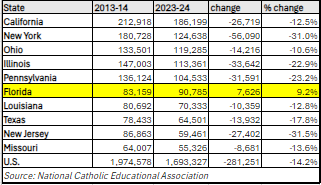
Catholic school enrollment in Florida grew more in the past year than in the previous 10 years combined, while Catholic school enrollment nationally held steady, according to the latest figures from the National Catholic Educational Association.
The longer-term trend lines now show Florida Catholic school enrollment up 9% over the past decade, while it’s down 14% nationally.
In light of the new data, we thought it appropriate to issue this brief update to our paper from August.
“Why Catholic Schools In Florida Are Growing: 5 Things To Know” took a closer look at Florida's upward trends and the leading factors behind them.
Our new brief is meant to supplement that paper. We updated a handful of key charts and graphs using new data from the NCEA and the Florida Catholic Conference, including a year-by-year breakdown of Catholic school enrollment for all 50 states.
We also added a couple of new charts. One highlights the number of students using special needs scholarships in Florida Catholic schools. The other does the same for non-Catholic students. Both are on the rise.
As with the paper, we hope our brief can inspire and inform, and perhaps point to lessons from Florida that might be especially useful to Catholic education supporters in states with new choice programs. Challenges remain, but now the wind is at your back.
Editor's note: Some of the figures in Appendix A in the original update brief were incorrect. The correct version here was put in its place on May 9, 2024.
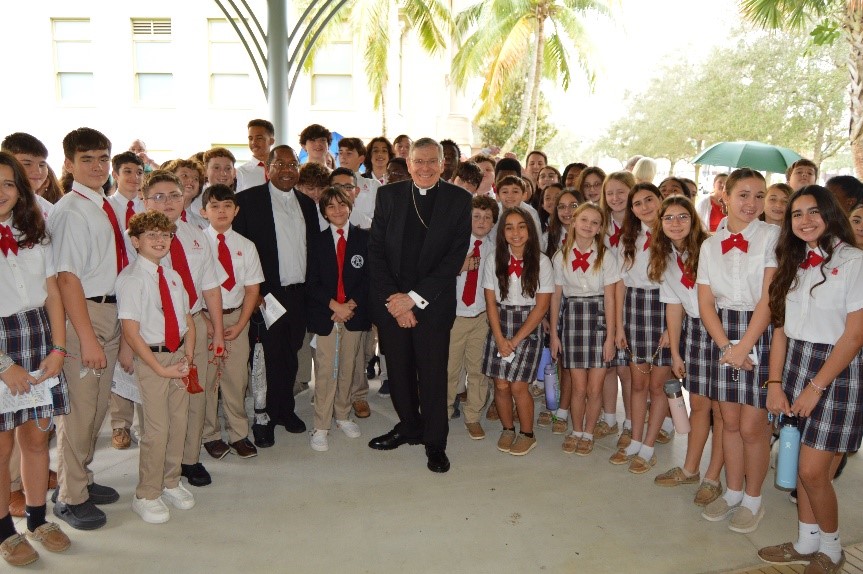
Bishop Barbarito of the Diocese of Palm Beach poses with Reverand Delvard, pastor and students from St. Ann Catholic School in West Palm Beach.
By Ron Matus and Lauren May
The latest national and state-by-state Catholic school enrollment numbers are out – and they amplify the contrast between what’s happening in Florida and most of the rest of America.
Bishop Barbarito of the Diocese of Palm Beach poses with Reverand Delvard, pastor and students from St. Ann Catholic School in West Palm Beach.
Nationally, Catholic school enrollment in PreK-12 held steady, according to the latest annual report from the National Catholic Educational Association, released Wednesday. In 2023-24, 1,693,327 students were enrolled in Catholic schools, virtually the same number as the prior year. (Officially, the 2022-23 number was 1,693,493.)
In Florida, enrollment climbed to 90,785, up 5.2% from the prior year.
The NCEA figures for Florida are slightly different than the numbers NextSteps reported in January. That report was based on enrollment figures from the Florida Conference of Catholic Bishops, which includes a broader group of preschool students in its count.
Either way, Florida continues to be an encouraging outlier.
Last August, Step Up For Students published “Why Catholic Schools In Florida Are Growing: 5 Things To Know,” which took a closer look at the Florida numbers and some of the factors behind them.
At that time, Florida was the only state in the Top 10 for Catholic school enrollment to see growth over the past decade – 4.4%. The latest figures show that’s still the case, but strong gains over the past year boost the 10-year increase to 9.2%.
Clearly, Florida’s robust education choice scholarship programs are a difference maker. But it’s also true that in the most competitive educational environment in the country, Florida Catholic schools have found even more ways to stand out to families.
A number of schools have incorporated popular programming, such as IB programs and classical curriculum while keeping Catholic teaching at the core of all that they do. At the same time, some dioceses have embraced – and relentlessly deployed – cutting-edge strategies to raise parental awareness about choice scholarships.
During scholarship application season, the Diocese of Venice, which covers southwest Florida, now sends more than 1 million texts and emails about the scholarships to Catholic families. Not coincidentally, the diocese has the biggest enrollment growth of any diocese in Florida, and all 16 of its schools now have wait lists.
Nationally, Catholic school enrollment is down 14.2% over the past decade, but there are encouraging signs here, too. After a post-COVID dip, the numbers climbed for two years before stabilizing this year. Five of the Top 10 states also showed some year-over-year growth this year. (Florida, Ohio, Pennsylvania, Louisiana, and Texas).
The good news is that there is no reason for Florida to remain the outlier given the growing number of states that have adopted major if not universal choice programs in the past three years. Catholic school supporters across the nation have a golden opportunity to help their schools further flourish and grow.
Ron Matus is Director of Research and Special Projects and Lauren May is Advocacy Director at Step Up For Students, which publishes this blog and administers education choice scholarship programs in Florida.
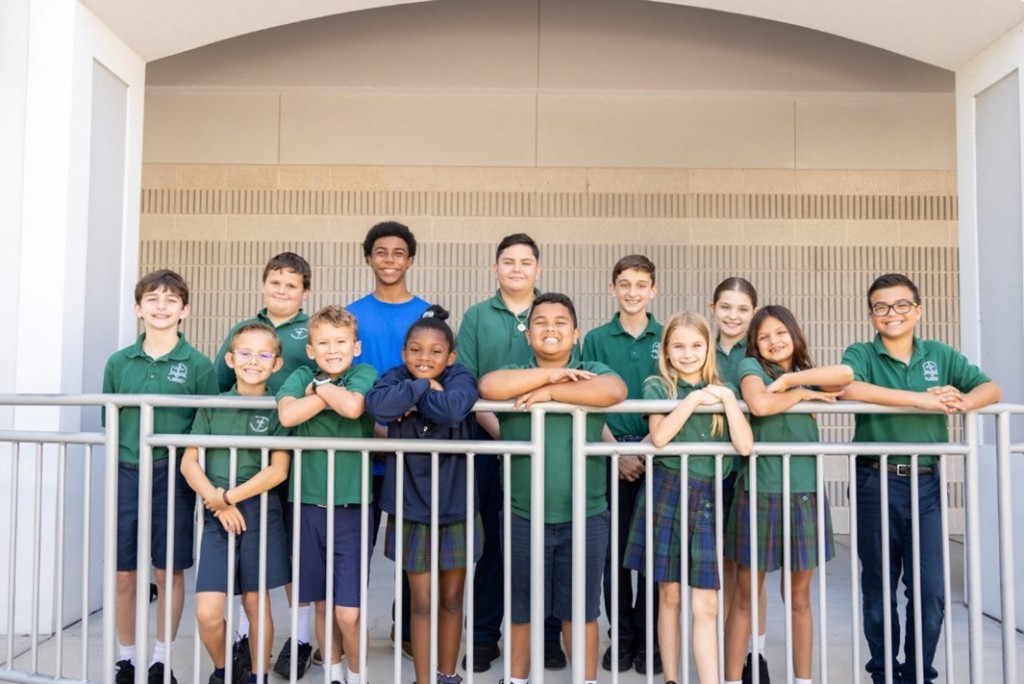
Students at St. Lawrence Catholic School in Tampa brought their bright smiles and are ready to start the school year.
School is back in session for Catholic schools across all seven dioceses in Florida.
This year, each of them is seeing another enrollment increase.
This broad, widespread enrollment growth is part of a longer-term trend that makes Florida stand out on the national landscape.
In a recent report published by Step Up For Students, only 10 states showed growth in Catholic school enrollment over the past decade. Of those 10, Florida is the only state with a significant number of students enrolled in Catholic schools.
These numbers may continue to change as some schools are still enrolling new students, but here is a preliminary look at year-over-year enrollment growth by diocese.
Diocese of Venice – 8%
Diocese of Palm Beach – 6%
Diocese of St. Augustine – 5%
Archdiocese of Miami – 3.5%
Diocese of St. Petersburg – 3.5%
Diocese of Orlando – 3%
Diocese of Pensacola/Tallahassee – 2%
Katie Kervi, Assistant Superintendent for the Diocese of Palm Beach, said that over the last three years enrollment in the diocese’s schools has grown by at least 6%.
“We are excited to see our schools flourishing and look forward to welcoming new students and families into our community,” she said. “Our Catholic schools provide a faith-based education paired with high academic standards. I believe the consistent increases in enrollment can be attributed to these strong foundations and because all families now have the opportunity to choose the educational environment that is best for their children.”
Legislation that went into effect on July 1 made the state’s Family Empowerment Scholarships available to all students who are eligible for K-12 public education.
Alina Mychka’s daughter was awarded a scholarship for the 2023-24 school year by Step Up For Students, which hosts this blog.
Her child started the year at Holy Family Catholic School in Jacksonville, and she says she is thankful she can send her child to a safe environment with a rigorous curriculum that reinforces her values.
Mychka immigrated to America from Ukraine eight years ago. She sends any extra dollars her family can spare back to her relatives in their war-ravaged home country.
Without the scholarship, she says, Catholic school would likely not be an option for her family.
This paper was authored by the Step Up For Students team of Lauren May, director of advocacy and a former Catholic school teacher and principal; Patrick Gibbons, senior manager for public affairs; and Ron Matus, director of research and special projects.
The good news: In the wake of the COVID-19 pandemic, America’s Catholic schools re-opened sooner than the vast majority of public schools and yielded considerably better academic outcomes, particularly for Black and Hispanic students.
The bad news: And yet, in most of the country, Catholic schools continue to fade away. Over the past decade, only 10 states showed growth in Catholic school enrollment. Only one of them – Florida – has significant numbers of students in Catholic schools.
The hopeful news: There’s no reason it has to stay that way.
Our white paper, “Why Catholic Schools in Florida Are Growing: 5 Things to Know,” aims to amplify the success of Florida’s Catholic schools and offer lessons for Catholic education elsewhere. With the recent, remarkable expansion of universal choice in multiple states, the time couldn’t be more right.
Florida’s Catholic schools operate in the nation’s most competitive education market. That they’re growing speaks volumes about the power of choice and the quality of the Catholic school brand.
It also speaks to change. Florida’s Catholic schools grow more diverse by the day, both with the students they serve and the programming they offer.
As choice expands, the future of Catholic schools will hinge on how well they adapt to ever more dynamic environments with ever more options. The experience in Florida suggests they are more than capable.
Editor's note: Some of the figures in Figure 1 and Appendix A in the original report were incorrect. The correct version here was put in its place on June 4, 2024.
On this episode, senior writer Lisa Buie talks with Nina Rees, president and chief executive officer of the National Alliance for Public Charter Schools. Founded in 2005, the alliance’s stated mission is to ensure all children have access to a high-quality public education regardless of their ZIP code.
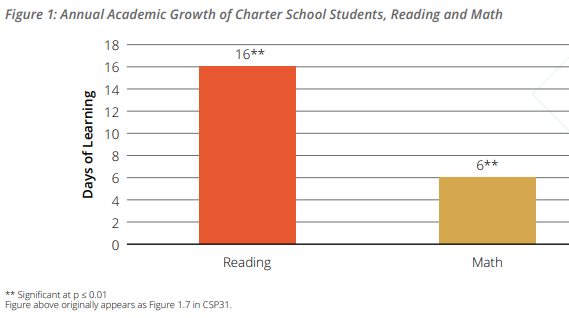
Rees discusses the recent study by the Center for Research on Education Outcomes, also known as CREDO, that showed over time, charter schools outperformed district-run schools in their communities and narrowed the achievement gap.
“If there was ever a doubt as to the effectiveness of charter schools, in their ability to close the achievement gap, this study definitely proves that gap can be closed and it's just a matter of doubling down and investing more in building these great schools in more places.”
Rees also discussed Oklahoma’s recent approval of St. Isidore of Seville Catholic Virtual Charter School, which, if it survives
Nina Rees
a court challenge, would be the nation’s first religious charter school.
Rees’ organization issued a statement disagreeing with the decision, arguing that the law has established that charter schools are public schools therefore required to operate as secular institutions. A coalition that includes Americans United for Separation of Church and State, the American Civil Liberties Union and the Education Law Center filed a lawsuit challenging the virtual charter school, which is set to open in 2024.
Episode details:
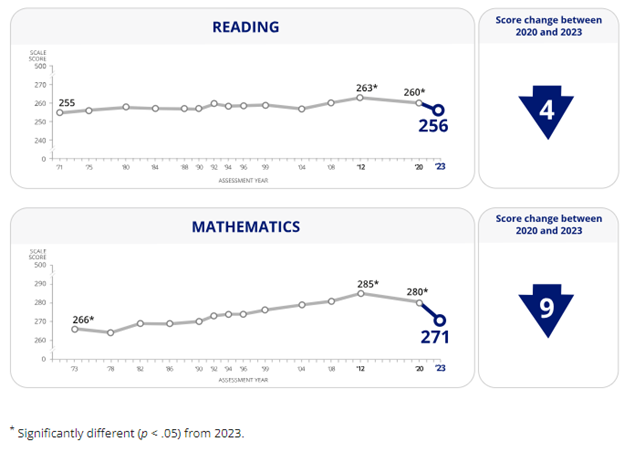
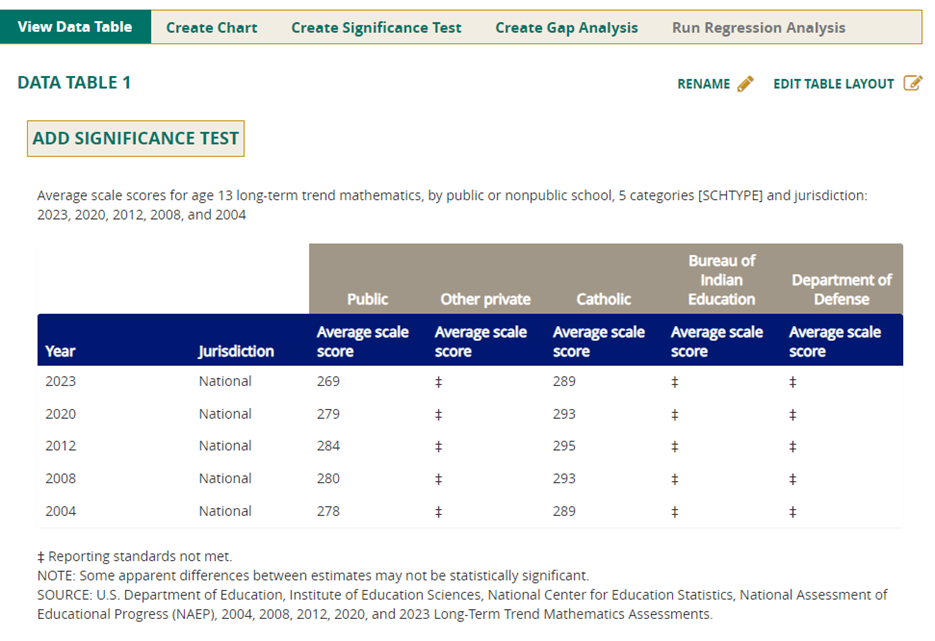
The National Assessment of Educational Progress released Long Term Trend data for 13-year-old students last week. On these exams, 10 points approximately equals a grade level worth of average academic progress. Mathematics achievement has dropped 14 points and reading seven points since 2012. The COVID-19 pandemic accelerated a pre-existing decline. Real spending per student was 160% higher in 2019-20 than in 1969-70, but reading scores are statistically identical (255 in 1970, 256 in 2023). Since 2019, spending has gone to record highs while achievement to near record lows.
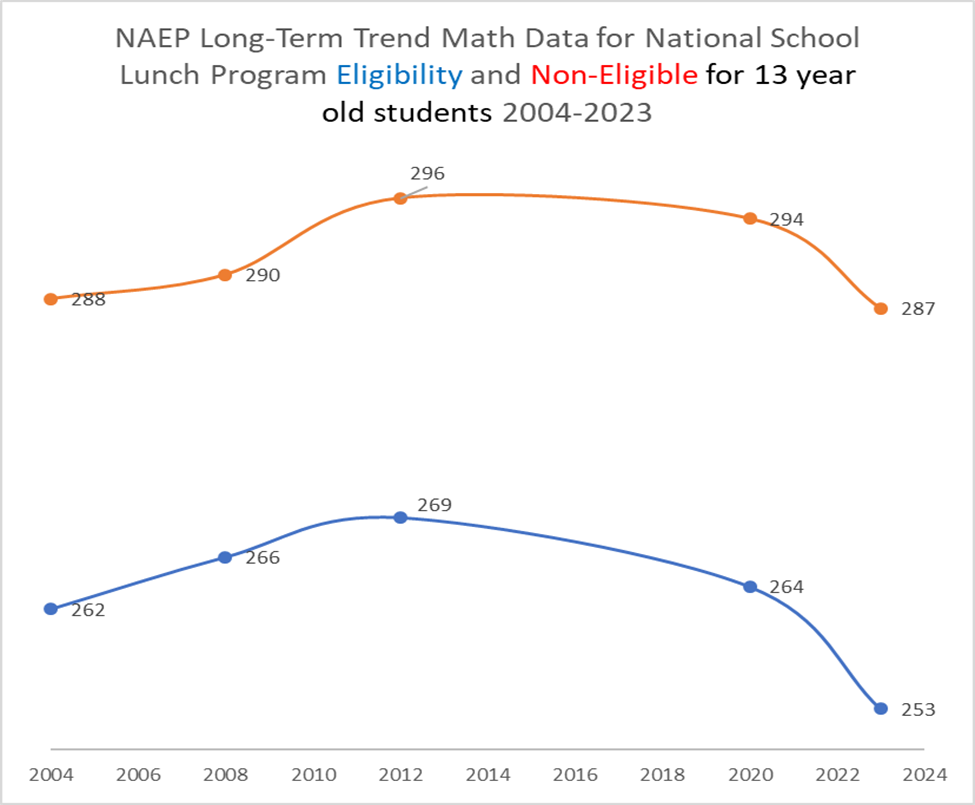
The news gets worse when you examine achievement gaps. The chart below shows the mathematics trend by free or reduced lunch eligibility status. The smallest gap stood at a still appalling 24 points in 2008. In 2023 the gap stood at 34 points, the largest on record.
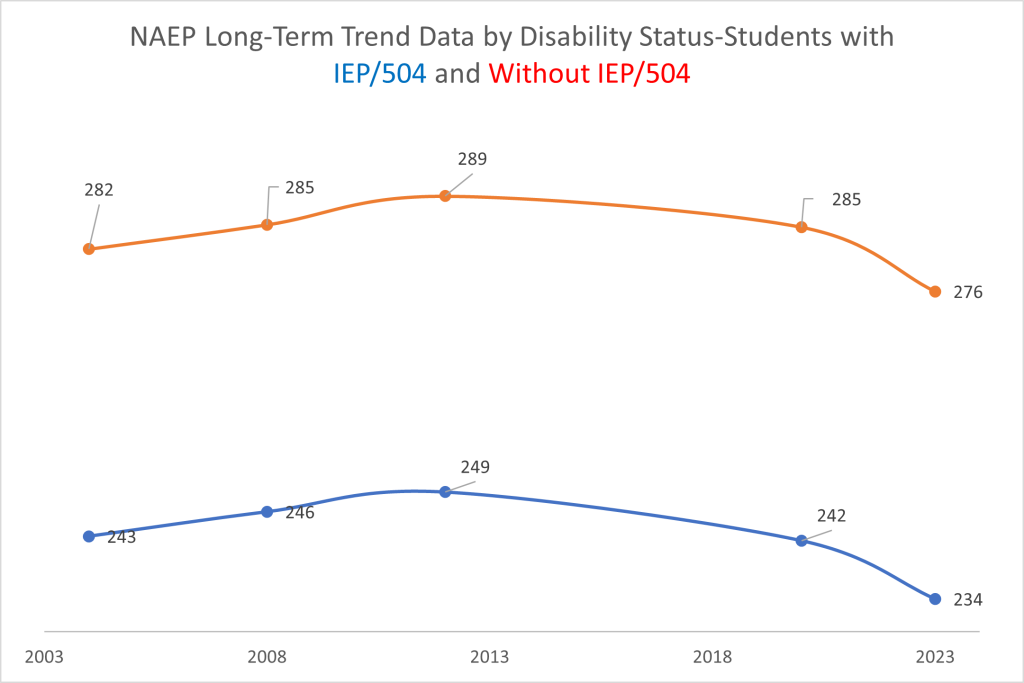
Similar story by disability status- bad for both, worst for IEP/504 plan students.
The gap between public school and Catholic school students increased from 11 points in favor of Catholic school students in 2004 to a 20-point advantage in 2023. The advantage for Hispanic students in Catholic schools stood at 23 points higher than their public-school peers.
Now it could be that you are not overly concerned about your child or grandchild learning civics, mathematics or reading. If so the union captured district system has growing numbers of empty seats just for you! As an added bonus, your special little ones can indirectly serve as funding units for some of the most reactionary special interests in American politics today!
Not your particular cup of tea? Well then consider making alternate plans. Millions before you have already done so, and the flight to freedom is just getting warmed up.
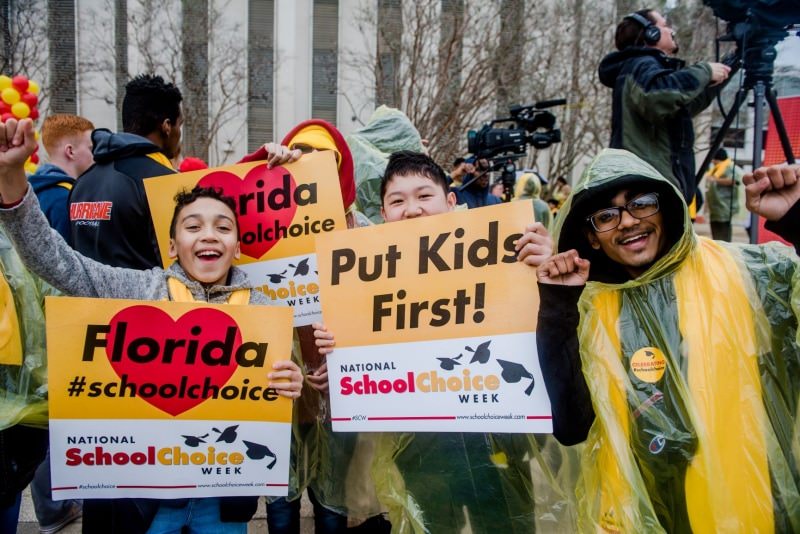
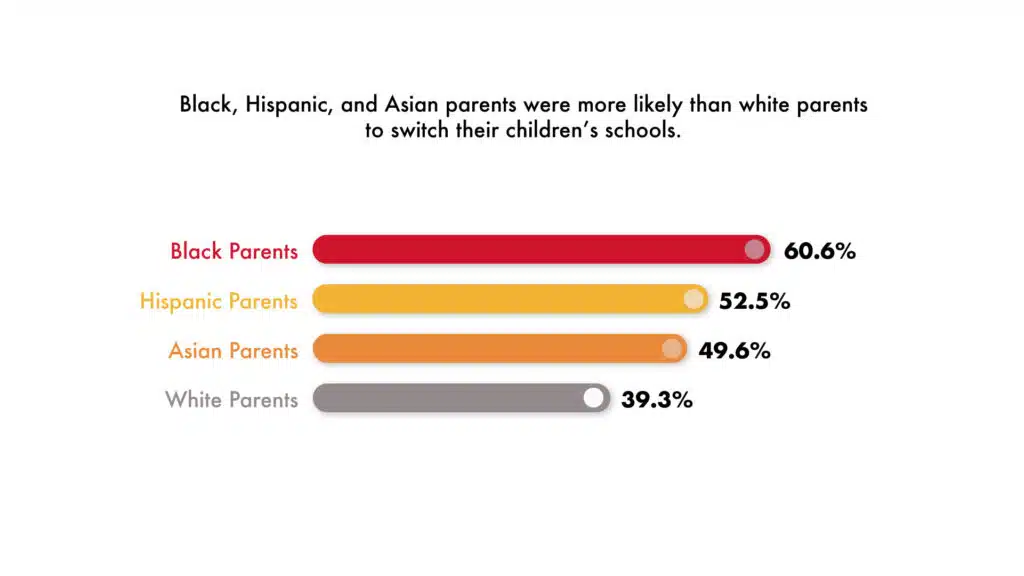
Nearly half of all parents are seeking new schools for their children in the 2023-24 school year. The data comes from a new survey by National School Choice Week, which found that 45.9 percent of parents want to enroll their child in a different learning environment this fall.
Of those parents, about 17 percent are still considering their options; 13 percent enrolled their student in a new school; 8.4 percent applied, and 7.5 percent chose homeschooling. That leaves 54 percent of parents keeping their child in their current school.
Though just under half of all respondents wanted to enroll their student in a new school, minority parents were far more likely to seek options than white ones. Black parents (60 percent) were far more likely to search for new school options than white parents (39 percent). Most Hispanic parents (53 percent) also sought new options.
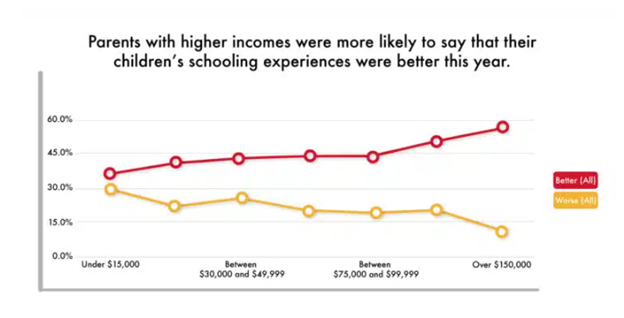
 Despite the large number of parents who are seeking to change schools, many thought schools were as good as or better than last year. About 45 percent of parents thought their student’s education was better than last year; 34.4 percent thought it was about the same and just 20.5 percent thought it was worse.
Wealthier parents, not surprisingly, were more satisfied with their educational choices than lower income parents.
The survey, by National School Choice Week, was conducted in May 2023 with more than 2,400 parents responding. Check out the full survey here.
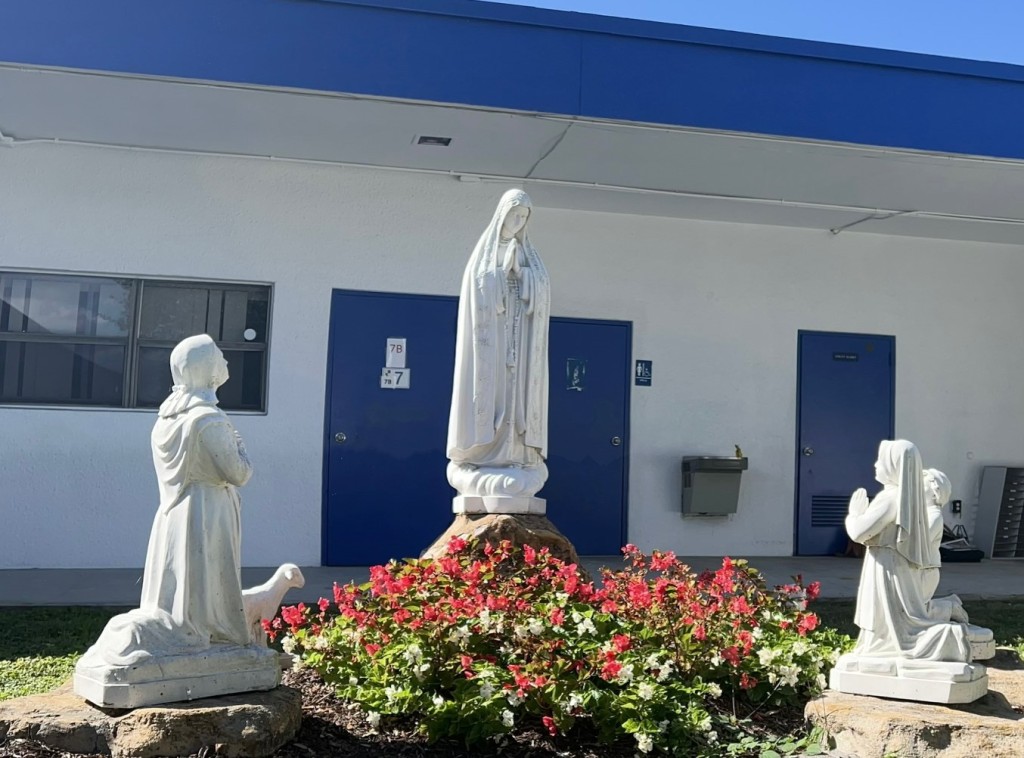
This replica statute of Our Lady of Fatima stands in the courtyard of St. Malachy Catholic School in Tamarac, Florida. Even after the school closed in 2009, the two charter schools that leased the campus never removed it. As the school reopens as a parish school in August, the statue has inspired those working to prepare the school for reopening. Photo courtesy of the Archdiocese of Miami
Since it closed in 2009, a victim of the Great Recession that wrecked family finances across the United States, the campus on the grounds of St. Malachy Catholic Church in Tamarac, Florida, has housed secular charter schools.
However, despite the focus those learning institutions placed solely on academics, one sacred element remained: the statue of the Virgin Mary. She stands in a courtyard atop a stone pedestal, in front of three children who kneel in reverence. The statue is a replica of Our Lady of Fatima, which, according to the Catholic church, the Virgin Mary appeared six times to three Portuguese shepherd children starting in 1917 and shared visions and messages. The church declared the visions of Fatima as “worthy of belief” in 1930.
As St. Malachy Catholic Church prepares to reopen its parish school after a 14-year hiatus, the statue is a powerful symbol of what a community’s faith and teamwork can accomplish.
“They never removed the statue of Our Lady,” said Zoraida Perez, the school’s registrar and first employee hired for the reopening. She said the fact that the statue remained feels like a miracle to her. “I did work in another parish where a charter school took over, and the first thing they did was remove all the images.”
Perez, who was not working for St. Malachy in 2008 but who lived in the area, recalled the strong emotions people felt when the economy forced the school, along with seven other area Catholic schools, to close due to low enrollment.
“Many of those families were so sad, and they had to decide between providing a home and food for their children or a private, parochial education,” said Perez, whose three children attended Catholic schools. Many of them had to make the decision to school and go to public school.”
Those who were able to continue in Catholic schools were offered seats at other area schools.
The transition to new schools was tough for some families, who missed the sense of community that a smaller school like St. Malachy, which first opened in 1984, provided. The school and the church are named for St. Malachy, an Irish Saint who lived during the 1100s.
The church leased the campus to a charter school, which closed in 2018. Another followed but closed in 2021 amid the coronavirus pandemic.
When leaders announced in March that the parish would reopen the school, a woman whose two children had to transfer to another Catholic school when St. Malachy closed showed up immediately with donations of backpacks and school supplies.
“She said her kids felt lonely because they were the new people at the school,” Perez said. “She said what they had at Saint Malachy was a family.”
Parish and school leaders said they based the decision to reopen on a population boom that included many young families moving to the area. Tamarac boasted a population of nearly 72,000 in 2020, according to the latest U.S. Census figures. That’s an increase of more than 10,000 from 2010, when the census showed a population of 60,427.
“The decision to reopen St. Malachy followed a feasibility study in which we looked at local demographic trends, educational options and other factors. Through this study, we determined that a viable Catholic school could reopen at St. Malachy without operating to the detriment of nearby Catholic schools,” said Jim Rigg, superintendent of schools for the Archdiocese of Miami.
Rigg, who as superintendent oversees 63 Catholic schools, doesn’t need statistics to show him what he has observed.
“People are moving here from all over the world, from the United States and Latin America and the Caribbean,” Rigg said. “We’re in growth mode.”
Figures from the 20222-23 school year confirm Rigg’s statement.
Total enrollment came in at 33,577, the highest in more than five years.
In Key West, the Basilica School of St. Mary Star of the Sea is expanding to offer high school in August. It will be the first time since 1986, when Mary Immaculate High School closed, that the county has had a Catholic high school. Also, Cristo Rey Miami High School, an independent Catholic school, opened in 2022.
Across the Sunshine State, Catholic school enrollment rose 6.3 percent in 2021-22, the biggest jump of any of the 10 states with the biggest Catholic enrollments and outpacing the 3.8 percent hike nationally, according to state-by-state figures from the National Catholic Educational Association.
Leaders attribute Florida’s trend-defying figures over the past several years to its robust education choice laws, which offer families access to scholarships to attend private schools.
“Catholic schools in states that have school-choice programs…had greater enrollment stability over the past two years than Catholic schools in states with no private-school choice,” according to a study by the Manhattan Institute. “That is, Catholic schools in states with multiple choice programs (two or more) lost far fewer students in the first year of the pandemic (–4.9%) than states with no private-school-choice programs (–7.6%), but both the robust choice and the nonchoice states rebounded in 2021–22 by the same percentage (+4%).
The six states with education savings accounts, which give families the ability to use funds to customize their students’ education, also saw enrollment increases that were twice as large as states that had no ESAs. This year, the Florida Legislature expanded education choice by granting automatic eligibility to all students regardless of income.
Even so, Archdiocese of Miami leaders are starting small at St. Malachy, with seats only for 4-year-old kindergarten and voluntary pre-kindergarten students as well as kindergarten. They expect to have about 45 students the first year. The next year, they plan to begin adding other grades, eventually capping out at eighth grade. (To learn about registration and careers, go here.)
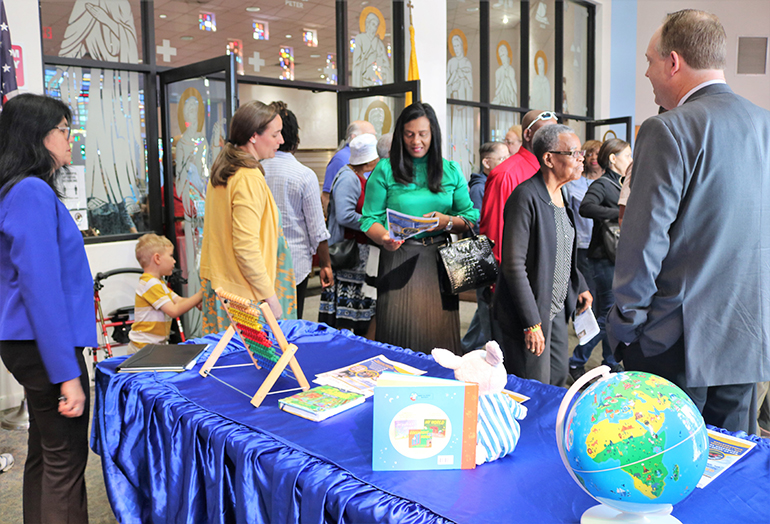
Jim Rigg, superintendent of schools for the Archdiocese of Miami, answers questions and hands out information about the soon-to-reopen St. Malachy School after church services at St. Malachy Church. Photo by Linda Reeves of Archdiocese of Miami
Perez said the community response has been overwhelming since word got out about the reopening plans. The Knights of Columbus St. Malachy Council 13355 have been doing handywork to help get the school ready to open in August. Nearby St. Bonaventure School reached out with guidance and local companies have donated and installed technology as well as offered free uniforms in the school’s blue and gold colors for incoming students.
In the areas of the school that will be occupied this fall, community members have installed new flooring, provided new furniture, moved the administrative offices to the front of the building and built a new canopy for the playground to provide shade. A parliament of owls found living in one part of the building provided inspiration for the school mascot: the owl.
“It takes a village to raise a child,” Perez said, quoting the African proverb. “This is where you find it.”

