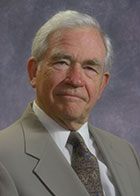
Coons
Editor's note: This is the first in a series of posts we're running this week to commemorate the 50th anniversary of Dr. King's "I Have a Dream" speech.
I grew up in a Minnesota city of 100,000 with - in my time - one black family. My introduction to the reality of public school segregation came in 1962 as - now at Northwestern in Chicago - I agreed to probe the public schools of the district on behalf of the U.S. Commissioner of Education. The racial separation was there as expected, but there was one big surprise; I was astonished to find enormous disparities, not only in taxable local wealth - hence spending - among the hundreds of Illinois districts, but even in individual school-by-school spending within the Chicago district itself. I wrote about both problems, sprinkling research with “action” including marches and demonstration both in Chicago and in Selma (prior to the main event there).
My interest in deseg politics had already provoked a law review article on the risks of anti-trust liability for King et al. who were planning boycotts of private discriminators. On the strength of that essay, Jack Greenberg, then director of the NAACP Inc. Fund, invited me to meet with King and his lieutenants at dinner in Chicago to discuss the question. We spoke at length - mostly about boycotts but also about schools. By that time I was already into the prospects for increasing desegregation in Chicago, partly through well-designed school choice.
I won’t pretend that I recall the details of that evening. What I can say is King’s mind was at very least open to and interested in subsidies for the exercise of parental authority - which clearly he valued as a primary religious instrument. I took my older boys next evening to hear him at a South Side church and, possibly, to follow up on our conversation, but he had to cancel. We heard sermons from his colleagues, some to become and remain famous. I did not meet King again.
King’s “Dream” speech does not engage specific public policy issues - on schools or anything else. Essentially a sermon, it is a condemnation of the sins of segregation and an appeal to the believer to hear scripture, with its call for indiscriminate love of neighbor, as the life-task of all who recognize the reality of divine love for us - his image and likeness. It is purely and simply a religious appeal that declares the good society to be one that rests upon benign principles that we humans did not invent but which bind us. I don’t know King’s specific understanding of or attitude toward non-believers, but this document clearly rests the realization of the good society upon its recognition of our divine source and its implication of the full equality of all persons.
Given that premise and the Supreme Court’s insistence upon the “wall of segregation” in the public schools, plus - on the other hand - the right of parents to choose a private religious education, the logic is rather plain.
Private schools live on tuition, and many American families couldn’t afford to enroll then or now. If low-income families were to exercise this basic human right and parental responsibility enjoyed by the rest of us, government would have to restructure schooling to insure access to an education grounded upon, and suffused with, an authority higher than the state. Given the economic plight of so many black parents, the only question would be how to design the system to secure parental choice without racial segregation by private educators.
And that possibility was to be the principal crutch of “civil rights” organizations in hesitating about subsidized choice. (more…)
Fifty years ago next week, Dr. Martin Luther King Jr. delivered his “I Have A Dream” speech to 250,000 people in Washington D.C. It remains one of the greatest speeches in American history, offering a sweeping vision of hope and equal opportunity in the midst of so much fear and turbulence.
Many of us will reflect on how far we have come, and how far we have to go, since Dr. King energized millions with his words - and there’s no doubt education will be part of those discussions. To that end, we’re running a series of posts next week on the Dream and our schools.
We asked our bloggers to consider a scenario described by education leader Howard Fuller: On Feb. 1, 1960, four black students sit down at a lunch counter in Greensboro, N.C. and are denied service. They spark the lunch counter movement, helping to focus the nation’s conscience on racial segregation. Now, four black students sit down at a lunch counter and they’re welcomed like other diners. But they can’t read the menu.
What do racial achievement gaps say about the state of Dr. King’s dream? How does our current education system expand or contract his vision of social justice and equal opportunity? Is there reason to be hopeful when it comes to school choice, educational quality and the academic success of low-income and minority children? Please join us, beginning Monday, to read what some of our bloggers have to say. And please add your thoughts to the discussion.
 Bill Maxwell, a highly regarded African-American columnist with the Tampa Bay Times, has used a new Hechinger Report to argue that charter schools are introducing a second wave of “white flight” in public education. His argument tracks the work of the Civil Rights Project at UCLA, which has called charter schools a “civil rights failure” and echoes the assertion of University of Minnesota researcher Myron Orfield that charters are “an accelerant to the normal segregation of public schools.”
Some of these findings are certainly cause for concern. But racial integration in American education is rooted in nearly a half-century of social policy and federal court intervention, which makes isolated conclusions about the new role of charter schools problematic. Yes, it could be that charter schools cause more racial segregation. It is also possible something else could explain the racial demographics. It could be, for example, that charter school enrollment merely reflects the racial makeup of the neighborhoods in which they operate.
In that sense, examining the racial ratios in charter schools is but one part of a much larger equation.
Maxwell’s column was inspired by an article in the Hechinger Report that began with an anecdote about a very white elementary charter school south of St. Paul/Minneapolis, Minn. The charter school, Seven Hills Classical Academy, was 82 percent white while the surrounding Bloomington Public School District averaged 57 percent white.
However, the school district obscures the vast range within the public schools themselves. Among Bloomington public elementary schools alone, the ratio of white enrollment ranged from 15 percent to 81 percent. In other words, there are also public schools with similar degrees of racial segregation.

(books on tape and caffeine are highly recommended for long road trips in western states!)
After 2,500 miles through high deserts, forested mountains, windswept prairies, and boggy woodlands – and 190 gallons of gas and one flat tire – I’ve reached my education destination. For the past five years in Nevada, I made a consistent pitch to my colleagues and lawmakers and the governor: “Copy Florida.” Now I live here in Tampa.
Resident Floridians may not realize how well their state actually performs on the education front. You may not even recognize the similarities between Nevada and Florida.
Yes, Nevada and Florida have a very different geography and climate. For one thing, Nevada is the driest state in the U.S., and Florida will receive twice as much rain in July as Nevada gets in an entire year. Florida’s tropical climate is thick with forests, swamps and beautiful beaches. Meanwhile, Nevada occupies the Great Basin and Mohave Desert; a dry desolate place known for prickly Joshua trees, barren mountains and temperatures that soar above 120 degrees.
The landscapes aside, Nevada and Florida share similar public education students and challenges. Both states have a student population that is majority minority today. Student poverty rates and disability rates are also comparable, though Nevada has a larger English language learner population. Nevada and Florida also spend about the same amount per pupil. Interestingly, both states are vacation and retirement destinations with more tourists than residents.
Not surprisingly, education attainment rates were once very similar.
Data from the U.S. Department of Education’s National Assessment of Educational Progress (NAEP) reading exam shows that Nevada and Florida had virtually indistinguishable achievement rates just 15 years ago. That has changed dramatically. While Nevada in the past few years has started to catch up with Florida on math, the Sunshine State has soared past the Silver State in reading. NAEP’s 4th grade reading scores are also a good barometer for education success and graduation rates.
These reading achievement levels are also striking when we zero in on low-income students who are on free or reduced-price lunch (FRL). In the charts below, we compare Nevada and Florida’s FRL students on the NAEP 4th grade reading exam. In this way we examine only the attainment for the most disadvantaged students in both states. (more…)
Charter schools. What happened to the Ben Gamla charter school in Pinellas is a "study in bad charter school governance." Choice Words. Parents try to figure out what to do now that a struggling charter school in Deland is closing. Daytona Beach News Journal. Ditto for the parents of a charter school in Lutz. Tampa Tribune. After 22 years in traditional public schools, a local principal is hired to lead the city of Cape Coral charter school system. Fort Myers News Press.
 Homeschooling. The Palm Beach Post takes a look at Space of Mind, a pricey but fascinating home-school school that insists it's not a school.
Tax credit scholarships. The number of parents seeking them grows in Highlands and beyond. Highlands Today.
School grades. Education Commissioner Tony Bennett is recommending another year of a "safety net" provision so grades don't drop more than one letter grade. Tampa Bay Times, Miami Herald, Palm Beach Post, Orlando Sentinel, Florida Times Union, Tampa Tribune, TCPalm.com, Associated Press. Other states are watching the goings-on. Miami Herald. Another story on how everyone is expecting grades to drop. Sarasota Herald Tribune.
VPK. Needs to be more focus on pre-K for poor kids. Pensacola News Journal.
Common Core. The Tallahassee Democrat offers an overview of the big challenges and potential payoffs ahead. (more…)

Merrifield: More school choice could make a teacher's job less Herculean. (Image from teacherportal.com)
Editor's note: John Merrifield is an economics professor at the University of Texas at San Antonio whose primary academic interest is school system reform studies. He's also editor of the Journal of School Choice, initiator of the annual School Choice and Reform International Academic Conference, and author of the critically acclaimed "The School Choice Wars."
A recent Wall Street Journal article about a National Council on Teacher Quality report on widespread deficiencies in teacher training programs is the latest example of hand-wringing about teacher ineffectiveness. Without discounting completely the need to address this issue along with others in the teaching profession – such as low pay, tenure, high turnover, poor materials, and the tendency to draw the lowest ability students - allow me to suggest the root of our teaching skill problem is actually the public school system’s monopoly on public funding.
The current system generates classroom composition that is so heterogeneous in student ability and life experience that only an extraordinarily rare teaching talent achieves significant academic progress for a high percentage of students in public school classrooms. Policies like mainstreaming a lot of special needs children will make teacher and public luck, in the form of unusually homogenous classrooms, increasingly rare.
Data reveal a few schools at the top and bottom that perform well or poorly with all students, respectively. But the truth is, teachers are quite effective with certain students and not effective with others - something that is often concealed by comprehensive test score averages. In 2011, I analyzed this fact in Texas, which has test score data disaggregated into several student sub-groups, and is especially important in Texas because of its diversity: large black and Hispanic populations and considerable variation in urban and rural settings. We found schools that taught black students well, and Hispanic students poorly, and vice versa. Other schools did well with low-achieving students, but not well with high achieving students, and vice versa.
Many would like to believe schools do an equally good job, regardless of race, ethnic background, students’ average ability level, or socio-economic status. Sadly this is not the case, and the differences are significant. Each school typically does better than others with different groups because teachers have strengths and weaknesses, even when they are not hired for them. (more…)
Florida’s high school graduation rate rocketed 23 percentage points to 72.9 percent between 2000 and 2010, putting the Sunshine State at No. 2 among states for progress over that span but still behind the national average, according to a new national report.
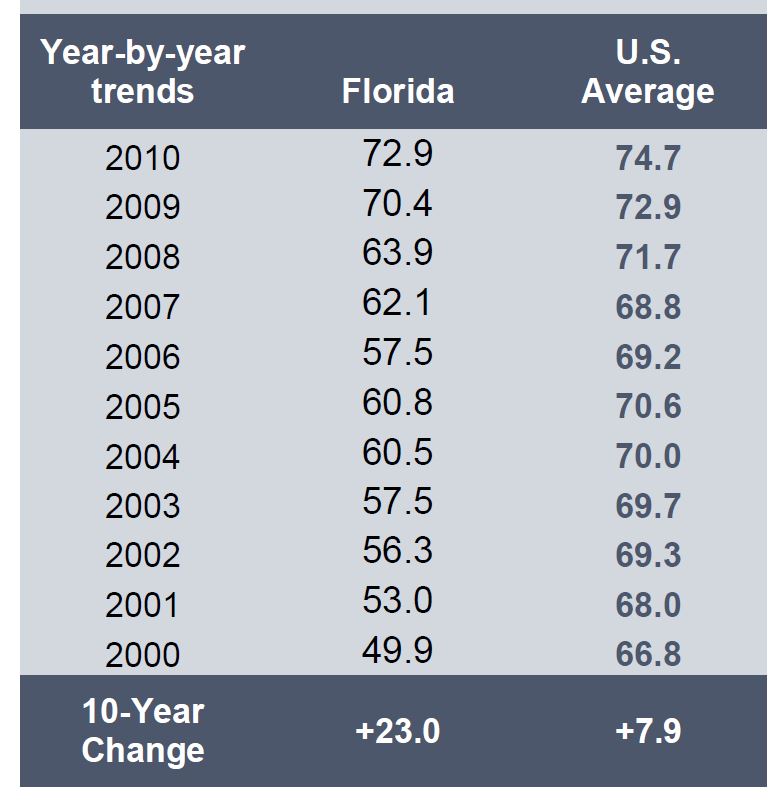
From Education Week
Only Tennessee did better, with a 31.5 percentage point gain, shows the annual Diplomas Count report from Education Week. The national rate was up 7.9 percent, to 74.7 percent.
Education Week, the country’s highly respected paper of record for education news, uses its own formula to calculate graduation rates.
Its findings are the latest in a stack from credible, independent sources that show Florida students and teachers are making some of the biggest academic gains in the country under a model distinguished by a tough, top-down accountability system and expanded parental school choice.
Florida ranks No. 44 in the percentage of students eligible for free- and reduced-price lunch (with the ranking going from lowest rate to highest), according to the latest federal figures. But the Education Week data puts it at No. 34 in graduation rates, ahead of states with less challenging student populations - and arguably better academic reputations - like Washington, North Carolina and Utah.
The gains also come despite tougher standards than other states. Among other things, Florida requires more academic credits to graduate than most states (24 to the national average of 21.1) and the passing of an exit exam (only 23 other states do). (more…)
Parent trigger. Another year, another defeat for the parent trigger. Coverage from Tampa Bay Times, StateImpact Florida, Orlando Sentinel, Palm Beach Post, Tallahassee Democrat, Associated Press, Education Week, Sarasota Herald Tribune.
 Marco Rubio. Visits a Tampa private school to tout his federal tax credit scholarship bill - and says nice things about public schools along the way. redefinED.
Teacher pay. Maybe teachers will get money for raises sooner rather than later after all. Miami Herald, Palm Beach Post, Orlando Sentinel, Associated Press.
School discipline. Hillsborough district officials are taking a closer look at the disproportionate number of suspensions for black males. Tampa Bay Times.
School turnarounds. Pinellas has five schools facing state intervention, but 11 other D schools may he headed that way, warns Superintendent Mike Grego, reports the Tampa Bay Times. Staff at the five must reapply for their jobs, reports the Tampa Tribune. (more…)
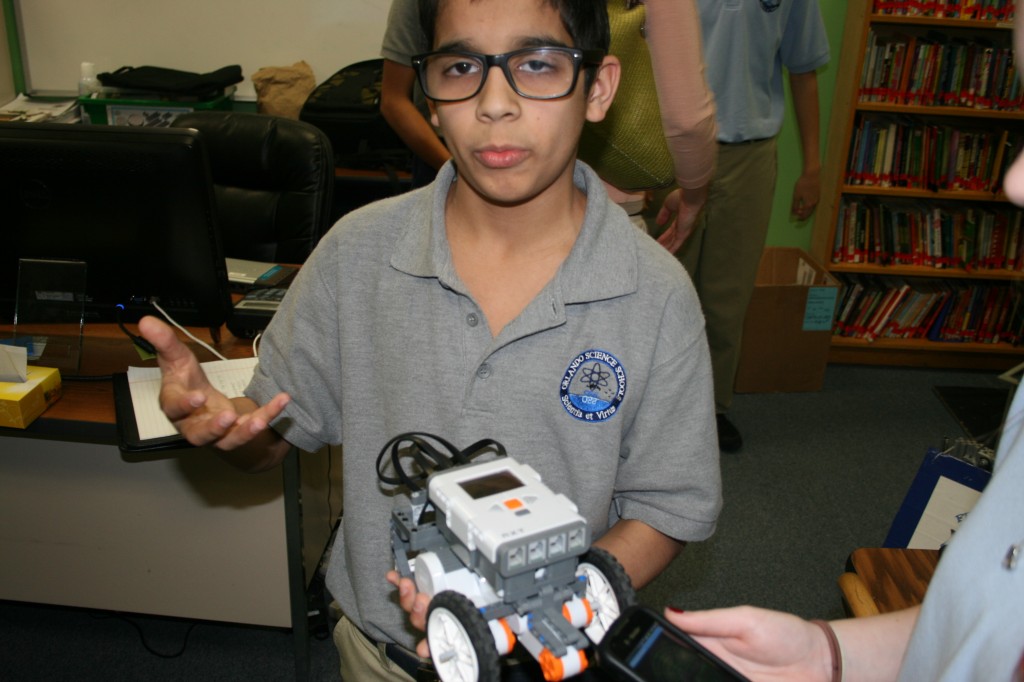
Kristopher Pappas, a sixth-grader at Orlando Science School, looks like a lot of 11-year-olds, like he could have a Kindle and a Razor and put a little brother in a headlock. But Kristopher says he wants to be a quantum mechanic, and with a blow dryer and ping pong ball, he proves he’s not an idle dreamer. He turns on the blow dryer and settles the ball atop the little rumble of air stream, where, instead of whooshing away, it shimmies and floats a few inches above the barrel. The trick is cool, but it’s Kristopher’s explanation that fries synapses. “You got to give Bernoulli credit,” he begins.
Bernoulli?
As a whole, Florida students don’t do well in science. The solid gains they’ve made over the past 15 years in reading and math haven’t been matched in biology, chemistry and physics. But schools of choice like the one in Orlando are giving hope to science diehards.
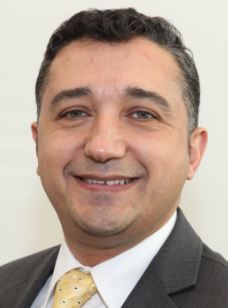
Akin
Orlando Science School is a charter school, tucked away in a nothing-fancy commercial park, next to a city bus maintenance shop. Founder and principal Yalcin Akin has a Ph.D in materials engineering and did research at Florida State University’s world-renowned magnet lab. His school opened in 2008 with 109 sixth- and seventh- graders. Now it has 730 kids in K-11 and serious buzz as the science school in Orange County, the 10th biggest school district in the nation. Only 26 schools in Florida can boast that 80 percent of their eighth graders passed the state science test last year (the test is given in fifth and eighth grades). At least two thirds were magnets or charters. Orlando Science School was one of them.
The kids are “constantly challenged, which is what you want,” said parent Kathi Martin. One of Martin’s daughters is in ninth grade; the other is in seventh. Mom wasn’t excited about the neighborhood school; the science magnets were too far away; the private schools didn’t feel like home. During a visit to Orlando Science School, she said, something clicked.
It’s “a school where it’s cool to be a nerd,” she said.
In 2006, the Orange County School Board denied the charter’s application. The state approved it on appeal.
Last year, 1,500 kids were on the waiting list. Last month, Orlando Mayor Buddy Dyer paid a visit.
“This is about word of mouth,” said Tamara Cox, the mother of eighth-grader Akylah Cox. “The parents recognize the value of what’s going on at OSS. That’s why there is such a need and such a calling for it.”
For every bad story about charter schools in Florida, several good ones go untold. (more…)
A “B” for teacher quality policies. That’s Florida’s grade, according to the National Center for Teacher Quality. That’s higher than any other state, notes the Gradebook.
 Bang for the buck. Florida students made some of the biggest gains in the nation on NAEP despite some of the smallest increases in ed funding, notes researcher Matthew Ladner at Jay P. Greene’s Blog.
Lawmakers’ ties to charter schools. WFTV in Orlando takes a look. The Tampa Bay Times did a similar but more detailed story last year.
Charter school facilities funding. The Fort Myers News Press takes a look at a task force’s recommendation to increase property taxes to pay for building construction and maintenance at charter schools. Redefined covers the Florida Charter Schools Conference where this was a topic yesterday.
Report on charter school growth. Miami Herald. StateImpact Florida. redefinED.
Promising charter on its way to Pinellas. With little comment, the Pinellas school board voted 7-0 Tuesday for a charter school application that dovetails with a legal settlement over black student achievement. Lots of history here; I wrote a bit about this earlier this week.
More questions in special needs student’s death. Tampa Bay Times.
(Image from simplystatedbusiness.com)

