 'Schools of Hope' rules: No charter school companies have yet applied to the Florida Department of Education to become "Schools of Hope." Part of the reason is that no rules have been established for the program, which offers financial incentives for charter schools to move into areas where traditional public schools have struggled persistently. Adam Miller, the director of the state’s school choice office, says the first round of rules is expected to be published in time for the Florida Board of Education to consider at its November meeting. redefinED. The state Board of Education will wait until its next meeting Oct. 18 to announce the public schools that will receive $2,000 more per student under the "Schools of Hope" legislation. The Legislature set aside $51.5 million for up to 25 schools, and 50 applied. Gradebook. No charter school conversions are on the agenda for next week's Florida Board of Education meeting. redefinED.
'Schools of Excellence': Six hundred and forty Florida schools in 44 counties are designated by the Florida Department of Education as "Schools of Excellence." The designation allows the schools to calculate class size by a schoolwide average, set daily start and finish times separate from the district, ignore the state’s minimum reading requirements, earn points toward certification renewal, and gives them greater latitude in hiring and budget decisions for the next three years. Here are the lists for elementary, middle, high and combination schools. Gradebook.
This year, the Florida Legislature passed a new law intended to draw proven charter schools into academically struggling areas.
So far, no charter school networks have applied to open "Schools of Hope." That might be, in part, because the state Department of Education is still developing rules to carry out the program.
Adam Miller, the director of the state's school choice office, told a House committee the new law has generated "inquiries, but not applications" from charter school operators.
"We've received calls from five or six nationally known organizations from around the country ... [with] questions about the policy, questions about the landscape in Florida, the regulatory framework, the funding. [And they are] beginning to look at Florida more than they ever did in the past," he told the House K-12 Innovation Subcommittee on Wednesday.
There have been "some conversations with Florida operators as well," he added. (more…)
Even as school choice has gone mainstream in Florida, the majority of its public-school students still attend zoned schools.
But many of their families are still choosing.
"As a parent, I looked at all the options, including my home-zoned school," Adam Miller, the school choice chief at the Florida Department of Education, told a state House panel this week. "If I had selected that option, I wouldn't be counted as a parent who exercised choice, but I actually did exercise choice, because I looked at all the options and decided that was the best choice for my child."
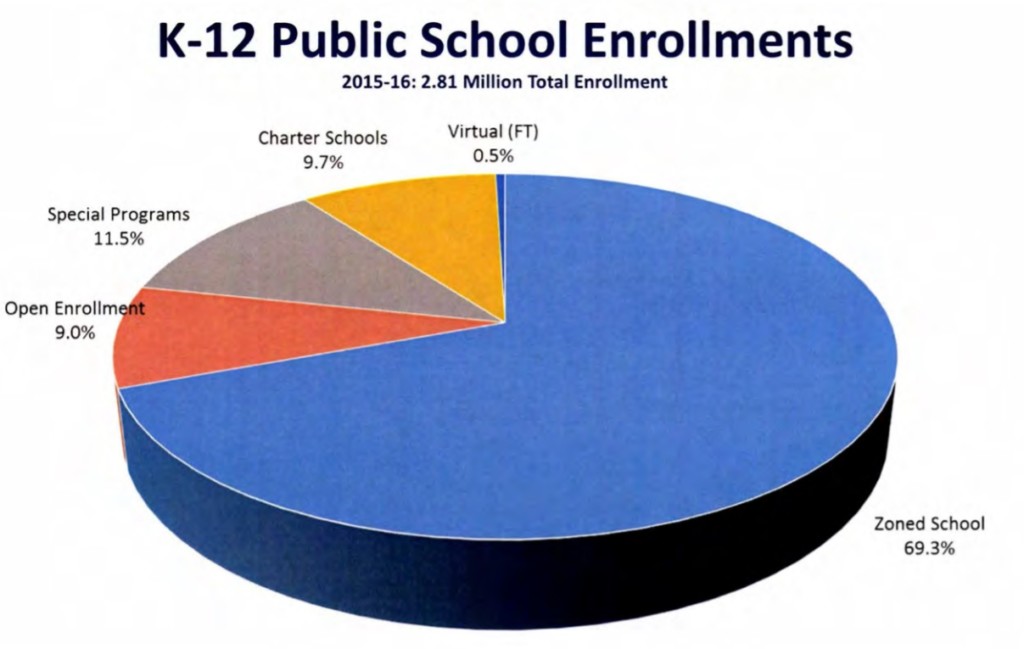
The majority of Florida's public-school students attend zoned schools, but for some of them, it's a conscious decision. Graph by Florida Department of Education
Florida will start funding charter school facilities based on the characteristics of the students they serve.
And under new rules approved today by the state Board of Education, charters will have to clear a higher academic bar to qualify.
A new state law requires the state to distribute more capital funding to charter schools where at least 25 percent of students have special needs, or at least 75 percent qualify for free- or reduced-price lunch.
The state rule created in response to that law also disqualifies charter schools from receiving state capital funding if they've received consecutive D's under the state accountability system. The previous rule only disqualified charter schools rated F.
At the state board's meeting in Tampa, that change received pushback from schools that could lose funding as a result.
Right now, more than 400 of the state's roughly 650 charter schools qualify for a share of $75 million set aside for facilities funding. The state is still updating its numbers to distribute funding under the new rule.
Adam Miller, the director of the state's school choice office, told the board that preliminary calculations show 142 charter schools could receive extra funding because more than three-quarters of their students are economically disadvantaged. Of those higher-poverty schools, Miller said current projections show seven could lose funding under the stricter academic requirements. (more…)
We've recently discovered that students who leave private schools for public schools are disproportionately likely to choose charters. But the majority of new charter students are coming from other public schools, so it's also worth looking at what schools they tend to leave behind.
Officials at the state Department of Education recently asked that question for the 50 charter schools that opened in Florida this school year.
According to findings presented recently to state lawmakers, the approximately 10,000 students who enrolled in the state's new charter schools were less likely to come from schools that receive top ratings on the state's accountability system.
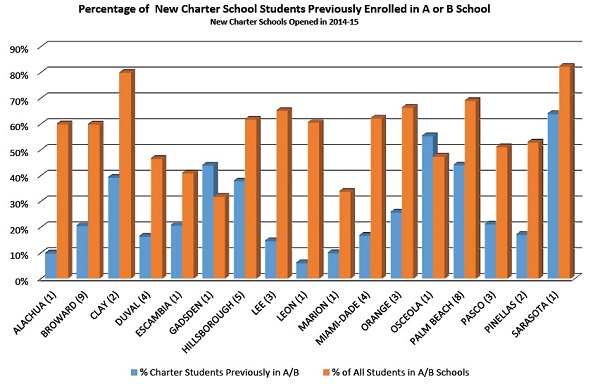
Students enrolling in Florida's new charter schools were less likely to come from A or B schools than public school students as a whole. Graph by Florida DOE.
On the other hand, new charter students were not especially likely to come from the lowest-rated schools.
(more…)
Florida's past few legislative sessions have seen some contentious battles between school districts and charter schools over issues like applications and capital funding, especially in the House.
State Rep. Manny Diaz, R-Hialeah, who chairs a key education panel, is trying to set a more collaborative tone this year.
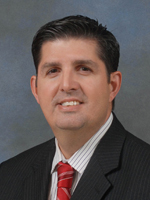
Rep. Manny Diaz Jr.
This week, he introduced legislation that would allow districts to seek charter-like flexibility in exchange for more regulatory freedom. On Wednesday, he brought in a group of district and charter representatives to talk charter school authorizing.
The two sides have for the past few years been trying to reach agreements on issues like promoting quality charters and screening out schools that aren't qualified.
Lawmakers have heard or floated proposals on both fronts in the run-up to the legislative session that begins in March, but this year's key charter school bills have yet to emerge.
Diaz said that while charter school issues have brought "fireworks" to the House Choice & Innovation Subcommittee in the past, "You see some common ground. Everyone involved in this wants the best for the kids and wants quality charter schools."
While lawmakers want to "provide the environment for quality charter schools to exist," he said, "there's no one here that wants to allow fly-by-nights, or folks who are in it for the wrong reasons to be in this industry."
Tim Kitts, the leader of a small Northwest Florida charter school network, has become a vocal advocate for stopping unqualified charters. He told the committee that around the state, he's seen "bad actors" on both sides - charter schools that aren't prepared to educate students, and districts that throw roadblocks in the way of charter operators with proven track records.
The state Board of Education on Tuesday unanimously approved a proposal creating a standard contract that will serve as a model for charter school agreements throughout the state.
Districts and charters alike have raised concerns about aspects of the plan — a sign, state school choice director Adam Miller said, that the proposal struck a balance between the two camps.
Much of the pushback, he noted during the board's meeting in Central Florida, centered on the policy of standard contracts itself. Districts have contended the proposal, created in response to 2013 legislation, is unconstitutional.
State officials have spent nearly a year and a half refining the plan, taking input from district and charter school attorneys.

