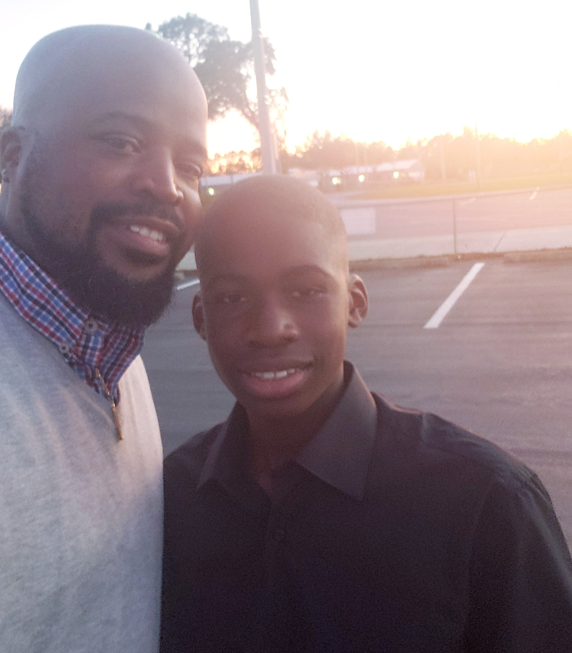
Education choice advocate Keith Jacobs and his son, Deuce, 13.
As a parent of a child with Autism Spectrum Disorder, I know that the decision about re-opening public schools during the COVID-19 pandemic could have a tremendous impact on the social-emotional health of my son, Deuce, 13, who thrives on structure.
The switch to online learning in the spring was particularly challenging. Even though my wife and I are educators, that still was not enough to supplant the intense interventions he received with face-to-face instruction in his public school building.
He became frustrated trying to navigate through the online platform while also completing quizzes and virtual labs all while being separated from the social connection and in-person support of his teachers.
Deuce independently completed assignments at his own pace. However, remote learning presented unique obstacles because he relies on over a dozen specific accommodations delivered through his Individualized Education Plan (IEP), most of which were either non-existent or difficult to replicate on the online platform.
Like many parents, the home became our workspace, in addition to being a school, restaurant, and gym. This forced us to balance the demands of our daily work while trying to maintain an instructional environment for our children. What worked for our youngest son, Christopher, 10, didn’t always work for Deuce.
The challenge for Deuce became monumental. I was forced to contact the teachers and administration on several occasions pleading for alternative assessments and assignments. I reiterated how difficult it was to comply with the demands of work while providing accommodations for my child outlined in his IEP.
I had to work with his Exceptional Student Education (ESE) case manager and speech therapist on providing additional technology assistance and modified lessons during their virtual sessions.
It was clear our situation would become even more daunting when we discovered that his accommodation “Text to Speech” was not present on the district’s online platform. Receiving this accommodation in the school building allowed him to have directions, questions, and answers read to him so that he could process the information more effectively.
Without the presence of this function, I was constantly asked to fulfill this role so that he could complete his assignment often after multiple attempts of completion on his own and visible frustration prior to asking for the accommodation.
I witnessed the despair in his eyes as he struggled with knowing he can do the work but receiving below-average assessments. His zeal and commitment toward learning, which were rewarded with a 3.75 grade point average, had been replaced by confusion and apathy.
Deuce suddenly found himself struggling to complete assignments, while I tried to prevent him from becoming fixated on these assignments for hours.
As often happens with children with autism, over-sensitivity to sensory stimuli made it even harder to concentrate in the home. Doors opening, phones ringing, conference calls and other distractions were a cacophonous barrier to learning.
As districts wrestle with when, or even if, to re-open public schools, they must consider all their stakeholders, including students who depend on in-person learning. Are we properly balancing health concerns with students’ social-emotional health from learning in an online platform?
These examples demonstrate why choice in education is so pertinent to families. In the last quarter of the previous school year, every child was forced to switch to distance learning with no consideration that some students just will not be successful in the model.
Even with households like mine, one child can thrive through distance learning while the other could potentially suffer in silence.
The school district’s decision in March was built out of necessity. With schools reopening in just a few weeks, these decisions need to be made with the understanding that there is no one solution to educate all students.
Parents need options.

