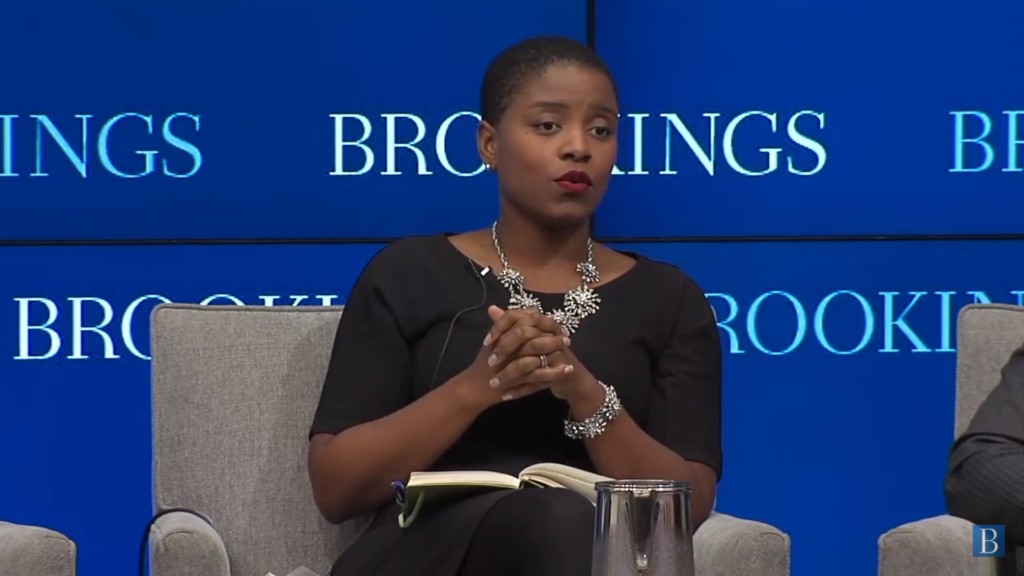
Maya Bugg, chief of the Tennessee Charter School Center, addresses a Brookings Institution public school choice event.
Charter schools are public schools. In many places, including all of Florida, school districts authorize and oversee them. But that doesn't mean district leaders view them as their own.
Maya Bugg of the Tennessee Charter School Center described this awkwardness during a Brookings Institution event this week on public school choice. Some Nashville school board members won't set foot in charter schools, she said. The school board members declined to pass a resolution to "advocate for all of the students it serves" — including those who attend charters.
"There's this tension of who is important, whose voice is important," Bugg said. "You've got the parents of children in your district. They have chosen to go to a school that you've approved." And yet, it's like they aren't part of the local public school system.
"This rhetoric is tough in some cities, and it's confusing to families, because it's a district at war within itself," she said.
Sound familiar? That kind of rhetoric has been on display in many parts of Florida. It's especially prevalent in the battles over new, contentious charter school legislation. But it's not the case everywhere. Officials in Hillsborough and Sarasota Counties, to cite two examples, have recently reiterated that charter school parents and educators are part of their district.
In the nation's capital, where an independent board authorizes charter schools, district Chancellor Antwan Wilson described a productive coexistence.
"I tend to believe the charter sector has benefited the D.C. public schools," he said. "When parents have other options, it forces us to pay attention" to ways district schools can improve. And, he added, a strong system of district-run public schools forces charters to continually raise their game. He described extraordinary steps D.C. teachers take, including visiting parents at home, to make sure they serve students well.
A new report from the Center on Reinventing Public Education looks at 18 cities around the country that embraced public school choice to meet parents' demand for diverse learning options. It suggests D.C. is further along than most of its counterparts.
More than half of the cities don't have a common application systems that allow parents to pick among various public schools at once. And roughly two-thirds don't have a unified transportation system for all their public schools.
The report doesn't cover any Florida cities. But the lack of common applications and transportation systems exists here, too.
Robin Lake, the center's director, said every city has an interest in improving schools and offering more choices. But every city also needs to create the infrastructure to make those options work.
"Choice is not magic," she said. "Anybody who says that it is is kidding themselves. It requires real commitment and investment."

