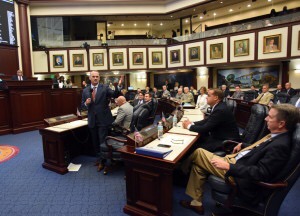
Rep. Richard Corcoran, R-Lutz speaks on the House floor.
America's education system is plagued by the same opaqueness and inefficiency as its health care system, and it needs to create a "marketplace" controlled by parents, the incoming leader of Florida's House told an education reform gathering this morning.
During his first year in the Florida legislature, Rep. Richard Corcoran, R-Lutz, filed a bill aimed at increasing price transparency for health care providers. Similar changes, he said, are needed in education.
States should create systems allowing parents to easily browse different education providers, ranked by price and quality. He said state lawmakers are looking to create such a system.
"It's coming to Florida," he said.
If parents had the power to direct education spending, he said, they would demand better quality and greater efficiency. Districts would no longer spend $25 million for a school building that would house 700 students, he said.
"If the marketplace exists, and we give that power to parents, you will absolutely transform education," he said during a panel discussion at the Foundation for Excellence in Education's annual conference in Denver. Corcoran has already declared his intention to expand parental choice after he takes over as House leader next fall. He framed the fight for more educational options as a battle over who gets to decide how billions of dollars are spent.
"We live in a voucher soceity right now in America. They're called bureaucratic vouchers," he said. "What we need is parent vouchers."
Corcoran, who also chairs the state House's appropriations committee, said education and health care consume nearly 70 percent of state spending. He said he fears that, in the coming years, rising Medicaid and education costs could swallow the rest of the budget.
He was joined on the panel by Matthew Ladner, a senior policy adviser with the foundation who has argued a demographic squeeze will soon grip state budgets, as baby boomers retire and youth populations grow.
"The status quo is unsustainable and has to change whether we want it to or not," Ladner said.

