Every morning, Kevin Gines gets up an hour earlier so his mom can drive him to a nearby public school, where the 16-year-old sophomore takes a naval science class. Then he heads to a private Christian academy in North Florida to finish the rest of his school day.
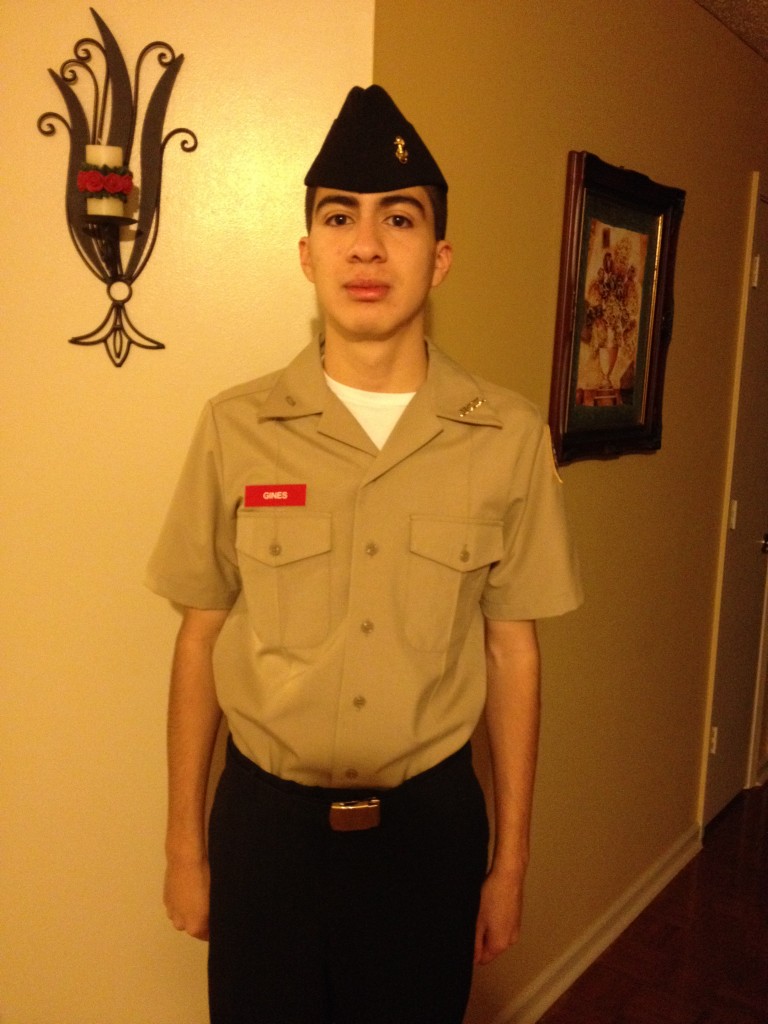
Florida private school student Kevin Gines makes the most of an opportunity to participate in a nearby public school's JROTC program.
“He’s really serious,’’ said Kevin’s father, Jesse, a security guard. “You should see how he shines his shoes. He’s already a soldier.’’
Kevin said he’s willing to make the extra effort because he knows it’s an opportunity he almost didn’t get. His school, the Christian Home Academy in Orange Park, doesn’t offer JROTC. So last May, the Gineses tried to sign up Kevin for the program at Middleburg High, a Clay County district school within minutes of their home.
School officials intervened, telling the Gineses that Kevin wasn’t eligible because he wasn’t enrolled in the public school, and that he couldn’t register for only one class. A high school in neighboring Duval County said Kevin could sign up for JROTC there, but it was too far for his mother to drive each day.
Kevin was about to give up, but not his dad. Jesse Gines combed through state statutes. He learned private school students are allowed to participate in extra-curricular activities at public schools, such as sports and gifted programs. So are homeschoolers and students taking classes through Florida Virtual School. There’s also a notice on the JROTC website that says students not enrolled at the school hosting the program can become special cadets.
But the district official overseeing enrollment wouldn’t budge. Kevin, who comes from a family of Marines, appeared to be caught in a gray area.
Then his dad reached out to Step Up For Students, the nonprofit that administers the Florida Tax Credit Scholarship. Kevin’s family uses the scholarship to send him and his little brother to Christian Home Academy. Step Up also co-hosts this blog.
We talked to JROTC officials as well as the state education commissioner at the time, Tony Bennett, and Clay County Superintendent Charlie Van Zant. Everyone agreed it would be a mistake if Kevin couldn’t join JROTC and follow his dream. (more…)
School choice: Expect debates on vouchers, school grades and charter schools this year as legislators set priorities for the upcoming session. The Buzz. Lawmakers propose legislation affecting public schools, from an overhaul of Florida’s school accountability system to a “massive expansion” of school-choice and career-education programs. Tallahassee Democrat. More from The Florida Current. More than 3,000 parents and prospective students crowd into the Bradenton Area Convention Center for Manatee County School District's first school choice fair. Bradenton Herald.
 Charter schools: The Charter School Appeals Commission recommends the state Board of Education turn down a Lakeland group's proposal for a charter school. The Ledger. Former Gov. Jeb Bush tours the Latin Builders Association Construction & Business Management Academy Charter High School as part of National School Choice Week. Local10.com
Virtual schools: Mom Heather Tempesta lets her daughter try Florida Virtual School after all. Tampa Bay Times.
Magnet schools: Manatee School for the Arts student and teacher get to spend D-Day at Normandy. Bradenton Herald.
Education budget: Orange County school leaders say Gov. Rick Scott's budget proposal isn't as generous as it seems. Orlando Sentinel. Much of Scott's proposed education spending boost would come from property taxes. The Buzz.
Governor's race: Seventy-one percent of Washington insiders surveyed in January think that the Florida gubernatorial race is the most important one to watch for education. Education Week.
Catholic schools: Catholic leaders hail small growth in school enrollment as a hopeful sign. Florida Times-Union. Publicly funded, private school choice programs in Florida are a big reason for the increase. redefinED.
Charter schools: A charter school company in Lee County gets a second chance at opening a school this fall after coming close to a district denial. Fort Myers News-Press.
Magnet schools: Pinellas County school leaders need to ensure reopening shuttered schools as magnet-style schools doesn't widen the gap between the lottery winners and the remaining students, writes the Tampa Bay Times. Pinellas school officials hope reopening those schools as technology magnets will reclaim students who left for private schools or are on waiting lists for other choice programs. The Tampa Tribune.
Traditional schools: The Hillsborough County School Board moves forward with a plan to buy new school busses and offers orientation for new principals. Tampa Bay Times.
Education budget: Florida Gov. Rick Scott says his recommendation for lawmakers to increase education spending would be enough to push it to a record high of $18.84 billion. The Buzz. More from the Tallahassee Democrat, News Service of Florida, Fort Myers News-Press, Palm Beach Post and Sun Sentinel.
Common Core: Brevard residents rally against the new education standards during a Republican Liberty Caucus of Eastern Florida forum. Florida Today.
 Again defying national trends, Catholic schools in Florida showed enrollment growth for the second year in a row this year.
Enrollment in PreK-12 reached 84,750, up from 84,258 last year, a modest increase of 0.6 percent, according to data released Monday by the Florida Conference of Catholic Bishops.
Enrollment was at 81,632 two years ago.
By contrast, Catholic school enrollment nationally, on the decline for decades, fell another 1.5 percent last year.
Publicly funded, private school choice programs in Florida are a big reason for the difference. Florida Catholic schools enroll students who use pre-K vouchers, McKay scholarships for students with disabilities and tax credit scholarships for low-income students. (The latter is administered by Step Up For Students, which co-hosts this blog.)
According to the conference, tax credit scholarship students in Florida Catholic schools increased 23 percent last fall, and 46 percent in fall 2012. McKay students jumped by 12 percent and 7 percent over the same span.
The latest numbers come as schools around the country celebrate National School Choice Week and National Catholic Schools Week. For a more detailed look at what's going on with Catholic school enrollment in Florida, check out our story from last year.
Update at 12:10 p.m. on Jan. 28: The Catholic school enrollment numbers in Florida are on the upswing even if you exclude Pre-K. According to the conference, there were 73,714 K-12 students in Florida Catholic schools in 2011-12, 75,969 in 2012-13 and 76,500 in 2013-14. Percentage-wise, the K-12 increase over the past two years is 3 percent and 0.7 percent, respectively.
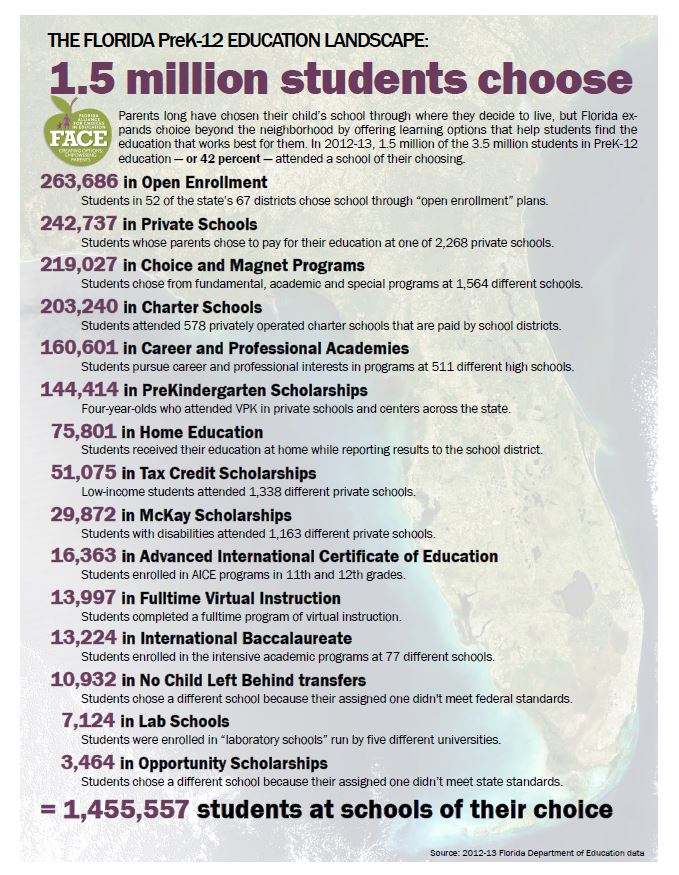
Editor's note: This week is National School Choice Week, so it's only fitting that we bring you this statistical snapshot of how deeply school choice has taken root in Florida, arguably the leading state for expanding learning options.
 Too many of those who hail Florida as a national leader in school choice miss the breadth of change afoot. Yes, students are choosing charters and tax credit scholarships and vouchers in ever-increasing numbers. But school districts themselves are also helping to create a new normal in public education, and the latest enrollment numbers bear that out.
Get this: 1.5 million students in Florida last year attended something other than their assigned neighborhood school. That's 42 of every 100 students in PreK-12.
The "Changing Landscape" document below is a project of the Florida Alliance for Choices in Education and Step Up For Students, and it was produced in partnership with the state Department of Education's Office of Independent Education and Parental Choice. The state tracks a wide variety of educational options in the 67 school districts, and the numbers are eye-opening.
In 2012-13, one of every four K-12 students chose a district-operated school that was outside their neighborhood, whether it be through "open enrollment" polices or to take advantage of a special magnet school or career academy or International Baccalaureate program. At the same time, non-district options experienced remarkable growth from the previous year: charter enrollment up 13 percent, vouchers for disabled students up 10 percent, tax credit scholarships for low-income students up 27 percent. And the biggest voucher program in Florida continued to be for pre-kindergarten, last year serving more than 144,000 4-year-olds in private centers and schools.
These are seismic shifts in the way education is being delivered and can only serve to stimulate more demand. Children who succeed in a school environment that is tailored to their needs will become adults who insist on the same for their offspring. As these numbers tend to suggest, that type of generational change is already under way.
Alabama: The state's new tax-credit scholarship program has nearly reached the $25 million cap (AL.com). A councilman of Birmingham says the Alabama Accountability Act must be repealed (AL.com).
Alaska: The state should abolish the Blaine Amendment and allow private school vouchers (Daily News Miner).
Arizona: Education reformers plan to rapidly expand the Education Savings Accounts program if the state Supreme Court approves (Arizona Daily Sun). The Arizona Daily Sun editorial board takes a stand against expanding Education Savings Accounts, instead arguing that the state should spend more money on traditional public schools. A Republican state senator owns businesses that have financial dealings with his own tax-credit scholarship organization (CBS 5).
California: Gloria Romero, a Democrat and former state senator, argues school choice is a parent's right (OC Register). Some public schools that convert to charters are seen as charter schools in name only (Seattle Times, Joanne Jacobs). Market competition leads to collaboration in L.A public school choice (EdSource). The California Charter Schools Association calls for the closure of a low-performing charter school managed by UC Davis, Sacramento City College and the Washington Unified School District (Sacramento Bee). Will the state embrace charter schools (San Diego Tribune)? San Diego earns low scores on the Brookings Institution's school choice index (Press Telegram).
D.C.: Thousands of parents attend a school choice convention to find the right school for their child (Washington Post). Democracy Prep, a charter school from New York City, will be taking over an Imagine charter school in the district (Washington Post).
Delaware: A judge blocks the closure of an all girls charter school on 14th Amendment grounds (Education Week).
Florida: Four school districts in the state rank in the top 25 for school choice according to a new Brookings Institution report (redefinED). Virtual charter schools grow (redefinED). The Duval County School District holds an expo to advertise public school choice options to parents (Action News Jacksonville). Legislators propose two competing charter school bills, one creating a standardized contract to make it easier to form charter schools and the other to require surety bonds before a charter school can open (Sun-Sentinel, Tampa Bay Times). Another proposed bill would allow charter schools to share space with district schools (Miami Herald).
Georgia: New rules require charter schools to score as well as or better than the state and district averages on the state's 110 point grading scale, or risk having their charters revoked (Atlanta Journal-Constitution).
Illinois: An op-ed writer says Chicago has too much school choice (Chicago Business). Six Catholic elementary schools are slated to close by next year (Chicago Tribune).
Louisiana: Gov. Bobby Jindal asks the court to reconsider the decision to allow federal monitoring of the voucher program to ensure racial balance (Times-Picayune). The U.S. Department of Justice is asking the court for the power to veto any voucher award (Cato Institute, National Review, Catholic Online). A state panel suggests a new way to fund the Course Choice program (Shreveport Times). New Orleans tops the Brookings Institution's school choice index (Watchdog). School choice empowers parents (Business Report). New Orleans shows how urban districts can create real achievement growth through school choice (US News and World Report). (more…)
 So here’s a new finding from a leading school choice group that might make some school choice supporters sigh: When it comes to reforms they think will best improve schools, Americans put school vouchers in the middle of the pack.
School vouchers finished behind smaller class sizes, technology and accountability in the survey released Tuesday by the Friedman Foundation for Educational Choice, but ahead of teachers’ unions, merit pay and a longer school day. The report notes respondents made those choices after generally rating public schools between poor and fair.
“The fact that respondents would rate schools so low but still show preference for the structural status quo indicates choice supporters have much work to do to overcome an ideology favorable to the types of the schools the vast majority of Americans attend and to which they send their children,” the report says.
On another interesting note, the report found Americans are more likely to favor private school tax credits and school vouchers for all over vouchers limited to low-income students or students with disabilities. That could mean a re-thinking, the report says, in how some school choice supporters have strategized the adoption of new choice programs.
“The first modern choice programs – in Milwaukee and Cleveland – were limited to urban, low-income families,” the report says. “But if the ultimate goal is universal choice – whether through vouchers or tax-credit scholarships – incrementalism may no longer be a necessary strategy, at least as measured by public support for reasons for choice.”
Like any survey, the latest from Friedman has a lot of nuance and caveats. It also offers a lot of worthy background about similar surveys. Check it out for yourself here. Press release here.
This op-ed, written by John E. Coons and Peter Hanley with the American Center for School Choice (which co-hosts redefinED), was published in today's USA Today.

Image from www.privateschoolreview.com
Supreme Court Justice Sonia Sotomayor was asked recently by CNN's Anderson Cooper whether she'd have become who she is without the help of a faith-based school, Blessed Sacrament in the Bronx. Sotomayor said, "Doubtful." In an interview with The New York Times, she said the school was "a road of opportunity for kids with no other alternative."
Now it's gone. Like more than 1,300 other Catholic schools in the past 20 years, Blessed Sacrament fell victim to sweeping social and economic forces — and to education policies that blind themselves to the value of faith-based schools.
The U.S. lacks a surplus of high-quality schools, especially that serve the urban poor. Yet year after year, we have watched as thousands of faith-based schools have been forced to close. America is losing a valuable national asset — not because it has become obsolescent or because the demand for it has disappeared, but because of a needlessly narrow view of which families should have the choice in education that is so dear to the middle class.
Charter and magnet schools have diversified public schools. Parents in select states and areas can opt for schools that stress language immersion, math and science, the arts. But parents who cannot afford a faith-based education routinely are told the state will offer no support. Only 16 states and Washington, D.C., have scholarships that empower parents to choose a faith-based school, and most of those are small and targeted. This is a costly mistake. Full column here.
 Alabama: Applications for the state's new tax credit scholarship program are now open (Alabama Opportunity Scholarship Fund, WTVY)
Arizona: Three charter schools will be shut down for poor performance (Arizona Business Journal).
California: The L.A. metro area has the largest number of students attending charter schools in the nation (LA School Report). Charter school growth booms in L.A. and San Diego (San Diego Union Tribune).
Georgia: NPR asks "what is school choice?" (WABE). Hall County ranks No. 1 in the nation for charter school enrollment growth (Access North Georgia). Charter school enrollment grows in the state as more schools request permission to convert to charters (Atlanta Journal Constitution).
Florida: If Catholic schools were a district, they'd be the 9th largest in the state (redefinED). 80,000 students attend charter schools in Miami-Dade, making it the 6th largest (numerically) metro charter area in the nation (Miami Herald). A virtual charter school is approved to set up shop in Pinellas County (Tampa Bay Tribune). Across the bay in Hillsborough, a school board votes down a charter school request by MacDill Air Force Base (redefinED). The number of students using "opportunity scholarships" to leave poor-performing schools doubles in Duval County (Florida Times Union). Florida Virtual School offers students flexibility (Townhall.com).
Indiana: Gov. Mike Pence wants vouchers for pre-k students (Indianapolis Star, Greenfield Reporter). Pence thinks charter school networks should be allowed to operate more like school districts (Courier-Journal). Public school districts will have to hold lotteries for public school choice if demand exceeds supply (Education Week). Gary ranks 5th in the nation for charter school enrollment (Post Tribune).
Louisiana: The Louisiana Association of Business and Industry is the most influential organization on education reform, according to a Brookings Institute study (Times Picayune). New Orleans has the largest percentage of students attending charter schools of any city in the nation...for 8 years in a row (Times Picayune). (more…)
 In the spirit of the holidays, the Hispanic Council for Reform and Educational Options, the Black Alliance for Educational Options and the redefinED blog are partnering on something a little bit different this year to raise awareness: A fun, one-day Twitter campaign.
We need you to help us. All you have to do is tweet.
Just think of one thing you wish would change to help the cause of vouchers, or charter schools, or parental empowerment, or anything else related to parental school choice. Then, on Wednesday, Dec. 18, tweet it out with #schoolchoiceWISH as a hash tag.
It can be personal. It can be political. But whatever it is, make it heartfelt.
If you’d like, attach a photo. We might even put it up on our facebook page.
We’ll be following everyone’s #schoolchoiceWISH tweets all day, and retweeting and replying. Please join us. Happy tweeting!
On a related note, we’ll soon be running a series of special guest blog posts on the wish list theme, too. More details soon.

