 Editor’s note: This commentary from Julie Young, managing director of ASU Prep Academy and ASU Prep Digital and a reimaginED guest blogger, appeared Wednesday on The 74.
A story is told about a flood that rose so quickly, a man had to go to the second floor of his home, where he prayed for God to save him. Before long, a neighbor came by in a canoe and yelled to the homeowner, “Come on in. I’ll get you out of here.”
The man answered, “No, I’ll be fine. I have faith God will save me. You go help the other neighbors.”
A little while later, the man had to climb into the attic, where he looked out a window and saw the waters rising further. Just then, a fire department rescue boat arrived and urged the man to let them send up a rescuer to bring him down.
The man yelled out the window, “No, you go on ahead to the other neighbors. I have faith God will save me.”
The waters rose still further, and the man had to go up on the roof. Not long after, a helicopter came by with a rescue worker dangling from a ladder to hoist the man up.
“No, no!” the man said, “I’m going to be fine. God will save me. You go help the other neighbors!”
Soon, the man was swept away in the flood, and he died. When he got to heaven, he was sad, dejected and a little angry. When God asked, “Why the sad face?” the man replied, “I prayed for you to save me, and you didn’t!”
God replied, “I sent you a canoe, a rescue boat, and a helicopter! What more did you expect?!”
The analogy describes the crisis many schools are encountering now as they face a flood of school disruptions, students in quarantine, and a growing number of students being left behind academically. We’ve been given a technological canoe, boat, and helicopter, but we aren’t using them.
In spring of 2020, schools across the nation scrambled to implement the hardware, systems, long-neglected tech infrastructure, software, and online curriculum to serve students in any location. It was the worst possible way to deploy online learning on a national scale, but our nation’s educators had no choice.
Dedicated teachers moved mountains to get resources, however imperfect, into the hands of their students and families. District leaders, committed to their teams, did everything in their power to resource and support their staff.
It was messy and monumentally frustrating, and it was a wake-up call to schools and districts everywhere to systematically design for resilience through digitally supported options and alternative learning models.
How is it possible that now, in the fall of 2021, we are nearly back where we started?
Nationwide, schools are again being forced into rolling closures, not only because of COVID but also because of teacher shortages, compounded further by legislated mandates regarding face-to-face learning. When it comes to tech infrastructure, content solutions, and teacher readiness, schools are leaps and bounds ahead of where they were pre-pandemic.
That’s why it is almost surreal that many schools, facing yet another round of closures, are actually prohibited from leveraging the very infrastructure they built precisely for this purpose.
To continue reading, click here.
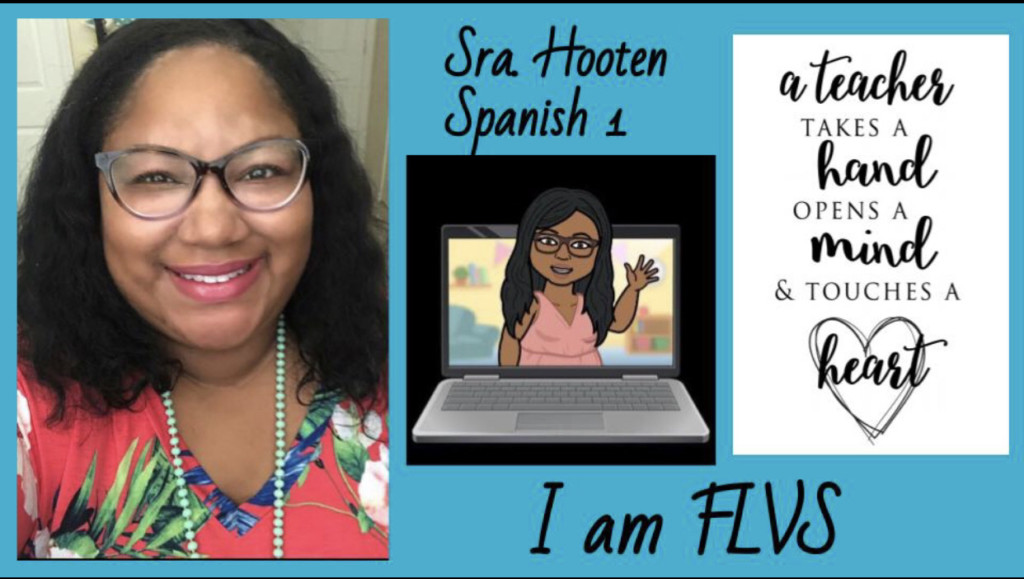
Florida Virtual School teacher Summer Hooten worked hard to schedule more live sessions than usual for her students this past year to create opportunities for collaboration and connection.
When the coronavirus pandemic shuttered brick and mortar schools and fueled a rush to online education in the spring of 2020, Florida Virtual School stepped up, investing $4.3 million in an expansion that allowed it to serve 2.7 million students by May.
As COVID-19 cases soared over the summer and concerned parents looked for alternatives to in-person learning, Florida Virtual School again emerged as a hero. School figures show full-time enrollment was up between July and September by 5,644 – a 98% increase – while the flexible virtual program saw course requests increase by 231,128, or 57% from the same time in 2019.
To accommodate the influx of students, Florida Virtual School hired additional teachers for a total of 2,500 faculty members during the 2020-21 school year.
The uncertainties associated with a global pandemic along with the added course load created challenges, even for the most experienced online educators. Two Florida Virtual School teachers, Leann Flynn and Summer Hooten, not only weathered the storm, but experienced the joy of teaching while reveling in what sets Florida Virtual School apart from district online programs.
Building real relationships is still No. 1
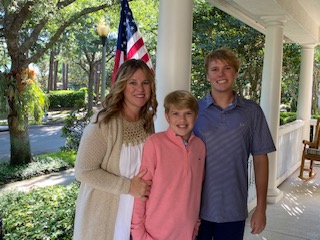
FLVS teacher Leann Flynn and her sons, William, 17 and Andrew, 13
“A lot of students never had anything like this happen in our lives,” said Flynn, a 20-year FLVS veteran who last year taught leadership skills to high schoolers. The curriculum, Mawi Learning, is based on the life of Mawi Asgedom, an Ethiopian refugee who graduated from Harvard University.
“His whole story was about grit and perseverance. That story is incredible right now,” Fynn said. “The course outlines these things people have gone through and what it takes to really have courage. It’s about overcoming.”
Hooten, who transitioned from traditional school to the FLVS Flex program several years ago so she could spend more time with her family, said the increase in students challenged her to work harder to maintain the personal connections for which FLVS is known. One tactic she employed was keeping careful notes on students’ interests and referring to them during one-on-one conferences.
“I asked them about their games, about their activities,” she said, explaining that at a traditional campus, it’s easier to know who is in the school band or the volleyball team.
Schedules are a must
As a virtual school, FLVS is not like synchronous district school online programs. Some lessons are live, but most are done on a student’s own time in line with their schedules. But that doesn’t mean they have permission to slack off.
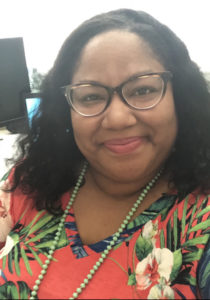
FLVS teacher Summer Hooten
“You are expected to continuously work on assignments,” Hooten explained. “Some traditional students who had taken classes with us understood how the program worked, but we got an influx of students who hadn’t taken classes with us before. It took some time to help them understand. We had to try to teach students different habits to help them continue to be successful. We do have expectations.”
Hooten compensated by scheduling more live lessons than usual and creating more opportunities for collaboration and connection. One lesson asked students to add photos to a map of where they were from so their classmates could get to know them better.
“I wanted them to feel more connected with other students even though they were in a virtual world, to be able to put a face with a name,” she said.
Flynn said she was more intentional than usual about checking in with students, faithfully keeping the commitment FLVS teachers make to be available for questions each day until 8 p.m. She also prepared video tutorials that students could access any time.
“They loved those,” she said, adding that she plans to continue that practice even after the pandemic is a memory.
Trust your instincts
Hooten said she had a few situations where students struggled, and she responded proactively.
One student who had consistently turned in assignments suddenly stopped. Rather than just entering failing grades, Hooten called the girl’s mother to see what was going on. Sure enough, there extenuating circumstances.
The girl’s computer was broken. Her mother had been working two jobs to make ends meet and had no money for a replacement. So, Hooten and a couple of friends dug into their own pockets and bought the girl a new Chromebook.
“The mom was just so thankful,” Hooten said. “Once her daughter got the computer, she submitted 10 assignments.”
Some students struggled because of school district mandates that required them to turn in their school-issued computers early. That got Hooten thinking about the benefits of education savings accounts, which provide families the flexibility they need to provide materials, including laptops, for their children despite their income level.
“That could help so many students,” she said.
Kindness goes a long way
Both teachers said the pandemic placed them in a position of being more than instructors. Each dealt with students who had been personally affected in some way. Several had family members who became ill and were forced to observe quarantine rules that involved sliding dinner plates under doors.
Other students experienced depression from stress and isolation. And because other family members were staying home to avoid infection, learning environments often were less than ideal. Backgrounds were noisy, and siblings sometimes had to share computers.
“We had to look at every student individually and the situation they were all in,” said Flynn, whose own children were learning online while she was teaching. “We were all struggling.”
Flynn said her heart went out to traditional classroom teachers who were expected to learn virtual instruction in a matter of days and later teach in-person and online at the same time.
“It’s like building a plane as you’re flying it,” she said.
Flynn said the challenging part for her was stepping into the role of counselor.
“There were just a lot of stressed-out students, and we saw a lot of anxious families,” she said, adding that she was glad FLVS’ personalized learning model allowed teachers to “be the encourager for these families when there was a lot of discouragement.”
Hooten recalled how she sent a depressed student a stress ball and a book. She also was able to give him an extension on some assignments. He finished the course successfully.
“He ended up writing me a thank you later,” she said. “It was the sweetest thing ever.”
At the end of a long academic year, Flynn and Hooten agree that FLVS gave them the chance to practice what the school does best: deliver education that best fits each student’s needs. They consider FLVS, which already offers unbundled services, as a gateway to the future of customized learning – despite the fact that none of Flynn’s friends had heard of it when she told them two decades ago she was going to work there.
Now, she said, “what we were envisioning is what is happening right now.”
 Editor’s note: With this commentary, redefinED welcomes Julie Young as our newest guest blogger. Founding CEO and former president of Florida Virtual School, Young serves as vice president of education outreach and student services at Arizona State University and is managing director of Arizona State University’s Prep Academy and ASU Prep Digital.
As the world continues to work through the pandemic, teachers and students are back in school wading through the new realities of whatever “school” means these days. Among other things, the pandemic has certainly challenged any notions of a “typical” school model. Indeed, if there is any commonality among schools right now, it is that “typical” may no longer exist.
Where will things go from here?
As we wondered aloud about this, we landed on a few predictions, based on our view of the industry in this moment, and our look back at how trends in tech adoption have played out over the years. Here are a few thoughts:
The switch to tech-supported learning is permanent.
While our natural tendency to look at the past with nostalgia is strong, especially during such turbulent times, educators seem to agree that after this mass exodus to remote learning, things will never go back to exactly what they were. This is both good and bad.
On the negative side, no digital learning professional would have wished 2020 on any teacher. Instantly rolling into remote learning was truly a worst-case scenario. What ensued was more about patching holes and saving the ship than proactively building the ship in the harbor and preparing for launch. Teachers have heroically moved forward, but few will disagree with the idea that today’s version of remote learning is not a permanent landing spot.
Because of the rough transition, it’s not surprising that we have lost teachers in the process, especially those on the cusp of retirement or early in their careers. After weighing the frustrations versus the option to leave, some are opting for the exit, especially in light of the reality that once school is “normalized,” digital learning is highly likely to play a bigger role.
On the upside, some teachers who are willing to take on the task of learning both the tools and the strategies for working effectively within online environments have found the online or blended environment to be invigorating. One seasoned teacher told us recently that teaching online for the first time opened up a whole new world of learning to him, helping him to address his own stagnancy.
At our site-based locations, where classes are still largely remote, students and teachers alike are becoming accustomed to some of the new Web 2.0 tools they have adopted. As teachers use various online tools, they often find new ways to incorporate them into their instructional planning. Since many of the tools teachers are using are free or low cost, we expect the uptick in use of digitally supported learning tools is here to stay, even in brick and mortar schools.
Many students will stay online.
Right now, full-time online learning programs are seeing huge enrollments spikes. In fact, as the 2020 school year approached, here in the network of ASU Preparatory Schools, where ASU Prep Digital lives, we saw many parents hedging their bets – enrolling students in both site-based and the fully online school.
We expect that there will be some “leveling out” when parents have more options for a traditional face-to-face environment and want to go back to what is familiar. At the same time, we know there will be parents and students who may have formerly been averse to an online learning environment but are now seeing benefits that they don’t want to lose, particularly the greater sense of student agency.
Innovation and model experimentation will increase.
Now that teachers and administrators in traditional schools have had to build new models in the worst possible conditions, they will soon be able to take stock of their new knowledge and apply it in a much more proactive and strategic manner.
We expect to see more innovation arising from the pandemic once educators can catch their breath. Over the years, we have always found that when teachers have space to try something new, they become the best source of information on how to improve the innovation on behalf of students.
Alternative school ideas – ‘unschool,’ micro-schools, learning pods, homeschooling, ‘outschool’ – will continue to increase.
Years ago, homeschooling was considered a radical notion, a fringe idea for hippies or religious groups. Today, homeschool is mainstream, and similar ideas are taking form.
“Micro-schools,” which harken back to the one-room schoolhouse notion, were already seeing growth before the pandemic. Micro-schools could be seen as an alternative for those who like the creativity homeschools affords, but they either don’t want to teach their own kids or don’t have the option to do so.
Homeschooling and even “unschooling” models, where curriculum is determined by the student’s interests versus a pre-set curriculum, now have access to online material to enhance and support student learning.
The flexibility inherent in alternative programs like these may be something parents increasingly want to see. While having the kids at home is an untenable situation for some families, others have found themselves surprised by the joy of simply being able to watch their kids in the moment of discovery.
Which leads us to the last point.
Notions about how and when students progress will continue to change.
For some time now, we’ve seen signs that old ideas about how a student progresses through material and grade levels are changing.
At the college level, the trend toward incremental learning with shorter-term certifications and stackable credentials has taken hold. This “incremental learning” trend has moved into the high school and even lower grade levels, with students now able to receive badges and other forms of recognition for learning mastery.
We have always known that students don’t all progress at the same rate, and progression across disciplines and skill areas also varies from one student to the next. For years, though, the idea of building a K-20 learning environment where competency and mastery determine advancement versus age or grade levels was hard to imagine.
Today, digital content and data tools are making it easier to envision a time when students will work toward achieving more and more mastery along a competency pathway, versus a course or grade level. At ASU Prep Digital, we already offer glimpses of this model by pulling down college on/off pathways into the high school program.
Students can opt for in-course college paths to get college credit while still in high school. Our full-time students can potentially earn up to 48 college credits at no cost throughout their high school career at no cost to the families. ASU Prep Digital continually works with innovation centers throughout the university to identify university materials and assets that can be repurposed for learning and for college and career readiness for high school students.
The wholesale dive into remote learning was a worst-case scenario. With every crisis, though, innovations arise, and we expect the pandemic to yield a new cadre of newly equipped educators who are ready to implement new possibilities they wouldn’t have explored otherwise.

Florida Virtual School is partnering with Step Up For Students to provide educational solutions for private schools as the COVID-19 pandemic stretches into the 2020-21 school year.
Florida private schools seeking online learning options for students who are not ready to return to campus just got a lifeline from one of nation’s leaders in virtual education.
Florida Virtual School, the state’s 23-year-old public online school district, recently announced it would make its roster of 190 courses available for purchase by private schools that participate in state scholarship programs such as the Florida Tax Credit Scholarship program for lower-income students and Gardiner Scholarship program for students with unique abilities, both of which are administered by Step Up For Students, which hosts this blog. Offerings range from classes for kindergarteners through 12th graders.
“Florida Virtual School is excited to partner with Step Up For Students to provide educational solutions that meet the needs of Florida’s private schools during these challenging times,” said Louis Algaze, president and CEO of Florida Virtual School.
This is not the first time the online school has come to the rescue of Florida’s students. In response to the COVID-19 pandemic that fueled a rush to online learning last spring, the nonprofit K-12 school spent $4.7 million to boost its capacity, allowing it to serve 2.7 million students in district, charter and private schools.
“It is our priority to help all students stay on track with their education and to partner with Florida schools and school districts to quickly support them with additional resources,” Algaze said. “We want to play our part to provide a coordinated, seamless education for all learners, kindergarten through high school.”
The partnership allows private schools to choose between two options. They can buy access to the Florida Virtual School system, pre-loaded with FLVS courses, for their instructors to teach online to their students, or they can buy the use of the platform to use other courses or create their own content that their teachers can use for online classes. (The first option requires a minimum of 25 students.)
School administrators also may choose between two teacher training programs: a self-paced guide or a live group webinar.
Because each school’s own faculty will be teaching the classes, there are no restrictions on the number of courses each student who receives a Florida Tax Credit Scholarship or Family Empowerment Scholarship may take.
Nine schools signed up as of Wednesday, and several others have expressed an interest.
“We want to expose our students to online learning and give them the opportunity to engage in online learning,” said Steve Hicks, vice president of operations for Center Academy, which operates nine campuses in Florida and one in Georgia for students with learning differences.
The school opened its first campus in 1968 with a vision to offer a specialized, full-day program for students who were falling through the cracks at their district schools.
“We could see the advantages, especially for courses we don’t typically offer in a small school,” said Hicks, who also serves as president of the Coalition of McKay Scholarship Schools and treasurer of the Florida Association of Academic NonPublic Schools.
He said state law requires students who are working toward a standard diploma to take an online class as part of the curriculum.
“Florida Virtual School is our go-to organization for that,” Hicks said, adding that the courses would be especially good for students who want to learn foreign languages other than those taught on campus.
The program also will allow Center Academy to broaden its offering of electives.
“We want to offer things kids are interested in,” Hicks said. “This provides some guided support. It’s a real incentive for private schools.”
The online experience also provides good preparation for Center Academy students who plan to attend college, which often requires more blended learning.
Hicks said that about 60 to 70 percent of students have returned to campus as the numbers of COVID-19 cases decline and distractions of home prove challenging to some students who may have attention deficit hyperactivity disorder or are on the autism spectrum.
He nevertheless sees a deeper partnership with FLVS as a good way for private schools to stretch their resources and continue to attract students.
Some schools, including his own, are losing teachers to district schools in the wake of a significant increase in the minimum salary Gov. Ron DeSantis signed into law for public school teachers this year. The legislation puts Florida in the top five nationally for teacher pay.
 Editor’s note: This post from Tom Vander Ark, co-founder and CEO of Getting Smart and a partner in Learn Capital, was originally posted on Forbes and appeared May 24 n the Getting Smart blog.
School leaders have about 90 days to get future ready. For many, it will require four infrastructure decisions and four innovation decisions.
This fall, many school districts and networks will find themselves running a distanced onsite program and a remote program simultaneously. There will also be an increased demand for full-time online learning and hybrid options.
The four new or updated elements of future-ready infrastructure include a blended core program, a distanced onsite strategy, an updated remote program and an online program.
Blend the core academic program
Many schools have spent five or 10 years blending digital tools and resources into their print-based curriculum and updating their instructional strategies. Some spent the last two months catching up.
Five years ago, our Implementation Guide 3.0 described blended learning as “a formal education program in which a student learns at least in part through online delivery of content and instruction with some element of student control over time, place, path, and/or pace at least in part at a supervised brick-and-mortar location away from home.”
A blended learning program is a learning management system (LMS) to manage content and assignments across different modes of learning (i.e., onsite and remote). Some districts put off a platform decision or allowed teachers to make their own decisions. But now is the time for schoolwide (if not districtwide) use of a common platform–the pandemic made it clear that education is officially a team sport and one where shared agility is mission-critical.
The second decision is defining a consistent approach to learning materials. That used to mean adopted textbooks but, in many cases, those can be replaced with high quality digital open educational resources and supplemented with teacher-developed content. The benefit of engaging asynchronous digital content became even more evident in the last two months.
A few platforms come loaded with content and embedded assessments that can provide a head start for running full-time online schools (discussed below). Some innovative schools like Purdue Polytechnic in Indianapolis, use one of these platforms for personalized knowledge and skill development, and supplement it with big integrated community-connected projects.
One thing this pandemic made clear is the benefit of collaboration (workflow and project management) and communication tools (texting and video conferencing) to keep you and your team and students connected.
You won’t find a suite of tools that does everything you want but options are improving. Canvas from Instructure and Schoology from Powerschool are popular platforms. Google Classroom and G Suite and Microsoft Classroom, 365, and Teams aren’t full-featured learning management systems but they are integrated collaboration and communication ecosystems –and they’re free.
Update your remote strategy
Because learners – small and large groups – may be moving back and forth between remote and onsite learning it will be important to link modes of learning.
Staff members may also need to work remotely periodically requiring temporary staffing strategies – teachers and leaders will need to be especially flexible next year.
Schools may need to update plans for take home mobile technology and strengthen broadband partnerships (discounts, mobile and community hotspots), to reach as close to every household as possible.
Build a social distanced onsite solution
Use a combination of place-shifting (i.e., extra spaces) and time-shifting (i.e., staggered schedules) to build a social distancing solution if that’s how you have to start school. The decision will depend on the number of buses you have and the number of cycles they make. The number of parents that choose to have their children stay home and participate in remote (or online) learning will also influence this strategy.
Some parents may also choose onsite learning but will avoid busing. In all cases, it will be important for school and district administrators to communicate with and survey parents/guardians frequently.
Start or partner with online school
With full and part-time enrollment, online schools are designed to support learning at home. Thousands of students transferred to online schools when school buildings closed and hundreds of thousands of students may follow over the next 18 months. As a result, school districts are scrambling to create online options to prevent further defections.
School districts that don’t have an online school, should start one or partner with one in their state. They can contract with a statewide provider, or license content from a statewide provider or assemble open content (like OpenEd from ACT), or use asynchronous content (like Edgenuity or Edmentum).
The new opportunity that someone will figure out in the next two years is combining the benefits of robust asynchronous content with project-based learning.
Every metropolitan area could use a cooperative online provider that provides online and hybrid (like two days a week onsite) options to families and a place for teachers that can’t teach in a school building–an online matching service for families looking for options and teachers needing alternative placement.
The four innovation opportunities are work that matters, skills for thriving, meeting learners where they are, and responsive options.
Note: 3,400 school districts have pledged to be Future Ready Schools and are probably making progress in these four areas.
Tom Vander Ark is author of “Better Together,” “Smart Parents,” “Smart Cities,” “Getting Smart” and “The Power of Place.” He is co-founder of Getting Smart and Learn Capital and serves on the boards of Education Board Partners, 4.0 Schools, Digital Learning Institute, Latinx Education Collaborative, Mastery Transcript Consortium and eduInnovation. Follow Tom on Twitter, @tvanderark.
 In this episode, Step Up For Students president Doug Tuthill interviews Louis Algaze, president and CEO of Florida Virtual School. Founded in 1997, FLVS is a publicly funded non-profit that operates as its own $240 million school district. During the 2018-19 academic year, it served 215,505 students, technically making it the largest public school in the United States.
Tuthill and Algaze discuss FLVS’ rapid expansion in the wake of COVID-19 and the role the online school will play going forward, touching on improvement opportunities for the learning model they expect will be an example for the nation’s public school system as it shifts gears into the fall and beyond.
"There is so much talent and desire … We’re looking forward to really fantastic things in the future."
EPISODE DETAILS:
· How FLVS rapidly expanded capacity to serve every public school student in Florida
· Differences between crisis learning and a full online education
· How the demand for blended learning will grow and what it will look like
· The challenge of acclimating nearly 2,000 teachers to a blended learning model and the commitment to train teachers statewide
· Collaborating with traditional public, charter, and private schools to address student needs
LINKS MENTIONED:
· Online school during COVID-19: It’s about student learning (Alaska)
· Florida Virtual School brings online education to Alaska
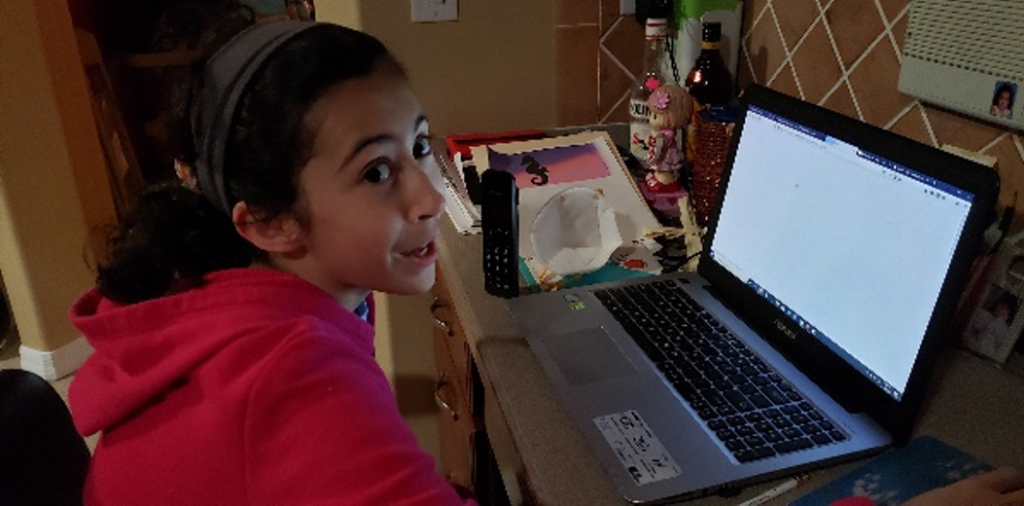
Berta DellaSalla, a seventh-grader at Bishop Larkin Catholic School, works on assignments online as her father, Gene, recovers slowly from coronavirus.
As schools continue to navigate their new reality in the face of coronavirus, a Catholic school in Port Richey is facing a challenge that goes beyond educating children and cuts to the heart of what it means to be a community.
On March 10, nearly a week before most brick-and-mortar schools closed, a parent at Bishop Larkin Catholic School tested positive for Covid-19. Administrators made the decision to shut the school down overnight, necessitating an immediate switch from in-person to online instruction.
“It was not a very difficult decision,” said principal Stacy Cervone. “Our priority was the safety of our students, staff and families, and finding the best way to keep everyone safe.”
Bishop Larkin Catholic School, accredited by the Florida Catholic Conference and a member of the National Catholic Education Association, serves 217 students in prekindergarten through eighth grade. Eighty-one students attend on a Florida Tax Credit Scholarship and two attend on a Gardiner Scholarship for students with unique abilities. (Step Up For Students, which hosts this blog, administers both scholarship programs.)
After receiving guidance from the Diocese of St. Petersburg, teachers began using an online platform called Educator Pages to post assignments. Students sign in each morning, then get started on four main assignments, which must be completed daily, covering core subjects like math and science that are presented as a live lesson, a recorded lesson or an interactive PowerPoint.
Students also engage in personal live learning time and choose one elective or resource class assignment to round out their day.
Cervone, a 22-year veteran educator who served as an assistant principal for Hillsborough County Public Schools before coming to Bishop Larkin a year ago, knew that her school needed to go above and beyond caring for students’ safety and educational needs. She considered it part of the school’s mission – working in partnership with parents and parish communities in a spirit of compassion, service and leadership – to aid the family directly affected by the virus.
Gene DellaSala, whose daughter, Berta, is a Bishop Larkin seventh grader, thought he was coming down with a cold in late February following a visit from a business associate who had recently traveled to China. In early March, Gene, 46, learned that his associate had tested positive for Covid-19.
Gene’s doctor diagnosed him with a cold and sinus infection, but his symptoms – a bad cough, stomach cramps and chills – worsened. His wife, Bertha, contacted the Pasco County Department of Health on March 9, and his doctor arranged for him to be tested for coronavirus. The next day, test results confirmed that Gene was the first person in Pasco County to contract the virus.
Bertha knew she had to contact Cervone.
“I felt terrible knowing that BLCS had to be shut down since our kids love it and appreciate the one-on-one relationships they have with everyone,” Bertha said. “But, on the other hand, we were relieved that no one else was going to be exposed to the virus and that they took the precautions to make sure (the school) was safe for everyone.”
For the past three weeks, Bishop Larkin parents and staff have been bringing the family take-out restaurant meals. They’ve picked up medications from the pharmacy. They call and text every day to check in. One parent offered to stop by the school to pick up books for Berta and deliver them to the house.
Bertha said the school’s support has been invaluable as Gene remains quarantined on one side of the house. She doesn’t drive, so help with grocery delivery has been a huge help. An online replication of school spirit days has been a morale booster.
But most of all, Bertha said, she’s appreciative her daughter has been able to continue learning. The educational continuity, in a virtual format, is helping Berta deal with her father’s illness and cope with the fact that she can’t be near him.
“She thrives on a routine, so it’s been hard to keep her motivated and engaged,” Bertha said, adding that the school counselor has called several times to make sure Berta is okay.
Meanwhile, Gene is recovering slowly but continues to test positive for coronavirus. Until he tests negative on two consecutive visits to the health department’s parking lot, where he is swabbed by a technician, he must remain in quarantine.
The school community has pledged to stand by the family for the duration.

Julie Young
Julie Young announced earlier this year that she would be stepping down as the head of Florida Virtual School, after more than 30 years in public education. Her announcement reverberated in education circles around the country, where she was recognized as a pioneer in her field and the "godmother of digital learning."
I sat down to talk with her about the early days of virtual education, the lessons she learned while it grew, and what the future might hold both for digital learning as a whole and for the institution she led for 17 years. The interview formed the basis of my profile of Young, which was published on redefinED Monday.
So the first thing I’m wondering is, why now?
I started thinking about it about a year and half ago. I started hinting to the team about a year and a half ago ... I just had something inside of me going, ‘Ok, we’ve done this. It’s in a really good place, and together this team has had the opportunity to have a huge impact on the field of education, and really the world of learning, and now what?’ I was asking myself the same questions and just feeling like there was something I wanted to do, and didn’t know what it was.
I’m really the type of person that when I’m in the middle of something, I’m all in. And so even thinking about it, for me, felt like blasphemy. I didn’t feel like I could explore other opportunities. I didn’t feel like it was the right thing to be thinking that while I was still totally engaged as CEO.
Looking out across the education landscape in Florida, there’s a lot of things that were maybe tried out 15 or 20 years ago that are now reaching maturity. What do you see in the virtual realm that are these signs of maturity – where FLVS can kind of grow on its own?
When we started, virtual education was this thing over here that was, I think, in many respects, to be feared by many. Intriguing to the business community, very intriguing to parents, but feared by the education community. When I look at it now, and I think about where we are, and I see that the school districts have their franchises and they’ve embraced virtual learning for their students – whether they’re using us to provide that or whether they’re using their own programs – to me really indicates that very soon, it’s going to be ubiquitous. Very soon, we’re not going to be asking kids, ‘Are you taking a course online?’ It’s just going to be, ‘I’m taking English,’ and people aren’t going to be paying attention to whether it’s English online or English in the classroom. And we’re there at the post-secondary level.
In addition, I think that the onset and the acceptance of the full-time virtual programs and the proliferation of those have really given students and families that additional opportunity, beyond Florida Virtual School, or within Florida Virtual School, to get a diploma.
I think you reach a point where there’s no turning back, and I think that we’re there. I think it’s going to look different every year. … Our student base – the students we serve – (is) potentially shrinking, and the district’s service (is) potentially growing, which really indicates that it’s permeating the status quo, so that we don’t have to do it all by ourselves. But we should look for the total population of virtual education in the state of Florida to be growing. And I think what Florida Virtual School’s value and niche going forward is and should continue to be is that we will continue to look for new ways to deliver virtual education, where we can work with students to determine, what’s the next thing? What’s the next learning opportunity that we haven’t thought of yet? We’ll be able to then move those ideas out into the masses as well. (more…)
Hits to Florida Virtual School continue this week with the nation's largest provider of online classes cutting 177 full-time positions.
 The cuts to instructional and support staff came Monday, and follow last month's elimination of 625 part-time teaching positions. The move was necessary, program officials said, after an internal review showed pre-enrollment had dropped 32 percent compared to last summer.
"For the first time in 16 years, we have had to make the painful decision to reduce staff,'' Florida Virtual School spokeswoman Tania Clow said late Tuesday in a prepared statement.
Florida Virtual School has 1,725 staff positions remaining. The program served more than 149,000 students in 2011-12.
So why is this happening? Florida Virtual School officials point to a new state funding formula that went into effect last month. Before the change, when students took six courses in their district school and one through Florida Virtual School, the district received its full per-student allotment for that student. Florida Virtual School got another one-sixth of the funding.
Now, the district receives six-sevenths of its allotment and Florida Virtual School receives one-seventh. The more courses a student takes online, the less money the district and Florida Virtual School receive. That has resulted in some school districts preventing students from signing up for Florida Virtual School.
The state Department of Education intervened in April, telling about 10 school districts to stop blocking student access to Florida Virtual School. Last month, it issued another warning to every superintendent in the state.
State Sen. Bill Galvano, R-Bradenton, chair of the Senate Education Appropriations Committee, told redefinED last week that he stands behind the funding changes, calling them more equitable. But he also said lawmakers likely will revisit the issue during the next legislative session to address enrollment concerns.
Meanwhile, Florida Virtual School officials say they'll continue serving students at the highest level.
"The entire FLVS family is saddened by the new realities we are facing,'' Clow said. "As always the FLVS team will continue to keep our students at the center ... helping them be successful in their learning.''
Florida lawmakers are starting to key in on a recent funding change that has put a big dent in enrollment at Florida Virtual School, with one promising the issue will be revisited in coming months and another saying action against school districts may be warranted.
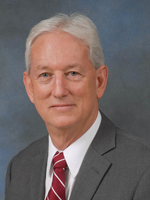
Rep. Carl Zimmermann
When legislative committees meet in Tallahassee in September, “I can guarantee you this is going to be discussed,” said Rep. Carl Zimmermann, a Pinellas Democrat who sits on the House Education Committee.
At issue is a change to the state’s education funding formula that lawmakers approved last spring. Under the old method, districts received their full per-student allocation even when that full-time student was taking one course with Florida Virtual School, which also received funding for that student. Now under that same scenario, the district receives six-sevenths of the allotment and FLVS receives one-seventh. The more courses a student takes online, the less money the district and FLVS receive.
Even before the recalculated formula went into effect last month, Florida Virtual School, the state’s leading provider of online classes and among the nation’s largest, reported dramatic declines in enrollment. They expect a $34 million loss. More troublesome, they say, is students are being turned away from a popular school choice option.
They say they’re still getting calls from students and parents, complaining that schools are making them take online classes through the district – or not letting them sign up at all. The situation prompted the Florida Department of Education to warn at least 10 districts to stop the practice, which may violate state law. And last month, after more reports surfaced, DOE’s chancellor of public schools sent another warning – this time in a memo to superintendents statewide. (more…)

