Editor's note: The Rev. Manuel Sykes is pastor of Bethel Community Baptist Church and president of the St. Petersburg NAACP, an active chapter on Florida's west coast. In this commentary, he responds to a recent Tampa Bay Times column that criticized a federal tax credit scholarship bill offered by U.S. Sen. Marco Rubio. The Times also published a letter to the editor from Rev. Sykes in today's editions.
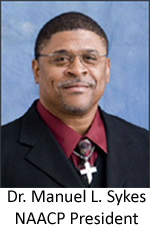 Florida offers the nation’s best lesson on whether private school options can help poor children, but the Tampa Bay Times seems uninterested in what these parents and students are telling us. Instead, it is busy pointing a distinctly partisan finger.
Argue if you want about whether the federal government should provide K-12 scholarships to low-income students, but the tax credit scholarship plan introduced by Republican U.S. Sen. Marco Rubio is not “bankrupt” or “craven.” It is instead a learning option that economically disadvantaged students wouldn’t otherwise have, and to label it as “money laundering” represents the kind of rhetorical excess that cheapens our public debate.
In Florida, more than 50,000 students are on a similar plan, and the results are encouraging to those of us who work with struggling children. The students who use the Florida Tax Credit Scholarship are truly poor – incomes barely above poverty and averaging less than $25,000 for a household of four – and more than two thirds of them are black or Hispanic. State research tells us they were among the lowest academic performers in the public schools they left behind, and testing results show they are making the same academic gains as students of all income levels nationally. Just as encouraging, the traditional public schools that are most impacted by students who choose the scholarships are themselves experiencing higher learning gains.
The educational results don’t seem to matter to those who prefer instead to dismiss scholarships as some kind of Republican conspiracy. Never mind that nearly half the Democrats in Florida’s Legislature also support this option, including a majority of the Black Caucus. Never mind those of us who work in disadvantaged communities in St. Petersburg and see children for whom these opportunities can make the difference between a diploma or a jail cell. Never mind that the Black Alliance for Educational Options, which represents elected black Democrats across the nation, has expressed its support for Rubio’s bill. (more…)
Eleven states currently offer tax credits to specified taxpayers who make contributions to tax-exempt non-profit organizations that in turn use those contributions to fund scholarships for qualifying, financially-needy, elementary and/or secondary school students attending private schools. This fairly recent development is currently empowering perhaps 150,000 lower-income families, who generally are unable to afford private schools, to make this sort of school choice for their children. To be clear, these plans provide benefits for taxpayers who make contributions that help other people’s children attend private schools.
Sen. Rubio
Sen. Marco Rubio, R-Fla., has just introduced a bill that would expand this tax credit scholarship initiative nationwide. To understand the good (and dubious) features of Senator Rubio’s proposal, it is important to appreciate the state law background against which it is set.
Florida has the financially largest of these 11 state tax credit programs, with about 50,000 children currently participating. It restricts the scholarships to children from truly low-income households; the child must be eligible for a free- or reduced-price school lunch – currently just over $40,000 a year for a family of four. Other states are more generous, with Oklahoma reaching well into the middle class since there a family of four can still qualify with $120,000 in annual income. Senator Rubio’s plan, while not as tightly restricted as Florida’s, focuses the scholarships on families with income no more than 250 percent of the poverty level, which is a bit over $50,000 today. The main thing to emphasize here is the senator clearly seeks by his bill to empower the least well-off Americans who are currently least able to exercise school choice – a choice that more well-to-do families make by either moving to a better public school district or paying for private schools on their own.
Several state plans give tax credits to both individual and corporate donors (and for corporate donors the plans sometimes allow credits against a variety of state taxes). Senator Rubio’s bill does the same – allowing married couples and single taxpayers both to obtain a federal income tax credit for an annual contribution of up to $4,500, and allowing corporations an annual corporate income tax credit of up to $100,000. Florida by contrast only allows corporate tax credits and Arizona (which was the first state to adopt this program) initially granted only individual tax credits. Senator Rubio’s proposed tax credit limit for couples and individuals is about twice that now allowed in Arizona. Some states have no cap on donations, and indeed in Florida a few very large corporate donors contribute millions each year to the plan.
Senator Rubio’s proposed tax credit is a 100 percent credit, as is true in both Florida and Arizona, for example. This means that for every qualifying dollar contributed, federal income taxes would be reduced by a dollar. This essentially makes contributions costless to the donors. They, in effect, are able to re-direct their tax dollars to this specific cause – helping needy families send their children to private schools. It is worth nothing, however, that some states grant only a partial tax credit, such as the 65 percent credit allowed in Iowa and the 50 percent credit allowed in Indiana. In those latter states, donors must put up some of their own money.
Most states that adopted these plans imposed a maximum overall limit on the amount of tax credits that may be claimed each year in support of the program. These maxima vary enormously and even so are often not reached. Senator Rubio’s plan has no such limit. It probably would be complicated and costly, but clearly not impossible, for the IRS to administer an overall ceiling in a way that allowed would-be donors to know whether their contribution was within the national maximum and hence truly eligible for the credit.
One important difference between many state plans and Senator Rubio’s proposal is there is no limit on the amount of the scholarship that may be awarded. Florida, for example, caps scholarships at $4,335 at present; in Georgia the limit is just over $9,000. Hence, as appears to be the case in states like Iowa and Indiana, it would be legally possible under the senator’s plan for a child to win a full scholarship to a very high cost, elite private school and hence indirectly obtain government financial aid well beyond what is now being spent on public schools. This is perhaps unwise. Note, however, that nothing in Senator Rubio’s bill would require scholarship granting organizations to award full scholarships or high-value scholarships. In many states at present, the average scholarship is less than $2,000 a year. Since it would be rare to find a school with tuition that low, either the families must find some way to come up with the difference, or the schools must use their own financial aid plans to make up some or all of the gap.
The most striking difference between most state plans and Senator Rubio’s is children already enrolled in private schools would be eligible for scholarships. (more…)
Tax credit scholarships. Tampa Bay Times columnist Robyn Blumner doesn't like U.S. Sen. Marco Rubio's proposal for federal scholarships.
 Charter schools. Tampa Bay Times columnist John Romano bemoans the number of charter schools that close because of low enrollment (but curiously doesn't mention traditional public schools that don't get closed despite the same problem). The Cape Coral City Council will consider a resolution asking the Lee County School Board to share capital funding with the city's charter schools, reports the Cape Coral Daily Breeze. More from the Fort Myers News Press.
Virtual schools. Expanding digital education is a top issue in the coming legislative session. The Florida Current.
Jeb Bush. In education, "he has a record of making messes," the Palm Beach Post editorializes (just days after two more credible, independent reports find Florida students leading the country in progress).
Parental engagement. Duval Superintendent Nikolai Vitti wants to import a Parents Academy program similar to one he worked with in Miami-Dade. Florida Times Union.
Education leadership. The Sarasota Herald-Tribune profiles Sen. Bill Galvano, R-Bradenton, the chair of the Senate Education Appropriations Subcommittee.
Teacher evaluations. The first year of statewide teacher evaluation data using the complicated the VAM formula shows the big difference in progress for students with the highest-rated teachers versus the lowest-rated teachers. StateImpact Florida.
Teacher testimony. Megan Allen, Florida's 2010 Teacher of the Year, testifies movingly before Congress about the impact that budget cuts will have on high-needs students. Answer Sheet. (more…)
On Wednesday, U.S. Sen. Marco Rubio, R-Fla., introduced a bill that would create a federal tax credit scholarship program for low-income students. Today he offers his thoughts about it in an op-ed for the Tampa Bay Times. Here's an excerpt:
Sen. Rubio
Unfortunately, hundreds of thousands of schoolchildren in our country are not as fortunate as I was. These children are being failed by our nation's broken public school system, and they and their parents deserve the freedom and flexibility of school choice. There is perhaps no greater symbol of failure in our education system and our society than the worried faces of parents sending their kids off to a failing school because they don't have the liberty to choose a better, safer school.
While some students may be lucky enough to attend high-quality public charter schools in their areas, a private school education has become unattainable for the majority of low-income and middle-class families. It's too difficult for parents in today's economic environment to incur the financial burden of paying tuition at a private school, forcing parents to bypass better and safer education options.
Further, because of our nation's fiscal crisis, private schools may not be able to distribute a high number of institutionally funded scholarships to children. The result is a large number of students and families yearning for the opportunity of gaining a better education at a high-performing private school that will adequately prepare them to compete in a 21st century global economy.
To ensure that more American children receive that opportunity, I have introduced the Educational Opportunities Act, to create a new federal tax credit for individuals and corporations to help families pay for expanded educational opportunities. Full op-ed here.
Parent trigger. Sen. Kelli Stargel, R-Lakeland, files a bill similar to last year's, drawing immediate fire from the Florida Democratic Party. News Service of Florida. More from the Tallahassee Democrat.
More tutoring oversight. The U.S. Department of Education is disturbed by what the Tampa Bay Times found with Florida's state-mandated tutoring program, reports Gradebook. Pinellas Superintendent Mike Grego asks Education Commissioner Tony Bennett to scrap the program completely, Gradebook also reports. The Miami-Dade school district also wants the mandate repealed, reports the Miami Herald. A tutoring company owner in Miami-Dade pleads guilty to 47 counts of fraud and grand theft and is sentenced to five years probation, the Herald also reports.
Charter schools. South Florida Sun Sentinel columnist Michael Mayo writes about the money feud that's pitting the successful Pembroke Pines charter school system against the Broward school district.
More Rubio vouchers. StateImpact Florida logs it in.
Teacher absenteeism. Florida teachers collectively have one of the lowest absentee rates in the country, according to a new Center for American Progress report, notes Gradebook. But with 29.1 percent missing at least 10 days in a 180-day year, it is still high.
Teacher evaluations. The Florida Times Union objects to the Florida Education Association's request to intervene in the newspaper's suit against the Department of Education for withholding teacher eval data. (more…)
Financial irregularities. Eighty-five percent of district schools in Palm Beach County show financial irregularities, an audit finds, with some cases involving “thousands of missing dollars, spotty tracking of fundraising cash and outstanding deficits in school funds,” reports the South Florida Sun Sentinel.
 Teacher turnover. The Pasco district knows it must find ways to slow the revolving door in high-needs schools. Tampa Bay Times.
Inconvenient truths. Florida Voices columnist Rick Outzen says it’s an “inconvenient truth” that Florida’s grad rates are so low. (It’s also an inconvenient truth, not mentioned in the column, that they’re among the fastest-rising in the country.)
Construction money. Supporters of traditional public schools say charter school funding is leaving them in a bigger bind, reports the St. Augustine Record. Says Colleen Wood with 50th No More (and Save Duval Schools): “It seems to be the idea that parental choice is the guiding principal (for charter schools) as opposed to (students getting) the best education possible.”
Rubio and tax credit scholarships. Florida offers a model for a federal program proposed by U.S. Sen. Marco Rubio, writes the Choice Words blog. (Step Up For Students, which co-hosts this blog, administers the Florida program.)
Evals. The ones for administrators came out last week, too. StateImpact Florida. But there's a disconnect between the new evals and school grades, writes Naples Daily News columnist Brett Batten.
Early learning funding formula. Gov. Rick Scott says the state won’t change it this year, drawing praise from early learning coalitions, reports Gradebook.
Stuck in the '70s. In an editorial about the three finalists for ed commish, the Tampa Bay Times likens the DOE to "an old pinball machine" and asks: "At what point does the privatization of the public school system go too far? And what will you do move the focus off of vouchers and back to the heart of Florida's future - its traditional public schools?" Orlando Sentinel columnist Beth Kassab says go with Tony Bennett.
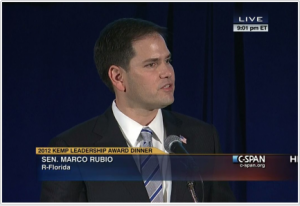 U.S. Sen. Marco Rubio, R-Fla., devoted a substantial portion of a major speech this week to education reform, saying public schools are a “disaster” for millions of disadvantaged American kids and pointing to parental school choice as a critical piece in uplifting the middle class.
More charter schools and more career and technical academies are among the changes necessary to ensure that people have the skills needed for the middle-class jobs of the future, Rubio, a Republican from Miami, said at the Jack Kemp Foundation’s Leadership Award Dinner (C-SPAN video here). He also proposed creation of a corporate federal tax credit to provide scholarships to low-income students who want to attend private schools.
“The bottom line is we are trying to prepare 21st century students using a 20th century education model,” Rubio said, according to a transcript of his remarks. “Now is the time to be creative, innovative and daring in reforming the way we provide our people the skills they need to make it to the middle class.”
Rubio is a longtime school choice supporter. But his latest remarks on the subject are noteworthy given the timing and context. In the aftermath of Mitt Romney’s loss, Republicans are re-branding their image to better appeal to middle-class voters – and Rubio squarely framed school choice as a vehicle for equal opportunity and upward mobility. Rubio’s points also dovetail with arguments long made by choice groups such as the Florida-based Hispanic Council for Reform and Educational Options. Minority voters are increasingly warming to vouchers, tax credit scholarships and other forms of expanded school choice, and polls suggest they may likewise warm to politicians who embrace such options.
In another section of his speech, Rubio mitigated his harsh assessment of failing schools, acknowledging the tough job schools face and offering sympathy for those in the trenches: “But perhaps the most effective thing we in government can do about societal breakdown is acknowledge the impact it is having. Ask any of the amazing teachers we are blessed to have here in America. I have four of them in my own family. They are on the frontlines of this problem. They will be the first to tell you that every single day, kids bring their home experience in to the classrooms. Every day, they see firsthand how kids living in dysfunctional homes are going to really struggle to make it. As a people, we cannot build a vibrant and broad-based middle class if we do not solve this problem.”
Here is the main section of the speech that touched on education: (more…)
Teacher evaluations. Errors mar the release of new teacher evaluation data. Coverage from Tampa Bay Times, Miami Herald, Orlando Sentinel, South Florida Sun Sentinel, Florida Times Union, Lakeland Ledger.
More on race-based achievement goals. NPR interviews Emily Richmond from the Education Writers Association about these goals in Florida and elsewhere. She offers context and nuance. Here’s her recent piece in The Atlantic that also mentions Florida.
Marco Rubio talks school choice. At the Jack Kemp Foundation dinner Tuesday night, he touts charter schools and tax credit scholarships. Full remarks here.Why did Florida settle? That’s the question Americans United for Separation of Church and State is asking after the Department of Education settled with Florida Christian College over whether its students can receive Florida Resident Access Grants.
Charters, competition and empty school buildings. EdFly Blog.
Charter school growth in southwest Florida. Florida Weekly.
Boundary jumpers. The Palm Beach school board delays a rezoning decision amidst parental angst and accusations of boundary jumpers, reports the Palm Beach Post.

