Students at the University of Austin are getting an overview of the nation’s rapidly expanding education choice movement, including its storied history in Florida.
The survey course includes guest lectures delivered by top national researchers and thought leaders, including Ron Matus, director of research and special projects at Step Up For Students. The nonprofit organization is Florida’s and the nation’s largest education choice scholarship funding organization. Matus, who spent 25 years as a journalist and eight years as the state education reporter at the Tampa Bay Times, has authored many white papers on education innovation in Florida for Step Up.
The topic of Matus’s lecture was “Freedom, Pluralism and School Choice: Competing Rationales and Contemporary Practice” and included a special emphasis on education innovation in the Sunshine State.
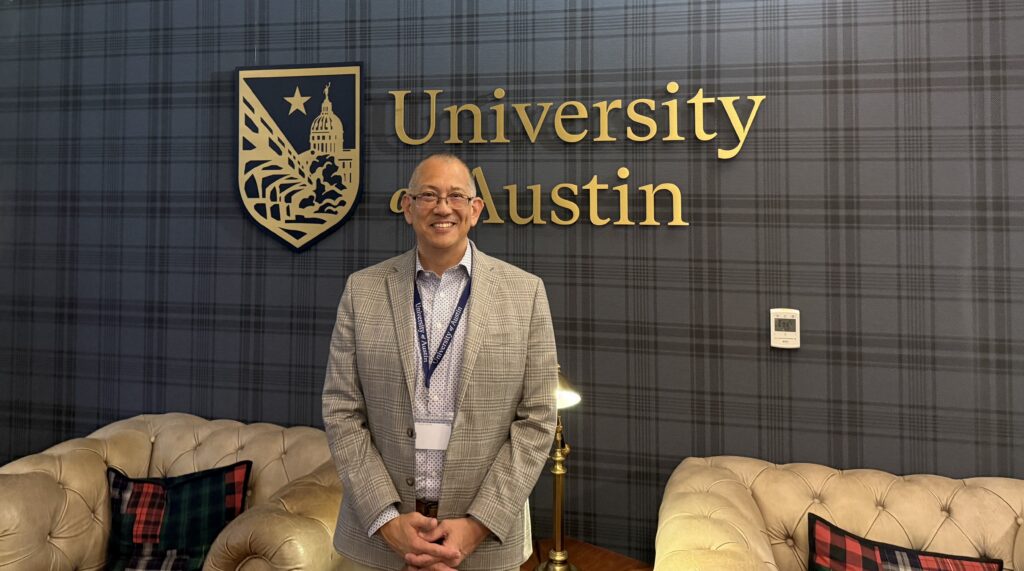
Matus shared the evolution of public education in Florida from its first model of neighborhood zoned district schools to the rise of charter schools, homeschooling, private school scholarships, educational savings accounts, a la carte learning, and even public schools now offering individual courses paid for with education savings accounts. He also described the many learning options now available, from traditional private schools to farm and forest schools to microschools and programs customized by families.
Matus also recommended reading that exposed students to various arguments in favor of education choice, including economist Milton Friedman’s 1955 groundbreaking essay “The Role of Government in Education,” which emphasized free markets and competition, and John E. Coons, a professor emeritus at the University of California, Berkeley, School of Law, who focused on dignity and fairness to all families regardless of income.
Erin Davis Valdez, executive director of the university’s Center for Education and Public Service, developed the course, which followed two K-12 practicums with rotations that began in the fall of 2025 at participating private and charter schools.
She describes the program as being in “the incubator phase,” and hopes to expand it into an academic minor.
“What we’re trying to do every term is offer a course for students interested in education policy as a career or in teaching as a career or something adjacent to it, like entrepreneurship,” she said. “But for now, students can take these as elective classes, and it builds their interest in the field.”
Valdez, who was homeschooled as a young child in Lakeland, Florida, a year before it became legal, said she chose the guest lecturers by looking for the best researchers and thought leaders in the movement. In addition to Matus, the list includes Eric Wearne, an associate professor in the Education Economics Center at Kennesaw State University and director of the Hybrid Schools Project. Wearne, who once described most traditional teacher prep programs as “thinly veiled arms of the HR department of the school district,” spoke on “Design Policy for New School Models.”
Others included Patrick Wolf, Distinguished Professor and 21st Century Chair in School Choice at the University of Arkansas, who spoke about the history of school choice policy, Jay P. Greene, senior fellow at the Defense of Freedom Institute, who spoke on the national responsibility of American universities; Katherine Bathgate, CEO and founder of SchoolForward, who spoke about economic foundations and emerging policy issues I education freedom; Mary K Wells, managing partner at Bellwether, who spoke on the last 30 years of education reform efforts; and Anita Scott, director of public policy for the Texas Home School Coalition, who spoke on connecting policy and practice in the homeschooling community.
Matthew Ladner, a senior adviser for education policy implementation at The Heritage Foundation’s Center for Education Policy and former executive editor of the NextSteps blog, is scheduled to lecture on June 1 about new directions in education choice and the question of accountability. The class will conclude June 8 with a lecture by Robert Pondiscio, a senior fellow at the American Enterprise Institute, whose topic is “The Last Days of Public School.”
Top 10 again. Education Week ranks Florida No. 6 this year in its annual Quality Counts report. redefinED. Orlando Sentinel. Associated Press.
Teacher evals. StateImpact Florida writes about the new Gates study on the best way to identify the best teachers. SchoolZone notes it. Jay P. Greene rips it. District officials in Palm Beach County don’t feel good about the new, state-mandated system, reports the South Florida Sun Sentinel.
Common Core. Reformers have to win the messaging battle, writes Mike Thomas at the EdFly Blog: “Our success in passing school reforms has had more to do with prevailing in legislative bodies than prevailing in the public arena. This has led to a dangerous neglect of the need for marketing. We now are paying the price for that as our opponents vigorously fight back, defining reform as an attack on public schools that is degrading the quality of education. That this isn’t true doesn’t matter. Sound bites often trump data.”
 Rezoning retreat. After affluent parents complain, Seminole district officials back away from plans to equalize the number of low-income students at each school. Orlando Sentinel.
Fire them. Hillsborough Superintendent MaryEllen Elia recommends firing two aides and demoting a principal and assistant principal in the aftermath of the drowning of a special needs student. Tampa Bay Times. Tampa Tribune.
More school safety. Tampa Bay Times. StateImpact Florida. Panama City News Herald. (more…)
 Between 1992 and 2009, the number of public school students nationwide grew by 17 percent while full-time school staff increased by 39 percent, according to a report released today by the Friedman Foundation for Educational Choice. But the extra employees didn't seem to do much good, the report continued, because student achievement nationally is flat.
The report suggests public schools could have saved tens of billions of dollars each year had staffing levels grown more modestly, with the savings plowed into higher teacher salaries, early childhood education or vouchers for low-income students.
Florida's public school student population increased 36 percent over that span, the report points out, while its teaching corps grew by 70 percent.
There's no doubt Florida's class-size reduction amendment, which voters approved in 2002, played a role. Unlike their national counterparts, Florida students have made respectable gains over the past 10 to 15 years, due to many factors that are tough to untangle.
In this era of expanding school choice, the report leaves us wondering: Will public dollars be spent more effectively in a system organized around customization?
More on staff growth in public education at the EdFly Blog and this recent Jay P. Greene op-ed in the Wall Street Journal.
by Alan Bonsteel
In 1954, the U.S. Supreme Court decision in Brown vs. Board of Education ended the "separate but equal" racial segregation of the south. In 1962, Milton Friedman's book, Capitalism and Freedom, for the first time advocated school vouchers.
Although the two events were separated by only eight years, hardly anyone at the time saw them for what they were -- two very different visions of achieving quality education for all, one through compulsion and coercion, and the other through freedom of choice, including the liberty to choose religious schools. In 1954, the conventional wisdom of the news media was that the Brown decision would, in time, mean equal education for our minorities. And in 1962, hardly anyone other than the visionary Friedman himself could foresee when many people throughout the U.S. would come to believe in school choice as a fundamental human right. Few people in those days would have bet on Friedman's vision emerging triumphant.
But consider where we are 57 years after Brown:
At a time when the public schools are widely perceived in areas as being overly segregated, and the black middle class has experienced a unique growth through those that are single and living alone rather than through families, the notion that our public schools are capable of achieving racial equality in education now seems almost quaint. By contrast, our schools of choice, whether private or charter, have greater opportunities for better integration and offer a superb education to minorities. Further, the racial integration in those schools exists on a far deeper level than a simple counting of whites versus minorities would suggest.
In 1998, researcher Jay P. Greene authored the study, "Integration Where it Counts." In it, he and his associates secretly observed whether students of various races in public and private schools sat next to each other in their lunch rooms. He found that in private schools, students of varying races were far more likely to sit next to each other than in public schools.
Further, private religious schools outperformed private non-religious schools. Greene hypothesized that the mission of the religious schools -- of teaching that we are all children of God -- played a role. To take this thought to the next higher plane, it is the difference between teaching that racial equality is endorsed by the local school board versus loving thy neighbor as thyself being God's will.
The American Center for School Choice, of course, has taken on a special guardianship of private religious schools, and the results of Greene's study, now more than a decade old, will come as no surprise to our members. Freedom of religion -- including the right to choose a religious school -- is a fundamental human right, even without any need to demonstrate tangible benefits. But it is certainly gratifying when religious freedom and tolerance can be shown to produce worldly benefits to our children and our communities.
The notion that the public school establishment, operating through compulsion and coercion when assigning most students to school, can bring about racial equality in education has now been decisively thrown on the scrap heap of history, and, in fact, no one is now advocating any credible way out of the damage that has been caused to minorities other than through school choice.

