Frank
When people hear the term “school choice,” they usually don't think about it in a traditional public school setting, said Joy Frank, general counsel for the Florida Association of District School Superintendents. But public school districts offer students a growing array of choice programs, too, from online classes to career academies to International Baccalaureate programs.
“We have embraced choice,” Frank told members of the Florida House Choice & Innovation Subcommittee during its first meeting this week.
Frank’s comments are another sign of evolving perceptions regarding parental school choice. She and others who are grounded in the traditional public school camp may not embrace publicly funded private options such as vouchers and tax credit scholarships. But it wasn’t long ago that even public options such as IB and magnet schools were considered controversial. Implicit in her remarks is an acknowledgement that giving parents more choice for their children is a worthy goal.
Frank went on to tout public school choice programs across the state, including Polk County’s Central Florida Aerospace Academy, which has a high school at the Lakeland Regional Airport. She also lauded the phenomenal growth of school choice in Miami-Dade County, which opened its first magnet school in 1973 and now offers some 340 choice programs serving 43,000 students. (Coincidentally or not, the Miami-Dade school district also has among the highest rates of students enrolled in charter schools and private schools via tax credit scholarships.)
Traditional school leaders in Florida are increasingly making similar statements. (more…)
Hillsborough school district must fix its problems with special education students in the wake of a student’s death, editorializes the Tampa Bay Times. It suggests an outside inquiry would be more appropriate and says of Superintendent MaryEllen Elia, “If there are larger problems with the special needs program, Elia needs to address those too. The review board she empaneled is full of insiders who hardly have an interest in exposing training or operational policies as deficient. Both clearly are.”
Podesta
Podesta to headline Jeb conference. John Podesta, former chief of staff under President Clinton, will be the keynote speaker Nov. 27 at the fifth annual national conference put on by Jeb Bush’s Foundation for Excellence in Education. He chairs the Center for American Progress, widely considered to be a progressive think tank.
Charter school performance. University of Central Florida professor Stanley Smith says his analysis shows charter performance as a whole isn’t so hot compared to district schools, reports StateImpact Florida.
Much anticipated charter in Palm Beach County. After parents clamored for it, construction is set to begin, reports the Palm Beach Post.
Charter dispute in Polk County. The school district and the charter schools in Lake Wales are tussling over student records and recruitment for IB, reports The Ledger.
Florida DOE makes changes to contracting procedures after problems surface in the Division of Blind Services. Tampa Bay Times.

Sen. Simmons
Big payout to charter school principal. The principal of a failed charter school gets a $519,453 check from the school’s board, reports the Orlando Sentinel, prompting outrage from Orange County school district officials and a call for an investigation from state Sen. David Simmons: “There's no room for abuse by charter or traditional schools," Simmons, a strong supporter of school choice, told the paper. "All it does is hurt children."
Lax oversight of charter school funding. An audit finds the U.S. Department of Education did not properly monitor how states were spending hundreds of millions of federal dollars for charter schools, reports the Associated Press. The audit also looked at charter funding oversight in Florida, California and Arizona. In Florida, according to the story, “state officials had no records of which schools received federal grant money nor which schools received on-site monitoring and audits.”
Charters, IB and a level playing field. The charter school system in Lake Wales complains the Polk County school district isn’t playing fair in recruiting students to the district’s IB programs, reports The Ledger.
Tax credit scholarships helping private schools. Growth in Florida’s tax credit scholarship program is giving private schools a boost, reports the Daytona Beach News-Journal.
Teacher who likes Mitt Romney. StateImpact Florida interview here.
Lesson from Miami-Dade. In winning the Broad Prize, the Miami-Dade school district showed “poverty does not have to be an obstacle to success,” editorializes the Miami Herald.
Pick up the pace. Florida needs to put even more focus on education and accelerate improvement, editorializes the Fort Myers News Press.
A closer look. Pinellas Superintendent Mike Grego says the district’s state-directed teacher evaluation system, which has caused widespread frustration, needs a review, reports the Tampa Bay Times.
 Florida’s next education commissioner will inherit a job that makes juggling chainsaws look easy. He or she must get under the hood of a complicated accountability system, ride herd on a historic shake-up of public education, dodge slings and arrows while walking a political tight rope and leap tall buildings in a single bound.
And yet, the job remains so compelling. Florida is the nation’s most promising bridge to an education system that can more fully give teachers and parents real power to help kids live out their dreams. In the last 10 to 15 years, no state has focused more on the low-income and minority students who are now a majority in Florida public schools. Simultaneously, no state has opened the door more to alternative learning options – options that have both empowered parents and multiplied the potential for educators to innovate. The result has been both dramatic and nowhere near enough. The next commissioner must find ways to continue the momentum.
To that end, we hope he or she can nimbly rotate hats long enough to also assume the role of explainer-in-chief. We know this won’t be easy; education reformers in Florida operate in an environment that is particularly tense and, in the past couple of years, has become downright ugly. But we can’t help but think that maybe, just maybe, the temperature will drop a few degrees if fair-minded people can be persuaded that not every education idea and not every education reform is a zero-sum proposition. Sometimes, they really can work in harmony with the other parts.
This is especially true with school choice. The sincere goal here isn’t “privatization,” it’s personalization. It’s about expanding options so more kids can be matched with settings that maximize their potential, and yes that includes private and faith-based options.
There’s no reason, and so far in Florida no demonstration, that these options have to come at the expense of traditional schools. It’s entirely possible – and many of us think it’s absolutely necessary – to support traditional public schools at the same time we push for additional options that, for individual students, may work better. (more…)
 Though we know little about the parents who long have chosen their school through where they decide to live (or to pretend to live), Florida keeps count of those who no longer want their neighborhood school. And here's some data to chew on: In a state known for its breadth of learning options, that number last school year reached 1.2 million.
In other words, using a conservative approach with new 2011-12 enrollment records, 43 of every 100 students in Florida public education opted for something other than their zoned school.
This number is produced largely from state Department of Education surveys required of the 67 school districts and reflects, not surprisingly, surging growth for choice options. Though total public school enrollment grew by only 1 percent last year, reaching 2.7 million, charters grew by almost 16 percent, online by 21 percent, private scholarships for poor children by 17 percent. (See an enrollment compilation of 2011-12 options here.)
Granted, Florida is not like most other states in this regard. A combination of educational, budgetary and political factors, including the gubernatorial tenure of Jeb Bush, has put the Sunshine State on an accelerated path of parental empowerment. That said, it is a diverse, highly populous state with national political significance, and this kind of transformation is central to the new definition of public education.
The national education debate is still absorbed by adults who grew up with a pupil assignment plan built almost entirely on geography. Many of them went to the same schools as their parents and even their grandparents, and it’s natural they would define public education that way. That may help explain why parent activists or groups such as the PTA continue to oblige the teacher unions that pressure them to resist laws giving parents more options. The union message – that traditional public schools are endangered – plays to the parents’ natural fears.
That’s why these numbers are worthy of pause. (more…)
Some of us at redefinED will be at the American Federation for Children summit tomorrow and Friday, where there will be lots of discussion about school choice and education reform. As good a time as any, we thought, to offer a snapshot of where Florida stands. Check out these numbers, which Doug Tuthill, the president of Step Up for Students and a redefinED host, shared last week with business leaders at a Leadership Florida event:
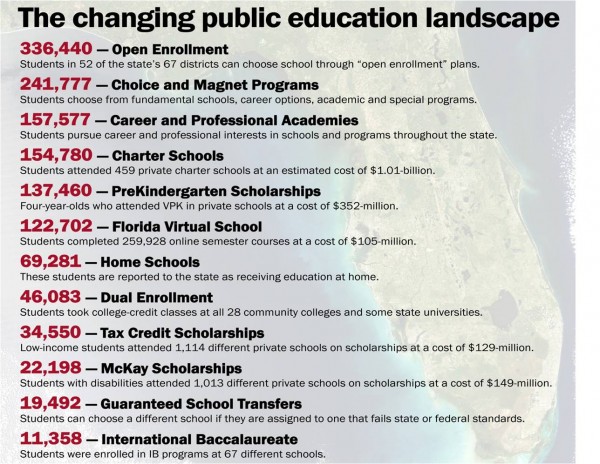
The numbers (carefully compiled by Jon East, vice president for policy & public affairs at Step Up) are from 2010-11 and we know in many cases the current figures are even higher. Charter school enrollment, for example, topped 175,000 this year, and the tax credit scholarship program serves more than 39,000 students. Altogether, the numbers underscore two things we emphasize at redefinED: School choice - the kind that allows parents to go beyond their neighborhood school - is becoming mainstream in Florida. And the lines between "public" and "private" are more blurred here than in any other state.
The AFC conference agenda includes Louisiana Gov. Bobby Jindal, New Jersey Gov. Chris Christie, Newark Mayor Cory Booker and an all-star line up of choice experts and advocates. We're hoping to have a little time to update you on what's going on with blog posts and tweets. For the latter, follow us at @redefinEDonline.

