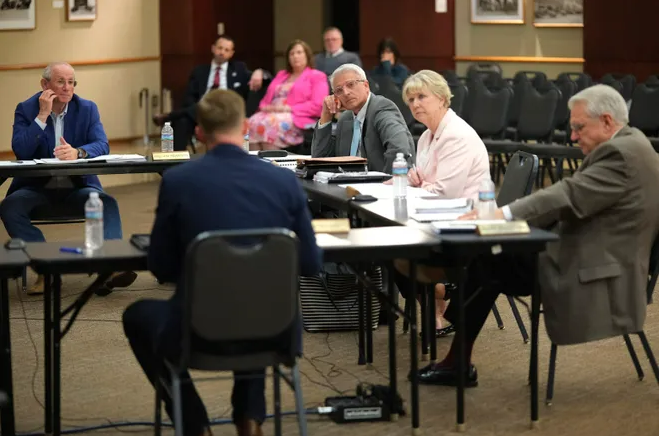
The Oklahoma Statewide Virtual Charter School Board met Tuesday to discuss a vote on whether to approve creation of St. Isidore of Seville Catholic Virtual School. PHOTO: Doug Hoke/The Oklahoman
Editor’s note: For related posts from reimaginED senior writer Lisa Buie, click here and here.
Concerned about conflicting attorney general opinions and the certainty of a lawsuit, members of Oklahoma Statewide Virtual Charter School Board unanimously voted to disapprove the application for what would be the nation’s first religious charter school.
The vote was a procedural move to buy time so board members could gauge the risk of personal liability following their final vote on St. Isidore of Seville Catholic Virtual School. Board members turned down the application on Tuesday after sidestepping the legal issue and instead raising questions about the school’s governance structure, special education plan, how it would prevent government money and private donations from co-mingling and technology.
“Do we have assurance from counsel if we are sued that we would have protection and support from the Attorney General’s Office?” board Chairman Robert Franklin asked during the discussion. “In recent history this board has been sued collectively and individually.”
The board’s counsel, Deputy Attorney General Niki Batt, said board members would receive representation if they were following state law and their actions were in the scope of their board position.
She said Oklahoma law explicitly states that no public money can be applied to support any religion.
That drew concern from board member Scott Strawn, who said, “Candidly, it feels like – intentional or not – that we’re basically being told make a decision against the advice of the attorney general and you may or may not have immunity.”
Heightening the tension are two conflicting legal opinions and statements the governor made about them.
Former Attorney General John O’Connor issued an opinion in December as his final official act that came as the statewide virtual charter school authorizing board was set to decide on the application for St. Isidore of Seville Catholic Virtual School, which the Archdiocese of Oklahoma City and the Diocese of Tulsa want to open to serve students in rural areas without a traditional Catholic school and to expand course offerings for students who already attend Catholic schools.
O’Connor said in his opinion that the state’s ban on publicly funded charter schools operated by sectarian and religious groups could violate the U.S. Constitution’s First Amendment and should not be enforced.
His successor, Gentner Drummond, withdrew O’Connor’s opinion and argued that it was based on precedent for private schools. Drummond said that state law defines, and the attorney general has previously recognized, charter schools as public schools, and that allowing the state to sponsor a religious school would create “a slippery slope” to use religious liberty to justify state-sponsored religion.
The clash promoted Gov. Kevin Stitt to weigh in by releasing a letter disagreeing with Drummond’s withdrawal of his predecessor’s opinion.
“You contend that the United States and the Oklahoma Constitutions permit, and indeed require, the state to discriminate against religious organizations seeking authorization to operate charter schools,” Stitt’s letter said. “In fact, the opposite is true.”
The letter continued, “These prohibitions run afoul of the non-discrimination principle articulated by the U.S. Supreme Court in recent cases.”
During Tuesday’s board meeting, state schools Superintendent Ryan Walters said he and the Oklahoma Department of Education would provide support to board members who approve the school’s application, thought it was unclear if that include legal representation.
Brett Farley, executive director of the Catholic Conference of Oklahoma, told The Oklahoman that the vote came as no surprise.
"This is fairly normal for their application process," Farley said. "It gives us more time to address their concerns, and so we'll do that and come back and present those and see where we go."
By turning down the application, members reset the clock on when a final vote must be taken. The rules allow applicants who are initially disapproved to make changes and resubmit their applications for a vote within 30 days. Had the board simply postponed Tuesday’s vote, the deadline for final approval would have been April 29.
You can watch a recording of the meeting here starting at the 49:22-minute mark.
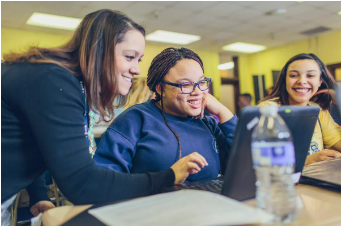
Victory College Prep, a charter school that opened in Indianapolis in 2005, received a seven-year charter renewal from the Mayor’s Office of Education Innovation in 2018. The Urban League of Indianapolis has recognized Victory College Prep as a School of Excellence.
Editor’s note: This article appeared last week on in.chalkbeat.org.
Republican lawmakers are advancing major changes to the state’s school funding system to benefit charter schools and districts with relatively low property tax values.
The proposed Republican House budget, along with a newly amended GOP Senate bill, would rework Indiana’s property tax system to pump more funding into charters and level what lawmakers say is an unfair playing field for charters and traditional public schools. Lawmakers also might create a dedicated funding stream for charters’ capital expenses that would replace the so-called “$1 law.”
But the proposals have been sharply criticized by Democrats and traditional public school leaders, who argued that the changes would come at the expense of thousands of students in traditional public schools.
The bills channel issues at the heart of a recent dispute over tax revenue in Indianapolis Public Schools. The district withdrew its plan to ask voters for new property taxes on the May ballot, amid criticism from charter school supporters that the draft ballot measure did not provide charters enough money. If the proposals become law, they could change the long-term balance of fiscal power within the state’s public education system.
Together, House Bill 1001 and Senate Bill 391 would do the following to boost funding for charters and school districts with low property values:
To continue reading, click here.
 Recently, I had the opportunity to speak to a group of state lawmakers, one of whom asked me a startling question after acknowledging that his state doesn’t have charter schools: Should we really bother with them?
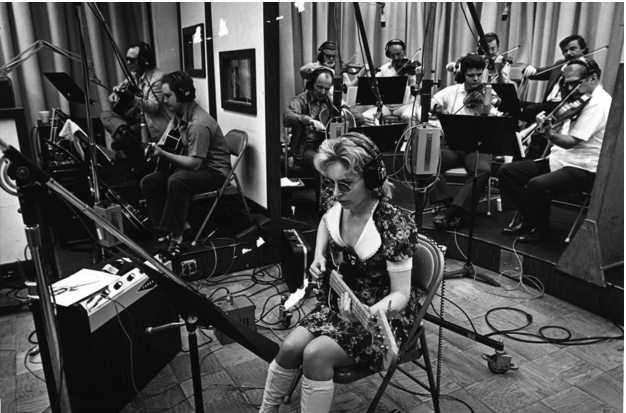
As I heard the record scratch in my head, my mind wandered to a documentary I saw about the Wrecking Crew, a very busy group of studio musicians in Los Angeles in 1960s. Come along for the ride, it will all make sense in the end.
While often uncredited, the Wrecking Crew played on scores of hit records while the credited artists would sometimes tour only to play simpler versions of the songs with their lesser musical talent. The Wrecking Crew played instruments on the Monkees’ first two albums.
Watching the 2008 documentary, it occurred to me that the Wrecking Crew likely was a big reason that pop-music from the 1960s has a distinctive sound. Much of the memorable music was in fact recorded by the same musicians.
The charter school movement also had a wrecking crew, but unlike the musical version, the charter wrecking crew has had a negative impact.
I’ve always been, and remain, an “all of the above” choice type of guy. Open enrollment, homeschooling, private choice or charter schools? Yes please! On the other hand, I’ve been aware that many, many years have passed since someone passed a robust charter school law.
To illustrate the point, there are nine states on this 2019 map from the National Center for Education Statistics that had fewer than 1% of students enrolled in charter schools. West Virginia passed its law in 2021, so let’s give it a pass for now.
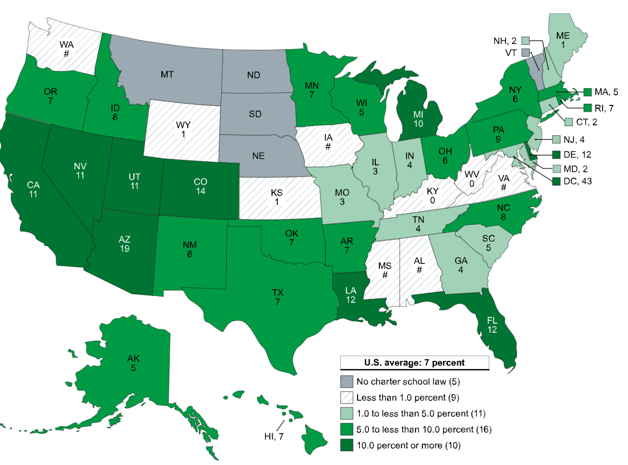
As for the remaining states, Alabama passed a charter law in 2015 and has five charter schools. Kansas passed a charter law in 1994 and has nine charter schools. Kentucky passed a charter law in 2017 and has zero charter schools.
Iowa passed a charter law in 2002 and has two charter schools. Mississippi passed a charter law in 2010 and has seven charter schools. Virginia passed a charter school law in 1998 and has seven charter schools. Washington passed their law in 2016 and has twelve charter schools.
The best charter laws passed since 2000 are in Indiana and Tennessee. Both had a less-than-stellar 4% market share in 2019.
Color me skeptical about the prospects for some of these states of reaching a double-digit charter market share before Haley’s Comet reappears in 2061.While there are some real stinker charter laws that passed before 2000, the malodorous consistency since 2000 is disappointing.
So again, imagine the Wrecking Crew, but in your imagination band members are confused about how to play their instruments. The songs sound similar, but they all sound bad. You know, like Nickelback.
I believe I answered the question from the lawmaker by saying that creating charter schools is a purely local decision. But then I got to thinking: What if during the early stages of COVID-19 someone had the bright idea of having states set up commissions to judge the worthiness of pandemic pods before they would be allowed to operate? Submit an 800-page application, hire the right consultants, and dig in for a multi-year process as the judges subject you to a technocratic beauty pageant.
People used to like all kinds of weird and antiquated things, but American parents are way past taking whatever commissions choose to give them. Choice advocates should catch up with parents – and consider partying like it’s 1999.
Otherwise, the movement in many states will remain wrecked.
Legislation: Universal school choice is a top priority of House Speaker Paul Renner and Rep. Ralph Mussullo, chair of the House Education and Employment Committee, supports multiple education bills, including changing high school start time to no earlier than 8 a.m. The 2023 legislative session begins this week. Florida Politics. Sen. Bryan Aliva is backing several new bills this legislative session, including one that would revamp the teacher recertification requirements and cut down the time it takes teachers to complete the process. Florida Politics. A series of proposed laws would transform the state's public K-12 education system. Critics say the state has too much control over the classrooms. Tampa Bay Times. Politico. Washington Post.
Opinions: Paula Montgomery of the League of Women Voters of the Pensacola Bay Area opposes charter schools and school vouchers, claiming that charter schools are not required to employ certified teachers, that private schools accepting vouchers are not required to test students and that public schools must accept everyone. However: Charters schools are required to employ certified teachers unless the school is approved under the "Schools of Hope" law that passed in 2017. Private schools have been reporting scholarship student test scores to state researchers since 2007-08. Finally, public schools can exclude students from attendance through zoning and deny students due to lack of accommodations for children with special needs. Pensacola Daily News Journal. Could chatbots be part of the future of education? Anne Trumbore, the Chief Digital Learning Officer at the Sands Institute for Lifelong Learning at the University of Virginia believes that chatbots could be effective and affordable private tutors. The 74. Teacher pay could be higher, says Chester E Finn, Jr. but the teacher unions and parents want smaller classrooms instead. Education Next. Parental backgrounds can have major impacts on their children's educational trajectory. For example, children living in a one-parent household are significantly more likely to be suspended from school or required to repeat a grade. Anna J. Egalite, a professor at North Carolina State University, offers some policy prescriptions to help students overcome these disadvantages. Education Next.
Book bans: Collier and Lee County public schools have banned or restricted 42 books. Naples Daily News published a list of these books. Flager County public schools will hold a hearing today over the request to ban or restrict Patricia McCormick's book "Sold." Flagler Live. Students in Pinellas County Public Schools are pushing back against efforts to ban books in school libraries. WUSF. Alachua County Public Schools says it has catalogued books in the libraries for years and has already established a process for parents to express concerns about books. Gainesville Sun.
Elections: Florida Republicans are looking to oust several school board members in 2023. WPTV.
Sarasota: The Sarasota County School District removed Duane Oakes, the chief of the district's police department from his role late Friday afternoon. No reason for the abrupt departure was given. Herald-Tribune.
Palm Beach: A Lake Worth High School AP math teacher was removed from the classroom after posting pictures of three students and comparing their skin color to shades of coffee. Palm Beach Post.
Polk County: A Lakeland mom wants Spessard L. Holland Elementary School renamed. She says the school is named after a man who supported racial segregation in schools. Bay News 9.

Tennessee Christian Preparatory School in Cleveland, Tennessee, one of 542 private schools in the state serving more than 105,000 students, provides a quality college preparatory education from a biblical worldview to equip students for tomorrow’s challenges by educating mind and soul.
Editor’s note: This article appeared Monday on tn.chalkbeat.org.
The Tennessee Senate on Monday approved two Republican-sponsored bills that would expand and clarify eligibility for students to receive private school vouchers or enroll in charter schools.
Both measures passed 27-5 along partisan lines and now await action in House committees.
Sen. Jon Lundsberg, of Bristol, sponsored the bill to expand eligibility for Gov. Bill Lee’s education savings account program to students who attended private or home schools during the last three school years. The current law says a student must move directly from a public to private school to be eligible for the program, which launched last fall in Memphis and Nashville.
A second bill, sponsored by Sen. Todd Gardenhire of Chattanooga and Rep. Charlie Baum of Murfreesboro, would cap enrollment at charter schools — which are publicly funded but independently operated — at 25% for students who live outside the school district that authorized the charter. The House is scheduled to take up that bill in its K-12 subcommittee.
Meanwhile, House Speaker Cameron Sexton filed legislation that would let the Tennessee Public Charter School Commission approve charter schools to serve home school students, as well as residential boarding schools that are charters. Those charter applicants could apply directly to the state-appointed commission for authorization, without having to go through local school boards.
All measures seek to continue the Republican governor’s push to expand education choices for families. But critics say vouchers and charter schools are vehicles to privatize education at the expense of traditional public schools, which operate under stricter regulations, provide more transparency through their locally elected school boards, and serve the bulk of students who are disadvantaged or have special needs.
To continue reading, click here.
Legislature: WFSU takes a look at the top issues the Florida legislature will be tackling in 2023. School vouchers come out on top of the list. WFSU.
Flagler: A Florida teen was held on $1 million bail after brutally attacking a teacher aid who confiscated his Nintendo Switch. WFLA. WESH. Flagler County voted down an effort to ban the book "Sold" from public school libraries. A second effort to ban the book on appeal will take place March 6. The book is one of 44 challenges requesting the banning of 22 books at district schools. Flagler Live.
Hillsborough: Black community members criticized Hillsborough County Public Schools plan to change school attendance zones. Meanwhile, parents of the wealthy south Tampa suburbs defended their efforts to keep school zones intact for their higher income neighborhoods. Board members unanimously voted to delay and workshop the plan further on March 9. Tampa Bay Times. WFLA.
Leon: Tallahassee Community College (TCC) announced the name of its new charter school, Tallahassee Collegiate Academy. One of the community college's trustees, Karen Moore, is listed as the charter school's founder. Moore will be stepping down as one of the trustees to helm the Board of Governors at the charter school. TCC received $2 million from the legislature to create a charter school on its campus. TCC was one of five colleges chosen to open new charter schools. Tallahassee Democrat.
Manatee: Manatee County Public Schools have seven named after local Black educators, entrepreneurs and leaders. The Bradenton Herald shines a spotlight on these schools. Bradenton Herald.
Palm Beach: Palm Beach County reveals what its newest high school, Dr. Joaquín Garcia High, will look like when it opens for the 2023-24 school year. The new school will serve 2,600 students in grades 9 through 12. Construction of the high school took two-years at a cost of $103 million. Palm Beach Post.
Pasco: Pasco County school board members are considering more restrictions on cell phone use at schools. John Legg recommended returning to old rules where students were required to keep phones off and out of sight except in cases of emergencies. Pasco currently allows students to access phones before and after class and during lunch. Tampa Bay Times.
Pandemic: Public school districts ramp up spending of Federal funds meant to alleviate schools from the effects of the COVID-19 pandemic. Schools had until Sept. 2024 to spend the funds and most of the money was saved during the first months with spending doubling this year over last. Marguerite Roza makes the case on how school districts can spend the remaining funds to benefit students. The 74. Last year, 82 students in Leon County were subject to a Baker Act, whether voluntarily or involuntarily, by a medical professional over mental health issues. Officials say there has been an increase in Baker Acts among youth since the start of the pandemic. Tallahassee Democrat.
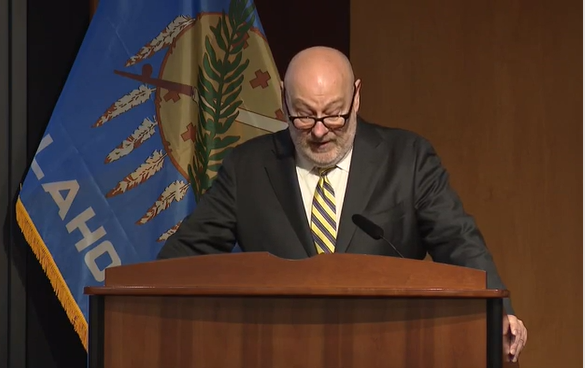
Keith Upton representing Americans United for Separation of Church and State spoke earlier today in opposition of the creation of an Oklahoma religious charter school.
This statement appeared today on the website of the Office of the Oklahoma Attorney General.
Attorney General Gentner Drummond today withdrew an opinion issued by his predecessor, stating that the Opinion “misuses the concept of religious liberty by employing it as a means to justify state-funded religion.”
In one of his final acts in office, then-Attorney General John O’Connor issued the Dec. 1, 2022, opinion in response to a request by Rebecca Wilkinson, the executive director of the Statewide Virtual Charter School Board (SVCSB). Drummond notified Ms. Wilkinson of his decision to withdraw the Opinion in a letter to her, with board members of the SVCSB included in the communication.
“Religious liberty is one of our most fundamental freedoms,” Drummond wrote. “It allows us to worship according to our faith, and to be free from any duty that may conflict with our faith. The Opinion as issued by my predecessor misuses the concept of religious liberty by employing it as a means to justify state-funded religion.”
He noted in the letter that charter schools are public schools that receive public funding, a position that is consistent with current state law and the Oklahoma Constitution. Drummond said the former Attorney General’s Opinion incorrectly concluded that Oklahoma taxpayer dollars could be tapped to fund religious charter schools.
As the Statewide Virtual Charter Board is currently considering an application for a religious virtual charter school, Drummond cautioned that approval of an application that is overtly religious in its teachings and operations will set a precarious precedent.
“While many Oklahomans undoubtedly support charter schools sponsored by various Christian faiths, the precedent created by approval of the … application will compel approval of similar applications by all faiths,” Drummond wrote.
“I doubt most Oklahomans would want their tax dollars to fund a religious school whose tenets are diametrically opposed to their own faith. Unfortunately, the approval of a charter school by one faith will compel the approval of charter schools by all faiths, even those most Oklahomans would consider reprehensible and unworthy of public funding.”

Great Hearts Academies, the leading provider of classical education in the country, is dedicated to serving families in the moral and intellectual formation of their children.
Editor’s note: This article from Rick Hess, resident scholar and director of education policy studies at the American Enterprise Institute, appeared recently on edweek.org. You can listen to a podcast with reimaginED executive editor Matt Ladner and Great Hearts Online executive director Kurtis Inforf here.
Great Hearts Academy launched in 2001 with 130 students. Today, it operates 33 classical K-12 schools serving more than 25,000 students in Arizona and Texas.
At a time when there’s a lot of interest in classic liberal arts school models, and with Great Hearts seeking to expand its offerings via pre-K and online offerings, it seemed like a good time to chat about their work with CEO Jay Heiler, who’s been on the board of Great Hearts since its founding and spent more than a decade as chair of the Arizona Charter Schools Association.
Here’s what he had to say.
Rick: So, Jay, what is a Great Hearts Academy? What makes it distinctive?
Jay: Great Hearts academies are grounded in an ethos of education as formation of the virtuous human person, not only in knowledge and intellect but also of the heart and character. We long and educate for a more philosophical, humane, and just society, but we consider this work as apart from the controversies of the day or the continuous political and polemical theater.
Our school model features a rich liberal arts curriculum and a culture that fosters friendship, marked by a common love of the true, the good, and the beautiful.
Rick: Can you talk a bit about what it takes to make that kind of curricular model work?
Jay: Great Hearts academy life is simple to understand in terms of what it includes and what it excludes. It includes the Great Books, the best of what has been thought and written for millennia, Socratic pedagogy grounded in conversation, and a culture of friendship.
It excludes screen time and pop culture, on the supposition that students are now immersed in an overabundance of those things outside of the school day.
Rick: Some critics have argued that Great Hearts’ value-based, classical model isn’t a good fit for all students. What’s your response to such critiques?
Jay: Great Hearts is an emphatically anti-elitist organization because its central assertion is that the best education for some is the best education for all, and our purpose is to make it accessible to all, so that all might have the chance to lead a great life and do things that matter to them and our society.
Classical education begins and succeeds by grounding itself in timeless things that do not change. It disabuses young minds from the common tendency to see one’s own time as safely evolved beyond the perils and failures of earlier times. It refutes the cult of novelty. It opens the mind by engaging with centuries of human thought and conversation, disaster and triumph, error and recovery, insight, and inspiration.
For these reasons, we believe every child would benefit from a Great Hearts classical education, and we go to work every day to reach as many families as possible.
Rick: How did Great Hearts get started?
Jay: In the early years of charter schools, the prevailing vision was “let a thousand flowers bloom.” Our original insight was that this is not how education would be reformed, accounting for goodwill or the market. So, we wanted to take the best possible education and replicate and then scale it. We began 21 years ago with 130 students in a leased church classroom building, improved for occupancy via some borrowed funds, with grades 7 through 9.
Rick: What’s your network look like today?
Jay: Since our founding, Great Hearts has grown to become the leading provider of classical education in the U.S., with more than 25,000 K-12 students in public, nonsectarian charter schools and now a new preschool offering as well: Young Hearts.
We have accomplished this as a nonprofit organization. We currently operate in Phoenix, San Antonio, Dallas, and Fort Worth. Amid the travails of the pandemic, we also launched Great Hearts Nova, our innovation-centric division which includes fully online charter academies in Arizona and Texas and microschools.
To continue reading, click here.
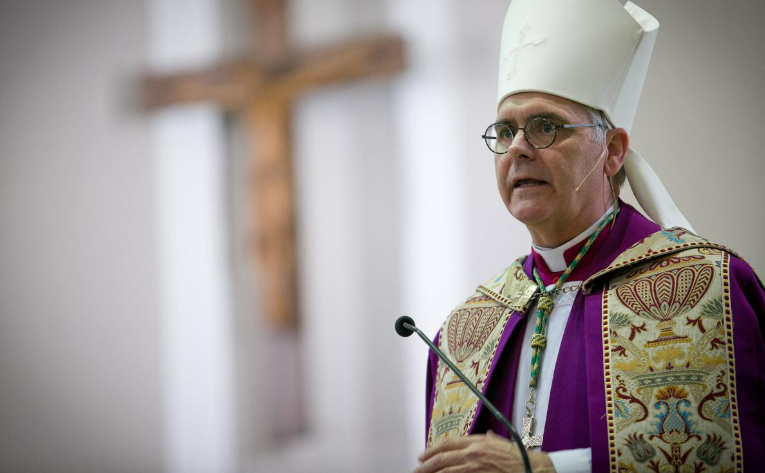
Oklahoma City Archbishop Paul S. Coakley wrote to the Statewide Virtual Charter School Board in November 2021, asking: “Before the Archdiocese undertakes the necessary time and expense to prepare a charter school application, I request confirmation that such an application will not be denied because of our religious affiliation or because of the integration of religion into our schools’ operations and programs.” Photo courtesy of Chris Porter
A meeting of an obscure state board set for Tuesday could swing open the door to religious charter schools nationwide.
Members of the Statewide Virtual Charter School Board in Oklahoma are expected to consider an application by the Archdiocese of Oklahoma City and the Diocese of Tulsa to open an online charter school that would include religious instruction among its offerings. If approved, it would be the nation’s first religious charter school.
So far, the two Catholic organizations in Oklahoma have been the only ones pursuing charter school authorization, said Shawn Peterson, president of Catholic Education Partners, a nonprofit that supports education choice efforts across the nation.
However, if Oklahoma gets authorization, which is not expected to be announced for a couple of months, look for other states to follow, he said.
“I think it may become a reality in Oklahoma in the short term, although I suspect that it will be challenged in court,” he said.
The two organizations began planning to apply for permission to open the virtual charter school in November 2021, when Archbishop Paul Coakley sent a seven-page letter to the board outlining the case for allowing a religious organization to open a charter school.
“The Archdiocese is enthusiastic about sponsoring a virtual charter school to improve educational opportunities for children and families in the state,” he wrote. “Yet we cannot ignore the reality that, regrettably, the discriminatory and unlawful exclusion of religious schools remains at least formally on the books of the state’s Charter School Act.”
Coakley cited the 2020 U.S. Supreme Court ruling in Espinoza v. Montana Department of Revenue that found that exclusion of religious schools from participating in a tax credit school choice scholarship program because of their religious status was unconstitutional. In his letter, Coakley also referenced Carson v. Makin, then a pending case that involved Maine’s ban on religious schools’ participation in “town tuitioning” programs that give private school scholarships to students in towns without public high schools.
Shortly after the archbishop’s letter was written, the U.S. Supreme Court agreed to hear Carson. On June 21, 2022, the justices ruled in favor of the plaintiffs, who had been barred from using the scholarship to send their daughter to a private Christian school.
The archbishop also references a case that the U.S. Supreme Court is considering hearing that involves a conservative North Carolina charter school whose dress code required that girls, whom it describes as “fragile vessels,” wear skirts to promote a traditional of “chivalry” and “respect.”
A group of parents who sued argues that the public school’s policy violated their daughters’ constitutional rights. In its defense, Charter Day School argues that charter schools were not “state actors” but essentially private schools, with only broad state oversight. In its ruling for the plaintiffs, the Fourth Circuit Court of Appeals, however, called charter schools public schools and therefore subject to state and federal anti-discrimination laws.
The high court has asked the solicitor general, the Biden administration’s top Supreme Court lawyer, for guidance before deciding whether to consider the case.
Meanwhile, Oklahoma Attorney General John O’Connor issued an opinion that says a state law that prohibits religious organizations from operating a public charter school likely violates the First Amendment of the U.S. Constitution and therefore “should not be enforced” because of rulings from the Oklahoma Supreme Court and U.S. Supreme Court.
In the Dec. 1 opinion, O’Connor cited three U.S. Supreme Court rulings: Trinity Lutheran v. Comer, in which the court ruled that religious organizations can’t be barred from participation in general benefit programs based on their status, as well as school cases Espinoza and Carson.
“As the U.S. Supreme Court emphasized in Carson, ‘a neutral benefit program in which public funds flow to religious organizations through the independent choices of private benefit recipients does not offend the Establishment Clause.’ … No student is forced to attend a charter school—it is one option among several for parents. … The Establishment Clause therefore provides no cover for a clear Free Exercise Clause violation here.”
The opinion drew praise from the American Federation for Children, a national education choice advocacy group.
“We applaud Attorney General John O’Connor’s opinion that underscores the right of families to access the best educational options for their kids,” Jennifer Carter, senior adviser for the American Federation for Children -- Oklahoma, said in a statement. “Today’s AG opinion is entirely in keeping with the spirit of what charter schools are meant to be: free public schools that offer tailored experiences to students in addition to those available in traditional public schools.”
However, not all education choice advocates share that view.
“Specifically, we take issue with the Attorney General’s assertion that charter schools are private entities/contractors that are not bound by the First Amendment’s Establishment Clause,” said Nina Rees, president and CEO of the National Alliance for Public Charter Schools. “The legal precedent cited in the Oklahoma Attorney General’s opinion (Trinity Lutheran, Espinoza, and Carson) are cases dealing exclusively with private schools, not charter schools, and we believe the precedent simply does not apply to public charter schools.”
Rees went on to say that her organization “believes there is no such thing as ‘private religious charter schools’… All charter schools are public schools. Public schools have never been able to, and cannot now, teach religion, require attendance to religious services or condition enrollment or hiring on religious beliefs. While a sectarian organization may be permitted to operate a charter school, that school must remain a nonsectarian, open enrollment, non-discriminatory public school.”
Other education choice advocates have raised questions the possible fallout if the religious charters are allowed.
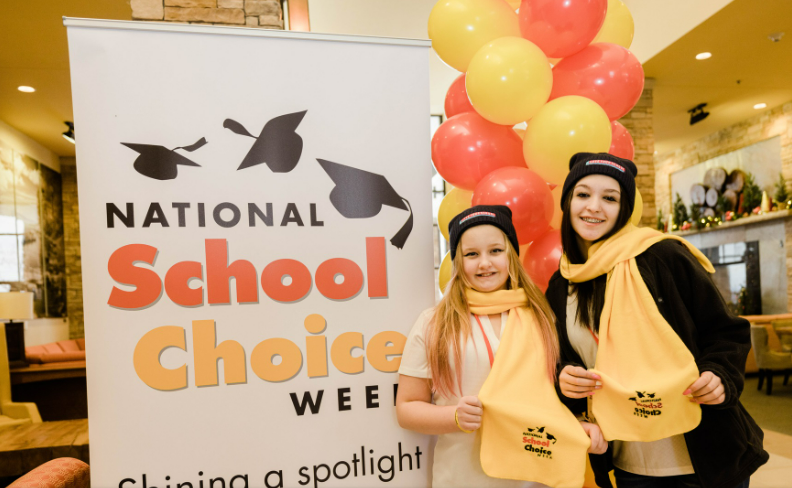 Editor’s note: Nina Rees is the President and CEO of the National Alliance for Public Charter Schools. reimaginED shares this commentary from Rees as National School Choice Week 2023 comes to a close.
 Happy National School Choice Week! This week is an opportunity to celebrate the 3.7 million students, 7,700 school leaders, and 240,000 teachers who make charter schools the shining star of America’s education landscape.
Since 1991, more than 12.3 million students have attended these unique public schools, a powerful testament to parents’ desire to find the best learning environment for their children. Yet there are still far too many students who are stuck in schools that may not fit their needs. Every student deserves a school where they feel inspired, motivated, safe, and loved. National School Choice Week is about making that promise a reality for more children.
The school choice movement is fueled by the passion and power of parents. A recent survey by The Harris Poll found that 86% of parents want more school options – even if they are satisfied with the school their children are attending. This is why so many politicians made education a priority in the recent elections.
We believe parental choice is not only a winning political issue, but also a unifying force capable of bridging differences and reducing polarization by putting the best interests of students squarely at the center of education policy. We also know that access to high-quality schools—particularly high-quality public schools that are free and open to all—is essential to increasing economic mobility, reducing inequality, and expanding social equity.
As we look across the country, we see game-changing momentum around efforts to boost parental choice – in all its forms – and to remind lawmakers that charter schools are the best vehicle to expand public school choice.
Charter schools provide flexibility and autonomy in exchange for results, and they must be hyper-responsive to the needs of students, parents, and communities. They inject new energy and innovation into education, make learning more personalized, and elevate the overall quality of our public education system.
As we celebrate National School Choice Week, we call on the lawmakers who championed parental choice on the campaign trail to translate their promises into action – by fighting to fund charter schools equitably (our students are worth no less than those attending district public schools), by including facilities funding in every state charter law (so money meant for the classroom doesn’t have to be spent maintaining the school building), and by ensuring that charter schools continue to have the freedom and flexibility to be responsive to students’ needs.
This is a week to celebrate the importance of school choice, to express gratitude to those who make these choices possible, and to recommit to fighting for educational opportunity for all. Let’s make it happen for our kids and families!

