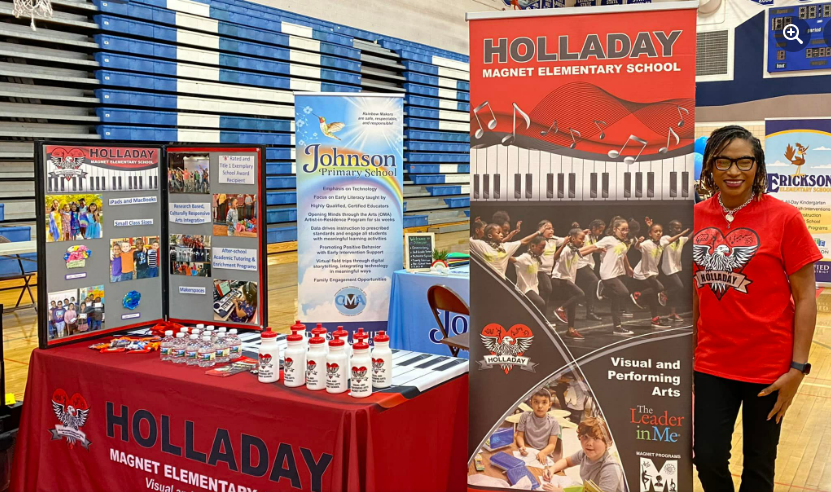
The mission of Holladay Fine Arts Magnet, part of the Tucson Unified School District, is to integrate visual and performing arts to foster creativity, equity, cultural responsiveness and innovation.
Editor’s note: This commentary was co-authored by these Arizona educators: Stephanie Miller, superintendent, Congress Elementary School District; Tonya Stroizer, principal, Holladay Fine Arts Magnet; Jessica Maskowske, school director, Western School of Science & Technology; Luis Perales, school leader, Mexicayotl Academy of Excellence; Angelina Canto, assistant superintendent of curriculum & instruction, Nogales Unified School District.
New data from the Center on Reinventing Public Education finds 93 of 100 large and urban districts have mentioned staffing shortages in the 2021-22 school year and close to half of these districts – 48 – are experiencing shortages across multiple departments and positions. Nearly two-thirds of districts are struggling to fill teaching or instructional aide positions. This trend is seen here in the Grand Canyon State as well.
The good news is that there is a tremendous opportunity with Senate Bill 1159 moving through the Arizona Legislature to reduce barriers to entering the profession and expand grow-your-own pipelines that can help leaders like us attract a broader, more diverse pool of talent.
We lead as principals and superintendents of vastly diverse models focused on project-based learning, college prep, STEM, and the arts. We have created diverse working environments that have created more teaching options for educators and diverse learning options for students and families in our rural and urban communities.
We need access to high quality teachers who are experts in their craft and will go above and beyond for our students. These additional pathways provide us with meaningful access to a diversity of educators who might not otherwise be able to access the certification process. We know what top talent looks like and we should be entrusted to make hiring decisions that best serve the needs of our students.
Opponents have suggested that this bill will lower the quality of teaching. This is absolutely false.
All candidates in any of these pathways must demonstrate the skills necessary to be successful with their students. In fact, this bill allows us to provide high-quality professional development experiences for these teachers based on cutting edge research.
The state cannot move as fast as the current need demands and more options are needed.
As leaders in the education profession, state policymakers should entrust us to make the right hiring and firing decisions for our students and families – having the best teachers in our classrooms is our priority. We aim to support the development of quality teachers.
For three school years, we have been challenged to rethink teaching and working in schools, redesign outdated models, and to reimagine learning for our students in a pandemic and soon post-pandemic world.
Last year, the Legislature passed House Bill 2862, which provided the option for schools and systems to have tremendous regulatory relief with seat time flexibility providing a runway to innovate. As more innovative models are developed, schools will need both teachers and school leaders with unique skills and talents to effectively lead their students to success.
This bill empowers interested local leaders like us with the tools to find, hire, and retain great talent we want. It’s not a mandate – but it’s an essential tool for the state’s most entrepreneurial, forward-thinking leaders to meet their classroom needs.
We have a growing school leadership talent pipeline crisis in our state too. Just as there is not one way to train to become an excellent teacher, there should not be one certification pathway to become an excellent school leader. State Bill 1159 empowers local school leaders like us with permission to develop the tools and programs to train and certify the next generation of high-quality school leaders. These pathways are meant to be locally driven and allow for high-impact work experiences so our school principal and assistant principal candidates can hit the ground running on day one.
The world of schooling and learning is changing. These new learning models are proving to be successful for our children, and more parents want access to them. We need new and additional preparation models to cultivate the next generation of teachers and school leaders. A diverse pool of talent that is locally trained is a benefit for the current teacher shortage and will help alleviate crowded classrooms and immediate staffing demands. This is an urgent need.
We know what excellent talent looks like and what our students deserve.
 Editor’s note: This is the third installment of “A Choice Conversation,” an ongoing dialogue between Doug Tuthill, president of Step Up for Students and a redefinED host, and John Wilson, a former NEA leader who writes the Unleashed blog at Education Week.
Doug Tuthill: John, it’s fascinating to see the new opportunities customization is providing teachers. In Florida, it’s increasingly common for teachers to teach at a district school in the morning, at a private school in the afternoon, and for an online school in the evening. The opportunities provided by technology are particularly intriguing. Three years ago my son’s Florida Virtual School teacher lived in Portland, Oregon, where she was a stay-at-home mom. Many online teachers are at home raising young children while teaching full time.
Recently, I’ve been wondering how customization will impact the services teacher unions provide their members. Given teachers will increasingly have multiple employers in the future, perhaps a key union service could be helping teachers manage the complexity that comes with multiple employers. For example, maybe teachers would prefer to be employed by their union and contracted out to various providers. That would reduce employment hassles for teachers and strengthen their relationship with the union. Unions could also provide financial and administrative support for teachers wanting to open their own schools, and form collaborative networks of teacher-owned schools. You’ve been much closer to internal union discussions in recent years than I have. How do union leaders think customization will affect the services they provide teachers?
John Wilson: Doug: You raise some very interesting points. Every teacher that is treated in a collective manner needs a union to leverage the unity of the group for fair wages and benefits, excellent learning and teaching conditions, and job security for being a good teacher. Customization can be bargained to accommodate those uniquenesses. I have heard some horror stories from virtual teachers as it relates to their employee status. They need a union. Those that are employees of a district have a union to represent them. Unions need to do a better job with those that are in a different configuration. Some of our state affiliates like Pennsylvania are reaching out to virtual teachers.
The challenge is not that teachers in virtual schools need a union. That is evident. The challenge is building the trust in unions to advocate policies that sustain their job. NEA supports a blended approach as the best method for virtual education. That may not be possible in every situation. There is a "chicken and egg" challenge here. If virtual educators joined the union and became activists, they would influence the policies. I have seen charter school educators do that in some state affiliates. It makes a difference, but virtual educators must join first and work from within.
Doug Tuthill: John: In this age of customization, teacher unions should use their collective power to ensure every teacher is treated as an individual. One-size-fits-all is as ineffective for teachers as it is for students. (more…)

